The short answer
Ragdolls are the most human-attached cat breed, and separation anxiety is the breed-defining behavioural trait, not a kitten quirk. The famous “limp when held” reputation reflects deep human-bonding wiring, not relaxation. Edmonton working households can keep a Ragdoll happy with the right setup: structured environment, scheduled stimulation, predictable routine, and often a second cat. A single Ragdoll alone 8 or more hours a day develops anxiety in a majority of cases, and Edmonton dark winters (7 to 8 hours of daylight in December and January) amplify the gap. The mitigations are well known, affordable, and the difference between a thriving cat and a surrender.
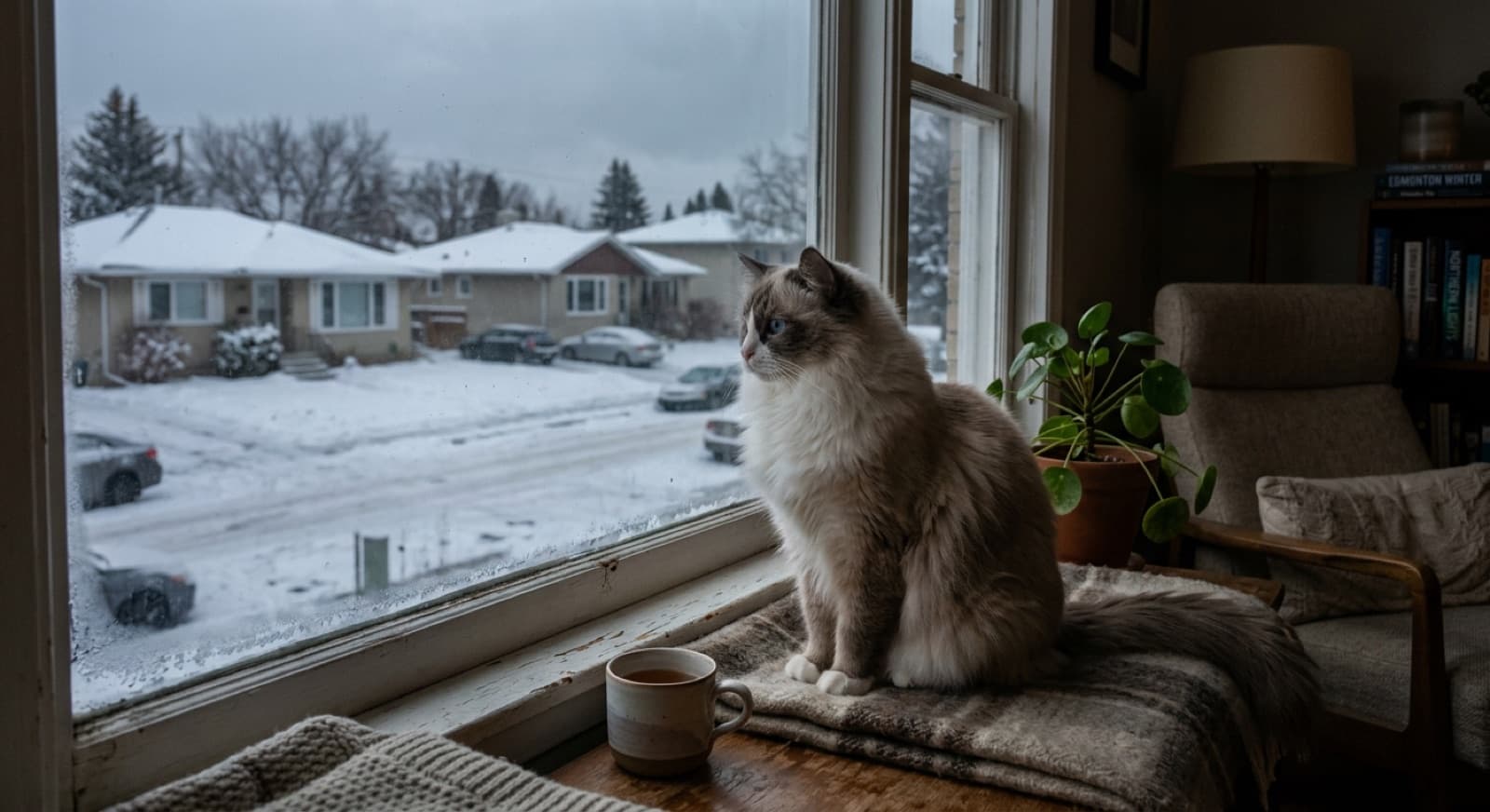
Why Ragdolls develop separation anxiety more than other breeds
The Ragdoll was founded in 1960s California by a breeder named Ann Baker, who selected the foundation cats specifically for human-attachment behaviour. The original goal was a cat that went limp when held, greeted owners at the door, slept on people, and tolerated handling that would offend most cats. Sixty years of selective breeding for that emotional profile produced a cat fundamentally different from most domestic breeds at the temperament level.
The trade-off is built into the genetics. A cat bred for deep bonding does not tolerate absence the way a cat bred for independence does. Most cat breeds are functionally indifferent to whether you are in the room. Ragdolls are not. They follow owners from room to room, vocalise when you close a door, sleep on your chest rather than at the foot of the bed, and greet returning humans with the kind of enthusiasm normally associated with dogs. The same wiring that makes the breed famously affectionate makes it vulnerable to separation distress.
This is why the “limp when held” reputation matters less than people think. Not every Ragdoll goes limp; the trait did not breed true in every line. But every Ragdoll carries the underlying attachment genetics, and that is the trait that determines whether your cat thrives in your household. A Ragdoll that does not go limp but follows you around the house and cries when you close the bathroom door is showing the real breed character. A cat that goes limp but is otherwise indifferent to your presence is unusual for the breed and probably reflects partial ancestry.
The Cornell Feline Health Center documents separation-related anxiety as a recognised feline behavioural condition, though it is less studied than the canine equivalent. Highly bonded individual cats develop anxiety patterns regardless of breed, but specific breeds (Ragdoll, Burmese, Siamese, Sphynx) show elevated rates because the bonding behaviour is breed-typical rather than individual.
The signs of Ragdoll separation anxiety
The symptoms range from mild and easy to miss, to severe and impossible to ignore. Home cameras have made the mild end of the spectrum visible to owners for the first time; many Ragdoll owners only discover their cat is distressed after watching footage from a Furbo or Petcube and seeing what happens 20 minutes after they leave for work.
1. Excessive vocalising after you leave
Howling, yowling, or persistent crying that starts within 5 to 30 minutes of you leaving. Often picked up first on a home camera. Distinct from the brief protest meow most cats make at a closed door. This is the most common and most under-recognised symptom because it happens when you are not there to hear it.
2. Inappropriate elimination outside the litter box
Often near the door you left from. The pattern is diagnostic: a Ragdoll that uses the box correctly when you are home and eliminates near the front door specifically when you are gone is showing separation-related stress, not litter-box preference. Always rule out medical causes (UTI, urinary crystals) with a vet workup first, but if the cat is medically clear and the pattern matches absence, the cause is behavioural.
3. Destructive behaviour
Uncharacteristic for the breed, which is why it stands out as a stress signal. Knocked-over plants, shredded paper, claw damage on previously untouched furniture. Ragdolls are not naturally destructive cats, so when destruction shows up, it usually correlates with absence.
4. Overgrooming and fur loss in stress patterns
Belly, inner thighs, and base of the tail are the typical areas. The fur loss is symmetrical and the skin underneath is usually healthy (no rash, no infection). This is psychogenic alopecia and it is one of the more severe signs because it indicates chronic stress rather than acute distress.
5. Greeting hysteria when you return
More intense than other breeds. Persistent vocalising, rubbing, climbing on you for 15 to 30 minutes after you walk in the door. This is sometimes mistaken for affection and dismissed; in a Ragdoll, the intensity correlates with how distressed the cat was during your absence. A relaxed Ragdoll greets you, settles within 2 to 3 minutes, and resumes normal behaviour.
6. Loss of appetite during absence
A Ragdoll that eats fine when you are home and leaves food in the bowl during your workday is showing stress. Some cats refuse to eat or drink unless a household member is in the room. Picked up most easily with a measured food schedule rather than free feeding, which masks the pattern.
7. Obsessive following when you are home (the Velcro cat pattern)
Following you from room to room including the bathroom, lying on your laptop when you work, blocking your path when you stand up. Mild Velcro behaviour is normal Ragdoll baseline. Obsessive Velcro behaviour, where the cat will not let you out of sight for a second, suggests anticipatory anxiety about future absence.
8. Refusing food or water unless someone is in the room
The extreme version of symptom 6. The cat treats eating as a social activity and will not engage in it alone. Common in highly bonded Ragdolls in single-occupant households. Often improves significantly with a second cat companion.
The Edmonton working-household reality
The honest numbers most breeders do not put on their websites, with the Edmonton dark-winter overlay.
An 8 to 10 hour workday is genuinely hard on a Ragdoll. The breed’s attachment wiring assumes a household with someone home most of the time, which most Edmonton working households are not. The breakdown by daily-absence duration, based on patterns we see across the Edmonton rescue network:
- 0 to 4 hours alone: most Ragdolls are fine. The cat may vocalise briefly when you leave and greet you enthusiastically when you return, but no chronic stress patterns develop.
- 4 to 6 hours alone: separation anxiety risk emerges in a meaningful share of single Ragdolls. Mild symptoms (vocalising, mild Velcro behaviour) become common. Some cats handle this duration fine indefinitely; others develop chronic stress.
- 8 or more hours alone: anxiety likely in most single Ragdolls unless mitigated. The full symptom spectrum (elimination, overgrooming, appetite loss) appears in a significant share of cases within 6 months.
The Edmonton winter overlay matters. Edmonton receives only 7 to 8 hours of daylight in December and January, and many Edmonton owners leave for work in the dark and return in the dark for 5 to 6 weeks. The cat is alone for the brightest hours of the day, then the household goes quiet again. Overlay that on Ragdoll attachment wiring and the “working household struggle” pattern intensifies through the darkest months.
This is why we see the “single Ragdoll surrender from a working household” pattern recurring at Edmonton Humane Society and Zoe's Animal Rescue. The owner did everything else right, the cat is healthy, and the surrender reason is some combination of inappropriate elimination, owner-allergy strain compounded by stress, or guilt about the cat’s obvious distress. It is almost always avoidable with the right setup from the start.
If you are considering adopting a Ragdoll into a full-time working household, you are not disqualified. You just need to plan the environment honestly before the cat arrives, not after the surrender conversation starts.
The 8 working-household mitigations
These are the solutions Edmonton Ragdoll owners use most successfully. None is sufficient alone; combining 4 or 5 of them reduces anxiety markedly. Combining all 8 plus a second cat is the platinum setup.
1. Window perches with bird activity
A window perch facing a bird feeder is genuinely one of the highest-value mitigations. Ragdolls watch bird and squirrel activity for hours and the stimulation reduces idle stress meaningfully. Edmonton backyards attract chickadees, magpies, blue jays, and house sparrows year-round; a $30 bird feeder mounted within view of an east or south window pays back in cat wellbeing. Two perches in different windows is better than one.
2. Cat TV and nature videos
A tablet or older TV running cat-specific YouTube content (bird videos, squirrel close-ups, aquariums) for 2 to 3 hours during your absence. Not all cats engage with screens but many Ragdolls do, especially when the audio is on. Cost: free if you have an old device, $50 for a basic tablet otherwise. Schedule it with a smart plug so it turns on after you leave and off before you return.
3. Food puzzle feeders
Extends mealtime from 5 minutes of grazing to 20 to 30 minutes of engagement. The mental work tires the cat and reduces idle stress. Start with easy puzzles and graduate to more complex designs. Brands worth buying: Trixie, Catit Senses, and Doc & Phoebe’s Indoor Hunting Feeder. Cost: $15 to $40 per puzzle. Rotate 3 to 4 puzzles so the cat does not solve them on autopilot.
4. Scheduled enrichment timers
Automatic feeders (Petlibro, Petsafe) drop a small portion at scheduled times midday. Battery-operated interactive toys (Petsafe Bolt laser, Hexbug nano) turn on for 15 minutes via timer. The scheduled novelty breaks up the long stretch of nothing happening. Cost: $50 to $150 in equipment that lasts years.
5. A second cat companion
The single most effective mitigation. See the dedicated decision tree below for whether this is right for your household. When it works, it works better than every other mitigation combined.
6. Cat camera with treat dispenser
Petcube Bites, Furbo Cat, or a similar interactive camera lets you check in midday, talk to your cat, and dispense a treat remotely. Two-way audio is the active ingredient; the cat hears your voice mid-day, which interrupts the stress arc. Cost: $200 to $300. Worth it for single-Ragdoll households where adding a second cat is not feasible.
7. Walk-in cat tree near a window in the main room
A multi-level cat tree in the room you spend the most time in (typically the living room), positioned near a window. The combination of altitude, outdoor visual access, and proximity to the human social hub makes it the most-used piece of cat furniture in most Ragdoll households. Look for trees rated for cats over 15 lbs; many cheap trees collapse under a full-grown Ragdoll male.
8. Predictable daily routine plus winter-aware lighting
Same departure ritual every workday, same return ritual every evening, same feeding and play times. Ragdolls are deeply routine-driven and the predictability itself reduces anxiety. The Edmonton overlay: through October to March, turn on a full-spectrum daylight bulb or two on a smart plug so the rooms the cat lives in get bright artificial light during what would otherwise be 6 hours of greyness. Vary the routine and the cat re-evaluates whether to be stressed each day; keep it the same and the routine becomes its own reassurance. The departure ritual matters most: a brief, calm goodbye is better than a long emotional one.
The one-cat-or-two decision tree
The most-asked question in the Ragdoll owner community. The honest answer depends on your household, not on the breed.
Get ONE Ragdoll if:
- You work from home, work hybrid with 3 or more home days, or are retired.
- You live in a multi-generational household where someone is home most days.
- You already have baseline cat experience and can spend significant daily time with your cat.
- You have another pet (a calm, cat-friendly dog can fill some of the social role).
- You have constraints (financial, space, partner objection) that make a second cat unrealistic.
Get TWO cats if:
- You work full-time outside the home, 8 or more hours daily.
- You live alone with no other pets.
- You can afford two cats financially (food, litter, vet care roughly doubles; insurance scales with each cat).
- Your space accommodates two cats comfortably (a 1-bedroom Edmonton condo can work; a studio is tight).
- You are committed enough to manage a proper 2 to 4 week introduction.
Adopt both at the same time if possible. Introducing two cats simultaneously is meaningfully easier than adding a second cat later. The cats arrive with no established territory, so they negotiate their hierarchy in a neutral space rather than one defending established turf against an interloper. If you are committed to two cats from the start, adopt them together from the same rescue litter or from a bonded-pair listing.
The second cat does NOT need to be another Ragdoll. A confident, social Domestic Shorthair sibling works fine, costs $200 to $300 from an Edmonton rescue instead of $2,000 from a breeder, and brings hybrid vigour to the household. The Ragdoll provides the bonding-with-humans social role; the second cat provides the cat-on-cat social role. Different personalities can complement each other well.
Best gender pairings, in our experience:
- Male and female: lowest conflict rate. The typical recommendation when starting fresh with two cats.
- Female and female: moderate conflict. Works fine if both are confident and the introduction is done well.
- Male and male: highest conflict rate, especially if both are unaltered or were rehomed late. Doable with the right cats and a careful introduction, but the riskiest combination.
All recommendations assume both cats are spayed or neutered, which every Edmonton rescue cat is by the time of adoption. Intact-cat dynamics are a different topic.
When NOT to get a second cat:
- Financial strain. A second cat doubles ongoing costs; do not adopt out of guilt and then run short on litter or vet bills.
- Your primary cat is conflict-prone or has shown aggression toward other cats in the past.
- Small apartment with no room for separate litter boxes, feeding stations, and retreat spaces.
- Partner or family member is not on board. Cat-related household conflict is a common surrender driver and worse than the original anxiety.
- Your Ragdoll is over 8 years old and has been a single cat all its life. Introducing a new cat to a senior solo cat can be harder than mitigating anxiety with the other 7 strategies.
For the introduction process itself, our cat-to-cat introduction guide covers the 4-week scent-swap and gradual-contact protocol that prevents botched introductions.
Male vs female Ragdoll personality differences
Male Ragdolls are widely described as needier and more affectionate than females. Females are slightly more independent and tolerate alone time better. Both are highly bonded compared to other breeds; the difference is internal to the breed, not relative to cats overall.
This affects separation-anxiety risk in a practical way. A male Ragdoll in a single-occupant Edmonton working household is the highest-risk profile: needy temperament, no social backup, long daily absence, dark winter overlay. A female Ragdoll in the same household is moderate-risk. A female Ragdoll in a household with a second cat is low-risk. A male Ragdoll in a household with a second cat is also low-risk.
The implication for adoption: if you are committed to a single cat in a full-time working household, a female Ragdoll is the softer choice. Edmonton rescues handle this consideration well when asked; foster homes can tell you whether a specific individual cat tracks toward the typical male or female temperament profile.
Both sexes are equally affectionate when their needs are met; the difference is how quickly distress emerges when they are not. Plan the environment for the higher-risk case (single-occupant working household with a male) and the lower-risk cases will be fine automatically.
Browse adoptable Ragdolls in Edmonton
Most Edmonton rescue Ragdolls are adults whose temperament and anxiety patterns are already documented by foster parents. The foster home can tell you whether a specific cat fits your working-household setup before you commit.
See Available Cats in Edmonton →When separation anxiety becomes a surrender driver
The single-Ragdoll-in-working-household surrender pattern is real and recurring at Edmonton rescues. The most common combinations:
- Inappropriate elimination near the front door becomes chronic; flooring or carpet replacement costs accumulate.
- Owner allergies that were tolerable before the stress-related overgrooming spreads more dander.
- The owner’s guilt about visible distress reaches the threshold where rehoming feels kinder than continuing.
- A household change (new job, divorce, new partner who is allergic, baby on the way) compounds the existing anxiety patterns.
If you are in this situation, several options exist before surrendering:
- Schedule a full medical workup. Confirm the elimination is not a UTI, urinary crystals, or hyperthyroidism. A vet visit costs $200 to $400 and rules out 80 percent of confounding medical causes.
- Book a behavioural consultation with a credentialed cat behaviour consultant (IAABC certification or a feline-specialised veterinary behaviourist). Edmonton options exist; ask your vet for a referral.
- Adopt a second cat if you have not already. This is the single highest-impact change and works in a meaningful share of cases.
- Consult your vet about anxiolytic medication. Fluoxetine and gabapentin are sometimes prescribed for severe feline separation anxiety, used short-term during transitions. This is your vet’s call, not yours; never medicate a cat without veterinary direction.
- Improve the environment with the 8 mitigations above. Most surrenders we see came from households running 2 or fewer of these, not the full setup.
If you have tried all of the above for 3 to 6 months and the cat is still chronically stressed, surrender to a Ragdoll-knowledgeable rescue is sometimes the right call. Edmonton Humane Society and Zoe's Animal Rescue both accept owner surrenders without judgment and place cats into foster homes that can match a Ragdoll to a more suitable household. This is not a failure; sometimes the cat needs a different environment to thrive.
Behavioural consultation in Edmonton: when to escalate
Most Ragdoll separation anxiety responds to environmental modification alone. A subset needs professional intervention. The severity scale:
- Mild: vocalising on departure, mild Velcro behaviour, enthusiastic greeting. No medical signs, no elimination issues. Manage with environmental enrichment; no consult needed.
- Moderate: occasional elimination outside the box, mild overgrooming, intermittent appetite changes. Try the 8 mitigations plus a second cat for 2 to 3 months. If no improvement, consult.
- Severe: chronic elimination outside the box, visible fur loss in stress patterns, persistent weight loss, refusal to eat alone. Consult a credentialed cat behaviour consultant or veterinary behaviourist before adding more environmental changes that may not help.
Vet first, behaviourist second. Separation anxiety symptoms overlap with several medical conditions. A urinary tract infection causes litter-box avoidance. Hyperthyroidism causes vocalising and pacing. Hypertension causes restlessness and weight loss. Dental pain causes withdrawal and appetite loss. Your vet rules these out with bloodwork and a urinalysis before behavioural treatment makes sense.
Edmonton clinics handle this well. For straightforward workups, your primary vet is the right starting point. For complex cases with multiple co-occurring conditions, Edmonton internal medicine and dermatology specialty referrals accept cases relevant to chronic stress presentations. Low-cost wellness workups for adopted rescue cats may be available through PALS or similar Edmonton subsidised programs.
For the behavioural side, look for a consultant with IAABC certification (the International Association of Animal Behavior Consultants), specifically with a feline specialty. Some cat behaviourists work remotely and offer video consults across Canada, which expands the available options beyond local-only providers. The ASPCA cat behaviour resources are a reasonable starting point for understanding what a consult will cover. Cost: $200 to $400 for an initial consultation, often with follow-up sessions at lower rates.
Medication should never be a first step; it should never be a substitute for environmental work; and it should never be administered without veterinary direction. When it is appropriate, it is appropriate, and the right vet behaviourist will tell you so.
Frequently Asked Questions
Do Ragdolls have separation anxiety?
Yes, more reliably than any other cat breed. Ragdolls were selectively bred from the 1960s onward for deep human attachment, so separation distress is the trait flip-side of the bonding they are famous for. In a working household where the cat is alone 8 or more hours a day, a substantial share of single Ragdolls develop some form of separation anxiety, ranging from mild vocalising and following to inappropriate elimination near the door you left from. The risk is highest for single-occupant homes with no other pets. The bonded cat the breed is sold on is the same cat that struggles when nobody is home.
Should I get two Ragdolls instead of one?
If you work 8 or more hours and live alone, yes. A second cat is the single most effective mitigation for Ragdoll separation anxiety. The second cat does not need to be another Ragdoll; a sociable Domestic Shorthair sibling works fine and costs $200 to $300 from an Edmonton rescue instead of $2,000 from a breeder. Adopt both at the same time if possible because introducing two cats simultaneously is easier than adding a second cat later. Best gender pairing in our experience: male and female. Male-male pairs have the highest conflict rate; female-female pairs are moderate.
How long can a Ragdoll be left alone?
Most Ragdolls handle 0 to 4 hours alone fine. Between 4 and 6 hours, anxiety risk emerges in many cats. Beyond 8 hours, anxiety becomes likely unless mitigated with a second cat, structured enrichment, or someone checking in midday. This is shorter than the average cat. A typical Domestic Shorthair handles a normal workday with no behavioural fallout. A Ragdoll often does not, and the gap is the breed's attachment wiring rather than poor training or environment.
Are male or female Ragdolls more affectionate?
Males are widely described as needier and more affectionate; females slightly more independent. Both are highly bonded compared to other breeds, but the difference is real enough that it affects separation-anxiety risk. A male Ragdoll in a working household is higher risk than a female. If you are committed to a single cat in a full-time working household, a female Ragdoll is a softer choice than a male. If you are getting two cats, the gender mix matters less because the second cat absorbs most of the social load.
Does my Ragdoll need another cat as a companion?
Not always, but often yes for working households. The decision tree: get one Ragdoll if you work from home, are retired, live in a multi-generational household, or can dedicate significant daily time to the cat. Get two cats if you work 8 or more hours, live alone, and have no other pets. The second cat is the difference between a Ragdoll that thrives and a Ragdoll that develops chronic stress behaviours. Financial strain, partner objection, small apartment, or a conflict-prone primary cat are the cases where you do not add a second cat even if anxiety risk is high.
Why doesn't my Ragdoll go limp when held?
Because the “limp when held” trait is not universal. The breed was founded on cats that did go limp, but the trait did not breed true in every line, and many modern Ragdolls do not exhibit it at all. Owners frequently ask if their Ragdoll is broken or fake; the cat is fine, the trait is just one of several behavioural inheritances and not the most important one. More reliable Ragdoll behavioural markers: trusting nature with strangers, dog-like greeting at the door, sleeping near you, following from room to room, vocalising when you leave. A Ragdoll that does these things is showing genuine breed temperament whether it goes limp or not.
Are Ragdolls suitable for full-time working households?
Conditionally yes. A single Ragdoll alone 8 or more hours a day, with no environmental enrichment, develops separation anxiety in most cases. A Ragdoll in the same household with a second cat, scheduled enrichment, window perches with bird activity, and a predictable routine is genuinely fine. The breed is not incompatible with working households; it is incompatible with empty working households. The mitigations are well known and affordable. Most surrender cases we see at Edmonton rescues are working households that adopted a single Ragdoll without setting up the environment for the breed.
Will a second cat make my Ragdoll happier?
In most cases yes, with caveats. A confident, sociable, lifestyle-compatible second cat reduces Ragdoll separation distress significantly. The caveat is that the introduction must be done properly over 2 to 4 weeks using scent swapping, visual contact through a door, and gradual supervised co-presence. A botched introduction creates a conflict-prone household worse than the original anxiety problem. If your Ragdoll is a year or more into anxiety patterns and the introduction is poorly handled, the result can be territorial spraying. Plan the introduction or get a behavioural consult before adopting.
When should I see a vet about my cat's anxiety?
See your Edmonton vet first, before assuming a behaviour is anxiety. Several medical conditions mimic anxiety symptoms: urinary tract infections cause litter-box avoidance, hyperthyroidism causes vocalising and pacing, hypertension causes restlessness, dental pain causes withdrawal. A vet workup with bloodwork rules medical causes out, which has to happen before behavioural treatment makes sense. Once medical is ruled out, escalate to a credentialed cat behaviour consultant if symptoms include chronic stress signs (weight loss, hair loss in stress patterns, persistent elimination outside the box). The Edmonton specialty vet route for severe cases is referral to a veterinary behaviourist.
Can separation anxiety be trained out of a Ragdoll?
It cannot be trained out, but it can be managed. The bonding wiring is genetic. What works is environmental modification (window perches, food puzzles, cat TV, scheduled enrichment), social support (a second cat or a pet-sitter), and routine consistency. Some severe cases benefit from anxiolytic medication prescribed by a vet behaviourist, used short-term during particularly stressful transitions like a new job or a move. The framing we tell adopters: your Ragdoll will always be a deeply bonded cat. The goal is to give that bond a sustainable shape, not to eliminate the attachment that makes the breed what it is.
Do Edmonton dark winters make Ragdoll separation anxiety worse?
Yes, in our experience. Edmonton receives substantially less daylight in winter than Calgary, with only 7 to 8 hours of usable daylight in December and January and indoor humidity that drops to 15 to 25 percent on furnace heat. Ragdolls (and their owners) experience the dark months more intensely. Owners leave for work in the dark, return in the dark, and the cat is alone for the brightest hours of the day. The mitigations matter even more from October through March: full-spectrum daylight bulbs in the rooms the cat spends time in, a window perch positioned for the available bird and squirrel activity, scheduled enrichment timers, and a second cat if you have not already. The dark winter does not change the underlying anxiety wiring, but it amplifies the gap between “manageable” and “chronic stress.”
Why is my Ragdoll eliminating outside the litter box when I'm gone?
Rule out medical first. A UTI or other urinary issue is the most common cause of sudden litter-box avoidance in any cat, and it has to be eliminated as a possibility before assuming the behaviour is anxiety-driven. Get a vet workup with bloodwork and a urinalysis. If medical is clear and the elimination happens specifically while you are gone, and especially if the spot is near the door you left from, it is a classic Ragdoll separation-anxiety pattern. The fix is the same as for vocalising and following: environmental enrichment, second cat, routine. Severe cases benefit from a behavioural consult plus possibly short-term medication.
Ragdoll Adoption in Edmonton
Rescue sources, real costs, surrender patterns, and how to find a real Ragdoll mix.
Ragdoll Scam Avoidance Edmonton
Kijiji red flags, fake breeder websites, and how to tell a real Canadian Ragdoll breeder from a scam.
Ragdoll Health Issues Edmonton
HCM, kidney disease, and the Edmonton specialty cardiology referral pathway.
Cat-to-Cat Introduction Edmonton
The 4-week scent-swap and gradual-contact protocol when you add a second cat for Ragdoll companionship.