The short answer
Three conditions decide Sphynx health outcomes: HCM (Hypertrophic Cardiomyopathy), documented at 20 to 40 percent breed prevalence with no reliable Sphynx-specific DNA test (annual echocardiogram from age 1 is the screening tool); CMS (Congenital Myasthenic Syndrome), DNA-testable through UC Davis VGL (request the certificate from any breeder); and juvenile-onset dental disease, with documented gingivitis from 7 to 10 months in some lines. Add skincare for sebaceous overproduction, urticaria pigmentosa risk, indoor sunburn through south-facing windows, and an anaesthesia profile that needs hypothermia-aware planning. Lifespan: the 2024 RVC UK study found a 6.8-year median (the shortest of any breed studied); breed-club estimates cite 8 to 14 years with proactive screening and dental care. Both numbers are honest. The single highest-leverage decision an Edmonton Sphynx owner makes is buying pet insurance before age 1, before the first echocardiogram is on file.
Informational only, not veterinary advice. Always consult your Edmonton veterinarian for individualised guidance on your specific cat.
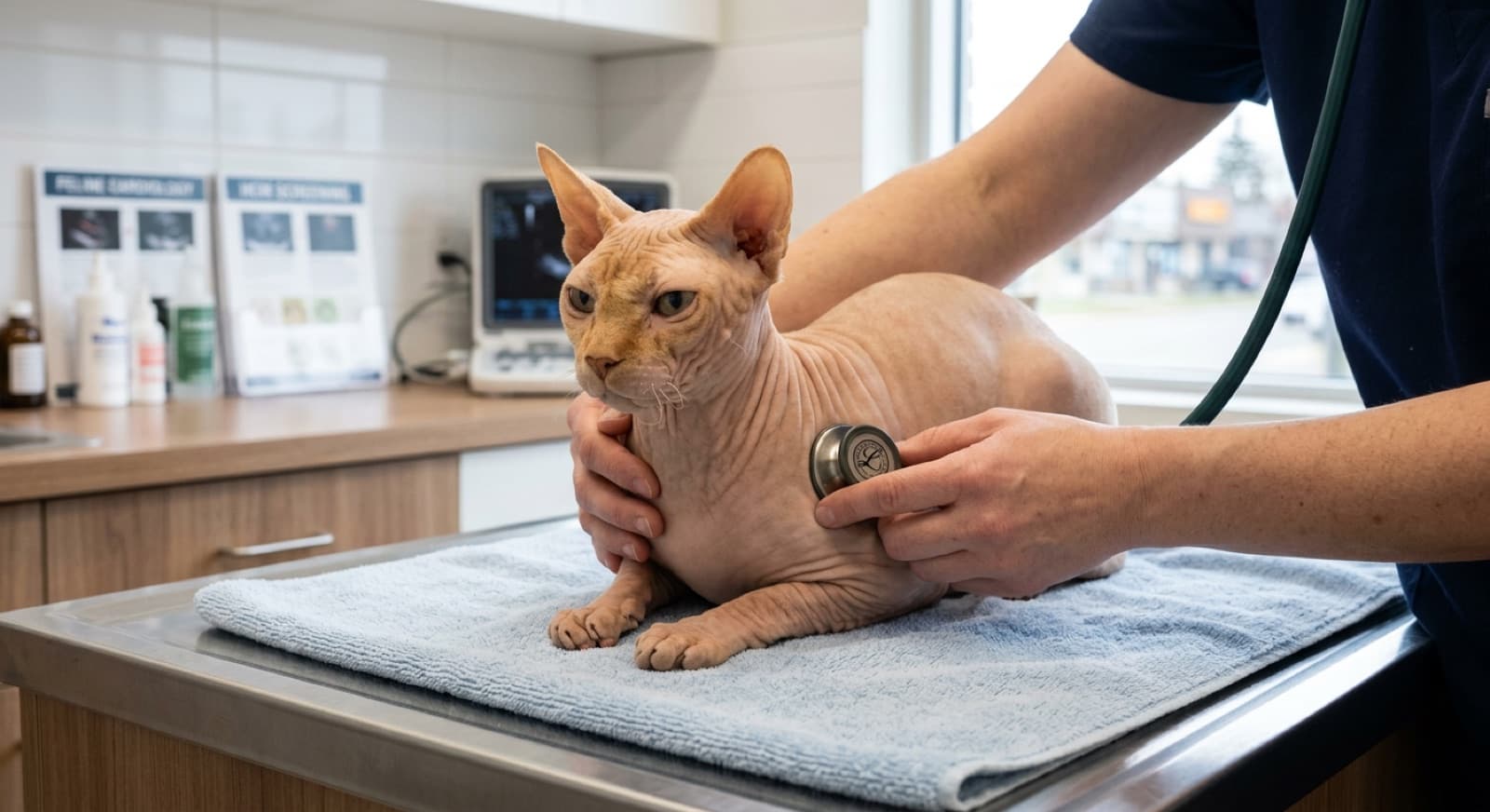
This article is informational only and is not veterinary advice. Always consult your Edmonton veterinarian for individualised health guidance for your specific cat. Sphynx are a breed with documented genetic and structural health risks across cardiac, neuromuscular, dental, dermatological, and anaesthetic systems. Proactive screening, ethical breeding history (where available), and ongoing veterinary care are essential. No medication, dosage, or treatment protocol is recommended on this page. Those decisions belong entirely with your veterinary team.
Sources informing this article include the Cornell Feline Health Center, the Royal Veterinary College VetCompass programme (2024 breed lifespan study), the UC Davis Veterinary Genetics Laboratory for the Sphynx and Devon Rex CMS DNA test, and breed standard references from the Cat Fanciers' Association (CFA) and The International Cat Association (TICA). Edmonton specialty cardiology referrals go through your general-practice vet. Treatment specifics still belong with your Edmonton veterinarian.
HCM: the breed-defining health risk
Hypertrophic cardiomyopathy is the most important Sphynx health condition by a meaningful margin, and the one that most strongly drives the breed's short median lifespan in population data. Prevalence is documented at 20 to 40 percent depending on the study population and age cohort, increasing with age. There is no reliable Sphynx-specific DNA test. The screening tool is annual echocardiogram from age 1 onward by a veterinary cardiologist.
HCM is the most common feline heart disease overall, but Sphynx are documented at meaningfully elevated breed risk. The disease causes the wall of the left ventricle to thicken abnormally; the chamber holds less blood, the heart works harder, and in some cats the condition progresses to congestive heart failure, a saddle thrombus that paralyses the rear legs, or sudden cardiac death.
Prevalence: 20 to 40 percent across studies
Chetboul 2012 examined a French Sphynx population and reported approximately 20 percent prevalence. A 2024 New Zealand cohort study indexed on PubMed Central as PMC11428990 reported 40 percent prevalence at a median age of 5.8 years, with 21.8 percent diagnosed at the very first screening, and males significantly more affected than females. The variation between studies reflects population age, screening intensity, and selection of the study cohort. The honest summary: somewhere between 1 in 5 and 2 in 5 Sphynx will develop HCM during their lifetime, with risk increasing as the cat ages. This is among the highest breed-specific cardiac risk profiles documented in cats.
No reliable Sphynx-specific DNA test
This is the critical Sphynx-specific point that distinguishes the breed from Ragdolls and Maine Coons. Ragdolls and Maine Coons each have a single, validated, breed-specific HCM DNA mutation (R820W and A31P respectively), and ethical breeders rely on those tests as part of screening. Sphynx do not have an equivalent reliable DNA test. The ALMS1 mutation identified in 2021 has not held up as a predictive screening tool in subsequent cohort studies. The practical conclusion: for Sphynx, an echocardiogram is not just gold standard. It is the only useful screening tool. Skip the DNA panels marketed for Sphynx HCM. Spend the money on the echocardiogram.
The annual echocardiogram protocol
Standard recommendation: annual echocardiogram from age 1 onward, performed by a veterinary cardiologist. In Edmonton, this means a referral from your general-practice vet to an Edmonton veterinary cardiology service. Cost: $400 to $600 per scan. If a murmur is detected at a routine exam between echos, an interim echo becomes appropriate. If symptoms appear (lethargy, breathing changes, hiding, refusal to eat), the echo becomes urgent rather than scheduled.
HCM symptoms to watch for at home
HCM can be silent for years. When symptoms appear, the most common ones are:
- Increased respiratory rate at rest (a sleeping cat should breathe 15 to 30 times per minute; persistently faster is a vet call)
- Lethargy or hiding when the cat is usually Velcro-sociable (a notable change for a Sphynx)
- Decreased appetite
- Sudden weakness, fainting, or collapse
- Sudden rear-leg paralysis (this can indicate a saddle thrombus, a blood clot at the aortic bifurcation; it is a same-day Edmonton 24-hour emergency)
- Open-mouth breathing or laboured breathing (always urgent in a cat)
Any of the above warrants a call to your veterinarian. Open-mouth breathing in a cat is an emergency. Drive to an Edmonton 24-hour emergency vet rather than wait until morning.
CMS (Congenital Myasthenic Syndrome)
CMS is the DNA-testable Sphynx genetic disease, and it is the question every Edmonton Sphynx breeder must answer for prospective buyers. The mutation is in the COLQ gene, identified in a PLOS ONE paper. CMS is autosomal recessive, which means a kitten needs two copies of the mutated gene (one from each parent) to develop the condition. Carriers (one copy) are clinically normal but pass the gene to half their kittens.
The condition causes progressive muscle weakness with onset between 3 weeks and 6 months. The pathognomonic sign is the chipmunk position: an affected kitten sits crouched with the head held forward and the eyes squinting, especially after activity. Other signs: exercise intolerance, regurgitation, and collapse after play. Severely affected kittens often do not survive to adulthood.
The good news: CMS is fully preventable in a breeding program. UC Davis Veterinary Genetics Laboratory offers the validated DNA test (search “Sphynx and Devon Rex CMS” at vgl.ucdavis.edu). Ethical breeders test every breeding parent and pair only carriers with non-carriers, which eliminates affected kittens. Both Sphynx and Devon Rex carry the same mutation.
For an Edmonton adopter, the practical takeaways: (1) Ask any breeder for the CMS DNA certificate on both parents, with the parents' registered names on the certificate. (2) If you adopt a Sphynx without breeder paperwork, you can order the CMS test yourself for one-time genetic clarity. (3) If a kitten or young Sphynx shows exercise intolerance, the chipmunk position after play, or regurgitation, see a vet promptly. Discuss specifics with your Edmonton veterinarian.
Juvenile-onset dental disease
Sphynx are documented for early-onset gingivitis, with symptoms appearing as early as 7 to 10 months. In severely affected lines, case reports of full mouth extractions before age 3 exist. The mechanism is not fully understood but appears to involve breed-specific gingival inflammation tendencies, possibly immune-mediated. The practical implication: dental disease in a Sphynx is not a problem that waits until middle age. It can be the dominant ongoing health expense in a young adult cat.
The Edmonton dental protocol for Sphynx: annual dental exam from age 1 (not age 2 like most cats), professional cleaning every 1 to 2 years from a young age, daily home brushing where the cat tolerates it. Cleanings in Edmonton run $400 to $800. Full mouth extractions, when needed, run $2,500 to $4,500. Importantly, Sphynx after full extractions do brilliantly; the procedure resolves chronic pain, and most cats eat normally on wet food afterward.
Anaesthesia consideration. Dental work requires general anaesthesia, and a Sphynx aged 1 or older should have a pre-anaesthetic echocardiogram considered as part of the workup. The cardiology consideration stacks with the dental work; plan both in coordinated visits where possible.
Urticaria pigmentosa
Urticaria pigmentosa (cutaneous mastocytosis) is a skin condition in which mast cells accumulate abnormally in the skin, producing crusted bumps and lesions on the head, neck, and legs. Sphynx and Devon Rex are over-represented in the veterinary literature. A retrospective case series from the Western College of Veterinary Medicine at the University of Saskatchewan found 9 of 13 reported feline cases were Sphynx, with 2 Devon Rex and 2 Sphynx/Devon Rex crosses among the remainder.
Diagnosis is by biopsy. Treatment is entirely vet-directed and varies with severity; no medication is recommended on this page. If you notice crusted bumps, persistent skin lesions, or scabby areas on a Sphynx, book a vet visit. Discuss specifics with your Edmonton veterinarian.
Anaesthesia caution: hypothermia + cardiac stack
Sphynx anaesthesia is a higher-risk profile than the average cat for two stacking reasons. Both need to be on your vet's pre-anaesthetic checklist before any elective procedure.
Hypothermia risk. Sphynx have no fur insulation, and general anaesthesia suppresses normal thermoregulation. Body temperature drops faster and further during a Sphynx surgery than for a typical cat. The mitigations: active warming devices, warmed IV fluids, careful core-temperature monitoring during and after the procedure, and warm recovery space.
Undiagnosed HCM. Because HCM prevalence runs 20 to 40 percent in the breed, an Sphynx without a recent echocardiogram could be carrying undiagnosed cardiac disease that significantly raises anaesthetic risk. A pre-anaesthetic echocardiogram is worth discussing with your vet for any Sphynx aged 1 or older before elective surgery (spay, neuter, dental cleaning).
An Edmonton clinic that handles Sphynx regularly with a clear pre-anaesthetic plan including warming protocols and cardiology screening can manage this safely. The decisions belong with your veterinary team, but it is reasonable to ask your vet directly about their Sphynx anaesthesia protocol before any procedure. A vet who says “Sphynx are no different from other cats” is missing the breed-specific picture; a vet who can describe their warming protocol and pre-anaesthetic screening for the breed is the right partner.
Browse adoptable Sphynx in Edmonton
Health-aware adoption is achievable. Alberta Sphynx Rescue typically pre-screens for CMS and basic cardiac before adoption, and the foster home has lived with the cat for weeks before placement. The 14-year lifespan version of Sphynx ownership starts with that foundation.
See Available Cats in Edmonton →Pet insurance: the single highest-leverage decision
For Sphynx more than almost any other breed, pet insurance is the single highest-leverage health decision an Edmonton owner makes, and the timing is everything. Canadian carriers (Trupanion, Petsecure, Pet Plus Us, and several others) price Sphynx among their highest-premium breeds because the actuarial picture (HCM risk, dental risk, anaesthesia complexity, shorter lifespan) is unfavourable. Monthly premiums of $70 to $130 are typical, sometimes higher.
The single rule that matters: enrol before age 1, before the first echocardiogram, and before any cardiac or dental diagnosis. Every Canadian pet insurance provider excludes pre-existing conditions. A Sphynx enrolled at age 6 months with a clean baseline qualifies for the broadest coverage. A Sphynx enrolled at age 18 months after the first screening flagged any cardiac change has that condition excluded indefinitely on any new policy.
What to look for in the fine print:
- Hereditary-condition coverage included (some lower-tier policies exclude HCM as breed-typical)
- Dental coverage included (many policies treat dental as an add-on)
- Annual cap that meaningfully covers a multi-year HCM management course
- Reasonable deductible structure
Compare directly across at least three providers. The right policy depends on your budget and risk tolerance; this page does not name a specific provider because the calculus is individual. But the timing is universal: do it early.
Annual screening cadence for Edmonton Sphynx owners
The realistic schedule for a healthy Sphynx, to discuss and adjust with your Edmonton veterinarian:
| Life stage | Suggested vet contact |
|---|---|
| Year 1 (kitten / new adopt) | Full wellness exam, vaccines, parasite prevention, baseline bloodwork, urinalysis, dental check, body condition baseline. Enrol pet insurance. CMS DNA test if not done. Discuss baseline echocardiogram timing. |
| Age 1 onwards | Annual echocardiogram by veterinary cardiologist. Annual dental exam. Annual exam plus bloodwork. Skincare review. |
| Age 5 onwards | Echocardiogram cadence may increase (semi-annual considered in higher-risk individuals). Continue annual dental. Senior bloodwork starts entering the conversation. |
| Age 7 and older | Semi-annual exams. Senior bloodwork panel including kidney function. Dental cleaning under anaesthesia at vet's recommendation with HCM-aware planning. |
This is a template, not a prescription. Your Edmonton veterinarian adjusts the cadence based on your individual cat, what they hear at routine exams, and any history you can provide.
At-home observation matters as much as the schedule. Watch for changes in breathing rate at rest, appetite, water intake, litter box habits, skin condition, weight, and energy. If something feels off, call your vet rather than wait.
Frequently Asked Questions
What are the main Sphynx health issues?
Three conditions decide Sphynx outcomes: Hypertrophic Cardiomyopathy (HCM), reported at 20 to 40 percent breed prevalence depending on population and age cohort, with no reliable Sphynx-specific DNA test (annual echocardiogram from age 1 is the screening tool); Congenital Myasthenic Syndrome (CMS), an autosomal recessive disease that IS DNA-testable through UC Davis VGL; and early-onset dental disease, with juvenile gingivitis documented from 7 to 10 months in some lines. Add to those: sebaceous overproduction requiring weekly skincare, sunburn risk through indoor windows, urticaria pigmentosa (Sphynx and Devon Rex are over-represented), anaesthesia caution from hypothermia risk and HCM stack, and large prominent eyes that need daily care. Lifespan estimates range from 6.8 years (2024 RVC UK study median, the shortest of any breed) to 14 years (breed-club estimates with proactive screening). Both numbers are honest. Discuss screening with your Edmonton veterinarian.
How common is HCM in Sphynx cats?
Reported prevalence ranges from 20 to 40 percent depending on the population studied and age cohort. The Chetboul 2012 French Sphynx study found about 20 percent prevalence. A 2024 New Zealand cohort study (PMC11428990) found 40 percent prevalence at a median age of 5.8 years, with 21.8 percent diagnosed at first screening and males significantly more affected. HCM is the leading identifiable cause of premature mortality in the breed. Prevalence increases with age, which is why annual screening matters more for Sphynx than for almost any other breed. Treatment is entirely vet-directed and depends on stage. Discuss specifics with your Edmonton veterinarian.
Is there a DNA test for Sphynx HCM?
No, not a reliable one. An ALMS1 mutation has been identified in Sphynx (Meurs 2021) and some commercial labs offer it as part of breed panels, but the 2024 New Zealand cohort study found NO association between ALMS1 variant status and HCM diagnosis. Variant frequency was 70.9 percent across all Sphynx in that population, but variant carriers were not significantly more likely to develop disease. UC Davis Veterinary Genetics Laboratory does NOT offer ALMS1 as a standalone test. The practical conclusion: do not rely on ALMS1 DNA testing for Sphynx HCM screening. Use annual echocardiograms by a veterinary cardiologist from age 1 onward instead. The DNA test you SHOULD order for a Sphynx is the CMS test, discussed in the next question.
Should I order the ALMS1 DNA test?
No, not as an HCM screening tool. The 2024 New Zealand study (PMC11428990) is the largest cohort to date and found ALMS1 variant status was not predictive of HCM development. A negative ALMS1 result does not mean your Sphynx will not develop HCM. A positive ALMS1 result does not mean your Sphynx will. Some Basepaws and Genimal panels include ALMS1 but it is not a substitute for echocardiogram screening. Spend that money on the annual echocardiogram instead. The DNA test that DOES matter for Sphynx is the CMS (Congenital Myasthenic Syndrome) test at UC Davis VGL.
What is CMS / Congenital Myasthenic Syndrome?
Congenital Myasthenic Syndrome is an autosomal recessive neuromuscular disease that affects Sphynx AND Devon Rex cats. It is caused by a mutation in the COLQ gene, identified in a PLOS ONE paper. The condition causes muscle weakness and exercise intolerance with onset between 3 weeks and 6 months. The pathognomonic sign is the chipmunk position: an affected kitten sits crouched with the head held forward and the eyes squinting, especially after activity. Other signs include regurgitation, exercise intolerance, and collapse after play. UC Davis Veterinary Genetics Laboratory offers a CMS DNA test for Sphynx and Devon Rex (vgl.ucdavis.edu). Ethical breeders test breeding parents and avoid carrier-to-carrier matings, which prevents affected kittens. Ask any breeder for the CMS DNA certificates on both parents. For Edmonton adopters acquiring a Sphynx without breeder paperwork, the test is a one-time genetic-question answered.
Should I screen my Sphynx for HCM?
Yes, and the recommendation is more aggressive than for most cat breeds. Annual echocardiogram from age 1 onward by a veterinary cardiologist. In Edmonton, this typically means a referral from your general-practice vet to an Edmonton veterinary cardiology service. Expect roughly $400 to $600 per scan. The reason for annual cadence starting at age 1 rather than the usual age 2: HCM prevalence in Sphynx is documented as high as 40 percent, with median age at diagnosis around 5.8 years and a meaningful number diagnosed at first screening. Annual screening from age 1 catches the disease earlier and gives more management options. Pet insurance enrolled before that first screening is critical.
Why do Sphynx have dental problems so early?
Sphynx are documented for juvenile-onset gingivitis, with case reports showing symptoms appearing as early as 7 to 10 months of age. In severely affected lines, case reports of full mouth extractions before age 3 exist. The mechanism is not fully understood but appears to be a combination of breed-specific gingival inflammation tendency, possibly related to immune-mediated factors. The practical implication: annual dental exam from age 1 (not age 2 like most cats), and professional cleaning every 1 to 2 years from a young age. Cleanings run $400 to $800 in Edmonton; extractions add $200 to $800 per tooth. Home brushing helps but does not prevent disease in heavily affected lines. The anaesthesia risk stacks with HCM, so dental work also requires the cardiology-aware planning discussed below.
What is urticaria pigmentosa?
Urticaria pigmentosa (cutaneous mastocytosis) is a skin condition in which mast cells accumulate abnormally in the skin, producing crusted bumps and lesions on the head, neck, and legs. Sphynx and Devon Rex are over-represented in the veterinary literature. A retrospective case series from the Western College of Veterinary Medicine at the University of Saskatchewan (WCVM) found 9 of 13 reported feline cases were Sphynx, with 2 Devon Rex and 2 Sphynx/Devon Rex crosses among the remainder. Diagnosis is by biopsy. Treatment is entirely vet-directed and varies with severity; no medication is recommended on this page. If you notice crusted bumps, persistent skin lesions, or scabby areas on a Sphynx, book a vet visit. Discuss specifics with your Edmonton veterinarian.
Are Sphynx really high-risk for anaesthesia?
Yes, for two stacking reasons that matter together. First, hypothermia risk is elevated because Sphynx have no fur insulation, and standard general anaesthesia suppresses normal thermoregulation. Active warming, warmed IV fluids, and careful core-body-temperature monitoring during and after the procedure are essential. Second, HCM prevalence in the breed means an undiagnosed cardiac condition can meaningfully raise anaesthetic risk for any individual cat. A pre-anaesthetic echocardiogram is worth discussing with your vet for any Sphynx aged 1 or older before elective surgery (spay, neuter, dental cleaning). For routine procedures at an Edmonton clinic that handles Sphynx regularly with a clear pre-anaesthetic plan including warming, the risk is manageable. Discuss specifics with your Edmonton veterinarian.
What is the real Sphynx lifespan?
There are two honest answers and the truth is somewhere in between. The 2024 Royal Veterinary College VetCompass UK study (n=7,936 cats) reported a median life expectancy from birth of 6.8 years for Sphynx, the shortest of any breed studied. Breed clubs and US-based breed-specific lifespan estimates typically cite 8 to 14 years with proactive HCM screening and dental care. Both numbers are accurate to the data they describe. The RVC figure includes all Sphynx, including those without screening or veterinary care. The 14-year figure represents what is possible with annual cardiology screening from age 1, pet insurance enrolled before any diagnosis, attentive dental care from age 1, and a household that prioritises skincare and indoor protection. For an Edmonton owner committed to that level of proactive care, an 11-to-13 year lifespan is a reasonable planning assumption.
Why is the RVC study lifespan so much shorter than what breeders say?
The RVC VetCompass UK study (2024) included a broad cross-section of pet Sphynx in the UK regardless of breeder source or veterinary engagement, which is what makes a median figure of 6.8 years credible as a population statistic. Breed clubs cite estimates based on Sphynx whose owners do proactive screening, dental care, and have enrolled pet insurance. The gap between the two numbers is driven primarily by undiagnosed HCM (the leading premature-mortality cause), juvenile-onset dental disease left untreated, and the cumulative effect of skipped specialty referrals. Proactive care does not eliminate these risks but pulls individual cats meaningfully toward the upper end. An Edmonton owner who builds a relationship with one general-practice vet, starts annual cardiology at age 1, takes dental disease seriously, and has insurance with dental coverage in place before any diagnosis is doing the work that closes the gap.
Where can I get a Sphynx echocardiogram in Edmonton?
Echocardiograms are performed by veterinary cardiologists, not general-practice vets. In Edmonton, this is typically a referral from your primary vet to an Edmonton veterinary cardiology service. Expect to pay roughly $400 to $600 per scan. Walking into a specialty centre without a referral is uncommon, so build the relationship with one general-practice clinic first and ask them to refer you in for the annual Sphynx screening from age 1 onward. The same Edmonton specialty pathway handles 24-hour emergency cardiac care as needed.
Is pet insurance worth it for a Sphynx?
Yes, more than for almost any other cat breed. Sphynx are among the highest-premium breeds for Canadian pet insurance because the carriers price for the documented HCM risk, dental risk, anaesthesia complexity, and lifespan profile. Monthly premiums of $70 to $130 across Trupanion, Petsecure, and Pet Plus Us are typical, sometimes higher. That cost is also why insurance matters more for this breed: a single HCM diagnosis or major dental case can cost five figures over a 10-to-13 year cat. A policy enrolled before the first echocardiogram at age 1 covers exactly the conditions Sphynx are most likely to need. The single most expensive mistake a new Edmonton Sphynx owner can make is waiting until after age 1 to buy insurance, after the first echo has been logged.
When should I buy pet insurance for my Sphynx?
Buy at adoption or by the first vet visit, ideally BEFORE the first echocardiogram and BEFORE age 1. Every Canadian pet insurance provider excludes pre-existing conditions, and HCM is the condition policies are most useful against for this breed. A Sphynx enrolled at month 3 with a clean baseline qualifies for the broadest coverage available. A Sphynx enrolled at age 2 after the first screening flagged any cardiac change has cardiac coverage excluded indefinitely on any new policy. The same logic applies to dental, which is also Sphynx-relevant. The cost of waiting is not the premiums saved, it is the coverage lost on the conditions you are most likely to need. This is more aggressive guidance than for most breeds, and it reflects the documented breed risk profile.
Sphynx Adoption Edmonton
Rescue vs breeder, real costs, waitlists, and the buy-vs-adopt math for Edmonton.
Sphynx Skincare & Edmonton Winter
Weekly bathing, daily oil-blotting, sweater wardrobe, heated beds, UV film, and the -30C Edmonton humidity protocol.
Sphynx Scam Avoidance Edmonton
The 2016 Alberta shaved-kitten scam case, the under-$1,000 red zone, and CMS certificate verification.
Cat Emergency Vet Edmonton
When to go, what it costs, and how to recognise the urgent signs that demand a 24-hour Edmonton emergency vet.