The short answer
Alberta has a documented Sphynx scam history. In 2016, Kijiji ads sold regular domestic shorthair (DSH) kittens that had been shaved with razors and chemical depilatories as “Sphynx kittens” for $650 to $800 cash across central Alberta including the Edmonton area. Coats grew back in two weeks. Some kittens had chemical burns and razor wounds. Alberta SPCA investigated. The pattern still runs today on Kijiji and Facebook Marketplace. If you want a real Sphynx in Edmonton, go through Alberta Sphynx Rescue or verify a CFA or TICA registered breeder. Anything below $1,000, paid in cash, with no home visit, is the scam zone.
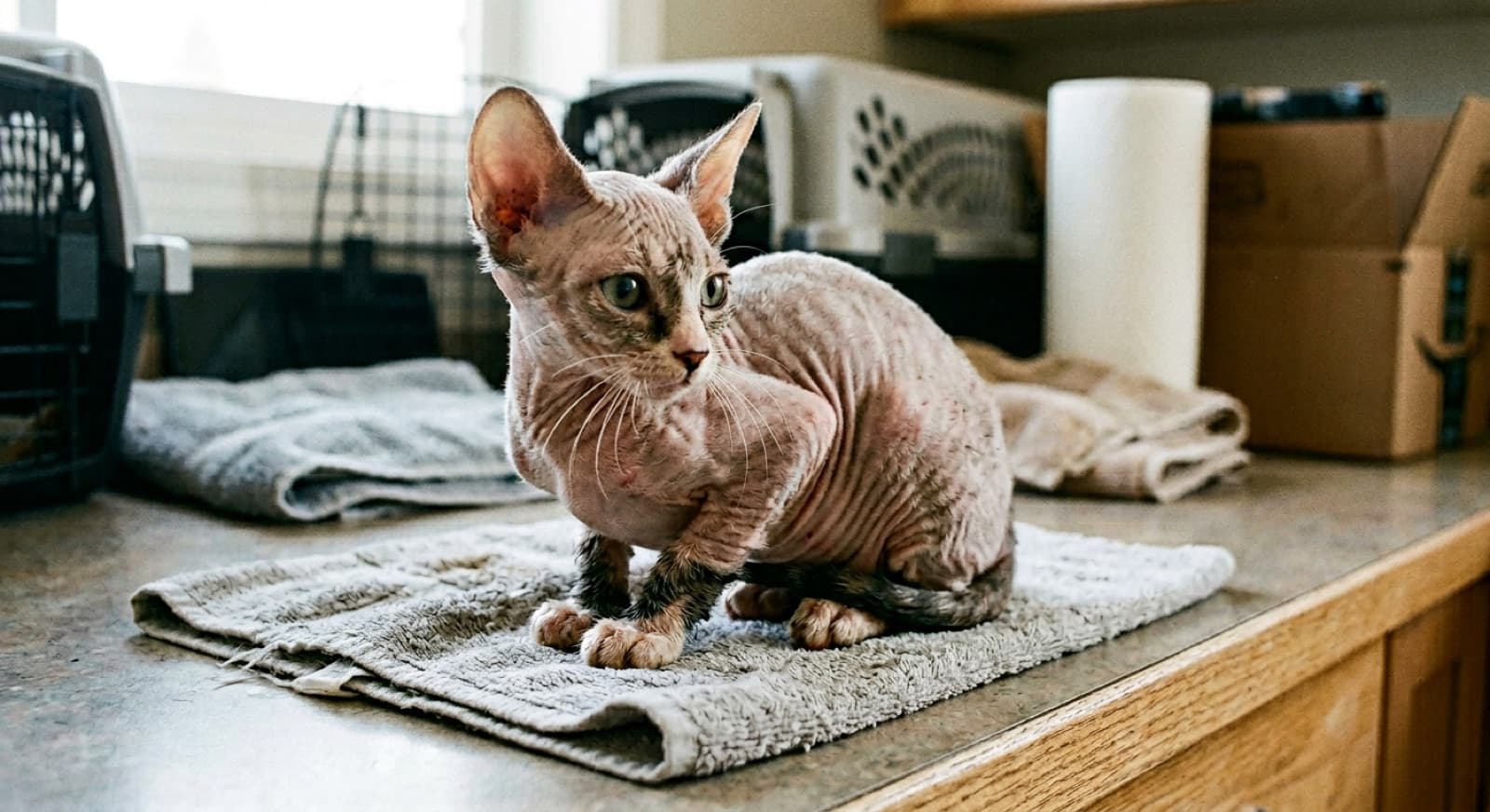
The 2016 Alberta shaved-kitten case: what actually happened
In 2016, Alberta became the centre of one of the more disturbing pet scams in recent Canadian memory. Kijiji listings advertising “Sphynx kittens for sale” appeared across the province at $650 to $800 cash. Victims came from across central Alberta and the Edmonton area. Exchanges happened in gas station parking lots. No paperwork, no home visit, no breeder credentials. The kittens looked hairless. The buyers paid cash and went home.
Within roughly two weeks, the coats grew back.
The kittens were not Sphynx. They were regular domestic shorthair kittens that had been shaved with razors and treated with chemical depilatories to mimic the hairless appearance long enough to complete a cash sale. CBC News, CTV News, and Global News all covered the case when the first victims came forward, with national-feed coverage of the Kijiji-sold-as-hairless scam.
Veterinary consequences were real. Some kittens needed treatment for razor burn. Others had chemical burns from the depilatory products used to remove fur on parts of the body razors could not reach. One kitten had a tail injury serious enough that veterinarians considered amputation. The Alberta SPCA launched an investigation after the first round of reports.
This was not an isolated viral story. It ran across multiple Canadian outlets. It is part of the public record of pet fraud in Alberta. And in 2026, ten years later, the scam structure that made it work is unchanged.
Why the 2016 pattern keeps working
The 2016 Alberta case worked because of four conditions that all still hold in 2026. Understanding why the pattern persists is how you avoid being the next victim.
The price gap is huge. A pet-quality Sphynx kitten from an ethical CFA or TICA registered breeder runs $2,500 to $5,000 in 2026. A scam Sphynx is offered at $650 to $1,000. To a buyer who has done some reading, a $700 Sphynx feels like a deal worth jumping on. The scammer knows this and prices accordingly. The gap is exactly wide enough to seem like a lucky find and exactly narrow enough not to seem suspicious.
Buyer ignorance about hairless cats is widespread. Most prospective Sphynx buyers have never met one in person. They have seen photos. They have read about the breed online. They know Sphynx are hairless. What they do not know is that a real Sphynx has wrinkled suede-like skin with visible peach-fuzz, a body temperature that feels almost feverish (38 to 40 degrees Celsius), sebaceous oil on the skin, lemon-shaped eyes, bat-wide ears, and a muscular build distinct from a generic DSH body shape. A first-time buyer cannot tell the difference between a real Sphynx and a freshly shaved DSH in the first 24 hours. By the time fur regrows, the cash is gone.
Cash-and-paperwork-free transactions are the classifieds norm. Kijiji and Facebook Marketplace are built for low-friction local exchanges. Cash, no contract, parking-lot meetup. That is the default for buying a used bike or a coffee table. Scammers exploit the fact that buyers do not question that structure when buying a cat the same way.
Verification of breed claims via photos is genuinely difficult. A reverse image search catches stolen photos, but in the 2016 case the photos were of real (shaved) cats the scammer actually had. The photos checked out. The cats were physically there to hand over. The fraud was the species claim, not the photo provenance.
These four conditions are why the same structure keeps producing Alberta victims a decade later. Awareness is the only real defence.
The current scam patterns on Kijiji and Facebook Marketplace
Each of these is the 2016 Alberta playbook in a slightly updated form. One red flag is a yellow caution. Two or more is a scam. Walk away.
1. Cash-only, parking-lot exchanges
The single clearest tell. Legitimate breeders welcome home visits and provide paperwork before money changes hands. Legitimate rescues use official payment portals. A seller who insists on cash in a parking lot is removing every protection you have, which is exactly the point. This was the 2016 Alberta structure. It is still the 2026 structure.
2. No registration paperwork
Legitimate CFA or TICA breeders provide registration numbers, cattery names, and registered parent names freely. Verify directly at cfa.org or tica.org. No paperwork or vague references to “registered with a Canadian registry” without specifics means the cat is not what the seller claims.
3. No CMS DNA test certificate
Congenital myasthenic syndrome (CMS) is a serious inherited neuromuscular disease in Sphynx with a validated DNA test at UC Davis VGL. Every ethical breeder tests breeding parents. Ask for the certificate by the parent’s registered name. No certificate means no genetic screening, which means no ethical breeder behind the listing.
4. No HCM echocardiogram on parents
HCM (Hypertrophic Cardiomyopathy) affects 20 to 40 percent of Sphynx and is the leading inherited killer in the breed. No commercial Sphynx HCM DNA test exists yet. Ethical breeders do annual cardiologist echocardiograms on every breeding parent and share the records. Absence of HCM screening records means the breeder is not screening for the breed’s biggest health risk.
5. Refusal of in-person cattery visit
An ethical Sphynx breeder welcomes and often requires the buyer to come to the cattery, meet the queen, see the kittens with their littermates, and observe the home environment. A seller who refuses or repeatedly delays an in-person visit is either hiding a poor environment or has no kittens at all. The 2016 Alberta scammers refused home visits for the same reason.
6. Refusal to wait 7 days before exchange
This is the Sphynx-specific test. A real Sphynx is unchanged after 7 days. A shaved DSH grows visible regrowth in days. If a seller refuses to let you wait a week before completing the transaction, the cat is likely shaved. This single request, calmly delivered, has dissolved many scam attempts on the spot.
7. Deposits demanded before kittens are born
Ethical breeders do not accept deposits on kittens that do not exist yet. A real breeder waits until kittens are born, alive, and confirmed at 4 to 6 weeks before taking waitlist money. Anyone asking for a deposit on a future or unborn litter is running the deposit-scam variant.
8. Pricing under $1,000 for a “purebred Sphynx”
Real Canadian CFA or TICA breeder pricing is $2,500 to $5,000. Real cost-of-production puts the breakeven above $2,000. Anything below $1,000 is either a shaved DSH (the 2016 pattern), a backyard breeder with no health testing, or a deposit-scam listing. The low price is the bait, not the bargain.
9. Stolen photos (cross-checked with reverse image search)
For deposit-scam variants (where there is no real cat at all), photos are stolen from real breeder websites or social media. Upload every photo to images.google.com or tineye.com. If the same photo appears on multiple unrelated websites in different countries, the listing is using stolen images. This catches the deposit-scam pattern. It does NOT catch the shaved-DSH pattern, where the photos are of the actual (shaved) cat being sold; for that, use the 7-day wait test instead.
10. Pressure tactics and urgency
“Another buyer is interested, send the deposit by tonight or you lose the kitten.” Real breeders have waitlists, not auctions. Urgency is a manufactured emotion to skip your verification steps. Slow down. The right Sphynx is worth the verification week.
The 7-day wait test: the Sphynx-specific shortcut
The single most effective verification step for a Sphynx listing in Alberta is the 7-day wait test. Tell the seller you want to wait one week between visiting the kitten and completing the purchase. A legitimate seller agrees without hesitation. A shaved-DSH scam seller will dodge with excuses, raise the price for “reservation,” or try to rush you through the transaction.
Why the 7 days work: real Sphynx are essentially hairless and stay essentially hairless through normal life. Their peach-fuzz down does not grow into visible fur in a week. A shaved DSH grows visibly into 1-2 mm of fur regrowth within 7 days, easily detectable on close inspection. The cat that looked hairless on day 0 will look obviously stubbly on day 7.
If you can run this test, do it. If you cannot (the seller pushes back), the test result is in: do not buy. The willingness or refusal to wait 7 days is itself the verification.
Real Sphynx physical markers (what to look for in person)
If you have an in-person visit before purchase (which you should), here is what a real Sphynx feels and looks like:
- Wrinkled skin. Especially around the head, shoulders, and leg joints. A shaved DSH has smooth skin under the stubble.
- Peach-fuzz down. Visible only in good light. Soft, very fine, sometimes called kitten fuzz. A shaved DSH has uneven stubble, not even fuzz.
- Warm to the touch (almost feverish). Sphynx body temperature is 38 to 40 degrees Celsius, which feels noticeably warm to a hand. A normal cat at 38 to 39 feels normal. A shaved DSH does not have the elevated metabolic warmth.
- Sebaceous oil on the skin. Sphynx skin produces oil that accumulates because there is no fur to absorb it. A real Sphynx feels slightly tacky or oily after a few days without bathing. A freshly shaved DSH does not.
- Lemon-shaped eyes. Distinctive Sphynx eye shape. A DSH has more rounded eyes.
- Bat-wide ears. Sphynx ears are dramatically large and set wide. DSH ears are smaller and more upright.
- Muscular athletic build. Sphynx are surprisingly dense and muscular under the skin. DSH builds vary but are usually less dense.
- Razor burn, chemical irritation, or scabbing on a “Sphynx.” If you see any of these, it is a shaved DSH and the cat needs immediate veterinary care.
The combination matters more than any single trait. A real Sphynx is the intersection of all of the above; a shaved DSH may pass one or two markers but fails the full set.
What to do if you think you have been scammed
The 2016 Alberta case produced real victims, including some whose kittens needed urgent veterinary care for chemical and razor injuries. If you think you bought a shaved DSH or a scammed Sphynx, the cat's welfare comes before any recovery effort.
Act in this order:
- Get the cat to an Edmonton vet. Chemical burns, razor wounds, or skin infection from depilatory exposure are real risks. An Edmonton 24-hour emergency vet handles same-day cases.
- Report to Alberta SPCA. The same body that investigated the 2016 case. They take animal-welfare-related fraud seriously and maintain investigative capacity.
- Report to the Canadian Anti-Fraud Centre at 1-888-495-8501. Free, takes 15 minutes.
- Report to Edmonton Police Service consumer fraud. File a report especially if the amount exceeded a few hundred dollars.
- Report the listing on the platform. Kijiji or Facebook Marketplace, with screenshots and the seller's profile. Platforms remove repeat offenders only when complaints stack.
- Contact Alberta Sphynx Rescue. They have rehabilitation resources and can take a surrendered cat if you cannot keep it.
- Document everything. Photos, the original listing, message history, payment records. Recovery is rare, but documentation supports law enforcement and helps the next buyer avoid the same operator.
The cat in your home is not at fault for the scam. Many shaved DSH victims went on to become beloved family pets after the fur grew back. They are still cats; they still deserve good care. The scam is on the seller, not the animal.
Bypass the Sphynx scam ecosystem entirely
Alberta Sphynx Rescue is the structurally-safe Sphynx path in Alberta. Real cats in real foster homes. You meet the cat before paying. The fee is honest. The structural risks of Kijiji parking-lot scams (no in-person meeting, cash-only, no paperwork) simply do not exist in rescue.
See Available Cats in Edmonton →The Alberta Sphynx Rescue path
Alberta Sphynx Rescue (ASR) is the structurally-safe Sphynx path in Alberta. ASR is Calgary-based with an Edmonton volunteer presence since 2022, scoped to Sphynx and other hairless and semi-hairless breeds including Devon Rex, Donskoy, Peterbald, Oriental, Cornish Rex, and Lykoi. Founded by Jennifer; Edmonton volunteer Jaime provides northern coverage.
The structural elements that make ASR scam-free are the opposite of every 2016 Alberta case feature:
- Registered non-profit with public charity status and audited finances.
- Foster home placement, not parking-lot exchanges. You meet the cat in a real home over multiple visits before adoption.
- Full vetting included: spay or neuter, vaccines, microchip, deworming, vet workup, basic cardiac screening for adults, CMS evaluation where applicable.
- Skincare routine handoff. The foster home has lived with the cat for weeks and knows what bathing schedule, shampoo, ear cleaning, and oil management work for this specific cat. You inherit that protocol.
- Adoption fee paid to a charity through official channels, not cash to an individual.
- Cross-province transport coordination available, so an Edmonton home can adopt a Sphynx that landed in Calgary or Lethbridge.
Adoption fees through ASR run $400 to $700 for fully-vetted cats. That is less than 25 percent of the lowest ethical-breeder price, with none of the scam risk. For Edmonton households that want a Sphynx without learning the breed by surviving a fraud, ASR is the answer.
Visit albertasphynxrescue.ca to apply. Patience matters; ASR places carefully, and Sphynx demand outpaces intake in most months. Watch live listings on LocalPetFinder Edmonton for ASR-affiliated postings.
If you really want a kitten from a breeder
The ethical breeder path exists and is legitimate for adopters who specifically want a registered Sphynx kitten with verified parent testing. The verification protocol:
- Start with the registries. Search the cattery at cfa.org and tica.org. A real cattery returns a live entry. A scam returns nothing.
- Ask for CMS DNA certificates on both parents, from UC Davis VGL, with the parents' registered names. The certificate names the cat, the date, and the result. Verify within 24 hours.
- Ask for HCM echocardiogram reports on both parents, dated within the last year, from a veterinary cardiologist. Annual cadence is the standard.
- Schedule the in-person cattery visit. Meet the queen, see the kittens with their littermates, observe the home environment. A breeder who refuses is not the right breeder.
- Wait for the kitten to be 12 to 16 weeks old before pickup. Ethical breeders do not release kittens before 12 weeks because of socialisation and skincare-routine handoff.
- Pay through a traceable method: cheque, certified bank draft, or business-account wire transfer. Never cash.
- Sign a contract with spay or neuter clause, return-to-breeder clause if you cannot keep the cat, and a written health guarantee.
This is what an ethical Sphynx breeder relationship looks like. If a seller cannot meet even one of these standards, the listing is not what it appears. Walk away. The right Sphynx is worth the patience.
Frequently Asked Questions
Were there really shaved kitten scams in Alberta?
Yes. In 2016, Canadian news outlets including CBC News, CTV News, and Global News documented a scam where regular domestic shorthair kittens were shaved with razors and chemical depilatories, then sold on Kijiji as “Sphynx kittens” for $650 to $800 cash. Victims came from across central Alberta including the Edmonton area. Coats grew back within roughly two weeks. Some of the kittens needed veterinary treatment for chemical burns and razor wounds, and one had a tail injury severe enough to nearly require amputation. The Alberta SPCA launched an investigation. This was a real, widely reported Canadian news story.
Is the Alberta Sphynx scam still happening?
The exact 2016 operator was investigated, but the pattern continues. Kijiji and Facebook Marketplace still see “Sphynx kitten” listings in the $600 to $1,000 cash-only range across Alberta including the Edmonton area most months. Some are shaved DSH kittens. Others are simple deposit scams with stolen photos. The structural conditions that made the 2016 scam work (premium breed prices, cash-friendly classifieds, buyer unfamiliarity with what a real Sphynx looks and feels like) are still in place. The honest expectation: assume any sub-$1,000 cash-only Sphynx listing is the scam zone until proven otherwise.
How can I tell if a "Sphynx" is actually a shaved kitten?
A real Sphynx has wrinkled skin (especially on the head, shoulders, and leg joints), a visible peach-fuzz down sometimes called kitten fuzz, slightly oily skin from sebaceous oil, and a body temperature warm enough that the cat feels almost feverish to the touch (38 to 40 degrees Celsius is normal). A shaved domestic shorthair will have stubble or visible regrowth, lack the body-heat warmth, often show razor burn or chemical irritation, and have a normal cat body shape instead of the Sphynx muscular and dense build. Within days, fur starts visibly regrowing. If you suspect it, ask to come back in seven days. A real Sphynx is unchanged. A shaved kitten is half-furred again.
What is a fair price for a Sphynx kitten in Edmonton?
Rescue: $400 to $700 (through Alberta Sphynx Rescue, the Calgary-based Sphynx-focused rescue with Edmonton volunteer presence since 2022). Ethical CFA or TICA registered breeder: $2,500 to $5,000 for a pet-quality kitten, sometimes higher for show-quality or rare colours. Anything below $1,000 cash with no paperwork, no parent registration, no CMS DNA test certificate, and no in-person cattery visit is the scam zone. The real cost of breeding a registered Sphynx (HCM echocardiogram screening, CMS DNA testing, queen retirement, skincare, vet care, registration) puts the breakeven price north of $2,000. A “deal” at $700 is the 2016 Alberta scam revisited.
Why are real Sphynx so expensive?
Sphynx are one of the most maintenance-intensive cat breeds to produce ethically. Both breeding parents need annual cardiologist echocardiograms (HCM affects 20 to 40 percent of the breed). The CMS (congenital myasthenic syndrome) DNA test through UC Davis VGL is required to avoid producing affected kittens. Queens retire young because of breed-specific health considerations. Kittens need specialised skincare from birth and stay with the breeder until 12 to 16 weeks. Stud fees from outside catteries are expensive because the verified breeding pool is small. Combined costs per litter run into thousands of dollars before the kitten reaches a buyer. The $2,500 to $5,000 price reflects real costs, not markup.
How do I verify a CFA or TICA Sphynx breeder?
Both registries publish free public breeder directories. Search the cattery name at cfa.org (Cat Fanciers Association) and tica.org (The International Cat Association). A real cattery returns a live entry with current registration and contact details. A fake or unregistered cattery returns nothing. Cross-check the cattery name the breeder gives you against what the directory shows. Real breeders welcome this check and provide their registration number freely. Scammers send screenshots instead of links, claim “registration is in progress,” or get evasive when asked. The directory check takes 30 seconds and catches almost every fake breeder website.
What is the CMS DNA test and why does it matter?
CMS stands for congenital myasthenic syndrome, a serious inherited neuromuscular disease in Sphynx that causes progressive muscle weakness. UC Davis Veterinary Genetics Laboratory (vgl.ucdavis.edu) offers the validated DNA test. Ethical breeders test every breeding parent and only pair carriers with non-carriers to avoid producing affected kittens. The certificate names the cat, the date, and the result. Ask for it by the parent's registered name and verify the test was actually run by UC Davis. A breeder who has not done CMS testing is risking the most serious genetic disease in the breed and either does not know the literature or does not care. Either way, walk away.
Can I really find a Sphynx through rescue?
Yes. Alberta Sphynx Rescue (albertasphynxrescue.ca) is the Calgary-based, Alberta-scoped rescue dedicated to Sphynx, Devon Rex, Donskoy, Peterbald, Cornish Rex, Lykoi, and other hairless or semi-hairless breeds. Founded by Jennifer, with Edmonton volunteer Jaime providing northern coverage since 2022. Adoption fees run $400 to $700 and cover spay or neuter, vaccines, microchip, deworming, vet workup, and HCM screening for adult cats. Cats live in foster homes, so adopters meet the cat and learn its actual personality and skincare routine before commitment. Cross-province transport coordination is available. This is the safest Sphynx path in Alberta with zero paperwork-scam or shaved-kitten risk.
What should I do if I think I bought a scammed Sphynx?
Act in this order. Get the cat to an Edmonton vet immediately. Chemical burns, razor wounds, and infection are real risks from shaved-DSH scams, so emergency care at an Edmonton 24-hour emergency vet is the first stop if signs of injury are present. Report to Alberta SPCA (the same body that investigated the 2016 case) and to Edmonton Police Service consumer fraud. Report the listing on the platform (Kijiji or Facebook Marketplace) with screenshots. Contact Alberta Sphynx Rescue (albertasphynxrescue.ca), which has rehabilitation resources and can take a surrendered cat if needed. Document everything: photos, the original listing, message history, payment records. Recovery of money is rare, but each filed report helps authorities track repeat operators.
Are Kijiji Sphynx listings ever legitimate?
Rarely. Occasionally a legitimate rehoming happens (an owner moving overseas, a medical reason), but ethical breeders almost never use Kijiji because the platform attracts cash-and-go buyers and undercuts the screening process that responsible breeders insist on. The 2016 Alberta case used Kijiji because the platform supported anonymous parking-lot exchanges. The pattern still runs there. If you see a Kijiji Sphynx listing, the verification standard is the same: cash-only is a red flag, no paperwork is a red flag, no registered cattery name is a red flag, no in-person home visit is a red flag, and refusal to wait seven days before exchange is a red flag. Most listings will fail this test.
Should I avoid cash payments for cat purchases?
For any transaction over a few hundred dollars, yes. Cash transactions are unreversible and untraceable, which is exactly why scammers prefer them. A legitimate breeder accepts cheque, certified bank draft, or wire transfer to a verified business account. A legitimate rescue takes payment through its official portal or charity processing system. The 2016 Alberta case relied entirely on cash-in-parking-lot exchanges because there was no way for the victims to dispute or trace the payment afterward. The simplest rule: if a seller insists on cash, they are removing every protection you have. Walk away.
What if a breeder will not let me visit the cattery?
That is the end of the conversation. Ethical Sphynx breeders welcome and often require an in-person cattery visit. You meet the queen, see the kittens with their littermates, inspect the home environment, and see the breeder's skincare and feeding routine in practice. A breeder who refuses an in-person visit is either hiding a poor environment or has no kittens at all. The 2016 Alberta scammers refused home visits because there was no cattery, only shaved DSH kittens shuffled between parking lots. The refusal of an in-person visit is one of the strongest single signals of a scam, and it never resolves in the buyer's favour. No visit, no deal.
Sphynx Adoption Edmonton
The honest Edmonton rescue path through Alberta Sphynx Rescue, real fees, and the buy-vs-adopt math.
Sphynx Health Issues Edmonton
HCM, CMS, juvenile dental disease, urticaria pigmentosa, and the Edmonton specialty cardiology referral pathway.
Sphynx Skincare & Edmonton Winter
Weekly bathing, daily oil-blotting, sweater wardrobe, and the -30C Edmonton winter humidity protocol.
Maine Coon Scam Avoidance Edmonton
The other major Edmonton cat-breed scam pattern: fake breeder websites, stolen photos, and how to verify.