The short answer
Sphynx care in Edmonton stacks five real commitments. Weekly bathing (sebaceous oil accumulates on skin with no fur to absorb it). Daily oil-blotting behind ears, under chin, in armpits. Sweater wardrobe across at least four weights for when room temperature drops below 22C. Heated cat beds in multiple rooms for self-thermoregulation. Cool-mist humidifier because Edmonton indoor winter humidity falls to 15 to 25 percent, which is meaningfully drier than Calgary and far below the 40 to 50 percent Sphynx skin prefers. Add UV-blocking film on south-facing windows to prevent solar dermatitis through glass, weekly ear cleaning, and an Edmonton 24-hour emergency vet relationship for when something goes wrong. Total annual Edmonton-winter-specific cost runs $700 to $1,400 above what a Calgary owner spends.
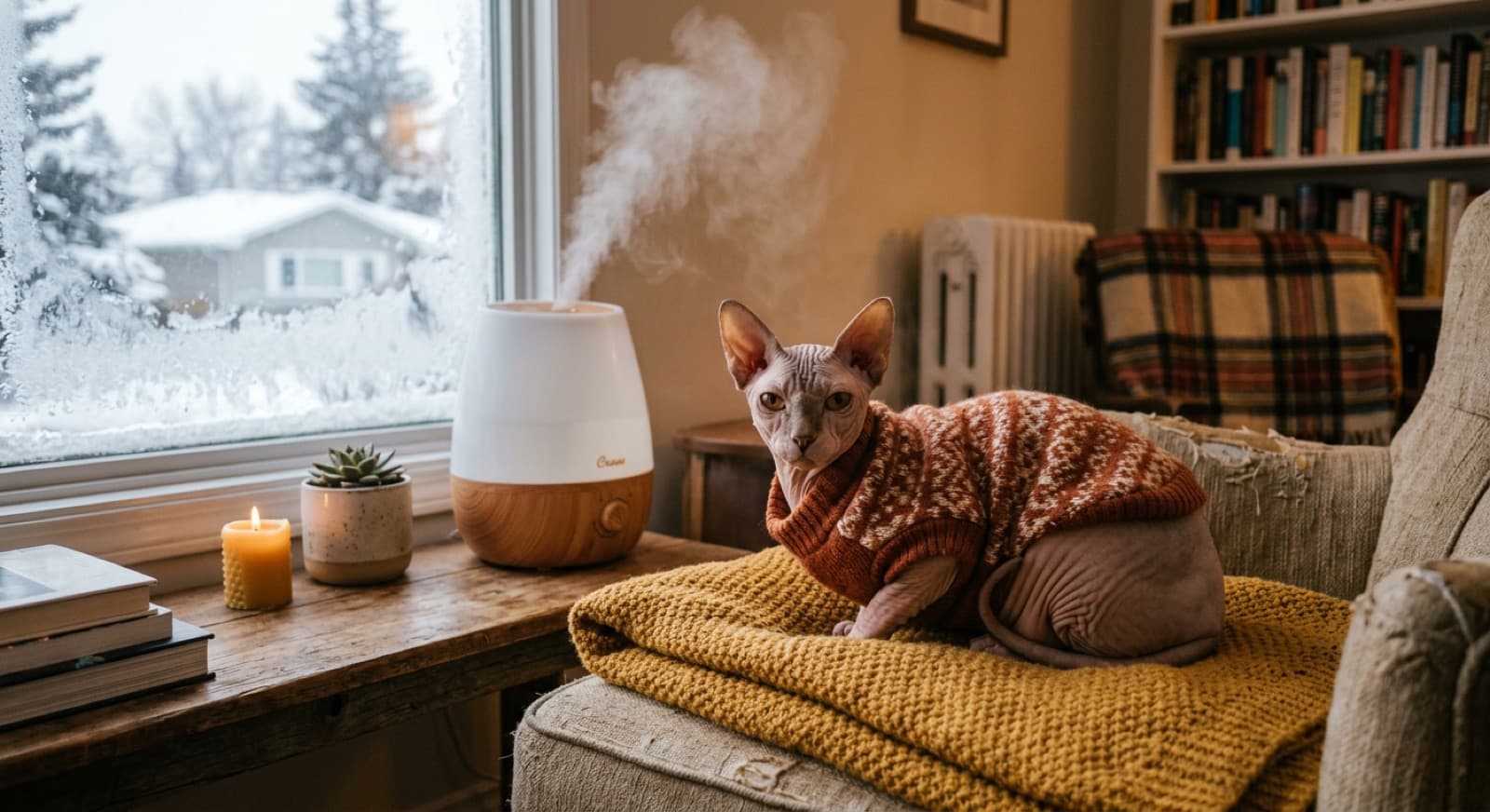
Why Edmonton Sphynx care is harder than Calgary
Three Edmonton-specific factors stack against the Sphynx and require care setups that Calgary owners can sometimes get away with skipping:
Colder winters. Edmonton routinely hits -30C and below, sometimes for weeks at a stretch through January and February. Calgary does too, but chinooks regularly break cold snaps within days. Edmonton chinooks are rarer and less dramatic. A Sphynx in Edmonton experiences more sustained cold than a Sphynx in Calgary, which translates to higher thermostat settings, more sweater-wear, and more time on heated beds.
Drier indoor humidity. Edmonton indoor relative humidity falls to 15 to 25 percent through 5 to 6 months of furnace heat. Calgary is typically 20 to 30 percent. Both are far below the 40 to 50 percent Sphynx skin prefers, but Edmonton is consistently drier. The skin barrier dries faster, eyes get more irritated, and static electricity (which a Sphynx feels acutely because no fur insulates) becomes a constant.
Less daylight. Edmonton receives 7 to 8 hours of daylight in December and January, which affects vitamin D regulation, mood, and energy in cats just as it does in humans. This is less direct a skin issue but affects general Sphynx well-being through the dark months. Full-spectrum daylight bulbs help.
None of these is a reason not to adopt a Sphynx in Edmonton. They are the reason the care setup needs to be more deliberate. An Edmonton Sphynx owner who runs the full protocol below has a cat that thrives. An Edmonton Sphynx owner who skips half of it has a cat that struggles through winter. The Cornell Feline Health Center documents general hairless-cat care considerations that all apply here, with the Edmonton overlay making the indoor environment work harder than in milder climates.
The weekly bathing routine
Sphynx skin produces sebaceous oil normally, but with no fur to absorb it, the oil accumulates on the skin surface. Without regular bathing, the cat becomes visibly greasy within days. By week 2 of skipped bathing, oil marks appear on furniture and bedding. By week 3, yeast and acne develop. Weekly bathing is the baseline.
What you need:
- A gentle cat-safe shampoo without fragrance or sulphates (Earthbath Hypoallergenic, Skout's Honor Probiotic, baby-safe shampoo for backup)
- A non-slip mat for the sink or tub
- Lukewarm water at body temperature (38C)
- Two clean towels (one for rinsing, one for drying)
- A treat the cat values (high-value protein treat)
- A warm dry environment for the immediate post-bath chill (a heated bed nearby is ideal)
The routine:
- Run the water to lukewarm before the cat arrives. Sphynx cool down fast; cold water shocks them.
- Wet the cat thoroughly with the lukewarm water, avoiding the face and inside the ears.
- Apply a small amount of shampoo and work it in gently over the body, paying attention to oil-collection zones (chin, behind ears, armpits, behind elbows).
- Rinse thoroughly. Residual shampoo dries the skin and causes irritation.
- Towel-dry firmly but gently. Get the cat as dry as possible before letting them out of the towel.
- Move the cat directly to a warm spot. A heated cat bed nearby is the gold standard.
- Reward generously with the treat.
Total bath time: 5 to 10 minutes. Most adult Sphynx tolerate the routine well as long as it is consistent. Cats bathed irregularly tend to dislike it more; weekly cats often learn to expect and accept it. Kittens introduced to bathing early adapt better than adults adjusting to a new routine.
The Edmonton dry-air consideration: in deep winter, the post-bath chill is sharper than in milder cities because indoor humidity is so low. Pre-warm the towel by tossing it in the dryer for 5 minutes before bath time. This single touch makes the post-bath experience significantly more comfortable for the cat.
Daily oil-blotting and ear cleaning
Daily oil-blotting. Between baths, oil accumulates fastest in five spots: behind the ears, under the chin, in the armpits, behind the elbows, and around the genital area. A daily pass with a soft microfibre cloth, a clean baby washcloth, or a pet wipe in these zones keeps the cat clean and catches skin issues early. Two to three minutes per day is sufficient. Most Sphynx tolerate it as long as the cloth is warm rather than cold; cold wipes are unpleasant for a cat with no fur.
Weekly ear cleaning. Sphynx ears are large and open, so they collect waxy oil debris faster than a normal cat. Use a cat-safe ear cleaner (Epi-Otic Advanced, Virbac Epi-Otic) on a cotton ball, gently wiping the visible inside of the ear without inserting anything into the ear canal. Brown discharge, redness, smell, head-shaking, or repeated scratching are signs of infection that need a vet visit. Annual wellness visits should include an ear check.
What to watch for between baths:
- Visible greasiness developing faster than usual (may signal hormonal changes or a brewing skin issue)
- Small bumps or scabs forming (acne, urticaria pigmentosa, or yeast)
- Redness or irritation in skin folds
- Unusual smell (yeast infection, often behind the ears or in armpits)
- Dandruff or flaking (often Edmonton-winter dryness, but persistent flaking is a vet conversation)
Most of these resolve with consistent skincare. Persistent or worsening signs are a vet visit because they can progress to bacterial or yeast infection requiring prescription treatment. Discuss specifics with your Edmonton veterinarian.
The four-weight sweater wardrobe
One sweater is not enough for Edmonton. The temperature differential across the city's winter calendar runs from a manageable -5C indoor-21C day to a brutal -35C cold snap with the thermostat held at 20C to control heating bills. Different days need different sweater weights. Four is the practical minimum:
| Weight | When | Cost range |
|---|---|---|
| Light cotton | Indoor temperature 21 to 22C. Mild winter days, transition months (October, April). | $15 to $25 |
| Fleece | Indoor temperature 19 to 21C. Most Edmonton winter days from November through March. | $20 to $35 |
| Knitted wool | Indoor temperature below 19C, cold snaps -25C and colder, evening hours when thermostats drop. | $30 to $50 |
| Back-up (any weight) | Always one in the wash, so the cat is never without a clean sweater. | $15 to $50 |
Sizing matters. Too tight restricts movement and breathing. Too loose snags on furniture and slips off. Measure your cat's neck circumference, chest circumference (just behind the front legs), and back length (base of neck to base of tail) before ordering. Cat-specific sweater brands (Kitty Knitty, Hot Dog Collars sized for cats) fit better than dog sweaters scaled down because the body proportions are different.
What to avoid: sweaters with dangling threads (catch on furniture), loose buttons or zippers (chewed and swallowed), heavy embellishments (uncomfortable on Sphynx skin), and anything labelled “dry clean only” (you will wash these multiple times a week).
Most Edmonton Sphynx owners spend $80 to $200 in the first year on a full sweater wardrobe, then $40 to $100 per year on replacements as sweaters wear out from frequent washing.
Heated cat beds: placement and safety
Heated cat beds let a Sphynx self-thermoregulate by moving to a warm spot when needed. Multiple beds in different rooms are better than one because the cat's preferred warm spot shifts with where you are in the home, the time of day, and the sun pattern.
Choose low-watt cat-specific beds. K&H Pet Products, ThermoKitty, and Aspen Pet make low-wattage heated beds rated for cats (typically 4 to 6 watts). Avoid high-watt beds intended for outdoor or kennel use; they can burn Sphynx skin. The cat will not move away because it loves the warmth, so the bed surface must stay safe even if the cat naps for hours.
Watch the surface temperature. Check your bed weekly with the back of your hand. If it feels uncomfortably warm to you, it is too warm for the cat. Most low-watt beds run at body temperature (38C); any hotter than that is too hot.
Placement strategy. Place one bed in the living room or main social space, one in the bedroom near your bed, and ideally one in the home office or wherever else you spend long stretches. The cat will choose. Avoid placement near drafty windows, air vents that blow directly on the bed, or sunny spots that cause overheating during peak sun hours.
Replacement schedule. Heated beds use heating elements that wear unevenly over years. Replace every 2 to 3 years even if the bed seems to work, because internal hot spots can develop without surface signs. The cost ($30 to $80 per bed) is small compared to the risk of a thermal injury.
Power cord safety. Sphynx are notoriously inquisitive and will chew cords. Run cords through cord protectors, behind furniture, or under rugs where they are inaccessible. Unplug when not in use during summer months.
The Edmonton humidifier strategy
This is the Edmonton-specific section that matters most. Calgary Sphynx owners can sometimes skip the humidifier in winter; Edmonton owners cannot. The indoor humidity differential is real: Calgary tends to run 20 to 30 percent indoor humidity through furnace season, while Edmonton tends to run 15 to 25 percent. Both are below the 40 to 50 percent Sphynx skin prefers, but Edmonton is the meaningfully drier of the two.
Why low humidity matters for Sphynx specifically. Dry indoor air does three things to a cat with no fur:
- Skin barrier dries faster, increasing risk of flaking, cracking, and irritation
- Eyes get more irritated because Sphynx have prominent eyes that benefit from ambient moisture
- Static electricity (which a furred cat barely notices but a Sphynx feels acutely) becomes a constant. Hand-petting at low humidity sometimes generates audible static shocks that startle the cat.
The setup. A cool-mist humidifier in the main living room ($60 to $120) makes a measurable difference. Many Edmonton Sphynx owners run two humidifiers (main room plus bedroom) and refill them daily during the deepest winter. A hygrometer ($15) lets you measure actual humidity rather than guess; target 40 to 50 percent in the rooms the cat spends time in.
Models to consider. Cool-mist (not warm-mist, which can scald). Larger tanks last longer between refills. Filters are easier to maintain than ultrasonic models that get mineral buildup. Honeywell HCM-350, Vicks Filter-Free, and Levoit Classic 200 are owner-favourite options in Edmonton Sphynx communities.
Water choice. If your Edmonton tap water is mineral-heavy (which varies by neighbourhood), use distilled water or descale regularly. Mineral buildup damages humidifier components and can release fine mineral dust into the air.
Maintenance. Empty and refill daily. Clean weekly to prevent mould or bacterial growth. Replace filters per the manufacturer schedule. A poorly-maintained humidifier becomes a health hazard rather than a help.
The cost: $60 to $250 in humidifier equipment first year, plus filters, plus the modest increase in your electricity bill. Total: $80 to $300 per year ongoing for two humidifiers running through Edmonton winter. This is part of the breed's real Edmonton cost.
UV-blocking window film: solar dermatitis prevention
Indoor Sphynx are at real risk of solar dermatitis from sun exposure through south-facing windows. Over years, repeated exposure progresses to squamous cell carcinoma on the ears, nose, and back. This is one of the breed-specific risks that adopters most often miss because indoor exposure feels safe.
The biology: window glass blocks UVB (the sunburn wavelength) but lets UVA through. UVA penetrates the skin and causes long-term damage including DNA changes that lead to skin cancer. The American Veterinary Medical Association (AVMA) recognises solar dermatitis as an established veterinary risk for hairless and light-skinned cats with chronic indoor sun exposure. A Sphynx napping in a sunny south-facing window for hours a day is being exposed to UVA continuously.
The fix. UV-blocking window film ($30 to $80 per window) applied to south-facing windows where the cat spends time. The film is essentially transparent, blocks UVA effectively, and is rated for years of life. Most Edmonton homes have one or two south-facing windows that get enough sun to matter; treating those is enough.
Alternative or supplemental strategies.
- Position cat beds away from south-facing windows during peak sunlight hours
- Use blinds or curtains to filter direct sun during the brightest part of the day
- Annual vet visits should include a skin check, especially on the ears and nose where sun damage shows first
For Edmonton specifically, summer months (June, July, August) bring 16 to 17 hours of daylight, which is when UVA exposure peaks. Window film matters more in those months than in deep winter when daylight is limited. But the film stays on year-round because skin damage accumulates whenever the sun is up.
Browse adoptable Sphynx in Edmonton
Adult Sphynx from Alberta Sphynx Rescue arrive in Edmonton homes with skincare routines already established in foster care, so you inherit a working system rather than building one from scratch. The Edmonton volunteer presence since 2022 means real coordination capacity in the city.
See Available Cats in Edmonton →The annual Edmonton-winter cost premium
Owning a Sphynx in Edmonton costs measurably more than owning one in Calgary, and meaningfully more than owning one in milder Canadian cities. The Edmonton-specific premium runs $700 to $1,400 per year above baseline Sphynx ownership:
| Edmonton-specific line item | Typical annual cost |
|---|---|
| Increased home heating bill (thermostat 1-2C higher through 5-6 months) | $300 to $600 |
| Humidifier electricity and filters (2 units typical) | $80 to $180 |
| Sweater wardrobe replacement (more wear from frequent washing in dry air) | $60 to $150 |
| Skincare product top-up (low humidity uses more moisturising shampoos) | $60 to $120 |
| Heated bed power consumption (longer use hours through Edmonton winter) | $40 to $100 |
| Vet visits for winter-related skin issues (when they happen) | $100 to $300 |
| Total Edmonton-winter premium | $700 to $1,400 |
This is on top of the baseline $1,800 to $3,000 annual Sphynx care cost. Combined, an Edmonton Sphynx household budgets $2,500 to $4,400 per year on the cat. That is the honest math. Adopters who underestimate this often surrender within 18 months because the budget did not absorb the winter premium.
For households that plan for it, the cost is manageable and the cat thrives. The Sphynx surrenders at Alberta Sphynx Rescue and the generalist Edmonton rescues are almost always from households that did not plan for it.
The seasonal calendar
Edmonton Sphynx care shifts across the year. Here is the rough seasonal map:
October to April (winter season). Humidifiers running daily. Sweaters in rotation. Heated beds in use. UV-film matters less because daylight is short. Indoor humidity often below 25 percent; target 40 to 50 percent in cat-occupied rooms via humidifier. Watch for dry-skin issues. Weekly bathing maintained.
May (shoulder season). Humidifiers transition to as-needed. Sweaters reduced to light cotton only. Heated beds still useful overnight. UV-film matters more as daylight increases. Weekly bathing maintained.
June to August (summer season). Humidifiers off or as-needed. Sweaters off. Heated beds off or summer-stored. UV-film matters most. Watch for sunburn risk through south-facing windows. Catio time during warmest weeks if you have a secure enclosed patio. Weekly bathing maintained or slightly more frequent if cat is more active.
September (shoulder season). Humidifiers transition back on as furnace starts. Sweaters return (light cotton). Heated beds back in rotation. UV-film matters less. Weekly bathing maintained.
This calendar assumes a typical Edmonton year. Climate variability (extended chinooks, deep cold snaps, unusual humidity) shifts the timing by weeks in either direction. Trust your cat's signals: shivering means add a sweater layer; flaking means raise the humidifier output; overheating on a bed means turn the bed off or lower the setting.
Frequently Asked Questions
How often does a Sphynx need a bath?
Once a week is the standard cadence for most adult Sphynx in Edmonton, with some cats tolerating slightly less (every 10 to 14 days) and others needing more (every 5 days, especially active or oily-skinned individuals). The reason is sebaceous oil. Sphynx skin produces oil normally, but with no fur to absorb it, the oil accumulates on the skin surface. Without regular bathing, the cat becomes visibly greasy, leaves oil marks on furniture and bedding, and develops yeast or acne. Edmonton dry winter (15 to 25 percent indoor humidity through 5 to 6 months of furnace heat) can shift this slightly toward less frequent baths because oil production sometimes drops in low humidity, but the weekly baseline is still the safe starting point. Adjust based on your specific cat's oil pattern.
What shampoo should I use for a Sphynx?
A gentle cat-safe shampoo without fragrances, parabens, or harsh detergents. The most-recommended options in Sphynx owner communities are Earthbath Hypoallergenic Cat Shampoo (fragrance-free), Skout's Honor Probiotic Pet Shampoo, and gentle baby-safe shampoos like Aveeno Baby for backup. The shampoo needs to clean oil effectively without stripping the skin so completely that oil production rebounds. Avoid human shampoos with harsh sulphates, anything medicated unless your vet specifically recommends it, and anything heavily fragranced. If your cat develops dry skin or dandruff, switch to a more moisturising formula. If yeast or acne is recurrent, ask your vet about a chlorhexidine-based shampoo (typically prescription-only). Discuss specifics with your Edmonton veterinarian.
How do I bathe a Sphynx without freaking the cat out?
Start young (kitten exposure is best), use lukewarm water (38C is ideal, body temperature of a Sphynx), keep baths short (5 to 10 minutes), use a non-slip mat in the sink or tub, talk calmly throughout, and reward generously after with high-value treats. Most Sphynx tolerate baths well as a routine, though few enjoy them. The cat should be towel-dried thoroughly and immediately wrapped in something warm (a clean dry towel, a blanket, a sweater) because the post-bath chill in an Edmonton winter home with 15 to 25 percent humidity is real and uncomfortable for the cat. A heated cat bed nearby for post-bath recovery is genuinely helpful. Some owners do baths in the bathroom sink for size, others prefer the laundry tub. The cat will signal which it tolerates better.
Do I need to clean a Sphynx's ears?
Yes, weekly is the standard cadence. Sphynx have large open ears with no fur to filter dust or oil, so the inside of the ear collects waxy oil debris faster than a normal cat. Use a cat-safe ear cleaner (Epi-Otic Advanced, Virbac Epi-Otic, or similar) on a cotton ball, gently wiping the visible inside of the ear without inserting anything into the ear canal. Once a week is plenty for most cats. If you notice excessive brown discharge, redness, smell, head-shaking, or the cat scratching at the ear repeatedly, see your vet because yeast or bacterial infections are common. Annual wellness visits should include an ear check.
How do I do daily oil-blotting?
A few minutes a day with a soft microfibre cloth, a clean baby washcloth, or a pet wipe. Focus on areas where oil accumulates fastest: behind the ears, under the chin, in the armpits, behind the elbows, and around the genital area. Wipe gently, replace or rinse the cloth, and check for any unusual smell, redness, or scabbing as you go. Daily oil-blotting reduces the need for bathing slightly and catches skin issues early. Most Sphynx tolerate it as long as the cloth is warm rather than cold. Cold wipes are unpleasant for a cat with no fur.
When does my Sphynx need a sweater?
When the room temperature drops below 22C, or when the cat shows shivering, hunching, or refusing to leave a heated spot. Edmonton homes often run at 20 to 21C through winter to manage heating bills, which is below Sphynx comfort. Most Edmonton Sphynx owners keep at least four sweaters in rotation: a light cotton for mild days, a fleece for normal winter days, a knitted wool for cold snaps, and a back-up while one is in the wash. Sizing matters: too tight restricts movement and breathing, too loose snags on furniture and slips off. Cat-specific sweater brands (Kitty Knitty, Hot Dog Collars) fit better than dog sweaters scaled down.
Are heated cat beds safe for Sphynx?
Yes, with one caveat: choose a low-watt cat-specific heated bed and check the surface temperature regularly. Sphynx have no fur to insulate against thermal injury, and a heated bed at too high a setting can cause skin burns; the cat will not move away because it loves the warmth. Use beds rated for cats specifically (K&H Pet Products, ThermoKitty, similar) at low or medium settings. Place multiple heated beds in different rooms so the cat can self-thermoregulate. Check the bed surface with your hand weekly; if it feels uncomfortably warm to you, it is too warm for the cat. Replace beds every 2 to 3 years as the heating element ages unevenly.
Do I need a humidifier for a Sphynx in Edmonton?
Strongly recommended. Edmonton indoor relative humidity falls to 15 to 25 percent through 5 to 6 months of furnace heat, which is meaningfully drier than Calgary and significantly drier than the 40 to 50 percent humidity Sphynx skin prefers. Low humidity causes flaking, increases static, irritates eyes (Sphynx have prominent eyes that benefit from moisture), and can worsen winter skin issues. A cool-mist humidifier in the main living room ($60 to $120) makes a measurable difference. Many Edmonton Sphynx owners run two humidifiers (main room plus bedroom) and refill them daily during the deepest winter. Watch for hard-water mineral deposits if your tap water is mineral-heavy; distilled water or regular descaling extends humidifier life.
Should I put UV-blocking film on my windows?
Yes, on any south-facing windows where the cat spends time. Sphynx skin is at real risk of solar dermatitis from sun exposure through indoor windows, which over years progresses to squamous cell carcinoma on the ears, nose, and back. The risk is the same indoor as outdoor because window glass blocks UVB but lets UVA through. UV-blocking window film ($30 to $80 per window) blocks UVA and reduces this risk. Most Edmonton homes have one or two south-facing windows that are sunny enough to matter; treating those is enough. Alternative: position cat beds away from south-facing windows during peak sunlight hours.
How do I prevent skin acne in a Sphynx?
Three things: keep the bathing routine consistent (weekly), wipe oil daily from the chin and behind the ears (where acne clusters), and use stainless steel or ceramic food and water bowls (not plastic, which harbours bacteria). Feline acne shows up as small black or red bumps under the chin, sometimes progressing to crusty scabs or hair loss. Mild cases respond to consistent skincare and bowl changes. Persistent or severe acne is a vet visit because it can progress to bacterial or yeast infection requiring prescription treatment. The bowl-material change is the single highest-impact one-time fix; many owners are surprised at how much chronic chin acne resolves with that swap.
Do Sphynx get cold in Edmonton even with sweaters and heat?
Yes, especially during -30C cold snaps when even well-heated homes have draft zones near windows and exterior doors. The cat will signal cold by shivering, hunching, seeking out heated spots persistently, refusing to leave a sweater, or curling into very tight balls. Mitigations: heated cat beds in multiple rooms, draft-blocking around exterior doors and basement-window areas, blankets the cat can burrow under, and willingness to bump the thermostat up by 1 or 2 degrees during the worst stretches. Edmonton Sphynx owners who have been through several winters often run their thermostat 1 to 2 degrees higher than they would for a haired cat, which is part of the breed's real ongoing cost.
Can I take my Sphynx outside in summer?
Briefly and with supervision only, never as an unsupervised outdoor cat. Sphynx are strictly indoor cats in Edmonton because of river-valley coyotes (Mill Creek Ravine, Whitemud, Capilano, Hawrelak), traffic, theft risk, and the cat's lack of fur to handle even mild outdoor exposure. A secure catio (enclosed outdoor patio) is the gold standard for outdoor air access during Edmonton's warmest 8 to 10 weeks of the year (mid-June to late August). Direct sun exposure during peak hours risks sunburn even in a catio, so partial shade is essential. Some Edmonton Sphynx tolerate harness walks in calm shaded areas during warm months, but this is individual and not universal. Outdoor exposure in winter is never appropriate, even with sweaters.
Sphynx Adoption Edmonton
Rescue vs breeder, real costs, waitlists, and the buy-vs-adopt math for Edmonton.
Sphynx Health Issues Edmonton
HCM, CMS, juvenile dental disease, urticaria pigmentosa, and the Edmonton specialty cardiology referral pathway.
Sphynx Scam Avoidance Edmonton
The 2016 Alberta shaved-kitten scam case, the under-$1,000 red zone, and the 7-day wait test.
Indoor vs Outdoor Cats Edmonton
Why Edmonton indoor cats live 12-18 years and outdoor cats average 3-5, plus the river-valley coyote reality.