The short answer
Ragdolls typically live 12 to 16 years with proactive care, and healthy individuals reach 18 years or beyond. The breed carries elevated risks for hypertrophic cardiomyopathy (HCM), feline lower urinary tract disease, and to a lesser extent polycystic kidney disease (PKD). HCM is the dominant concern, and the critical thing to know is that Ragdoll HCM is both genetic AND acquired. The DNA test catches one specific mutation; an echocardiogram catches the condition itself. Annual echocardiograms from age 5 onwards are the gold standard regardless of DNA status. Many Calgary vets see only a handful of Ragdolls per year, so knowing what to ask for is part of being a responsible owner.
Informational only, not veterinary advice. Always consult your Calgary veterinarian for individualised guidance on your specific cat.
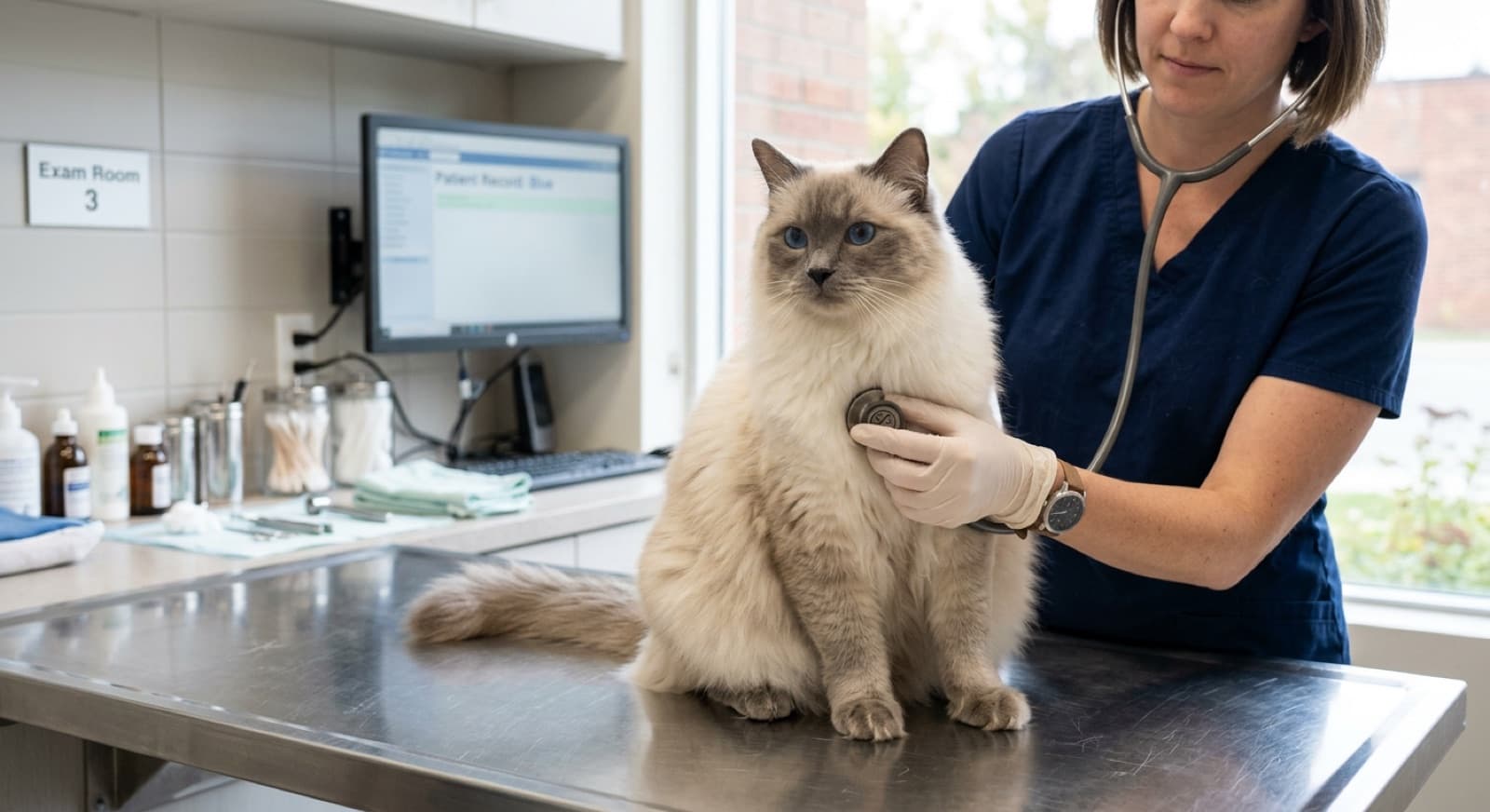
This article is informational only and is not veterinary advice. Always consult your Calgary veterinarian for individualised health guidance for your specific cat. Ragdolls are a breed with documented genetic and acquired health risks. Proactive screening from ethical breeders and ongoing veterinary care from a qualified veterinarian are essential. No medication, dosage, or treatment protocol is recommended on this page. Those decisions belong entirely with your veterinary team.
Sources informing this article include the UC Davis Veterinary Genetics Laboratory, the American College of Veterinary Internal Medicine (ACVIM), the Cornell Feline Health Center, the Winn Feline Foundation research summaries, and the Cat Fanciers' Association breed health guidance. Treatment specifics still belong with your Calgary veterinarian.
The Ragdoll vet preparedness gap
This is the part of Ragdoll ownership most adopters do not anticipate. The Ragdoll is a relatively uncommon breed in Calgary general-practice rotation, and many veterinarians see only a handful per year. Breed-specific HCM screening protocols, the DNA-versus-echocardiogram distinction, and the urinary risk profile are not always front-of-mind. As an owner, knowing what to ask for is part of the job.
Calgary owners often report that when they raise Ragdoll-specific concerns, responses range from genuinely engaged to dismissive. A vet who says “Ragdolls are not really different from other cats” is not wrong about general feline medicine, but the breed-elevated HCM risk and the specific screening cadence are real. The right conversation is not adversarial. It is informed.
Useful questions to ask your Calgary veterinarian:
- Are you familiar with Ragdoll-specific HCM screening protocols?
- What is your auscultation approach for a Ragdoll at routine exams?
- At what age would you recommend a baseline echocardiogram for my Ragdoll?
- If you hear a murmur, who do you refer to for cardiology?
- Do you have a recommended urinalysis cadence for an adult Ragdoll?
A vet who engages thoughtfully with these questions is the right partner. A vet who waves them off is a reason to ask for a cardiology referral directly, or seek a second opinion. The specialty centres in Calgary, particularly Western Veterinary Specialist Centre and VCA Canada West Veterinary Specialists, handle Ragdoll cardiology routinely. Your general-practice vet refers you in.
If you are still in the adoption-decision phase, our companion guide on Ragdoll adoption in Calgary covers the rescue landscape, real costs, and waitlists. The Ragdoll scam avoidance guide covers verification of breeder claims, including HCM testing records.
HCM (hypertrophic cardiomyopathy): the dominant health concern
HCM is the most-discussed Ragdoll health issue for good reason. It is the most common heart condition in cats overall, Ragdolls carry a documented elevated breed risk, and the condition can be both inherited and acquired. Every Calgary Ragdoll owner should understand the difference between the DNA test and an echocardiogram before they get either one.
Hypertrophic cardiomyopathy is a disease in which the wall of the left ventricle (the main pumping chamber of the heart) thickens abnormally. As the muscle thickens, the chamber holds less blood and the heart has to work harder. In some cats this stays mild for years. In others it progresses to congestive heart failure or to a sudden blood clot (thromboembolism) that often paralyses the rear legs. In the worst cases, sudden cardiac death is the first sign.
Ragdolls are one of several cat breeds with documented elevated HCM risk. The condition has been identified in many breeds and in mixed-breed cats, so this is not Ragdoll exclusive. What sets the Ragdoll situation apart is that the breed carries a known specific genetic mutation (often referred to as the Ragdoll-type HCM mutation, sometimes called HCM2) AND the condition develops in Ragdolls without that mutation.
Ragdoll HCM: genetic AND acquired
This is the part Calgary owners most often misunderstand, and it has real consequences. The Ragdoll HCM DNA test detects one specific mutation. A cat that tests negative for that mutation is at lower genetic risk from THAT specific cause. But:
- Other genetic mutations can cause HCM (some not yet identified or tested for)
- HCM also develops in cats without any known genetic trigger
- A negative DNA test does NOT mean a Ragdoll is HCM-safe for life
This is why the gold-standard recommendation for Ragdolls is annual or periodic echocardiograms from age 5 onwards regardless of DNA status. The DNA test is a useful pre-breeding screen for ethical breeders, not a substitute for cardiac imaging in the individual cat over its lifetime.
The DNA test versus the echocardiogram
| Tool | What it does | What it does NOT do |
|---|---|---|
| Ragdoll HCM DNA test | Detects the Ragdoll-type HCM mutation in the cat's DNA. Available through commercial labs such as the UC Davis Veterinary Genetics Laboratory. | Does not detect other HCM-causing mutations. Does not detect acquired HCM. A negative DNA test does NOT mean the cat will never develop HCM. |
| Echocardiogram | A live ultrasound of the heart, performed by a veterinary cardiologist. Visualises the heart muscle and measures thickening in real time. Detects HCM regardless of genetic cause. | Snapshot in time. A normal echo today does not guarantee a normal echo at age 8. Cardiologists usually recommend periodic rechecks for breeds at risk. |
In plain language: a clean DNA test is reassuring but not a clean bill of heart health. An echocardiogram is the gold-standard diagnostic. Ethical Ragdoll breeders do both: DNA test breeding cats, and run annual echocardiograms on parents before each litter. Cats that pass both should still produce kittens that get echocardiograms periodically through life.
For Calgary rescue Ragdolls (or Ragdoll mixes), the DNA test may be less informative since parental ancestry is unknown. The practical screening tool is veterinary auscultation at routine exams, followed by an echocardiogram referral if your vet hears a murmur or if you want a baseline. Discuss the right approach with your Calgary veterinarian.
HCM symptoms to watch for at home
HCM can be silent for years. When symptoms appear, the most common ones are:
- Increased respiratory rate at rest (a sleeping cat should breathe 15 to 30 times per minute; persistently faster is a vet call)
- Lethargy or hiding when the cat is usually social (a notable change for a Ragdoll, given the breed's typical attachment behaviour)
- Decreased appetite
- Sudden weakness, fainting, or collapse
- Sudden rear-leg paralysis (this can indicate a saddle thrombus, a blood clot that lodges where the aorta divides; it is a same-day Calgary 24-hour emergency)
- Open-mouth breathing or laboured breathing (always urgent in a cat)
Any of the above warrants a call to your veterinarian. Open-mouth breathing in a cat is an emergency. Drive to a Calgary 24-hour emergency vet rather than wait until morning.
Diagnosis and management
Diagnosis starts with a routine veterinary exam where the vet listens to the heart with a stethoscope. A heart murmur is not itself a diagnosis of HCM (many cats have benign or stress-related murmurs), but it is a reason for further workup. The definitive diagnostic is an echocardiogram performed by a veterinary cardiologist. Your Calgary general-practice vet may refer to Western Veterinary Specialist Centre or VCA Canada West Veterinary Specialists for this.
Management of HCM is entirely vet-directed. There are several treatment approaches in feline cardiology, and what is appropriate depends on the stage of disease, the individual cat, and other health factors. No medication, dosage, or treatment protocol is recommended on this page. Your veterinary cardiologist makes those decisions in partnership with you.
Polycystic Kidney Disease (PKD)
PKD is far more associated with Persian cats than Ragdolls, but it has been documented in Ragdoll lines and is worth mentioning. It is a dominant genetic condition in which cysts form in the kidneys and gradually compromise kidney function. The DNA test is widely available; ethical breeders test for it as part of standard pre-breeding screening.
Symptoms appear later in life and look like any chronic kidney disease: increased thirst, increased urination, weight loss, and decreased appetite. Diagnosis combines DNA testing, ultrasound, and routine bloodwork. Management of established chronic kidney disease is vet-directed and includes dietary changes and bloodwork monitoring.
For a Calgary Ragdoll owner, the practical takeaway: PKD is a lower-probability concern than HCM or urinary issues, but annual bloodwork from middle age onward catches early kidney decline before symptoms appear. Discuss screening with your veterinarian.
FIP (Feline Infectious Peritonitis)
FIP is not Ragdoll-specific. It can affect any cat, and young cats (under 2 years old) are most vulnerable. FIP is a viral disease that arises from a mutation of the feline coronavirus, and it has historically been one of the most heartbreaking diagnoses in feline medicine.
Treatment options have evolved in recent years, but the regulatory status of FIP-specific antiviral therapy varies by country and changes over time. Calgary owners suspecting FIP in their cat should go directly to their veterinarian rather than seek treatment information online, since specific drugs, dosages, and access routes are decisions only a licensed veterinarian can make. Your vet may refer to a feline internal medicine specialist for diagnosis and treatment planning.
The Ragdoll cattery FIP question: Ragdolls from group-housing environments (catteries, multi-cat rescues) may have had higher coronavirus exposure than single-cat-household kittens. Some catteries have had documented FIP outbreaks, which is one reason to verify a breeder's health history transparently before purchase. For Calgary rescue Ragdolls, this is a question worth asking the rescue and a topic to discuss with your Calgary veterinarian at the first wellness visit.
Bladder and urinary issues (FLUTD)
Feline lower urinary tract disease (FLUTD) is a documented elevated risk in Ragdolls. The umbrella term FLUTD covers several conditions: idiopathic cystitis (bladder inflammation without an identifiable cause, often stress-linked), bladder stones, urinary crystals, and bacterial urinary tract infections. The shared feature is inflammation and irritation of the lower urinary tract.
Symptoms a Calgary owner might notice:
- Straining to urinate (cat sits in the litter box but produces little or nothing)
- Frequent small trips to the litter box
- Blood in the urine
- Urinating outside the litter box (often on cool, smooth surfaces like bathtubs or tile)
- Excessive grooming of the genital area
- Vocalising or appearing distressed while in the litter box
A male cat that is straining and unable to urinate is a same-day Calgary 24-hour emergency. Urinary blockage in male cats can become life-threatening within 24 to 48 hours. Drive to a 24-hour emergency clinic rather than wait.
Diagnosis combines urinalysis, urine culture, imaging (radiograph or ultrasound) for stones, and sometimes bloodwork. Management depends on the specific underlying cause and is entirely vet-directed.
What an owner can do day to day:
- Feed wet food (higher water content supports urinary health)
- Provide multiple clean water sources around the home
- Keep the litter box scrupulously clean (Ragdolls are particular about this)
- Reduce environmental stress where possible
- Watch litter box behaviour daily and act fast on changes
Annual urinalysis from middle age onward is worth discussing with your Calgary veterinarian, particularly if your Ragdoll has had any prior urinary episode. Recurring FLUTD is one of the cost categories pet insurance is most useful for.
Common Calgary adopter scenarios
Health questions look different depending on how a Ragdoll ends up in your home. Here is how the screening conversation typically goes for the four common scenarios in Calgary:
| Scenario | Practical first steps |
|---|---|
| Rescue cat with unknown history | Full week-1 wellness exam at your Calgary vet. Auscultation. Baseline bloodwork and urinalysis. Discuss whether an echocardiogram referral makes sense. |
| Adopted retired breeder cat | May have records. Ask for them. DNA test results, prior echocardiogram reports, vaccination history, dental records all matter. Bring them to your vet. |
| “Ragdoll mix” from Kijiji or a free rehoming | No genetic testing has been done. Treat as unknown history. Same week-1 plan, plus a frank conversation with the previous owner about any signs noticed. |
| Young Ragdoll from a breeder | Verify DNA testing was done on both parents. Ask to see test certificates and prior cardiology reports. Ethical breeders provide these without hesitation. |
In every scenario, the foundation is the same: build a relationship with one Calgary veterinary clinic, do annual wellness exams without skipping, and let your vet decide when specialty referral is warranted.
Browse adoptable Ragdolls in Calgary
Health-aware adoption is achievable. Calgary rescue cats are vet-checked at intake, and ongoing specialty care is well-supported through clinics like Western Veterinary Specialist Centre. Live Ragdoll and Ragdoll-mix listings from Calgary rescues, updated regularly.
See Available Ragdolls →Calgary specialty vet directory
Cardiology and internal medicine for Ragdolls usually involve referral from your general-practice vet to a specialty centre. The Calgary clinics that handle these workups:
| Clinic | Services relevant to Ragdolls |
|---|---|
| Western Veterinary Specialist Centre | Cardiology (echocardiogram), internal medicine, imaging. Referral from your general-practice vet typically required. |
| VCA Canada West Veterinary Specialists | Cardiology, internal medicine, imaging, emergency. Open 24 hours for emergencies. |
| Calgary Pet Wellness & Spay/Neuter Clinic | Affordable wellness exams, vaccines, spay/neuter, basic diagnostics. A practical first stop for routine care when budget is a concern. Refers out for specialty work. |
Your relationship with one general-practice clinic matters more than picking the “best” one. A vet who knows your cat's baseline catches subtle changes that a one-time specialist visit misses. The specialist comes in when something specific is needed.
Pet insurance ROI for Ragdolls
Pet insurance is usually worth strong consideration for a Ragdoll because the breed's elevated health risks can produce real cost over a lifetime. A few directional figures to plan around (these are 2026 Calgary estimates, not quotes from any specific provider):
- HCM workup and lifetime management can run several thousand dollars depending on stage and treatment approach
- Annual cardiology echocardiogram at a Calgary specialty centre: typically $300 to $500
- Recurring FLUTD care, including diagnostics and prescription urinary diet, can add hundreds per year
- Emergency visit for suspected saddle thrombus, urinary blockage, or open-mouth breathing: easily $1,500 to $3,000 for one night
The lever that matters most is enrolling early. Every Canadian pet insurance provider excludes pre-existing conditions. A Ragdoll kitten enrolled before any diagnosis qualifies for the broadest coverage. A cat enrolled at age 5, after a heart murmur is detected or a urinary episode is recorded, has that condition excluded indefinitely.
Compare providers directly on what they cover (annual limits, deductibles, hereditary-condition exclusions, cardiology coverage, urinary coverage). This page deliberately does not name a specific provider because the right policy depends on your budget and risk tolerance. Read the fine print on hereditary-condition coverage in particular, since some lower-tier policies exclude HCM as a breed-typical condition.
Annual screening cadence for Calgary Ragdoll owners
The realistic schedule for a healthy Ragdoll, to discuss and adjust with your Calgary veterinarian:
| Life stage | Suggested vet contact |
|---|---|
| Year 1 (kitten / new adopt) | Full wellness exam, vaccines, parasite prevention, baseline bloodwork, urinalysis, dental check, body condition baseline. Discuss whether a baseline echocardiogram is appropriate. |
| Years 2 to 4 | Annual exam, annual bloodwork, vaccines per schedule, body condition tracking, dental exam, attention to litter box behaviour. |
| Age 5 onwards | Consider annual echocardiogram regardless of DNA status. Annual urinalysis. Continue annual exam and bloodwork. |
| Age 7 and older | Annual or semi-annual exams. Senior bloodwork panel including kidney function. Dental cleaning under anaesthesia at vet's recommendation. Echocardiogram cadence increases. |
This is a template, not a prescription. Your Calgary veterinarian adjusts the cadence based on your individual cat, what they hear at routine exams, and any genetic or health history you can provide.
The other half of health is at-home observation. A cat's owner sees them daily and catches the subtle changes a vet exam every 12 months can miss. Watch for changes in breathing rate at rest, appetite, water intake, litter box habits, grooming, weight, and energy. If something feels off, call your vet rather than wait.
The Ragdoll lifespan question
Lifespan is one of the most-asked Ragdoll questions on rescue forums and the one most clouded by emotion. The honest reality:
- Average Ragdoll lifespan is 12 to 16 years
- Healthy Ragdolls routinely reach 18 years or beyond
- HCM is the leading cause of premature death in the breed
- Larger cats (Ragdoll, Maine Coon) average slightly shorter lifespans than smaller Domestic Shorthairs, but the gap is small with good care
- Indoor-only lifestyle, weight management, dental care, and annual screening pull individual cats toward the upper end of the range
The owners we see whose Ragdolls live longest share a pattern: they picked one Calgary veterinary clinic and stayed loyal, they did not skip annual exams when nothing seemed wrong, they took breathing changes and litter box changes seriously, and they made the cardiology referral when their vet suggested it. None of that requires panic. It requires consistency.
Frequently Asked Questions
What is HCM in Ragdolls?
Hypertrophic cardiomyopathy (HCM) is a thickening of the heart muscle that restricts blood flow and forces the heart to work harder. It is the most common heart condition in cats overall, and Ragdolls carry a documented elevated breed risk. Symptoms can stay subtle for years: lethargy, hiding, faster breathing at rest, or in worst cases sudden collapse. Diagnosis requires an echocardiogram performed by a veterinary cardiologist. Management is entirely vet-directed. Discuss any symptoms or risk concerns with your Calgary veterinarian.
Is Ragdoll HCM both genetic AND acquired?
Yes, and this is the critical distinction many owners miss. Ragdolls have a known breed-specific genetic mutation (often called HCM2 or the Ragdoll-type HCM mutation) that can be DNA tested. But HCM also develops in Ragdolls without that mutation, from other genetic causes or non-genetic factors. A cat that tests negative for the breed-specific Ragdoll HCM mutation can still develop HCM later. This is why annual echocardiograms in adulthood are the gold standard regardless of DNA status. Discuss the right screening approach with your Calgary veterinarian.
What is the difference between the HCM DNA test and an echocardiogram?
These tools answer different questions. The DNA test (available through labs like the UC Davis Veterinary Genetics Laboratory) screens for one specific Ragdoll HCM mutation. A negative result only means the cat does not carry that one mutation. An echocardiogram is a live ultrasound of the heart muscle performed by a veterinary cardiologist. It detects HCM in real time regardless of genetic cause. A cat with a negative DNA test can still develop HCM from other causes. Ethical Ragdoll breeders do both: DNA test parents and run annual echocardiograms on breeding cats.
At what age should a Ragdoll get an echocardiogram?
There is no single correct answer for every cat, and this is a decision to make with your Calgary veterinarian. Many cardiologists suggest a baseline echocardiogram in young adulthood for breeds with elevated HCM risk, and periodic rechecks from age 5 onwards regardless of DNA status. If a cat has any heart murmur detected during a routine exam, or shows lethargy or breathing changes, an echocardiogram becomes urgent rather than scheduled. Your vet may refer you to Western Veterinary Specialist Centre or VCA Canada West Veterinary Specialists for the cardiology workup.
What is the typical Ragdoll lifespan?
Ragdolls commonly live 12 to 16 years, with healthy individuals reaching 18 years or beyond. HCM is the leading cause of premature death in the breed, which is why screening matters so much. Larger cats (Ragdolls, Maine Coons) tend to average slightly shorter lifespans than smaller Domestic Shorthairs, but with proactive screening and consistent veterinary care, Ragdolls reach the upper end of this range routinely. Indoor lifestyle, weight management, dental care, and annual vet visits all matter.
How common is PKD in Ragdolls?
Polycystic kidney disease (PKD) is far more associated with Persian cats than Ragdolls, but it has been documented in Ragdoll lines. It is DNA testable, and ethical breeders test for it as part of pre-breeding screening. Symptoms appear later in life and look like any chronic kidney disease: increased thirst and urination, weight loss, decreased appetite. Diagnosis combines DNA testing, ultrasound, and routine bloodwork. Management is vet-directed. Annual bloodwork from middle age onward catches early kidney decline before symptoms appear.
Are Ragdolls prone to bladder issues?
Yes, Ragdolls have a documented elevated risk of feline lower urinary tract disease (FLUTD), including bladder stones, crystals, and idiopathic cystitis. Signs include straining to urinate, blood in urine, frequent small trips to the litter box, or urinating outside the box. A male cat unable to urinate is a same-day Calgary 24-hour emergency. Management involves wet food, adequate hydration, stress reduction, and vet-directed treatment for any specific underlying cause. Annual urinalysis from middle age onward is worth discussing with your veterinarian.
Is pet insurance worth it for a Ragdoll?
For a Ragdoll, insurance is usually worth strong consideration because the breed carries documented health risks whose lifetime costs can run into the thousands. HCM management, recurring bladder care, and ongoing specialist visits all add up. The lever that matters most is enrolling early. Canadian pet insurance providers exclude pre-existing conditions, so a kitten enrolled before any diagnosis qualifies for broader coverage than a cat enrolled after a heart murmur or urinary issue is found. Read the fine print on hereditary-condition coverage, since some lower-tier policies exclude HCM as a breed-typical condition.
What week-1 vet workup is recommended for a rescue Ragdoll?
For any rescue Ragdoll (or suspected Ragdoll mix) with limited known history, a full week-1 wellness exam is the right starting point. Your Calgary vet will typically do a thorough physical, listen carefully for a heart murmur, review weight and body condition, check teeth and gums, look for parasites, and discuss baseline bloodwork. If the cat is an adult with no history, your vet may recommend an echocardiogram referral or a urinalysis. This is the standard foundation for an informed care plan, and your veterinarian decides what each individual cat needs.
Why do many vets seem unfamiliar with Ragdoll-specific issues?
Many Calgary general-practice veterinarians see only a handful of Ragdolls per year, so breed-specific awareness varies. Ragdoll HCM has been studied in feline cardiology research, but the testing protocols and the DNA-versus-echocardiogram distinction are not always front-of-mind in a busy general-practice clinic. As an owner, it is reasonable to ask your vet directly about their familiarity with Ragdoll-specific HCM screening. If your vet dismisses breed-specific differences, that is a fair reason to ask for a cardiology referral or seek a second opinion. Specialty centres like Western Veterinary Specialist Centre handle Ragdoll cardiology routinely.
When should I see a feline cardiologist?
You see a cardiologist by referral from your general-practice vet. Common reasons: a heart murmur detected at a routine exam, breathing changes at home, a baseline echocardiogram for a Ragdoll at risk, or follow-up monitoring of a known HCM diagnosis. Walking into a specialty centre without a referral is uncommon and may not be possible at all clinics. Build the relationship with one general-practice clinic first, and they will refer to Western Veterinary Specialist Centre or VCA Canada West Veterinary Specialists when warranted.
Are Ragdolls a generally unhealthy breed?
No. Ragdolls are a fundamentally healthy breed with several documented elevated risks that are manageable with proactive care. The dominant concerns are HCM, urinary issues, and to a lesser extent PKD. Healthy Ragdolls routinely live into their later teens. The story we hear from Calgary owners is that the cats who do best have owners who built a relationship with one veterinary clinic early, kept up with annual exams without skipping, discussed periodic echocardiograms from middle age onward, and watched at home for the subtle warning signs. None of that requires panic. It requires consistency.
Ragdolls in Calgary
Browse adoptable Ragdoll and Ragdoll-mix listings from Calgary rescues.
Ragdoll Adoption Calgary
Rescue versus breeder, real costs, waitlists, and the buy-vs-adopt math.
Ragdoll Scam Avoidance
Red flags, verification of HCM testing claims, and why Calgary rescue is the scam-free path.
Ragdoll Separation Anxiety
Why Ragdolls bond hard, the signs, and the Calgary working-owner playbook.