The short answer
Maine Coon kitten scams are everywhere. Stolen photos, fake websites, deposits demanded before any real kitten exists. Even careful buyers get caught, as the viral Reddit “I got scammed” thread (330-plus comments) proves. The honest path: a Calgary rescue cat is scam-free by design. The cat is real, lives in a foster home you can visit, and the fee runs $200 to $800 rather than $4,000 wired to a stranger. Most rescue intake is Maine Coon mix or domestic longhair, which delivers 80 percent of the gentle-giant experience without the scam ecosystem.
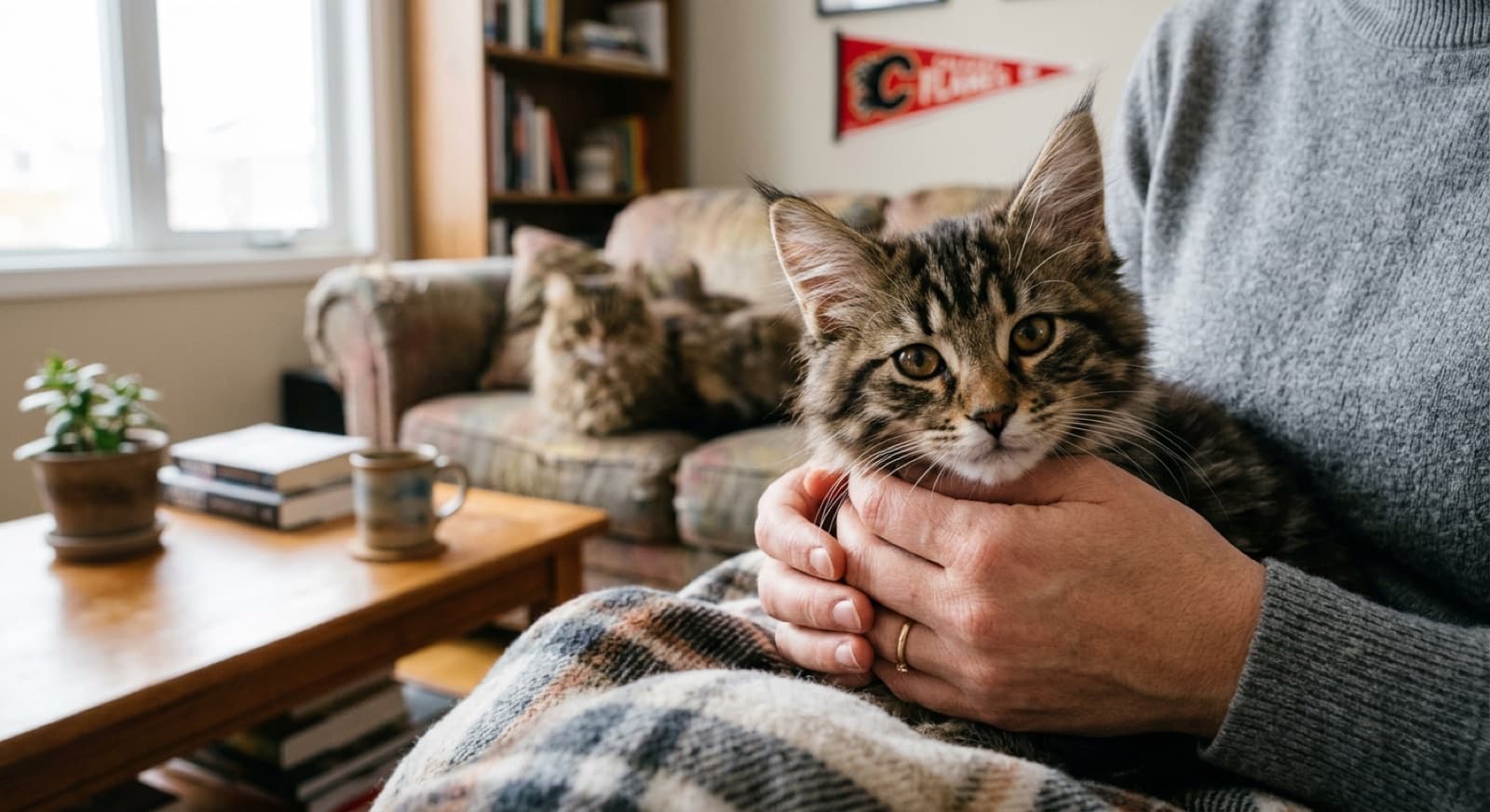
Why Maine Coons are the most-scammed cat breed
Pet scams target specific breeds for specific reasons. Maine Coons hit every reason at once. They are the most-searched cat breed in North America, which means a steady stream of motivated buyers. Ethical breeder prices sit at $1,800 to $4,000 CAD with 6 to 12 month waitlists, which means buyers are tempted to chase a shortcut. Long-haired tabby photos look generic enough that the same handful of stolen images get reused across dozens of fake breeder websites without buyers ever spotting the same cat twice.
The result is a scam ecosystem that runs year-round, not just at gift-giving season. The Canadian Anti-Fraud Centre consistently lists pet scams among the most-reported online fraud categories, with Maine Coon kittens, French Bulldogs, and Goldendoodles making up the bulk of the listings. The pattern crosses borders. Operators in West Africa, Eastern Europe, and Southeast Asia target North American buyers because the dollar amounts are high and the recovery rate is near zero once money is wired.
The reason this guide leads with rescue is not a moral preference. It is structural. A real Calgary rescue cat sits in a real foster home with a real coordinator who picks up the phone. Every step that creates risk in a scam (no physical address, no in-person meeting, wire payment, urgent timeline) is the opposite of how rescue works. We will cover ethical breeders later in this guide, but the safest starting point in Calgary is always rescue first.
The 10 Reddit-validated red flags
Each of these red flags comes directly from documented scam reports on r/scams, r/MaineCoons, and Canadian Anti-Fraud Centre filings. One red flag is a yellow caution. Two or more is a scam. Walk away.
1. Deposit required before the litter is born
Ethical breeders do not accept deposits on kittens that do not exist. Real waitlist money comes only after kittens are born, alive, and confirmed at 4 to 6 weeks. Anyone asking you to send money for an “upcoming litter” with no current kittens is running the most common variant of the scam.
2. Venmo, Zelle, wire transfer, or Interac e-Transfer only
Payment method is the cleanest tell. Scammers refuse PayPal Goods and Services, credit cards, and any platform with buyer protection because those payments can be reversed. If a seller insists on payment methods that cannot be charged back, the conversation is over.
3. “Ships anywhere in North America”
Ethical Maine Coon breeders rarely ship. Pickup in person is the default, occasionally a supervised flight nanny for vetted long-distance buyers. A website that advertises easy shipping to any address is built for a scam, not for the welfare of kittens.
4. No video calls allowed
A real breeder welcomes video calls with the kitten and the mother. A scammer dodges, claims technical problems, sends pre-recorded clips, or insists you must trust the website. The video-call refusal is the moment to walk away. There is no real cat to show.
5. Photos look too professional
Stolen photos are usually high-end professional shots lifted from real breeders. Reverse image search every photo before sending money (TinEye and Google Images both work). If the same image appears on multiple unrelated websites or stock photo sites, the listing is fake.
6. Kitten described as ready to go at 6 to 8 weeks
Ethical breeders rehome at 12 to 16 weeks minimum. Earlier separation harms socialisation and immune development. Anyone offering an “8-week-old ready to ship” is either inexperienced or running a scam. The breed clubs are explicit on this: minimum 12 weeks.
7. Website is recent with no breed club affiliation
Check the domain age via WHOIS lookup (free at whois.com). A “cattery” whose domain was registered three months ago, with no TICA or CFA cattery listing, is almost certainly a scam. Real catteries have years of history, registered cattery names, and verifiable show records.
8. Pressure tactics
“Someone else is interested, send the deposit by tonight or you lose the kitten.” This is the oldest line in the book. Real breeders have waitlists, not auctions. Urgency is a manufactured emotion to skip your verification step. Slow down. The right cat is worth the verification week.
9. No HCM testing mentioned for parents
HCM (Hypertrophic Cardiomyopathy) is the leading inherited killer in Maine Coons. Every ethical breeder DNA tests and echocardiogram-screens parents and freely shares results. Vague language like “health tested” or no mention of HCM at all means the breeder is not screening for the breed’s most serious disease.
10. Price below $1,500 for a “purebred Maine Coon”
The math does not work below this floor. The real cost of breeding a TICA-registered Maine Coon (HCM testing, queen retirement, vet care, food, registration) puts the breakeven price north of $1,800. Anything below $1,500 advertised as “purebred” is either a mix mislabelled or a scam listing with no cat behind it.
The verification checklist for a real breeder
If you are determined to go the breeder route, here is what an ethical breeder freely provides before any money changes hands. Missing any of these is a hard stop.
- HCM DNA test results for both parents, dated, with the testing lab named
- Hip dysplasia screening (PennHIP or OFA radiographs) for both parents
- Multiple video calls with the kitten, the mother, and the breeder’s home environment
- Kitten not released before 12 to 16 weeks, ever, no exceptions
- Spay or neuter contract (pet-quality kittens are sold with mandatory altering)
- TICA or CFA registration paperwork with numbered, verifiable papers
- Vet records: first vaccines, deworming, microchip, FeLV and FIV test
- Written health guarantee in the purchase contract
- References from previous adopters and the breeder’s veterinarian, with phone numbers you actually call
- In-person pickup or a supervised flight nanny, never an unverified shipping company
If a seller cannot produce this list within a week of being asked, the listing is not a real breeder. Cross-check the cattery name against the official TICA breeder directory and the CFA breeder search. Both are public, free, and take 30 seconds to use.
How to verify a breeder website
A five-minute verification routine catches almost every scam before the deposit lands. Run all five steps before sending any money.
| Step | How | What you are checking |
|---|---|---|
| Reverse image search | Upload every kitten photo to images.google.com or tineye.com | Same photo appearing on multiple sites = stolen |
| WHOIS lookup | whois.com, search the domain | Domain less than 1 year old = high scam risk |
| TICA / CFA directory check | Search cattery name on tica.org and cfa.org | No listing = no real registration |
| Vet reference call | Ask for the breeder’s vet name and number, then call | Confirms the cats actually exist and see a vet |
| Google the cattery name + “scam” | Plain Google search | Previous victims often leave reviews |
If any of these five steps return a red result, stop. Do not send a deposit while “waiting to see” if the other steps clear. Scammers have prepared answers for partial verification but cannot survive the full sweep. The most common mistake buyers report on Reddit is doing two or three of these checks, getting nervous, and sending the deposit anyway. The whole point of the sweep is the discipline to walk away when one step fails.
What to do if you have already been scammed
Recovery is rare but documentation matters. Every report you file helps the next buyer avoid the same operator and gives investigators a paper trail.
Move fast on the steps where time matters, and follow up on the rest within a week.
- Credit card dispute: if you paid by credit card, call the card issuer immediately. Most chargebacks must be filed within 60 days. This is the only step with a realistic chance of getting money back.
- Canadian Anti-Fraud Centre: file a report at antifraudcentre-centreantifraude.ca or by phone at 1-888-495-8501. Free, takes 15 minutes.
- Better Business Bureau: file a complaint at bbb.org. BBB scam tracker is one of the most-checked databases by future buyers, so your report directly prevents the next victim.
- Platform report: if the listing was on Facebook, Instagram, Kijiji, or Marketplace, report the post and the seller’s profile. Platforms remove repeat offenders only when complaints stack.
- RCMP / local police: file a report if the amount is over $5,000 or if the operator is in Canada. Cross-border cases involve the FBI and Interpol but rarely result in recovery.
- Bank fraud team: if you paid by Interac e-Transfer or wire transfer, contact your bank’s fraud team. Recovery is rare but possible if you report within hours, not days.
Mental note: the shame of being scammed is the operator’s most powerful tool. The people you talk to at the Anti-Fraud Centre take hundreds of these calls a week. Filing is routine. Not filing is what keeps the scam running.
Bypass the scam ecosystem entirely
Calgary rescue Maine Coons and Maine Coon mixes are real cats in real foster homes. You meet the cat before paying. The fee is honest. The structural risks of breeder scams (no address, wire payment, urgent deposit) simply do not exist in rescue.
See Available Maine Coons in Calgary →The scam-free Calgary rescue path
Calgary rescue is scam-free by design, not by accident. Every structural element that lets a scam work is missing. Rescues are registered non-profits with public charity numbers, audited finances, and physical addresses. Cats live in foster homes that adopters visit before paying. The fee goes to the rescue, not an individual. Every step is verifiable.
The Calgary rescues that regularly intake Maine Coons and Maine Coon mixes:
| Rescue | Good to know |
|---|---|
| Calgary Humane Society | The largest intake in the city. Steady stream of long-haired mixes labelled “Domestic Longhair” that often have visible Maine Coon ancestry. See calgaryhumane.ca. |
| MEOW Foundation | Cat-only rescue, large adult inventory, many long-haired cats. Strong foster notes on temperament. |
| AARCS | Province-wide intake including occasional purebred Maine Coon surrenders from rural Alberta breeders that close. |
| FRFA (Feline Rescue Foundation of Alberta) | Smaller, often seniors and special-needs cats including retired Maine Coon breeding queens. |
| Pawsitive Match | Mixed-species rescue with occasional Maine Coon mix intake. |
The honest expectation: most rescue cats described as Maine Coon are actually Maine Coon mix or domestic longhair with similar physical traits (tufted ears, plumed tail, large frame). That is not a downgrade. A domestic longhair gives you the gentle-giant personality, the impressive coat, and the dramatic appearance for $200 to $800 instead of $4,000. The 10 to 20 percent of Maine Coon traits you do not get (registered pedigree, breed club show eligibility) are exactly the parts that do not matter to a family pet.
For the full inventory walkthrough, see our Maine Coon adoption guide for Calgary, and to confirm what you are actually looking at, the Maine Coon identification guide covers the physical markers that separate a real Maine Coon mix from a generic long-haired tabby.
If you really want a kitten from a breeder
Some adopters genuinely want a registered Maine Coon kitten and are willing to do the work. That is a valid choice as long as the work actually gets done. The path looks like this.
Start with the official directories. TICA and CFA both let you search by breed and country. Filter to Canada and start with breeders in Alberta, British Columbia, and Saskatchewan to keep pickup local. Expect a 6 to 12 month waitlist at any reputable breeder, sometimes longer for specific colour preferences. A waitlist deposit ($300 to $500) is paid only after live kittens are born and selected.
Plan an in-person visit. Drive to the cattery, meet the queen, watch the kittens interact with their mother and littermates, see the home environment. Ethical breeders not only welcome this, they require it. A breeder who refuses an in-person visit is not a breeder you should buy from.
Ask for the paperwork up front: HCM test results dated within the last year, hip scores for both parents, full pedigree with TICA or CFA cattery numbers, vet records, contract draft. A real breeder sends this without hesitation. Pay attention to the breed-club affiliation question. A breeder active in shows, club committees, or the regional rescue (yes, breed clubs run rescues for retired breeders) has years of community accountability that a scam operator cannot fake.
Retired adults are an underused path. Ethical Maine Coon breeders place retired breeding cats around age 5 to 8 into pet homes, often through breed-specific rescue networks. These are full pedigreed Maine Coons with verified health histories, available for adoption fees in the $300 to $600 range rather than kitten prices. Many of them end up in Calgary rescue intake when the breeder uses AARCS or a similar partner. Worth asking every rescue if they currently have a former breeding adult.
Frequently Asked Questions
What is the most common Maine Coon scam?
The classic version is a fake breeder website with stolen photos lifted from real breeders in Europe or the United States. The scammer takes a deposit by Venmo, Zelle, or wire transfer, then either disappears entirely or strings the buyer along with delivery delays until the trail goes cold. The Reddit r/scams subreddit has hundreds of these reports, with Maine Coon kitten variants being one of the most common. Same playbook every time: a slick website, beautiful photos, urgent payment, no real cat behind any of it.
Is paying a deposit before the litter is born ever legitimate?
No. Ethical breeders do not take deposits on kittens that do not exist yet. A real breeder waits until kittens are born, alive, and at least 4 to 6 weeks old before accepting any waitlist money. Anyone asking for a deposit on a future or unborn litter is either inexperienced or running a scam. The honest answer is to walk away from any breeder using that structure, no matter how good the photos look.
What price is realistic for a Maine Coon in Canada?
A pet-quality Maine Coon kitten from a TICA or CFA registered Western Canadian breeder runs $1,800 to $4,000 CAD in 2026. Anything well below that range is a red flag. Anything well above is usually show-quality with breeding rights restricted. A "purebred Maine Coon" advertised at $600 to $1,000 is either a long-haired tabby mix mislabelled or, more commonly, a scam listing with no real cat behind it. Real breeders price at the going rate because their costs (HCM testing, hip screening, vet care, queen retirement) are real.
How do I verify a breeder is TICA-registered?
TICA (The International Cat Association) publishes a searchable breeder directory at tica.org. CFA (Cat Fanciers Association) does the same at cfa.org. Search the cattery name and confirm it returns a live entry with current registration. Then ask the breeder for their cattery name and registration number and cross-check. A real breeder gives you these details freely. A scammer dodges, sends a screenshot instead of a directory link, or claims registration is "in progress."
Can I get scammed through a rescue?
Not realistically. Calgary rescues like the Calgary Humane Society, MEOW Foundation, and AARCS operate as registered non-profits with charity status, public board members, audited finances, and physical addresses you can visit. The cats live in foster homes you can see before paying. The fee is paid to the rescue, not an individual. Every step is the opposite of the scam structure. If a "rescue" is asking for wire transfers, refusing in-person visits, or has no public address, it is not a rescue.
What payment methods are safe vs unsafe?
Safe: credit card (chargeback protection), PayPal Goods and Services (buyer protection), or a verified non-profit rescue payment portal. Unsafe: Venmo, Zelle, Interac e-Transfer to a stranger, wire transfer, cryptocurrency, gift cards, Western Union, or any "friends and family" payment with no recourse. Scammers insist on the unsafe options because they cannot be reversed. If a seller refuses any payment method that offers buyer protection, that alone is the answer.
I think I have been scammed. What now?
Report to the Canadian Anti-Fraud Centre at 1-888-495-8501 or antifraudcentre-centreantifraude.ca. File a complaint with the Better Business Bureau. If you paid by credit card, dispute the charge immediately with your card issuer. If the scam originated on Facebook, Instagram, or Kijiji, report the listing on that platform. If money crossed the Canada-US border, the RCMP and FBI both take reports. Recovery is rare but documenting the fraud helps stop the operator from victimising the next buyer.
Are imported Maine Coons safer or riskier?
Riskier by a wide margin. International "imports" from Russia, Eastern Europe, or unverified US sources are the single most common scam pattern for Maine Coons. The cat in the photos either does not exist or is not the one shipped. Quarantine paperwork is forged. Once money crosses borders, recovery is nearly impossible. A legitimate import from a vetted breeder is possible but extremely rare, requires extensive documentation, and is never urgent. If a seller leads with international shipping, treat it as a scam until proven otherwise.
Are "free Maine Coon" Kijiji listings ever real?
Occasionally a long-haired tabby mix gets relisted as a "Maine Coon" by a well-meaning owner who has no idea what the breed actually is. Almost none of them are real Maine Coons. Most are domestic longhairs with some tabby tufting. That is not a tragedy. A domestic longhair from rescue or a Kijiji rehoming gives you 80 percent of the gentle-giant experience for a fraction of the cost. Just adjust your expectations and verify with our guide on what a Maine Coon actually looks like.
What is reverse image search and how do I use it?
Reverse image search lets you find every place a photo has appeared online. Save the breeder photo, then upload it to Google Images (images.google.com, click the camera icon) or TinEye (tineye.com). If the same photo appears on multiple breeder websites in different countries, or on a stock photo site, the listing is using stolen images. Scammers reuse the same library of photos across dozens of fake websites. One reverse search catches most of them in under a minute.
What does HCM testing prove and not prove?
HCM (Hypertrophic Cardiomyopathy) is the major inherited heart disease in Maine Coons. A DNA test confirms whether a cat carries the MyBPC3 mutation, which is one known cause. An echocardiogram by a veterinary cardiologist screens for the disease itself. Ethical breeders do both on every breeding cat and share the results before sale. The test does not guarantee a kitten will never develop HCM (other mutations exist), but its absence means the breeder is not screening for the most common inherited killer in the breed. No HCM results means no deal.
Why are there so many Maine Coon scams specifically?
Three reasons stack. Maine Coons are the most-searched cat breed in North America (high buyer volume). Ethical breeder prices sit at $1,800 to $4,000 with 6 to 12 month waitlists (high motivation to find a shortcut). And long-haired tabby photos look generic enough to steal and reuse across dozens of fake listings without buyers spotting the same cat twice. The combination makes Maine Coons one of the most-targeted pet scam categories in Canada, alongside French Bulldogs and Goldendoodles for dogs.
Maine Coons and Maine Coon Mixes in Calgary
Live rescue listings for Maine Coon mixes and long-haired cats with the gentle-giant temperament.
Maine Coon Adoption Calgary
The honest Calgary rescue path, real fees, and what to expect from intake to pickup.
Maine Coon Identification
The physical markers that separate a real Maine Coon mix from a generic long-haired tabby.
Maine Coon Health Issues
HCM, hip dysplasia, and the screening protocol every owner should know.