The short answer
Calgary shelters label long-haired tabbies as “Maine Coon mix” often, but most of those cats are Domestic Longhairs with no meaningful breed ancestry. Eight reliable traits indicate real Maine Coon genes: large adult size, slow growth, lynx-tipped ear tufts, tufted feet, long bushy tail, neck ruff, polydactyl paws, and chirping vocalisations. Most shelter-labelled mixes show 0 to 2 of these. A cat showing 4 or more is a genuine Maine Coon mix worth the rescue route, delivering most of the breed experience at a fraction of the breeder price.
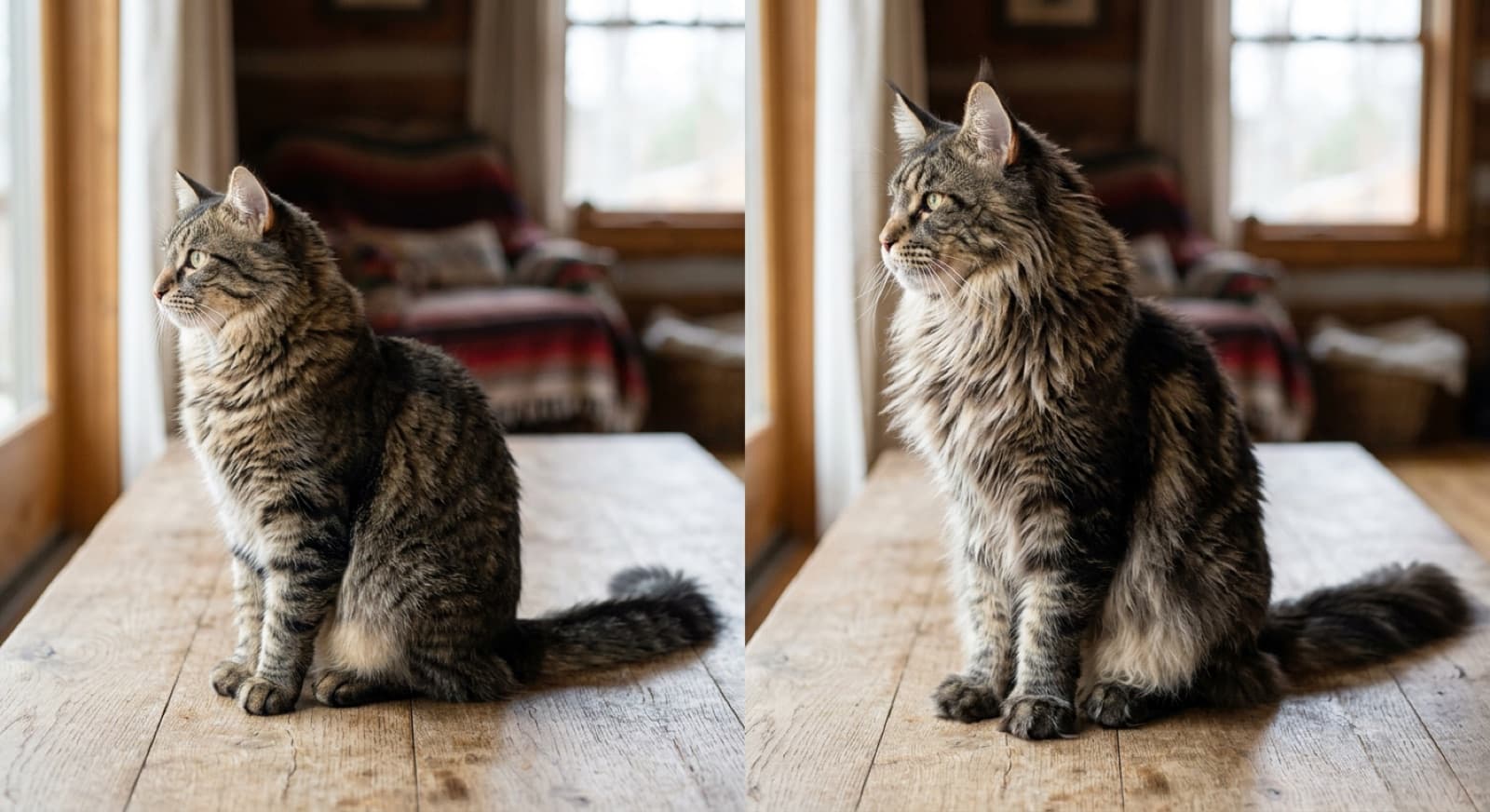
The Maine Coon mix labelling problem
Walk through the Calgary Humane Society listings on a Saturday and you will see “Maine Coon mix” tagged on perhaps a third of the long-haired cats. The real rate of Maine Coon ancestry is much lower. The label is rarely flat-out wrong, but it is rarely fully accurate either.
Four things drive the over-labelling. First, shelters compete for adopter attention, and the Maine Coon name carries weight. A long-haired tabby called a Maine Coon mix moves faster than the same cat called a Domestic Longhair, so the label nudges adoptions and helps the cat get home. Second, shelter intake staff rarely have breed verification training. Any cat with longer fur and visible ear fluff gets the label by default. Third, the label is hard to disprove without a DNA test, so nobody pushes back at intake. Fourth, the Maine Coon is genuinely one of the most common breeds in North America, so any long-haired cat in Canada plausibly carries some ancestry going back generations.
The honest result is a label that lives somewhere between marketing and guesswork. It is not deceptive on purpose, and it is not random either. It is simply not the same as a verified pedigree, and adopters who want a Maine Coon experience should know how to read past the label. Rescues we work with at MEOW Foundation and the Calgary Humane Society are honest about this when asked directly. Most foster homes will tell you what the cat actually is once you ask the right questions.
The framing we tell adopters: a “Maine Coon mix” label is a starting point for further investigation, not a guarantee. Look at the cat, count the traits, talk to the foster home, and decide based on what is actually in front of you. If you are mainly looking for a long-haired, gentle, sociable cat, you do not need the breed at all. If you specifically want Maine Coon character, the trait checklist below tells you whether this individual delivers it.
The 8 Maine Coon traits
These are the breed traits that show through reliably in real Maine Coon ancestry. A trait can appear in a non-Maine-Coon cat by coincidence (especially coat length), but the more traits a cat shows together, the stronger the breed signal. The Cat Fanciers’ Association maintains the formal Maine Coon breed standard, and The International Cat Association documents the same traits in its own TICA breed registry. The list below is the practical version for rescue adopters, not the formal show standard.
1. Large adult size
Adult males 13 to 18 lbs, females 8 to 12 lbs. Some males reach 20 lbs without being overweight. Most cats labelled Maine Coon mix at Calgary intake top out at 10 to 12 lbs as adults, which is normal Domestic Longhair territory. True Maine Coon ancestry shows in size by age 2 and continues filling out into year 3 or 4. This is the single most reliable trait because it is hard to fake and easy to verify at adoption with a scale.
2. Slow growth to full size (3 to 5 years)
Purebred Maine Coons keep growing into their fourth year and sometimes their fifth. A typical Domestic Longhair finishes growing at 12 to 18 months and stops. If your cat is 18 months old and still visibly bulking out, that is a genuine breed signal. If your cat is 2 and the same size it was at one, it is not a Maine Coon mix in any meaningful sense. Combined with adult size, slow growth is the strongest pair of indicators in the checklist.
3. Lynx-tipped ear tufts
Distinctive pointed tufts of longer hair extending up from the ear tips, like a lynx. Most Domestic Longhairs have minimal ear fluff or none at all. Real lynx tips are visible from across the room and persist year-round. The fur inside the ear (the “ear furnishings”) is a softer signal and present in many long-haired cats; the lynx tip on the outside of the ear is the breed-specific one.
4. Big tufted feet (snowshoe paws)
Maine Coons have famously large feet with prominent hair between the toes, an adaptation to walking on snow. The hair tufts under and between the toes are distinct from general paw fluff and one of the most reliable breed indicators. Pick the cat up gently and look at the underside of a paw. Visible tufts between every toe, with hair extending beyond the pad, is a strong signal. Smooth pink pads with no hair between them is not Maine Coon territory.
5. Long bushy tail carried high
The tail should be as long as the body or close, with thick fur that flares out into a plume, and the cat carries it raised. Maine Coons in cold weather use the tail to wrap around themselves like a blanket. A short, sparse, or low-carried tail rules out strong breed ancestry. A long, flag-like tail held proudly upright is one of the easier traits to spot in shelter photos.
6. Ruff (mane) around the neck
A distinct collar of longer fur around the neck and chest, more pronounced in winter coat and reduced after a summer shed. The ruff frames the face like a lion’s mane. Calgary’s climate brings the ruff out reliably from October through April. A long-haired cat with a uniform coat and no neck ruff differentiation is showing Domestic Longhair pattern, not Maine Coon.
7. Polydactyl paws (extra toes)
Historically about 30 percent of Maine Coons were polydactyl, before show breeders selected the trait out for the modern standard. The genetic frequency in the broader population (including mixes) remains elevated. Other breeds and random-bred cats can also be polydactyl from independent genetic origins, so extra toes alone do not prove ancestry. Combined with 3 or 4 other traits, polydactyly is one of the stronger indicators on the list.
8. Vocalisations: chirping and trilling
Maine Coons make distinctive sounds that are not standard meows. The chirp is short and high-pitched, often directed at birds outside a window, and the trill is a rolling, multi-syllabic greeting sound. These vocalisations are inherited and persist even in mixes. If your cat chirps at birds, that is one of the most charming and reliable signals of genuine Maine Coon character in the home, hard to mistake for anything else once you have heard it.
The honest verdict checklist
Tally the traits. The number is more useful than any individual one.
0 to 1 traits: Domestic Longhair. The cat probably has no Maine Coon ancestry worth talking about. Long fur alone does not make a cat a Maine Coon mix. This is the most common result for shelter-labelled cats.
2 to 3 traits: Possible distant mix. Some Maine Coon ancestry may be present, but the breed character is not the dominant influence. The cat will behave more like a Domestic Longhair with a few breed-flavoured features. Honest framing in a listing would be “long-haired tabby, possibly some Maine Coon ancestry.”
4 to 5 traits: Clear Maine Coon mix. The cat carries enough breed character to deliver most of the experience: the gentle temperament, the eventual large size, the social vocal nature. This is the sweet spot for adopters who want Maine Coon character without breeder cost. About 80 percent of the breed experience at 50 percent of the price.
6 to 8 traits: Strong Maine Coon presence. Likely a first-generation mix or an unregistered purebred surrendered without papers. These cats appear at Calgary rescues a few times a year, usually surrendered from broken breeder situations or owner crises. They go fast.
Why Maine Coon mix labelling matters for adoption
Beyond the labelling debate, the practical case for adopting a Maine Coon mix is strong. Mixed-breed cats benefit from genetic diversity (hybrid vigour), avoiding the concentrated inherited risks that show up in purebred lines. Maine Coons are predisposed to hypertrophic cardiomyopathy (HCM), a heart-muscle condition that runs in the breed. Mixes with a wider gene pool typically carry lower HCM risk than registered purebreds, though they can still inherit the marker, which is why a DNA test that flags HCM is worth running on any cat that shows 4 or more breed traits.
The temperament holds up well in mixes. Maine Coons are known for being gentle, social, and dog-like in their clinginess. They follow their owners from room to room, greet people at the door, and tolerate children and other pets better than most cat breeds. A 4-trait mix typically delivers this temperament intact. You do not need a 7-trait near-purebred to get the Maine Coon personality; the social, vocal, follow-you-around character comes through reliably in moderate mixes.
The economics tilt heavily toward rescue. An ethical Canadian Maine Coon breeder charges $1,500 to $3,500 CAD per kitten, with waitlists of 6 to 18 months and verification expected from organisations like the Canadian Cat Association. A Maine Coon mix from a Calgary rescue runs $150 to $350 CAD including spay or neuter, vaccinations, microchip, and a vet workup. The math is straightforward: roughly 10x cheaper through rescue, and you skip the waitlist entirely.
Adopting a mix also bypasses the scam ecosystem. Maine Coon kitten scams are widespread on Kijiji, Facebook Marketplace, and fake breeder websites. Anyone advertising Maine Coon kittens under $1,000 with no waitlist and instant availability is almost certainly running a scam or a backyard operation. The rescue route removes that risk entirely. For more on what to watch out for, see our Maine Coon scam avoidance guide.
Browse Maine Coon mixes at Calgary rescues
See current cats labelled Maine Coon and Maine Coon mix from MEOW Foundation, Calgary Humane Society, AARCS, and other Calgary rescues. Use the 8-trait checklist on real listings before you book a meet-and-greet.
See Available Maine Coons →Cat DNA testing: when does it actually help?
Manage your expectations. Cat DNA tests are far better at flagging health markers than at answering “is my cat a Maine Coon?”
The two main consumer cat DNA tests in Canada are Basepaws and Wisdom Panel for Cats. Both run $100 to $170 CAD shipped, use a cheek swab, and return results in 4 to 8 weeks. Embark, the major dog DNA test brand, does not currently sell a cat product despite their dog test being the gold standard. For cats, Basepaws is the closest equivalent.
The breed report is the disappointing part. Cat breeds are genetically far less distinct than dog breeds because most cat breeds are recent (last 100 to 200 years) compared with thousands of years for dog breed differentiation. For a typical Calgary rescue cat, the ancestry section comes back as “mostly domestic / random-bred” with small low-confidence percentages assigned to specific breeds. A cat with 5 visible Maine Coon traits might come back showing 12 percent Maine Coon and 88 percent domestic. The number is real but the test cannot give you a satisfying “yes this is a Maine Coon mix” answer the way a dog test would for a Labrador mix.
The health report is where the money is worth spending. Both tests screen for known feline genetic conditions, including the HCM marker that runs in Maine Coons, the polycystic kidney disease (PKD) marker common in Persians, and progressive retinal atrophy markers. The Cornell Feline Health Center documents these conditions and their breed-linked patterns. For a long-haired tabby you suspect has real Maine Coon ancestry, a DNA test that flags HCM gives your vet actionable information for monitoring with annual echocardiograms starting at age 3.
The honest recommendation: spend the $150 on the test if (a) the cat shows 4 or more breed traits and you want HCM screening, or (b) you genuinely cannot let go of the curiosity. Skip it if you mainly want a breed confirmation for the listing label.
Maine Coon vs other long-haired breeds Calgary adopters confuse
Several long-haired breeds get confused with Maine Coons in rescue listings. Knowing the differences helps you read the label more accurately.
Maine Coon vs Norwegian Forest Cat
Similar size, similar coat, similar cold-climate adaptation. The key differences are face shape and ear tufts. Maine Coons have a rectangular face with pronounced lynx tips on the ear tips. Norwegian Forest Cats have a triangular face with a straighter profile and softer, less defined ear tufts. Both breeds are very rare in Canadian rescues; a Calgary cat labelled either is almost always a Domestic Longhair.
Maine Coon vs Siberian
Both are large, long-coated, and cold-climate breeds. Siberians have a rounder face shape and a more compact, muscular body. Siberians are also one of the few cat breeds with genuinely lower Fel d 1 allergen levels, which Maine Coons do not share. A long-haired cat that triggers fewer allergies than expected is more likely to have Siberian ancestry than Maine Coon.
Maine Coon vs Persian
Easy to tell apart. Persians have a flat, brachycephalic (pushed-in) face with breathing implications. Maine Coons have a rectangular, normal-profile face. Persian coats are denser and need daily grooming; Maine Coon coats are coarser and need weekly grooming. Confusion happens only with very young kittens before facial structure is fully developed.
Maine Coon vs Ragdoll
Ragdolls always have striking blue eyes and a colourpoint pattern (darker face, ears, paws, and tail with a lighter body). Maine Coons come in many eye colours and many coat patterns including tabby, solid, and tortoiseshell. A blue-eyed colourpoint long-haired cat is a Ragdoll or Ragdoll mix, not a Maine Coon.
Maine Coon vs Domestic Longhair
This is the comparison that actually matters in Calgary rescues. Domestic Longhair is the catch-all for any long-haired cat of mixed or unknown ancestry. Roughly 95 percent of long-haired cats in Canadian shelters are Domestic Longhairs, and most of them get labelled Maine Coon mix at intake. The 8-trait checklist is how you tell the difference. For background on the Domestic Longhair label, see our Domestic Shorthair guide (the longhair version is the same concept with a longer coat).
What to ask your Calgary rescue about a Maine Coon mix listing
The foster home is the best source of information about an individual cat. Ask these five questions in your initial email or at the meet-and-greet, and the answers will tell you more than the breed label.
- “How was the breed assessed at intake?” If the answer is “the cat is long-haired and large” (or any equivalent), the label is intake guesswork, not verification. That is fine; just adjust your expectations. If they have parent information or surrender paperwork, ask to see it.
- “Do you have any history on the parents?” Most rescue cats arrive as strays or owner-surrenders with no parent information. When parent info exists (TNR colonies, breeder surrenders, owner stories), it is a much stronger signal than appearance alone.
- “What is the current adult weight, or projected adult weight if the cat is still growing?” Foster homes weigh their cats monthly. A 14-pound male at 18 months with no excess fat is a real Maine Coon signal. A 9-pound male at 2 years is a Domestic Longhair regardless of coat length.
- “Has the cat been DNA tested?” Almost never yes, but worth asking. Some rescues run tests on cats they suspect have HCM risk, especially for adopters who specifically want Maine Coon character.
- “Can you describe the cat’s vocalisations and how it greets people?” A chirping, trilling, follow-you-around cat is showing Maine Coon temperament regardless of how the appearance checklist scores. A standard meowing, independent cat is not showing breed character even if the coat is gorgeous.
The foster home will appreciate the specific questions. They want adopters who care about the actual cat, not just the label.
The Calgary rescue landscape for Maine Coon-type cats
Several Calgary rescues consistently list long-haired cats labelled Maine Coon or Maine Coon mix. The rate is small relative to Domestic Shorthairs, but a few real mixes appear each month across the network. The rescues we work with most often on this:
- MEOW Foundation is cat-only and the largest dedicated cat rescue in Calgary. Their foster homes do detailed temperament assessments, which makes the “Maine Coon mix” label more reliable than at general-intake shelters. Long-haired tabbies show up regularly.
- Calgary Humane Society has the highest intake volume in the city and consequently the most long-haired cats. The breed labels are more generous here because of the volume; use the 8-trait checklist on the listing photos before you book a meet-and-greet.
- AARCS serves Alberta-wide and pulls cats from rural shelters and overflow situations. Their cat inventory rotates fast, and bonded long-haired pairs from breeder surrender situations occasionally come through.
- BARCS, Pawsitive Match, Cochrane Humane, and Heaven Can Wait round out the Calgary-area network. Each posts cats periodically; subscribing to their email lists and checking weekly is more effective than waiting for a specific cat.
The patient strategy works best. Real Maine Coon mixes (4+ traits) are rare enough that they get adopted within days of listing. Subscribe to alerts, check the listings regularly, and be ready to move quickly when a strong mix appears. For the broader Calgary cat adoption process, our cat adoption guide walks through the full timeline.
Frequently Asked Questions
How do I tell if my cat is a real Maine Coon?
Count the breed traits. A true Maine Coon shows several together: adult size 13 to 18 lbs (males), slow growth to full size over 3 to 5 years, lynx-tipped ear tufts, tufted feet, long bushy tail, neck ruff, sometimes polydactyl paws, and chirping vocalisations. 4 or more traits is a credible mix. 0 to 2 is a Domestic Longhair regardless of the label. Without papers from a recognized registry, no rescue cat is a confirmed purebred.
What is the most reliable Maine Coon trait?
Adult size combined with slow growth. Males 13 to 18 lbs, females 8 to 12 lbs, still filling out at age 3 or 4. A long-haired tabby that tops out at 10 lbs by age 2 is not a Maine Coon mix in any meaningful sense. Tufted feet are the next most reliable indicator because they are hard to fake by appearance alone.
Are Maine Coon mixes considered Maine Coons?
No, not technically. A purebred has registration papers from TICA or CFA. A mix does not meet the breed standard and cannot be registered. That said, a 4-trait mix delivers most of the Maine Coon experience: gentle, social, vocal, eventually large. For adopters who want the personality rather than the pedigree, a strong mix is the same experience at a fraction of breeder cost.
Why do shelters label so many cats Maine Coon mix?
The label increases adoption interest, shelter staff rarely have breed verification training, and it is hard to disprove without DNA testing. The Maine Coon is genuinely common in North America, so the label is rarely flat wrong. But most cats with the label are really Domestic Longhairs with a generous tag at intake.
Is a cat DNA test worth it?
For breed curiosity, usually not. Cat breeds are genetically less distinct than dog breeds, so the ancestry report comes back as “mostly domestic” with low-confidence breed percentages. The tests earn their cost on the health side. They screen for HCM (the heart condition Maine Coons are predisposed to) and PKD. Worth running on cats showing 4+ breed traits.
At what age does a Maine Coon reach full size?
3 to 5 years. This is one of the most distinctive Maine Coon traits and one of the easiest to verify. A Domestic Longhair finishes growing at 12 to 18 months. A Maine Coon keeps filling out into its fourth year. If your cat is 2 and the same size it was at one, it is not a Maine Coon.
Are all polydactyl cats Maine Coons?
No, but polydactyly is more common in Maine Coons than in any other recognized breed. Historically about 30 percent were polydactyl. Plenty of non-Maine-Coon cats are polydactyl from independent genetic origins, so extra toes alone do not prove ancestry. Combined with 3 or 4 other traits, polydactyly is a strong indicator.
Do all Maine Coons chirp?
Most do. Maine Coons chirp, trill, and chatter rather than meow in the standard way. These vocalisations are inherited and persist in mixes. A long-haired tabby that chirps at birds outside a window is showing genuine breed character. The chirp is short and high-pitched, the trill is rolling and used in greeting.
Maine Coon vs Norwegian Forest Cat?
Face shape and ear tufts. Maine Coons have a rectangular face with pronounced lynx-tipped ear tufts. Norwegian Forest Cats have a triangular face with softer ear tufts. Both are rare in Canadian rescues. A Calgary rescue cat labelled either is almost always a Domestic Longhair.
Can a Domestic Longhair be a Maine Coon mix?
Yes, and most “Maine Coon mix” listings are exactly this. Domestic Longhair is the catch-all for any long-haired cat of mixed ancestry. If one parent was a Maine Coon, the cat is technically both. The honest question is how much Maine Coon ancestry the cat actually has. The 8-trait checklist answers that without a DNA test.
Purebred Maine Coon vs Maine Coon mix?
Pedigree papers and breed predictability. A purebred has documented parents and costs $1,500 to $3,500 CAD from an ethical Canadian breeder, with a 6 to 18 month waitlist. A Maine Coon mix has no papers and costs $150 to $350 CAD at a Calgary rescue. For families wanting the personality rather than the show ring, the mix is the better deal.
Are Maine Coon mixes hypoallergenic?
No. Maine Coons are not hypoallergenic and neither are their mixes. Cat allergies come from Fel d 1, a saliva and skin protein, not hair. Long coats spread the allergen further. Genuinely lower-allergen breeds are Siberian, Russian Blue, Balinese, and Bengal, none of which look like Maine Coons.
Maine Coon Cats in Calgary
Browse adoptable Maine Coons and Maine Coon mixes from Calgary rescues.
Maine Coon Adoption in Calgary
Rescue sources, real costs, surrender patterns, and how to find a real Maine Coon mix.
Maine Coon Scam Avoidance
Kijiji red flags, fake breeder websites, and how to tell a real Canadian Maine Coon breeder from a scam.
Maine Coon Health Issues
HCM, hip dysplasia, and the Calgary specialty vets who handle Maine Coon care.