The short answer
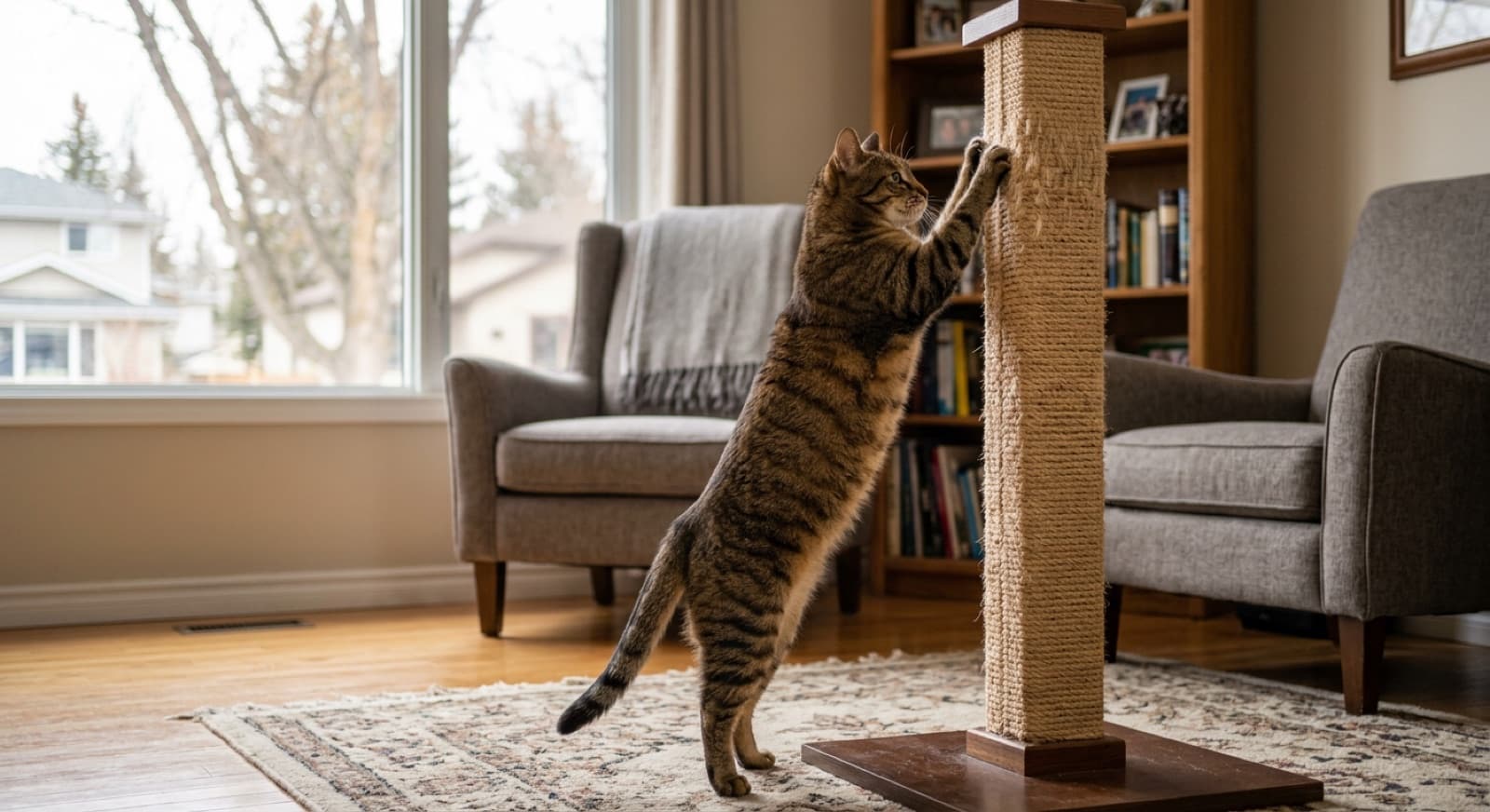
Declawing is illegal in Alberta since July 2020. Cats must scratch (claw maintenance, stretching, marking, stress relief); the goal is redirection. Provide 2 to 3 scratching posts of different types (vertical sisal at least 30 inches tall, horizontal cardboard, angled options) in the locations the cat uses (near sleeping spots, near furniture being scratched, near doorways). Make scratched furniture temporarily less attractive (double-sided tape, foil, Sticky Paws). Positive reinforcement when the cat uses the post. Trim claws every 2 to 4 weeks. Most cats redirect within 2 to 4 weeks of consistent intervention. Soft Paws are an acceptable transition tool. Never punish; punishment damages the bond and worsens stress without teaching alternatives.
The Alberta declaw ban
Declawing has been banned for Alberta veterinarians by the Alberta Veterinary Medical Association since July 2020 as an unethical procedure. Edmonton veterinarians do not perform declawing.
Declawing involves amputation of the last bone of each toe (equivalent to amputating each human finger at the last knuckle). The procedure has no medical benefit to the cat and is associated with:
- Chronic pain (often lifelong)
- Litter box avoidance (the litter texture hurts the amputated paws)
- Biting behaviour (the cat's primary defence is removed, so they bite instead)
- Gait changes and arthritis
- Behavioural changes including increased aggression and anxiety
The Alberta Veterinary Medical Association ban follows similar bans in British Columbia, Nova Scotia, New Brunswick, Newfoundland and Labrador, and Prince Edward Island. The American Veterinary Medical Association discourages declawing as a routine procedure. Edmonton adopters with scratching concerns should work through the redirection framework below.
Browse adoptable cats in Edmonton
Edmonton rescue cats are NEVER declawed (Alberta law). Provide appropriate scratching surfaces and redirection from day one.
See Available Cats →Frequently Asked Questions
Why do cats scratch?
Scratching is essential feline behaviour, not destructive misbehaviour. Cats scratch for several reasons: claw maintenance (the outer claw sheath sheds and scratching helps remove it), muscle and tendon stretching (cats use scratching as a full-body stretch, particularly after waking), visual and scent marking (paw pads have scent glands; scratched surfaces are marked as the cat's territory), stress relief and emotional regulation, and play. Cats cannot simply be trained out of scratching; they must scratch. The framework is not "stop the cat from scratching" but "redirect scratching to acceptable surfaces." Furniture scratching is communication that the cat does not have appropriate scratching options, not that the cat is being destructive.
Is declawing legal in Alberta?
No. Declawing has been banned for Alberta veterinarians since July 2020 by the Alberta Veterinary Medical Association as an unethical procedure. The ban followed similar bans in British Columbia, Nova Scotia, New Brunswick, Newfoundland and Labrador, Prince Edward Island. Declawing involves amputation of the last bone of each toe (equivalent to amputating each human finger at the last knuckle) and is associated with chronic pain, litter box avoidance, biting behaviour, gait changes, and arthritis. The procedure has no medical benefit to the cat. Edmonton veterinarians do not perform declawing. Adopters with concerns about scratching should work through the redirection framework below; declawing is neither legal nor appropriate.
What kinds of scratching posts work best?
Most cats prefer vertical surfaces tall enough for a full-body stretch (at least 30 to 36 inches tall) covered in sisal rope or sisal fabric. Sisal has the right texture for satisfying claw scratching and is widely available at Edmonton pet stores. Other cats prefer cardboard scratchers (horizontal or angled), wood scratchers, or carpet-covered posts. Each cat has individual preferences; offer 2 to 3 different types initially to identify what your cat actually uses. Avoid: posts shorter than the cat's full-stretch length (the cat will scratch furniture instead because furniture is taller), unstable posts that wobble when scratched (cats abandon unstable posts immediately), small flimsy posts marketed for kittens (most adult cats need substantial posts). Edmonton pet store budget: $30 to $150 for a quality post; $100 to $400 for a cat tree with multiple scratching surfaces.
Where should I place scratching posts?
Location matters substantially. Place posts near the surfaces the cat currently scratches (or near the cat's favourite sleeping spots, since cats scratch after waking). For Edmonton homes, common placements: near the couch (the most-scratched furniture in most homes), in the bedroom near the bed, near the cat's food and water area, near any entry point the cat uses regularly (the cat's territory-marking instinct activates near doorways). Multiple cats need multiple posts distributed across the home. Hiding posts in basement corners or out-of-the-way locations defeats the purpose; cats scratch as part of their daily routine, and the posts must be in their routine locations.
How do I redirect a cat from furniture to a scratching post?
A three-step framework. (1) Place the scratching post directly in front of the furniture surface being scratched. The post becomes the immediate alternative the cat encounters when approaching the furniture. (2) Use positive reinforcement: treats, praise, or play when the cat uses the post. Some cats respond to catnip on the post (rub fresh catnip on the post fibers). (3) Make the furniture less attractive: temporarily cover scratched areas with double-sided tape (cats dislike sticky textures), aluminum foil (the sound and texture deter), or specially-made furniture protectors (Sticky Paws is a widely-available brand). Most cats redirect within 2 to 4 weeks of consistent intervention. Once the new pattern is established, the furniture protection can usually be removed. Never punish the cat for scratching; punishment damages the bond without teaching the alternative.
What about Soft Paws or claw caps?
Soft Paws (the most widely-known brand) are vinyl caps glued over the cat's claws to prevent scratching damage to furniture. The caps last 4 to 6 weeks before they shed naturally with the outer claw sheath. Pros: immediate protection of furniture, no surgery, removable if discontinued. Cons: requires application every 4 to 6 weeks (some cats tolerate the application process well; others find it stressful), some cats develop nail bed issues from prolonged use, the caps do not address the underlying behaviour (the cat still wants to scratch, the caps just prevent damage). Soft Paws can be a useful tool for a transition period while redirecting to scratching posts, or for cats with severe scratching behaviour in apartments where furniture damage is a tenancy concern. Edmonton vets and groomers can apply Soft Paws if you are uncomfortable doing it at home. The product is widely available at Edmonton pet stores; cost roughly $20 to $40 per set of 40 caps (4 to 6 month supply).
My cat is scratching despite having posts. What now?
Audit the setup. Common reasons cats still scratch furniture despite having posts. (1) Wrong post type: try a different texture (sisal, cardboard, carpet) and orientation (vertical, horizontal, angled). (2) Posts too short or unstable: the post must be tall enough for full stretch and stable enough not to wobble. (3) Posts in the wrong locations: move posts near the furniture being scratched and the cat's sleeping spots. (4) Too few posts: one post per cat plus one extra is the baseline; multi-cat households often need more. (5) Underlying stress: scratching increases during stress periods; identify and address stressors (new pets, schedule changes, visible outdoor cats, Edmonton dry winter). (6) Old patterns reinforced by scent: clean previously scratched furniture with enzyme cleaners to remove scent markers; cats return to the same spots partly because they smell their own scent there.
How often should I trim my cat's claws?
Every 2 to 4 weeks for indoor cats. Trimmed claws reduce damage when scratching does occur and prevent overgrown claws from causing pain or growing into the paw pads. Use small cat-specific nail trimmers ($10 to $25 at Edmonton pet stores). Trim only the clear tip of the claw, avoiding the pink "quick" inside the claw (cutting the quick causes pain and bleeding; styptic powder stops bleeding if you cut too short). For cats who resist nail trimming, work slowly: trim one or two nails at a time over several sessions, pair with treats and praise, use Edmonton groomer services if home trimming is not working (groomers typically charge $15 to $25 for a nail trim). Many Edmonton vets offer nail trimming as a quick add-on service during routine visits.
What about training a cat with treats?
Positive reinforcement training works on cats; many adopters underestimate this. Cats are trainable through clicker training, treat reinforcement, and consistent timing. For scratching redirection: keep high-value treats accessible near scratching posts, reward immediately when the cat uses the post (within 1-2 seconds for the cat to associate treat with behaviour), use the same cue or marker word every time. Some cats respond to a "clicker" sound combined with treats. The training is the same principles used in dog training; cats just have shorter attention spans and require more patience. Edmonton force-free trainers familiar with cats (CCPDT, KPA, IAABC certified trainers who work with cats) can help with specific behaviour challenges; consultation typically $100 to $250 per session.
Is there anything I should never use to stop scratching?
Several common interventions either fail or cause harm. Never declaw (illegal for Alberta vets since 2020). Never use punishment-based interventions: spray bottles, hitting, yelling, or compressed air cans. Punishment damages the cat-human bond without teaching the alternative, increases stress (which often increases unwanted scratching), and can trigger fear-based aggression. Avoid scent deterrents marketed as "anti-scratch sprays" with unclear or harsh ingredients; many cats simply work around them. Avoid covering all furniture with plastic permanently (some Edmonton adopters do this and it does not address the underlying need; the cat continues to seek scratching outlets, and the furniture is unusable as furniture). Avoid limiting the cat to one room hoping to "protect" the rest of the house; this increases stress and worsens behaviour.
What if my cat is a recent rescue with no scratching habits established?
New rescue cats are the best opportunity to establish good scratching habits from the start. Before the cat comes home, set up 2 to 3 scratching posts in different locations (near the eventual sleeping spot, near the food and water area, in the main living area). Day one: introduce the cat to the posts during the safe-room settling phase (per the 3-3-3 rule). Most cats explore and use posts when they are the most accessible scratching options. Reinforce with treats, praise, and positive attention. New rescue cats typically establish post-using habits within 1 to 2 weeks if posts are the only scratching options easily available. Foster home information about the cat's scratching preferences (vertical vs horizontal, sisal vs cardboard) can inform your initial post selection. The 3-3-3 settling rule from our cat adoption guide framework applies here too.
Bottom line for Edmonton cat scratching furniture?
Cats need to scratch; the goal is redirection, not elimination. Declawing is illegal for Alberta veterinarians since 2020 and is neither appropriate nor effective. Provide 2 to 3 different scratching posts (vertical sisal, horizontal cardboard, angled options) in the locations the cat actually uses (near sleeping spots, near furniture being scratched, near doorways). Posts must be tall enough for full stretch (30+ inches) and stable enough not to wobble. Make scratched furniture temporarily less attractive (double-sided tape, foil, Sticky Paws). Positive reinforcement with treats when the cat uses the post. Trim claws every 2 to 4 weeks. Most cats redirect within 2 to 4 weeks of consistent intervention. Soft Paws are an acceptable transition tool. Never punish the cat or use spray bottles; punishment damages the bond and increases stress without teaching alternatives. Edmonton force-free trainers can help with persistent challenges.
Adoptable Cats in Edmonton
Live listings from Edmonton Humane Society, Zoe's, SCARS, and AARCS Edmonton fosters.
Cat Adoption Guide Edmonton
Day-one preparation including scratching post setup as part of new-cat home prep.
Cat Litter Box Problems Edmonton
Related behaviour-troubleshooting framework with medical-first principle.
First Week with a Rescue Cat Edmonton
Establishing good scratching habits from day one with new rescue cats.