The short answer
Four conditions define the Bengal health profile: HCM (the dominant adult-onset concern, screened annually from age 2 by echocardiogram, no DNA test exists), PRA-b (inherited blindness, DNA-testable), PK-Def (inherited hemolytic anemia, DNA-testable), and FIP (now treatable with GS-441524, a meaningful financial commitment that varies by cat weight, treatment form, and pharmacy). General anaesthesia is standard-protocol for Bengals, with a pre-anaesthetic echocardiogram recommended from age 4. Lifespan is 12 to 16 years with proactive care. The single highest-leverage decision a Calgary Bengal owner makes is buying pet insurance before any diagnosis.
Informational only, not veterinary advice. Always consult your Calgary veterinarian for individualised guidance on your specific cat.
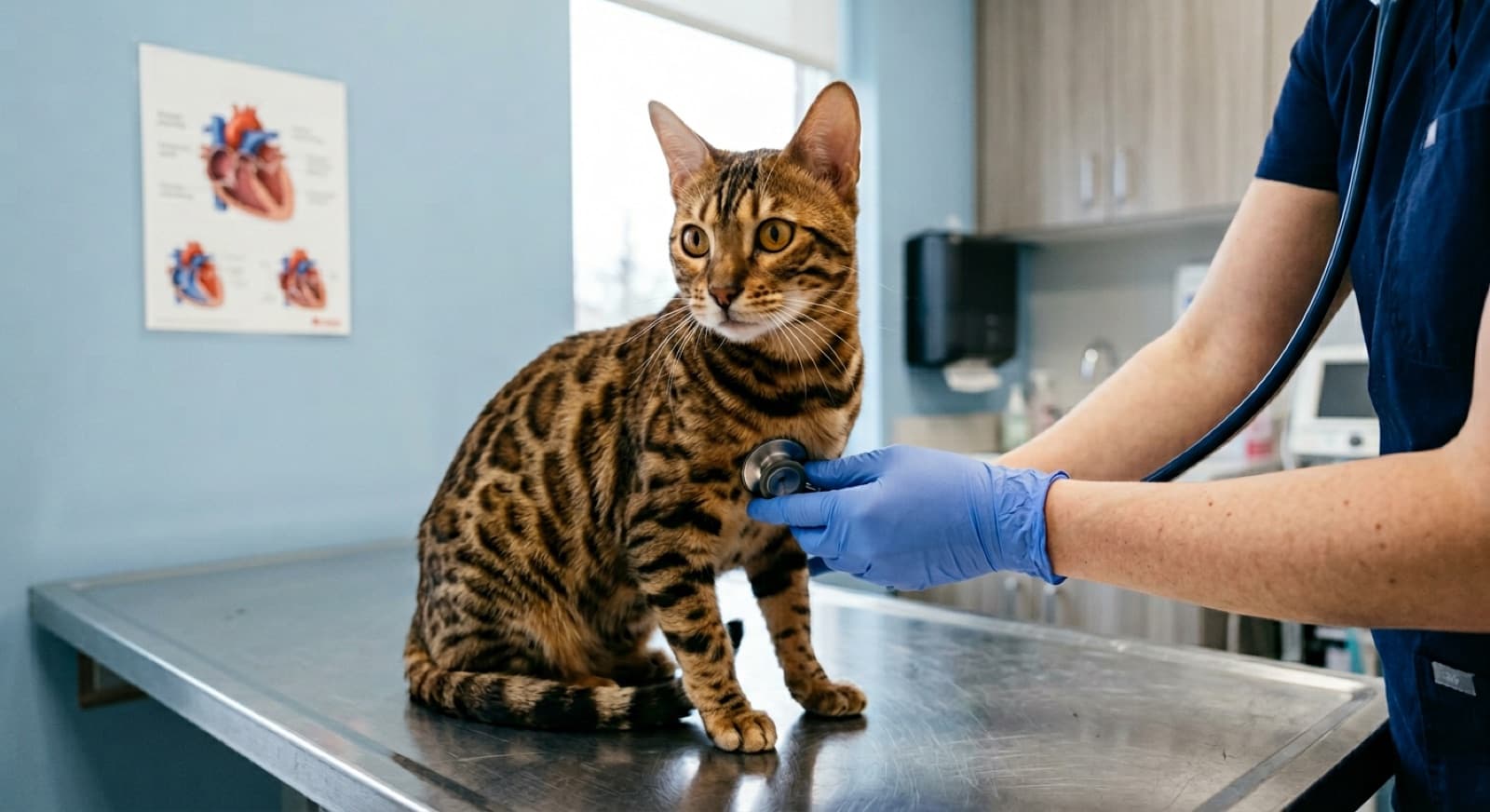
This article is informational only and is not veterinary advice. Always consult your Calgary veterinarian for individualised health guidance for your specific cat. Bengals are a breed with documented genetic and acquired health risks. Proactive screening from ethical breeders and ongoing veterinary care are essential. No medication, dosage, or treatment protocol is recommended on this page. Those decisions belong entirely with your veterinary team.
Sources informing this article include the UC Davis Veterinary Genetics Laboratory, the Cornell Feline Health Center, The International Cat Association (TICA) breed health guidance, and Wisdom Panel DNA testing references. Calgary specialty referrals go through Western Veterinary Specialist & Emergency Centre. Treatment specifics still belong with your Calgary veterinarian.
HCM (hypertrophic cardiomyopathy): the dominant concern
HCM is the most-discussed Bengal health issue and the one most consequential to plan around. Bengals are over-represented in the published feline cardiology literature, and unlike Ragdoll or Maine Coon HCM, there is no commercially available DNA test for the Bengal form. The screening tool is the echocardiogram. Every Calgary Bengal owner should understand this distinction before age 2.
Hypertrophic cardiomyopathy is a disease in which the wall of the left ventricle (the main pumping chamber of the heart) thickens abnormally. As the muscle thickens, the chamber holds less blood and the heart has to work harder. In some cats this stays mild for years. In others it progresses to congestive heart failure or to a sudden blood clot (thromboembolism) that often paralyses the rear legs. In the worst cases, sudden cardiac death is the first sign.
Bengals are over-represented for HCM in the published feline cardiology literature, and specific prevalence figures vary between studies. That breed over-representation is the basis for the annual echocardiogram screening protocol the cardiology community recommends, regardless of how the cat presents at home.
No DNA test for Bengal HCM
This is the part Calgary Bengal owners most often misunderstand. Ragdolls have a DNA test (the HCM2 mutation). Maine Coons have a DNA test (the MyBPC3 mutation). Bengals do not. As of 2026 there is no commercially available DNA test for the Bengal form of HCM. The only screening tool is the echocardiogram.
That changes the conversation with breeders. An ethical Bengal breeder will tell you that their breeding cats receive annual echocardiograms from a veterinary cardiologist, and they will be able to produce the reports. A breeder who claims their lines are HCM-clear because of DNA testing is either mistaken or selling a different breed's test. For Calgary rescue Bengals (or Bengal mixes), parental history is unknown, so the practical screening tool is the same: annual echocardiogram from age 2 by a Calgary veterinary cardiologist.
The echocardiogram protocol
Diagnosis starts with a routine veterinary exam where the vet listens to the heart with a stethoscope. A heart murmur is not itself a diagnosis of HCM (many cats have benign or stress-related murmurs), but it is a reason for further workup. The definitive diagnostic is an echocardiogram performed by a veterinary cardiologist.
In Calgary, this means a referral from your general-practice vet to Western Veterinary Specialist & Emergency Centre, which houses the city's main feline cardiology service. Expect to pay roughly 400 to 600 dollars per scan. The recommended cadence for an asymptomatic Bengal is annual from age 2 onwards.
Walking into a specialty centre without a referral is uncommon and may not be possible at all clinics. Build the relationship with one general-practice clinic first, and ask them to refer you in for the screening echocardiogram when your Bengal reaches the recommended age.
HCM symptoms to watch for at home
HCM can be silent for years. When symptoms appear, the most common ones are:
- Increased respiratory rate at rest (a sleeping cat should breathe 15 to 30 times per minute; persistently faster is a vet call)
- Lethargy or hiding when the cat is usually social (a notable change for a Bengal, given the breed's typical high activity level)
- Decreased appetite
- Sudden weakness, fainting, or collapse
- Sudden rear-leg paralysis (this can indicate a saddle thrombus, a blood clot that lodges where the aorta divides; it is a same-day Calgary 24-hour emergency)
- Open-mouth breathing or laboured breathing (always urgent in a cat)
Any of the above warrants a call to your veterinarian. Open-mouth breathing in a cat is an emergency. Drive to a Calgary 24-hour emergency vet rather than wait until morning.
Treatment and lifetime cost
Management of HCM is entirely vet-directed. There are several treatment categories in feline cardiology, including medications that reduce heart muscle workload and prevent blood clot formation. What is appropriate depends on the stage of disease, the individual cat, and other health factors. No medication, dosage, or treatment protocol is recommended on this page. Your veterinary cardiologist makes those decisions in partnership with you.
Lifetime cost of HCM management varies widely. A Bengal diagnosed early with mild disease might cost 3,000 to 5,000 dollars in cumulative monitoring and medication over a decade. A cat with progressive disease, recurring imaging, and emergency interventions can easily reach 10,000 dollars or more. This is the strongest single argument for pet insurance enrolled before age 2.
PRA-b (progressive retinal atrophy, Bengal variant)
PRA-b is the Bengal-specific variant of progressive retinal atrophy, an inherited form of feline blindness. It is autosomal recessive, which means a kitten needs two copies of the mutated gene (one from each parent) to develop the condition. Carriers (cats with one copy) have normal vision but can pass the gene to their kittens.
Vision loss typically begins around 7 weeks of age and progresses to severe impairment by about 2 years. The change is gradual, which is why cats adapt so well. A Bengal that loses vision over its first two years learns its home environment in stages, and by the time blindness is complete, the cat navigates by smell, hearing, and whisker-based spatial sense.
DNA testing is straightforward:
- Available through the UC Davis Veterinary Genetics Laboratory and Wisdom Panel
- Cheek swab kit, returned by mail
- Cost: roughly 60 to 100 dollars per test
- Results in 2 to 4 weeks
Ethical breeders test breeding pairs. Acceptable pairings are N/N (clear) bred to N/N or N/PRA-b (carrier). Pairing two carriers (PRA-b/N x PRA-b/N) has a 25 percent chance of producing affected kittens and should not happen. Pairing two affected cats (PRA-b/PRA-b x PRA-b/PRA-b) guarantees affected kittens and is not ethical breeding.
For a Calgary Bengal adopter, the conversation with a breeder includes asking to see PRA-b test certificates for both parents. For a Calgary rescue Bengal, the test is optional but informative; if you suspect an unusual sensitivity to dim light in a young Bengal, a DNA test confirms or rules out PRA-b without invasive procedures.
No treatment exists for PRA-b. Management is environmental: keep furniture stable, do not rearrange rooms, keep food and litter boxes in fixed locations, and supervise any unfamiliar-space access. A blind Bengal in a stable indoor home lives a normal feline life and a normal feline lifespan.
PK-Def (pyruvate kinase deficiency)
Pyruvate kinase deficiency is an inherited hemolytic anemia documented in Bengals (and several other cat breeds, including Abyssinians and Somalis). It is autosomal recessive, like PRA-b, so a kitten needs two copies to develop the condition.
PK-Def causes red blood cells to break down prematurely, which produces episodic anemia. Affected cats may show lethargy, pale gums, jaundice (yellowing of the gums and the whites of the eyes), and exercise intolerance. Onset is variable: some affected cats present in young adulthood, others in middle age. The condition is manageable with supportive care and is rarely immediately fatal, but it does shorten lifespan in some affected cats.
DNA testing is available through the UC Davis Veterinary Genetics Laboratory for about 60 to 100 dollars. Ethical breeders test breeding cats and follow the same pairing logic as PRA-b: clear-to-clear or clear-to-carrier is acceptable, carrier-to-carrier is not.
For Calgary adopters, asking a breeder to produce PK-Def test certificates on both parents is standard. For a Calgary rescue Bengal showing unexplained pale gums or recurring episodes of lethargy, the test is one of the workup options a vet may discuss. Management of PK-Def is vet-directed and depends on the severity in the individual cat.
FIP (feline infectious peritonitis): the treatment revolution
FIP used to be a near-certain death sentence. It is not any more. GS-441524 antiviral treatment has transformed FIP outcomes in the last few years, and Calgary access is well established through specialty vets. This is the single biggest change in feline medicine for breed-prone breeds.
FIP is caused by a mutation of the common feline coronavirus inside an individual cat. The coronavirus itself is widespread and usually harmless, but in a small proportion of cats it mutates into the form that causes FIP. The disease has two main presentations: wet (effusive, with fluid accumulating in the abdomen or chest) and dry (granulomatous, with inflammatory lesions in organs and sometimes neurological signs).
Bengals are over-represented in FIP literature, though specific incidence figures are not well-published. The likely reason is that Bengals more often come from multi-cat cattery environments where coronavirus exposure is higher. Single-cat households with limited cat-to-cat contact see less FIP than catteries or multi-cat rescues. The Cornell Feline Health Center is the citation-grade source for general FIP information.
GS-441524 access in Calgary
GS-441524 is the antiviral that has changed FIP outcomes. It is now accessible in Canada through veterinary prescription via compounding pharmacies. The treatment course runs about 84 days, typically as a daily oral or injectable dose. Cost is a meaningful financial commitment that varies widely by cat weight, treatment form (oral vs injectable), and compounding pharmacy. Discuss specifics with your Calgary veterinarian and confirm pricing before starting treatment.
The access pathway works like this: a primary Calgary vet identifies suspected FIP, refers to a specialist for diagnostic confirmation (often at Western Veterinary Specialist & Emergency Centre), the diagnosis is confirmed, the prescription is written, and a compounding pharmacy fills the prescription. Calgary owners report that the diagnosis-to-treatment timeline is typically 1 to 3 weeks, which matters because faster intervention produces better outcomes.
Signs of FIP in a young Bengal include persistent fever that does not respond to antibiotics, weight loss, decreased appetite, lethargy, abdominal swelling (wet form), jaundice, or neurological signs (head tilt, seizures, gait change). Any of these signs in a young cat warrants a same-week vet appointment.
General anaesthesia for Bengals
Bengals tolerate standard feline anaesthetic protocols. Unlike Maine Coons and Ragdolls, where breed-elevated HCM is more formally documented as an anaesthesia caution, no Bengal-specific anaesthesia warning is published. Routine spay or neuter at a young age, dental cleanings, and most elective surgeries are low-risk procedures.
The practical caveat is HCM-driven. Any cat aged 4 or older benefits from a pre-anaesthetic echocardiogram before elective surgery, because Bengals carry elevated HCM risk. If an annual screening echocardiogram is already part of your Bengal's care plan, that report is what your vet uses. If not, a pre-operative echocardiogram referral is worth discussing with your Calgary veterinarian before elective procedures in middle-aged or older Bengals.
Standard pre-operative bloodwork and pulse oximetry monitoring during surgery are the rest of the protocol. For young Bengals under 4 with no history of heart issues, standard protocols are used. Discuss any specific concerns with your Calgary veterinarian before the procedure.
Other conditions to know about
Beyond the four headline conditions, several less common issues are worth keeping on the radar:
- Urinary tract issues (FLUTD, bladder stones). Moderate Bengal predisposition. A wet-food-heavy diet helps. A male cat that is straining and unable to urinate is a same-day Calgary 24-hour emergency.
- Patellar luxation. The kneecap slipping out of its groove. Occasional in Bengals, more common in some toy dog breeds. Mild cases are managed conservatively; severe cases may need surgical correction.
- Hip dysplasia. Rare in Bengals but documented. Symptoms can mimic other joint conditions and are diagnosed by radiograph.
- Distal neuropathy. Rare. A degenerative nerve condition presenting with hindlimb weakness in young adult Bengals. Bloodwork and neurological exam guide diagnosis.
- Flat-chested kitten syndrome. Rare but documented in active Bengal lines. Usually identified in young kittens and managed with veterinary care. Adults are not typically affected.
- Dental disease. Not breed-specific, but worth flagging. Bengals benefit from annual dental exams and periodic professional cleanings under anaesthesia (which is where the pre-anaesthetic echocardiogram becomes relevant for cats aged 4 and over).
None of these conditions on its own justifies a different adoption decision. Bengals as a breed are fundamentally healthy, with several documented elevated risks that are manageable with proactive care. Annual exams catch most issues early.
Find your Bengal companion in Calgary
Browse Bengal-type cats currently in Calgary rescue. Adult cats with known health history are often easier to insure and budget for than breeder kittens.
See Available Bengals →Pet insurance for Bengals: the timing matters
This is the single highest-leverage decision a Calgary Bengal owner makes. Buy before any diagnosis. The conditions Bengals are at elevated risk for (HCM, FIP, urinary issues) are exactly the ones pet insurance is most useful against, and pre-existing condition exclusion is industry-wide.
Bengals are pet-insurance-positive because the breed's elevated health risks can produce real lifetime cost. A few directional figures to plan around (these are 2026 Calgary estimates, not quotes from any specific provider):
- HCM workup and lifetime management can run 3,000 to 10,000 dollars depending on stage and treatment approach
- Annual cardiology echocardiogram at a Calgary specialty centre: typically 400 to 600 dollars
- GS-441524 FIP treatment full course: a meaningful financial commitment that varies by cat weight, treatment form, and compounding pharmacy. Confirm pricing with your Calgary veterinarian before starting treatment.
- Emergency visit for suspected saddle thrombus, urinary blockage, or open-mouth breathing: easily 1,500 to 3,000 dollars for one night
Canadian carriers Bengal owners typically consider include Trupanion, Petsecure, and Pet Plus Us. Monthly premium ranges 50 to 90 dollars depending on age, deductible, and coverage tier. The right policy depends on budget and risk tolerance.
The pre-existing condition rule
Every Canadian pet insurance provider excludes pre-existing conditions. This means anything diagnosed before policy purchase is permanently excluded from coverage, and related conditions are often excluded too. A few examples of how this plays out for Bengals:
- HCM diagnosed at age 4 on a routine echocardiogram, with no prior policy in place: HCM permanently excluded from any subsequent policy
- A urinary blockage incident at age 2: future FLUTD episodes may be excluded as related
- A heart murmur noted at routine exam but not yet investigated: enrolling immediately may preserve coverage, but providers vary
The clear takeaway: enrol at adoption or by the first vet visit, ideally before age 3. A Bengal kitten enrolled at month 3 with a clean physical exam qualifies for the broadest coverage available. The cost of waiting is not the premiums you save, it is the coverage you lose on the conditions you are most likely to need.
Read the fine print on hereditary-condition coverage in particular, since some lower-tier policies exclude HCM as a breed-typical condition. The full-coverage tier is usually worth the premium difference for a Bengal.
Calgary specialty vet access
Cardiology, internal medicine, and FIP treatment for Bengals usually involve referral from your general-practice vet to a specialty centre. The Calgary clinic that handles most Bengal-relevant specialty work:
| Clinic | Services relevant to Bengals |
|---|---|
| Western Veterinary Specialist & Emergency Centre | Cardiology (echocardiogram for HCM screening), internal medicine, FIP diagnostic confirmation, 24-hour emergency. Referral from your general-practice vet typically required for specialty consults. Emergency walk-in is available. |
Your relationship with one general-practice clinic matters more than picking the “best” one. A vet who knows your cat's baseline catches subtle changes that a one-time specialist visit misses. The specialist comes in when something specific is needed: the annual HCM echocardiogram, a suspected FIP workup, or an emergency.
For routine spay, neuter, vaccines, and wellness care, any Calgary general-practice veterinary clinic that you trust is appropriate. The Bengal-specific layer (echocardiograms, DNA test interpretation, FIP prescription) is where specialty referral comes in.
Year-1 and ongoing Bengal vet costs
The realistic budget for a healthy Calgary Bengal, to discuss with your veterinarian and adjust based on the individual cat:
| Cost category | Calgary range (2026) |
|---|---|
| Routine annual wellness exam, vaccines, parasite prevention | 400 to 700 dollars per year |
| Annual cardiology echocardiogram (age 2 onwards) | 400 to 600 dollars per year |
| DNA testing (PRA-b + PK-Def, one-time) | 120 to 200 dollars total |
| Pet insurance (full-coverage tier, before any diagnosis) | 600 to 1,100 dollars per year |
| Spay or neuter (one-time, often via rescue at lower cost) | 200 to 500 dollars one-time |
| Dental cleaning under anaesthesia (every 1 to 3 years) | 600 to 1,200 dollars per cleaning |
| If HCM is diagnosed (cumulative lifetime, without insurance) | 3,000 to 10,000 dollars over disease lifetime |
| If FIP is diagnosed (one-time GS-441524 treatment course) | Varies widely by weight, treatment form, and pharmacy. Confirm with your Calgary veterinarian. |
The HCM and FIP rows are why pet insurance matters. Without coverage, a single major diagnosis can run five figures. With coverage purchased before diagnosis, the same diagnosis may cost a few thousand in deductibles and co-insurance. The math is the same conversation as the cost of waiting on insurance: every month of delay is a month of risk.
Building a Bengal emergency kit
Bengals run larger than average domestic cats, so plan for gear that fits a 10 to 15 pound active adult. The basics to keep in one place:
- Cat carrier sized for a Bengal. Minimum 24 by 16 inches, hard-sided, rated for car travel. Expect 80 to 150 dollars for a quality carrier. A too-small carrier in a stressed cat is a same-day vet problem.
- Printed copy of your pet insurance policy. Including policy number and after-hours contact.
- Recent photo of your cat. For identification if a carrier opens during transport, or for posting if the cat is lost.
- Vaccination records. Most Calgary emergency clinics ask for current vaccine status on intake.
- Written list of known sensitivities. Any prior reactions to medications, food intolerances, or chronic conditions.
- After-hours vet phone number. Western Veterinary Specialist & Emergency Centre operates 24-hour emergency. Save the number in your phone and post it on the fridge.
- Latest annual echocardiogram report. Especially important for Bengals aged 2 and over. If your cat is brought in for breathing changes or collapse, the existing cardiology report saves time.
Keep the kit in one accessible place. A stressed owner during a same-day vet trip should not be searching through filing cabinets for paperwork.
The Bengal lifespan question
Lifespan is one of the most-asked Bengal questions on rescue forums, and the answer cuts through a lot of breed mythology:
- Average Bengal lifespan is 12 to 16 years
- Healthy Bengals routinely reach the upper end of that range
- HCM is the leading cause of premature death in the breed
- Indoor-only lifestyle, weight management, dental care, and annual screening pull individual cats toward the longer end
- Outdoor-access Bengals (where local bylaws and the cat's temperament permit) face the same outdoor risks as any cat: vehicles, predators, infectious disease, theft
The Bengals we see live longest share a pattern: their owners picked one Calgary veterinary clinic and stayed with it, did not skip annual exams, started the cardiology screening protocol at age 2, watched for breathing and litter box changes at home, and had pet insurance in place before any diagnosis. None of that requires a panicked or anxious owner. It requires consistency. The owner who shows up for annual exams in good years is the same owner ready for the cardiology referral when a murmur shows up at age 6.
Frequently Asked Questions
What are the main Bengal health issues?
Four conditions matter most for Bengals: hypertrophic cardiomyopathy (HCM), progressive retinal atrophy Bengal-type (PRA-b), pyruvate kinase deficiency (PK-Def), and feline infectious peritonitis (FIP). HCM is the dominant adult-onset concern and the reason annual echocardiograms from age 2 onwards are the screening protocol. PRA-b and PK-Def are both DNA-testable inherited conditions, so ethical breeders screen parents and Calgary adopters can verify status. FIP treatment has been transformed by GS-441524, now accessible through Calgary specialty vets. Discuss screening with your Calgary veterinarian.
How common is HCM in Bengals?
Bengals are over-represented for HCM in the published feline cardiology literature. Specific prevalence figures vary between studies, and the exact lifetime risk for any individual Bengal varies as well. The practical takeaway: HCM is common enough in the breed to justify a documented annual echocardiogram screening protocol from age 2 onwards, regardless of how the cat looks at home. Discuss screening cadence with your Calgary veterinarian.
Should I screen my Bengal for HCM?
Yes, the standard recommendation for Bengals is an annual echocardiogram performed by a veterinary cardiologist starting around age 2. HCM can stay silent for years before producing symptoms, and the first sign is sometimes sudden collapse or a saddle thrombus (a blood clot that paralyses the rear legs). An echocardiogram catches thickening of the heart muscle early, when management options are widest. In Calgary, this is typically a referral from your general-practice vet to Western Veterinary Specialist & Emergency Centre cardiology. Discuss the right cadence with your Calgary veterinarian.
Is there a DNA test for Bengal HCM?
No. Unlike Ragdoll HCM (which has a known DNA-testable mutation called HCM2) and Maine Coon HCM (the MyBPC3 mutation), Bengal HCM has no commercially available DNA test as of 2026. This is the critical point Bengal owners need to understand. The only screening tool for Bengal HCM is a live echocardiogram performed by a veterinary cardiologist. A clear DNA test on parents does not exist for this breed, so ethical Bengal breeders rely on annual echocardiograms of breeding cats instead. For Calgary owners, this means the echocardiogram is not optional if HCM screening is the goal.
What is the difference between PRA-b and other cat eye conditions?
PRA-b is the Bengal-specific variant of progressive retinal atrophy, an inherited form of blindness. It is autosomal recessive, so a kitten needs two copies of the mutated gene (one from each parent) to develop the condition. Vision loss usually begins around 7 weeks of age and progresses to severe impairment by about 2 years. Cats adapt remarkably well to blindness in familiar environments. DNA testing is available through the UC Davis Veterinary Genetics Laboratory and Wisdom Panel for about 60 to 100 dollars. Ethical Bengal breeders test breeding pairs and avoid pairing two carriers.
Can a Bengal with PRA-b have a good quality of life?
Yes. Blind cats are not impaired cats in the way many adopters fear. Cats navigate primarily by smell, hearing, and whisker-based spatial sense, and a Bengal that loses vision gradually (which is how PRA-b progresses) adapts to its home environment as the change unfolds. The owner manages this by keeping furniture stable, not rearranging rooms, keeping food and litter boxes in fixed locations, and supervising any outdoor or unfamiliar-space access. There is no treatment that reverses PRA-b, but a blind Bengal in a stable indoor home lives a normal feline life and a normal feline lifespan.
Are Bengals prone to FIP?
Bengals are over-represented in FIP literature, though specific incidence figures are not well-published. FIP arises from a mutation of the common feline coronavirus inside an individual cat, and breeds that come from multi-cat group-housing environments (like cattery-bred Bengals) tend to see higher coronavirus exposure than single-cat-household kittens. The good news is that FIP is no longer a death sentence. GS-441524 antiviral treatment has changed FIP outcomes dramatically, and Calgary access is well established through specialty vets. Discuss any signs of FIP (persistent fever, weight loss, abdominal fluid, jaundice, neurological signs) with your veterinarian immediately.
How is FIP treated in 2026?
GS-441524 is the current standard of care for FIP and has transformed the disease from nearly always fatal to treatable in most cases. The treatment course runs about 84 days, typically as a daily oral or injectable dose. In Canada, GS-441524 is accessed through veterinary prescription via compounding pharmacies. Cost is a meaningful financial commitment that varies widely by cat weight, treatment form (oral vs injectable), and compounding pharmacy. Discuss specifics with your Calgary veterinarian and confirm pricing before starting treatment. Your primary Calgary vet writes the prescription, often after referral to a feline specialist for diagnosis confirmation. This is one of the strongest pet-insurance ROI cases of any feline condition. The Cornell Feline Health Center is the citation-grade source for general FIP information.
Is pet insurance worth it for a Bengal?
For a Bengal, insurance is usually worth strong consideration. Bengals carry documented elevated risks for HCM and FIP, both of which can produce five-figure lifetime cost without insurance. Canadian carriers (Trupanion, Petsecure, Pet Plus Us) typically run 50 to 90 dollars per month depending on age and coverage tier. The single rule that matters most: enrol before any diagnosis. Pre-existing condition exclusion is industry-wide. If an echocardiogram at age 4 catches HCM and the cat had no policy, that diagnosis is excluded from any subsequent policy. Read the fine print on hereditary-condition coverage, since some lower-tier policies exclude HCM as breed-typical.
When should I buy pet insurance for my Bengal?
Buy at adoption or by the first vet visit, ideally before age 3. Every Canadian pet insurance provider excludes pre-existing conditions, and the conditions Bengals are at elevated risk for (HCM, FIP, urinary issues) are exactly the ones policies are most useful against. A kitten enrolled at month 3 with a clean exam qualifies for the broadest coverage available. A cat enrolled at age 5, after a routine echocardiogram detects HCM, has that diagnosis excluded indefinitely. The cost of waiting is not the premiums you save, it is the coverage you lose on the conditions you are most likely to need.
What is a normal lifespan for a Bengal?
Bengals typically live 12 to 16 years, with healthy individuals reaching the upper end of that range routinely. HCM is the most common cause of premature death in the breed, which is why proactive echocardiogram screening matters so much. Indoor-only lifestyle, weight management, dental care, and consistent annual veterinary exams all pull individual cats toward the longer end of the range. The Bengals we see live longest are the ones whose owners built a relationship with one Calgary veterinary clinic early, did not skip annual exams, and made the cardiology referral when their vet suggested it.
Where can I get a Bengal echocardiogram in Calgary?
Echocardiograms for HCM screening are performed by veterinary cardiologists, not general-practice vets. In Calgary, this typically means a referral from your primary vet to Western Veterinary Specialist & Emergency Centre (westernvet.ca), which houses the city's main feline cardiology service. Expect to pay roughly 400 to 600 dollars per scan. Walking into a specialty centre without a referral is uncommon, so build the relationship with one general-practice clinic first, and ask them to refer you in for the screening echocardiogram from age 2 onwards.
Are Bengals high-risk for anesthesia?
Not specifically. Bengals tolerate standard feline anaesthetic protocols, unlike Maine Coons and Ragdolls where breed-elevated HCM is a more formally documented anaesthesia caution. The practical caveat for Bengals is that any cat aged 4 or older benefits from a pre-anaesthetic echocardiogram before elective surgery, because of the underlying HCM risk profile. Standard pre-operative bloodwork and pulse oximetry monitoring during surgery are the rest of the protocol. Routine spay or neuter at a young age, and most dental cleanings, are low-risk procedures. Discuss any specific concerns with your Calgary veterinarian before the procedure.
What should be in my Bengal emergency kit?
A cat-rated carrier large enough for a Bengal (most Bengals are bigger than average domestic cats, so plan for a 24 by 16 inch carrier minimum, around 80 to 150 dollars), a printed copy of your pet insurance policy, a recent photo of your cat for identification, vaccination records, a written list of known sensitivities or chronic conditions, and the after-hours phone number for a Calgary 24-hour emergency clinic. Western Veterinary Specialist & Emergency Centre runs 24-hour emergency. Keep the kit in one place so a stressed owner is not searching during a same-day vet trip.
Bengal Cats in Calgary
Browse adoptable Bengal and Bengal-mix listings from Calgary rescues.
Bengal Adoption Guide
Rescue versus breeder, real costs, scams, and the buy-vs-adopt math for Calgary.
Bengal Energy & Enrichment
Why Bengals need more enrichment than most cats, and the Calgary indoor-cat playbook.
Bengal F1-F4 Alberta Legality
Hybrid generation rules, the legal status in Alberta, and what Calgary adopters need to know.