The short answer
Alberta restricts Bengal hybrids by generation. F1, F2, and F3 Bengals are illegal to own as private pets, subject to seizure under provincial wildlife rules. F4 and later are legal as domestic cats with TICA paperwork proving generation. About 99 percent of TICA-registered Bengals sold in Canada today are SBT (F4 or higher), so most ethical Canadian breeder kittens are legal. The dangerous listings are the “exotic F1 Bengal $5,000” ads on Kijiji and Facebook, which are either fraud (a lower-gen cat mislabelled to inflate price) or genuinely illegal cats that can be seized. Verify F-generation directly with TICA, not the seller. Or skip the entire question and adopt from a Calgary rescue, where every Bengal-type cat is already a legal domestic cat by definition.
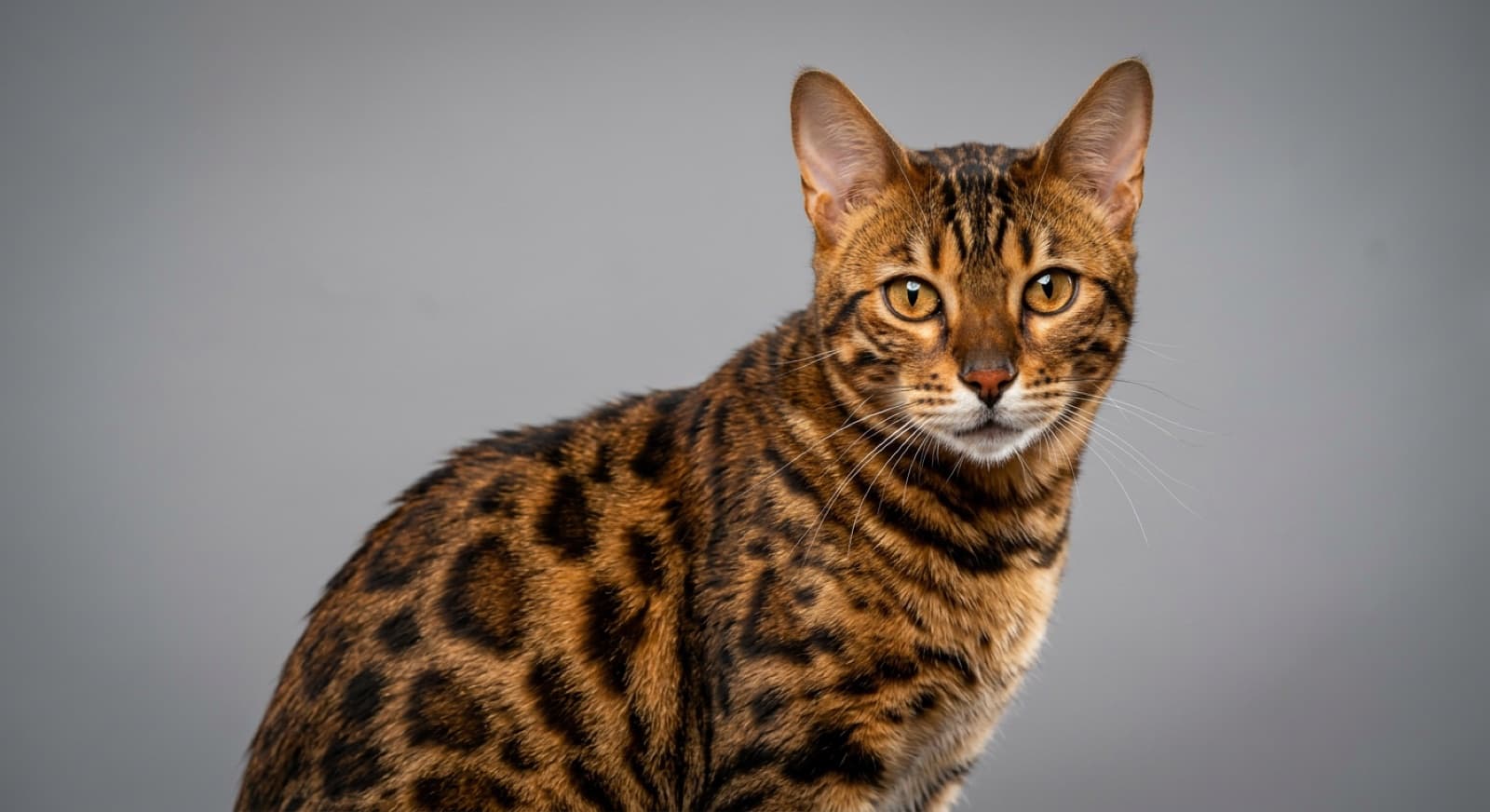
What “F-generation” actually means
The Bengal breed exists because of a deliberate cross between the Asian Leopard Cat (a small wild cat native to South and East Asia) and a domestic cat. F-generation describes how many generations removed a given Bengal is from that wild ancestor. The lower the number, the more wild ancestry; the higher the number, the more genetically domestic the cat.
| Generation | What it means | Alberta status |
|---|---|---|
| F1 | Asian Leopard Cat bred directly to a domestic cat. 50 percent wild. | Illegal |
| F2 | F1 bred to a domestic Bengal. About 25 percent wild ancestry. | Illegal |
| F3 | F2 bred to a domestic Bengal. About 12.5 percent wild ancestry. | Illegal |
| F4 | Fourth generation removed. About 6 percent wild ancestry. | Legal with TICA papers |
| F5+ | Fifth generation or later. Genetically domestic. | Legal with TICA papers |
| SBT | F4 or later with three consecutive generations of Bengal-to-Bengal breeding. | Legal with TICA papers |
The SBT designation matters because it is the TICA standard for what most people picture when they think “Bengal kitten from a real breeder.” SBT cats have a documented pedigree showing three consecutive generations of Bengal-to-Bengal breeding with no outcrosses to either a domestic cat or an Asian Leopard Cat. Roughly 99 percent of TICA-registered Bengals sold in Canada today fall into the SBT category. The handful of F1, F2, and F3 cats that exist in North America are generally bred by a small number of specialty programs in jurisdictions where they remain legal, and almost never end up in legitimate Canadian pet homes.
One useful distinction: F-generation describes ancestry, not behaviour or appearance. An SBT Bengal can look every bit as wild as an F2 (rosetted coat, glittered fur, athletic build) because the visual breed standard has been selected for over generations. The difference is behavioural predictability and legal status, not aesthetics. A well-bred SBT kitten is a domestic cat that happens to look spectacular.
The Alberta legal framework: what is true, what is myth
Most of what circulates online about Bengal legality in Alberta is partially right and partially wrong. The actual provincial position is published at alberta.ca/wildlife-as-pets and the relevant quote is direct:
“Bengal cats (hybrid of a house cat and an Asian leopard) and ocicats... are considered to be domestic cats, provided they are registered with The International Cat Association (TICA) as being an F4 generation or greater.”
That single sentence is the whole framework. F4 and later with TICA registration: domestic cat, legal, no special permit required. F1 through F3, or any Bengal-type cat without TICA paperwork proving F4+ status: classified as wildlife, possession by a private individual is prohibited.
What enforcement looks like
Provincial Fish and Wildlife officers have authority to investigate suspected illegal possession of controlled species, which includes lower-generation Bengal hybrids. In practice, enforcement is complaint-driven. Officers do not patrol Calgary neighbourhoods looking for spotted cats. They respond when someone files a report, typically a neighbour, a former roommate, or a veterinary clinic that suspects an illegal animal. When an investigation occurs, the officer asks the owner to produce TICA paperwork proving F4+ status. If the owner cannot, the cat is subject to seizure.
Seizure does not end with the cat being returned. Illegal Bengals are typically placed at a licensed wildlife rehabilitation facility (where they generally do not thrive, having no functioning wild instincts despite the F-generation classification) or euthanised. Domestic-cat rescues cannot accept them. The legal cost to the owner can include fines under the Alberta Wildlife Act, with possession offences potentially reaching several thousand dollars depending on the specifics. This is not legal advice for any specific situation; consult a lawyer experienced in Alberta wildlife law if you are facing a charge.
Calgary city bylaws
The provincial framework applies in Calgary. The City of Calgary appears not to add further restrictions on Bengals beyond what Alberta law sets out, but if you are considering importing a Bengal of any generation, confirm directly with the City of Calgary via 311. Municipal bylaws can change, and a Bengal owner in Calgary is responsible for compliance with both provincial wildlife rules and the Responsible Pet Ownership Bylaw (which covers licensing, vaccination, and similar standard cat-ownership requirements).
Cross-border imports and CITES
Bringing a Bengal across the Canadian border adds federal complexity. The Asian Leopard Cat is a CITES-listed species, and depending on F-generation and country of origin, federal CITES permits may be required at the border in addition to provincial wildlife rules. The practical reality: cross-border Bengal imports are paperwork-heavy and slow, and the moment the cat lands in Alberta the F4+ provincial rule takes precedence regardless of how the cat was legally classified at origin. If you want a Bengal in Alberta, sourcing from a TICA-registered Canadian breeder or a Canadian rescue is dramatically simpler than importing.
Myths to bust
- “All Bengals are illegal in Alberta.” False. F4+ with TICA paperwork is fully legal. The breed is legal; specific low generations are not.
- “Lower F-gen means a better, more exotic personality.” False and dangerous. F1 through F3 cats show unpredictable wild-type behaviour, including marking, prey drive, and stress responses that make them poor candidates for ordinary households even setting aside the law.
- “Breeders can paper around the F-gen rule.” False. TICA tracks generations through its pedigree system, and fraudulent paperwork is catchable by direct verification with TICA. A cattery selling an F2 cat as an F4 is committing fraud against both the buyer and TICA.
- “The law was just made up; nobody enforces it.” Partially true and dangerously misleading. Enforcement is rare in absolute terms but the legal authority is real, the penalty is severe (loss of the cat plus fines), and complaint-driven enforcement means a single neighbour dispute can trigger a seizure.
The scam landscape: F-gen mislabelling and TICA paper forgery
Bengal scams in Alberta follow predictable patterns because the F-generation legal threshold creates exploitable price gaps. The same scam plays out in two opposite directions depending on what the seller thinks the buyer wants.
The F1-as-F4 scam (cat is illegal, buyer does not know)
A seller has a cat with substantial Asian Leopard Cat ancestry (genuinely F1, F2, or F3) and markets it to a buyer who wants a legitimate Bengal pet. The cat is labelled “F4” or “SBT” in the ad, fake or fabricated TICA paperwork is attached, and the buyer pays $1,800 to $3,500 thinking they are getting a legal SBT kitten. The cat is illegal in Alberta. The buyer is now in the awkward position of either knowingly possessing an illegal animal or surrendering the cat after already paying for it. This is the more dangerous version because the buyer does not realise the legal exposure until it is too late.
The F4-as-F1 scam (cat is legal, buyer overpays)
The reverse pattern. A seller has a perfectly ordinary SBT Bengal or an F5+ cat and markets it as a rare “F1 hybrid” for $5,000 or more, targeting buyers who associate lower generations with rarity and exotic status. The cat is fine legally, but the buyer has paid double or triple the true market value for what is, in reality, a standard SBT kitten. This version damages your wallet without putting you in legal jeopardy.
TICA paper forgery
Forging TICA paperwork is technically easy. A scammer fabricates a cattery name, generates an official-looking pedigree document with a registration number, and attaches it to whatever cat is being sold. The buyer sees TICA paperwork and assumes verification has happened. The verification has not happened.
Real verification means going around the seller. Search the cattery name directly in the public TICA breeder directory. If the cattery is not in the directory, the paperwork is fake. If the cattery is in the directory, phone TICA at (956) 428-8046 to confirm the specific pedigree number and the F-generation listed on it. Real TICA-registered catteries appear in the directory with current contact information; fabricated ones do not. The whole verification takes ten minutes and catches almost every fake-paperwork scam.
The photo-theft scam
A scammer hijacks images from legitimate American or European Bengal breeders, builds a website using a similar cattery name, and runs ads on Kijiji or Facebook. The cat in the photos exists but is not the cat being sold. There is no real cat behind the listing. Verification: reverse image search every photo using TinEye or Google Images. If the same photo appears on multiple unrelated breeder websites, or on stock photo sites, the listing is using stolen images. Legitimate breeders welcome video calls with the specific kitten present, holding a piece of paper with the buyer’s name written on it. A scammer cannot produce that.
The urgency scam
“Sick family member, must rehome immediately, send $1,500 deposit by e-Transfer tonight or the kitten goes to the next person.” This pressure pattern is designed to bypass standard verification because verification takes time. Real breeders welcome scrutiny and have waitlists, not auctions. Any urgency framing is the cue to slow down, not to act. The right cat is worth the verification week.
The “Bengal kitten $600” Facebook re-homing scam
Photo of a brown spotted tabby cat presented as a Bengal kitten on a Facebook rehoming group. No paperwork, no breeder information, no health records. The cat in the photo may not exist; the seller may be running the same listing under multiple accounts. The price floor for any legitimate TICA-registered Bengal kitten in Canada is approximately $1,800. Anything advertised at $600 to $1,200 as a “purebred Bengal” or “TICA registered Bengal” is either fraud, an unregistered brown-spotted mix being mislabelled, or a sick cat from a backyard operation. All three outcomes end badly.
How to verify a real Bengal with real TICA paperwork
If you are going the breeder route, here is the verification routine. Run every step before any money changes hands. Skipping a step is how buyers get scammed.
- Ask for the cattery name and TICA registration number first. Before discussing kittens, prices, or availability. A real breeder provides this without hesitation. A scammer hedges.
- Verify the cattery directly through TICA. Search at tica.org or phone (956) 428-8046. The cattery either appears in good standing or it does not. There is no in-between.
- Ask for both parents’ full TICA pedigrees with F-generation marked on every ancestor going back at least three generations. This confirms SBT status and rules out an F2 or F3 being passed off as F4.
- Confirm DNA testing on both parents: PRA-b clear (progressive retinal atrophy) and PK-Def clear (pyruvate kinase deficiency). Results from UC Davis VGL or Wisdom Panel are the standard. A breeder who skips DNA testing is not running an ethical program.
- Confirm HCM screening on both parents: annual echocardiogram by a veterinary cardiologist within the last 12 months. Hypertrophic cardiomyopathy is the major inherited heart disease in Bengals. No HCM result means no deal.
- Request a live video call with the specific kitten and one or both parents. The breeder holds up a piece of paper with your name written on it during the call. This catches photo-theft scams.
- Pay deposit only after live kittens are confirmed born and selected. Deposits range $300 to $500 at that stage. Anyone asking for a deposit on a future or unborn litter is running the most common variant of the kitten scam.
- Arrange in-person pickup or a vetted flight nanny. Never wire-transfer to a personal account. Never accept shipping arrangements from an unknown company.
- Read the breeder contract carefully. Look for the spay or neuter agreement (pet-quality kittens are sold with mandatory altering), the return-to-breeder clause if you cannot keep the cat, the written health guarantee, and explicit F-generation language confirming SBT status.
If a breeder cannot or will not produce this list within a week of being asked, the listing is not a real breeder. There is no situation where these elements are optional. Ethical Bengal breeders see this list as routine and provide it before being asked, because their reputation depends on it.
Bengal pricing reality in Calgary 2026
Price is the single cleanest filter for legitimacy. The honest Canadian Bengal market has a tight range for a reason: the costs of running an ethical TICA-registered cattery (HCM testing, DNA panels, queen retirement, vet care, registration, food, kitten socialisation) are real and roughly the same for every breeder. Listings outside this range are almost always a scam in one direction or the other.
| Path | Price (CAD) | Legality | Risk |
|---|---|---|---|
| Calgary rescue Bengal mix or adult | $300 to $500 | Legal | Low (already vetted) |
| National Bengal Rescue (pedigreed) | $400 to $700 | Legal | Low |
| Ethical Canadian TICA breeder (SBT F4+) | $1,800 to $3,500 | Legal | Low if verified |
| Show or breeding rights Bengal | $4,000 to $6,000+ | Legal | Moderate (contract complexity) |
| “F1 Bengal” Kijiji listing | $1,500 to $6,000 | Likely illegal | High (fraud or illegal possession) |
| “Bengal kitten $600” any platform | Under $1,200 | Scam zone | Very high (no paperwork, no testing) |
The Bengal Rescue national network at bengalrescue.org is the underused middle path. Pedigreed Bengal mixes and retired breeding cats are placed through Bengal Rescue in the $400 to $700 range, all genetically SBT or higher (no F1 to F3 cats enter the rescue stream because they cannot be legally rehomed). For Calgary adopters who want a true pedigreed Bengal at rescue prices, this is the cleanest path that exists.
What to do if you already own a Bengal of uncertain generation
Three scenarios cover almost every Calgary owner who finds themselves in this situation.
You have TICA paperwork showing F4+ or SBT
You are fully legal. Keep the paperwork in a folder with your other pet records, and keep a digital copy accessible on your phone in case a provincial officer or a veterinary clinic asks. No further action required.
You have no paperwork and the cat looks like a typical Bengal
You are in a legal grey zone, but practically speaking most cats in this situation are SBT or later. If your cat has the standard SBT appearance (rosetted coat, athletic but not extreme build, normal cat behaviour, no marking or wild-type stress responses), the probability of a low-generation hybrid is genuinely low. A DNA test through Wisdom Panel can confirm a predominantly domestic-cat genetic profile, which is useful as a supporting record though not a substitute for TICA paperwork. Most Calgary owners in this situation continue without incident because enforcement is complaint-driven.
You suspect you have a low-generation hybrid (F1-F3)
This is the harder case. Signs include extreme wild-type appearance (very large ears, very dark base coat, very athletic build), marking behaviour, prey-drive responses that go beyond normal Bengal play, or a seller who originally described the cat as “exotic” or “low-generation.” Do not advertise the cat publicly, including on rehoming groups. Contact a licensed wildlife rehabilitation facility for guidance. Voluntary surrender to a facility is generally a safer outcome than waiting for a complaint-driven seizure, both for you legally and for the cat (a rehab facility manages low-generation hybrids more humanely than the alternative). If you are facing a charge or a seizure, contact a lawyer experienced in Alberta wildlife law before doing anything else.
Skip the F-gen drama. Browse adoptable Bengal mixes in Calgary.
Calgary rescue Bengals are domestic-cat genetic profiles by default. Adoption fee covers full vetting, paperwork is straightforward, and there is no F-generation verification process. Just a real cat in front of you with a known temperament.
See Available Bengals →The rescue path bypasses all this
Calgary rescue Bengals are domestic-cat genetic profiles by default. No legitimate domestic-cat rescue accepts F1, F2, or F3 hybrids; those cats, when surrendered, are transferred to licensed wildlife rehabilitation facilities. Every Bengal or Bengal mix that arrives in Calgary rescue intake is genetically a domestic cat, which means the F-generation question is already settled by the time the cat reaches the listing page.
The Calgary rescues that occasionally intake Bengal-type cats:
- Calgary Humane Society ( calgaryhumane.ca): the largest intake in the city. Bengal mixes appear in the cat inventory periodically.
- MEOW Foundation: cat-only Calgary rescue, large adult inventory, strong foster notes on temperament.
- AARCS: province-wide intake, occasional Bengal-type surrenders from rural Alberta breeders that close their programs.
- Pawsitive Match: mixed-species Calgary rescue with periodic Bengal mix intake.
- BARCS: Calgary-area rescue with occasional Bengal mix inventory.
- Cochrane Humane Society: serves the Cochrane and west-Calgary area, periodic spotted-cat intake.
- Heaven Can Wait: High River-based, lists on Calgary adoption pages, occasional Bengal mix intake.
- Bengal Rescue (national network): bengalrescue.org. Pedigreed Bengals and retired breeding cats placed at $400 to $700, all SBT or higher by definition.
Adoption fees across these rescues run $300 to $500 and cover spay or neuter, core vaccines, microchip, deworming, FeLV and FIV test, and a baseline vet workup. The equivalent veterinary work performed at a private clinic on a kitten purchased elsewhere would cost approximately $400 to $700 separately, so the rescue fee is effectively cheaper than the medical workup alone, never mind the cost of the cat itself.
The rescue path is the clean answer for adopters who want a Bengal-look cat without the F-generation verification process. Zero paperwork verification needed, zero TICA cross-checking, zero scam risk, zero legal grey area. The cat in front of you is already on the legal side of the F-generation line.
Cross-province context
Alberta is one of the stricter provinces on Bengal hybrids, but it is not unique. Provincial law varies significantly across Canada, and a cat that is legal in one province may not be legal in another. The reference site hybridlaw.org/canada maintains a province-by-province summary that is useful for cross-checking before any cross-border move.
The general pattern: provinces with explicit wildlife legislation tend to apply F-generation thresholds similar to Alberta’s, while provinces without explicit hybrid-cat rules generally rely on municipal bylaws (which vary by city). Quebec, Ontario, and British Columbia each have their own framework, and the legal status of a Bengal in any of them is not automatically the same as in Alberta.
The practical rule for Calgary residents: if you are bringing a Bengal into Alberta from another province, Alberta law applies on arrival. Even if the cat was legally classified as F3 in another jurisdiction, the moment it crosses into Alberta the F4+ TICA-paperwork rule controls. Bring the paperwork with you, and verify F4+ status before the move. The cleanest cross-province transfers involve a Bengal that is already SBT with full TICA pedigree; those move without legal issue.
What a real TICA paper looks like vs a fake
TICA paperwork is the only legal proof of F-generation in Alberta, which makes recognising a real one from a fake the single most important verification skill for a Bengal buyer.
A real TICA pedigree contains
- The cattery name exactly as it appears in the public TICA breeder directory at tica.org
- A unique TICA registration number that can be cross-checked against the directory and confirmed by phoning TICA at (956) 428-8046
- A full pedigree chart showing parents, grandparents, and great-grandparents, with each ancestor’s registration number listed
- F-generation explicitly marked on every ancestor in the chart (so a kitten’s SBT status can be traced back three generations)
- The official TICA logo and pedigree formatting consistent with current TICA documents (compare to sample pedigrees on tica.org if unsure)
- The breeder’s signature and date
A fake TICA paper typically
- References a cattery name that does not appear in the TICA breeder directory
- Includes a vague “TICA registered” label without a specific registration number to cross-check
- Has no parent documentation, or lists parents whose registration numbers do not resolve in the TICA system
- Shows no F-generation markings on any ancestor (or marks only the kitten itself, with the chain back to wild ancestors missing)
- Comes from a seller who pressures you to skip TICA verification (“our cattery is in good standing, just trust us”)
- Arrives as a low-quality scan or photo rather than as a properly issued document
The single best fake-detection move: do not look at the paper at all. Go directly to tica.org/en/find-a-breeder, search the cattery name, and confirm the registration is current. If the cattery is not in the directory, no other detail matters. Walk away.
Frequently Asked Questions
Is a Bengal legal in Alberta?
It depends on the generation. The Government of Alberta classifies F1, F2, and F3 Bengals as wildlife hybrids that cannot be kept as private pets. F4 and later generations are treated as domestic cats, provided they are registered with The International Cat Association (TICA) and the owner can produce paperwork proving F4+ status. Roughly 99 percent of TICA-registered Bengals sold in Canada today are SBT (F4 or higher), so most legitimate Bengal kittens for sale through ethical Canadian breeders are legal to own in Alberta. The illegal ones are almost always being marketed deliberately as “exotic” F1 or F2 cats on Kijiji or social media.
What is the difference between F1, F2, F3, F4, and SBT Bengals?
F1 is the first generation hybrid, produced by breeding an Asian Leopard Cat directly with a domestic cat. F2 is the second generation (an F1 bred to a domestic Bengal). F3 is the third. F4 is the fourth generation removed from the Asian Leopard Cat ancestor, and Alberta law treats F4+ as domestic cats. SBT, which stands for Stud Book Tradition, is the TICA designation for an F4 or later cat with at least three consecutive generations of Bengal-to-Bengal breeding documented in its pedigree. SBT is the gold standard for what most people picture when they think “Bengal kitten from a breeder.”
Can I own an F1 Bengal in Calgary?
No. An F1 Bengal in Calgary is illegal under provincial wildlife legislation, and the City of Calgary does not override that. Provincial Fish and Wildlife officers can request to see TICA paperwork on any Bengal-type cat, and an F1 cat is subject to seizure. The cat is rarely returned. It typically goes to a licensed wildlife rehabilitation facility or is euthanised. Anyone advertising an F1 Bengal for sale in Alberta is either selling an illegal animal or, more commonly, mislabelling a lower-generation cat to inflate the price.
What happens if I am caught with an illegal F1-F3 Bengal in Alberta?
Documented enforcement is rare but the legal exposure is real. Provincial Fish and Wildlife officers have the authority to seize a hybrid cat that the owner cannot prove is F4 or later. Fines under the Alberta Wildlife Act can reach several thousand dollars for illegal possession of a controlled species. The cat itself is typically placed at a licensed facility or euthanised because no rehoming option exists. If you are facing a seizure or charge, contact a lawyer experienced in Alberta wildlife law immediately. This article is informational and not legal advice.
How do I know if my Bengal is F4 or higher?
Only TICA paperwork proves generation. A real TICA pedigree shows the cattery name, registration number, and a full ancestry chart going back at least three generations with F-generation explicitly marked on each ancestor. If you have no paperwork at all, you cannot prove generation by appearance. Most cats sold in Canada as “Bengals” without paperwork are SBT-level mixes or lower, but you cannot legally rely on a guess. A DNA test from a service like Wisdom Panel can confirm a predominantly domestic-cat genetic profile, which is a useful supporting record but not a substitute for TICA paperwork.
Are Bengals legal everywhere in Canada?
No. Provincial law varies. Alberta is one of the stricter provinces, with explicit F-generation classification under wildlife rules. Other provinces have different frameworks, ranging from outright bans on hybrid cats to no restriction at all. The reference site hybridlaw.org maintains a province-by-province summary that is useful for cross-checking. The important point: if you are importing a Bengal into Alberta from another province, Alberta law applies on arrival, regardless of how the cat was legally classified at the origin. Bring TICA paperwork proving F4+ before you cross the border.
How do I verify a TICA-registered Bengal breeder?
Three steps. First, ask the breeder for their cattery name and TICA registration number before any money changes hands. Second, search the cattery directly at tica.org or phone TICA at (956) 428-8046 to confirm the cattery is in good standing. Third, ask for both parents’ full TICA pedigrees showing F-generation marked on every ancestor going back three generations. A real breeder provides this freely. A scammer dodges, sends a screenshot instead of a directory link, or claims registration is in progress. The video-call test (live video of the kitten with one or both parents) is the final check.
Why are F4 Bengals legal but F3 is not?
The Alberta classification reflects how genetically removed a cat is from its Asian Leopard Cat ancestor. F1, F2, and F3 retain enough wild ancestry that the province treats them as hybrid wildlife. F4 is the threshold at which Alberta law (and TICA registration standards) consider the cat genetically domestic enough to be kept as a pet. Behaviourally, F4 and later cats are typically docile domestic cats with a striking rosetted coat. F1 and F2 cats can show unpredictable wild-type behaviour, including marking, prey drive, and stress responses that make them poor candidates for ordinary households even setting aside the law.
Is the $5,000 F1 Bengal on Kijiji a scam?
Almost certainly yes. Two patterns explain those listings. In the first, the cat being advertised is actually an SBT or F5 cat being mislabelled as F1 because “F1” sounds rare and exotic to less-informed buyers willing to pay extra. The cat is fine legally, but you have overpaid by thousands. In the second pattern, the cat genuinely is F1, F2, or F3 and is illegal to own in Alberta. Either way you lose. The honest, ethical Canadian Bengal market is SBT kittens at $1,800 to $3,500 with full TICA paperwork. Anything outside that range and structure should be treated as fraud until proven otherwise.
Can I bring a Bengal across the Canadian border?
Cross-border Bengal imports involve federal CITES rules in addition to provincial law. If the cat has any Asian Leopard Cat ancestry within the past few generations, CITES permits may be required at the border depending on the country of origin. On arrival in Alberta the provincial F4+ rule applies regardless of how the cat was classified at origin. The practical answer: importing a Bengal across borders is paperwork-heavy and slow. If you want a legal Bengal in Alberta, source from a TICA-registered Canadian breeder or a Canadian rescue. Cross-border imports are where most legal trouble starts.
What if a breeder will not provide F-generation paperwork?
Walk away. A breeder who cannot or will not produce TICA paperwork showing F-generation is either not a real breeder, not selling a real Bengal, or selling a cat whose generation cannot be legally kept in Alberta. There is no middle ground. Real TICA-registered breeders provide pedigrees as a routine part of every sale because their entire reputation depends on the paperwork. Vague claims like “Bengal-type” or “Bengal cross” with no paperwork are unregulated, and the cat may be anything from a brown spotted tabby to a true low-generation hybrid. Either way, no paperwork means no deal.
Are rescue Bengals always F4+?
In practice, yes. Calgary rescues do not intake F1, F2, or F3 Bengals. Those cats, when surrendered, go to licensed wildlife rehabilitation facilities, not domestic-cat rescues. Any Bengal or Bengal mix that arrives in standard rescue intake is genetically a domestic cat with a known temperament. That is what makes the rescue route the cleanest answer for Calgary adopters who want a Bengal-look cat without the F-generation verification process. The rescue cat in front of you has already cleared the legal question by being in rescue at all.
What does SBT mean on a TICA paper?
SBT stands for Stud Book Tradition. It is the TICA designation for a Bengal that is at least F4 and has at least three consecutive generations of Bengal-to-Bengal breeding in its pedigree, with no domestic-cat or Asian Leopard Cat outcrosses in those three generations. SBT is the highest registration class for show and breeding purposes, and an SBT cat is unambiguously legal to own in Alberta. When you see “SBT” on a real TICA pedigree, you are looking at a kitten that meets every legal threshold and the breed-club standard.
Can I sue a breeder who sold me a mislabelled F-generation Bengal?
You can pursue civil action for misrepresentation, and Alberta consumer protection law treats deliberately mislabelled pedigreed animals as actionable. The practical limits: you need documentation (the original ad, the contract, the paperwork the breeder provided), the breeder needs to be findable, and the legal cost can exceed the purchase price. The realistic path is reporting to TICA (which can revoke the breeder’s registration), filing with the Better Business Bureau, and warning the next buyer on public review platforms. If the cat itself is now illegal to own, contact a lawyer experienced in Alberta wildlife law before doing anything else.
Bengal Cats in Calgary
Live rescue listings for Bengals and Bengal mixes. SBT genetic profile by default, no F-generation paperwork drama.
Bengal Adoption Guide
The honest Calgary rescue path, real fees, breeder vs rescue economics, and what to expect from intake to pickup.
Bengal Health Issues: HCM, PRA-b, PK-Def
Bengal health: HCM screening from age 2, PRA-b and PK-Def DNA tests, FIP treatment, and the specialty vets that handle breed care.
Bengal Energy: Enrichment & Apartment Living
Bengal energy: why high-drive Bengals get surrendered, the enrichment setup that actually works in apartments, and adolescence survival tips.
New cat? Start with these care guides
Everything a new adopter needs to set up a safe, happy home.