The short answer
Bengals are the highest-energy domestic cat breed. The number one reason Bengals are surrendered to rescue, both at Calgary shelters and across the North American Bengal rescue network, is “we underestimated the energy.” Calgary’s apartment-dense neighbourhoods (Beltline, Mission, Bridgeland, Eau Claire) combined with six months of indoor-only winter make the problem worse here than in detached housing or warmer climates. The fix is structural enrichment: a 6 ft cat tree, two window perches, scheduled twice-daily play, puzzle feeders, ideally a second cat or a catio. Owners who set this up before the cat arrives keep their Bengals. Owners who try to retrofit it after destruction starts often surrender.
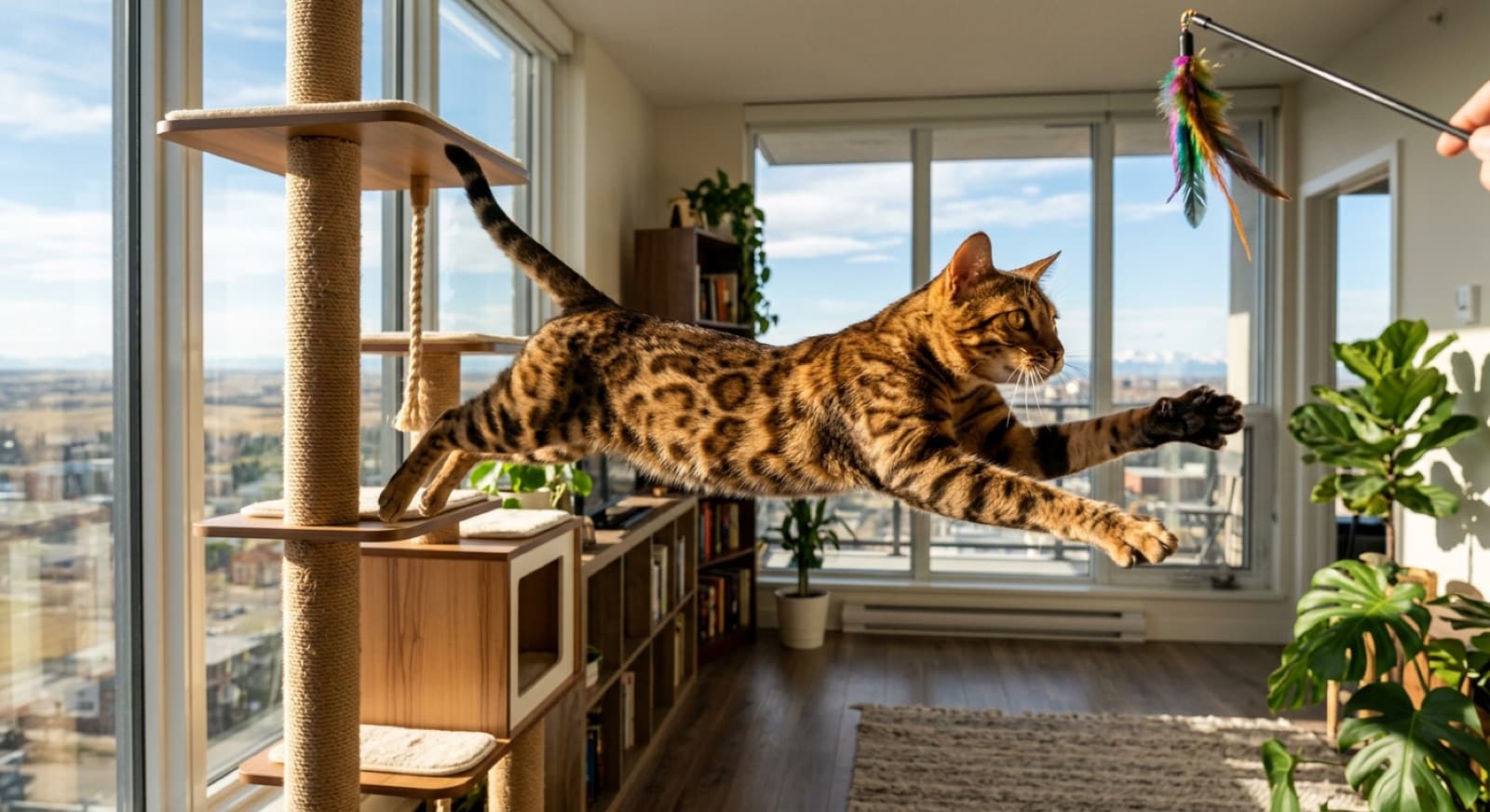
What “Bengal energy” actually means
The Bengal breed was founded in the 1960s and 1970s by crossing the wild Asian Leopard Cat with domestic shorthairs. The wild ancestry is now four to six generations back in every legally pet-class Bengal (F4 and beyond, also called SBT), but the behavioural inheritance did not dilute the way the coat pattern did. A modern SBT Bengal looks domestic but acts like a small wild cat in a domestic body.
The traits that define Bengal energy:
- Extreme prey drive. A Bengal will stalk, pounce, and catch toys for 30 to 45 minutes when most cats lose interest at 10. The drive does not turn off; it needs an outlet.
- Vertical climbing instinct. Bengals jump 6 feet vertically from a standing start. Bookshelves, fridge tops, curtain rods, and the highest point in any room are default targets. If you do not give them legal high places, they will invent them.
- Problem-solving intelligence. Bengals open lever-handle doors, drawers, cabinets, and faucets. They watch what you do and replicate it. Child-locks on cupboards with treats inside are common Calgary Bengal-owner installations.
- Water curiosity. Most Bengals jump into showers, play in water bowls, drink from running taps, and bat at running faucets. This is not a quirk of individual cats; it is breed-typical. Leaving a tap dripping is a common enrichment hack.
- Vocalisation. Especially males, especially intact, especially at night, especially under-stimulated. Bengals chirp, trill, yowl, and meow at full volume. Quiet is not a Bengal trait.
- Nocturnal energy peaks. 3 to 5 AM zoomies are stereotypical. The cat sleeps in the daytime, wakes at dusk, and is most active when you want to sleep. This is normal and addressable with a 9 PM hard play session and a late feeding.
None of this is a Bengal misbehaving. It is breed-typical behaviour expressed in a home environment that did not anticipate it. The cat you adopted is doing exactly what 70 years of selective breeding produced. The question is whether your setup matches the cat.
For a baseline reference on cat behavioural needs, International Cat Care’s cat-friendly home guidelines apply universally but the activity-level expectations need to be roughly doubled for a Bengal.
Why Bengals end up in rescue: the surrender story
The Bengal rescue intake pattern repeats almost word for word across North America. The phrasing owners use when surrendering (paraphrased from Bengal Rescue intake notes and consistent across breed-specific rescue networks):
- “Too much energy for our apartment.”
- “Destroyed our blinds and curtains.”
- “Knocks everything off every shelf.”
- “Yowls all night, the neighbours are complaining.”
- “Attacks our other cat.”
- “We work from home and he will not leave us alone for video calls.”
- “Bites and scratches during play, drew blood.”
The pattern underneath all of these: the adopter wanted an exotic-looking cat, did not read deeply about Bengal-specific behaviour, brought home a kitten that was manageable for the first few months, and then energy ramped up in adolescence (6 to 18 months) past what the household could handle. The cat is not defective. The setup did not match the cat.
The pattern is preventable with realistic expectations and the right environment from day one. It is much harder to retrofit. A Bengal who has spent six months learning that the curtains are the best vertical surface available will not stop climbing curtains just because you finally bought a cat tree. The behaviour is established. You have to redirect, not just provide.
In Calgary specifically, we see the “single Bengal in a single-bedroom condo, owners both work full time” surrender at MEOW Foundation, Calgary Humane Society, and AARCS on a recurring basis. The cats are healthy. The owners did most things right. The one thing they did not do was build the enrichment infrastructure before the cat moved in.
The Calgary apartment and condo reality
Calgary’s downtown core and inner neighbourhoods are dense with condo and apartment living. Beltline, Mission, Bridgeland, Eau Claire, Kensington, and Inglewood all skew small-unit. A typical adopter inquiring about a Bengal is in a 600 to 900 sqft one-bedroom condo. This is fine for a Bengal in principle. It is not fine without setup.
Three Calgary-specific compounding factors:
- Six-month indoor-only season. November through April, the cat is not getting any outdoor stimulation. -25°C is not catio weather. Harness walks are off the table for most of winter. The cat’s entire stimulation budget for six months comes from inside the unit.
- Thin condo walls. Bengal yowling at 3 AM through a shared bedroom wall is a real neighbour-complaint and lease-termination risk. Detached housing tolerates a vocal cat. Condos do not.
- No off-leash cat infrastructure. Unlike dogs, there is nothing in Calgary that lets a cat burn energy outdoors safely. No cat parks. No off-leash trails. The bird-feeder catio in the back yard does not exist in a 5th-floor condo.
The good news: square footage matters far less than verticality and scheduled stimulation. A well-set-up 700 sqft condo can house a happy Bengal indefinitely. A 1,500 sqft suburban home with no cat tree, no scheduled play, and food in a bowl produces the same surrender story.
The Calgary fix is not moving to a bigger place. The fix is the setup inside the place you have.
The enrichment infrastructure that actually works
These are the structural pieces that turn a destructive Bengal into a calm one. No single item is sufficient. Combining 5 or 6 of them is the working baseline. Combining all of them plus a second cat is the platinum setup.
1. A 6 ft cat tree, weight-rated for 15+ lbs
Non-negotiable. The single highest-impact piece of cat furniture in a Bengal household. Multiple platforms, a sturdy base that will not tip when a 12 lb cat launches from the top, positioned near a window with bird or squirrel view. Budget $150 to $300. Cheap $40 trees from big-box stores collapse under adult Bengals within months. Brands that hold up: Frontpet, Go Pet Club, Armarkat large-cat models, Trixie. Two trees in two rooms is better than one big one.
2. Two or three window perches
Bengals watch outside activity for hours. Window perches give them altitude, sun, and visual stimulation without you doing anything. Suction-cup designs work on most condo windows; freestanding perches work where suction does not. Calgary backyards attract chickadees, magpies, house sparrows, and squirrels year-round. A $30 bird feeder mounted within view of a window pays back enormously in cat wellbeing. Two perches in different windows is meaningfully better than one.
3. Puzzle feeders for at least 80% of meals
Replace the food bowl with puzzle feeders for dry food and slow feeders for wet. Extends mealtime from 5 minutes of grazing to 20 to 30 minutes of mental work. Drains the same kind of energy that destruction comes from. Brands: Trixie, Catit Senses, Doc & Phoebe’s Indoor Hunting Feeder, Petsafe SlimCat. Budget $15 to $40 per puzzle. Rotate 3 or 4 designs so the cat does not solve them on autopilot. Hide a few puzzles around the apartment so the cat has to forage.
4. Scheduled interactive play, twice daily
15 to 20 minutes morning, 15 to 20 minutes evening, minimum. Use prey-style wand toys: Da Bird (feathers), Cat Dancer (wire), Neko Flies (insect mimics). Rotate them daily so they stay novel. Follow the natural sequence: stalk, chase, catch, eat. Let the cat win the toy. Feed a small meal after the evening session. This sequence drains Bengal energy more efficiently than any other intervention. Laser pointers alone, without a closing capture target, leave the cat frustrated rather than satisfied.
5. A second cat companion
Often the single most effective mitigation. Two Bengals (especially sibling pairs from the same litter) burn off energy on each other and dramatically reduce destruction and yowling. A confident adult Domestic Shorthair or active Tonkinese also works. What does not work: pairing a Bengal with a shy senior cat (the senior gets bullied) or with a small fragile pet (prey drive). For introduction protocol, see our cat-to-cat introduction guide.
6. A catio (enclosed outdoor patio)
If you have a balcony or patio, screening it into a catio is the highest-impact Calgary enrichment investment. Bengals get fresh air, sunlight, real bird activity, and outdoor stimulation without escape, theft, or predator risk. Works most of the year except deep cold snaps. DIY catio kits run $300 to $800; balcony screening is cheaper. Check your condo board rules first; most allow it with a balcony enclosure that does not modify the building exterior.
7. Harness training (for some individuals)
Bengals are uniquely leash-trainable compared to other cat breeds. Not every individual will accept a harness, but many do, especially when started at 8 to 16 weeks. Use a proper cat harness (not a dog model), build tolerance indoors for several weeks, then try short low-stimulation outdoor walks. Calgary winter limits this for six months, but spring through fall harness walks are a real enrichment option for some Bengals. Pathways behind your block, quiet courtyards, and your own back yard work better than busy streets.
8. Foraging hides and rotated novelty
Rotate hidden food and treat stashes around the apartment. Small portions tucked on shelves, in cardboard boxes, inside paper bags. Mimics the natural patrol behaviour of a small wild cat working a territory. Combined with puzzle feeders this gives the cat a job. Rotate toys in and out of storage on a weekly basis so the same dozen toys feel novel every Monday.
The vocalisation problem (especially nighttime)
Bengal yowling is one of the top three surrender drivers in Calgary condos. Thin walls plus a vocal breed plus a frustrated cat is the recipe for neighbour complaints and lease conversations. The good news: nighttime yowling is one of the most fixable Bengal problems if you address the underlying cause.
The yowling is almost always one of:
- Hunger. Real or boredom-disguised. Cat last ate at 6 PM, peak hunger is 4 AM, and the cat is broadcasting that fact.
- Seeking attention. Cat learned that yowling brings you out of bed to feed, pet, or yell. Any response (including yelling) reinforces the behaviour.
- Understimulation frustration. Cat slept all day, has full energy at 3 AM, no acceptable outlet, vocalises out of pent-up drive.
- Sexual frustration. Intact males spray and vocalise. Spay/neuter at 6 months minimum resolves most of this. All Calgary rescue cats are altered before adoption.
- Multi-cat territorial conflict. Two cats not properly bonded, midnight skirmishes, yowling escalates.
- Medical. Hyperthyroidism (common in older cats) causes vocalising. Vet workup rules this out.
The fix for the most common case (hungry, understimulated cat) is a scheduling change rather than a behavioural one:
- Feed the last meal at 10 PM, not 6 PM. Delays peak hunger from 4 AM to 8 AM, which lands during your wake window.
- Run a hard 15-minute wand-toy session at 9 PM. Drains energy right before sleep. The cat is genuinely tired when you go to bed.
- Set an automatic feeder for a small 5 AM portion. The cat learns the feeder is the reliable source, not you. Petlibro and Petsafe automatic feeders run $60 to $150 and last years.
- Do not respond to yowling. Any response (food, attention, even yelling) reinforces it. The first 5 to 10 days are hard. After that, the behaviour extinguishes if the schedule above is in place.
If yowling persists for more than two weeks after implementing this schedule, escalate to a vet for medical workup. Hyperthyroidism is the most common medical cause in older Bengals.
Adolescence (6 to 18 months) — the hardest window
If you adopt a Bengal kitten and survive the first six months, you are not in the clear. Adolescence is when most Bengal surrenders happen. The 6 to 18 month window is peak intensity: energy surges, boundary testing, sexual maturation if not yet altered, and the development of habits that will define the adult cat.
Like adolescent dogs of high-drive working breeds, adolescent Bengals act out for predictable reasons. Their bodies are adult-sized but their impulse control is not. They test what they can climb, what they can knock over, what gets a reaction. They also enter sexual maturity around 6 months if not spayed or neutered: females cycle, males may begin to spray. Calgary rescues alter every cat before adoption, so this is rarely an issue for adopted Bengals, but it matters for kittens from breeders.
Surviving Bengal adolescence:
- More play, not less. Adolescent Bengals often need 60 minutes of interactive play per day, not 30. Add a midday session if you can; otherwise extend the morning and evening sessions.
- Spay/neuter at 6 months minimum. Non-negotiable. Resolves most spraying, cuts down vocalisation, eliminates roaming attempts.
- Reinforce climbing on legal surfaces. Treat the cat tree as the high-value zone. Discourage furniture climbing with redirection (pick up, place on tree, treat) rather than punishment.
- Expect destruction during this window. One ruined houseplant, one shredded blind, one knocked-over lamp is normal. If you make it to 18 months without a surrender conversation, adulthood is calmer.
- A second cat helps disproportionately during adolescence. Two adolescent Bengals burn off energy on each other in a way no human can match. This is the single biggest case for getting two cats from the start.
The 12 to 18 month window is statistically when most Bengal owners surrender. If you make it past that, you have an adult cat who is still demanding but manageable. Adulthood from 3 years onward is the easier ride.
Multi-cat household compatibility
Bengals do well in multi-cat households with the right companions. The wrong pairings cause more problems than they solve.
- Bengal + Bengal: usually excellent, especially sibling pairs from the same litter or established bonded pairs. Two adolescent Bengals together is the single biggest energy-drain combination.
- Bengal + confident adult Domestic Shorthair: usually works if introduced slowly over 2 to 4 weeks. The DSH needs to be confident and play-oriented, not shy or sedentary.
- Bengal + active Tonkinese, Abyssinian, or other high-energy breed: usually works. Similar play styles and energy levels.
- Bengal + shy senior cat: usually fails. The senior is bullied, the Bengal escalates, the senior’s quality of life collapses. Avoid.
- Bengal + dog: variable. Medium-energy cat-friendly dogs (most Labs, Goldens, mixed breeds raised with cats) often pair well and play together. Nervous, prey-driven, or small fragile dogs are poor matches.
- Bengal + small pets (hamsters, rabbits, birds, lizards): do not house in the same room. Bengal prey drive is strong enough that even a closed cage is stressful for the prey animal and obsession-inducing for the Bengal.
The introduction process matters as much as the pairing choice. Even a perfect pairing can fail if introduced badly. Plan for 2 to 4 weeks of scent swapping, visual contact through a door, supervised short co-presence, and gradual escalation. Our cat-to-cat introduction guide covers the full protocol.
Browse adoptable Bengal-type cats in Calgary
Many Bengal mixes in Calgary rescue are surrenders from owners who underestimated the energy. Foster notes describe the actual cat in front of you, including energy level, household compatibility, and training, which is more useful than breed reputation alone.
See Available Bengals →When energy becomes a behavioural problem — and when to escalate
Normal Bengal energy is not a behavioural problem. A demanding cat that climbs, vocalises, and plays hard is doing what the breed does. The line between “Bengal being a Bengal” and “something is wrong” is whether the behaviour responds to environmental work.
Red flags that warrant a vet visit AND a certified cat behaviour consult:
- Aggression toward humans. Not play-biting; actual hostile aggression with stiff body, flat ears, hissing, and unprovoked attacks. Different from rough play.
- Inappropriate elimination outside the litter box. Especially if persistent and not explained by litter-box hygiene or competition with another cat.
- Self-injurious overgrooming. Fur loss on belly, inner thighs, base of tail. Skin underneath usually healthy. This is psychogenic alopecia and signals chronic stress.
- Persistent intercat aggression. Beyond normal play. Stalking, ambushing, unprovoked attacks on a household cat over weeks.
- Sudden behaviour change. A calm Bengal who becomes destructive overnight, a vocal Bengal who goes silent, an active Bengal who hides. These usually have medical causes.
Vet first, behaviourist second. Several medical conditions present as behaviour issues. A urinary tract infection causes litter-box avoidance. Hyperthyroidism causes vocalising and pacing. Dental pain causes withdrawal and aggression. Hypertension causes restlessness. A vet workup with bloodwork and a urinalysis rules these out before behavioural treatment makes sense. The American Association of Feline Practitioners publishes feline behavioural guidelines that align with this medical-first protocol.
For complex behaviour cases with multiple co-occurring issues, Western Veterinary Specialist & Emergency Centre accepts referrals for internal medicine and behaviour-relevant workups. For the behavioural side specifically, look for an IAABC-certified cat behaviour consultant; the IAABC directory lists certified consultants and some offer remote video sessions across Canada. Initial consults run $200 to $400.
Medication is rarely the first answer for a Bengal. The vast majority of behaviour problems in this breed respond to environmental modification. If a vet behaviourist does recommend short-term anxiolytic support during a transition (move, new baby, new pet introduction), follow their direction. Never medicate a cat without veterinary supervision.
Indoor-only commitment and the harness exception
Bengals are indoor-only cats for safety reasons. Theft risk is real (Bengals are visually distinctive and high-value, and stolen-cat reports in Calgary are not rare). Escape risk is high (problem-solving plus prey drive plus athletic ability). Predator risk is real in any Calgary neighbourhood that backs onto green space; coyotes take cats year-round, especially in winter. Cold injury is real for any cat outdoors in Calgary winter.
That said, Bengals tolerate outdoor stimulation more than most breeds when delivered safely:
- Catio: always a yes. Enclosed, supervised, controlled. Works most of the year in Calgary.
- Harness walks: a yes for some individuals. Start kitten-young, build tolerance indoors first, low-stimulation environments only. Quiet streets, your own back yard, courtyards work better than busy streets.
- Balcony with secure screening: a yes if the balcony is fully enclosed against jumping. Open balconies are not safe for any cat, especially a Bengal who will absolutely attempt the jump to the next balcony or the bird below.
- Free-roam outdoors: never. The breed traits that make Bengals fun (athleticism, problem-solving, prey drive) are the same traits that get them killed or stolen outside.
For the broader indoor-outdoor decision framework that applies to all Calgary cats, see our indoor vs outdoor cats guide.
What enrichment failure vs working setup actually looks like
The two stories Calgary Bengal owners send rescue intake coordinators.
Story A — enrichment failure (the surrender story):
900 sqft one-bedroom condo. Single owner, works full time outside the home, gone 9 hours a day. One small carpet-post cat tree, 4 feet tall, against a wall (no window view). Three toys on the floor that the cat lost interest in after the first week. Food in a bowl, refilled twice a day. 5 minutes of laser-pointer play maybe three nights a week. No second cat. No catio. No window perch. The cat has nothing to do for 9 hours, finds the curtains, climbs them, falls, finds the bookshelf, knocks things off, finds the bedroom and shreds the rug. Yowls from 4 AM onward because it slept all day. After six months the neighbours complain, the cat starts eliminating near the door, the owner calls a rescue. The cat is healthy. The setup was wrong.
Story B — working setup (the keeper story):
Same 900 sqft one-bedroom condo. Same single owner, same 9-hour workday. 6 ft cat tree near the south window with the bird feeder mounted outside. Second cat (Domestic Shorthair from MEOW Foundation, sibling-bonded with the Bengal kitten from a Calgary rescue litter at adoption). Two window perches. Three rotated puzzle feeders for 80% of meals. Twice-daily 20-minute wand-toy sessions, last one at 9 PM. Automatic feeder set for 5 AM small portion. Cat camera with treat dispenser for midday check-in. Catio on the balcony for spring through fall. Two years in, the cat is calm, the apartment is intact, the neighbours have never complained, and the cat lives to 16. The breed did not change. The setup did.
The gap between Story A and Story B is roughly $500 to $1,000 in one-time setup costs (cat tree, perches, puzzles, feeder, camera, catio) plus 30 to 40 minutes of daily owner time. That investment is what keeps a Bengal in a Calgary condo for life.
Frequently Asked Questions
How active is a Bengal compared to a regular cat?
A Bengal is the highest-energy domestic cat. Compared to a typical Domestic Shorthair, a Bengal will need roughly three to four times more interactive play, vertical climbing space, and mental stimulation to stay calm. The wild Asian Leopard Cat ancestry shows up behaviourally even in F4+ SBT lines: high prey drive, problem-solving intelligence, water curiosity, and pronounced vocalisation. A DSH is content to sleep 16 hours a day on a couch. A Bengal will climb the curtains if you do not give it something better to do.
Are Bengals okay in apartments?
Yes, but only with structural enrichment. Square footage matters less than vertical space, scheduled stimulation, and ideally a second cat. A 700 sqft Calgary condo with a 6 ft cat tree, two window perches, daily wand-toy sessions, and puzzle feeders works fine. The same condo without those is the recipe for the surrender story we see most often at Calgary rescues. The fix is not a bigger apartment. The fix is the setup inside the apartment you have.
How much daily play does a Bengal need?
Thirty to forty-five minutes minimum of interactive play, split into two or three sessions. Morning and evening 15 to 20 minute wand-toy sessions are the baseline. Adolescent Bengals (6 to 18 months) often need more. The sessions need to follow the natural hunt-catch-eat-groom-sleep sequence: chase the prey, let the cat catch it, feed a small meal afterward. A laser pointer with no closing capture leaves the cat frustrated, not drained.
Why does my Bengal vocalise so much?
Bengals are one of the most vocal domestic breeds, especially males, especially intact cats, and especially when understimulated. The yowling is usually one of: hunger (real or boredom-disguised), seeking attention, frustration from understimulation, sexual frustration (if intact), or multi-cat territorial conflict. The fix is not punishment. Schedule the last meal at 10 PM not 6 PM. Run an active play session at 9 PM. Set an automatic feeder for a small 5 AM portion so the cat learns to wait. Calgary condo walls are thin and neighbour complaints are real, so this matters more here than in detached housing.
Will my Bengal calm down with age?
Somewhat, but not as much as owners hope. Adolescence (6 to 18 months) is peak intensity and the hardest window. Adulthood from 3 years onward is more manageable but still demanding compared to a regular cat. A senior Bengal at 10 or 12 years is calmer but still climbs, plays, and vocalises more than most cats. Plan the household for the adult cat, not the dream of the cat eventually settling down.
Should I get two Bengals?
For most working households, yes. Two Bengals (especially sibling pairs from the same litter) burn off energy on each other and dramatically reduce destruction and yowling. A confident adult Domestic Shorthair or active Tonkinese also works as a second cat. What does not work is pairing a Bengal with a shy senior cat; the senior gets bullied. Adopt both at the same time from a Calgary rescue or as a bonded pair if possible.
Are Bengals good with dogs?
Often yes, with the right dog. Medium-energy, cat-friendly dogs (most Labs, Goldens, mixed breeds raised with cats) pair well with Bengals because the Bengal can match the dog energetically and they often play together. Nervous, prey-driven, or small fragile dogs are a poor match. The Bengal will chase. Introduce slowly over two to four weeks the same way you would introduce two cats.
Can a Bengal be harness-trained?
Yes, more reliably than most cat breeds. Bengals are uniquely leash-tolerant when started young (8 to 16 weeks is ideal) and many adults walk on a harness fine in low-stimulation environments. A few Calgary Bengal owners do short neighbourhood walks. Start with the harness indoors for several weeks before any outdoor attempt. Calgary winter limits this most of the year, but spring through fall harness walks are a real enrichment option for some individuals.
What is the right cat tree for a Bengal?
Minimum 6 feet tall, weight-rated for at least 15 lbs, with multiple platforms and a sturdy base that will not tip when a 12 lb cat launches from the top. Position it near a window with bird or squirrel view. Budget $150 to $300 for a quality tree. Cheap $40 trees from big-box stores collapse under adult Bengals within months. Brands that hold up: Frontpet, Go Pet Club, Armarkat, and Trixie large-cat models.
Are Bengals destructive?
Under-enriched Bengals are destructive. Properly enriched Bengals usually are not. The destruction story (shredded blinds, knocked-over shelves, ruined houseplants) is almost always a symptom of unmet exercise and mental stimulation needs. Calgary Bengal surrenders rarely come from households running full enrichment setups. They come from households where the cat had a small tree, a few toys, and 5 minutes of play a week, and the cat invented its own entertainment.
When should I see a cat behaviourist?
See your vet first to rule out medical causes. Several conditions mimic behaviour issues: hyperthyroidism causes vocalising and pacing, urinary tract infections cause litter-box avoidance, dental pain causes withdrawal and aggression. Once medical is ruled out, escalate to a credentialed cat behaviour consultant if you see persistent aggression toward humans, inappropriate elimination outside the box, self-injurious overgrooming, or chronic intercat aggression. Look for IAABC certification; some consultants offer remote video sessions across Canada.
Are Bengals good with kids?
Better with older children (8+) than toddlers. Bengals play hard, including with hands and feet, and the play style can overwhelm small children. School-age kids who can follow instructions about not chasing the cat and respecting cat body language usually pair well. Bengals are not lap cats with kids the way some Ragdolls are; they engage through play, climbing, and interactive games. A Bengal in a household with two active 10 year olds often does great.
Bengal Cats in Calgary
Browse adoptable Bengals and Bengal mixes from Calgary rescues with foster-documented temperament.
Bengal Adoption in Calgary
Rescue sources, real costs, surrender patterns, and how to find a real Bengal mix.
Bengal Health Issues
HCM, PRA-b, PK deficiency, and the Calgary specialty vets who handle Bengal care.
Bengal F1-F4 Alberta Legality
Generation rules, what is legal to own in Alberta, and why pet-class Bengals are F4+ SBT only.