The short answer
Indoor cats in Calgary live 12 to 18 years on average. Outdoor cats live 3 to 5. The biggest threats are coyotes (active in every Calgary neighbourhood), vehicle traffic, winter cold below -20°C, fights with other cats, and infections. Almost every Calgary cat rescue requires indoor-only adoption, and they're right. The American Bird Conservancy's Cats Indoors program and the American Association of Feline Practitioners both recommend indoor-only living as the standard of care.
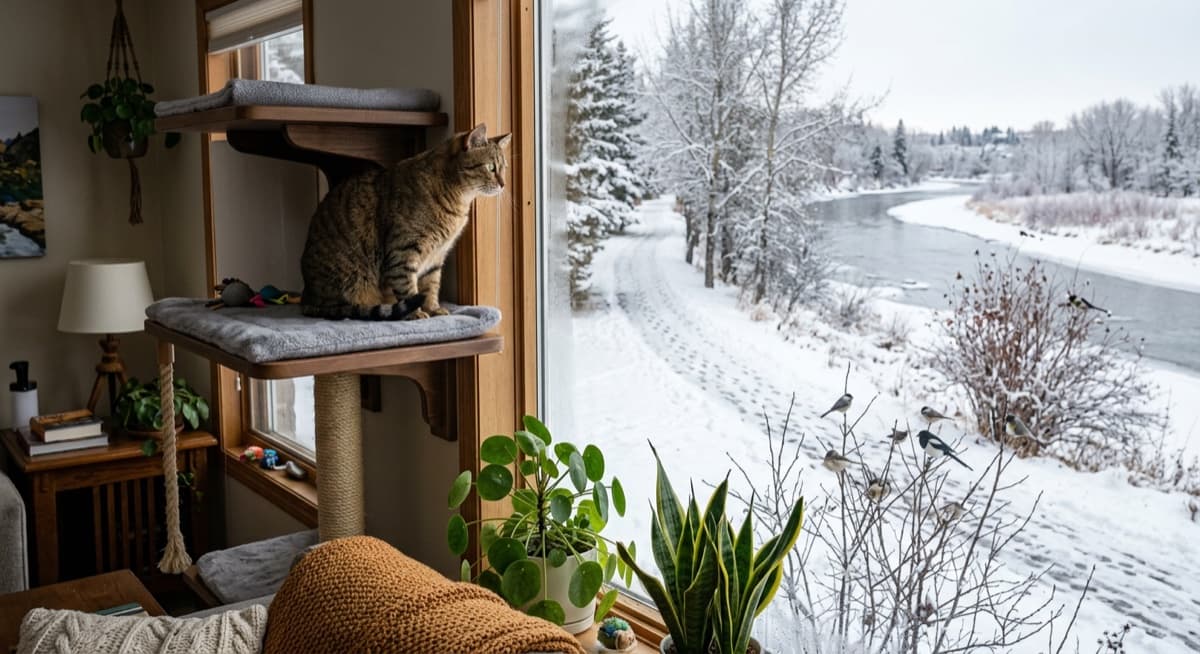
The lifespan difference is dramatic
Cat-care literature converges on roughly the same gap, summarized by the ASPCA and the American Association of Feline Practitioners:
- Indoor cats: typically 12 to 18 years, with many living to 20+
- Indoor-outdoor cats: typically 6 to 10 years
- Strictly outdoor cats: typically 3 to 5 years in urban Calgary
That's not subtle. An outdoor cat in Calgary loses roughly two-thirds of its potential lifespan compared to an indoor sibling.
What actually kills outdoor cats in Calgary
Coyotes: the biggest urban threat
Coyotes live throughout Calgary, including the river paths along the Bow and the Elbow. They have adapted to urban life and actively hunt cats in residential areas. Coyote sightings in inner-city neighbourhoods (Bridgeland, Bowness, Mount Pleasant, Hillhurst, Inglewood) are constant year-round. Coyotes hunt most actively at dawn, dusk, and overnight, exactly when many cats want to be out. A coyote can clear a 6-foot fence and grab a cat in seconds. Most Calgary cat rescues have stories of recovered cats killed by coyotes.
Vehicle traffic
Traffic is the single most common cause of outdoor cat death in suburban Calgary. Cats roam unpredictably and don't understand traffic. Roads with even moderate volume kill outdoor cats regularly. Speed limits don't matter; a slow car still kills a cat.
Winter cold
Calgary winters routinely sit below -20°C, with cold snaps reaching -30°C. A cat caught outside in those temperatures dies in hours from hypothermia. Even short-haired cats with thick coats cannot survive Calgary's coldest nights without shelter. Frostbite on ears, paws, and tail is common in cats let outside through Calgary winters.
Predators beyond coyotes
Larger raptors (red-tailed hawks, great horned owls) can take small cats. Foxes are present in Calgary's outskirts. Off-leash dogs in parks attack cats. Even raccoons can injure cats badly in fights.
Infections and parasites
Outdoor cats catch FIV (feline immunodeficiency virus, transmitted by bites in fights), FeLV (feline leukemia, transmitted by bodily fluids), feline panleukopenia, ringworm, fleas, ticks, intestinal parasites, and more. Indoor cats are essentially immune to most of these. The AVMA's indoor-outdoor cat guidance walks through the disease and injury risks in detail. If you have adopted an FIV-positive cat, see our FIV+ cat care guide.
Theft and “rescue”
Friendly outdoor cats are sometimes taken by strangers who assume they're lost. Purebred cats (Maine Coons, Bengals, Ragdolls) are stolen for resale. Even microchipped cats sometimes never come home.
Poison and human malice
Antifreeze (which tastes sweet to cats) is the most common accidental poisoning. Some neighbours don't want cats in their yards and intentionally poison or trap them.
Why Calgary rescues require indoor-only
Almost every Calgary cat rescue makes indoor-only living a non-negotiable adoption requirement:
- MEOW Foundation: strict indoor-only
- Calgary Humane Society: recommends indoor-only
- AARCS: strict indoor-only for cats placed in urban areas
- FRFA (Feline Rescue Foundation of Alberta): strict indoor-only
- Cochrane Humane: recommends indoor-only or supervised outdoor only
- Pawsitive Match: indoor-only requirement
They're not being overly cautious. They've seen too many rescued cats die after going outside. If you sign an indoor-only adoption agreement and then let the cat outside, the rescue can legally reclaim the cat. For the full adoption process and what rescues ask of applicants, see our complete Calgary cat adoption guide.
One more local rule that catches some new adopters by surprise: under the City of Calgary Responsible Pet Ownership Bylaw, every cat over 3 months of age requires a city licence. Licences fund animal services and help reunite lost cats with owners, which matters more if the cat ever does slip outside.
Safe outdoor alternatives
Catio (cat patio)
An enclosed outdoor structure attached to your home. The cat gets fresh air, sunlight, and bird-watching without predator or traffic risk. Catios range from $200 DIY kits to $5,000+ custom builds. Calgary has several catio builders (search “catio builder Calgary”) and DIY plans are widely available online.
Leash walks
Some cats tolerate harness training and short supervised walks. Use a proper cat harness (not a dog harness; they fit differently). Train indoors first for several weeks, then move to short outdoor walks. Never leave the cat unattended even on a leash. Most cats prefer the catio, but some genuinely enjoy walks.
Supervised yard time
You sit outside with the cat in a fenced yard. Stay within arm's reach the entire time. Most cats explore for 10-30 minutes then want to go back inside. This is high-effort but works for cats that desperately want outdoor sensory experience.
How to keep an indoor cat happy
The fair concern with indoor cats is boredom. Here's what actually helps:
Some product links below are Amazon affiliate links — we may earn a small commission at no extra cost to you. It never changes what we recommend.
- Vertical space. Cat trees, wall shelves, cat condos. Indoor cats use vertical territory more than horizontal, so height matters more than square footage.
- Window perches with a view. Position by windows facing bird feeders, busy streets, or backyards. “Cat TV” entertains for hours.
- Daily interactive play. 10 to 15 minutes with a wand toy is enough. Make them chase, pounce, and “kill” the toy.
- Puzzle feeders. Make them work for kibble. Slows eating, exercises their hunting instinct.
- Rotating toy supply. Hide half their toys, swap weekly. Old toys feel new again.
- A feline companion. Two cats keep each other entertained when you're at work. Bonded pairs are perfect for this.
- Bird feeder outside the window. Cheap and endlessly entertaining.
- Catnip and silvervine. Most cats respond to one or both. Natural enrichment, no downside.
A brand-new cat needs more than enrichment. They need a careful settling-in period before they trust their new home. See our first week with a rescue cat guide for the decompression timeline.
What about barn cats and feral cats?
Some Calgary-area rescues (notably FRFA and rural shelters) place barn cats: semi-feral cats that don't want to live indoors and would be miserable in a house. These cats are placed in farm and acreage settings with shelter, food, and basic care, but live primarily outdoors. They're a different category from house cats and are matched specifically with outdoor-life situations. Don't confuse “barn cat placement” with “outdoor cat”; these are cats that genuinely cannot live indoors.
Previously outdoor cats: the transition
If you adopt a cat that was previously indoor-outdoor, the transition to indoor-only is hard. They'll cry at doors and windows for weeks. Stick with it. They adjust, but it takes 4 to 8 weeks. Increase enrichment significantly during this period. Once adjusted, they typically stop trying to escape. If your cat does slip outside and gets hurt, our Calgary emergency vet guide covers where to go after hours.
Frequently asked questions
How long do outdoor cats live in Calgary?
3 to 5 years on average, versus 12 to 18 years for indoor cats. The lifespan gap is one of the largest in the cat-care literature.
Are coyotes really a threat to Calgary cats?
Yes. Coyotes are present throughout the city, including inner-city neighbourhoods. They actively hunt cats. The City of Calgary tracks coyote activity and reports cat predation as a major concern in residential areas.
Can I let my cat outside if I have a fenced yard?
Cats climb 6-foot fences easily. Coyotes also enter most yards. Only safe outdoor options are a catio or supervised leash walks. Never leave the cat unattended outside.
How do I keep my indoor cat happy?
Vertical space, window perches, daily interactive play, puzzle feeders, rotating toys, and ideally a feline companion. Bored cats develop behaviour issues, so enrichment is essential.
There's a feral cat colony in my Calgary neighbourhood. What can I do?
Contact MEOW Foundation's Trap-Neuter-Return (TNR) program. They lend traps free of charge to community members, then handle spay/neuter, vaccination, and ear-tipping (the universal sign of a sterilized community cat). Returned cats live out their lives without producing more kittens, so the colony stabilizes and shrinks over time. TNR is the most humane and most effective way to manage feral colonies. Don't try to relocate or trap-and-remove cats yourself, since feral cats die quickly outside their territory. AARCS and other Calgary rescues sometimes assist with kitten-only intake from colonies (kittens under 8 weeks can usually be socialized; adult ferals usually cannot).
Browse indoor-only cats in Calgary
Cats specifically suited for indoor and apartment living from Calgary rescues.
Browse Indoor Cats →Related guides
New cat? Start with these care guides
Everything a new adopter needs to set up a safe, happy home.