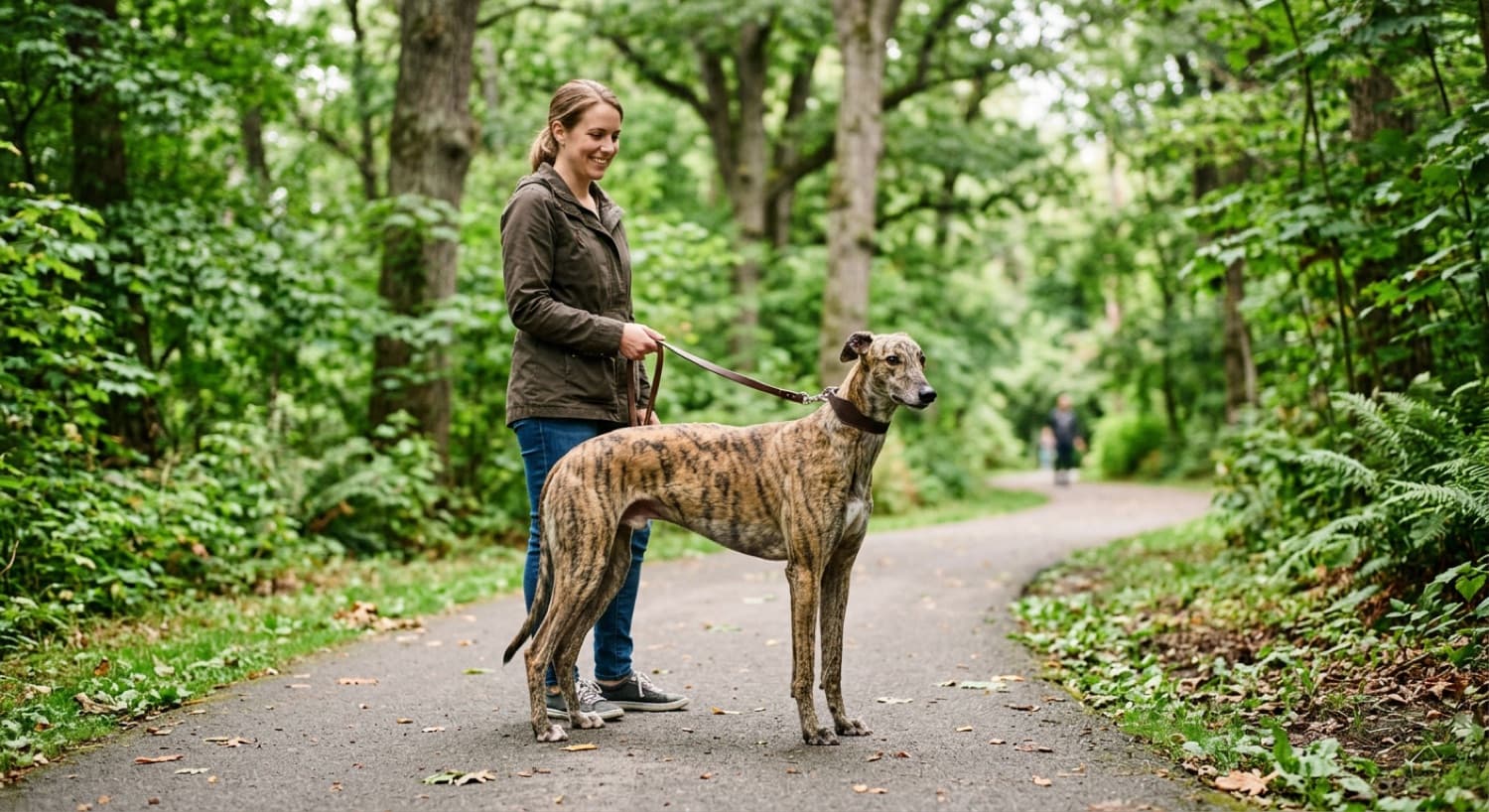
The short answer
Your retired racer has never seen stairs, mirrors, soft beds, vacuums, glass doors, or a quiet house before. Racing kennels are single-level concrete with kennel-mates around the clock and scheduled outings. Almost everything in a normal Calgary home is a first encounter for a 4 to 7 year old dog. The forum-canonical timeline is 6 days, 6 weeks, 6 months. Six days for basic survival, six weeks for routine, six months for the dog's real personality and trust to fully emerge. Do not evaluate the adoption at week 1. Judge it at month 6. Sleep startle is real (never pet a sleeping Greyhound). Housetraining takes 4 to 8 weeks. Most quirks resolve with patience.
What is the 6 days / 6 weeks / 6 months transition timeline?
The forum-canonical framing for retired racer adjustment. 6 DAYS: survival mode, learning the basics. 6 WEEKS: routine settles, real personality emerges. 6 MONTHS: full trust and household integration. Do not evaluate the adoption based on the first 6 weeks. Judge it at 6 months.
First 6 Days: Survival mode
- Dog learns where the door is, where food appears, that you are safe
- Expect refused meals, hiding, possible accidents
- No clear personality yet. The dog you see this week is not who they are
- Stairs likely impossible. Mirrors and the vacuum are genuinely terrifying
- Do not introduce visitors, do not bathe, no off-leash anywhere ever
- Stay home as much as possible. Book this week off if you can
First 6 Weeks: Routine settles
- Sleep patterns regulate. Settled Greyhounds sleep 18 to 20 hours a day
- Food intake normalizes. Most Greyhounds eat reliably by week 2 to 3
- Basic cues (name, “outside”) start to form
- Stairs become possible with consistent practice
- Housetraining accidents drop. Most reliable by week 4 to 6
- Personality starts to emerge: goofy, dignified, anxious, snuggly. You start to see who they are
First 6 Months: Full integration
- Trust is fully established. The dog has bonded with you
- Separation tolerance normalizes (1 to 6 hours alone is fine for most)
- Household routines are predictable, and the dog initiates them on their own
- Real personality fully visible: silly, dignified, mischievous, whoever they are
- Some dogs continue settling for 12+ months. Do not worry if your dog is on a slower curve
Why won't my new Greyhound lie down on his bed?
He has likely never seen a soft dog bed before. Racing kennels use thin foam or shredded paper. The dog does not recognize a plush bed as something to lie on. Solutions: place the bed where you sit (your scent plus the bed equals trust), do not force them onto it, leave a worn t-shirt on the bed, place treats on it without pressure. Most retired racers figure out beds within 1 to 2 weeks. If after 4 weeks they still avoid it, try a flatter orthopedic bed. Deep plush beds feel unstable to a dog raised on flat surfaces.
My retired racing Greyhound won't eat on day one. Should I worry?
Skipping meals in the first 24 to 72 hours is a normal stress response, not breed-specific. Greyhounds out of racing kennels often refuse food in new environments. The food is different from track kibble, the bowl is in an unfamiliar spot, and they are used to eating with kennel-mates. Try the same kibble brand the rescue used, feed in a quiet low-traffic spot, leave food down 15 minutes then remove. Do not hand-feed. It creates dependency. If 48 hours pass with no food or water, vet check. Greyhounds are deep-chested and bloat-prone, so prolonged anorexia plus sudden re-feeding needs vet guidance.
How do I teach my new Greyhound to use stairs?
Most retired racing Greyhounds have never seen stairs in their life. Racing kennels are single-level. The bewildered “stairs are baffling” reaction has gone viral several times. Your dog is not broken.
Process: (1) Start with a single low step (porch step). (2) Use treats to lure forward. (3) Once comfortable, try 2 to 3 stairs. (4) Practice going UP first (easier than down for sighthound body shape). (5) Never push or carry. Let the dog process. Most Greyhounds master stairs within 2 to 4 weeks. If you live in a 2-story Calgary home, plan for the dog to live mostly on the main floor for the first month.
What is sleep startle (alligator-rolling) and how do I prevent getting bitten?
Sleep startle is a documented Greyhound trait. The dog snaps reflexively if touched while deeply asleep. Some Greyhound networks call it “alligator-rolling” because the head whips fast and the snap is reflexive. Not aggression. An involuntary nervous response from racing kennel life where dogs slept in stacked crates without physical interruption. The dog often wakes confused, sometimes with no memory of snapping. NEVER pet a sleeping Greyhound. Say their name first or scuff your foot to wake them, wait until they look at you, then approach. Tell every household member, especially children. Use baby gates to keep kids away from the dog's bed. Sleep startle usually fades over 6 to 12 months as the dog feels safe in their new home, but the underlying reflex never fully disappears in some dogs. Manage the environment. Do not try to train it out.
My Greyhound is afraid of mirrors, glass doors, the vacuum, and the TV. Is this normal?
Completely normal. Racing kennels have none of these. First-mirror exposure causes confusion. Some Greyhounds bark at their reflection or try to circle behind it. Glass doors cause hesitation. The world is right there but they bump into it. The vacuum is genuinely terrifying because they have never heard a household appliance. TV surprises them on day one too, especially shows with animal sounds. Introduce slowly. Keep the vacuum off when first showing it. Approach noisy items with treats and a calm voice. Give the dog escape options. Most Greyhounds adjust within 2 to 4 weeks of repeated exposure.
How do I housetrain a kennel-raised Greyhound?
Treat your retired racer as completely untrained for the first 2 to 4 weeks. They have been let out of kennels at scheduled times for years and have never had to signal a person. The entire concept does not exist for them. Process: schedule potty trips every 2 to 3 hours initially, watch for signs (sniffing, circling, restlessness), reward heavily for outside elimination, supervise indoors continuously, crate when not supervised. Most retired racers are reliably housetrained within 4 to 8 weeks. UTIs mimic housetraining failure, so book a vet check if accidents persist past 30 days despite consistent routine.
When can I leave my new Greyhound alone?
Slowly, starting from week 2 to 3. Greyhounds raised in racing kennels are highly social pack dogs. They slept and ate alongside other Greyhounds around the clock. Sudden hours alone in a quiet house can produce separation anxiety if rushed. Process: 5 to 10 minute absences in week 1 to 2 (literally walk to the mailbox), build to 30 to 60 minutes in week 2 to 3, half-day by week 4 to 6. A second dog dramatically reduces SA in Greyhounds. Adopting a bonded pair from NCGL or other Greyhound rescues is a strong option. If the dog vocalizes, paces, or destroys things while alone, slow the timeline and consult a force-free Calgary trainer.
Muzzles, prey drive, and why a retired racer never goes off leash
Three rules every Greyhound rescue in Canada repeats. Skip these and you risk a bite, a dead cat, or a dog killed in traffic.
Basket muzzles are familiar, not stressful
Most retired racers have been muzzled daily for years. A basket muzzle is useful in the first 4 to 8 weeks if you have a resident cat, small dog, or kids in the house. Pick a basket muzzle so the dog can pant, drink, and take treats. Phase out once you have read the dog's real reactions over a few weeks. Calgary NCGL volunteers can recommend correct sizing.
Prey drive is real and cat-testing is not a guarantee
Greyhounds were bred to chase small fast-moving animals. A reputable rescue will cat-test before placement and tell you straight. Even a cat-tolerant Greyhound needs slow introductions, baby gates, and supervised contact only for the first 30 days. Outdoor cats and stray cats are different from a resident indoor cat. The dog who tolerates your cat on the couch may still chase one across the yard. Assume prey drive is on until proven otherwise.
Never off leash in unfenced space, ever
Greyhounds top 70 km/h in seconds and have almost no recall when prey drive triggers. Even bonded retired racers will chase a squirrel across four lanes of traffic. Calgary off-leash parks like Nose Hill and Sue Higgins include other dogs, cyclists, and wildlife your Greyhound was bred to chase. The rule is universal: never off leash in unfenced space. Use a 30-foot long line in private fenced yards for sprinting, and a 6-foot leash for everything else.
Calgary-specific first-month setup
Calgary's climate adds three first-month requirements your average Greyhound transition guide does not cover.
Winter coat ready before adoption
If you are adopting October through April, have an insulated coat sized and ready before the dog arrives. Greyhounds have 1 to 2 percent body fat and develop hypothermia at temperatures most dogs handle. Brands well-regarded for Greyhound fit: Voyagers K9 Apparel, Hurtta Extreme Warmer, Duds for Buds. See our Calgary winter dog care guide.
Slip lead plus martingale, no flat collars
Greyhound necks are larger than their heads. Standard flat collars slip off easily, especially during a startled spin. Use a martingale (limited-slip) collar for ID plus a sighthound-cut harness for walks. Slip leads are the standard for first-month walks because they cannot slip off.
Vet introduction in first 30 days
Find a Calgary vet experienced with Greyhounds before you need one. Greyhound bloodwork values are dramatically different from normal dogs (higher RBC, lower WBC). An inexperienced vet may misdiagnose normal Greyhound results as polycythemia or leukopenia. See our Greyhound health and vet guide.
Frequently Asked Questions
My Greyhound won't lie down on his bed?
Likely never seen one. Place it where you sit, leave a worn shirt on it, treats without pressure. 1 to 2 weeks. Try a flatter orthopedic bed if plush feels unstable.
Won't eat on day one. Worry?
Normal 24 to 72 hour stress response. Same kibble brand, quiet spot, no hand-feeding. 48 hours no food or water means vet.
Stairs are impossible. How do I help?
Never seen stairs in racing life. Single low step first, treats lure, UP before down, never push or carry. 2 to 4 weeks.
What is sleep startle?
Reflexive snap when touched asleep. Not aggression. Never pet a sleeping Greyhound. Wake by name or voice first. Manage the environment, especially around kids.
Afraid of mirrors, glass, vacuum?
Normal. Never seen any of these in racing kennels. Slow introductions, treats, escape options. 2 to 4 weeks.
Housetraining a kennel-raised Greyhound?
Treat as untrained for 2 to 4 weeks. Potty trips every 2 to 3 hours, supervise, crate. Reliable in 4 to 8 weeks. UTI check if past 30 days.
When can I leave my Greyhound alone?
5 to 10 min in week 1, 30 to 60 min in week 2 to 3, half-day by week 4 to 6. A bonded pair adoption helps. Slow the timeline if SA shows.
Should my Greyhound wear a muzzle at home?
Basket muzzle is familiar from track life. Useful for the first 4 to 8 weeks with resident cats, small dogs, or kids. Phase out once reactions are clear.
Can a retired racer be safe with cats?
Sometimes, never assumed. Get a rescue cat-test, do slow indoor introductions, use baby gates and a basket muzzle, and assume prey drive is on outside.
Why never off leash?
Greyhounds top 70 km/h in seconds and lose recall when prey drive triggers. Universal rule from every rescue: never off leash in unfenced space. Long line in fenced yards only.
What is the 6-6-6 timeline?
6 days survival, 6 weeks routine settled, 6 months full integration. Do not evaluate before 6 months. The dog you adopted and the dog you have at month 6 look like different animals.
My new Greyhound won't eat — is this normal?
Yes, very common in the first 3-7 days. The transition from kennel routine to home is stressful. Many ex-racers refuse food for 24-72 hours. Offer their previous diet, keep meals on a routine schedule, avoid forcing. If refusing food beyond 5 days OR showing other illness signs (vomiting, lethargy, dehydration), call your vet. Stress-related fasting is normal; medical issues are not.
Is post-adoption owner anxiety (feeling overwhelmed) normal?
Absolutely. Most owners describe weeks 2-6 as the hardest. You realize the commitment, the velcro reality, the never-off-leash limitation, and the medical considerations. This is called “post-adoption blues” and resolves with time, NCGL support, and seeing your dog settle. Reach out to other Greyhound owners on Reddit r/Greyhounds or local Calgary Facebook groups.
What are the biggest mistakes new Greyhound owners make?
Five common mistakes: (1) Taking off the Martingale collar before the dog learns “home = safety” (slip risk on Day 1), (2) Allowing off-leash in unfenced areas to “see what happens” (almost universal regret story), (3) Forcing introductions with cats or small dogs too quickly, (4) Disturbing the sleeping dog (sleep startle), (5) Treating the first 3 days as the personality baseline — the real dog emerges in weeks 3-6.
Are younger or older ex-racers better for first-time owners?
Depends on goal. Younger (2-4 yrs): more energy, longer companionship, longer training timeline, often comes with more medical needs. Older (5-8 yrs): calmer, lower-key, often already done first-home adjustment in fostering, may have known medical history. “Senior” Greyhounds (8+) are EXCEPTIONAL choices for retirees and first-time owners — calmer, grateful, often hospice-eligible reduced-fee placements through NCGL.
Do retired racers know how to be pets — have they ever been in a house?
Almost universally NO. Track Greyhounds live in kennels their entire racing career. The first time they see stairs, glass doors, mirrors, hardwood floors (slippery!), couches, beds, and household appliances is their first day in your home. Expect 2-4 weeks of “first-time” experiences. Most adapt within 2 months. The “alligator rolling” sleep startle is from kennel sleep instinct — wake by voice, not touch.
Greyhound Adoption Calgary
Where to find them, real costs, the off-leash truth, and Italian Greyhound distinction.
Greyhound Health + Vet Guide
Anesthesia, bloodwork, osteosarcoma, bloat, corns, dental. The page to print for your vet.
Greyhound Feeding & Digestion Calgary
Bloat prevention, racing-diet transition, slow feeders, large-breed kibble.
Rescue Dog Decompression
The general first-3-days protocol for any rescue. Pairs with this Greyhound-specific guide.
Calgary Winter Dog Care
Greyhound coats are mandatory in Calgary winter. Broader winter protocol covered here.
New dog? Start with these care guides
Everything a new adopter needs to set up a safe, happy home.