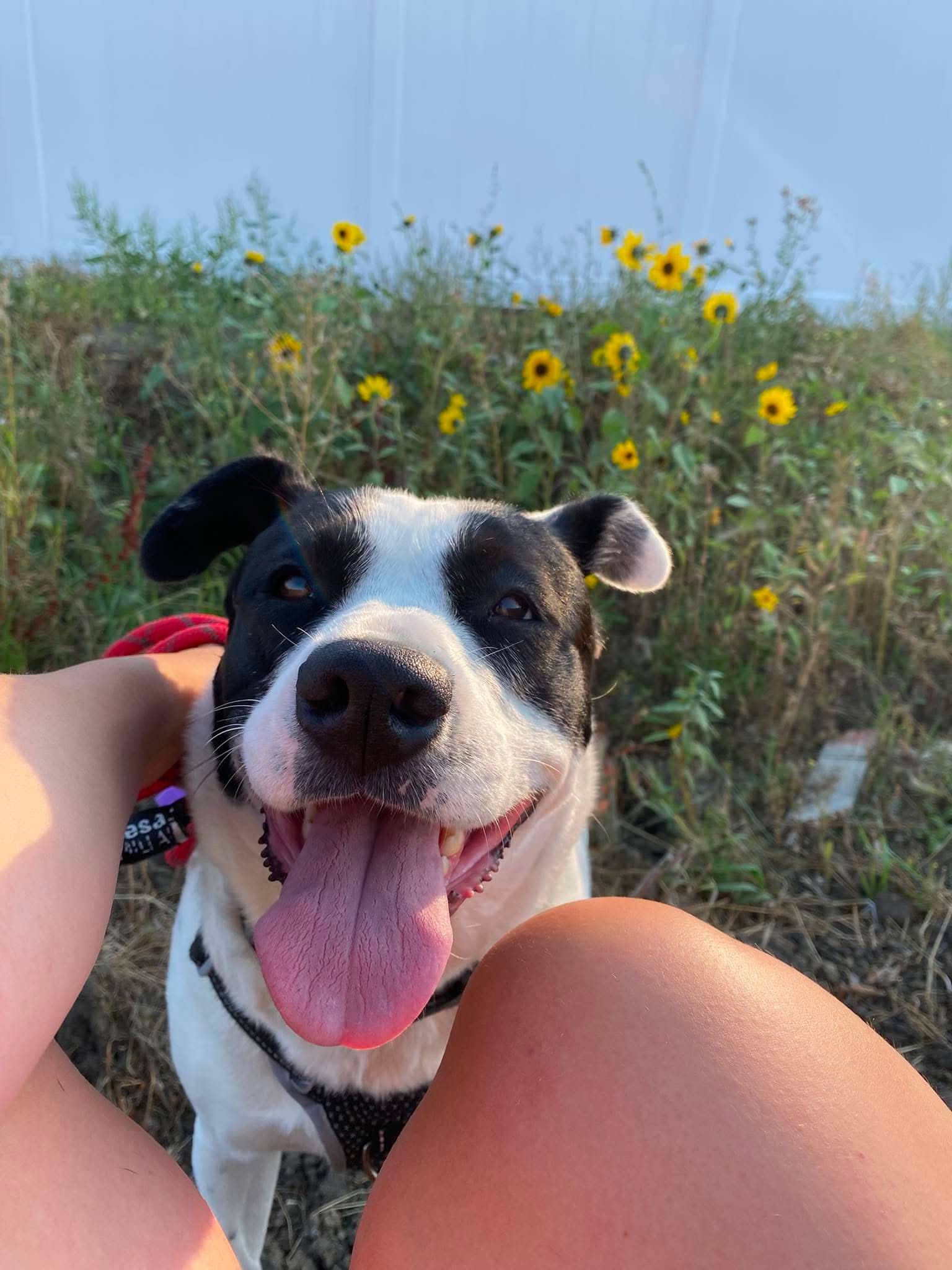
Pit Bulls in Saskatoon, right now
We're currently tracking 1 adoptable Pit Bull in central Saskatchewan, listed by 1 rescue including Running Wild Rescue. Listings update regularly, and most Pit Bulls in Saskatoon get adopted within days of being posted — if one catches your eye, reach out fast.
Adopting a Pit Bull-type dog in Saskatoon
Pit Bull-type dogs and bully crosses appear in Saskatoon rescue with high frequency. The Saskatoon SPCA on Hanselman Avenue, the Saskatoon Animal Control Agency pound on Clarence Avenue South, Bright Eyes Dog Rescue, Saskatoon Dog Rescue, and SOS Prairie Rescue all see Staffy-type dogs, American Staffordshire mixes, and bully crosses through the year. The breed category covers the American Pit Bull Terrier, American Staffordshire Terrier, Staffordshire Bull Terrier, and any cross with those parent lines plus visual bully traits — most adoptable Saskatoon dogs in this category are mixed-line crosses, often with Lab, Boxer, Mastiff, or Cattle Dog parentage.
This page pulls every adoptable Pit Bull-type dog from the Saskatoon shelters into one searchable place, refreshed regularly. Most adoptable Saskatoon Pit Bulls are 1 to 5 year old dogs surrendered from rural Saskatchewan acreages, from First Nations community intake (Saskatoon rescues regularly transport from reserves with strong intake pipelines), or from urban Saskatoon households where housing changed and the new building or landlord excluded the breed. Saskatoon rescues place Pit Bull-type dogs with applicants who have done basic homework on the breed, have insurance and housing sorted in writing, and are realistic about strength, dog-dog compatibility, and exercise needs.
Saskatchewan has no breed-specific legislation — read this first
Saskatoon and the Province of Saskatchewan have no breed-specific legislation (BSL). It is fully legal to own, adopt, transport into, or breed a Pit Bull-type dog in Saskatoon. There is no breed-based muzzle requirement, no mandatory sterilisation by breed, no breed-based liability insurance requirement, and no breed-based housing restriction in municipal law. The City of Saskatoon operates under two relevant bylaws: the Animal Control Bylaw No. 7860 (1999) covering licensing, leashing and general animal care, and the Dangerous Animals Bylaw No. 8176 (2003) covering aggressive-dog designation. Both are behavior-based, not breed-based.
Under Bylaw 8176, a dog can be declared "dangerous" by the Provincial Court only if the specific dog (a) without provocation, in a vicious or menacing manner, chased or approached a person or domestic animal, (b) is known to attack without provocation, or (c) has bitten, inflicted injury, or attacked a person or domestic animal without provocation. The designation applies to the individual dog based on documented behavior, not to a breed by appearance. Read the source at the City of Saskatoon dangerous-animals page <a href="https://www.saskatoon.ca/services-residents/pet-licensing-animal-services/enforcement/dangerous-animals" target="_blank" rel="noopener noreferrer">saskatoon.ca/services-residents/pet-licensing-animal-services/enforcement/dangerous-animals</a>. For comparison, Winnipeg has had a Pit Bull ban since 1990 and Ontario has the Dog Owners' Liability Act province-wide — Saskatoon adopters can legally own a Pit Bull-type dog where Winnipeg and Toronto adopters cannot. No 2024-2026 Saskatoon city council motion to introduce BSL is on record.
Saskatoon housing and insurance reality — landlord by landlord, not law
The absence of municipal BSL does not mean every Saskatoon landlord, condo board, or home insurer will accept a Pit Bull-type dog. Private exclusions are legal in Saskatchewan rental and insurance markets, and they are widespread. Most major Canadian home insurers (State Farm, Aviva, Intact, TD Insurance and several others) exclude or surcharge bully-type breeds by name on the standard liability portion of home and tenant policies, regardless of the individual dog's history. The exclusion is a written line in the policy schedule — get the policy in writing before applying to adopt. Some Saskatoon insurance brokers will shop a market that covers the breed without surcharge; the rescue often knows which Saskatoon brokers handle bully-type files routinely.
Saskatoon condo declarations in Stonebridge, downtown Saskatoon, the University area, Riversdale and Nutana sometimes write breed exclusions or weight caps (typically 25 to 35 lbs) into their bylaws. A 50 to 70 lb Staffy-type dog is over the weight line in some buildings. Saskatoon private landlords have wide discretion under the Saskatchewan Residential Tenancies Act to refuse pets — the protections that exist in Ontario do not exist here. Realistic Saskatoon placement is detached suburban (Erindale, Silverwood, Confederation, Lawson Heights, Sutherland), an owned home, or a verified pet-friendly rental with the breed in writing. Read everything in writing before applying to adopt — Saskatoon rescues will ask.
Why Pit Bull-type dogs cycle through Saskatoon rescue
Three patterns dominate Saskatoon Pit Bull-type intake. First: rural acreage and farm surrenders — Saskatchewan rural communities keep Pit Bulls and bully crosses as working farm dogs, guard dogs, and family pets, and the dogs surrender when farming families downsize, age out, or move into Saskatoon. The Saskatoon SPCA and rural Saskatchewan SPCAs handle the transfer pipeline. Second: First Nations community intake — Bright Eyes Dog Rescue, SOS Prairie Rescue, Saskatoon Dog Rescue, and several other Saskatoon-based foster networks run consistent intake from northern Saskatchewan reserves where free-roaming dog populations are managed through transport-and-rehome partnerships. Many of the most stable, well-tempered Pit Bull-type dogs in Saskatoon rescue come from these programs.
Third: urban Saskatoon housing-change surrenders. A bully-type dog that lived happily in a household for three years gets surrendered when the household moves to a new rental that excludes the breed by lease clause, when an insurance renewal flags the breed, or when a separation or job loss forces a downsize to a building that does not accept the dog. Saskatoon rescues hear this story constantly. Plenty of Saskatoon Pit Bull-type dogs stay in their homes their entire lives; the ones in rescue are usually there because of life circumstances, not because of behavior.
Health: HD/ED, mast cell tumors, atopic dermatitis, L-2-HGA
Hip dysplasia (HD) and elbow dysplasia (ED) run at moderately elevated rates in Pit Bull-type dogs — many adoptable Saskatoon bully crosses need eventual joint management ($80 to $200/mo NSAID + glucosamine + omega-3) or, in severe cases, surgical correction at WCVM small animal surgery in-city ($6,000 to $8,500 per hip for total hip replacement, $5,000 to $7,500 per knee for cruciate ligament repair). The Saskatoon advantage is concrete: WCVM small animal surgery, oncology and dermatology are all in-city on the University of Saskatchewan campus, a 10-minute drive from most Saskatoon neighbourhoods. Calgary, Edmonton or Regina Pit Bull owners face hours of road travel for the same referral-level care.
Mast cell tumors (MCTs) — the most common skin cancer in dogs — show up at elevated rates in Pit Bull-type breeds. WCVM oncology in-city handles biopsy, grading, surgical excision and follow-up chemotherapy when needed ($2,500 to $6,500 for surgical resection + grade III follow-up). Atopic dermatitis (environmental allergies, often presenting as paw licking, ear infections and skin redness) runs in many bully lines — WCVM dermatology in-city handles allergy testing and immunotherapy ($1,500 to $3,000 upfront plus $80 to $150/mo maintenance). L-2-hydroxyglutaric aciduria (L-2-HGA) is a neurometabolic disorder over-represented in Staffordshire Bull Terriers — a DNA test is available ($90 to $150 at Saskatoon vets) and Saskatoon rescues often have it run before placement. Other concerns: hypothyroidism, cardiac conditions, brachycephalic features in some lines, and cruciate ligament tears. Lifespan 10 to 14 years is realistic with proactive medical management. Pet insurance taken out the week of adoption is essential.
What Pit Bull-type dogs are actually like to live with
The stable Pit Bull-type rescue dog in Saskatoon is one of the most affectionate, people-oriented, family-bonded dogs in any shelter. The breed reputation in popular media is largely separate from the temperament profile of dogs that come through foster evaluation. Most Saskatoon adopters of bully-type dogs report a deeply bonded, gentle family companion. The realistic parts to plan for:
- Dog-dog compatibility varies. Some are excellent with other dogs; some are dog-selective in adolescence and adulthood. Read foster notes.
- Prey drive can be high. Cats and small animals are not safe assumptions for every dog. Saskatoon jackrabbits and ground squirrels are real triggers.
- Stranger-friendly by default. Most are not guard dogs — they welcome visitors. Suits busy households.
- Physically strong. Walking gear and the handler need to fit a 50 to 75 lb athletic dog. Solid leash control matters.
- Need real exercise. 60 to 90 minutes daily plus mental work. Sutherland Beach, Hampton Village, Avalon and Pierre Radisson off-leash all work.
- Saskatoon winter: short coats handle -35°C cold poorly without protection. Insulated coat below -15°C, paw boots for ice and street salt.
- Saskatoon summer: +30°C handles reasonably with shade and water, but brachycephalic-leaning dogs (American Bullies) need humidex caution.
- WCVM in-city advantage for MCT oncology, atopy dermatology, and orthopedic surgery.
- Insurance in writing before adopting. Most major Canadian insurers exclude or surcharge.
- 10 to 14 year lifespan with proactive medical management.
What the fee usually covers
Pit Bull-type adoption fees at Saskatoon rescues typically run $250 to $500 for an adult dog, $400 to $700 for puppies under 1 year. The fee covers spay or neuter, core vaccinations, microchip, deworming, behavior assessment in foster, basic dental check, and a vet check before placement. Saskatoon rescues running First Nations community transport pipelines often have lower fees and may run breed-specific adoption events with reduced fees to move volume. Confirm the exact number on the dog's own listing.
How to actually search
Apply within 48 to 72 hours when a Pit Bull-type dog matches the household. Use the filters above to narrow by energy (moderate-high), size (medium to large, 40 to 75 lbs), compatibility (especially around other dogs and cats), and shelter. Read foster notes on dog-dog history, prey drive, recall, leash strength, and any documented behavior incidents. Foster homes will set up a video call and an in-person meet-and-greet, and Saskatoon rescues will verify housing and ask for insurance documentation before placing.
Looking more broadly? Browse every adoptable dog across the province on Dog Adoption Saskatchewan.
The rescues that most often list Pit Bulls across Saskatchewan are Saskatoon SPCA, Saskatoon Animal Control Agency, Bright Eyes Dog Rescue, and Saskatoon Dog Rescue. For breed-specific background, the Canadian Kennel Club is a useful reference.
Pit Bull adoption in other Saskatchewan cities
Pit Bull Adoption FAQ — Saskatoon
How many Pit Bulls are available for adoption in Saskatoon?
As of October 2026, Pit Bulls are rare in Saskatoon rescue — only 1 is listed right now across 1 rescue on LocalPetFinder. They tend to get adopted fast, so setting an alert is the most reliable way to find one.
Where can I adopt a Pit Bull near me in Saskatoon?
Pit Bull-type dogs and bully crosses appear with high frequency in Saskatoon rescue. The major sources are the Saskatoon SPCA on Hanselman Avenue, the Saskatoon Animal Control Agency pound on Clarence Avenue South, Bright Eyes Dog Rescue, Saskatoon Dog Rescue, and SOS Prairie Rescue. Saskatoon rescues regularly transport from northern Saskatchewan reserves and rural acreages, so volume is consistent year-round. Set up an alert and apply within 48 to 72 hours of a dog appearing. Saskatchewan has no breed-specific legislation — the legality question is a private-insurance and private-landlord question, not a municipal law question.
Is it legal to own a Pit Bull in Saskatoon?
Yes. Saskatoon and the Province of Saskatchewan have no breed-specific legislation (BSL). It is fully legal to own, adopt, transport into, or breed a Pit Bull-type dog. The City of Saskatoon operates under the Animal Control Bylaw No. 7860 (1999) and the Dangerous Animals Bylaw No. 8176 (2003), both of which are behavior-based, not breed-based. A dog can be declared dangerous by the Provincial Court only if the specific dog has chased, attacked or bitten a person or domestic animal without provocation — the designation applies to individual dogs based on documented behavior, not to a breed by appearance. Read the framework at <a href="https://www.saskatoon.ca/services-residents/pet-licensing-animal-services/enforcement/dangerous-animals" target="_blank" rel="noopener noreferrer">saskatoon.ca/services-residents/pet-licensing-animal-services/enforcement/dangerous-animals</a>. This is different from Winnipeg (Pit Bull ban since 1990) and Ontario (province-wide restriction under the Dog Owners' Liability Act).
Do Saskatoon landlords and insurers allow Pit Bull-type dogs?
Sometimes yes, sometimes no — and the law does not require them to. The absence of municipal BSL does not override private landlord and insurer decisions. Most major Canadian home insurers (State Farm, Aviva, Intact, TD Insurance and others) exclude or surcharge bully-type breeds by name on the liability portion of home and tenant policies, regardless of the individual dog's history. Get the policy in writing before applying to adopt. Saskatoon condo declarations in Stonebridge, downtown, the University area, Riversdale and Nutana sometimes write breed exclusions or 25 to 35 lb weight caps into their bylaws. Saskatchewan private landlords have wide discretion to refuse pets under the Residential Tenancies Act. Realistic Saskatoon placement is detached suburban, an owned home, or a verified pet-friendly rental with the breed in writing.
Why does WCVM matter for a Saskatoon Pit Bull owner?
Pit Bull-type dogs carry elevated rates of mast cell tumors (MCTs, the most common skin cancer in dogs), atopic dermatitis, hip and elbow dysplasia, cruciate ligament tears, and L-2-hydroxyglutaric aciduria (in Staffordshire Bull Terrier lines). Western College of Veterinary Medicine (WCVM) oncology, dermatology, small animal surgery and internal medicine are all in-city on the University of Saskatchewan campus, a 10-minute drive from most Saskatoon neighbourhoods. MCT surgical excision and chemotherapy, atopy immunotherapy workups, hip replacement and cruciate repair all stay local. Calgary, Edmonton or Regina Pit Bull owners face hours of road travel for the same referral-level care. The L-2-HGA DNA test is available at Saskatoon general practices for $90 to $150 and Saskatoon rescues often have it run before placement.
Are Pit Bulls aggressive?
No more than any other breed of similar size, on individual temperament. The stable Pit Bull-type rescue dog in Saskatoon is typically intensely affectionate and people-oriented — most are not guard dogs and welcome visitors. Dog-dog compatibility varies more widely than human-directed temperament; some dogs are excellent with other dogs, some are dog-selective. The foster home will tell you which the specific dog is, based on weeks of direct observation. Saskatchewan operates a behavior-based dangerous-animal framework under City of Saskatoon Bylaw 8176 — individual dogs of any breed can be declared dangerous by the Provincial Court for documented attacks or vicious behavior, but the framework does not assume aggression by breed.
How much does it cost to adopt a Pit Bull in Saskatoon?
Adopting a Pit Bull in Saskatoon typically costs $250 to $650, and puppies usually carry a premium at $450 to $800. The exact fee varies by rescue, and older dogs are often reduced. That fee is not a purchase price. It covers work already done on the dog: spay or neuter, vaccinations, deworming, microchip, and a basic vet workup, which would cost several hundred dollars more if you arranged it yourself after buying. Buying the same breed from a registered breeder generally runs well over $1,000, usually with a waitlist. Ask the rescue what is included before you apply, since a few include extras like a starter bag of food or a first-month insurance trial.
Are these Pit Bulls for sale in Saskatoon?
Not for sale, for adoption, which is usually the better deal. Every Pit Bull here comes from a Saskatoon rescue or shelter, not a breeder, pet store, or classified seller. Adoption fees are typically $250 to $650, with puppies at $450 to $800 and already include vaccinations, deworming, microchip and spay or neuter when age-appropriate, versus roughly several thousand dollars to buy a Pit Bull from a breeder. If you searched "pit bull for sale saskatoon" or "pit bull puppies for sale," adopting gets you a healthy, vetted dog for a fraction of the price.
Where can I buy a Pit Bull in Saskatoon, and should I?
You can buy from a registered breeder, but it is worth weighing against adoption first. A reputable Pit Bull breeder typically charges several thousand dollars and often has a waitlist, while a rescue Pit Bull costs $250 to $650, with puppies at $450 to $800 fully vetted and may be available now. Be cautious of cheap pit bull-for-sale ads on classified sites and marketplaces, which are frequently backyard breeders or puppy-mill resellers with unvetted, sometimes sick animals and no health guarantee. If you do buy, insist on seeing where the puppies were raised and getting vet records. For most families in Saskatoon, adopting a rescue Pit Bull is cheaper, faster, and gives a dog in need a home.
Are there free Pit Bulls in Saskatoon, or pit bulls under $500?
Adoption is the closest honest answer, and it is not free. A rescue Pit Bull in Saskatoon typically costs $250 to $650, with puppies at $450 to $800, so the lower end lands under the "$500" people search for and the rest does not. What the fee buys is work already done, the vaccinations, deworming, microchip and spay or neuter, which would cost more than the fee itself if you arranged it yourself, and it is still far below breeder prices. Be wary of genuinely free pit bull listings. An animal advertised free to a good home has usually not been vetted, and free rehoming ads are the route flippers and unregistered breeders use to move animals with no health guarantee and no recourse. Paying a rescue fee buys you a dog someone has already examined, treated, and been honest with you about.
Are there Pit Bull puppies in Saskatoon, or only adults?
Both, but adults far outnumber puppies, and it is worth knowing that before you start looking. Most Pit Bulls arriving in Saskatoon rescue are adolescents and adults, because that is the age at which first homes tend to give up. Puppies do come through, usually as accidental litters or with a surrendered mother, and they are typically spoken for quickly. Setting an alert beats refreshing the page. It is also worth asking whether you actually want one: an adult arrives with a temperament a foster has already observed and described, where a Pit Bull puppy is a prediction, and for this breed in particular knowing what you are getting is the more useful thing.
Where can I find a Pit Bull near me in Saskatoon?
Start with the listings on this page, which pull from Saskatoon rescues and shelters and are refreshed regularly, so what you see is what is genuinely available rather than a stale directory. If nothing suits today, that is normal for this breed: rescue intake is intermittent rather than steady, and a breed with none listed this week often has several next month. Setting an alert beats checking back, and it is worth widening to nearby towns, since most rescues serving Saskatoon will adopt out across a reasonable driving distance rather than only inside one municipality.
Have a dog to rehome?
Rehoming a Pit Bull in Saskatoon?
List your dog free. Local adopters browsing Saskatoon see owner listings first: no shelter, no fees, you choose the home.
List your pet free →Takes 3 minutes. You stay in control of who adopts.
Not seeing one yet?
Get notified when a Pit Bull is listed in Saskatoon
We'll email you the moment a Pit Bull is listed in Saskatoon on LocalPetFinder, from a rescue or an owner rehoming.
One email when there's a match. Unsubscribe anytime.
For rescues & shelters
Are you a Saskatoon-area rescue? List your adoptable dogs free.
Free shelter account: your dogs appear here and across LocalPetFinder, with analytics and adoption applications included.