The short answer
Do not start with commands. Start by letting your dog decompress, because a newly adopted dog has just lost everything it knew and cannot learn while it is overwhelmed. Once it settles, work the skills in order of how much they affect daily life: house-training and a calm crate or safe space first, then name response and the core commands, then leash manners, greetings, and socialization, and finally rock-solid recall and the prevention of problems like separation anxiety. Use reward-based training throughout, prevent mistakes rather than punish them, and measure progress in weeks and months. Get professional help early for anything involving fear or aggression.
Most new owners try to train a dog the way they would assemble furniture: open the box, follow the steps, done by the weekend. A dog is not furniture, and an adopted dog especially is not a blank slate. It arrives with a history you usually cannot see, dropped into a home that smells, sounds, and feels nothing like the last one. The owners who do best are the ones who treat the first weeks as settling-in, not bootcamp, and then build skills patiently in a sensible order. That order is the whole point of this guide.
Below is a 90-day roadmap split into three stages: what to do immediately, what to build over the first few months, and what to keep working on for the long haul. You do not need any equipment beyond a leash, a flat collar or harness, treats your dog loves, and patience. Every linked guide here is free, and so is our step-by-step command course, which walks you through each obedience cue with hand signals and troubleshooting.
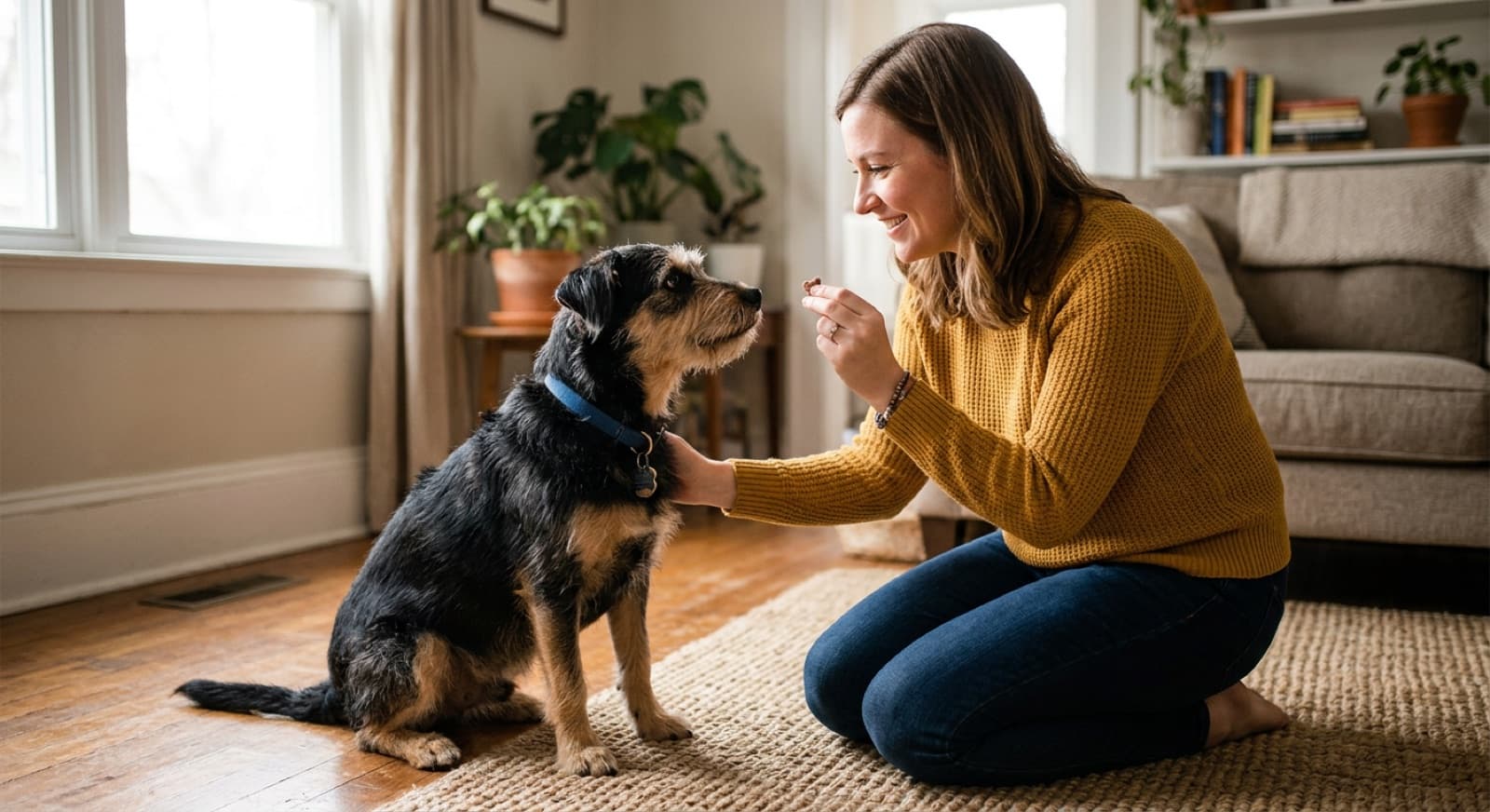
Step 0: Let your dog decompress first
This is the step new adopters skip, and it causes more early problems than anything else. A dog that has just changed homes is flooded with stress hormones. It may hide, refuse food, pace, have accidents, or shut down completely. None of that is the “real” dog, and none of it is a training problem. It is a frightened animal that does not yet know it is safe.
A widely used rule of thumb is the 3-3-3 rule: roughly three days to start coming out of the initial shock, three weeks to settle into a routine and show more personality, and three months to feel genuinely at home. Treat those as loose guideposts, not deadlines. Your only jobs in the first few days are to keep the world small and predictable, offer food and water, give the dog a quiet space it can retreat to, and let it come to you. Read our guides on the first three days and the first week before you do anything else.
Once the dog starts to relax, eat normally, and show curiosity, you can begin gentle training. If it stays shut down, fearful, or reactive well past those early weeks, that is worth understanding rather than pushing through. Our guide on telling apart a normally anxious versus genuinely traumatized pet will help you decide whether to keep going solo or bring in a professional.
Immediate: management before training
The early weeks are about preventing problems and building a routine, not drilling commands. Most of what feels like “bad behaviour” now is really a management gap.
House-training
This is the number-one priority for almost every new owner, and it is a management problem before it is a training one. Take the dog to the same outdoor spot on a tight schedule (after waking, eating, drinking, and playing, plus first and last thing), reward the instant it goes in the right place, and prevent accidents in between with supervision or a crate. Never punish accidents, which only teaches the dog to hide when it goes. Our puppy potty training guide has the tips, an age-by-age schedule, and the crate method, and the broader house-training guide covers dogs and cats of any age, including the one situation where accidents mean “call the vet” instead of “train harder.”
Crate and safe-space training
A crate is not a cage, it is a den, and it does double duty: it prevents accidents and destructive chewing when you cannot supervise, and it gives an anxious new dog a place that feels safe. The trick is to make the crate a good place, never a punishment. Feed meals in it, toss treats inside, and build up time slowly so the dog chooses to rest there. Done right, it is also the foundation for preventing separation anxiety later. See our crate training guide for the step-by-step method, sizing, and how long is too long.
Your dog's name and the first three commands
Before any command, your dog needs to reliably look at you when you say its name. That single response is the on-ramp to everything else. From there, the highest-value first commands are sit (the gateway cue and a default “ask politely” behaviour), come (recall, the one command that can save a life), and a release of pressure like look at me for focus. Keep sessions short, a few minutes a few times a day, and always end on a win. Our free command course teaches name recognition, sit, and come as Level 1, with the rest unlocking as you go.
Puppy biting and mouthing
If you adopted a puppy, those needle teeth will find your hands, and it is normal play and teething, not aggression. Teach bite inhibition rather than punishing: the moment teeth touch skin, let out a calm yelp or simply end the game and step away for a few seconds, so biting predicts the fun stopping. Then redirect to a chew toy and praise the dog for using it. Keep chews available everywhere, and watch for over-tiredness, since an exhausted puppy bites far more (the fix is often a nap, not more correction). Most puppies grow out of it as adult teeth come in. Adult dogs that mouth usually need the same end-the-game-and-redirect approach. See the full method in our guide on how to stop a puppy from biting.
Short-term: the skills that shape daily life
With the basics in place, build the behaviours that make walks, visitors, and everyday outings calm instead of stressful.
Loose-leash walking (the number-one complaint)
Leash pulling is the single most common thing owners struggle with, and it makes every walk a chore. Dogs pull because it works: pulling gets them to the sniff, the dog, the squirrel. The cure is to make pulling never pay. Stop moving the instant the leash goes tight, wait for the dog to put slack back in the line, then move again, and reward generously any time the dog walks near you. A front-clip harness reduces pulling power while you train but does not replace the training. Start in boring, low-distraction places and add difficulty slowly. Our full guide on how to stop a dog pulling on the leash walks through the stop-and-go method, and the heel and leash-manners lessons in the command course break it down further.
Jumping up and polite greetings
Jumping is an excited, friendly behaviour that owners accidentally reward with attention, even “no, down!” counts as attention. The fix is to make four-on-the-floor the thing that gets the good stuff. Teach an alternative the dog can do instead, usually a sit for greeting, and reward it heavily. When the dog jumps, remove the reward by turning away and giving zero attention until the paws are down, then reward calm. The hard part is consistency: every family member and every visitor has to follow the same script, or the dog learns that jumping works on some people. A reliable “sit” or “place” from the command course is your greeting tool, and our guide on how to stop a dog jumping up has the full routine.
Socialization, done properly
Socialization is not “letting the dog play with other dogs.” It is calm, positive exposure to the full range of normal life: different people, surfaces, sounds, vehicles, and well-behaved dogs, all at a pace the dog can handle. For puppies, the prime window closes around 16 weeks of age, so early positive experiences matter enormously (work within your veterinarian's vaccination guidance). For adult rescue dogs, socialization is more about controlled, confidence-building exposure and never flooding a nervous dog. Skip the chaotic off-leash dog park as a starting point, because one bad experience can create lasting fear. Our guides on introducing a new pet and choosing a dog that is good with kids and other pets cover safe introductions, and our full dog socialization guide covers the critical window and how to do it right.
Barking
Barking is a symptom, not a single problem, and the fix depends entirely on the cause. Alert barking at the window, boredom barking, anxiety barking, and demand barking all look similar but need different responses, so the first job is figuring out why. Yelling is the universal wrong move, because to the dog it sounds like you are joining in. For boredom, add exercise and mental work. For demand barking, make sure barking never earns the thing the dog wants. For alert barking, manage the trigger (block the window view) and teach a calm alternative. Anxiety-driven barking, especially when you leave, points to separation issues covered in Stage 3. Our guide on why dogs bark and how to stop excessive barking works through each cause.
Ongoing: reliability, prevention, and enrichment
These are the long-game skills. They never really “finish,” and they are what turn a settled dog into an easy one.
Bulletproof recall
Coming when called is the most important safety skill a dog can have, and it is built, not installed. Make your recall word the best thing in the dog's world: practise on a long line, pay every single recall with high-value food or play, and never call your dog to do something it dislikes. Build up slowly from the house to the yard to quiet outdoor spaces before you ever trust it off-leash, and work within local leash bylaws. The off-leash recall and emergency-stop lessons in the command course are the advanced level for a reason.
Preventing separation anxiety
Separation-related problems have grown fast, partly from dogs adopted during work-from-home periods who never learned to be alone. The good news is that prevention is far easier than treatment. From early on, build alone-time in small doses, make your comings and goings boringly low-key, and give the dog a positive association with being on its own (a stuffed chew when you leave). If your dog already panics, vocalizes, or is destructive when alone, that is true separation anxiety and needs a gradual desensitization plan. Our separation anxiety guide lays out the steps, and severe cases deserve professional help.
Chewing and mental enrichment
Destructive chewing is almost always boredom, understimulation, or stress, not spite. The answer is rarely more correction and almost always more outlets: appropriate chew toys, puzzle feeders, scent games, and training itself, which tires a dog out more than a walk does. Trainers increasingly treat mental enrichment as “the new exercise,” and for good reason. A dog whose brain is busy is a dog that is not redecorating your couch. Our full guide on how to stop destructive chewing covers the outlets and enrichment that fix it, and pet-proofing while you build these habits is in our new pet checklist.
Reactivity and aggression: know when to stop and call a pro
This is the one area where do-it-yourself is the wrong instinct. Leash reactivity (lunging and barking at dogs or people), fear-based aggression, and resource guarding are serious, they tend to get worse without the right approach, and they can be dangerous to practise on alone. Learn what is actually going on first with our guides on reactivity and resource guarding, then get a qualified, force-free professional involved early. Catching these things at the warning-sign stage is far easier than after a bite.
The method behind all of it
Every step above runs on the same three principles, and if you only remember these, you will be fine.
- Reward what you want, prevent what you do not. Reward-based training is both more effective and safer than punishment, which the veterinary behaviour community warns can increase fear and aggression. Mark and pay the right behaviour, and set the environment up so mistakes are hard to make. You can read the position of the American Veterinary Society of Animal Behavior on humane, reward-based methods, which the ASPCA echoes in its guidance on common behaviour issues.
- Consistency beats perfection. A mediocre rule applied every single time by every single person beats a perfect plan followed half the time. Get the whole household using the same words and the same responses. Surveyed owners consistently name this as the thing they wish they had understood sooner.
- Patience, because your dog reads your energy. Frustration travels straight down the leash. Short sessions, calm delivery, and ending on a win do more than long, tense drills. Progress is measured in weeks, and the occasional backward step is normal, not failure. The American Kennel Club training library is a solid, free reference if you want to go deeper on any single skill.
Ready to teach the commands?
Our free, step-by-step command course turns this roadmap into practice: 14 lessons from name recognition to off-leash recall, with hand signals, troubleshooting, and progress tracking that saves as you go.
Start the Free Command Course →Frequently asked questions
What should I train my new rescue dog first?
Nothing, for the first few days. Let the dog decompress before you ask anything of it. A newly adopted dog has just lost everything familiar, and pushing training too early backfires. Once it starts to relax (usually within the first week), begin with the unglamorous management skills: house-training, settling in a crate or safe space, and getting the dog to respond to its name. Formal commands like sit and come come next. Leash manners, greetings, and socialization follow once the basics are steady. The order matters more than the speed.
How long does it take to train an adopted dog?
Think in months, not days. The basics of house-training and a few commands usually come together over the first few weeks of consistent work. Reliable recall, calm greetings, and solid leash manners are more like a three-to-six-month project, and some skills keep improving for a year. Adult rescue dogs often learn faster than puppies because they already have bladder control and a longer attention span, and many arrive already knowing more than you expect. Consistency is the single biggest factor in how fast it goes.
Is it harder to train an adult rescue dog than a puppy?
Usually it is easier, not harder. The myth that you cannot teach an older dog is just that, a myth. Adult dogs have full bladder control, longer focus, and are often calmer learners than a frantic puppy. They may carry habits from a previous home, and some need to unlearn things, but they also skip the hardest parts of puppyhood entirely. The main adjustment with an adult is patience around its history: give it time to trust you before expecting much, and build from there.
What training method actually works?
Reward-based training, also called positive reinforcement. You mark and reward the behaviour you want, and prevent or redirect the behaviour you do not, rather than punishing mistakes. The veterinary behaviour community is clear on this: reward-based methods are both more effective and safer than punishment, which tends to increase fear and aggression. In plain terms, catch your dog doing the right thing and pay it well, set the environment up so the wrong thing is hard to do, and stay calm. Yelling and physical corrections damage trust and slow everything down.
Why does my new dog pull on the leash so hard?
Because pulling works. Dogs naturally walk faster than we do, and every time pulling gets them closer to the interesting thing, it gets reinforced. The fix is to make pulling never pay: stop moving the instant the leash goes tight, wait for slack, then continue. Reward the dog for walking near you with a loose leash. A front-clip harness reduces pulling power while you train, but it is a tool, not a cure. Loose-leash walking is one of the slower skills to build, so expect weeks of short, focused practice in low-distraction places first.
How do I stop my puppy from biting?
Puppy biting is normal teething and play behaviour, not aggression, and almost every puppy does it. The goal is not to punish it but to teach bite inhibition. When those needle teeth land on skin, let out a calm yelp or simply stop the game and step away for a moment, so the puppy learns that biting ends the fun. Then redirect to an appropriate chew toy and reward chewing on that instead. Keep good chew options everywhere, make sure the puppy is getting enough rest (overtired puppies bite more), and stay consistent. Most puppies grow out of it as the adult teeth come in.
Should I socialize my dog at the dog park?
Not as a first step, and not as your main plan. Socialization means calm, positive exposure to lots of different people, places, sounds, and well-behaved dogs, not turning a nervous animal loose in a chaotic off-leash park. A bad dog-park experience can create fear that lasts. Instead, expose your dog gradually and at its own pace: quiet streets, new surfaces, friendly visitors, and controlled greetings with dogs you know are stable. For puppies, the prime socialization window closes around 16 weeks, so positive early exposure matters a lot, always within your vet vaccination guidance.
When should I get a professional dog trainer?
Get help early for anything involving real fear or aggression: growling, snapping, biting that breaks skin, intense leash reactivity, or serious resource guarding. Those are not DIY projects, and the right professional makes them much safer to work through. Beyond that, a good group class or a few private sessions is worth it for almost any new dog, especially a first one, because a skilled set of eyes catches problems early. Look for a trainer who uses reward-based, force-free methods. Avoid anyone who relies on fear, pain, or dominance, which can make behaviour problems worse.
Is this dog training guide really free?
Yes, completely free, with no signup required. LocalPetFinder is a free pet adoption platform, and this guide, our step-by-step command course, and all of our training and behaviour articles are free to use. The whole point is to help more adopted dogs succeed in their new homes, because a dog that settles in well is a dog that stays.
Step-by-Step Command Course
14 lessons from sit to off-leash recall, with progress tracking.
House-Training a Dog
The golden rules, the routine, and when an accident means see a vet.
The 3-3-3 Rule for Rescue Dogs
What to expect in the first 3 days, 3 weeks, and 3 months.
What Does Reactive Mean?
Reactivity is usually fear, not dominance, and when to get a pro.
Still looking for your dog?
Learning to train before you adopt is one of the smartest things you can do. Browse adoptable rescue dogs when you're ready.
Browse Adoptable Dogs →