The short answer
Three conditions decide BSH outcomes: HCM (Hypertrophic Cardiomyopathy), documented at 8.5 percent breed prevalence in the Granstrom 2011 Danish cohort (males 20.4 percent, roughly 2 to 3 times the general cat population), with NO validated BSH-specific DNA test (echocardiogram screening from age 1 to 2 is the only tool); PKD1 (Polycystic Kidney Disease), inherited from the Persian outcrosses used to rebuild the breed after the Second World War, DNA-testable through UC Davis VGL, and dropping fast in screened lines (variant frequency fell from 0.99 percent in 2019 to 0.71 percent in 2022); and Blood Type B at 20 to 45 percent prevalence, with critical implications for breeding (neonatal isoerythrolysis kills mismatched kittens within 1 to 3 days) and for any BSH receiving anaesthesia or transfusion. Add dental disease, obesity (the number-one BSH management issue), and the rare Hemophilia B documented in a 1993 BSH family. Lifespan with proactive care is 12 to 17 years. The single highest-leverage decision a Calgary BSH owner makes is buying pet insurance before age 3, before the first baseline echocardiogram is on file.
Informational only, not veterinary advice. Always consult your Calgary veterinarian for individualised guidance on your specific cat.
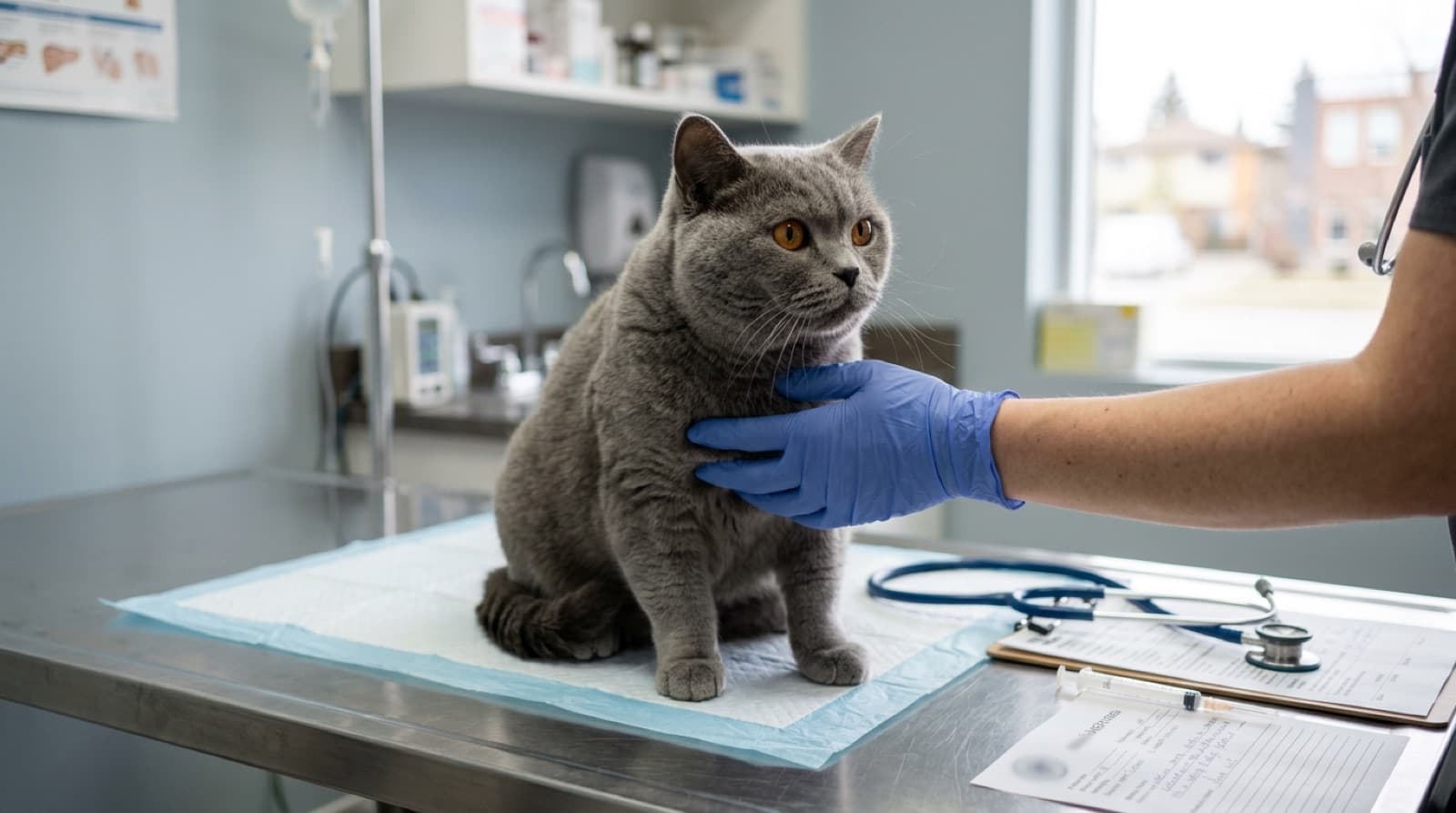
This article is informational only and is not veterinary advice. Always consult your Calgary veterinarian for individualised health guidance on your specific cat. BSH carry documented genetic and structural health risks across cardiac, renal, haematological, dental, and metabolic systems. Proactive screening, ethical breeding history (where available), and ongoing veterinary care are essential. No medication, dosage, or treatment protocol is recommended on this page. Those decisions belong entirely with your veterinary team.
Sources informing this article include the Cornell Feline Health Center, peer-reviewed research indexed on PubMed Central and PubMed (the Granstrom 2011 Danish BSH HCM echocardiographic cohort study indexed as PMID 21736622, the Maggio-Price and Dodds 1993 Hemophilia B BSH family report indexed as PMID 8307821, and the Calgary and Saskatoon feline blood type prevalence data indexed as PMC7186432), the UC Davis Veterinary Genetics Laboratory for the feline PKD1 and blood type DNA tests, the Royal Canin Academy feline HCM and weight management material, and breed standard references from the Governing Council of the Cat Fancy (GCCF), the Canadian Cat Association (CCA), the Cat Fanciers' Association (CFA), and The International Cat Association (TICA). Calgary specialty referrals go through Western Veterinary Specialist & Emergency Centre. Treatment specifics still belong with your Calgary veterinarian.
HCM: the breed-defining health risk
Hypertrophic cardiomyopathy is the BSH health condition that matters most. The Granstrom 2011 Danish echocardiogram cohort (n=329 BSH) found 8.5 percent HCM-positive, with another 4.3 percent equivocal. Males sat at 20.4 percent prevalence. Field studies estimate BSH HCM prevalence is roughly 2 to 3 times the general cat population. There is no validated BSH-specific DNA test. The screening tool is echocardiogram by a veterinary cardiologist, starting with a baseline at age 1 to 2.
HCM is the most common feline heart disease overall, but BSH carry elevated breed risk. The disease causes the wall of the left ventricle to thicken abnormally. The chamber holds less blood, the heart works harder, and in some cats the condition progresses to congestive heart failure, a saddle thrombus that paralyses the rear legs, or sudden cardiac death.
Prevalence: the Granstrom 2011 Danish cohort
The most-cited BSH HCM prevalence study is Granstrom et al. 2011, published in the Journal of Veterinary Internal Medicine and indexed on PubMed as PMID 21736622. The cohort examined 329 BSH by echocardiogram. The headline numbers: 8.5 percent of the cats were HCM-positive on echo, and another 4.3 percent were equivocal. Males were significantly more affected, at 20.4 percent prevalence. The honest summary: roughly 1 in 12 BSH overall, and roughly 1 in 5 male BSH, were affected at the time of study, with risk rising further with age. Field studies (less formally published but cited in feline cardiology references) place BSH HCM prevalence at roughly 2 to 3 times the general cat population. This puts BSH among the breeds with documented elevated cardiac risk, alongside Maine Coon, Ragdoll, and Sphynx.
Why a Maine Coon or Ragdoll DNA test is the wrong answer
The Maine Coon HCM mutation is called A31P, and the Ragdoll HCM mutation is called R820W. Both are validated for their respective breeds and are useful screening tools in those populations. Both have been occasionally detected in individual BSH on commercial breed panels. Neither is breed-typing for BSH. Recommending a Maine Coon A31P test or a Ragdoll R820W test as a BSH HCM screening tool is medically incorrect. A negative result on those tests does NOT mean a BSH will not develop HCM, because the BSH cardiac risk is not driven by the A31P or R820W mutations. A positive result does NOT predict BSH disease because the predictive value of those mutations has only been established in Maine Coon and Ragdoll populations.
The practical conclusion for Calgary owners: do not run a Maine Coon or Ragdoll HCM DNA test on a BSH expecting it to mean something. Spend that money on the baseline echocardiogram at Western Veterinary Specialist & Emergency Centre instead.
The actual screening tool: echocardiogram by a veterinary cardiologist
Echocardiogram is the gold standard for HCM screening in any breed, and it is the only validated screening tool for BSH. The recommended schedule for BSH is a baseline at age 1 to 2, then a repeat every 1 to 2 years until age 7, then annually thereafter. The schedule reflects the Granstrom 2011 prevalence data and the established rise in feline HCM risk with age. In Calgary, this is a referral from your general-practice vet to Western Veterinary Specialist & Emergency Centre, which houses the city's main feline cardiology service. Expect roughly $400 to $600 per scan.
The insurance timing window
Every Canadian pet insurance provider excludes pre-existing conditions. If a BSH is enrolled in pet insurance BEFORE the first baseline echocardiogram at age 1 to 2, cardiac coverage is included. If the same BSH is enrolled AFTER the first echo flagged any change, cardiac coverage is excluded indefinitely. Given that BSH HCM management can become a significant cumulative cost over a 12-to-17 year cat, the timing of the policy purchase is more financially material for this breed than for an average cat. Buy before age 3, before the baseline echo.
Symptoms and emergency signs
HCM is often silent until late. Watch for increased respiratory rate at rest (a sleeping cat should breathe 15 to 30 times per minute; persistently faster is a vet call), lethargy in a usually placid BSH that becomes notably less engaged, sudden weakness or collapse, rear-leg paralysis (saddle thrombus, a same-day emergency), or open-mouth breathing. Open-mouth breathing in any cat is a same-day Calgary 24-hour emergency. Treatment is entirely vet-directed and depends on stage of disease. No medication or dosage is recommended on this page.
PKD1: the Persian-inherited risk, now declining
Polycystic Kidney Disease in BSH is caused by the same autosomal-dominant ADPKD1 mutation found in Persians. BSH inherited it through the heavy use of Persian outcrosses to rebuild the breed after the Second World War. The good news: PKD1 is DNA-testable through UC Davis VGL, and prevalence is dropping fast in screened lines. UC Davis VGL data shows BSH variant frequency fell from 0.99 percent in 2019 to 0.71 percent in 2022.
Autosomal-dominant Polycystic Kidney Disease (ADPKD) causes cysts to form in the kidneys, gradually replacing functional renal tissue. Most affected cats develop chronic kidney disease by middle age. Because the inheritance is autosomal dominant, a single defective copy from one parent is enough to cause disease; an affected parent passes the mutation to roughly half of any litter.
The Persian connection
BSH carry PKD1 because the breed was reconstructed using heavy Persian outcrosses in the mid-twentieth century, after the breed's numbers collapsed during the Second World War. The Persian ADPKD1 mutation rode along into the BSH gene pool. Historically this made PKD1 a meaningful BSH concern. Today, thanks to widespread DNA testing in reputable breeding programs, prevalence has dropped sharply in screened lines.
The UC Davis VGL data
The UC Davis Veterinary Genetics Laboratory tracks variant frequency in tested populations and publishes summary data on its breed pages. BSH PKD1 variant frequency in tested cats dropped from 0.99 percent in 2019 to 0.71 percent in 2022. That trend reflects the effect of widespread DNA testing combined with responsible breeder decisions not to use affected cats. PKD1 is now one of the genuine success stories of feline genetic testing.
The UC Davis VGL DNA test
UC Davis VGL offers the feline PKD1 DNA test for approximately $44 alone, or $66 bundled with the PRA-pd test. A cheek swab kit is mailed to you, you collect the sample at home, and you return it for laboratory analysis. Results typically come back within 2 to 3 weeks. The test result is definitive: clear, heterozygous (one copy, affected), or homozygous (two copies, more severely affected). For pedigreed BSH kittens, ask the breeder for the PKD1 certificate on both parents before agreeing to a deposit. For an adopted BSH-type rescue cat without paperwork, running the test once answers the genetic question for life.
If your cat tests positive
A positive PKD1 result is not an emergency. Most affected cats progress slowly. The management plan involves monitoring renal function on annual bloodwork (a chemistry panel including BUN, creatinine, and SDMA), watching for clinical signs of kidney disease as the cat ages, and treating chronic kidney disease as it develops. Discuss specifics with your Calgary veterinarian. Pet insurance enrolled before the diagnosis is the financial leverage that matters here.
Blood Type B: the underestimated breed-specific risk
BSH carry notably high Blood Type B frequency, reported at 20 to 45 percent depending on country and lines. By contrast, the Calgary and Saskatoon domestic shorthair population sits at roughly 3 to 4 percent Type B (per PMC7186432). The implications are real for breeding (neonatal isoerythrolysis kills mismatched kittens) and for any BSH receiving anaesthesia or blood transfusion (mismatched transfusion causes a severe acute reaction).
Cats have three blood types: A (the most common), B (relatively rare overall but common in certain breeds), and AB (very rare). Unlike dogs, cats develop strong naturally occurring antibodies against the opposite blood type from very early in life, without any prior exposure. This is what makes feline blood type mismatch acutely dangerous in both transfusion and the breeding context known as neonatal isoerythrolysis.
BSH prevalence: 20 to 45 percent Type B
Multiple international surveys place BSH Type B frequency at 20 to 45 percent depending on country and breeding lines. This sits among the highest Type B frequencies of any breed. By contrast, a Calgary and Saskatoon study of domestic shorthair cats (indexed on PubMed Central as PMC7186432) found only about 3 to 4 percent Type B in the broader pet population. The gap between BSH and the general Calgary cat population is large enough that BSH-specific clinical handling is warranted.
Neonatal isoerythrolysis (NI): the breeding catastrophe
A Type B queen bred to a Type A tom produces kittens that may be Type A. Those Type A kittens are born healthy, then nurse the mother's colostrum in the first 24 to 48 hours of life. The colostrum contains powerful anti-A antibodies, because the Type B queen's immune system makes them naturally without prior exposure. The antibodies cross into the kitten's bloodstream through the immature neonatal gut, attack the kitten's Type A red blood cells, and kill the kitten within 1 to 3 days. Mortality is high. This is preventable entirely by typing both parents before breeding and either avoiding Type B queen + Type A tom matings or removing the kittens from the mother within the first 24 hours and bottle-raising them. Adopters of pedigreed BSH should ask whether breeding parents were blood-typed.
Transfusion safety
Any BSH that needs a blood transfusion (during surgery, after trauma, or for severe anaemia from disease) must be blood-typed before the transfusion. A mismatched transfusion (Type A blood given to a Type B cat or vice versa) triggers an acute haemolytic transfusion reaction, which can be fatal. The risk is high enough that pre-transfusion typing is standard practice in any responsible feline ICU. For a BSH facing elective surgery, pre-anaesthesia blood typing is reasonable practice because of the elevated likelihood of needing blood support in an unexpected complication.
The UC Davis VGL blood type test
UC Davis VGL offers a feline blood type DNA test for roughly $45 to $60, depending on bundling with other tests. Cheek swab kit, results in 2 to 3 weeks, definitive A or B or carrier reporting. For an adopted BSH-type cat without paperwork, this is a sensible one-time test to run before any planned anaesthetic procedure.
For full depth on cat blood types, NI, transfusion safety, and the BSH breeding implications, see our dedicated guide: British Shorthair Blood Type B Calgary.
Hemophilia B: rare but documented in BSH
Hemophilia B is an X-linked bleeding disorder caused by Factor IX deficiency. It was documented in a BSH family in 1993 by Maggio-Price and Dodds, published in the Journal of the American Veterinary Medical Association (203(12):1702-1704) and indexed on PubMed as PMID 8307821. The condition is rare and is not a routine screening target in BSH.
The relevance for Calgary adopters is awareness rather than active screening. A BSH that bleeds excessively or unexpectedly after a routine procedure (spay, neuter, dental cleaning, biopsy) warrants a clotting workup including factor levels. Because the inheritance is X-linked, males are more often clinically affected; females are typically carriers. If your veterinarian is investigating an unexpected bleeding event in a BSH, the breed history of Hemophilia B is part of the relevant differential diagnosis. Treatment of any active bleeding event belongs entirely with your vet team. No medication, dosage, or product recommendation is made on this page.
Dental disease: common in BSH lines
Dental disease is reported as a common BSH issue, with gingivitis and periodontitis typically appearing in the age 5 to 8 window in predisposed lines. Some BSH families show severe disease requiring multiple extractions or full-mouth dental work by middle age. The mechanism is not unique to BSH but the breed is over-represented in clinical caseloads at the more severe end of the spectrum.
The BSH dental schedule
- Annual oral exam from age 2 at the wellness visit. Catches early gingivitis when it is still reversible with cleaning.
- Professional cleaning every 1 to 2 years once any visible gingivitis or tartar is documented, typically starting around age 5 to 8.
- Home brushing with feline-safe paste, ideally started in kittenhood. Helps slow disease but does not prevent it in predisposed lines.
- Any reluctance to eat, dropping food, drooling, or visible red gum margins is a same-week vet call, not a wait-and-see situation.
Conditions to watch for
- Gingivitis (red, inflamed gum line at the tooth base; reversible if caught early)
- Periodontitis (progression beyond gingivitis to bone and ligament damage; not reversible, only manageable)
- Feline odontoclastic resorptive lesions (FORLs), in which the tooth structure resorbs from the root upward; painful, treatable only by extraction
Calgary cost reality
A professional dental cleaning under anaesthesia at a Calgary general-practice clinic typically runs $400 to $800, including pre-anaesthetic bloodwork, anaesthesia, scaling, polishing, and recovery. Extractions add roughly $200 to $800 per tooth depending on complexity. A BSH needing multiple extractions in one session can land in the $2,000 to $3,500 range without insurance. Because BSH also carry the documented HCM risk, every dental anaesthetic event is a good prompt to confirm cardiology screening is current. Pre-anaesthesia blood typing is reasonable practice because of the high Type B prevalence (covered earlier).
Obesity: the number-one BSH management issue
BSH were bred for a compact, chunky, cobby build with heavy bone, broad chests, and dense muscle. The look is part of the breed standard, and many BSH naturally carry weight in the 9-to-17-pound range as healthy adults (males often larger, often 14 to 17 pounds; females typically 9 to 12 pounds). The downside of that build is that BSH are easily overfed and easily slide into genuine obesity, which is the most-reported BSH management issue in breed owner communities.
Why BSH obesity matters more than for an average cat
Obesity in any cat raises the risk of diabetes mellitus, osteoarthritis, urinary tract disease, and hepatic lipidosis if rapid weight loss occurs. In BSH specifically, obesity compounds two existing breed risks. It worsens HCM by raising cardiac workload, and it stresses joints already loaded by a heavy frame. A BSH carrying an extra two or three pounds is meaningfully more at-risk than a domestic shorthair carrying the same extra weight, because the BSH cardiovascular system is already operating with elevated baseline HCM risk.
The Calgary BSH weight management routine
- Portion control by weight, not by volume. Weigh the daily allotted dry food on a kitchen scale once, then transfer the measurement to a measuring cup so the daily ration is consistent.
- Scheduled feeding, not free-feeding. Two or three meals per day at fixed times. Free-feeding a BSH a bowl of dry food is the fastest path to weight gain.
- Monthly weigh-ins. Stand on a bathroom scale alone, then with the cat. Note the cat's weight in a phone log. Trends matter more than single readings.
- Interactive play 10 to 15 minutes twice a day. BSH are placid by temperament but will engage a wand toy at adult age if the routine is built in.
- Vet-monitored body condition scoring at the annual wellness visit. Ask your Calgary general-practice vet for the target body condition score and the daily calorie budget that maintains it.
The Royal Canin Academy publishes peer-reviewed feline weight management material that your Calgary vet can adapt for a BSH-specific feeding plan.
Anaesthesia profile: standard with two BSH-specific add-ons
BSH do not have a unique breed-level anaesthesia contraindication. Standard feline protocols apply. Two add-ons matter for this breed: pre-anaesthesia blood typing (because of the high Type B prevalence and transfusion-reaction risk) and a pre-anaesthetic echocardiogram for any BSH aged 2 or older before elective surgery (because of the documented HCM risk).
Routine procedures (spay, neuter, dental cleaning) remain manageable. The standard feline anaesthetic protocol is appropriate for BSH. The two add-ons are not breed-level contraindications, they are sensible pre-procedure preparations that reflect the documented BSH risk profile.
What a BSH-aware anaesthetic plan includes
- Pre-anaesthetic blood typing (UC Davis VGL DNA test or a clinic in-house typing card), so any unexpected need for transfusion can be met with type-matched blood
- Pre-anaesthetic bloodwork including renal panel (BSH carry the Persian-inherited PKD1 risk; baseline kidney function matters)
- Pre-anaesthetic echocardiogram for any BSH aged 2 or older before elective surgery, especially if a baseline cardiology screen is not yet on file
- Intraoperative cardiac biomarker monitoring (NT-proBNP) where indicated and available
- Standard intraoperative pulse oximetry, capnography, and blood pressure monitoring
- Active warming throughout the procedure (warmed IV fluids, forced-air warming blankets)
- Monitored recovery until the cat is fully alert
For complex cases or specialty procedures, Western Veterinary Specialist & Emergency Centre handles BSH-specific anaesthetic management on referral, including cardiology-aware planning for known HCM cats and pre-transfusion type-matching protocols.
Find your BSH-type companion in Calgary
Real purebred BSH are rare in Calgary rescue, but BSH-look domestic shorthair mixes appear regularly. Adult cats with known cardiac and dental history are often easier to insure and budget for than breeder kittens.
See Available British Shorthair-type Cats →BSH lifespan: 12 to 17 years with proactive care
BSH lifespan with proactive care is typically 12 to 17 years. Swedish insurance data (Agria, the largest published feline insurance dataset in Europe) shows a median life expectancy above 12.5 years across the insured BSH population. The number is meaningfully better than the breed averages for breeds with more aggressive cardiac profiles (Sphynx, some Maine Coon lines), and reflects two things: the BSH cardiac risk is real but generally slower-progressing than in some other at-risk breeds, and BSH owners who engage with veterinary medicine reach the upper end of the lifespan range with consistency.
What drives the upper end of the range
The BSH owners we work with whose cats live longest share a pattern. They built a relationship with one Calgary general-practice clinic early, did not skip annual wellness exams, started cardiology screening with a baseline echo at age 1 to 2 and repeated it on schedule, ran the PKD1 DNA test once and acted on the result, took dental disease seriously from age 5 onward, managed weight by portion control from kittenhood, and had pet insurance with dental coverage in place before any diagnosis. For that owner, a 14-to-16 year lifespan is a reasonable planning assumption. None of that requires panic. It requires consistency over a decade or more.
What drives the lower end
- Undiagnosed HCM is the leading premature-mortality cause. A cat without a baseline echocardiogram by age 2 may present in heart failure or with a saddle thrombus at an age when earlier diagnosis would have allowed years of medical management.
- Obesity left unmanaged compounds cardiac and joint stress, and is the most preventable accelerator of BSH decline.
- Untreated dental disease contributes to systemic health decline over years and is itself painful.
- Pre-existing condition exclusion from insurance bought late means owners face the full out-of-pocket cost of HCM or PKD management and sometimes cannot sustain it.
Pet insurance for BSH: buy before age 3
BSH sit mid-range for Canadian cat-breed pet insurance premiums because carriers price for the documented HCM risk, the PKD1 risk, and the higher-than-average dental risk. Typical monthly premium $55 to $95 across Trupanion, Petsecure, and Pet Plus Us. The critical timing rule: buy before age 3, before the first baseline echocardiogram and before any chronic-condition diagnosis.
BSH are pet-insurance-positive because the breed's combination of elevated cardiac risk, Persian-inherited renal risk, dental disease tendency, and 12-to-17-year lifespan compounds cost into the cat's years. A few directional figures to plan around (these are 2026 Calgary estimates, not quotes from any specific provider):
- Baseline cardiology echocardiogram at age 1 to 2 at a Calgary specialty centre: typically $400 to $600
- Repeat echocardiograms every 1 to 2 years until age 7, then annually: $400 to $600 each
- UC Davis VGL PKD1 DNA test (one-time, if adopting without paperwork): $44 alone, $66 bundled with PRA-pd
- UC Davis VGL feline blood type DNA test (one-time, before any anaesthetic procedure): $45 to $60
- Professional dental cleaning every 1 to 2 years: $400 to $800 per cleaning, plus $200 to $800 per tooth for extractions if indicated
- HCM management if diagnosed: varies widely with stage. Discuss specifics with your Calgary veterinarian.
- PKD progression management if diagnosed: chronic kidney disease care. Discuss specifics with your veterinarian.
- Emergency visit for open-mouth breathing, saddle thrombus, or unexpected bleeding: easily $1,500 to $3,000 for one night
Canadian carriers and premium ranges
Trupanion, Petsecure, and Pet Plus Us are the Canadian carriers BSH owners typically consider. Monthly premiums of $55 to $95 are typical for a healthy BSH enrolled before age 3. Premium rises if the policy is purchased after a diagnosis is on file. The base policy is the foundation; the dental add-on rider is worth considering for BSH because dental disease is a documented breed concern.
The pre-existing condition rule
Every Canadian pet insurance provider excludes pre-existing conditions. For a BSH, the timing is sharper than for an average cat:
- Cardiac change noted on the first baseline echo with no prior policy: HCM and related cardiac coverage permanently excluded on any new policy
- Renal cysts noted on imaging or PKD1 positive with no prior policy: chronic kidney disease coverage may be excluded indefinitely
- Gingivitis noted at a dental exam with no prior policy: dental coverage may be excluded indefinitely
Enrol at adoption or by the first vet visit, ideally before age 3. The cost of waiting is not the premiums saved, it is the coverage lost on the conditions you are most likely to need.
Calgary specialty vet access
Cardiology, complex dental surgery, internal medicine, and emergency care for BSH usually involve referral from your general-practice vet to a specialty centre. The Calgary clinic that handles most BSH-relevant specialty work:
| Clinic | Services relevant to BSH |
|---|---|
| Western Veterinary Specialist & Emergency Centre | Cardiology (baseline echocardiogram from age 1 to 2 and ongoing HCM monitoring), internal medicine (PKD1 progression, renal disease), dental specialty (complex extractions, refractory periodontitis), pre-transfusion typing and transfusion medicine, cardiology-aware anaesthesia for known HCM cats, 24-hour emergency. Referral from your general-practice vet typically required for specialty consults; emergency walk-in is available. |
Your relationship with one general-practice clinic matters more than picking the “best” one. A vet who knows your BSH's baseline catches subtle changes that a one-time specialist visit misses. The specialist comes in when something specific is needed: the baseline HCM echocardiogram, a complex dental cleaning, a transfusion or pre-transfusion typing question, or an emergency.
For routine spay, neuter, vaccines, dental care, and wellness exams, any Calgary general-practice veterinary clinic you trust is appropriate. The BSH-specific layer (cardiology screening from age 1 to 2, PKD1 DNA testing once, blood typing before any anaesthetic, weight management) is where the partnership between general-practice and specialty referral matters.
Building a BSH emergency kit
BSH are medium-to-large cats (9 to 17 pounds adult; males often at the larger end), so emergency gear runs a touch bigger than the typical cat kit. The basics to keep in one accessible place:
- Cat carrier sized for a chunky breed. A 24 by 16 inch hard-sided carrier rated for car travel handles a larger male BSH comfortably, roughly $70 to $140. A familiar carrier left open in the home throughout the year is less stressful in an emergency.
- Printed copy of your pet insurance policy. Including policy number and after-hours contact.
- Recent photo of your cat. For identification if a carrier opens during transport. Note any distinguishing markings.
- Vaccination records. Most Calgary emergency clinics ask for current vaccine status on intake.
- Blood type record. Specific to BSH: if your cat has been blood-typed (UC Davis VGL DNA test or in-clinic typing card), include the type in the kit. A known Type B record saves critical minutes if transfusion becomes necessary at an emergency clinic.
- Written list of known sensitivities and conditions. Any prior medication reactions, PKD1 DNA test result, HCM screening history, dental history, any known anaesthesia issues. This list saves time when the cat cannot speak for itself.
- After-hours vet phone number. Western Veterinary Specialist & Emergency Centre operates 24-hour emergency. Save the number in your phone and post it on the fridge.
- Latest cardiology report. Especially important for BSH aged 2 and over with any baseline echo on file. If your cat is brought in for breathing changes or collapse, the existing cardiology report saves critical time at triage.
Keep the kit in one place. A stressed owner during a same-day vet trip should not be searching through filing cabinets for paperwork.
Year-1 and ongoing BSH vet costs
The realistic budget for a healthy Calgary BSH, to discuss with your veterinarian and adjust based on the individual cat:
| Cost category | Calgary range (2026) |
|---|---|
| Routine annual wellness exam, vaccines, parasite prevention | $400 to $700 per year |
| Baseline cardiology echocardiogram (age 1 to 2) | $400 to $600 one-time, then per recheck |
| Ongoing cardiology rechecks (every 1 to 2 years to age 7, then annually) | $400 to $600 per recheck |
| UC Davis VGL PKD1 DNA test (one-time, if no breeder paperwork) | $44 alone, $66 bundled with PRA-pd |
| UC Davis VGL feline blood type DNA test (one-time, before any anaesthetic) | $45 to $60 |
| Annual oral exam (included in wellness visit from age 2) | Included |
| Professional dental cleaning under anaesthesia (every 1 to 2 years from age 5 to 8 onward) | $400 to $800 per cleaning |
| Dental extractions if indicated (per tooth) | $200 to $800 per tooth |
| Pet insurance with dental add-on (before any diagnosis, before age 3) | $660 to $1,140 per year |
| Spay or neuter (one-time, often via rescue at lower cost) | $200 to $500 one-time |
| If HCM diagnosed (cumulative lifetime management) | A meaningful financial commitment. Discuss specifics with your Calgary veterinarian. |
| If PKD1 positive and progressing (chronic kidney disease care) | Varies with stage. Discuss with your veterinarian. |
The cardiac and dental rows are why pet insurance matters for BSH. Without coverage, a single HCM diagnosis or a major dental case can cost five figures over a 14-to-17 year cat. With coverage purchased before age 3 and before the first baseline echocardiogram, the same diagnosis may cost a few thousand in deductibles and co-insurance over the cat's life. The breed-specific double-leverage: BSH sit mid-range for premiums (cheaper than Sphynx or Maine Coon) but carry meaningful documented risks, so the value-per-premium-dollar is favourable.
Frequently Asked Questions
What are the main British Shorthair health issues?
Three conditions decide BSH outcomes: Hypertrophic Cardiomyopathy (HCM), documented at approximately 8.5 percent breed prevalence in a Danish cohort (Granstrom 2011), with males at 20.4 percent prevalence, roughly 2 to 3 times the general cat population, and no validated BSH-specific DNA test; PKD1 (Polycystic Kidney Disease), inherited from the Persian outcrosses used to rebuild the breed after the Second World War, DNA-testable through UC Davis VGL, and dropping fast in screened lines; and Blood Type B at 20 to 45 percent prevalence, which is critical for breeding (neonatal isoerythrolysis kills mismatched kittens) and pre-anaesthesia or pre-transfusion typing. Add to those: dental disease, obesity, and the rare bleeding disorder Hemophilia B documented in a BSH family in 1993. Lifespan with proactive screening is 12 to 17 years, with Swedish insurance data showing a median above 12.5 years.
How common is HCM in British Shorthair?
A Danish echocardiogram cohort study (Granstrom et al. 2011, n=329 BSH, indexed on PubMed as PMID 21736622) found 8.5 percent of BSH were HCM-positive on echocardiogram, with another 4.3 percent equivocal. Males were significantly more affected at 20.4 percent prevalence. Field studies estimate BSH HCM prevalence is roughly 2 to 3 times the general cat population. HCM risk increases with age, which is why annual or biennial echocardiogram screening matters. Treatment is entirely vet-directed and depends on disease stage. Discuss specifics with your Calgary veterinarian.
Is there a DNA test for BSH HCM?
No, not a validated one. The Maine Coon A31P mutation and the Ragdoll R820W mutation have been occasionally detected in individual BSH on commercial panels, but neither is breed-typing for BSH. Recommending a Maine Coon DNA test or a Ragdoll DNA test as a BSH HCM screening tool is medically incorrect. A negative result on those tests does not mean a BSH will not develop HCM, and a positive result does not predict BSH disease. The screening tool that actually matters for BSH is echocardiogram by a veterinary cardiologist. The recommended schedule is a baseline at age 1 to 2, then every 1 to 2 years until age 7, then annually. In Calgary that is a referral from your general-practice vet to Western Veterinary Specialist & Emergency Centre.
Why is PKD1 a concern in BSH?
BSH share the autosomal-dominant ADPKD1 gene with Persians because Persians were used heavily in the mid-twentieth-century rebuild of the BSH gene pool after the Second World War. A single defective copy from one parent causes disease. The good news is that PKD1 is DNA-testable through UC Davis VGL, and screened lines have shown dramatic reduction. UC Davis VGL data shows BSH variant frequency dropping from 0.99 percent in 2019 to 0.71 percent in 2022 thanks to widespread DNA testing in reputable breeding programs. Adopters of pedigreed BSH kittens should request the PKD1 certificate on both parents. Adopters of BSH-type rescue cats without paperwork can run the test once for about $44 alone or $66 bundled with PRA-pd at UC Davis VGL (vgl.ucdavis.edu).
What is Blood Type B and why does it matter for BSH?
Cats have three blood types: A, B, and the rare AB. The relevant fact for BSH is that the breed carries notably high Type B frequency, reported at 20 to 45 percent depending on country and lines. By contrast, a Calgary and Saskatoon study of domestic shorthair cats (indexed on PubMed Central as PMC7186432) found only about 3 to 4 percent Type B in the general pet population. The implications are twofold. In breeding: a Type B queen bred to a Type A tom produces kittens that nurse mothers anti-A antibodies in colostrum and die from neonatal isoerythrolysis within 1 to 3 days. In veterinary care: any BSH receiving a blood transfusion or undergoing surgery where transfusion might be needed should be blood-typed first because a mismatched transfusion causes a severe acute reaction. UC Davis VGL offers a feline blood type DNA test for roughly $45 to $60. See our dedicated guide for the full depth on this topic.
Should I screen my BSH for HCM?
Yes. The recommended schedule for BSH is baseline echocardiogram at age 1 to 2 by a veterinary cardiologist, repeat every 1 to 2 years until age 7, then annually thereafter. The schedule reflects that the documented BSH HCM prevalence (8.5 percent in the Granstrom 2011 Danish cohort, 20.4 percent in males) sits well above the general cat population, and risk rises with age. In Calgary this is a referral from your general-practice vet to Western Veterinary Specialist & Emergency Centre, where the city has its main feline cardiology service. Expect roughly $400 to $600 per echocardiogram. Pet insurance enrolled before that first baseline echo is critical: every Canadian provider excludes pre-existing conditions, and a cardiac change noted before a policy is in place is excluded indefinitely.
Are BSH at higher anaesthesia risk?
BSH do not have a unique breed-level anaesthesia contraindication. Standard feline protocols apply. However, two breed-specific considerations make the pre-anaesthetic workup more important than for an average cat. First, the high Blood Type B prevalence means pre-anaesthesia blood typing is reasonable practice, because if blood transfusion becomes necessary during or after surgery, a mismatched product causes a severe acute reaction. Second, the documented HCM risk means a pre-anaesthetic echocardiogram is worth discussing with your vet for any BSH aged 2 or older before elective surgery (spay, neuter, dental cleaning), particularly if a baseline screening echo is not yet on file. Discuss specifics with your Calgary veterinarian well in advance of any procedure.
Why are BSH prone to obesity?
BSH were bred for a compact, chunky, cobby build with heavy bone, broad chests, and dense muscle. The look is part of the breed standard. The downside is that BSH are easily overfed and easily become genuinely obese, which is the number one health complaint owners raise in breed forums. Obesity in BSH compounds two existing breed risks: it worsens HCM by raising cardiac workload, and it stresses joints that are already loaded by a heavy frame. The fix is straightforward (portion control, scheduled feeding rather than free-feeding, regular weighing, interactive play) but requires consistency over years. Talk to your Calgary veterinarian about a target body condition score for your individual cat and the daily calorie budget that maintains it.
How long do BSH live?
BSH lifespan with proactive care is typically 12 to 17 years. Swedish insurance data shows a median life expectancy above 12.5 years across the insured BSH population. Lifespan in any individual cat is driven by how aggressively the three breed-defining risks are screened and managed: HCM (annual or biennial echocardiogram from age 1 to 2), PKD1 (DNA test once, monitor renal function if positive), and obesity (the daily-decision risk that is entirely within owner control). Add competent dental care from age 2 onward, pet insurance enrolled before age 3, and a relationship with one Calgary general-practice clinic, and a 14-to-16 year lifespan is a reasonable planning assumption for a healthy adopted BSH.
What is Hemophilia B in cats?
Hemophilia B is a rare X-linked bleeding disorder caused by Factor IX deficiency. It was documented in a BSH family in 1993 by Maggio-Price and Dodds (JAVMA 203(12):1702-1704, indexed on PubMed as PMID 8307821). The condition is rare and is not a routine screening target. The relevance for adopters is awareness: a BSH that bleeds excessively or unexpectedly after routine surgery (spay, neuter, dental cleaning, biopsy) warrants a clotting workup, and the family history of the condition is now part of the breed literature. Affected cats need vet-directed management. Do not screen routinely; do flag any unexplained bleeding to your veterinarian.
Where can I get a BSH echocardiogram in Calgary?
Echocardiograms are performed by veterinary cardiologists, not general-practice vets. In Calgary, this is a referral from your primary vet to Western Veterinary Specialist & Emergency Centre (westernvet.ca), which houses the city's main feline cardiology service. Expect to pay roughly $400 to $600 per scan. Walking into a specialty centre without a referral is uncommon, so build the relationship with one general-practice clinic first and ask them to refer you in for the baseline BSH screening echo at age 1 to 2. The same centre handles 24-hour emergency care.
Is pet insurance worth it for a BSH?
Yes. BSH sit in the middle of the cat-breed premium range for Canadian carriers, typically $55 to $95 per month across Trupanion, Petsecure, and Pet Plus Us, because the carriers price for the documented HCM risk and the dental risk. A single HCM diagnosis or a major dental case can cost five figures over a 14-to-17 year cat. A policy enrolled before the first baseline echocardiogram and before age 3 covers exactly the conditions BSH are most likely to need. The dental add-on rider is worth considering: BSH dental disease typically starts in the age 5 to 8 window in predisposed lines, and a single cleaning with multiple extractions can easily exceed $2,000 in Calgary.
When should I buy pet insurance for my BSH?
Buy at adoption or by the first vet visit, ideally before age 3 and before the first baseline echocardiogram. Every Canadian pet insurance provider excludes pre-existing conditions. A BSH enrolled at month 3 or month 6 with a clean baseline qualifies for the broadest coverage available. A BSH enrolled at age 4 after a screening echo flagged any cardiac change has cardiac coverage excluded indefinitely on any new policy. The same logic applies to dental: gingivitis noted at the first dental exam with no prior policy may exclude dental coverage. The cost of waiting is not the premiums saved, it is the coverage lost on the conditions you are most likely to need.
Should I get DNA testing on my "BSH mix" rescue cat?
For a rescue BSH-type cat without breeder paperwork, the two DNA tests worth running once are the UC Davis VGL PKD1 test (about $44 alone, or $66 bundled with PRA-pd) and the UC Davis VGL feline blood type test (about $45 to $60). PKD1 settles a Persian-inherited renal risk in one swab. Blood type informs both future transfusion safety and (if your cat is intact and you have any breeding intentions, which you should not for an unknown-lineage rescue) any potential litter planning. Do NOT run the Maine Coon A31P or Ragdoll R820W HCM DNA tests for a BSH or BSH-mix: those mutations are not breed-typing for BSH, and a result either way provides no clinical guidance. The actual HCM screening tool is echocardiogram, not DNA.
British Shorthair Cats in Calgary
Browse adoptable BSH and BSH-type domestic shorthair listings from Calgary rescues.
British Shorthair Adoption Guide
Rescue versus breeder, real costs, scam patterns, and the buy-vs-adopt math for Calgary BSH adopters.
British Shorthair Blood Type B
The 20-to-45 percent Type B prevalence, neonatal isoerythrolysis, transfusion safety, and the UC Davis VGL DNA test.
BSH vs Chartreux vs Russian Blue
Comparing the three blue cat breeds on temperament, health, grooming, and Calgary rescue availability.