The short answer
Three blue cat breeds get confused constantly. BSH has copper eyes plus chubby cheeks plus stocky build plus plush single coat plus blue paw pads. Chartreux has copper eyes plus narrow muzzle plus shorter legs plus woolly double coat. Russian Blue has vivid green eyes plus slim elegant body plus silver-tipped double coat. Most Calgary rescue blue cat listings are blue or grey DSH or BSH-look mixes. They are wonderful cats; they just are not breed-pure. Pure Chartreux is extremely rare in North America. Pure Russian Blue is more common in rescue than BSH because the breed is more widely distributed.
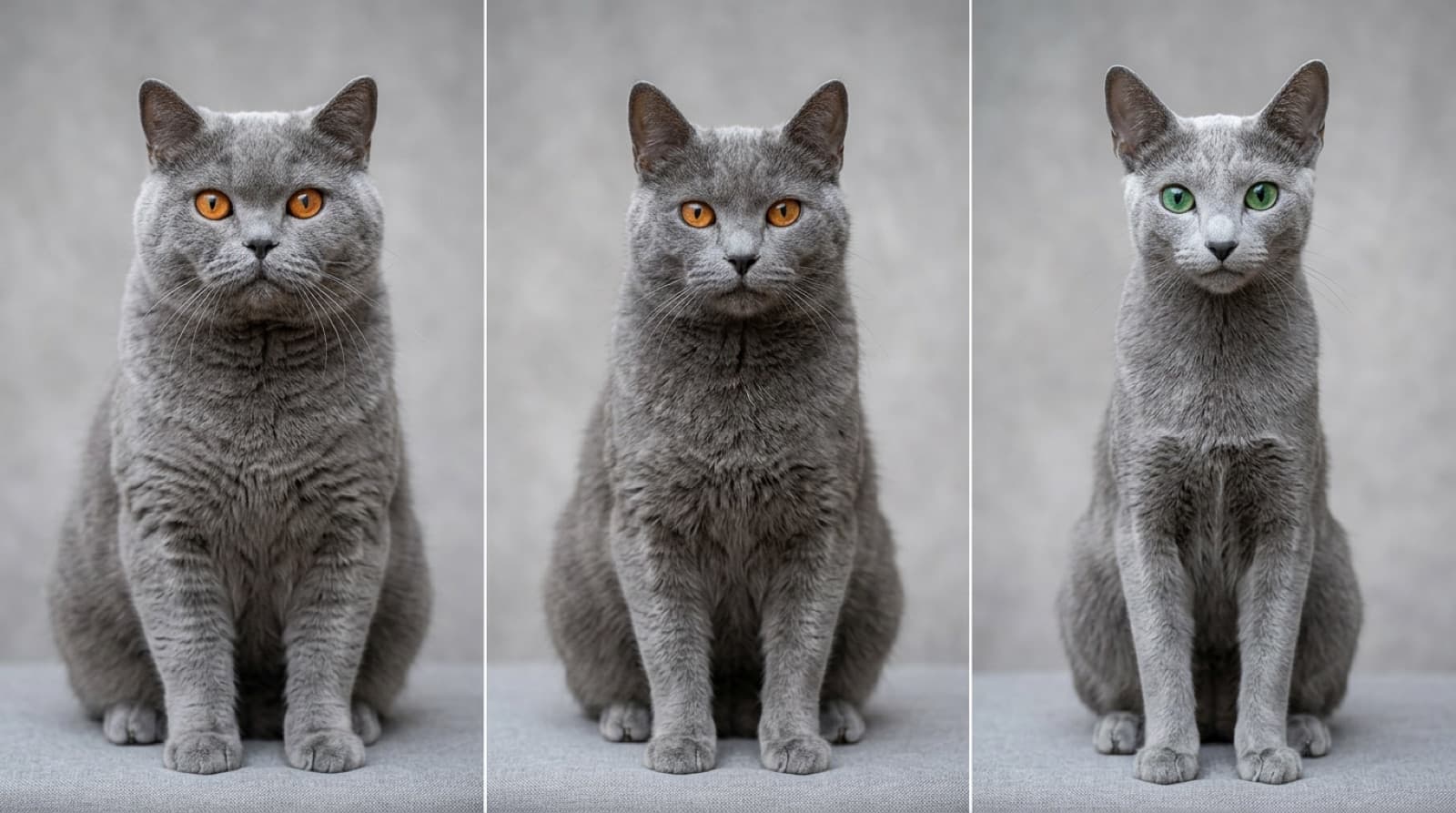
The three blues at a glance
The three breeds all carry the dilute black gene that produces a blue or grey coat colour, which is why adopters confuse them constantly. Beyond coat colour they share almost nothing. Origin, head shape, eye colour, body type, coat structure, lifespan, temperament, and Calgary rescue availability all differ materially. The comparison table is the fastest reference; the depth sections below explain each breed in turn.
| Trait | British Shorthair | Chartreux | Russian Blue |
|---|---|---|---|
| Origin | England | France | Russia (Archangel Isles) |
| Head shape | Round, broad, chubby cheeks | Round with narrow muzzle | Wedge-shaped, refined |
| Eye colour | Copper or deep gold | Copper to gold | Vivid green |
| Body type | Compact, heavy, stocky, broad chest | Muscular, shorter legs, potato-on-toothpicks silhouette | Long, slim, elegant, long legs |
| Coat | Dense plush single coat; blue paw pads on blue cats | Woolly water-resistant double coat (sheep-like) | Short silky double coat with silver tipping (shimmer) |
| Adult weight | 9 to 17 lbs | 7 to 16 lbs (males larger) | 7 to 12 lbs |
| Lifespan | 12 to 17 years | 12 to 15 years | 15 to 20 years |
| Temperament | Calm, undemanding, NOT a cuddler | Quiet (the “silent smiler”), gentle | Shy, bonded to one or two humans |
| Calgary rescue availability | Rare pure; common as BSH-look DSH mixes | Essentially nil | Occasional pure; regular as Russian Blue-look mixes |
The eye colour row alone settles most identification questions. Vivid green eyes on a blue-coated cat point to Russian Blue or Russian Blue mix. Copper or gold eyes with a broad muzzle and chubby cheeks point to BSH. Copper or gold eyes with a narrow muzzle and a sheep-like coat point to Chartreux. Yellow, amber, or hazel eyes with any of these body types usually point to a Domestic Shorthair carrying partial breed ancestry from somewhere in the family tree.
British Shorthair: the chubby-cheeked blue
The British Shorthair is the oldest of the three breeds in formal registry terms. Romans brought cats to Britain roughly 2,000 years ago, and the British farm cat population evolved over centuries into a sturdy hunter adapted to the climate. In the 19th century, English cat fanciers began selectively breeding from these farm cats and the British Shorthair was recognised as a formal breed by the late 1800s. The blue colour variant became the iconic look, and most modern BSH show champions still come from blue lines. The breed is recognised by CCA, CFA, TICA, and GCCF.
The head is the breed’s signature feature. BSH have a very round skull with a broad muzzle, chubby cheeks (more prominent in males than females), and a short broad nose. The eyes are large, round, and copper or deep gold for blue-coated cats. The body is compact, heavy, stocky, and broad-chested with a thick neck and short sturdy legs. Adult males commonly run 12 to 17 lbs, females 9 to 13 lbs. The coat is a dense plush single coat (no woolly undercoat layer like Chartreux) that feels like teddy-bear fur to the touch.
The breed-specific physical tell most non-breeders do not know: blue paw pads. A blue-coated BSH has blue paw pads matching the coat colour. A blue cat with pink or grey paw pads is almost certainly not breed-pure BSH. This is a fast verification step and ethical breeders will happily let you check the paw pads on a kitten.
The temperament reality often surprises new BSH owners. The breed looks cuddly and stuffed-animal-like, but BSH are typically not lap cats. They are calm, undemanding, affectionate from a respectful distance, and prefer to sit near their humans rather than on top of them. They tolerate children and other pets well but rarely actively seek affection. Adopters expecting a snuggly cat based on the look are often disappointed by the reality. Calgary BSH owners we work with consistently describe their cats as “dignified” rather than “cuddly.”
Common confusions: BSH gets confused with chunky blue Domestic Shorthair (which lacks the breed-standard round head and copper eyes), with Chartreux (which has a narrower muzzle and a woolly double coat), and with Russian Blue (which has vivid green eyes and a slim elegant body). The chubby cheeks plus copper eyes combination is unique to BSH among the blue breeds.
Chartreux: the French silent smiler
The Chartreux is a French breed with records dating to the 16th century. Legend ties the breed to French Carthusian monks (the Chartreuse order), though the historical link is debated. The breed was nearly lost during the Second World War and was revived through careful breeding in the late 1940s and 1950s. CFA, TICA, and FIFe all recognise Chartreux as a distinct breed.
The key BSH distinguisher is the narrow muzzle. Chartreux share the round head shape with BSH at a glance, but the muzzle is meaningfully narrower and more refined, giving the face a slightly tapered look compared to the broad-muzzled BSH. The eyes are copper to gold (never green; a green-eyed Chartreux is misidentified). Adult weight runs 7 to 16 lbs with males notably larger than females.
The body type is the second key distinguisher. Chartreux have a muscular stocky body sitting on shorter legs proportionate to the body, producing a distinctive silhouette sometimes called “potato on toothpicks.” The leg-to-body ratio is shorter than BSH and dramatically shorter than Russian Blue. The chest is broad but the overall outline is more compact than BSH because of the shorter leg length.
The coat is the third distinguisher and arguably the easiest to feel. Chartreux have a woolly water-resistant double coat with a dense undercoat and a slightly resilient guard coat. The feel is closer to sheep’s wool than to the plush teddy-bear feel of BSH. The water-resistance is a real working-cat adaptation from the breed’s farm-cat ancestry. Running a hand through a Chartreux coat feels meaningfully different from running a hand through a BSH coat.
Temperament is the “silent smiler” reputation. Chartreux are famously quiet, sometimes nearly mute, with a permanent slight upturn at the corners of the mouth that reads as a faint smile. They are gentle, observant, attached to their humans without being demanding, and tolerate handling well. The breed is often described as the cat for people who want feline company without feline noise.
Calgary rescue availability is essentially nil. Worldwide Chartreux registration numbers run in the low thousands, with most breeding stock concentrated in France and the United States. A true Chartreux at a Calgary rescue would be a once-in-a-decade event. Almost every Calgary rescue listing tagged Chartreux is either a misidentified BSH-look mix or a chunky blue DSH with a woolly-feeling coat. Adopters who specifically want Chartreux are realistically looking at breeder routes through France or the United States with import logistics, or at Specialty Purebred Cat Rescue cross-border placements.
Russian Blue: the green-eyed shimmer
Russian Blue origin traces to the Archangel Isles, a Russian port from which the breed was exported to Britain in the 1860s. Early British breeders refined the type, and the breed gained registry recognition through the late 19th and early 20th centuries. The breed nearly collapsed during the Second World War, was revived through outcrosses to other blues (including Siamese), and gradually returned to type by the 1960s. Modern Russian Blue is recognised by CFA, TICA, FIFe, and the Canadian Cat Association.
The single fastest identification tell across all three blue breeds is here: vivid green eyes are mandatory in the Russian Blue breed standard. A blue or grey cat with copper or yellow eyes is not a Russian Blue, regardless of seller claims. Russian Blue kittens are born with blue eyes that transition through amber to vivid green by 12 to 16 months. An adult Russian Blue with anything other than vivid green eyes is not breed-pure. This rule is consistent across every major registry.
The body type is the second tell and distinguishes Russian Blue from both BSH and Chartreux. Russian Blue have a long, slim, elegant body with long legs, a refined wedge-shaped head, and a slender neck. The silhouette reads as athletic and aristocratic rather than compact and chunky. Adult weight runs 7 to 12 lbs, notably smaller than BSH or Chartreux. If you place a Russian Blue next to a BSH the difference is immediate: the BSH is twice as visually substantial.
The coat is the third distinguishing feature. Russian Blue have a short silky double coat with silver tipping at the ends of the guard hairs. The tipping creates a shimmer effect under light that neither BSH nor Chartreux produce. The coat stands slightly away from the body rather than lying flat, giving the cat a faintly plush outline despite the short length. The blue colour is uniform across the coat with no markings or pattern.
Russian Blue produce lower levels of Fel d 1 (the primary cat allergen) than most breeds, which is why the breed gets marketed as hypoallergenic. No cat is truly hypoallergenic. Lower Fel d 1 is not zero Fel d 1, and individual allergy response varies widely. Some allergic people do well with Russian Blue and some still react. Before committing, spend extended time with the specific cat to confirm tolerance.
Temperament is shy and bonded to one or two humans. Russian Blue are reserved with strangers, slow to warm to new people, and intensely attached to their chosen humans once trust is established. They tend to be quiet, observant, and routine-loving. Households with frequent visitors or chaotic schedules sometimes find the breed too withdrawn; quiet households suit them well.
Calgary rescue availability is meaningfully better than BSH or Chartreux because the breed has a wider distribution. Slim grey DSH with green eyes appear in Calgary rescue networks regularly and may carry partial Russian Blue ancestry. Pure Russian Blue surrenders are uncommon but not unheard of. US-based breed-specific networks like Specialty Purebred Cat Rescue occasionally facilitate cross-border placements of retired breeder cats into Canadian homes.
The eye-colour quick test
When you are looking at a blue cat at a Calgary rescue or in a breeder photo, eye colour settles most identification questions in under five seconds.
Vivid green eyes
Russian Blue or Russian Blue mix. Russian Blue have mandatory vivid green eyes per the breed standard. A green-eyed blue cat with a slim elegant body and silver-tipped coat is breed-pure or close to it. A green-eyed blue cat with a chunky stocky body is a green-eyed DSH or DSH-Russian Blue mix.
Copper or gold eyes plus broad muzzle plus chubby cheeks
British Shorthair or BSH mix. The combination of copper eyes plus the round head with chubby cheeks plus the stocky compact body plus the plush single coat plus blue paw pads is BSH-specific. A blue cat with copper eyes but pink or grey paw pads is more likely a BSH-look mix than breed-pure.
Copper or gold eyes plus narrow muzzle plus woolly coat plus shorter legs
Chartreux or (much more commonly in Calgary) Chartreux-look DSH. The narrow muzzle is the key BSH distinguisher. The woolly water-resistant coat feels meaningfully different from BSH plush. The potato-on-toothpicks silhouette caps it. Real Chartreux are extremely rare at Calgary rescues; if the cat checks all four boxes, treat it as a strong Chartreux-look mix rather than confirmed breed-pure unless pedigree paperwork accompanies it.
Yellow, amber, or hazel eyes plus any body type
Almost certainly a Domestic Shorthair carrying partial breed ancestry from somewhere in the family tree. Without pedigree paperwork, treat as DSH from a care and cost perspective. The cat may carry partial BSH, Chartreux, or Russian Blue ancestry but breed verification is not possible. The look and temperament are what you are adopting.
What “blue mix” at a Calgary rescue actually is
This is the most adoption-relevant part of the article. Calgary rescue cats tagged BSH mix, Chartreux, or Russian Blue mix are usually blue or grey Domestic Shorthair with partial breed ancestry at best. They are wonderful cats; they just are not breed-pure in any verifiable sense.
Walk through the MEOW Foundation listings or the Calgary Humane Society cat section and you will see blue-coated cats tagged BSH mix, Russian Blue mix, and occasionally Chartreux. The real rate of registered breed ancestry in these cats is low. Most are one of the following:
- BSH mix: usually blue or grey Domestic Shorthair with a round face, plush coat, and stocky build. May carry partial BSH ancestry, may just be a chunky blue DSH that looks BSH-shaped. Without paperwork, treat as DSH from a cost and care perspective.
- Chartreux: almost always misidentified. True Chartreux in Canadian rescue is essentially nil. A Calgary rescue cat tagged Chartreux is realistically a BSH-look mix with a slightly narrower muzzle or a chunky blue DSH with woolly-feeling coat.
- Russian Blue mix: slim grey Domestic Shorthair with green eyes. May carry partial Russian Blue ancestry; less rare than BSH or Chartreux mixes because Russian Blue is a more widely distributed breed. The slim build plus green eyes plus grey coat combination is the most credible mix signal among the three.
- Pure surrenders: occasional, especially BSH. Households overwhelmed by daily grooming costs (for BSH plush coat seasonal shedding) or breed-specific health costs sometimes surrender adult cats with paperwork. Rare but not unheard of at Calgary intake.
The honest framing we tell adopters: the breed label on a rescue listing is foster shorthand for the visual look, not verified ancestry. Foster notes that describe the actual cat (body type, temperament, coat texture, paw pad colour, eye colour) are more useful than the breed tag. If a foster note reads “round head, copper eyes, blue paw pads, plush coat, stocky build, 13 lbs,” you have actionable information pointing to genuine BSH ancestry. If it just reads “BSH mix,” you have a label.
Common adopter mistake: assuming purebred because the cat looks the part. The look is the easy part; the breed verification is the hard part. Without pedigree paperwork, all three breed labels translate to “DSH with the look” from a cost and care planning perspective. That is not a bad thing. Most adopters who want a blue cat for the look and temperament find the rescue route satisfies the want at a fraction of breeder cost.
British Shorthair vs British Longhair: the registry split
British Longhair is the long-haired variant of the British Shorthair. The long-hair gene entered the BSH gene pool through mid-20th century Persian outcrosses used to rebuild breeding populations after the Second World War. The long-hair gene is recessive, so BSH litters occasionally produce long-haired kittens when both parents carry the gene. By the late 20th century, breeders began selectively breeding for the long-haired type and the British Longhair stabilised as a distinct breeding population.
The registry positions split:
- TICA: separate breed since 2009. British Longhair advanced to championship status in 2009 and has its own breed standard distinct from British Shorthair.
- CFA: separate breed since 2014. CFA accepted British Longhair as a provisional breed in the early 2010s and granted championship status in 2014.
- FIFe: separate breed since 2017. FIFe recognised British Longhair as a distinct breed in 2017.
- GCCF (United Kingdom): variant only. GCCF does not consider British Longhair a separate breed; long-haired British cats register as British Shorthair Longhair variant rather than British Longhair.
The same kitten can have papers reading British Longhair (TICA, CFA, FIFe) or British Shorthair Longhair variant (GCCF) depending on which registry the breeder uses. Both registrations are legitimate. The cat itself is identical regardless of paperwork wording.
Why GCCF holds the variant position: GCCF reasons that the long-hair gene is a coat variation within one breed (similar to how some registries handle Persian and Himalayan), not a genetic split that warrants separate breed status. The reasoning is internally consistent; it just differs from the position TICA, CFA, and FIFe converged on.
Calgary rescue availability: British Longhair is extremely rare. A BL surrender at a Calgary rescue would be exceptional. Long-haired blue cats at Calgary rescues are almost always long-haired Domestic Shorthair or DLH with partial Persian or BSH ancestry. If you specifically want a documented British Longhair, the breeder route is realistic; the rescue route is not.
How to verify a real BSH, Chartreux, or Russian Blue breeder
If you are buying a kitten from a breeder rather than adopting from a rescue, breed verification matters. The step-by-step is similar across all three breeds with breed-specific DNA testing differences.
- Ask for CCA, CFA, or TICA registration paperwork by name. A vague “registered” claim is not enough. The breeder should provide a specific registration number and cattery name. Cross-reference the cattery on the registry online directory (cca-afc.com for CCA, cfa.org for CFA, tica.org for TICA). If the cattery does not appear in the directory, the paperwork is fake.
- Verify the cattery directly. Both CFA and TICA maintain searchable breeder directories. The Canadian Cat Association directory at cca-afc.com lists Canadian catteries specifically.
- Confirm both parents are registered with photos and registration numbers. The pedigree should document at least three generations back.
- Confirm breed-specific DNA test certificates:
- BSH: PKD1 (polycystic kidney disease) and Blood Type testing through UC Davis Veterinary Genetics Laboratory. Blood type B is more common in BSH than in most breeds, and blood type matters for emergency transfusion planning and breeding compatibility.
- Chartreux: GSD IV (glycogen storage disease type 4) through UC Davis VGL. This is a Chartreux-specific recessive genetic test; ethical Chartreux breeders test before breeding.
- Russian Blue: no breed-specific DNA panel is universally required, but HCM (hypertrophic cardiomyopathy) screening via annual echocardiogram on both parents is the standard.
- Confirm HCM screening via annual echocardiogram by a veterinary cardiologist for any of the three breeds. HCM is the most common feline heart condition and affects all three breeds at modestly elevated rates.
- Confirm kitten release age of 12 to 14 weeks minimum. Kittens released earlier are usually being moved before health issues become apparent.
- Visit the cattery in person. Meet both parents. Observe living conditions. Ethical breeders welcome cattery visits; sellers who refuse visits or insist on parking-lot meets are running fraud.
- Pay via verifiable method. Never cash in a parking lot. Etransfer, certified cheque, or credit card through a documented invoice creates a paper trail.
- Read the contract. Look for a spay or neuter agreement, a return-to-breeder clause, and a health guarantee covering the breed-specific conditions (PKD progression and blood type confirmation for BSH; GSD IV negative confirmation for Chartreux; HCM diagnosis for any of the three).
Ethical Canadian breeders charge $2,500 to $4,500 for a registered kitten with paperwork, breed-specific DNA testing on both parents, HCM screening, and verified conformation. Anyone advertising purebred BSH, Chartreux, or Russian Blue under $1,500 with no waitlist and no health testing documentation is running a scam or selling mix kittens as purebred. The kitten may be healthy and adoptable; the label and price together are fraud.
DNA testing your “blue mix” rescue cat
For adopters who already have a blue or grey rescue cat and want to know what is actually in there, a Wisdom Panel cat DNA test runs around $130 USD (Canadian pricing varies with import and shipping) and reports breed percentages plus health markers.
The breed report often comes back as “mostly domestic” with low-confidence percentages because cat breeds are less genetically distinct than dog breeds. Many cats labelled BSH mix at a Calgary rescue come back as 95% domestic with no detectable BSH signal. This is not the test failing; it is the underlying reality of cat genetics, where most pet cats descend from a small set of historical populations and the breed signal is weaker than in dogs.
The health side is more actionable. The Wisdom Panel cat test reports:
- Blood type: A, B, or AB. Blood type B is more common in BSH-ancestry cats. Knowing the cat’s blood type matters for emergency transfusion planning and is information you genuinely use if the cat ever needs surgery or blood products.
- PKD1 status: the polycystic kidney disease mutation associated with Persian and BSH ancestry. Positive status gives your vet actionable kidney monitoring information for the lifetime of the cat.
- HCM risk variants: the test reports several breed-associated hypertrophic cardiomyopathy variants. Positive status flags the need for periodic echocardiogram screening.
For BSH-leaning rescue cats, the test is worth running primarily for blood type and PKD1 information. For Chartreux-leaning cats, a separate GSD IV test through UC Davis VGL is the relevant Chartreux-specific health screen. For Russian Blue-leaning cats, no breed-specific test is critical; standard feline health markers apply.
The breed report is useful for curiosity but should not change adoption decisions. The cat in front of you is the cat in front of you regardless of what the DNA test reports about ancestry percentages.
Scam patterns specific to the blue trio
Blue cat scams cluster around rarity-pricing claims, eye-colour misrepresentation, and breed misidentification. Knowing the breed standards tells you which listings are fraud.
The “rare colour” BSH markup
Some sellers mark up unusual BSH coat colours (chinchilla silver, golden, colourpoint, lilac, cinnamon) at $1,000+ premiums over standard blue pricing. The unusual colours exist in BSH but are not particularly rare from established breeders. The honest cost range for an ethical Canadian BSH kitten in any standard colour is $2,500 to $4,500. Pricing built on rarity claims should be questioned.
“Imported European BSH” Instagram and Facebook listings
A pattern of social-media listings claiming imported European bloodlines at premium pricing. Often these are kitten mill outputs with fabricated import paperwork. Real imported breeding stock comes with documented transit history, microchip records, and registry transfers. Vague “imported European bloodline” claims with no paperwork are a fraud signal.
“Chartreux” misrepresenting BSH
Because true Chartreux are extremely rare in North America, almost every kitten advertised as Chartreux in Canada is misidentified BSH or BSH mix at Chartreux-premium pricing. Verification: ask for the GSD IV DNA test certificate (Chartreux-specific) and the breed-club registration. Real Chartreux breeders have both. Misrepresenters have neither.
“Russian Blue” with copper or yellow eyes
The single fastest scam tell. Russian Blue have mandatory vivid green eyes per the breed standard across every major registry. A blue cat with copper, yellow, or amber eyes marketed as Russian Blue is misidentified. The seller is either uninformed or running fraud. Either way, the cat is not a Russian Blue.
“BSH” with green eyes
The reverse pattern. Blue-coated BSH should have copper or deep gold eyes per the breed standard. A blue cat with green eyes marketed as British Shorthair is either misidentified (often part Russian Blue or just a green-eyed DSH) or breed-fault by the BSH standard. Real blue BSH from ethical breeders consistently show copper eyes.
Photo theft and stock image fraud
Across all three breeds, sellers post stock photos or stolen breeder photos of high-quality cats while delivering different cats at meet-up. Verification: reverse image search the photos before paying anything. Insist on cattery visits with the specific kitten in real time. Sellers who refuse visits or pressure deposits before viewing are running this pattern.
Skip the breed-paperwork drama. Browse adoptable blue-coated cats in Calgary.
Calgary rescue blue and grey cats deliver the look at $400 to $600 in adoption fees. Usually they are Domestic Shorthair or mix rather than the specific breed they appear to be without papers. Foster notes describe the actual cat in front of you.
See Available BSH-type Cats →The rescue path bypasses all this
Calgary rescue blues (BSH-look, Chartreux-look, Russian Blue-look, or just generic blue DSH) are domestic cats with whatever genetic profile they happen to have. Adoption fees run $400 to $600 and cover spay or neuter, vaccinations, microchip, deworming, and a vet workup. Zero paperwork verification. Zero breed-claim verification. Zero scam risk. The cat in front of you is the cat in front of you.
For most adopters who want a blue cat for the coat and the temperament rather than show records, the rescue path is the clean answer. If the priorities are blue-grey coat, calm temperament, indoor lifestyle, and a 12 to 17 year companion, every Calgary rescue blue cat delivers exactly that. Lifespan and care needs are similar to the purebred versions. The difference is verifiable ancestry and breed-specific health screening, both of which matter for breeding programs and show registration but rarely change daily ownership.
Several Calgary rescues consistently list blue-coated cats. MEOW Foundation is the largest cat-only rescue in Calgary; their foster homes do detailed temperament and grooming-tolerance assessments. Calgary Humane Society has the highest cat intake volume in the city. AARCS pulls cats from rural Alberta shelters and overflow situations, occasionally including purebred surrenders.
For adopters who specifically want documented breed ancestry, Specialty Purebred Cat Rescue operates across North America and occasionally facilitates cross-border placements of retired breeder cats into Canadian homes. Worth checking if you want a confirmed BSH, Chartreux, or Russian Blue without the breeder route.
For Calgary owners committed to the breeder route for any of the three breeds, establish a relationship with Western Veterinary Specialist & Emergency Centre early for breed-specific health concerns. BSH blood type B confirmation, Chartreux GSD IV monitoring, and HCM screening across all three breeds benefit from specialty veterinary input. The full medical picture for British Shorthair specifically is covered in our BSH health issues guide.
Frequently Asked Questions
What’s the difference between BSH, Chartreux, and Russian Blue?
Eye colour is the fastest tell. British Shorthair has copper or gold eyes, a broad muzzle, chubby cheeks, a stocky compact body, a dense plush single coat, and blue paw pads on blue-coated cats. Chartreux has copper to gold eyes, a narrow muzzle (the key BSH distinguisher), shorter legs, a muscular potato-on-toothpicks silhouette, and a woolly water-resistant double coat. Russian Blue has vivid green eyes (mandatory in the breed standard), a wedge-shaped head, a slim elegant long-legged body, and a silver-tipped short double coat that creates a shimmer. All three share the blue or grey coat colour, but everything else differs.
How can I tell if my “blue” cat is a real British Shorthair?
Without CFA, TICA, or CCA pedigree paperwork you cannot confirm purebred status. The traits to look for: round broad head with chubby cheeks, broad muzzle (not narrow), copper or gold eyes (never green), compact heavy stocky body with a broad chest, dense plush single coat (not a woolly double coat), and blue paw pads on a blue-coated cat. Adult weight 9 to 17 lbs. Paperwork from a verifiable CCA, CFA, or TICA cattery with both parents documented is the only confirmation. A Wisdom Panel cat DNA test reports breed percentages but is not a substitute for a pedigree.
Are all BSH supposed to have copper eyes?
For blue-coated British Shorthair, yes. The breed standard for blue BSH specifies copper or deep gold eyes. Green eyes on a blue-coated BSH is a fault, not a feature, and usually points to a non-BSH ancestor (often Russian Blue ancestry or just a green-eyed Domestic Shorthair). Other coat colours in BSH allow other eye colours: silver tabby and golden BSH can have green or hazel eyes per the standard, white BSH can have copper, blue, or odd eyes, and colourpoint BSH have mandatory blue eyes. But for the classic blue British Shorthair, copper is the standard.
Are all Russian Blue supposed to have green eyes?
Yes. Vivid green eyes are mandatory in the Russian Blue breed standard across CFA, TICA, FIFe, and CCA. A blue or grey cat with copper or yellow eyes marketed as Russian Blue is misidentified. The green eye colour develops over the first year of life; kittens are born with blue eyes that transition to amber and then to green by 12 to 16 months. An adult Russian Blue with anything other than vivid green eyes is not breed-pure. This is the single fastest way to verify a Russian Blue claim against a BSH or Chartreux claim.
Why is the Chartreux so rare in Canadian rescues?
Chartreux is a low-population breed globally. Estimated worldwide registered Chartreux numbers run in the low thousands, with most breeding stock concentrated in France and the United States. Canada has very few Chartreux breeders, and the breed almost never appears in Canadian rescue networks. Most Calgary rescue cats labelled Chartreux are misidentified British Shorthair mixes or chunky blue Domestic Shorthairs with woolly-looking coats. A true purebred Chartreux at a Calgary rescue would be a once-in-a-decade event.
Is a “BSH mix” at a Calgary rescue really part British Shorthair?
Usually not in any verifiable sense. Calgary rescue cats tagged BSH mix are typically blue or grey Domestic Shorthair with a round face, plush coat, and stocky build. The cat may carry partial BSH ancestry from somewhere back in the family tree, or it may just be a chunky blue DSH that looks BSH-shaped. Without pedigree paperwork, the breed label is foster shorthand for the visual look. Treat the cat as a DSH from a care and cost perspective: $400 to $600 adoption fee, full vetting included, no breed-specific health screening assumed.
What’s a British Longhair?
The long-haired version of the British Shorthair. The long-hair gene came from mid-20th century Persian outcrosses used to rebuild BSH gene pools after the Second World War, and the recessive long-hair gene occasionally produces long-haired kittens in BSH litters. TICA recognised British Longhair as a separate breed in 2009. CFA recognised it as a separate breed in 2014. FIFe recognised it in 2017. GCCF in the UK considers it a variant only, registered as British Shorthair Longhair variant rather than a separate breed.
Why does TICA call them separate breeds but GCCF does not?
TICA, CFA, and FIFe reason that the long-hair version has stabilised as a distinct breeding population with its own standard and warrants separate breed status. GCCF reasons that the long-hair gene is a coat variation within one breed, not a genetic split, and registers British Longhair as British Shorthair Longhair variant. Both positions are internally consistent. The same kitten can have papers reading British Longhair (TICA, CFA, FIFe) or British Shorthair Longhair variant (GCCF) depending on which registry the breeder uses.
Are Russian Blue hypoallergenic?
No cat is truly hypoallergenic. Russian Blue produces lower levels of Fel d 1 (the primary cat allergen) than most breeds, which some allergy sufferers tolerate better. Lower Fel d 1 is not zero Fel d 1. Allergy response varies by individual; some allergic people do well with Russian Blue and some still react. Before committing, spend extended time with the specific cat (ideally a 30-minute or longer visit at the rescue or breeder) to confirm tolerance. The hypoallergenic label is shorthand for lower-allergen, not allergen-free.
What’s the difference between Russian Blue and Korat?
Both have a silver-blue coat colour but the breeds are otherwise distinct. Russian Blue has a short double coat with silver tipping that creates a shimmer effect, vivid green eyes, a wedge-shaped head, and a slim elegant body. Korat has a single silver-blue coat without tipping (less shimmer), green eyes that are less vivid than Russian Blue, a heart-shaped head, and a semi-cobby muscular body. Korat originates in Thailand; Russian Blue originates in Russia. Both are CFA and TICA recognised. Korat is extremely rare in North American rescue networks.
Should I get DNA testing on my “blue mix” rescue cat?
For breed curiosity, optional. For health screening, yes if the cat shows strong BSH traits. Wisdom Panel offers a cat test at around $130 USD (Canadian pricing varies with import and shipping) that reports breed percentages plus health markers. The breed report often comes back as mostly domestic because cat breeds are less genetically distinct than dog breeds. The health side is more useful for BSH-leaning cats: the test can flag blood type B and PKD1 status. Blood type matters for emergency transfusion planning.
How can I verify a real Chartreux or Russian Blue breeder?
Ask for CCA, CFA, or TICA registration paperwork by name with a specific cattery number, then verify the cattery directly on the registry online directory. Confirm both parents are registered with photos and registration numbers. For Chartreux, confirm GSD IV (glycogen storage disease type 4) DNA testing through UC Davis VGL on both parents. For Russian Blue, confirm HCM screening via annual echocardiogram on both parents. Kitten release age should be 12 to 14 weeks minimum. Visit the cattery in person and meet both parents. Pay via verifiable method, never cash in a parking lot.
What’s a “Wedgehead” vs “Doll Face” Russian Blue?
Informal terms used by some breeders to describe head-shape variation within the Russian Blue breed. Wedgehead refers to the more extreme wedge-shaped head that matches the modern American show standard, with a longer narrower muzzle. Doll Face (or sometimes Classic) refers to a more rounded head shape closer to the original European Russian Blue type, with a less extreme wedge. Both register as Russian Blue under CFA, TICA, and CCA. Neither is officially named in registry standards; the terminology is breeder-facing rather than registry-facing. The health profile is the same; the difference is aesthetic.
Can a “BSH” have green eyes?
Blue-coated BSH should not have green eyes per the breed standard. Copper or deep gold is the standard for blue BSH. A blue cat with green eyes marketed as British Shorthair is either misidentified (often part Russian Blue or just a green-eyed DSH) or breed-fault by the breed standard. Other BSH coat colours allow other eye colours: silver tabby and golden BSH allow green or hazel, white BSH allow copper, blue, or odd eyes, and colourpoint BSH have mandatory blue eyes. But the specific combination of solid blue coat plus green eyes is not BSH standard.
British Shorthair Cats in Calgary
Browse adoptable British Shorthair and BSH-look mixes from Calgary rescues.
British Shorthair Adoption Guide
Rescue sources, real costs, surrender patterns, and how to find a real BSH or BSH mix in Calgary.
British Shorthair Health Issues
HCM, PKD, blood type B, and the Calgary specialty vets who handle BSH care.
British Shorthair Blood Type B
Why blood type matters for BSH owners, transfusion planning, and breeding compatibility.