The short answer
Adopt a BSH-type mix from a Calgary rescue ($400 to $600) or pay $2,500 to $4,500 for a CCA, CFA, or TICA-registered breeder kitten with PKD1 + blood type + HCM screening. Real purebreds almost never land at Calgary rescues; what does appear regularly is the blue or grey BSH-look DSH. Adults settle at 9 to 17 lbs (males 14-17, females 9-12) and reach full size in 3 to 5 years, longer than most cat breeds. Lifespan 12 to 17 years per Swedish insurance data. Blood Type B prevalence is 20 to 45 percent in BSH versus 3 to 4 percent in DSH, which makes pre-anaesthesia typing essential. Anything under $1,500 from a self-described breeder is the scam zone.
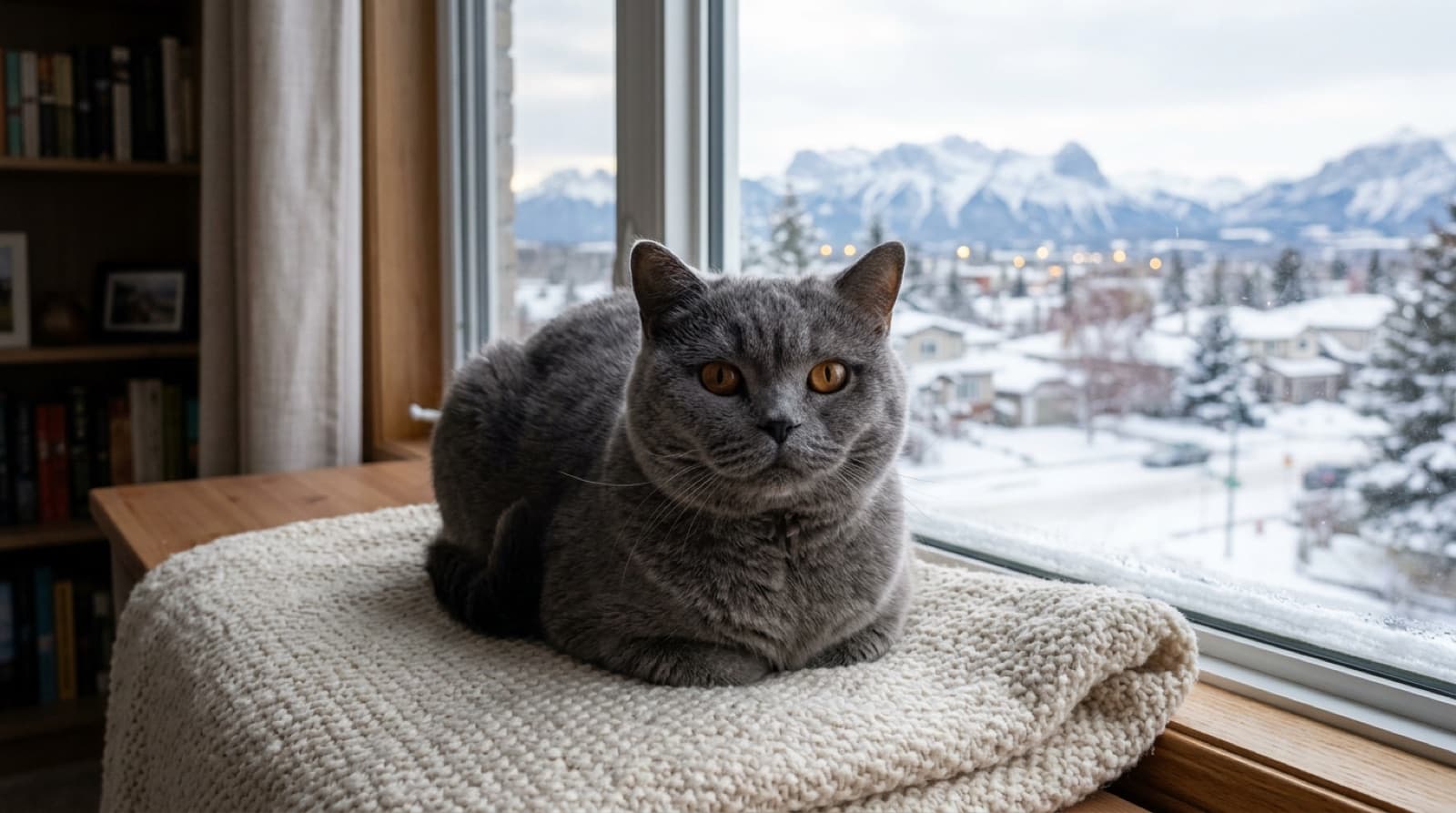
The buy-vs-adopt question for BSH specifically
Most adopters who land on this page have already fallen for the look. The chubby cheeks, the round head, the dense plush coat, the steady copper eyes, the chunky body that looks like a soft heavy throw pillow with a face. The question they arrive with is harder than usual for the breed: pay a Canadian CCA, CFA, or TICA breeder $3,000 and wait six months to a year for a kitten with full DNA testing and known parents, or take a blue or grey BSH-look mix from a Calgary rescue this month for $500. The honest answer depends on what you actually want.
The breeder path gives you predictability. If you specifically want a kitten with PKD1-clear parents, both parents blood-typed (the Type B math matters more in this breed than almost any other), parent echocardiograms ruling out HCM, and CCA, CFA, or TICA registration with verifiable pedigree, the breeder route is the only reliable way to get all of that. You pay $2,500 to $4,500, plus a deposit, plus a 6 to 12 month wait. For adopters who want the verified BSH with paperwork, this is the right path. It is also expensive, and Canadian BSH breeders are not common, so verification matters more than usual.
The rescue path gives you a real cat now, just not necessarily a pedigreed one. Almost no purebred BSH appear in Calgary rescues, and that is the honest truth. What does appear regularly are blue, grey, or BSH-look domestic shorthairs with the round face, plush coat, and stocky build that draws people to the breed. Foster teams at MEOW Foundation, Calgary Humane Society, and the other generalist rescues label these honestly: BSH-mix, BSH-type, blue DSH. The cat is wonderful, the look is most of what attracted you to the breed in the first place, the temperament is broadly compatible, and the cost is a fraction of the breeder route.
Neither path is wrong. The reframe most BSH adopters miss is that the question is not really “breeder kitten or rescue purebred.” The question is “do I specifically need the paperwork, or do I want the cat?” If you need the paperwork, breeder. If you want the cat, a Calgary rescue BSH-type mix delivers 80 to 90 percent of what most adopters actually wanted at 15 to 20 percent of the cost.
Where to find a BSH-type cat in Calgary
There is no Canadian BSH-specific rescue, which makes this breed's adoption map different from breeds like Sphynx (Alberta Sphynx Rescue) or Persian (Specialty Purebred Cat Rescue). Adoption flows through the generalist Calgary cat rescues, and the cats are almost always BSH-look mixes rather than verified purebreds. Here is the honest map:
| Rescue | Good to know |
|---|---|
| MEOW Foundation | Cat-only, largest cat intake in Calgary. Pure BSH are extremely rare; blue or grey BSH-look DSH appear regularly. Foster notes are detailed and honest about breed labelling. See meowfoundation.com. |
| Calgary Humane Society | Steady cat intake. BSH-type cats appear occasionally, almost always labelled as DSH or DSH-mix with breed-look notes. Structured written profiles per cat. See calgaryhumane.ca. |
| AARCS | Alberta-wide. Sees BSH-look mixes from rural surrenders and hoarding seizures occasionally. Foster system is strong, so foster notes will tell you how the cat behaves. |
| BARCS, Pawsitive Match, Cochrane Humane, Heaven Can Wait | Generalist Calgary-area rescues. BSH-type intake is uncommon but does happen. Worth alert subscriptions; not worth daily refreshing. |
| Specialty Purebred Cat Rescue (US-based) | A US purebred cat rescue network at purebredcatrescue.org. Occasional Persian and BSH placements, but cross-border transport to Calgary is rare and requires significant coordination. |
The honest read: there is no breed-specific shortcut for BSH in Canada. LocalPetFinder aggregates live cat listings from Calgary rescues regularly, so an alert keyed to blue or grey cats catches the BSH-look intake without you checking each rescue site by hand. When a BSH-type cat does post, it usually goes within days because so many adopters are watching the breed look.
Foster teams at Calgary rescues are increasingly careful about breed labelling. The pattern most adopters see now is honest: a blue DSH with round face and plush coat will be listed as “DSH, BSH-type look” rather than as a BSH outright. This is the right answer ethically (no pedigree, no breed claim) and a useful signal for adopters (the rescue is being transparent about what they know and do not know). If a rescue labels a cat as a pure British Shorthair without pedigree paperwork, ask follow-up questions about the source.
The real Calgary cost breakdown
A rescue adoption fee is not the cat's price. It is a partial reimbursement for vetting and foster care the rescue already paid for. That is why a $500 BSH-mix from MEOW Foundation is better value than a “free” Kijiji kitten. And a BSH kitten listed under $1,500 by a self-described breeder is almost always missing the DNA testing, the blood typing, and the registration that an ethical breeder includes.
2026 Calgary BSH pricing across realistic options:
| Path | Typical price | What is included |
|---|---|---|
| Calgary rescue BSH-mix | $400 to $600 | Spay or neuter, vaccines, microchip, deworming, vet workup, foster assessment, behaviour notes. Blue or grey DSH with BSH look, not pedigreed. |
| Ethical Canadian CCA, CFA, or TICA breeder (pet quality) | $2,500 to $4,500 | CCA, CFA, or TICA registered, PKD1 DNA-tested parents (UC Davis VGL), blood-typed parents, annual parent echocardiograms for HCM, kitten released at 12 to 14 weeks, contract with spay or neuter clause. |
| Show or breeding rights kitten | $4,500 plus | Same testing, breeding contract, often co-ownership terms. |
| Under $1,500 unverified seller | Scam zone | Red flag. No paperwork, no DNA testing, no blood typing, often a Kijiji listing with wire-transfer demands or pressure to pay before meeting the kittens. The classic backyard-breeder pattern. |
The rescue adoption fee covers spay or neuter, core vaccines, a microchip, deworming, parasite treatment, and a vet exam. Replacing all of that on a “free” Kijiji kitten runs $480 to $900, so even the top of the rescue range is cheaper than catching up an unvetted cat. The ethical breeder fee covers all of that plus PKD1 DNA testing on parents (about $50 to $80 per parent through UC Davis VGL), blood typing on parents (about $60 to $80 per parent), annual echocardiograms on breeding cats (about $300 to $500 per cat per year by a veterinary cardiologist), CCA, CFA, or TICA registration, and the longer 12 to 14 week rearing window. That is roughly $1,500 to $2,500 of pre-sale investment per litter, which is why the floor is $2,500 and not $1,200.
Annual care for a BSH runs in the mid-range for cat breeds:
- Food: $50 to $90 per month. BSH eat more than smaller breeds because males commonly hit 14 to 17 lbs and need calories accordingly. The breed is selected for chunky build, which makes obesity easy if you free-feed. Measured meals are better than free-feeding for this breed specifically.
- Litter: $25 to $40 per month. A large covered or open box. BSH are heavy cats and need a sturdy box.
- Annual vet care: $700 to $1,400. Routine wellness plus annual echocardiogram starting at age 1 to 2 ($300 to $500). Dental cleanings as needed (often required by age 5 to 8). This is the line item that drives BSH ongoing cost above the average cat.
- Pet insurance: $40 to $80 per month. More valuable for BSH than most breeds because of HCM risk and dental disease. Pre-existing condition clauses matter, so enrol before any cardiac or dental diagnosis lands on the record.
- Dental: $1,500 to $3,500 per cleaning under anaesthesia in middle age. Most BSH need one to two of these over their lifespan. The pre-anaesthesia blood typing also matters and should be done once and recorded permanently.
- Brushing supplies: $30 to $60 per year. Slicker brush and rubber grooming mitt. The plush single coat sheds seasonally, especially in Calgary spring and fall, and weekly brushing keeps the house and the cat happier.
First-year setup costs another $700 to $1,200 above the adoption fee: large litter box, scratching posts (BSH like sturdy vertical scratchers), cat tree rated for heavier cats (most lightweight trees tip with a 15-lb BSH), water fountain (helps with kidney health), large carrier, food bowls, brushes. Honest first-year total: $1,700 to $2,800 for a rescue BSH-mix, $4,000 to $7,000 for a breeder kitten with full setup. Ongoing years run $1,400 to $2,400, with dental and HCM diagnosis years pushing higher. Our full Calgary cat cost breakdown has the standard-cat line items for comparison.
What sends a BSH-type cat into Calgary rescue?
BSH-type surrenders follow patterns that are different from the Sphynx pipeline (which is dominated by underestimated bathing) or the Persian pipeline (which is dominated by grooming and brachycephalic care). For BSH, the surrender drivers are subtler:
Owner expectation mismatch on cuddliness. This is the number one BSH-specific surrender driver, and it surprises adopters more than any other. People see the Instagram chubby blue cat in someone's arms and adopt expecting a velcro lap cat. BSH are not velcro lap cats. They are calm, present, affectionate-on-their-own-terms cats that follow you between rooms but do not want to be carried. The owner feels rejected, the bond does not develop the way they imagined, and they surrender after 6 to 18 months saying “the cat just is not affectionate.” The cat is being itself; the expectation was wrong. We see this pattern at almost every Calgary rescue that takes BSH-type intake.
Obesity and downstream joint or cardiac issues. BSH are bred for a chunky look, which is part of the appeal but is also a real risk. Free-fed BSH commonly reach 18 to 22 lbs, which creates joint stress, exacerbates HCM if the cat is predisposed, and shortens lifespan. The vet flags the weight, the owner cannot adjust, and the cat is surrendered with weight issues. Foster teams routinely receive BSH-types needing structured feeding and gradual weight loss, which is straightforward but requires commitment.
Owner relocation or no-pet rental. Calgary is a transient city. Job moves, condo no-pet clauses, downsizing for retirement. The cat is healthy, well-bonded, and an excellent adoption candidate. BSH adapt well to new owners because the breed is calm and even-tempered.
Allergy discovery after adoption. Same pattern as every other breed. The owner did not allergy-test before adoption, the family member develops symptoms, the cat is surrendered. BSH are not hypoallergenic, and the plush single coat sheds enough during seasonal blowouts to spread Fel d 1 widely.
Elderly owner dies or moves to assisted living. A real and common pattern with BSH because the breed is popular with older adopters who want a calm, undemanding cat. The cat is often 7 to 12 years old at surrender, healthy, and looking for a quiet second home. These cats are genuinely wonderful adoption candidates because the temperament is already settled and the cat is unlikely to bond again as intensely with a primary person but will settle calmly into a steady household.
Breeder retirement of breeding queen. Ethical CCA, CFA, or TICA breeders retire breeding females around age 5 to 7 and place them in pet homes. These cats come with documented pedigree, PKD1 DNA-clear status, blood typing on record, multiple years of echocardiogram records, and were originally selected for temperament. The catch is the adjustment window, because a cat that lived its first 5 to 7 years in a cattery environment needs 4 to 8 weeks to fully relax in a single-family home. Calgary adopters interested in a verified retired-breeder BSH should contact CCA or TICA-registered Canadian breeders directly to ask about upcoming retirements.
Financial hardship after HCM or dental diagnosis. The first echocardiogram reveals HCM, or the cat develops resorptive dental disease requiring full mouth extractions. The family is unprepared for the ongoing cost ($30 to $80 per month in cardiac medication, $2,500 to $4,500 for full extractions in Calgary). Some surrender; rescues often place these cats in experienced homes that understand the care.
Adult BSH adoption: the underserved path
The BSH question on most adoption forums is “where can I find a kitten?” The better question for most Calgary households is “why am I not considering an adult?” Adult BSH adoption is genuinely underrated for this breed in particular, because the slow maturity makes age 1 to 2 kittens still kittens, and a 4 to 7 year-old adult is calmer, fully grown, and a known quantity.
The advantages of adopting an adult BSH-type cat. The temperament is already known and visible in foster notes. The size is already there (BSH reach full size in 3 to 5 years, longer than most breeds; an adult adoption skips the slow growth window). The cat is already housetrained. Most adult BSH-types at Calgary rescues are calm, easy to handle, and well-socialised. The foster home can tell you exactly how the cat behaves around other cats, dogs, children, and strangers. With a calmer breed like BSH, adopting an adult removes most of the temperament gamble.
The slow-maturity factor. BSH are famous for taking 3 to 5 years to reach full physical and emotional maturity, which is longer than almost any other domestic cat breed. A 1 year-old BSH is still very much a kitten in body and temperament. A 3 to 4 year-old is calmer, denser, more settled, and more like the BSH image adopters arrive wanting. If you specifically want the calm chunky cat from Instagram, an adult is closer to that picture than a kitten.
Retired breeder BSH deserve a special note. Retired CCA, CFA, or TICA breeding queens (age 5 to 7) sometimes become available through breeder networks. These cats arrive with full pedigree paperwork, PKD1-clear DNA test results, recorded blood type, multiple years of HCM echocardiogram history, and the temperament that originally got them selected for breeding. The catch is the adjustment window: cats that lived in a cattery environment for 5 to 7 years need 4 to 8 weeks to fully relax in a single-family home. Once settled, the bond is calm and steady, and these cats often live another 5 to 10 healthy years.
The adjustment timeline. Two to four weeks for most adult BSH-types, shorter than the Sphynx or Siamese adjustment. The 3-3-3 rule applies cleanly: three days of cautious exploration, three weeks of testing the new space and settling, three months to fully relax into the household routine. BSH are not high-anxiety cats, so the transition is usually undramatic. Signs of progress: the cat eats reliably in the open, sleeps in visible locations, and begins to follow household members between rooms at their own calm pace. Our first-week rescue cat guide covers the full transition protocol that applies to BSH-types as much as any other breed.
Step back from the kitten-vs-adult debate. A BSH kitten from a Canadian CCA or TICA breeder is a 6 to 12 month waitlist plus a $3,000 kitten plus 18 months of kitten chaos plus the slow march to full maturity at age 3 to 5. A surrendered adult BSH-type from a Calgary rescue is $500, available within weeks, fully grown, and with a known temperament. For first-time BSH owners and Calgary households that want the breed look and personality without the kitten phase, the adult path is usually the better answer.
The breeder waitlist and verification
Six to twelve months is the honest Canadian BSH breeder waitlist, sometimes longer for the most popular blue colour. The waitlist exists because ethical breeders run two or three litters per year and screen homes carefully. If a Canadian breeder offers an immediate kitten with no application, no waitlist, and no DNA test paperwork, that is a strong red flag worth investigating before any money changes hands.
The deposit conversation is where most Canadian BSH scams start. The reputable pattern is straightforward: you submit an application, get on the waitlist, and pay a deposit only after a specific litter is born and confirmed healthy, usually $500 to $1,000 toward the final kitten price. A deposit demanded before pregnancy is confirmed, or for a kitten from a litter that does not yet exist, is the textbook signature of a fake breeder. The same is true of wire-transfer-only requirements or pressure to pay before meeting the kittens.
The questions a serious BSH breeder welcomes:
- PKD1 DNA test certificate. Request the actual certificate with the parents' registered names on it, dated and from UC Davis VGL. PKD1 is the autosomal dominant Polycystic Kidney Disease gene inherited from Persian outcrosses historically used in BSH lines. UC Davis VGL data shows variant frequency has fallen below 1 percent thanks to widespread testing, but verification is still essential. “They are tested” without paperwork is not enough.
- Blood type DNA test certificate for both breeding parents. This is the BSH-specific verification most adopters miss. Blood Type B prevalence is 20 to 45 percent in BSH versus 3 to 4 percent in domestic shorthairs per published Canadian veterinary data (PMC7186432). A Type B queen bred to a Type A tom produces kittens at high risk of Neonatal Isoerythrolysis. The UC Davis VGL feline blood type test detects b/b alleles and the rare AB allele. Both parents must be tested for the breeder to be doing this right.
- HCM screening on parents. Annual echocardiogram on breeding cats read by a veterinary cardiologist. Both parents, every year. There is no BSH-specific commercial DNA test for HCM that reliably predicts the disease, despite occasional breeder claims to the contrary. The Maine Coon (A31P) and Ragdoll (R820W) HCM mutations are breed-specific and do not apply to BSH. The Granstrom 2011 Danish cohort study found 8.5 percent of BSH echo-positive overall and 20.4 percent of males, roughly two to three times general population prevalence. Annual echocardiograms are the standard of care.
- Kitten release age. Twelve to 14 weeks minimum. BSH industry standard is 12 weeks, with many ethical breeders holding until 13 or 14 weeks for fuller socialisation. A breeder releasing kittens at 8 to 10 weeks is cutting socialisation short and signals corner-cutting.
- Registration body. Canadian Cat Association registration (under cca-afc.com), CFA (cfa.org), or TICA (tica.org). Verify cattery numbers directly via the registry breeder directory, not just the seller's own claim.
- Contract terms. Spay or neuter agreement (timing varies), return-to-breeder clause if you cannot keep the cat, health guarantee covering progression of PKD or HCM diagnosed in the first 1 to 2 years.
Calgary-area BSH breeders exist; if you go that route, verify CCA, CFA, or TICA registration directly via cca-afc.com, cfa.org, or tica.org rather than trusting a seller's own claim, and request the actual PKD1 + blood type DNA test certificates with the parents' registered names. The most reliable shortcut: if a breeder cannot produce a UC Davis VGL certificate for both PKD1 and blood typing within 24 hours of asking, walk. Hemophilia B (Factor IX deficiency, documented in BSH per Maggio-Price and Dodds 1993 JAVMA) is rare but worth asking about; ethical breeders will know whether their lines have any history of bleeding events post-surgery.
Is that cat actually a BSH?
One of the most common questions we get from new adopters is whether the blue or grey cat they saw on a Calgary rescue listing is actually a British Shorthair. Several traits define the breed under CCA, CFA, and TICA standards:
- Very round head, chubby cheeks, broad face. The defining structural feature. A blue cat with a narrow muzzle or a wedge-shaped face is not a BSH.
- Copper or gold eyes. Not green. A blue cat with vivid green eyes is a Russian Blue, not a BSH. Eye colour is the single fastest tell when distinguishing BSH from the look-alike breeds.
- Dense plush single coat. The coat is short but extremely dense and stands away from the body, often described as having “crisp” resistance when you push your hand through it. A flat or sleek coat is not a BSH.
- Stocky, compact, muscular body. Heavy bone, broad chest, short legs. Males commonly hit 14 to 17 lbs at full maturity; females 9 to 12 lbs. A slim or athletic-built blue cat is not a BSH.
- Short broad muzzle. The face is rounded with a strong chin, not pointed or wedge-shaped.
- Blue paw pads for blue-coated BSH. A clean tell for the blue colour variant specifically: the paw pads should match the coat colour. Pink or black paw pads on a blue cat suggest the cat is not a pure BSH.
The most common confusions at Calgary rescues:
- Chartreux. The closest visual match. French breed, similar coat colour, copper eyes. The differences are subtle: Chartreux have a slightly narrower muzzle, less round head, and slightly slimmer body. Most Calgary adopters will never see a true Chartreux in rescue (the breed is very rare in Canada), so this confusion is mostly theoretical here.
- Russian Blue. The most common misidentification. Vivid green eyes (not copper), slim athletic body (not stocky), narrow face (not round), short double coat (not plush single). A green-eyed blue cat is a Russian Blue or a Russian Blue mix.
- Korat. Thai breed with green eyes and a heart-shaped face. Rare in Canada; almost never seen in Calgary rescue.
- Blue domestic shorthair (the most common “BSH-look” in rescue). Blue or grey coat, round-ish face, sometimes a plush coat. Often labelled “BSH-mix” or “BSH-type look” in foster notes. Wonderful cats, often very close to the BSH look. Not pedigreed.
- British Longhair. The long-haired variant. Recessive long-hair gene from historical Persian outcrosses. Same body type, head, and temperament as BSH; coat is long and plush. Very rare at Calgary rescues.
Full depth on telling BSH apart from Chartreux and Russian Blue specifically lives in the dedicated guide linked in the cross-link grid below.
British Shorthair vs British Longhair: same breed in some registries
The British Longhair (BL) is the long-haired variant of the BSH, carrying a recessive long-hair gene inherited from historical Persian outcrosses used to rebuild the BSH gene pool after the Second World War. The two share the same body type, head shape, eye colour preferences, and temperament; only coat length differs. The registries disagree on whether BL is a separate breed:
- TICA recognised British Longhair as a separate breed in 2009.
- CFA followed with separate-breed recognition in 2014.
- FIFe recognised BL as a separate breed in 2017.
- GCCF (the historic UK registry) still treats BL as a variant of BSH rather than a separate breed.
- CCA (Canadian Cat Association) treats them as separate breeds.
In Calgary rescue, BL listings are very rare. The cat itself is uncommon, and most rescue staff label a long-haired blue cat as “Persian mix” or “DLH-mix” rather than “British Longhair” without pedigree paperwork. Adopters specifically seeking a BL should expect to wait, or to go the breeder route.
Calgary climate considerations
BSH are strictly indoor cats in Calgary, as all cats should be, but the breed is considerably less climate-sensitive than the flat-faced (Persian, Exotic) or hairless (Sphynx) breeds. The dense plush single coat handles Calgary winter indoor temperatures fine; there are no sweater wardrobes, no heated bed requirements, no skincare routines. Most BSH are comfortable at normal household temperatures of 18 to 22C without intervention.
The breed-specific Calgary considerations are smaller in number and lower in cost than other pedigreed breeds:
Seasonal coat blow. The plush single coat sheds more dramatically during Calgary's spring and fall transitions, when daylight hours change rapidly. Weekly brushing during these periods reduces hairballs and keeps the house manageable. A slicker brush and a rubber grooming mitt cover most of the need.
Indoor exercise in long winters. BSH are calm and sedentary by temperament, and Calgary winter limits the natural movement opportunities a cat might have. Without active play sessions, BSH gain weight easily, which exacerbates the breed's inherent obesity tendency. Wand toys, food puzzles, and structured 10-minute play sessions twice daily keep the cat's weight and joint health better than free-feeding and TV.
Chinook humidity swings. Calgary's rapid temperature shifts (-25 to +5 in hours during a chinook) do not affect BSH the way they affect Sphynx, because the dense coat insulates the skin barrier from humidity swings. No special prep needed.
Outdoor exposure: never. Standard indoor-only reasoning applies: theft risk for the visible “designer” look of a purebred BSH, coyotes on the Bow River pathways and Nose Hill, no street smarts. Catio time during summer is fine with shade and supervision; everything else is indoors. Our indoor vs outdoor cats guide covers the full Calgary safety case.
Breed background worth knowing
The British Shorthair is one of the oldest English breeds and traces directly back to the cats Romans brought to Britain roughly 2,000 years ago. Modern BSH were selectively bred from sturdy British farm cats in the late 19th century by Harrison Weir, often called the father of the cat fancy. The first cat show in 1871 at the Crystal Palace in London featured BSH as a foundational breed. The breed was nearly lost twice, during the First and Second World Wars, and the modern gene pool was rebuilt in the post-WWII period through outcrosses to Persian, which introduced both the recessive long-hair gene (giving us the British Longhair today) and the PKD1 mutation that ethical modern breeders test out of their lines.
The breed is registered by the Canadian Cat Association, the Cat Fanciers' Association, and TICA. The historic UK registry is the Governing Council of the Cat Fancy. Modern BSH come in many colour variants beyond the famous blue: white, black, cream, chocolate, lilac, silver, tabby, tortoiseshell, colourpoint, and many more. The blue (technically grey) is by far the most popular and the colour most people picture when they hear “British Shorthair.”
Three traits surprise most first-time BSH adopters:
The slow maturity. BSH take 3 to 5 years to reach full physical and emotional maturity, which is longer than nearly any other domestic cat breed. A 1 year-old BSH is still very much a kitten in body, weight, and temperament. The chunky, calm, settled BSH from Instagram is usually a 3 to 5 year-old adult, not a kitten. Adopters who expected to have the full BSH look at age 1 are sometimes surprised by how long the cat continues to grow and fill out.
The not-a-cuddler temperament. BSH are widely described as “teddy bear cats” in marketing material, which sets adopters up for a cuddle-on-demand expectation the breed does not actually meet. The reality: BSH are calm, present, and affectionate-on-their-own-terms. They will sit in the same room as you, follow you between rooms at their own pace, and accept short cuddle sessions when they initiate them, but most BSH do not want to be carried or held against their will. This is the single biggest expectation mismatch driving surrenders. If you specifically want a cat that will sit in your lap for hours and beg to be held, look at Ragdoll or Sphynx instead.
The dental disease risk. A significant proportion of BSH develop gingivitis and resorptive lesions in middle age, with many requiring full mouth extractions by age 5 to 8. The procedure is expensive ($2,500 to $4,500 in Calgary including the pre-anaesthesia blood typing and a veterinary cardiologist clearance if HCM has been diagnosed), and many BSH owners are unprepared for it. The good news: BSH do brilliantly after full extractions; chronic mouth pain resolves, and most cats eat normally on wet food afterward. Pet insurance enrolled early is the single best preventive financial step.
Browse adoptable BSH-type cats in Calgary
Real purebred BSH at Calgary rescues is near-zero, but blue or grey DSH and BSH-look mixes show up regularly with the round face, plush coat, and chunky build that draws people to the breed. Foster notes describe the actual cat in front of you.
See Available British Shorthair-type Cats →Frequently Asked Questions
Where can I adopt a British Shorthair in Calgary?
There is no Canadian BSH-specific rescue, so adoption goes through the generalist Calgary cat rescues: MEOW Foundation, Calgary Humane Society, AARCS, BARCS, Pawsitive Match, Cochrane Humane Society, and Heaven Can Wait. Pure purebred British Shorthair intake at any of these is near-zero. What does appear regularly is the BSH-look domestic shorthair: a round-faced, blue or grey, stocky cat with the plush coat and chubby cheeks people associate with the breed. These cats are wonderful and physically very close to the look adopters want, but they are not pedigreed BSH. Set alerts on LocalPetFinder for blue or grey cats and watch listings as they refresh.
How much does a British Shorthair cost in Calgary?
A BSH-type domestic shorthair from a Calgary rescue runs $400 to $600 fully vetted: spay or neuter, vaccines, microchip, deworming, foster assessment. An ethical Canadian CCA, CFA, or TICA-registered breeder kitten with PKD1-clear DNA-tested parents, blood-typed parents, HCM-echocardiogrammed parents, and a 12 to 14 week release age runs $2,500 to $4,500. Show or breeding rights kittens run higher. Annual care for a BSH is $1,400 to $2,400, with dental disease, HCM cardiology, and obesity management driving the high end. Honest first-year total: $1,700 to $2,800 for a rescue mix, $4,000 to $7,000 for a breeder kitten with full setup.
Is $1,200 fair for a BSH kitten?
No, and that price point is one of the clearest scam signals in the breed. Ethical Canadian CCA, CFA, or TICA breeders price pet-quality BSH kittens at $2,500 to $4,500 because the testing alone (PKD1 DNA, blood typing for both parents, annual parent echocardiograms, registration, 12 to 14 week rearing) costs the breeder $1,500 to $2,500 per litter. A $1,200 BSH kitten from a self-described breeder almost always means no DNA testing, no blood typing, no HCM screening, no registration, and often kittens released too young. The textbook patterns: Kijiji listings, wire-transfer-only payment, no waitlist, pressure to pay before meeting the kittens. If you want a verified BSH kitten on a tight budget, the honest answer is to wait and save, or adopt a BSH-type mix from a Calgary rescue for $400 to $600.
Can I really find a purebred BSH at a Calgary shelter?
Realistically, almost never. The BSH gene pool in Canada is small, kittens are expensive, and most purebreds are kept by their original breeders or buyers across their full 12 to 17 year lifespan. The cats that appear at MEOW Foundation, Calgary Humane Society, AARCS, or other generalist rescues labelled “British Shorthair” are almost always BSH-look domestic shorthairs: blue or grey coat, round face, plush coat, stocky build. Foster teams use the BSH label honestly to flag the look, but they do not have pedigree paperwork. If you specifically need a CCA, CFA, or TICA-registered BSH with verifiable parents, the breeder route is the only reliable path. If you want the look and personality, a BSH-type DSH is genuinely a wonderful cat at a fraction of the price.
Are British Shorthairs good with kids and other pets?
Yes, with the right expectations. BSH are calm, undemanding, and tolerant, which makes them genuinely good cats for households with older children who understand “the cat is not a stuffed animal.” They are less suited to households with toddlers who chase or grab, because BSH respond to overhandling by retreating rather than scratching, and a cat that hides constantly is not a happy cat. With other cats, BSH usually do well, especially when introduced slowly. With calm dogs, they generally adapt with proper introductions. The cat-to-cat and cat-to-dog introduction guides in our resources hub cover the slow-introduction protocol that prevents most early problems.
Are British Shorthairs cuddly cats?
Not in the way people often expect, and this is the single most common owner expectation mismatch with the breed. BSH are calm, affectionate, and bonded to their families, but they typically do not want to be carried, held in your lap for long stretches, or cuddled on demand. The Instagram fantasy of the chubby blue cat curled in your arms is, for most BSH, not the reality. What they do is settle in the same room as their person, follow you between rooms at their own pace, and accept short cuddle sessions on their terms. Adopters who expected a Velcro lap cat (like a Ragdoll or Sphynx) and instead got the BSH version of affection sometimes feel disappointed, and disappointment is the start of the surrender pipeline. If you want a calm, present, undemanding companion that loves you in its own way, BSH are perfect. If you want a lap cat, look at Ragdoll or Sphynx.
How long do British Shorthairs live?
Twelve to 17 years, with Swedish insurance data showing a median lifespan above 12.5 years which puts BSH on the longer-lived end of pedigreed cat breeds. The two biggest variables affecting the upper range are HCM and dental disease. Cats with annual echocardiograms from age 1 to 2 catch hypertrophic cardiomyopathy early enough for medication to extend life; cats without screening sometimes die suddenly in their late single digits. Dental disease, especially gingivitis and tooth resorption, is common in middle age and requires regular vet attention. With both screened proactively, BSH can comfortably reach 15 to 17 years. Without screening, the median falls. Plan for the proactive-care lifestyle and you protect for the higher end.
Why is BSH blood typing so important?
Because BSH carry a notably high prevalence of Blood Type B, around 20 to 45 percent depending on country and lines, compared with about 3 to 4 percent in domestic shorthairs in Calgary and Saskatoon per published Canadian veterinary data. This matters in three situations. First, pre-anaesthesia: a transfusion mismatch in surgery is rapidly fatal, so any BSH going under anaesthesia should be blood-typed first. Second, breeding: a Type B queen bred to a Type A tom produces kittens at high risk of Neonatal Isoerythrolysis (NI), where antibodies in the queen's colostrum destroy the kitten's red blood cells in the first 24 to 48 hours. Third, emergency: if your cat ever needs a transfusion, knowing the type in advance saves critical time. UC Davis VGL offers a feline blood type DNA test. Full depth lives in our dedicated BSH Blood Type B guide linked in the cross-link grid.
What is the difference between British Shorthair and British Longhair?
The British Longhair (BL) is the long-haired variant of the BSH, carrying a recessive long-hair gene inherited from historical Persian outcrosses used to rebuild the BSH gene pool after the Second World War. The two share the same body type, head shape, and temperament; only coat length differs. The registries disagree on whether BL is a separate breed: TICA recognised it as a separate breed in 2009, CFA followed in 2014, and FIFe in 2017. The GCCF in the UK still treats BL as a variant of BSH rather than a separate breed. In Calgary rescue, BL listings are very rare, in part because the cat itself is rare and in part because most rescue staff label a fluffy blue cat as “Persian mix” rather than “British Longhair” without paperwork.
How can I tell a BSH from a Chartreux or Russian Blue?
Eye colour is the fastest tell. BSH have copper or gold eyes. Russian Blue have vivid green eyes. Chartreux have copper or orange eyes like BSH, so the comparison gets harder there. The next tell is build. BSH are stocky and broad with chubby cheeks and a very round head. Chartreux have a similar coat colour but a narrower face and slightly slimmer body. Russian Blue are slim, elegant, and athletic, with a smaller frame. The third tell for the blue BSH specifically: paw pads should be blue, not pink or black. A grey or blue cat with green eyes and a slim body is not a BSH, no matter what the listing says. Full depth on telling these three breeds apart lives in our dedicated BSH vs Chartreux vs Russian Blue guide.
Are British Shorthairs hypoallergenic?
No. Cat allergies are triggered by the Fel d 1 protein in saliva and skin dander, not by fur length, and BSH produce typical Fel d 1 levels. The dense plush single coat does shed seasonally, and the shedding spreads Fel d 1 through the household just like any other haired breed. People with mild cat allergies sometimes tolerate BSH well, and the breed is quieter and less roaming than many cats which can reduce allergen dispersal, but BSH are not a safe choice for severe cat allergy. There is no truly hypoallergenic cat breed; the closest options are Siberian (lower Fel d 1 in some lines) and Sphynx (less coat to spread the protein). Air filtration, frequent brushing, and Fel d 1 reduction diets matter more than breed choice.
What are the main BSH health concerns?
Four to plan for. Hypertrophic cardiomyopathy (HCM) is the dominant cardiac concern, with the Granstrom 2011 Danish cohort study finding 8.5 percent of BSH echo-positive and 20.4 percent of males, roughly two to three times the general cat population. There is no BSH-specific commercial DNA test for HCM (the Maine Coon and Ragdoll DNA tests do not apply), so annual echocardiograms from age 1 to 2 by a veterinary cardiologist are the screening standard. Polycystic Kidney Disease (PKD1, the same gene as Persians) was historically prevalent but UC Davis VGL data shows the variant has fallen below 1 percent thanks to widespread DNA testing. Dental disease, including gingivitis and resorptive lesions, often requires significant intervention in middle age. Obesity is the fourth, partly because the breed is selected for a chunky look and partly because BSH are calm and sedentary indoors. The dedicated BSH health guide in this cluster has the full screening and prevention protocols.
British Shorthair Cats in Calgary
Browse adoptable BSH and BSH-type cats from Calgary rescues, with foster notes on each cat's actual temperament and care needs.
British Shorthair Health: HCM, PKD, Blood Type B
British Shorthair health: 8.5% HCM (Granstrom 2011, no DNA test), PKD1 testable via UC Davis VGL, Blood Type B + NI risk, dental, obesity.
British Shorthair Blood Type B
Why BSH carry 20 to 45 percent Blood Type B prevalence, pre-anaesthesia typing, Neonatal Isoerythrolysis breeding risk, and where to test in Calgary.
BSH vs Chartreux vs Russian Blue: ID Guide
Telling apart the three blue cat breeds: BSH (copper eyes, chubby), Chartreux (narrow muzzle, French), Russian Blue (green eyes, slim).
New cat? Start with these care guides
Everything a new adopter needs to set up a safe, happy home.