The short answer
Blood Type B affects roughly 20 to 45 percent of British Shorthair cats versus only 3 to 4 percent of general Calgary and Saskatoon domestic shorthairs per a peer-reviewed Canadian study (PMC7186432). Three Calgary-specific implications. First, pre-anaesthesia blood typing before any spay, neuter, dental cleaning, or surgery (a mismatched transfusion if complications require one causes severe reaction). Second, pre-transfusion typing in any ER scenario (knowing the type ahead of time saves critical minutes at triage). Third, breeder due-diligence on type-matched matings: a Type B queen bred to a Type A tom produces kittens that die from anti-A antibodies in colostrum within 1 to 3 days of birth (neonatal isoerythrolysis). The UC Davis VGL feline blood type DNA test runs about $45 to $60 USD and is a one-time fee. Discuss specifics with your Calgary veterinarian.
Informational only, not veterinary advice. Always consult your Calgary veterinarian for individualised guidance on your specific cat.
This article is informational only and is not veterinary advice. Always consult your Calgary veterinarian for individualised guidance for your specific cat. Feline transfusion medicine, pre-anaesthetic risk assessment, and neonatal isoerythrolysis prevention are vet-directed decisions. No medication, dosage, treatment, or breeding protocol is recommended on this page. Those decisions belong entirely with your veterinary team.
Sources informing this article include the peer-reviewed Canadian feline blood type prevalence study indexed on PubMed Central as PMC7186432 (Calgary and Saskatoon domestic shorthair baseline), the UC Davis Veterinary Genetics Laboratory for feline blood type DNA testing, the Cornell Feline Health Center for feline blood group reference material, the American Association of Feline Practitioners (AAFP) for feline transfusion and blood typing guidance, the Royal Canin Academy for feline anaesthesia material, and breed standard references from the Canadian Cat Association (CCA), the Cat Fanciers' Association (CFA), and The International Cat Association (TICA). Calgary specialty and emergency referrals run through Western Veterinary Specialist & Emergency Centre. Treatment specifics still belong with your Calgary veterinarian.
What feline blood types are
Cats use the AB blood group system, which is structurally similar to but operationally different from the human ABO system. Three feline blood types exist: Type A (most common across cats overall), Type B (rare in many breeds but elevated in some, including British Shorthair), and Type AB (very rare).
The clinically important feature is the antibody pattern. Cats produce naturally occurring antibodies against the blood type they do NOT carry, with no prior sensitisation needed. A Type B cat produces strong anti-A antibodies from birth onward. This is fundamentally different from human ABO biology, where a first transfusion of mismatched blood is sometimes survivable because antibody levels build over time. In cats, the antibodies are already there, in high titre, before the cat is ever exposed to a transfusion or a litter of kittens.
The practical consequences flow from that fact. A Type B cat transfused with Type A blood undergoes acute haemolytic reaction within minutes, sometimes seconds. A Type B queen carries those antibodies into her colostrum, and Type A kittens nursing on that colostrum absorb antibodies that destroy their own red blood cells. Both scenarios are preventable with one piece of information: the cat's blood type.
The three types at a glance
| Type | Antigens on red cells | Natural antibodies | Frequency |
|---|---|---|---|
| Type A | A antigen | Weak anti-B (rarely clinically severe) | Most common across cats overall; near 100 percent in some breeds (Siamese, Burmese) |
| Type B | B antigen | Strong anti-A (severe acute reaction with mismatched transfusion or colostrum) | 3 to 4 percent of Calgary and Saskatoon DSH; 20 to 45 percent of British Shorthair |
| Type AB | Both A and B antigens | None (no naturally occurring antibodies) | Very rare (less than 1 percent in most populations) |
Why BSH carries elevated Blood Type B
The published estimate is roughly 20 to 45 percent of British Shorthair cats carry Type B, depending on country and breeding lines surveyed. The historical reason is the breed's mid-20th-century reconstruction: the BSH gene pool was rebuilt after wartime population collapse using European cats that happened to carry the b allele at elevated frequency, and the breeding bottleneck concentrated it.
British Shorthair is one of several breeds documented at elevated Type B frequency. Devon Rex, Cornish Rex, Turkish Van, and some Persian and Exotic Shorthair lines also run elevated. At the other end of the spectrum, Siamese, Burmese, Tonkinese, and Russian Blue run nearly 100 percent Type A. The breed-level number is the breed average; individual cats vary, which is why typing the specific cat matters more than relying on the breed estimate alone.
For Calgary BSH owners, the breed-level estimate is most useful as a planning prior. A coin-flip range (roughly 1 in 3 to nearly 1 in 2 odds of Type B at the upper end of estimates) is not abstract: it means pre-anaesthesia typing is a meaningful safeguard, not a niche precaution, and breeder due-diligence on type-matched matings is a real responsibility, not paperwork theatre.
The Type B inheritance pattern is autosomal recessive. A cat must inherit one copy of the b allele from each parent to express Type B. A cat with one b allele and one A allele is Type A clinically but is a Type B carrier; if bred to another carrier, roughly 25 percent of kittens will be Type B and the carrier-to-carrier mating itself carries no NI risk (carriers are Type A and produce no anti-A antibodies). The risk emerges when a Type B queen (b/b) is bred to a Type A or AB tom: kittens that inherit at least one A allele become NI-vulnerable as soon as they nurse on Type B colostrum.
The Calgary and Saskatoon DSH baseline (PMC7186432)
A peer-reviewed Canadian study indexed on PubMed Central as PMC7186432 reported Calgary and Saskatoon domestic shorthair populations carry Blood Type B at roughly 3 to 4 percent. That is the local baseline against which the BSH 20 to 45 percent figure is the breed-specific risk.
The Calgary and Saskatoon DSH 3 to 4 percent figure is unusually relevant for Calgary BSH owners because it is local, recent, and peer-reviewed. Most published feline blood type prevalence comes from European or US populations; Canadian data is comparatively sparse. The PMC7186432 figure means a random Calgary or Saskatoon DSH walking into a vet clinic has roughly a 1 in 25 to 1 in 33 chance of being Type B. A BSH or BSH-look mix in the same Calgary clinic has, by breed prior, roughly a 1 in 5 to nearly 1 in 2 chance of being Type B at the upper end of estimates.
That difference, roughly 5 to 15 times the random baseline odds, is what makes the BSH-specific typing recommendation different from the general feline recommendation. A general-practice Calgary vet seeing a steady stream of DSH adopters does not type every cat pre-spay, because the baseline odds of needing it are low. A vet seeing a BSH or BSH-mix faces meaningfully higher odds, and a one-time test that costs roughly $50 to $80 removes the transfusion-reaction risk permanently.
The same reasoning applies to NI prevention. A breeder pairing two random Canadian DSH cats faces low NI odds because Type B is rare in both. A BSH breeder pairing two BSH cats faces meaningfully higher odds, and the responsible answer is DNA-typing both parents before the mating decision is made. CCA, CFA, and TICA registered BSH breeders should be familiar with this expectation.
Neonatal Isoerythrolysis: the breeding risk
Neonatal isoerythrolysis (NI) is a preventable but high-mortality kitten condition specific to Type-mismatched queen-and-kitten pairings. The mechanism is straightforward; so is the prevention. Every BSH breeder should know it, and every BSH adopter coming from a breeder should ask about it. Discuss specifics with your Calgary veterinarian.
NI happens when a Type B queen produces Type A or AB kittens. The queen's naturally occurring anti-A antibodies concentrate in her colostrum (the first milk, produced in the 24 to 48 hours after birth). Type A or AB kittens that nurse on that colostrum during the first 24 hours of life absorb anti-A antibodies through the gut wall into circulation. Those antibodies bind to and destroy the kittens' own red blood cells.
What it looks like
Signs appear within 1 to 3 days of birth and include:
- Fading, weakness, and refusal to nurse, even when the kitten initially seemed healthy at birth
- Dark or red-tinged urine (haemoglobinuria), the hallmark sign that distinguishes NI from generic fading kitten syndrome
- Pale or yellow-tinged mucous membranes (anaemia and jaundice as red cells are destroyed)
- Tail-tip necrosis in some surviving kittens (microvascular damage from antibody-mediated haemolysis)
- Death within 1 to 3 days in severely affected kittens
Mortality is high once symptoms appear. Some affected kittens survive with intensive supportive care but may carry long-term anaemia or other complications. The honest answer is that prevention is the only reliable management strategy.
How to prevent it
Three approaches, in order of practicality:
- DNA-type both breeding parents before any mating. UC Davis VGL cheek-swab test runs about $45 to $60 USD per cat and is a one-time fee. A Type B queen bred only to a Type B tom produces only Type B kittens with zero NI risk. A Type A queen bred to any tom produces no NI risk because the queen has no naturally occurring anti-A antibodies. The only at-risk pairing is Type B queen × Type A or AB tom.
- Type kittens within hours of birth and cross-foster the at-risk ones. If a Type B queen has been bred to a Type A or AB tom (or the tom's type was not known), type each kitten at birth via in-clinic card test. Type A or AB kittens are removed from the Type B queen for the first 24 hours of life and either bottle-fed colostrum substitute or cross-fostered onto a Type A queen. After 24 hours the gut wall closes and absorbed maternal antibodies are no longer a risk; kittens can return to the original queen for normal nursing.
- Avoid the at-risk mating entirely. The simplest answer for a small breeder is to only pair Type B to Type B, or to only breed Type A queens. This eliminates the management burden of post-birth cross-fostering and is the breeding decision most CFA and TICA judges and BSH breed clubs would consider responsible practice.
What this means for Calgary BSH adopters
If you are adopting a BSH kitten from a breeder, ask whether parents were blood-typed and whether the mating was designed with NI prevention in mind. A breeder who has not heard of NI, has not typed parents, or dismisses the question is a hard pass; the question is one a responsible BSH breeder expects and answers without hesitation. If the kitten itself was blood-typed before placement, ask for the certificate. CCA, CFA, and TICA registered breeders following BSH breed standards should treat this as routine.
If you are adopting a BSH or BSH-mix adult from a Calgary rescue, NI is no longer a risk for that specific cat (the kitten window has passed). The remaining risks are pre-anaesthesia and pre-transfusion, covered in the next two sections.
Pre-anaesthesia blood typing: the routine surgery risk
Any BSH headed for spay, neuter, dental cleaning, or other elective surgery faces a low-probability but high-consequence risk: intraoperative bleeding that requires transfusion. A pre-anaesthesia blood type test, added as a $50 to $80 line item to the surgery estimate, removes that risk permanently. It is reasonable to discuss this with your Calgary veterinarian before scheduling.
The reasoning chain. A healthy BSH heading for a routine spay or neuter does not expect to need a transfusion. But routine surgery sometimes goes non-routine: a vessel that does not clot as expected, a ligature that slips, an unexpected mass discovered during the procedure. If transfusion becomes urgent during anaesthesia, the surgical team has minutes, not hours, to identify compatible blood. A pre-anaesthesia type test that costs $50 to $80 and was done at the wellness exam two weeks earlier means the team already knows the answer.
The same logic applies to dental cleanings, which are more relevant for BSH than for many breeds because dental disease is a documented breed concern (covered in the BSH health-issues cornerstone). Dental cleanings involve anaesthesia and sometimes meaningful bleeding from extractions. A BSH presenting for routine dental work benefits from pre-anaesthesia typing for the same reason.
What to ask your Calgary vet
- “My cat is a British Shorthair (or BSH-mix). Given the documented breed prevalence of Type B at 20 to 45 percent, would you recommend pre-anaesthesia blood typing before the spay/neuter/dental?” Some Calgary practices recommend it as routine for BSH; others type only if transfusion looks likely based on the procedure. Either answer is defensible; ask before scheduling.
- “If a transfusion became urgent during the procedure, what is your protocol for type-matching, and how quickly can compatible blood be sourced in Calgary?” The answer reveals how prepared the clinic is for the rare but possible scenario.
- “Can the type result be added to the permanent file so future surgeries do not need to repeat the test?” Yes, in any modern clinic record system. Get it noted explicitly.
The Calgary specialty layer
For complex surgeries (cardiac, orthopaedic, intra-abdominal mass, complex dental) Calgary referrals often go through Western Veterinary Specialist & Emergency Centre, which handles cardiology, internal medicine, surgical specialty, and 24-hour emergency. Specialty practices are familiar with pre-anaesthesia blood typing as a standard precaution for breeds with elevated Type B prevalence. If your BSH is referred for specialty surgery, the typing question will usually be part of the pre-anaesthetic workup; if it is not raised, ask. Discuss specifics with your Calgary veterinarian.
Find your BSH-type companion in Calgary
Real purebred British Shorthair are rare in Calgary rescue, but BSH-look DSH mixes appear regularly. Ask the rescue if blood typing has been done. If not, budget for it at the first vet visit. The breed-prevalence math means typing is one of the highest-value one-time tests for any BSH-look cat.
See Available British Shorthair-type Cats →Pre-transfusion typing: the ER scenario
The second practical reason to type your BSH is the emergency scenario. A BSH presenting to a Calgary 24/7 emergency clinic with trauma (struck by a vehicle, fall from height), severe anaemia (immune-mediated haemolytic anaemia, severe flea infestation in a kitten, toxicity), or major blood loss may need transfusion within minutes of arrival.
Western Veterinary Specialist & Emergency Centre and Calgary's other 24/7 emergency centres can perform feline blood typing and cross-matching on arrival, but the workup takes time the critically ill cat may not have. Knowing the type ahead of time, recorded in the file at your primary Calgary clinic and noted on the cat's ID tag, saves critical minutes at triage. Some BSH owners also engrave the blood type on the cat's collar tag for the same reason owners engrave allergies or chronic conditions.
The Calgary blood bank reality matters here too. Calgary does not have a dedicated feline blood bank like some major US cities. Donor cats are organised informally through the specialty practices. Type A feline blood is more readily available because Type A is the dominant type across the donor pool. Type B feline blood is meaningfully harder to source on short notice because Type B donors are rare. A Type B BSH presenting to a Calgary ER with severe blood loss may face a real wait while compatible blood is located. Pre-typing does not solve that supply problem, but it removes the typing-workup delay, which is its own meaningful gain in a critical case.
What to do as a BSH owner
- Type the cat once. UC Davis VGL DNA test or in-clinic typing card, whichever your primary vet prefers. One-time cost of $45 to $80.
- Record it in the permanent file. Ask your primary Calgary clinic to flag the blood type prominently in the record system, not buried in a wellness exam note from three years ago.
- Note it on the cat's ID tag. A small engraving like “TYPE B” or “TYPE A” on the collar tag saves time at triage.
- Know your nearest 24/7 emergency clinic. For most of Calgary, Western Veterinary Specialist & Emergency Centre handles overnight emergencies. Save the phone number and post it on the fridge.
- If your cat has Type B specifically, mention it on every clinic visit. Repetition ensures the staff who see your cat after a shift change still know.
How to get your BSH blood-typed in Calgary
Three practical options. The right choice depends on the use case, the timing, and whether you want a permanent on-file record:
| Method | Cost | Turnaround | Best for |
|---|---|---|---|
| UC Davis VGL feline blood type DNA test | About $45 to $60 USD | 1 to 2 weeks | Breeding decisions, permanent record, identifies the rare AB allele, no needle stick required (cheek swab) |
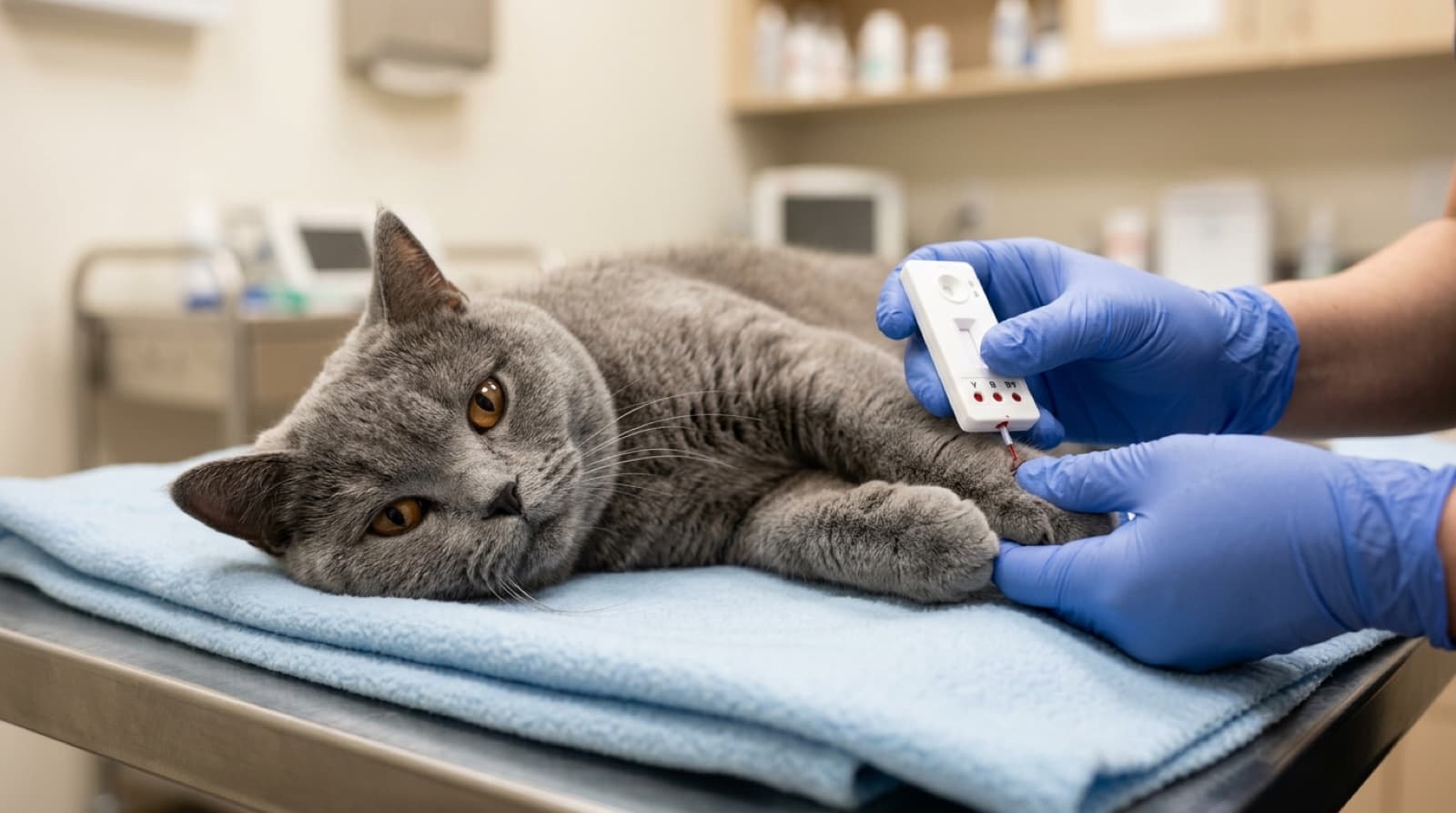
| In-clinic typing card | About $50 to $80 added to vet visit | Minutes | Pre-anaesthesia same-day decisions, urgent triage, when the result is needed today |
| Reference-lab cross-match | Variable, generally higher | Hours | Actual pre-transfusion compatibility check against specific donor blood; most rigorous option for transfusion |
For most BSH owners, the practical recommendation is the UC Davis VGL DNA test at adoption or at the first vet visit. A $45 to $60 one-time fee, a cheek swab the owner can collect at home and mail in, a permanent record returned in 1 to 2 weeks. The result goes in the file and never needs to be repeated.
The in-clinic typing card is the right choice when timing matters: a same-day pre-anaesthesia question, an urgent triage scenario, or a moment when the DNA-test lead time is too long. Most Calgary primary-care clinics carry feline typing cards.
The reference-lab cross-match is reserved for actual transfusion compatibility checks against specific donor blood, usually done at a Calgary specialty or 24/7 emergency clinic when transfusion is about to happen. Ask the attending vet; this is not a routine wellness test.
What to ask a BSH breeder about blood type
A responsible BSH breeder familiar with CCA, CFA, or TICA breed standards expects these questions and answers them without hesitation. A breeder who has not heard of neonatal isoerythrolysis, has not typed breeding parents, or dismisses the questions is a hard pass. The cost to the breeder of doing this right is small; the cost to a kitten of doing it wrong is the kitten's life.
The four questions:
- Have both breeding parents been blood-typed, and may I see the certificates? UC Davis VGL DNA test results are the gold standard. In-clinic typing card results are acceptable as long as the breeder kept the documentation. A breeder who says “we have not typed” or “we do not think it matters” is signalling unfamiliarity with breed-specific care expectations.
- Was this litter's mating planned with blood-type compatibility in mind? The answer should describe the queen's type, the tom's type, and the reasoning. Safe matings: Type B queen × Type B tom (zero NI risk); Type A queen × any tom (zero NI risk because the queen has no anti-A antibodies). At-risk mating: Type B queen × Type A or AB tom. If the at-risk pairing was used, the breeder should describe the mitigation (kitten typing at birth, cross-fostering Type A kittens off the Type B queen for 24 hours).
- Have the kittens themselves been typed, and is the certificate coming with the kitten? Ideal answer: yes, the kitten was typed at the first vet visit and the certificate is in the take-home paperwork. Acceptable: the parents were typed in a way that makes kitten typing unnecessary (e.g. Type B queen × Type B tom means all kittens are Type B). A breeder who has not typed kittens and used an at-risk pairing should be pressed harder.
- What is your protocol if NI is suspected in a future kitten? Listen for whether the breeder knows what NI is, knows the signs (fading, dark urine, weakness within 1 to 3 days), knows what to do (remove kitten from the queen, type immediately, consult an experienced feline vet), and is willing to support the owner through the situation. The answer reveals competence more than any other single question.
Adding context: Canadian BSH breeders registered with the Canadian Cat Association (CCA), the Cat Fanciers' Association (CFA), or The International Cat Association (TICA) follow breed standards that include health screening expectations. Blood typing for British Shorthair specifically is not a strict registry requirement but is widely considered ethical practice among reputable BSH breeders. A breeder who advertises BSH kittens cheaply on Kijiji or Facebook Marketplace without registry affiliation, without health-screening documentation, and without blood typing should be treated with the same scepticism as any other underground operation.
What to ask a Calgary rescue about adopting a BSH-mix
Most Calgary rescues including MEOW Foundation, Calgary Humane Society, AARCS, BARCS, Pawsitive Match, Cochrane Humane, and Heaven Can Wait do not proactively blood-type intake cats. The adoption fee covers spay/neuter, vaccines, microchip, and basic vetting, but typing is usually not included unless there was a medical reason. This is reasonable: the random DSH baseline of 3 to 4 percent Type B does not justify routine typing across an entire shelter intake.
For BSH or BSH-look DSH mixes specifically, the breed prior changes the math. A few practical questions to ask the rescue:
- “Has this cat been blood-typed?” Most often the answer is no. That is fine; it just means you are budgeting for the test at the first post-adoption vet visit.
- “Was pre-anaesthesia typing done before the spay or neuter?” If the cat is already spayed or neutered, ask whether typing was part of the workup. If it was, ask for the result so you can record it.
- “Does the medical history note any prior transfusion or transfusion reaction?” Unlikely but worth asking; would be a useful data point if it exists.
- “Is there anything else in the medical record that flagged a haematology concern?” Severe anaemia, immune-mediated haemolytic disease, or unusual bleeding events would all be relevant context.
Budget plan: at the first post-adoption vet visit (typically the wellness exam booked for 1 to 2 weeks after adoption), add the UC Davis VGL DNA test ($45 to $60 USD) or in-clinic typing card ($50 to $80). Get the result recorded in the file. If the cat will need spay or neuter through your primary vet (some rescues place cats too young for surgery and the new owner handles it), request pre-anaesthesia typing as part of the surgery workup. Discuss specifics with your Calgary veterinarian.
The Calgary blood bank reality
Calgary does not have a dedicated feline blood bank like some larger US cities (Animal Blood Resources International serves much of the US; Canada does not have a directly comparable national-scale feline blood bank). Donor cats are organised informally through the specialty and 24/7 emergency practices. Western Veterinary Specialist & Emergency Centre and Calgary's other 24/7 emergency centres maintain donor lists and can perform typing, cross-matching, and transfusion in-house.
Type A feline blood is more readily available because Type A is dominant in the donor pool. Type B feline blood is meaningfully harder to source on short notice. In a critical bleeding case, a Type B BSH may face a real wait while compatible blood is located. There is no fully reliable workaround at the population level, but the individual-cat workarounds are:
- Type your cat ahead of time and record it. Removes the typing delay during emergency triage.
- Maintain pet insurance. Emergency transfusion, hospitalisation, monitoring, and ICU care are expensive and typically covered under standard accident-and-illness policies, provided no pre-existing condition applies.
- Know which 24/7 emergency centre you would go to. Save the number. Drive the route once during daylight so you are not learning it at 2 AM in a snowstorm.
Discuss specifics with your Calgary veterinarian.
Cost reality
The Blood Type B safety story is one of the cheapest meaningful health investments a Calgary BSH owner makes. The numbers, to discuss with your Calgary veterinarian and adjust based on your specific clinic:
| Item | Calgary range (2026) |
|---|---|
| UC Davis VGL feline blood type DNA test (one-time) | About $45 to $60 USD |
| In-clinic typing card (one-time or pre-anaesthesia) | $50 to $80 added to vet visit |
| Pre-anaesthesia typing add-on to surgery | $50 to $80 added to surgery estimate |
| Engraved blood type tag (one-time) | $10 to $25 one-time |
| Reference-lab cross-match (only when transfusion imminent) | Variable. Discuss with attending vet. |
| Emergency transfusion + hospitalisation (if needed) | A meaningful financial commitment. Pet insurance with standard accident-and-illness coverage typically applies. |
Lifetime cost of preventive typing: pennies per day across the cat's life. Cost of a transfusion reaction or a litter of NI kittens: incalculable. The math is one of the easiest in feline preventive medicine. Discuss specifics with your Calgary veterinarian.
Frequently Asked Questions
What blood types do cats have?
Cats have the AB blood group system, which has three blood types: Type A (most common across cats overall), Type B (rare in many breeds but elevated in some, including British Shorthair), and Type AB (very rare). Unlike humans, cats produce naturally occurring antibodies against the blood type they do not carry, with no prior sensitisation needed. Type B cats have strong naturally occurring anti-A antibodies from birth. This is what makes feline blood typing critical even for a first transfusion or a first pregnancy. Discuss your specific cat with your Calgary veterinarian.
What is Blood Type B and why does it matter for British Shorthair?
Blood Type B is one of three feline blood types in the AB blood group system. It matters disproportionately for British Shorthair because the breed carries Type B at roughly 20 to 45 percent prevalence (varies by country and breeding lines), whereas the general Calgary and Saskatoon domestic shorthair baseline is only 3 to 4 percent per a peer-reviewed Canadian study (PMC7186432). A BSH or BSH-look mix in Calgary is roughly 5 to 15 times more likely to be Type B than a random rescue DSH. The practical implications are pre-anaesthesia blood typing before any surgery requiring transfusion possibility, pre-transfusion typing in any ER scenario, and breeder due-diligence on type-matched matings to prevent neonatal isoerythrolysis (NI) in kittens. Discuss specifics with your Calgary veterinarian.
How common is Blood Type B in BSH?
Published estimates range from about 20 to 45 percent of British Shorthair cats carrying Type B, varying with country and breeding lines. By comparison, a peer-reviewed Canadian study indexed on PubMed Central (PMC7186432) found Calgary and Saskatoon domestic shorthair populations carry Type B at only 3 to 4 percent. Other high-Type-B breeds include Devon Rex, Cornish Rex, Turkish Van, and some Persian and Exotic Shorthair lines. Some breeds run nearly 100 percent Type A (Siamese, Burmese, Tonkinese). The breed-level number is a useful planning estimate, but the only way to know YOUR cat is to type the individual cat.
What is Neonatal Isoerythrolysis (NI)?
Neonatal isoerythrolysis is a fatal newborn-kitten condition caused by a blood-type mismatch between queen and kittens. The mechanism: a Type B queen carries naturally occurring anti-A antibodies (no prior exposure required) and concentrates them in her colostrum, the first milk produced in the 24 to 48 hours after birth. If she has been bred to a Type A or AB tom and produces Type A or AB kittens, those kittens nurse on antibody-loaded colostrum within the first 24 hours of life. The anti-A antibodies bind to and destroy the kittens' red blood cells. Signs appear within 1 to 3 days: fading, weakness, refusal to nurse, dark or red-tinged urine (haemoglobinuria), and death. Mortality is high once symptoms appear. Prevention is straightforward: blood-type both breeding parents BEFORE the breeding decision is made. Discuss specifics with your Calgary veterinarian.
Should I have my BSH blood typed before surgery?
It is reasonable to discuss this with your Calgary veterinarian for any BSH or BSH-mix headed for spay, neuter, dental cleaning, or other elective surgery, especially given the breed Type B prevalence is documented at 20 to 45 percent. The reasoning: if a surgical complication required an emergency transfusion, transfusing the wrong type into a Type B cat causes severe acute reaction (haemolysis, hypotension, potentially fatal). A pre-anaesthesia in-clinic typing card adds roughly $50 to $80 to the surgery cost and removes that risk entirely. Some Calgary practices recommend it as routine for BSH; others type only if transfusion looks likely. Ask your vet before scheduling. Discuss specifics with your Calgary veterinarian.
How do I get my BSH blood typed in Calgary?
Three practical options. The in-clinic typing card uses a few drops of blood and returns a result in minutes, typically $50 to $80 added to a regular visit; ideal for pre-anaesthesia decisions. The UC Davis Veterinary Genetics Laboratory (vgl.ucdavis.edu) offers a feline blood type DNA test via cheek swab, runs about $45 to $60 USD, returns in 1 to 2 weeks, and identifies the b/b genotype as well as the rare AB allele; ideal for breeding decisions or anyone wanting a permanent on-file record. A reference-lab cross-match against potential donor blood is the most rigorous option for an actual transfusion compatibility check, but it takes time and is typically performed in an ER scenario. Ask your primary Calgary vet to record the type in the file once you have it; some owners also engrave it on the cat ID tag.
What does a BSH blood test cost?
The UC Davis VGL DNA test runs roughly $45 to $60 USD (cheek swab, mailed in, results in 1 to 2 weeks). The in-clinic typing card adds roughly $50 to $80 to a vet visit (drops of blood, results in minutes). Pre-anaesthesia typing is often added as a $50 to $80 line item to a surgery estimate. Lifetime cost is pennies per day. Compare that to the cost of a transfusion reaction or a litter of NI kittens. Most Canadian pet insurance policies do not cover routine blood typing because it is considered preventive (similar to vaccinations), but the once-in-a-lifetime fee makes coverage status mostly moot. Confirm pricing with your Calgary veterinarian.
Can a BSH have a transfusion reaction?
Yes, and this is the main practical reason pre-typing matters. A Type B cat transfused with Type A blood experiences an acute haemolytic reaction: anti-A antibodies bind donor red blood cells, those cells lyse rapidly, and the cat develops haemolysis, hypotension, shock, and potentially death within minutes to hours. Even a single mL of mismatched blood can be fatal in a Type B cat. The reverse (Type A cat transfused with Type B blood) is less severe but still causes destruction of donor cells and significantly reduces transfusion benefit. The only safe transfusion is type-matched, ideally cross-matched. Knowing the type before an emergency, recorded in the file at your primary Calgary clinic, is the practical safeguard. Discuss specifics with your Calgary veterinarian.
What questions should I ask a BSH breeder about blood type?
Four questions, all of which a responsible breeder should answer without hesitation. First: have both breeding parents been blood typed, and can you see the certificates? UC Davis VGL DNA results are the gold standard. Second: was the mating planned with type compatibility in mind, meaning either a Type B queen bred only to a Type B tom (no NI risk), or a Type A queen bred to any type (no NI risk)? Third: have the kittens been typed before placement, or has the breeder verified that no kitten is Type A from a Type B queen via cross-fostering or another mitigation? Fourth: is the kitten coming with a written record of blood type? A breeder who has not heard of NI, has not typed the parents, or dismisses your questions is a hard pass. CCA, CFA, and TICA registered breeders following CFA or TICA breed standards should be familiar with this.
Do Calgary rescues blood-type BSH-mix cats?
Not as a routine standard. Most Calgary rescues including MEOW Foundation, Calgary Humane Society, AARCS, BARCS, Pawsitive Match, Cochrane Humane, and Heaven Can Wait do not proactively blood-type their intake cats unless there is a medical reason (planned surgery requiring potential transfusion, suspected anaemia, breeding history concern). The adoption fee covers spay/neuter, vaccines, microchip, and basic vetting, but typing is usually not included. If you adopt a BSH or BSH-look mix from a Calgary rescue, budget an additional $45 to $80 at your first vet visit for either the UC Davis VGL DNA test or an in-clinic typing card. Ask the rescue if pre-spay/neuter typing was done; if not, request it before the surgery is scheduled. Discuss specifics with your Calgary veterinarian.
Where can I get emergency feline blood transfusion in Calgary?
Calgary 24/7 emergency veterinary centres including Western Veterinary Specialist and Emergency Centre (westernvet.ca) can perform feline blood typing, cross-matching, and transfusions. Calgary does not have a dedicated feline blood bank like some major US cities; donor cats are organised informally through the specialty practices. Type B feline blood is meaningfully rarer in the donor pool and harder to source in an emergency. This rarity is one more reason to type your BSH proactively and record the type in the file at your primary Calgary clinic. If your cat presents to the ER and the type is already on file, critical minutes are saved at triage. Discuss specifics with your Calgary veterinarian.
What if my BSH is mixed breed: does blood typing still matter?
Yes, often as much as for a purebred BSH. Type B inheritance is genetic, and a BSH-mix cat can carry one or two copies of the b allele depending on parents. A BSH-look DSH from a Calgary rescue is meaningfully more likely to be Type B than an unrelated DSH; the breed-defining gene pool concentrates the b allele. The practical answer: the cost of typing one cat is small (about $45 to $80), the consequence of skipping it before surgery or in an ER is potentially fatal, and the breed history is an honest reason to test. Type your BSH-mix at the first vet visit, record it in the file, and you never need to type again. Discuss specifics with your Calgary veterinarian.
Is blood typing covered by pet insurance?
Usually no, because most Canadian pet insurance carriers (Trupanion, Petsecure, Pet Plus Us) categorise blood typing as preventive care similar to vaccinations and routine wellness, which falls outside the standard accident-and-illness coverage. Some carriers offer wellness add-on riders that may include preventive diagnostics; check your policy specifics. The good news: the test is a one-time fee of roughly $45 to $80, so coverage status is mostly moot. If a TRANSFUSION is required in an emergency, the transfusion itself (the blood product, monitoring, hospitalisation) IS usually covered under standard accident-and-illness coverage, provided no pre-existing condition exclusion applies. Confirm specifics with your insurer. Discuss specifics with your Calgary veterinarian.
What is the AB blood type in cats?
Type AB is the third and rarest feline blood type, distinct from the more common Type A and Type B. AB cats carry BOTH A and B antigens on their red blood cells, but unlike Type O humans, they produce NO naturally occurring anti-A or anti-B antibodies. This makes Type AB cats universal recipients (they can accept Type A, Type B, or Type AB blood without an acute haemolytic reaction), though Type AB is preferred when available. Type AB is rare overall (less than 1 percent in most populations) and is identified by DNA testing through UC Davis VGL or by in-clinic blood typing. AB results are surprising enough that some clinics confirm with a second test. Discuss specifics with your Calgary veterinarian.
British Shorthair Cats in Calgary
Browse adoptable British Shorthair and BSH-look mix listings from Calgary rescues. Real purebreds are rare; mixes are regular.
British Shorthair Adoption Guide
Rescue versus breeder, real costs, scam patterns, breeder verification, and the buy-vs-adopt math for Calgary.
British Shorthair Health: HCM, PKD, Blood Type B
British Shorthair health: 8.5% HCM (Granstrom 2011, no DNA test), PKD1 testable via UC Davis VGL, Blood Type B + NI risk, dental, obesity.
BSH vs Chartreux vs Russian Blue: ID Guide
Telling apart the three blue cat breeds: BSH (copper eyes, chubby), Chartreux (narrow muzzle, French), Russian Blue (green eyes, slim).
New cat? Start with these care guides
Everything a new adopter needs to set up a safe, happy home.