The short answer
Two body types share the “Persian” name. Doll Face (Traditional) is the original conformation: visible nose, normal tear drainage, easier breathing, less staining, lower anaesthesia risk. Peke Face (Modern/Show) is the extreme flat-face conformation that emerged from a 1950s mutation and became the CFA show standard. CFA registers both as Persian and folded Himalayan colourpoint Persians into the breed in 1984 as a colour division. TICA registers Himalayan as a separate breed. For Calgary adopters, Doll Face is the lower-health-risk choice. But most rescue Persians are mixes and you take the cat in front of you. This article teaches you which is which.
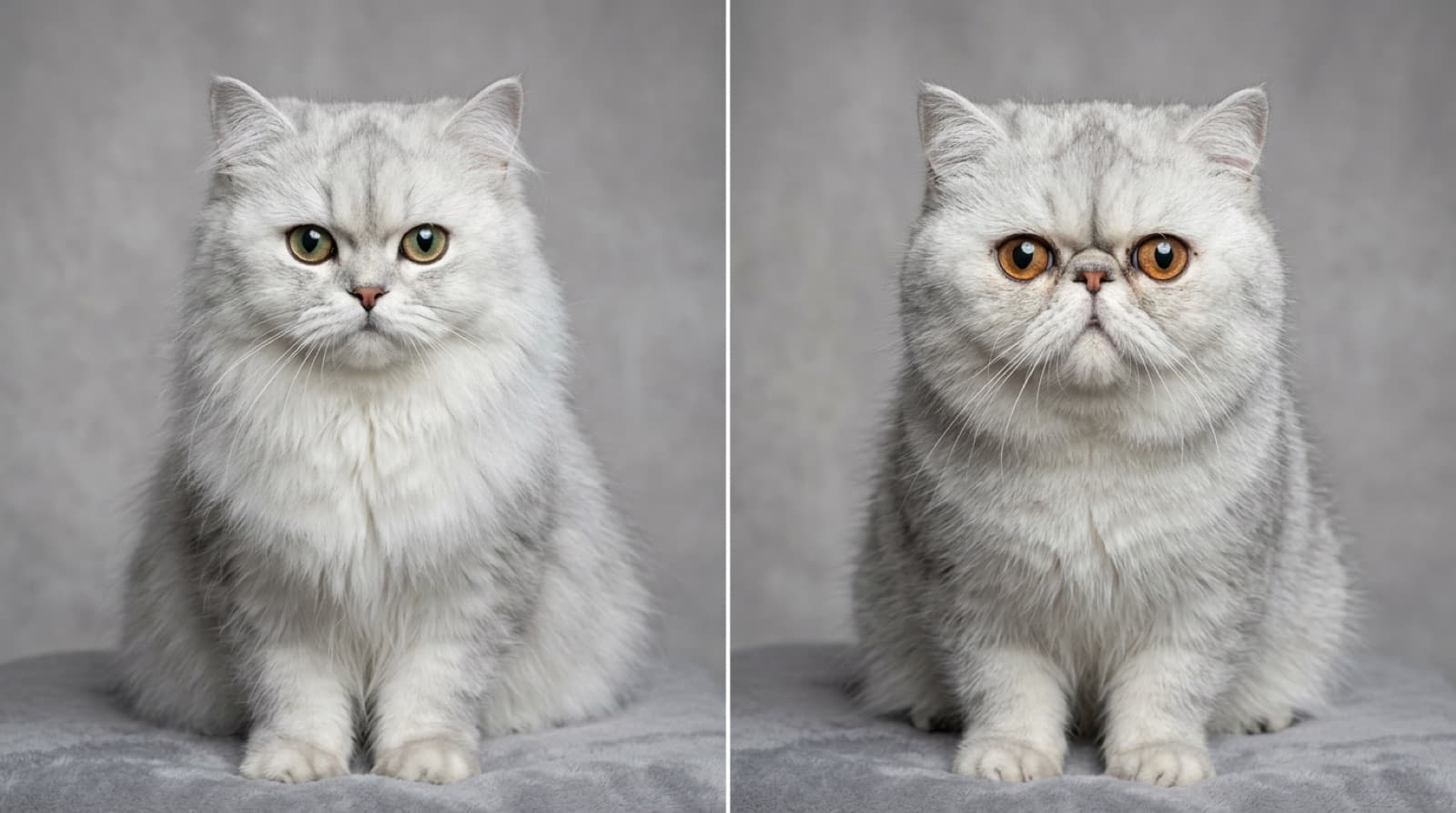
The two body types: Doll Face vs Peke Face
The Persian breed has split visually into two body types over the last 75 years. Both descend from the same long-haired cats imported into Europe in the 1600s and 1700s and refined into a recognised breed in late-1800s England. The split happened because of a spontaneous mutation in the 1950s that produced a flatter face in red tabby Persians. Show breeders selectively bred for the flatter look, and by the 1980s the Peke Face conformation dominated CFA show rings. Breeders who kept the original visible-nose look formed a parallel preservation movement, and the original conformation is now called Doll Face or Traditional Persian.
The two body types are easy to tell apart once you know what to look for. Both share the long flowing double coat, the cobby (short and stocky) body, the small wide-set ears, and the same family of temperaments. The differences are concentrated in the skull and face structure, and those differences drive the health gap.
Doll Face (Traditional Persian)
- Visible, properly-set nose with no “nose break”
- Normal tear drainage (nasolacrimal ducts function normally)
- Lower brachycephalic airway syndrome risk
- Easier breathing (normal stenotic nares and soft palate length)
- Substantially less tear staining (~30 to 40% epiphora rate vs ~85 to 90% in Peke Face)
- Lower anaesthesia risk (no BAS complications stacking with potential HCM risk)
- Original pre-1950s Persian conformation
- Still registered as Persian by CFA, but does not dominate show rings
- Also called Traditional Persian, Old Style Persian, or Classic Persian
Peke Face (Modern/Show Persian)
- Nose set between the eyes (the “nose break”)
- Severely shortened skull producing a flat front profile
- Full brachycephalic airway syndrome risk
- Audible breathing at rest (mild) to obvious snoring (moderate to severe)
- High chronic tear-staining rate (~85 to 90%)
- Higher anaesthesia risk (BAS plus potential HCM stack)
- Higher dental issues (severely shortened dental arch with crowding)
- CFA modern show standard, developed from a 1950s spontaneous mutation in red tabby Persians
- Registered as Persian in all major registries
Both types share the same temperament family: calm, quiet, affectionate but reserved, low-energy, indoor-only preference, and a strong tendency toward routine. The Peke Face type does not have a different personality. Both types share the same grooming reality, covered in our Persian grooming guide. The medical reality differs materially; the grooming reality is identical.
The CFA position: one breed, two conformations, plus Himalayan
The Cat Fanciers’ Association (CFA) recognises Persian as one breed. The breed standard accommodates both Doll Face and Peke Face conformations under the single Persian name. Show rings have favoured Peke Face since the late 1950s, so most CFA show champions today are Peke Face, but a Doll Face Persian from registered Persian parents is still registered as Persian.
In 1984, CFA folded Himalayan (the colourpoint Persian) into Persian as a colour and pattern division. Before 1984, CFA recognised Himalayan as a separate breed (recognition granted in 1957). After 1984, all colourpoint Persians register as Persian with Himalayan colour notation. The reasoning: the body type of a colourpoint Persian matches the Persian standard, and only the colour pattern reflects Siamese ancestry from the mid-20th century crosses that produced the colourpoint Persian look. CFA argued this should be a colour division within Persian, not a separate breed.
So a CFA-registered Persian today can be any of four combinations: Doll Face solid-colour, Peke Face solid-colour, Doll Face Himalayan (colourpoint), or Peke Face Himalayan. All four register as Persian with descriptors. Calgary breeders working in CFA produce all four; the conformation and colour notation appear on the registration paperwork.
Why CFA did not split body types into separate breeds: CFA reasons that the Doll Face and Peke Face conformations are variation within one breed, not a genetic split. The lineage is the same. The breeding population is the same. Show preference shifted but the breed did not divide. This is the same logic CFA applied to Siamese (where both Traditional and Modern register as Siamese in CFA, while TICA splits Traditional off as Thai).
The TICA position: Himalayan as a separate breed
The same colourpoint cat can have different paperwork depending on which registry the breeder uses. This trips up Calgary adopters expecting a “Himalayan” registration certificate.
The International Cat Association (TICA) registers Himalayan as a separate breed with its own standard. TICA Persians are non-colourpoint. TICA Himalayans are colourpoint. Both can be Doll Face or Peke Face conformation within their respective TICA breed designations.
TICA argues that the colourpoint pattern reflects a meaningfully distinct breeding history. Mid-20th century breeders crossed Persians with Siamese to introduce the colourpoint pattern into the Persian body type. The resulting cat is genetically part Siamese, even if the body type matches Persian. TICA argues this distinct breeding history warrants separate breed status, the same way Tonkinese (Siamese-Burmese cross) and Snowshoe (Siamese-bicolour cross) get separate breed status.
Why this matters for Calgary adopters: paperwork from a TICA-registered colourpoint Persian kitten will read “Himalayan,” not “Persian.” This confuses buyers who expect a Persian certificate or who think Himalayan and Persian are different breeds when they are physically the same animal. The cat is the same. The registry just calls it something different. If a Calgary breeder offers a colourpoint Persian kitten with CFA papers, those papers will say Persian with Himalayan colour notation. If the same breeder used TICA, the same kitten would have papers saying Himalayan. Both are legitimate.
Practical implication for verification: when checking paperwork on a colourpoint Persian or Himalayan kitten, cross-reference the cattery on the registry’s online directory (cfa.org or tica.org). If the cattery exists and the registration number is valid, the paperwork is real regardless of which name appears on it.
The Himalayan history: Persian plus Siamese
Mid-20th century breeders deliberately crossed Persians with Siamese to create a long-haired cat with the colourpoint pattern. The Persian contributed the long flowing coat, the cobby body, and the calm temperament. The Siamese contributed the colourpoint pattern (darker face mask, ears, paws, tail) and the mandatory blue eyes that come with the colour-point gene.
By the 1950s the cross had stabilised into a recognisable breed type with consistent Persian body conformation and consistent colourpoint pattern. CFA recognised Himalayan as a separate breed in 1957. The breed gained popularity through the 1960s and 1970s. In 1984, CFA reorganised: Himalayan was folded into Persian as a colour and pattern division, on the reasoning that body type drives breed identification and the colour pattern is a separable trait.
TICA kept the separate-breed designation. WCF and FIFe took intermediate positions over the years. The cat itself never changed. The same colourpoint Persian today can be registered as Persian (CFA) or Himalayan (TICA), and both registrations are legitimate.
The colourpoint pattern carries one consistent rule: Himalayan colourpoint Persians have mandatory blue eyes. The same colour-point gene mutation that produces the darker points also affects eye pigment. A colourpoint Persian without blue eyes is not breed-pure under either CFA Himalayan colour division or TICA Himalayan breed standard. Non-colourpoint Persians have eye colour determined by coat colour: copper for solid black, blue, red, cream, tortie, and white; green or blue-green for silver and golden; and copper, blue, or odd-eye for white.
What “Persian mix” at a Calgary rescue actually is
This is the most adoption-relevant part of the article. Calgary rescue cats labelled “Persian mix” are usually long-haired Domestic Shorthair or Doll Face crosses. They are wonderful cats; they just are not purebred Persian in the registry sense.
Walk through the MEOW Foundation listings or the Calgary Humane Society long-haired cat section and you will see “Persian mix” tagged on cats with Persian-like coats. The same pattern shows up at AARCS and the smaller Calgary cat rescues. The real rate of registered Persian breed ancestry in these cats is low. Most are one of four things:
- Long-haired Domestic Shorthair (DLH) with a Persian-like coat but a visible nose, lankier body, and no documented Persian ancestor. Most common at Calgary rescues.
- Doll Face Persian crossed with DLH, often from Calgary Kijiji backyard breeders who let an unspayed Persian-type cat have an accidental litter. The visible-nose half-Persian look is common in these crosses.
- Adult retired breeder Persians from purebred breeding programs. Less common at general Calgary rescues; more common through Specialty Purebred Cat Rescue cross-border placements.
- Pure Persian surrenders from households overwhelmed by daily grooming, severe matting, or BAS-related health costs. Regular but not frequent at Calgary intake.
Adopters should know what they are actually getting. The honest framing we tell adopters: a “Persian mix” label is shelter shorthand for “long-haired cat that may or may not have breed ancestry.” Foster notes describe the actual cat (body type, temperament, grooming tolerance, any health flags), which is more useful than the breed label. If a foster note says “Doll Face type, breathes quietly, no tear staining,” you have actionable information. If it just says “Persian mix,” you have a label.
If you specifically want a Persian-type cat for the look (long flowing coat, cobby body, calm temperament), the rescue route delivers all of that regardless of breed verification. If you specifically want documented Persian breed ancestry with conformation guaranteed Doll Face for the health reasons, you need either parent documentation from a surrender story (rare) or a breeder route with verified Doll Face lines.
How to identify body type when shopping or adopting
Identifying Doll Face vs Peke Face takes about ten seconds once you know what to look for. The signals are concentrated in profile and breathing.
Look at the profile from the side
Visible nose with a slight forehead curve down to the nose tip = Doll Face. Nose set between the eyes with a flat forehead-to-mouth profile (no visible bridge) = Peke Face. The side profile is the single clearest tell. A photo from the side shows it in a fraction of a second.
Look at the eye placement
Doll Face eyes sit at normal angles relative to the muzzle. Peke Face eyes look bulgier and more centrally positioned because the skull shortening pushes the eye sockets forward. The bulgy-eye look is a Peke Face indicator even when you cannot see the profile.
Listen for breathing
Doll Face cats breathe quietly at rest. Peke Face cats often have audible breathing at rest (mild cases) to obvious snoring (moderate to severe cases). If you can hear the cat breathing from across a quiet room, the conformation is Peke Face and the breathing is consistent with brachycephalic airway syndrome. This is a meaningful health indicator, not just a quirk.
Check tear staining
Doll Face cats may have mild staining or none. Peke Face cats almost always have significant brown staining around the eyes due to overflow drainage. The staining is permanent without daily eye care and even with daily care the underlying drainage problem persists. A Persian with no visible tear staining is almost certainly Doll Face. A Persian with heavy brown staining is almost certainly Peke Face.
At a breeder: ask directly
Ask explicitly: “Doll Face or Peke Face? Traditional or Modern?” Ethical breeders will tell you directly which conformation their lines produce. Cagey breeders who avoid the question are usually selling Peke Face but trying to avoid the health-risk conversation. The breeder’s willingness to discuss conformation honestly is itself a screening signal.
At a Calgary rescue: read the foster notes
Foster notes often describe the cat as “Doll Face / Traditional type” or “Peke Face / Modern type” if the foster is breed-aware. If not labelled, the side-profile photo in the listing tells you. Ask the rescue directly if you are unsure. MEOW Foundation and Calgary Humane Society fosters generally respond promptly to specific questions about body type and breathing.
The health-risk tradeoff Calgary adopters should understand
The Doll Face vs Peke Face choice is genuinely a medical decision, not just an aesthetic preference. Here is the honest comparison for Calgary adopters thinking through what they are committing to.
Doll Face Persian: the lower-stress medical path
- Lower brachycephalic airway syndrome risk
- Lower anaesthesia risk (relevant for routine dental cleanings and any surgery)
- Fewer tear-staining issues, lower daily eye care commitment
- Easier dental management (more normal dental arch length)
- Same PKD risk (Persian-specific, conformation-independent, screen with PKD1 DNA test)
- Same coat care commitment (daily brushing, seasonal shaving)
- Same 12 to 17 year lifespan
Peke Face Persian: the higher-management medical path
- Higher brachycephalic airway syndrome risk, sometimes requiring surgical correction
- Higher anaesthesia risk; pre-anaesthesia evaluation by a veterinary specialist is wise
- Daily eye care non-negotiable (warm-water wiping to manage staining)
- More frequent dental cleanings under anaesthesia due to dental crowding
- Same PKD risk (Persian-specific, conformation-independent)
- Same coat care commitment
- Same 12 to 17 year lifespan if BAS is managed proactively
For first-time Persian owners, Doll Face is the lower-stress entry point. The grooming reality is identical. The medical reality is materially different. A first-time Peke Face owner who has not budgeted for BAS evaluation, daily eye care, and higher anaesthesia cost can be blindsided at the first vet visit.
For Calgary owners committed to the Peke Face look (whether for show records or aesthetic preference), the path forward is proactive: establish a relationship with Western Veterinary Specialist & Emergency Centre early for BAS assessment, budget for daily eye care, and accept that anaesthesia events will require more planning than they would for a Doll Face cat. The full medical picture is covered in our Persian health issues guide.
The PKD risk is conformation-independent. Both Doll Face and Peke Face Persians carry the same elevated PKD1 risk. Ethical breeders of both types screen parents with UC Davis Veterinary Genetics Laboratory PKD1 DNA testing before breeding. The same applies to HCM screening via annual echocardiogram by a veterinary cardiologist.
Skip the body-type drama. Browse adoptable Persian-type cats in Calgary.
Calgary rescue Persians are the cat in front of you: body type, temperament, and grooming tolerance documented by foster homes. Most adoption-ready Persians arrive having already gone through the matting and shave-down reality.
See Available Persians →Scam patterns specific to body type and Himalayan classification
Persian scams cluster around body-type misrepresentation, fake Himalayan rarity claims, and classification confusion. Knowing the breed standard tells you which kittens are mislabelled and which sellers are running fraud.
The “rare Doll Face” premium
Some Calgary sellers mark up Doll Face Persians as “rare Traditional” at two to three times normal kitten pricing. Doll Face Persians are not particularly rare among ethical breeders who preserve the older type. The conformation exists in healthy supply. Premium pricing built on a rarity claim should be questioned. The honest cost range for an ethical Canadian Persian kitten (Doll Face or Peke Face) is $1,200 to $3,000.
The “show-quality Peke Face” markup
The reverse pattern: extreme Peke Face cats marketed at show-quality pricing without actual show records. Show quality means consistent placement at sanctioned CFA or TICA shows, not just a flat face. Ask for show records and judges’ critiques. A breeder who cannot produce documented show placements is not selling show quality, regardless of how flat the face is.
Himalayan colourpoint markup
Himalayan colourpoint patterns (especially rarer colours like flame point or lynx point) get marked up by sellers exploiting the perception that colourpoint Persians are exotic. They are not particularly rare from CFA or TICA breeders. The colourpoint Persian breeding population is large and stable. A Himalayan colourpoint kitten should cost roughly the same as a solid-colour Persian kitten from the same breeder, not double.
“Teacup Persian” listings
Not a real classification. Neither CFA nor TICA recognises a teacup Persian variety. The Persian breed standard specifies a medium-sized cobby cat weighing 7 to 12 pounds adult. Anything advertised as a teacup Persian is either undersized due to runt status or poor nutrition (a health flag, not a feature) or mislabelled Exotic Shorthair kittens. Walk away.
PKD-testing claims without paperwork
Any breeder claiming PKD-negative parents but unable to produce a UC Davis VGL or Laboklin certificate listing the parent’s registered name is selling unverified. PKD1 is an autosomal dominant Persian-specific mutation that is reliably testable. Ethical breeders test both parents and provide certificates without being asked. The certificate names the cat, not just the cattery, so cross-reference parent name on the certificate against parent name on the pedigree.
Body-type misrepresentation
A breeder labels a Peke Face kitten as “Doll Face” knowing the buyer wants the lower-health-risk type. The buyer realises at first vet visit when the cat presents with audible breathing and severe tear staining. Verification: ask for clear profile photos of both parents before money changes hands. If the parents have flat faces, the kitten will develop a flat face. Body type misrepresentation is one of the most common Persian buyer complaints.
The “registered Persian” claim with no specifics
A vague “registered” claim with no cattery name and no registration number is the most common fraud pattern. Ask for the specific TICA or CFA cattery number. Verify the cattery directly on the registry website. If the cattery does not appear in the directory, the paperwork does not exist. Ethical breeders provide registration details upfront without being asked.
For the broader scam-pattern picture across all Persian purchases, our Persian adoption guide covers Kijiji red flags, fake breeder websites, and what real Canadian breeder verification looks like.
How to verify a real Persian with real CFA or TICA paperwork
If you are buying a Persian kitten from a breeder rather than adopting from a rescue, breed verification matters. Here is the step-by-step:
- Ask for CFA or TICA registration paperwork by name. A vague “registered” claim is not enough. The breeder should provide a specific registration number and cattery name. Cross-reference the cattery on the registry online directory (cfa.org for CFA, tica.org for TICA). If the cattery does not appear in the directory, the paperwork is fake.
- Verify the cattery directly on the registry website. Both CFA and TICA maintain searchable breeder directories. A real cattery will appear with active status.
- Confirm both parents are registered with photos and registration numbers. The pedigree should document at least three generations back.
- Confirm PKD1 and PRA-pd DNA test certificates with each parent’s registered name printed on the certificate. UC Davis VGL or Laboklin are the recognised labs for Persian DNA panels.
- Confirm HCM screening on parents via annual echocardiogram by a veterinary cardiologist. Ethical breeders provide the most recent screening results without being asked.
- Confirm body type and Himalayan or non-Himalayan in writing. The breeder should state explicitly whether the kitten is Doll Face or Peke Face conformation and whether it carries the Himalayan colourpoint pattern. Get this in writing so misrepresentation is documented if it surfaces later.
- Confirm kitten release age of 12 to 16 weeks minimum. Persian kittens released earlier are usually being moved before health issues become apparent.
- Read the contract. Look for a spay or neuter agreement, a return-to-breeder clause, and a health guarantee covering PKD progression and HCM diagnosis.
- For Traditional or Doll Face kittens registered via TICA, paperwork may say “Persian” for non-colourpoint or “Himalayan” if colourpoint. For CFA, paperwork will say “Persian” with body type and Himalayan colour notation if applicable. Both legitimate.
For adopters who already have a cat without paperwork and want to know what is actually in there, a Wisdom Panel cat DNA test runs around $130 USD (Canadian pricing varies with import and shipping) and reports breed percentages plus health markers. The Persian-specific health value is real: the test flags PKD1 status, which gives your vet actionable kidney monitoring information for the lifetime of the cat. The breed report is informative but not a substitute for a pedigree.
The rescue path bypasses most of this
Calgary rescue Persians and Persian mixes are domestic cats with whatever body type they happen to have. Adoption fees run $300 to $500 and cover spay or neuter, vaccinations, microchip, deworming, and a vet workup. Zero paperwork verification. Zero body-type-claim verification. Zero scam risk. The cat in front of you is the cat in front of you.
For most adopters who want a Persian for the coat and the temperament rather than show records, the rescue path is the clean answer. If long flowing coat, cobby body, calm indoor temperament, and patient affectionate companionship are the priorities, every Calgary rescue Persian or Persian mix delivers exactly that. Lifespan is 12 to 17 years. Care needs are the same as a purebred Persian: daily brushing, seasonal shaving, eye care if Peke Face, dental monitoring, and indoor-only lifestyle.
Several Calgary rescues consistently list Persian-type cats. MEOW Foundation is cat-only and the largest dedicated cat rescue in Calgary; their foster homes do detailed temperament and grooming-tolerance assessments. Calgary Humane Society has the highest cat intake volume in the city. AARCS pulls cats from rural Alberta shelters and overflow situations, including occasional purebred surrenders.
For adopters who specifically want documented Persian breed ancestry, Specialty Purebred Cat Rescue operates across North America and occasionally facilitates cross-border placements of retired breeder Persians into Canadian homes. Worth checking if you want a confirmed Doll Face Persian without the breeder route.
What real CFA or TICA paperwork looks like vs a fake
If you are pursuing the breeder route and verifying paperwork, here is what real registration documentation includes vs what fake paperwork looks like.
Real paperwork includes:
- Specific cattery name that appears in the registry online directory. Cross-reference at cfa.org or tica.org.
- Cattery registration number that matches the directory entry.
- Pedigree chart documenting at least three generations of registered ancestors, with parents and grandparents named.
- Breed name printed correctly: CFA lists “Persian” for both body types with Himalayan colour notation for colourpoint; TICA lists “Persian” for non-colourpoint and “Himalayan” for colourpoint.
- Official registry seal or watermark on the certificate.
- Microchip number cross-referenced to the registry record (ethical breeders microchip before sale).
- PKD1 and HCM screening certificates for both parents, with each parent’s registered name printed on the certificate.
Fake or misleading paperwork shows: vague “registered” claims without cattery specifics, missing parent documentation, requests to skip registry verification, breed name written incorrectly for the registry (e.g. a CFA certificate that says “Himalayan” as the breed instead of Persian with Himalayan colour notation), or pressure to complete the sale before verification can be done. Walk away from any of these.
Frequently Asked Questions
What’s the difference between Doll Face and Peke Face Persian?
Skull and nose conformation. Doll Face (Traditional) Persian has a visible, properly-set nose, normal tear drainage, lower brachycephalic airway syndrome risk, easier breathing, and substantially less tear staining. Peke Face (Modern/Show) Persian has a nose set between the eyes (the “nose break”), a severely shortened skull, a full brachycephalic profile, audible breathing, and ~85 to 90% rate of chronic tear staining. Both share the same coat, the same temperament, the same 12 to 17 year lifespan, and the same Persian-specific PKD risk. The medical reality differs materially; the grooming reality is identical.
Is a Doll Face Persian healthier than a Peke Face?
Yes, materially. Doll Face Persians have lower brachycephalic airway syndrome risk because their nasal passages and soft palate are closer to normal length. They have lower anaesthesia risk, which matters because Persians need anaesthesia for routine dental cleanings and any surgical procedure. They have substantially less tear staining because nasolacrimal ducts drain normally. Both types share the same PKD risk and the same grooming needs. For first-time Persian owners, Doll Face is the lower-stress entry point.
Is a Himalayan the same as a Persian?
It depends on the registry. CFA folded Himalayan into Persian in 1984 as a colour and pattern division: a CFA Himalayan is a colourpoint Persian, registered as Persian with a Himalayan colour notation. TICA registers Himalayan as a separate breed with its own standard. The cat itself is the same animal regardless of registry; the name varies. A CFA pedigree will read Persian; a TICA pedigree on the same cat may read Himalayan.
Why does CFA call them all Persian but TICA splits Himalayan as a separate breed?
CFA reasons that the body type of a colourpoint Persian matches the Persian standard and only the colour pattern reflects Siamese ancestry, so it should be registered as a Persian colour division. TICA reasons that the colourpoint pattern reflects a meaningfully distinct breeding history (mid-20th century Persian-Siamese crosses) and warrants separate breed status. Both positions are internally consistent. CFA recognised Himalayan as a separate breed in 1957, then folded it into Persian in 1984. TICA kept the separate-breed designation.
Are all Persians supposed to have flat faces?
No. The flat-faced Peke Face look is the modern CFA show standard, but the original Persian conformation (Doll Face / Traditional) has a visible, properly-set nose with no flatness. The Peke Face look comes from a 1950s spontaneous mutation in red tabby Persians that was selectively bred for. Both conformations are still registered as Persian by CFA. Ethical Doll Face breeders preserve the older type for health reasons.
Can a Persian have green or copper eyes?
Yes. Persian eye colour depends on coat colour. Solid black, blue, red, cream, and tortoiseshell Persians typically have brilliant copper eyes. Silver and golden Persians (chinchilla) have green or blue-green eyes. White Persians can have copper, blue, or odd eyes (one of each). Himalayan colourpoint Persians have mandatory blue eyes (the colour-point gene also affects eye pigment). Eye colour is standard-defined per coat type, but green and copper are both standard for non-colourpoint Persians.
Is a Doll Face Persian rarer than a Peke Face?
Not particularly. Doll Face Persians are less common in CFA show rings because the show standard favours the Peke Face conformation, but they are not rare among ethical breeders. Several Doll Face preservation breeders operate across North America. “Rare Traditional Persian” pricing premiums of two to three times the normal kitten price should be questioned.
Why do Peke Face Persians have brown tear stains?
The severely shortened skull compresses the nasolacrimal ducts that normally drain tears from the eye to the nasal cavity. Drainage fails or runs at reduced capacity, and tears overflow onto the face. The overflow tears contain porphyrins (iron-containing pigments) that oxidise on contact with air and stain the fur reddish-brown. Doll Face Persians have functional drainage and rarely show staining. Peke Face Persians show staining in approximately 85 to 90% of cases regardless of grooming effort. Daily eye wiping reduces visible staining but cannot fix the underlying drainage problem.
How can I tell if my cat is a real Persian?
Without CFA or TICA registry paperwork you cannot confirm purebred status. The traits to look for: long flowing double coat with thick undercoat, cobby body, large round eyes, small ears set wide apart, short legs, plumed tail, and either a visible nose (Doll Face) or flat face with nose break (Peke Face). Paperwork from a verifiable CFA or TICA cattery with both parents documented is the only confirmation. A Wisdom Panel DNA test reports breed percentages but is not a substitute for pedigree.
Is a $500 “purebred Persian kitten” a scam?
Almost certainly. Ethical Canadian Persian breeders charge $1,200 to $3,000 for a registered kitten with paperwork, PKD1 DNA testing on both parents, HCM screening, and verified Doll Face or Peke Face conformation. Anyone advertising purebred Persians under $900 with no waitlist and no health testing documentation is either running a scam or selling Persian-mix kittens as purebreds. The honest path at that budget is rescue, where a Calgary Persian or Persian mix costs $300 to $500 with full vetting included.
What is a “teacup Persian”?
Not a real classification. Neither CFA nor TICA recognises a teacup Persian variety. The term is marketing language used by unethical breeders selling undersized or runt kittens, kittens from poor nutrition that failed to grow, or mislabelled Exotic Shorthair kittens. The Persian breed standard specifies a medium-sized cobby cat weighing 7 to 12 pounds adult. Anything advertised as a teacup Persian is either undersized due to health problems or fraudulently labelled. Walk away.
Are Persians and Exotic Shorthairs the same?
Same body type, different coat. Exotic Shorthair is essentially a short-haired Persian, created in the 1960s by crossing Persians with American Shorthairs and selecting for Persian body type with short plush coat. Same cobby body, same flat or doll face conformation options, same temperament, same brachycephalic health risks for Peke Face lines, same PKD risk. CFA and TICA recognise Exotic Shorthair as a separate breed. The grooming needs differ dramatically: Persians need daily brushing and seasonal shaving; Exotic Shorthairs need a weekly brush. If you want the Persian look and temperament without the coat commitment, Exotic Shorthair is the answer.
Should I get DNA testing on my “Persian mix” rescue cat?
For breed curiosity, optional. For health screening, yes if you can afford it. Wisdom Panel offers a cat test at around $130 USD (Canadian pricing varies with import and shipping) that reports breed percentages plus health markers. The breed report often comes back as “mostly domestic” with low-confidence percentages because cat breeds are less genetically distinct than dog breeds. The health side is more useful: Persians carry an elevated PKD1 risk and the DNA test can flag the mutation, which gives your vet actionable kidney monitoring information for the lifetime of the cat.
What is “Persian doll face” vs “traditional Persian”?
Same thing, different terminology. “Doll Face” refers to the visible-nose conformation and is the more common shopper-facing term. “Traditional Persian” refers to the same conformation framed as preservation of the original pre-1950s body type. Some breeders use “Old Style Persian” or “Classic Persian” for the same look. All four terms describe a Persian with a visible nose, normal tear drainage, lower brachycephalic risk, and the original conformation that existed before the 1950s mutation produced the Peke Face look.
Persian Cats in Calgary
Browse adoptable Persians and Persian mixes from Calgary rescues.
Persian Adoption in Calgary
Rescue sources, real costs, surrender patterns, and how to find a real Persian or Persian mix.
Persian Health Issues
PKD, HCM, brachycephalic airway syndrome, and the Calgary specialty vets who handle Persian care.
Persian Grooming Calgary
Daily brushing, seasonal shave-downs, eye care, and the Calgary groomers who handle Persian coats.