The short answer
Adult Persians settle at 7 to 12 lbs and reach full size around 18 to 24 months, with a 12 to 17 year lifespan. A Calgary rescue Persian or Persian mix is $300 to $500 fully vetted, often arriving shaved-down from the foster team. An ethical Canadian CFA or TICA breeder kitten with PKD1 plus PRA-pd DNA-tested parents is $1,200 to $3,000. Anything under $900 from a self-described breeder is the scam zone. Pure Persians are uncommon at Calgary rescues, but adult grooming-overwhelm surrenders and Himalayan mixes are regular intake. Doll Face beats Peke Face on health by a wide margin. Pick body type first, colour second.
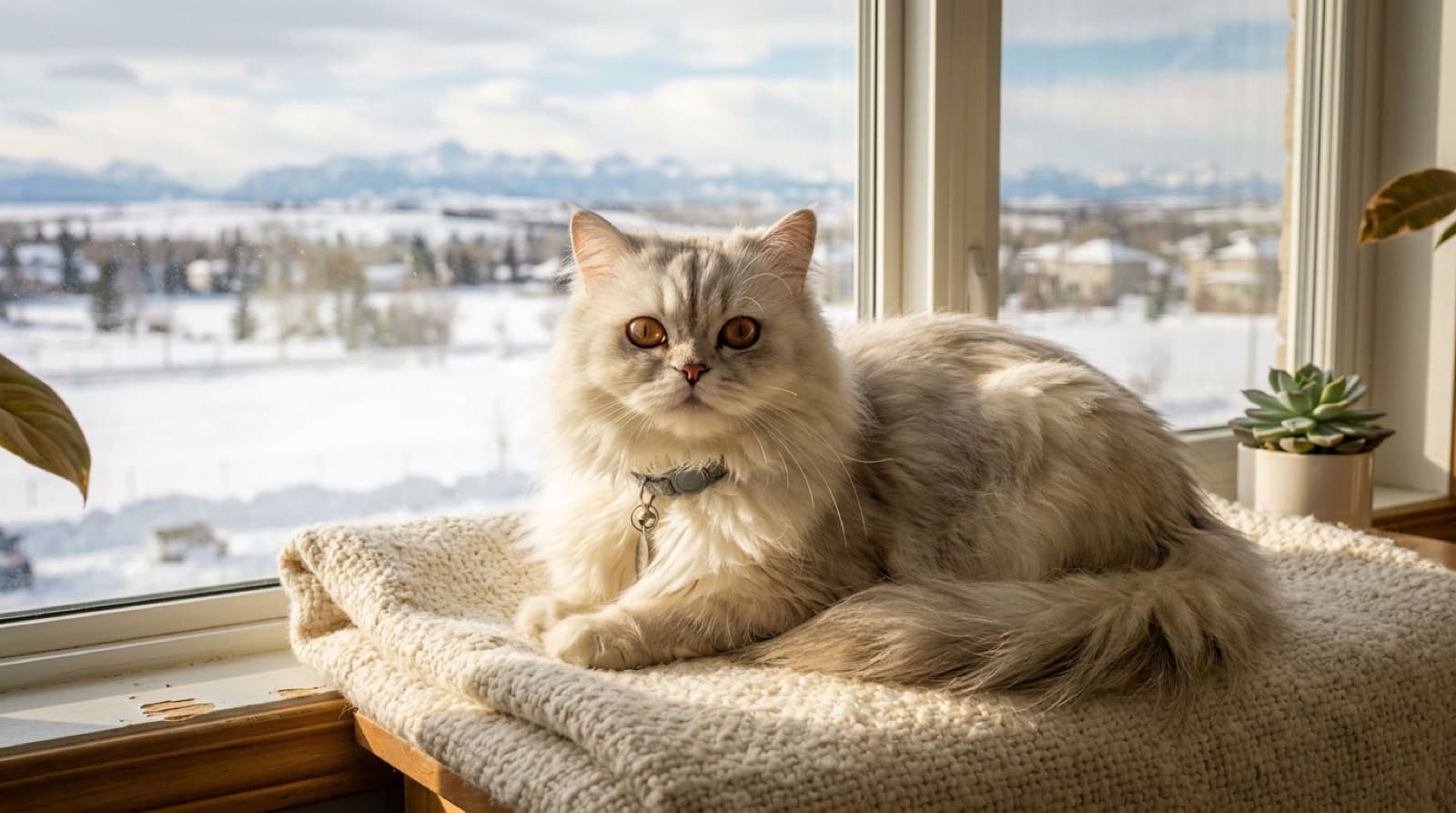
The buy-vs-adopt question without the shaming
Most people who land on this page have already done the homework on Persians. They want the long flowing coat, the round face, the quiet temperament, the lap-cat presence. The question they actually arrive with is harder: pay a Canadian CFA or TICA breeder $2,000 and wait six months for a kitten with documented PKD1 testing, or take a Persian mix from a Calgary rescue this month for $400. Both are reasonable. We are a rescue aggregator, so our framing leans toward adoption, but the math deserves an honest look without the moral judgment that often clouds this conversation.
The breeder path gives you predictability of body type and verified health testing. If you specifically want a Doll Face Persian with documented PKD1 plus PRA-pd negative parents, the breeder route is the only reliable way to get it. A registered kitten from an ethical CFA or TICA breeder comes with DNA test certificates carrying the parents' registered names, parent echocardiogram results for HCM screening, documented pedigree, and a kitten released at 12 to 16 weeks. You pay $1,200 to $3,000 plus deposit, plus the 4 to 9 month wait. For an adopter who specifically wants a Doll Face for health reasons and a verified test history, this is the right path.
The rescue path gives you a real cat now at a fraction of the price. Most Calgary rescue intake labelled as Persian or Persian mix arrives from grooming-overwhelm households. The cat is already spayed or neutered, vaccinated, microchipped, vet-checked, and often shaved down by the foster team because the previous owner stopped brushing. You save $900 to $2,600 against a breeder kitten, and a cat that would otherwise stay in care leaves the system. The trade-off is no pedigree paper, no DNA test results, and slightly less predictability on adult coat type.
Neither path is wrong. The reframe most Persian adopters miss is that the question is not breeder kitten or rescue kitten, it is breeder kitten or rescue adult Persian. The latter is usually the better answer for a Calgary household that wants a Persian as a pet, not a show cat. Adult Persians at rescue are almost always surrendered because of grooming-overwhelm, financial hardship after a vet diagnosis, or owner life change, not because anything is wrong with the cat. That framing holds up over a 12 to 17 year lifespan.
Where to find a Persian in Calgary
The purebred Persian at a Calgary rescue is uncommon. Persian mixes, Himalayan mixes, and adult grooming-overwhelm surrenders are not. Many adult Persians arrive shaved-down because the foster team had to start over on a matted coat. Here is where they show up:
| Rescue | Good to know |
|---|---|
| MEOW Foundation | Cat-only, largest cat intake in Calgary, best single source for Persian and Himalayan mixes. See meowfoundation.com. |
| Calgary Humane Society | Steady long-coat intake, structured behaviour notes, occasional adult Persian grooming-overwhelm surrenders. See calgaryhumane.ca. |
| AARCS | Alberta-wide foster network, long-coat rescues from rural intake, strong written profiles per cat. Persian mixes appear regularly. |
| BARCS, Pawsitive Match, Cochrane Humane, Heaven Can Wait | Smaller or nearby rescues. Less frequent Persian-type intake but worth setting alerts on. |
| Specialty Purebred Cat Rescue (US-based) | A US-based rescue at purebredcatrescue.org that places several hundred Persian-type cats per year. Cross-border placement to Canada is occasional, not routine, and requires significant coordination. |
| Informal Facebook networks | Persian Rescue Network and similar groups handle informal placements. Not formally endorsed; verify any private placement carefully and request vet records before committing. |
The honest read on this list: MEOW Foundation is your best single bet for a Persian-type Calgary cat. The Calgary Humane Society and AARCS see Persian and Himalayan mixes regularly enough that monthly checks are worth it. The smaller rescues are worth alert subscriptions but not daily refreshing. Specialty Purebred Cat Rescue is the right path if you specifically want a verified pedigreed Persian and are open to a cross-border application with transport coordination.
Shelter Persians are rare in the strict pedigree sense. What looks like a Persian at a Calgary rescue is often a Domestic Longhair (DLH) with a Persian-like coat, or a genuine Persian or Himalayan mix from a grooming-overwhelm surrender. The label is often directionally right, but CFA or TICA papers are rarely available. For most adopters, this matters less than it sounds, because the day-to-day pet experience of a Persian mix is close enough to a registered cat to satisfy.
Set up alerts so you do not have to check every site by hand. LocalPetFinder pulls live cat listings from these Calgary rescues regularly into one searchable place. A Persian-type intake moves quickly because so many adopters are watching for the look, so the day the cat posts is usually the day to apply.
The real Calgary cost breakdown
A rescue adoption fee is not the cat's price. It is a partial reimbursement for vetting the rescue already paid for. That is why a $400 Persian mix from MEOW Foundation is cheaper than a “free” Kijiji kitten. And any Persian listed under $900 by a self-described breeder is almost always a scam, a backyard breeder, or a Domestic Longhair misrepresented as a Persian.
2026 Calgary Persian and Persian mix pricing across the realistic options:
| Path | Typical price | What is included |
|---|---|---|
| Calgary rescue (Persian mix or adult) | $300 to $500 | Spay or neuter, vaccines, microchip, deworming, vet workup, foster assessment, often an initial professional groom. |
| Specialty Purebred Cat Rescue (US, cross-border) | $400 to $700 plus transport | Surrendered or retired pedigreed Persian, full vetting, occasionally registration papers. Transport coordination required. |
| Ethical Canadian CFA or TICA breeder (pet quality) | $1,200 to $3,000 | CFA or TICA registered, PKD1 plus PRA-pd DNA-tested parents, kitten released at 12 to 16 weeks, contract with spay or neuter clause. |
| Show or breeding rights kitten | $3,500 plus | Same testing, breeding contract, often co-ownership terms. |
| Under $900 unverified seller | Scam zone | Red flag. No paperwork, no DNA testing, often a fake listing, a backyard breeder, or a DLH sold as a purebred Persian. |
The adoption fee covers spay or neuter, core vaccines, a microchip, deworming, parasite treatment, a vet exam, and frequently an initial professional groom because most surrendered Persians arrive matted. Paying for that vetting yourself on a free Kijiji kitten runs about $480 to $900, before any breed-specific health screening. So even at the top of the rescue range, a $500 adopted Persian mix is cheaper than catching up a free kitten on the same vetting.
Annual care for a Persian runs higher than most breeds because professional grooming is a recurring line item:
- Food: $40 to $70 per month. Persians are small to medium and eat less than a Maine Coon. High-protein wet food plus a quality dry sits in the $50 to $65 range. Therapeutic kidney diets, common in older Persians, push higher.
- Litter: $25 to $40 per month. A standard large litter box works fine. Persians sometimes drag long coat-hair through litter; trimming around the back end (the sanitary trim) helps.
- Professional grooming: $80 to $150 per session, every 4 to 6 weeks. This is the Persian-specific line item, running $700 to $1,950 per year. Not optional. Skipping it leads to matting, painful de-matting, and eventually a shave-down by the vet under anaesthesia.
- Annual vet care: $500 to $900. Routine wellness, vaccines, dental check, kidney bloodwork starting around age 7 to screen for PKD progression. Higher if you carry pet insurance, which is more useful for Persians than most breeds because of PKD and BAS risk.
- Eye care supplies: $15 to $30 per month. Daily eye cleaning is non-negotiable for 85 to 90 percent of Persians. Soft cloths, saline solution, and occasionally vet-prescribed eye wipes.
- Enrichment: $200 to $400 first year, $50 to $100 ongoing. Persians are low-energy, so a modest cat tree, window perches, and quiet companionship cover most needs. They do not require the elaborate climbing infrastructure a Bengal or Abyssinian demands.
First-year setup costs another $1,500 to $2,500 above a normal cat for grooming infrastructure (slicker brush, metal comb, mat splitter, nail clippers, eye-cleaning supplies, large carrier) plus the initial professional groom. Honest first-year total: $2,800 to $4,500 for a rescue Persian, $4,000 to $7,000 for a breeder kitten. Ongoing years run $1,800 to $3,000, with the PKD or BAS years pushing higher. The 15-year cost of a Persian is roughly double a Domestic Shorthair, mostly driven by grooming and flat-face vet care.
Our full Calgary cat cost breakdown has the standard-cat line items for comparison.
What sends a Persian into Calgary rescue?
Persian surrenders are more common than most adopters expect, and the patterns are predictable.
Grooming-overwhelm. This is the number-one reason Persians end up at MEOW Foundation and the Calgary Humane Society. Adopters underestimate the daily 10 to 15 minute brushing commitment plus the $80 to $150 professional groom every 4 to 6 weeks. The owner tries to keep up for a few months, falls behind, the coat starts matting, the cat resists brushing because it now hurts, and the situation spirals. Foster teams routinely receive Persians that have been shaved down by a vet because the matting was too severe to brush out. The shave-down is not a flaw; it is a fresh start. Many adopters actually prefer adopting a shaved Persian because both you and the cat get to build the grooming habit from the ground up.
Polycystic Kidney Disease progression to chronic kidney disease. PKD1 affects a significant share of unscreened Persian lines, and the disease progresses to chronic kidney disease in middle age. The financial and emotional weight of managing chronic renal disease in a 10-year-old Persian surrenders some families. The cat is otherwise healthy and bonded, but the path forward is expensive and emotionally heavy. Rescues often place these cats in experienced homes that understand renal care.
Unanticipated brachycephalic vet bills. Brachycephalic Airway Syndrome (BAS) surgery, advanced dental work, and chronic tear-duct treatment add up. Owners who did not budget for breed-specific costs surrender when the bills hit. The Calgary specialty option for BAS workups and dental anaesthesia consults is Western Veterinary Specialist & Emergency Centre, which handles brachycephalic respiratory referrals from Calgary general practice vets.
Behavioural issues from undergroomed cats. A Persian whose coat is painfully matted becomes brushing-aversive, then handling-aversive. The cat bites, the family stops trying, the situation worsens. Foster teams un-do this with patient handling and a fresh shave, but it is one of the harder rehabs in the cat-rescue world and a real reason families surrender.
Owner life change. Allergies after adoption (the long coat traps and spreads dander), divorce, new baby, move to a no-pet rental, financial hardship, owner illness. The cat is healthy, calm, and an excellent adoption candidate for a household that understands the grooming commitment.
Retired breeder placements. Ethical CFA or TICA breeders retire breeding females around age 5 to 7 and place them in pet homes. These cats come with documented pedigree, full PKD1 and PRA-pd test history, and were selected for temperament. They are excellent placements for households comfortable with an adult cat.
Adult Persian adoption: the underserved path
The Persian question on most adoption forums is “where can I find a kitten?” The better question for most Calgary households is “why am I not considering an adult?” Adult Persian adoption is genuinely underrated, and the reasons hold up.
The advantages of adopting an adult Persian. The temperament is already known. The grooming tolerance is visible from the foster notes. The size is already there. Most adults are fully litter-trained, often already trained for handling, and accustomed to grooming sessions if the foster team has done the rebuild work. There is no kitten chaos. The foster home can tell you exactly how the cat behaves around other cats, dogs, children, and strangers, because they have seen it. A Persian kitten is a temperament and health gamble. An adult is a known quantity, which matters more for a high-maintenance breed like the Persian than for almost any other.
The shaved-down advantage. Many adult Persians at Calgary rescues arrive shaved because the foster team had to start over on matting. This is genuinely a feature, not a flaw. You and the cat both get a fresh start on the grooming routine, with no painful matting baggage. The coat regrows over six to nine months, and by then the daily brushing habit is established. Adopters who walk in expecting the iconic full-coat Persian sometimes find this disappointing, but it is the easier path to a healthy long-term grooming relationship.
Retired breeder Persians deserve a special note. Ethical CFA or TICA breeders retire breeding females around age 5 to 7 and place them in pet homes. These cats come with documented pedigree, full PKD1 plus PRA-pd test history, parent echocardiogram records, and are usually spayed at retirement. They were originally selected for temperament. The catch is the adjustment window, because a cat that lived its first 5 to 7 years in a cattery environment needs 6 to 12 weeks to fully relax in a single-family home. The first few weeks can look like an anxious cat hiding behind furniture. The bond that develops after that period is genuinely deep and holds up across the long lifespan.
The adjustment timeline. Four to six weeks for most adult Persians, longer for retired breeder cats. The 3-3-3 rule applies but stretches: three days of mostly hiding, three weeks of testing the new environment and bonding with one person, three months to fully relax. Persians signal stress through hiding rather than vocalisation, which is the opposite of how a Siamese shows stress. Signs of progress: the cat starts eating in the open. The cat uses the litter box reliably without you watching. The cat sleeps where you can see them instead of behind the couch. Eventually the cat seeks physical contact, settles in your lap, and stays. From there the bond deepens for years.
Step back from the kitten-vs-adult debate for a moment. A Persian kitten is months on a CFA or TICA breeder waitlist plus a $2,000 kitten plus a year of kitten chaos plus the grooming-rebuild risk if you skip even a week of daily brushing. A surrendered adult Persian from a Calgary rescue is $400, available within weeks, often already shaved for a fresh start, and you skip both the kitten phase and the catastrophic-matting learning curve. For first-time Persian owners and households that want the look and personality without the chaos, the adult path is usually the better answer.
The breeder waitlist and verification (the short version)
Four to nine months is the honest Canadian Persian breeder waitlist. The waitlist exists because ethical breeders run two or three litters per year and screen homes carefully. If a Canadian breeder offers an immediate kitten with no application, no waitlist, and no DNA test paperwork, that is a strong red flag worth investigating before any money changes hands.
The deposit conversation is where most Canadian Persian scams start. The reputable pattern is straightforward: you submit an application, get on the waitlist, and pay a deposit only after a specific litter is born and confirmed healthy, usually $300 to $500 toward the final kitten price. A deposit demanded before pregnancy is confirmed, or for a kitten from a litter that does not yet exist, is the textbook signature of a fake breeder. The same is true of wire-transfer-only requirements or pressure to pay before meeting the kittens.
The questions a serious Persian breeder welcomes:
- PKD1 DNA test certificate. The single most important breeder question. Request the actual certificate with the parents' registered names on it, dated and from UC Davis VGL or Laboklin. “They're tested” without paperwork is not enough. UC Davis runs the test at $44 alone or $66 bundled with PRA-pd, cheek swab in mail.
- PRA-pd DNA test certificate. Same labs as PKD1. Persian-specific Progressive Retinal Atrophy is autosomal recessive, so one tested parent is sometimes acceptable if the other is clear by pedigree, but two tested parents is the safer standard.
- HCM screening. Annual echocardiogram on breeding cats read by a veterinary cardiologist. There is no Persian-specific HCM gene test, so phenotypic screening is the standard.
- Body type clarity. Ethical breeders disclose whether they breed Doll Face (Traditional) or Peke Face (Modern). The distinction has real health implications and should be discussed openly. See the dedicated Doll Face vs Peke Face guide for the depth.
- Kitten release age. Twelve weeks minimum, 14 to 16 weeks is better. A breeder releasing kittens at 8 to 10 weeks is cutting socialisation short.
- Registration body. CFA registration (under cfa.org) or TICA (tica.org). Verify cattery numbers directly via the registry breeder directory, not just the seller's own claim. See cfa.org and tica.org.
- Contract terms. Spay or neuter agreement, return-to-breeder clause if you cannot keep the cat, health guarantee terms.
Calgary-area Persian breeders exist; if you go that route, verify CFA or TICA registration directly via cfa.org or tica.org rather than trusting a seller's own claim, and request the actual PKD1 plus PRA-pd test certificates with the parents' registered names. This is the short version of the verification process. The full breakdown lives in the dedicated Doll Face vs Peke Face guide and the Persian health article in this cluster.
Is that cat actually a Persian?
One of the most common questions we get from new adopters is whether the long-coated cat they saw on a Calgary rescue listing is actually a Persian. Several traits define a purebred Persian under the CFA and TICA breed standards:
- Long flowing single coat. Fine, dense, and prone to matting without daily attention. The coat lies in long flowing layers rather than the dense double coat of a Maine Coon or Norwegian Forest Cat. A long-coated cat without that fine flowing texture is more likely a Domestic Longhair or a Maine Coon mix.
- Round head, large round eyes. The head is round rather than wedge-shaped, with large expressive round eyes set wide. Eye colour varies by coat colour (copper, blue, green, odd-eyed), so eye colour alone is not diagnostic.
- Cobby body, short legs. Persians are stocky and low-slung with mandatory short legs and a thick body. A lanky long-coated cat is not a Persian; it is more likely a DLH or a Maine Coon mix.
- Doll Face or Peke Face. The two recognised body types within the Persian breed. Doll Face (Traditional) has a visible nose set below the eyes. Peke Face (Modern) has the nose set between the eyes with a pronounced “nose break.” Both are CFA-registered as Persian. The dedicated cornerstone in this cluster covers the depth on which to pick.
- Calm low-energy temperament. Persians are quiet, gentle, undemanding, and lap-oriented. A high-energy long-coated cat that climbs curtains and bounces off walls is not behaving like a purebred Persian.
Common confusion at Calgary rescues: Domestic Longhair (DLH) with a Persian-like coat but visible nose plus lankier body equals not a Persian. Himalayan (colourpoint Persian) often shows up as “Siamese mix” on listings because of the point markings, when it is actually a Persian colour division. Maine Coon mixes have the long coat and big size but a more rectangular head and longer body. Ragdoll mixes are large, soft, and floppy but lack the round Persian face.
Calgary climate and indoor-only commitment
Persians are strictly indoor cats. The case beyond the usual indoor-only reasoning (theft risk, no street smarts, coyotes on Bow River pathways and Nose Hill) is breed-specific.
The long single coat mats in Calgary's weather. The dry winter air, the humidity swings during chinooks, the dust and pollen of dry summers, and the snow and ice of full winter all conspire against a Persian coat. Outdoor exposure dramatically accelerates matting. A Persian that spends afternoons in a Calgary backyard becomes a brushing emergency within weeks.
Peke Face frostbite risk. The flat face on Peke Face Persians has less surface area for protective fur on the nose and face, putting these cats at higher risk of frostbite than other breeds during deep cold snaps. Doll Face Persians have somewhat better facial coverage but still suffer in true Alberta winter. Neither is built for outdoor Calgary cold.
Brachycephalic breathing in summer heat. Persians, especially Peke Face, struggle with summer heat because the brachycephalic airway is inefficient at cooling. A Calgary July afternoon on a sunlit balcony is genuinely dangerous for a Peke Face Persian in a way it is not for a Domestic Shorthair.
Indoor enrichment matters but Persians are not high-energy cats. A moderate cat tree, window perches for bird-watching, daily structured grooming bonding time, and quiet companionship cover most enrichment needs. No elaborate climbing infrastructure required. A secure catio (enclosed outdoor patio) is a strong enrichment option for the spring and fall shoulder seasons, when temperatures are moderate. Avoid catio time in deep winter cold or peak summer heat.
Our indoor vs outdoor cats guide covers the full Calgary safety case.
Breed background worth knowing
The Persian is one of the oldest known cat breeds. Long-haired cats were imported to Italy from Iran (then Persia) in the 1620s by Italian traveller Pietro della Valle, and the breed spread across Europe over the following centuries. Persians were among the founding breeds recognised by the CFA in 1906. The original conformation, what we now call Doll Face or Traditional, has a visible nose and a moderately rounded face. The Peke Face conformation emerged from a spontaneous mutation in red tabby Persians in the 1950s and became the modern CFA show standard by the 1980s. Both are still registered as Persian under CFA rules.
The Himalayan, a colourpoint Persian, was developed in the mid-20th century by crossing Persians with Siamese to produce the Siamese-style point markings on the Persian body. CFA folded the Himalayan into Persian in 1984 as a colour division, so under CFA rules a Himalayan is a Persian. TICA still registers the Himalayan as a separate breed. Calgary breeders sell all three (Doll Face Persian, Peke Face Persian, Himalayan) under “Persian” or “Himalayan” depending on their primary registry. The animal welfare research community, including the Universities Federation for Animal Welfare (UFAW), has documented the health trade-offs of the extreme Peke Face conformation, which is part of why ethical breeders increasingly prioritise Doll Face lines.
Three traits surprise most first-time Persian adopters:
The daily grooming reality. Most adopters expect “some grooming.” What they get is a 10 to 15 minute daily ritual plus a professional groom every 4 to 6 weeks. Skipping even a few days leads to mats; skipping a few weeks leads to a vet shave-down. This is the single biggest mismatch between Persian expectation and Persian reality.
The tear-staining inevitability. 85 to 90 percent of Persians have chronic epiphora, the brownish-reddish staining below the eyes caused by tear duct anatomy and brachycephalic facial structure. Daily eye cleaning is required. The staining is cosmetic on white and light-coloured Persians but does not affect health when managed.
The long lifespan with high vet involvement. Persians frequently live 12 to 17 years, with many reaching 15 to 17. Over that span, regular specialty vet visits are normal, not exceptional. The Cornell Feline Health Center documents the breed's elevated rates of PKD, dental disease, and respiratory issues, all of which justify the higher annual vet budget. A Persian adopted at age 3 will likely be in your home until you are 12 to 14 years older.
Browse adoptable Persian-type cats in Calgary
Browse Persian-type cats currently in Calgary rescue: purebred, mix, Himalayan, and adult surrender placements from MEOW Foundation, the Calgary Humane Society, AARCS, and more. Many adult Persians arrive shaved, a fresh start for both you and the cat.
See Available Persians →Frequently Asked Questions
Where can I adopt a Persian in Calgary?
A purebred Persian at a Calgary rescue is uncommon, but adult Persian surrenders and Persian or Himalayan mixes show up regularly. The rescues to watch are MEOW Foundation (cat-only, the biggest Calgary cat intake), the Calgary Humane Society, AARCS, BARCS, Pawsitive Match, Cochrane Humane Society, and Heaven Can Wait. For verified pedigreed Persians, Specialty Purebred Cat Rescue in the US (purebredcatrescue.org) places several hundred Persian-type cats per year, with occasional cross-border placement to Canadian homes. Watch live listings on LocalPetFinder and set an alert so you hear about a Persian-type cat the day it posts, because grooming-overwhelm surrenders move fast once families see the foster photo.
How much does a Persian cost in Calgary?
A Persian mix or adult retired Persian from a Calgary rescue runs about $300 to $500. That fee covers spay or neuter, core vaccines, microchip, deworming, and a vet workup, and usually an initial professional groom. An ethical Canadian CFA or TICA breeder charges $1,200 to $3,000 for a pet-quality kitten with PKD1 and PRA-pd DNA-tested parents, kitten released at 12 to 16 weeks. Anything under $900 from a self-described breeder is the scam zone. Annual care runs $1,800 to $3,000 once the cat is home, which is higher than most breeds because professional grooming every 4 to 6 weeks is a recurring line item, not optional.
Is $600 fair for a Persian kitten?
Not from a breeder. The honest Canadian breeder floor for a pet-quality Persian kitten with CFA or TICA registration and PKD1 plus PRA-pd tested parents is about $1,200. A kitten advertised at $600 by a self-described breeder is in the scam zone. The most common pattern is a backyard breeder with no DNA testing, a Kijiji listing with stolen photos, or a Domestic Longhair sold as a Persian. A $600 price is reasonable for an adult Persian or Persian mix from a Calgary rescue with full vetting and an initial groom, but it is not fair for a kitten with paperwork. Pay $1,200 plus from a verified CFA or TICA breeder, or $300 to $500 from rescue.
Can I find a purebred Persian at a Calgary shelter?
Occasionally. Most shelter cats labelled as Persian are Domestic Longhair (DLH) cats with a Persian-like coat, or genuine Persian mixes from grooming-overwhelm surrenders. True purebred Persians land in rescue mainly through three pathways: families that underestimated daily grooming time, financial hardship after a PKD or BAS diagnosis, and retired breeder placements from ethical CFA or TICA catteries. The realistic path to a verified purebred is through Specialty Purebred Cat Rescue, a direct breeder retired-cat placement, or patience watching MEOW Foundation intake. For most adopters, a Persian or Himalayan mix from a Calgary rescue delivers most of the experience at a fraction of the breeder cost.
What is the difference between Doll Face and Peke Face Persian?
Doll Face Persians have a visible nose and the original pre-1950s conformation, with substantially lower rates of breathing trouble, dental crowding, and tear staining. Peke Face Persians have the nose set between the eyes, the full brachycephalic facial structure, and substantially higher rates of all flat-face health problems. CFA registers both as Persian; Peke Face is the modern show standard. For health, Doll Face wins by a wide margin. For the iconic flat-face Persian look from magazines and cat shows, Peke Face is what people picture. The full breakdown, including which Calgary breeders produce each type and what to expect at the vet over a lifetime, lives in the dedicated Doll Face vs Peke Face guide in this cluster.
Is a Himalayan the same as a Persian?
Depends on the registry. The Himalayan is a colourpoint Persian developed in the mid-20th century by crossing Persians with Siamese to produce the Siamese-style point markings on a Persian body. CFA folded the Himalayan into Persian in 1984 as a colour division, so under CFA rules a Himalayan is a Persian with colourpoint markings. TICA still registers Himalayan as a separate breed. Calgary breeders market them as either Persian or Himalayan depending on which registry they primarily breed under. Day to day, Himalayans have the same coat, the same grooming demand, the same flat-face health risks, and the same temperament as solid Persians. The point markings are the only meaningful day-to-day difference.
How much grooming does a Persian really need?
Ten to fifteen minutes of daily owner brushing, plus a professional groom every 4 to 6 weeks at $80 to $150 per session. This is not optional. The Persian single coat mats catastrophically without daily attention, and matted Persians end up at MEOW Foundation shaved down because the foster team had to start over. Annual grooming alone runs $700 to $1,950 in Calgary. Many owners adopt the lion cut (shaved body, fluffy head, fluffy tail) to reduce maintenance, which is a reasonable middle path. If daily 10 to 15 minutes of brushing sounds untenable, the Persian is the wrong breed. The full grooming protocol and tool list lives in the dedicated Persian grooming guide in this cluster.
Are Persians good for first-time cat owners?
Temperamentally yes, logistically with caveats. Persians are calm, quiet, gentle, low-energy lap cats with one of the most forgiving personalities of any breed. They do not climb curtains, knock things off counters, or vocalise persistently. The catch is the grooming commitment. A first-time cat owner who underestimates the daily 10 to 15 minutes of brushing plus professional sessions every 4 to 6 weeks ends up with a matted cat and a surrendered cat. If you are confident you will keep up with grooming, a Persian is a wonderful first cat. If you are not sure, adopt an adult who already arrived shaved at a Calgary rescue and use that fresh start to build the grooming habit from day one.
How long does an adult Persian take to adjust?
Four to six weeks for most adult Persians, sometimes longer for retired breeder cats coming from cattery environments. Persians bond intensely with one primary caretaker and need a quiet decompression room for the first week. The 3-3-3 rule applies: three days of mostly hiding, three weeks of testing the new space, three months to fully relax. Persians signal stress through hiding rather than vocalisation, which is the opposite of how a Siamese shows stress. A Persian that eats in the open, uses the litter box reliably, and sleeps where you can see them is settling in well. From there the bond deepens for years across the long 12 to 17 year lifespan.
Are Persians good with kids and other pets?
With gentle older kids yes, with toddlers usually not, with other pets depends. Persians prefer quiet predictable environments and dislike rough handling, loud noises, and unpredictable movement. A family with calm school-age children and a low-energy household is a great fit. Toddlers and high-energy boisterous kids are usually a poor match because the Persian will hide rather than engage. With other cats, Persians do well with calm companions and poorly with high-energy breeds like Bengals or Abyssinians. With dogs, calm older dogs work; high-energy dogs do not. The cat-to-cat introduction guide in our resources hub covers the slow-introduction protocol for sensitive breeds.
Are Persians hypoallergenic?
No, and the long coat actually traps and spreads allergens more than a short-coated cat. Cat allergies are triggered by Fel d 1 protein in saliva and skin dander, not by coat length, so no breed is truly hypoallergenic. Persians produce Fel d 1 like every cat and shed it through grooming, with the long coat acting as a delivery system that spreads dander further. Adopters with mild cat allergies sometimes assume the long coat will help; it usually makes symptoms worse. Our hypoallergenic cats guide covers what actually reduces allergen exposure in a Calgary household, which is air filtration, frequent bathing, and Fel d 1 reduction diets, not breed selection.
What are the main Persian health concerns?
Four to plan for. Polycystic Kidney Disease (PKD1) is the dominant breed-specific concern; historical prevalence in unscreened lines runs 36 to 49 percent, and ethical breeders DNA-test parents through UC Davis VGL. Brachycephalic Airway Syndrome causes breathing trouble, exercise intolerance, and heat sensitivity, and is substantially worse in Peke Face than Doll Face Persians. Chronic epiphora (excessive tearing) affects 85 to 90 percent of Persians and requires daily eye cleaning. Progressive Retinal Atrophy (PRA-pd) is a recessive blindness mutation that ethical breeders also DNA-test for. For Calgary specialty cardiac and respiratory referrals, Western Veterinary Specialist & Emergency Centre handles brachycephalic workups. The dedicated Persian health article in this cluster covers full screening details.
Persian Cats in Calgary
Browse adoptable Persians, Himalayan mixes, and adult retired Persian placements from Calgary rescues, every body type and colour.
Persian Grooming: Daily, Pro, Matting Guide
Persian grooming: the 10-15 min daily routine, $80-150 pro groom every 4-6 weeks, matting prevention, and winter coat reality.
Doll Face vs Peke Face Persian: ID Guide
Doll Face vs Peke Face Persian identification: Traditional vs Modern body type, CFA vs TICA Himalayan classification, and rescue mix reality.
Persian Health: PKD, BAS, HCM Guide
Persian health: PKD1 DNA test, brachycephalic airway syndrome, HCM screening, eye care, dental, and anaesthesia caution for flat-face cats.
New cat? Start with these care guides
Everything a new adopter needs to set up a safe, happy home.