The short answer
Persians need 10 to 15 minutes of owner brushing every day, monthly bathing, and a professional groom every 4 to 6 weeks at $80 to $150 per session in Calgary 2026. That is $700 to $1,950 per year just for grooming, plus the daily time commitment for the breed lifespan of 12 to 17 years. Skip the daily and within a week you have mats. Skip the professional and within a couple months you have a cat that needs to be shaved down under sedation. Calgary winter air (dry, low-humidity, indoors with forced-air heat) accelerates mat formation compared to humid climates. If you cannot commit to daily grooming, a Persian is the wrong breed.
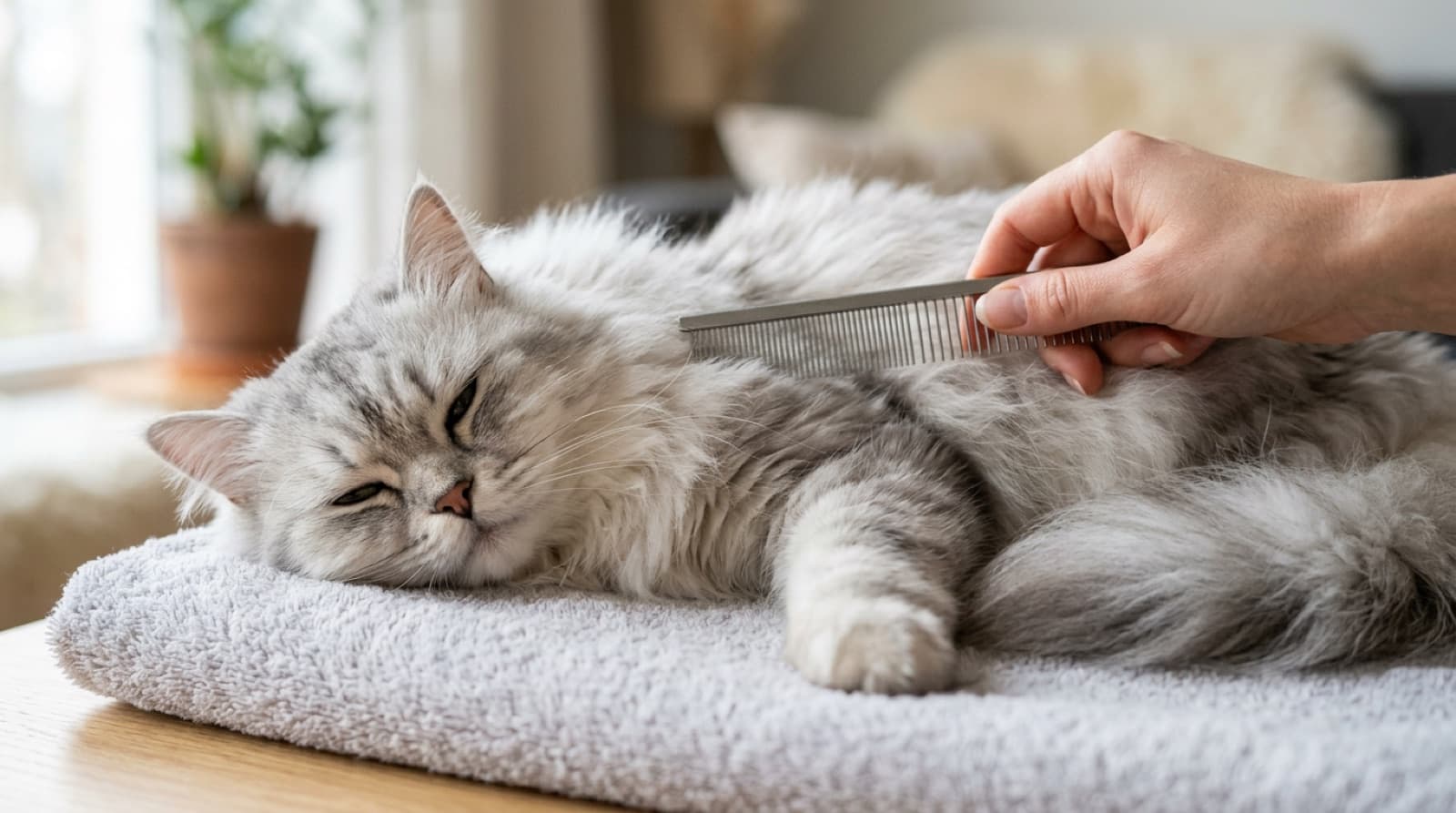
Why Persian coats mat so fast
Persian coats are biologically different from the coats of self-grooming breeds. Most cats have a guard coat (a protective outer layer of stiffer hair) that sheds dead undercoat outward. Persians do not. They have a long single coat where hair grows continuously and dead hair stays trapped in the coat instead of shedding cleanly. Once a few trapped hairs start knotting against neighbouring hairs, the knot cascades fast into a mat.
The areas that mat first are the friction zones: behind the ears (against collars and bedding), under the armpits (against ribcage in sleep), the belly (against floor when stretched out), around the genitals (against litter and bedding), and the base of the tail. These are the spots to check daily even when the rest of the coat looks fine.
Calgary’s climate makes mat formation noticeably worse than humid environments do. Three factors stack. First, dry winter air pulls moisture out of the coat, increasing friction between hair shafts and accelerating tangling. Second, the chinook humidity swings (a dry minus 25 morning turning into a 5 above afternoon) cause rapid expansion and contraction of hair shafts, which loosens trapped hairs into mat-forming positions. Third, forced-air heating in most Calgary homes runs the indoor humidity below 30 percent through winter, which is brutal on long coat. Persians in Vancouver or Toronto mat slower than Persians in Calgary; this is not theory, it is what every Calgary cat groomer reports.
The practical implication: a brushing routine that works in summer (when indoor humidity is higher) may not be enough through winter. Many Calgary Persian owners increase daily brushing time from 10 minutes in summer to 15 minutes through winter. Running a humidifier in the room where the cat sleeps also helps, both for the coat and for the cat’s respiratory comfort.
The International Cat Care guidance on long-coat breeds is clear: daily grooming is the expected baseline, not an aspirational target. The CFA breed standard for Persians describes the coat as requiring “extensive grooming” in plain terms.
The daily routine that actually works
10 to 15 minutes every day. The schedule below is what most Calgary Persian owners settle into after the first few months.
The tools first. You need four essentials:
- Slicker brush: a brush with fine bent wire bristles for surface tangles. Removes loose dead hair and works through the top layer.
- Metal greyhound comb (or similar long-toothed metal comb): the workhorse. This is what finds the mats forming near the skin before they cascade.
- Blunt-tip safety scissors: for emergency mat removal only. Blunt tips matter; rounded scissors are far safer against thin cat skin.
- Eye-cleaning supplies: vet-approved tear-stain remover or gentle saline solution, plus soft microfiber cloths or cotton pads. Avoid cotton balls; fibers can stick to fur and eyes.
The session itself, in order:
- Slicker brush over the whole coat (3 to 4 minutes). Quick once-over to remove surface tangles and loose hair. Light pressure; the goal is the top layer.
- Metal comb section by section (5 to 7 minutes). This is the work. Comb in small sections starting from the head and moving back, lifting the coat and combing all the way down to the skin. Pay extra attention to the mat-risk zones (behind ears, armpits, belly, base of tail, around genitals). If the comb catches, stop and gently work out the knot before continuing.
- Eye cleaning (1 to 2 minutes). Damp microfiber cloth from the inner corner outward, gentle pressure. Use a separate cloth for each eye to prevent cross-contamination if one eye has an infection. Daily eye cleaning prevents porphyrin stain accumulation and lets you catch eye changes early.
- Weekly add-ons (2 to 3 minutes): nail check and trim if needed, ear check, dental check (look at gums and teeth), body palpation for lumps or weight changes.
Most Calgary owners settle on after-dinner as the daily slot because the cat is relaxed and the household is calmer. Some Persians prefer morning. The specific time matters less than the consistency. Whatever time you pick, do it every day.
The bonding angle is genuine. Daily grooming sessions are when you notice early lumps, weight changes, skin irritations, dental issues, and behaviour shifts. Owners who groom daily catch medical issues weeks earlier than owners who do not. The 12-minute session is a health check disguised as a brush.
If the cat resists, do not force it. Cats who hate grooming usually have one of three issues: no early socialisation, painful matting making the brush hurt, or an underlying medical problem (arthritis, skin condition, dental pain) making handling unpleasant. Start kittens young (4 weeks and up) with treat-paired short sessions. For adult Persians who resist, two 5-minute sessions twice daily often work better than one 15-minute session, and treat-pairing every brush stroke builds tolerance over weeks not days. If resistance is sudden in a previously cooperative cat, vet workup first.
The Calgary professional grooming schedule
Every 4 to 6 weeks is the standard for Persians. This is not optional. Daily owner brushing keeps the coat manageable between visits; professional grooming resets the coat fully and handles work that home tools cannot. Skipping professional grooming and trying to do everything at home is the second most common path to a matted Persian, behind skipping daily brushing entirely.
Cost in Calgary 2026: $80 to $150 per session. At the 4 to 6 week interval, that is 9 to 13 visits per year, totalling $700 to $1,950 annually. This is the dominant ongoing cost of Persian ownership beyond food and vet care. Budget for it from day one.
A full Persian professional groom includes:
- Full bath with cat-safe shampoo (Persians need monthly bathing because coat oils accumulate)
- Blow-dry with a professional dryer (high-velocity, low-heat). Air-drying after a bath leads directly to matting; the professional dryer is hard to replicate at home and is one of the main reasons professional grooming is non-optional
- De-shedding and deep comb-out (the work that goes deeper than daily home brushing)
- Sanitary trim around the genitals and under the tail to prevent fecal matting
- Nail trim
- Ear cleaning
- Optional lion cut (full body shave leaving the mane, lower legs, and tail-tip long) for owners who prefer the lower-maintenance look
- Optional paw pad trim to remove fur between paw pads, which improves traction on hard floors
How to choose a Calgary cat groomer:
- Cat-specific experience. The international standard is certification from the National Cat Groomers Institute of America (NCGI). Calgary has a limited pool of NCGI-certified cat groomers, but the certification or equivalent cat-only experience is the marker to look for. A general dog-and-cat pet groomer who does mostly dogs may not have the gentle handling Persians need.
- No force-restraint policies. Ethical groomers handle cats with patience and breaks, not with restraint devices that traumatise the cat. Ask directly: “What do you do if a cat is stressed?” Reassuring answers involve breaks, slower pacing, and rescheduling. Concerning answers involve restraint or sedation by default.
- Sedation policy. Ethical groomers do not routinely sedate; sedation is a vet-referral process for cats in genuine medical distress (heavy matting requiring shave-down, extreme fear unresponsive to gentle handling). Routine sedation is a red flag.
- Cat-only or cat-prioritised facility. Cats handle grooming better in calm environments without dog barking. Cat-only salons exist in Calgary; failing that, look for groomers who book cats in separate quiet windows.
- Pricing transparency. A $150 cat-specific groomer is worth far more than a $60 dog-groomer-who-also-does-cats. Persian grooming is not where to economise.
Book the next appointment as you leave each one. Calgary cat-specific groomers fill up fast, and a 6-week interval means you need the next slot held before you walk out the door of the current one.
The mat decision tree and when to shave
Large mats are a same-week professional appointment, not a home project. Pelts are a medical issue.
Mats happen even to careful owners. The decision tree by mat size:
- Tiny mat, smaller than a dime, near the surface: work it out at home. Sprinkle cornstarch or unscented baby powder on the mat to reduce friction. Hold the base of the mat against the skin with one hand to prevent pulling. Use the metal comb to gently tease apart from the outside inward. Patience over force. If it does not budge in 5 minutes, escalate.
- Medium mat, quarter-sized, partially down to skin: blunt-tip safety scissors with extreme care, OR let a professional handle it. To scissor at home: slide a comb between the mat and the skin, scissor against the comb (not against the skin), and cut the mat in slices rather than cutting it off in one go. If you cannot get a comb under the mat, do not scissor. Book a professional.
- Large mat, palm-sized, all the way to skin: do not scissor at home. The skin is paper-thin and pulled tight under a large mat, and the most common Persian emergency vet visit related to grooming is a cut from home scissor attempts. Professional groomer with clippers (not scissors) is the only safe option.
- Pelt (multiple mats joined together over body sections): emergency professional appointment. Often requires a partial shave (lion cut or full body) under the groomer. If the cat is in pain (refusing to move normally, hiding, vocalising during touch), vet-supervised sedated shave may be required. Western Veterinary Specialist & Emergency Centre handles severe matting cases that need vet supervision.
When matting becomes a medical issue rather than a grooming issue:
- Restricted movement. Mats over joints can limit range of motion. A Persian that suddenly walks stiffly or stops jumping may have skin-pulling mats.
- Skin infections. Mats trap moisture and skin oils against the skin. Bacterial and fungal infections develop underneath, often invisible until the mat is removed.
- Parasites. Fleas and other parasites harbour under mats where topical treatments cannot reach.
- Pain on touch. If the cat flinches or vocalises when you touch a matted area, the mat is pulling on skin. This is a same-week vet or groomer issue, not a “next monthly groom” issue.
- Visible skin damage. Redness, sores, or hot spots around mats indicate active skin breakdown. Vet first; the mat removal is part of treatment.
The honest rule: if you are looking at a mat and unsure whether it is “home-fixable” or “professional,” assume professional. The downside of unnecessarily booking a groomer is $80 to $150 and an inconvenient afternoon. The downside of an at-home scissor accident is an emergency vet bill and a cat in pain. The asymmetry is large.
The lion cut: Calgary summer option, winter risk
The lion cut is the iconic Persian summer haircut. The groomer shaves the body down to roughly 1 cm while leaving the head fur, mane, lower legs, and tail-tip long. The cat ends up looking like a tiny lion.
The pros are real. Heat relief in summer (Calgary July highs of 25 to 30 degrees are not nothing for a heavily coated indoor cat). Full mat reset for a coat that has gotten ahead of you. Eight to 12 weeks of lower-maintenance grooming while the coat grows back. The daily routine drops to roughly 5 minutes during the regrowth period.
The cons matter, especially in Calgary. The lion cut removes the protective coat the cat relies on for thermoregulation. Indoor Calgary homes stay warm enough that this is not a winter survival issue, but it is a comfort issue, and a shaved Persian in a Calgary winter home will seek out warm spots, sleep under blankets, and act noticeably colder than a fully coated cat. If your heat goes out in January and the cat is freshly shaved, you have a problem.
The Calgary-specific timing:
- May through September: lion cuts work well. Indoor temperatures are comfortable, summer heat is manageable, and the coat regrows before fall.
- October through April: avoid the full lion cut. Calgary winters demand the coat. If your Persian is matted past the point of comb-out in winter, ask the groomer about a partial shave (sanitary area plus the matted spots only). This handles the immediate problem while preserving body coat for warmth.
- Year-round low-maintenance option: a continuous short clip (somewhere between lion cut and full coat, trimmed to 2 to 3 cm) every 6 to 8 weeks. Some Calgary owners do this as their permanent setup because it balances maintenance and warmth. Costs about the same as standard grooming.
If you do go for a summer lion cut, take a few before-and-after photos. Many Calgary Persian owners report that the cat seems visibly happier and more active in the weeks after a lion cut, especially during summer heatwaves.
Daily eye care routine
Roughly 85 to 90 percent of Persians have epiphora (chronic tearing). This is a direct consequence of the breed’s flat-faced (brachycephalic) skull structure: the tear ducts are shortened or compressed, tears overflow rather than drain normally, and the overflow runs down the face. Daily eye cleaning is part of the standard Persian routine, not a special intervention.
Tools and method:
- Vet-approved tear-stain remover or gentle saline solution. Avoid over-the-counter products containing antibiotics or harsh chemicals; some have been linked to side effects. Ask your vet for a brand recommendation.
- Soft microfiber cloth or cotton pads. Avoid cotton balls; fibers can stick to fur or accidentally touch the eye.
- Separate cloth or pad per eye. If one eye has an early infection, you do not want to spread it to the other. This is the single most important hygiene rule and the one new Persian owners most often skip.
- Gentle wipe from the inner corner outward, supporting the cat’s head with your other hand. Avoid the eye itself; you are cleaning the fur and skin below the eye.
- Daily timing. Easiest to fold into the post-brushing slot of the daily grooming session.
The brown stain. Porphyrin is a pigment present in tears that oxidises red-brown when exposed to air. The stain accumulates on light-coloured fur below the eyes. Daily cleaning prevents accumulation but does not eliminate the underlying tearing. Doll Face Persians (the traditional type with less extreme facial flattening) tend to have less staining than Peke Face Persians (the modern show type). Genetics drive the underlying tear-duct anatomy; cleaning addresses only the visible result.
When eye issues become a vet visit:
- Sudden increase in tearing. A Persian that suddenly tears noticeably more than usual may have an emerging eye infection or corneal issue.
- Eye redness or swelling. Same-day vet visit.
- Squinting or holding one eye closed. Likely corneal ulcer, very common in flat-faced breeds. Same-day vet visit.
- Discharge that is yellow, green, or thick rather than clear. Infection. Same-day vet visit.
- Cloudiness or visible damage to the eye surface. Same-day vet visit.
For the full medical picture on Persian eye conditions, see our Persian health issues guide. The American Association of Feline Practitioners publishes accessible owner-facing resources on brachycephalic eye care.
The monthly bathing routine
Persians need bathing more than most cat breeds. Roughly monthly is standard. The single coat lacks the protective oils that self-cleaning breeds rely on; coat oils accumulate fast, dust and dander build up, and litter dust collects in belly fur. Without monthly bathing the coat becomes greasy, the cat smells, and mat formation accelerates.
The method:
- Brush thoroughly first. This is the most important step new Persian owners skip. Wet mats are far harder to remove than dry ones. A thorough comb-out before the bath catches every existing tangle. If the cat is heavily matted, do not bath; book a professional shave-down first.
- Use cat-safe shampoo only. Cat-specific formulations are pH-balanced for feline skin (which is different from human or dog skin). Never use human shampoo. Never use dog shampoo containing tea tree oil, essential oils, or pyrethrins; some are toxic to cats.
- Pre-soak with warm water. Warm, not hot. Cats burn far more easily than humans because their skin is thinner. Test on your inner wrist.
- Avoid head submersion. Wipe the face with a damp cloth instead. Water in Persian eyes or ears is uncomfortable and can cause ear infections.
- Lather methodically. Work the shampoo through the coat by section, focusing on belly, armpits, and base of tail. The whole-body lather should take 3 to 5 minutes.
- Rinse extremely thoroughly. Residual shampoo causes skin irritation, which Persians are prone to anyway. Rinse twice if unsure.
- Towel dry first, then dryer. Squeeze water out gently with a towel rather than rubbing (rubbing creates tangles). Finish with a professional pet dryer or a hairdryer on low heat held at distance.
- Comb again while drying. The drying-comb combination is what professional groomers do and is one reason their work lasts longer than home baths. Section by section, comb the coat as you dry.
- Final brush when fully dry. A finishing brush with a pin brush or slicker.
The full home bath takes 45 to 75 minutes for most Persians. Plan accordingly. Many Calgary owners do monthly home baths between professional grooms; others let the groomer handle the monthly bath as part of the 4 to 6 week professional appointment. Either works.
Frequency adjustments. Increase bathing if the cat develops a skin condition (vet-directed only). Decrease bathing only on vet advice; standard healthy Persians need monthly. Cats who go outside need more frequent bathing, but Calgary Persians should stay indoor-only regardless (coyotes on river paths, traffic, theft, harsh winters).
The “I cannot keep up with grooming” surrender pattern
This is the conversation Persian owners tend to avoid. Most Persian surrenders to Calgary rescues happen at month 3 to 6 of ownership, and the reason on the surrender form is some version of “could not keep up with grooming.”
The pattern is consistent. An adopter falls in love with the look of a Persian. They commit to brushing “a few times a week.” By week 3, mats are forming. By month 2, the mats are bigger and the cat is starting to resist brushing. By month 3, the cat is partially pelted and the owner is overwhelmed. By month 4 to 6, the cat is at a rescue or being rehomed informally.
If you are reading this and recognising yourself, the path forward is not shame. It is structural.
- First step: book a professional groom plus full shave-down or lion cut. Reset the coat. You buy yourself 8 to 12 weeks of much easier maintenance while the coat grows back. The cat is more comfortable, you are not battling mats, and you have time to set up the right routine.
- Second step: try the new daily routine with the shorter coat. Many owners find a freshly shaved Persian far easier to keep up with. If 5 to 10 minutes a day on a short coat is sustainable for you, the long coat at 10 to 15 minutes a day might be too. Make the call honestly now, not after the coat grows back.
- Third step: consider a permanent short clip. A continuous 2 to 3 cm trim every 6 to 8 weeks at a Calgary groomer is a legitimate long-term solution. Costs run the same as standard grooming. The cat is healthy, mat-free, and the daily owner brushing time drops to 5 minutes. Some Persian owners maintain this setup for the entire life of the cat.
- If still not sustainable: rehome ethically. Reach out to Specialty Purebred Cat Rescue or contact MEOW Foundation, Calgary Humane Society, or AARCS about owner-surrender intake. The Persian Mafia and Persian Rescue Network (informal Facebook groups) sometimes facilitate cross-border rehoming. The honest framing: surrender before the cat becomes neglected is responsible; surrender after months of progressive neglect harms the cat. The right time is now, not after another month of trying.
Calgary rescue intake of matted Persians is common. Many of the Persians at MEOW Foundation, Calgary Humane Society, BARCS, and Pawsitive Match arrive already shaved because the previous owner could not keep up. The rescues do not judge surrenderers harshly; they would much rather receive a cat that needs help than discover one that has been suffering for months.
There is no shame in admitting the breed is not for you. Persians are demanding, and there are dozens of other wonderful cat breeds in Calgary rescues (Domestic Shorthairs, Russian Blues, British Shorthairs, Tonkinese) that do not require this level of commitment.
Browse adoptable Persian-type cats in Calgary
Many Persian surrenders arrive at Calgary rescue already shaved, which is a clean slate for both you and the cat. Foster notes describe the actual cat in front of you, including grooming tolerance, which is more useful than breed reputation.
See Available Persians →First-week grooming routine for new Persian adopters
If you have just adopted a Persian (especially a rescue Persian arriving shaved or partially shaved), the first few weeks set the grooming relationship for the rest of the cat’s life. Rush into a full 15-minute session day one and you create lasting resistance. Build up gradually and the cat learns grooming is a normal calm part of the day.
The 3-3-3 rule from our first-week rescue cat guide applies to grooming too:
- Day 1 to 3: minimal handling. Let the cat settle into the home. Hands-off grooming. Eyes only if there is visible discharge, with the gentlest possible wipe.
- Day 4 to 7: introduce the slicker brush with treat pairing. Two-minute sessions only. Show the brush, treat. Touch the cat with the back of the brush, treat. One or two gentle strokes, treat. Build positive association before increasing duration.
- Week 2: 5 to 7 minute sessions. Slicker brush and a brief metal-comb pass. Continue treat-pairing. Add daily eye cleaning. If the cat shows distress, back off and go shorter.
- Week 3 to 4: full 10 to 15 minute routine. By this point the cat should accept the routine as normal. Book the first professional groom for the 4 to 6 week mark.
Treat pairing is the consistent ingredient. The treats matter; high-value protein treats (freeze-dried chicken, salmon) work far better than dry kibble. Use them only for grooming so the cat learns the association.
If the cat arrived shaved, the first 6 to 8 weeks of the regrowth period are the easiest grooming window you will have. Use the time to perfect the daily routine before the coat reaches the matting-risk length.
Doll Face vs Peke Face: grooming differences
Persians come in two recognisable body types, and the grooming demands differ in meaningful ways. For the full type comparison see our Doll Face vs Peke Face guide. For grooming specifically:
- Doll Face Persians (Traditional): longer muzzle, more typical cat-like face. Tear-duct compression is less severe, so tear staining is reduced (though daily eye cleaning is still part of the routine). Coat care is similar to Peke Face Persians; the difference is mainly in the face. Slightly easier to maintain overall.
- Peke Face Persians (Modern, Show): extremely flat face. Severe tear-duct compression drives heavy epiphora and pronounced tear staining. Daily eye cleaning is critical, and stains accumulate faster on light fur. Coat itself is similar to Doll Face. The brachycephalic facial structure also makes Peke Face Persians more prone to skin folds that require specific cleaning attention.
For new Persian adopters, the Doll Face type is genuinely easier. The coat work is comparable, but the face care is less intensive. Most Persians in Calgary rescue are mixes (often Doll Face appearance because Peke Face is the show-line type that mostly comes from breeders), which works in the adopter’s favour.
Common grooming mistakes Calgary Persian owners make
Patterns we see consistently from Calgary rescue intake and from owner-forum threads. Avoid these and you avoid most of the trouble.
- “Weekly brushing is enough.” It is not. Daily is the standard. Weekly produces mats within a few weeks.
- Bathing without brushing first. Wet mats are far harder to remove than dry mats. Always thorough comb-out before bath, every time.
- Air-drying after a bath. The coat mats during air-drying. Use a dryer (professional or low-heat hairdryer at distance) and comb while drying.
- Scissoring at home on large mats. Skin under a large mat is paper-thin and pulled tight. Home scissor injuries are the most common Persian grooming emergency vet visit.
- Using human or dog shampoo. Human shampoo is wrong pH; dog shampoo with tea tree, essential oils, or pyrethrins can be toxic. Cat-safe shampoo only.
- Skipping eye care. Daily eye cleaning takes 1 to 2 minutes and prevents staining, infections, and corneal ulcers. Owners who skip it pay later in vet visits.
- Booking a dog-groomer-who-also-does-cats. Persian grooming needs cat-specific experience, gentle handling, and the right professional dryer. Dog-primary groomers often lack all three.
- Forcing through cat resistance. Cats remember bad grooming experiences for months. Shorter sessions, treat pairing, and patience build lasting cooperation. Forcing builds lasting resistance.
- Treating the lion cut as a permanent solution for matting. The lion cut works for summer or as a one-time reset. As a permanent strategy without changing the underlying daily routine, it leads to the same cycle every regrowth period.
- Ignoring the Calgary winter humidity impact. Many Calgary Persian owners increase brushing duration through winter and add a humidifier. Both help noticeably.
Frequently Asked Questions
How much grooming does a Persian really need?
Persians need 10 to 15 minutes of owner brushing every day, monthly bathing, and a professional groom every 4 to 6 weeks. The daily brushing is non-negotiable. The annual budget for professional grooming alone runs $700 to $1,950 in Calgary 2026. This is a daily commitment for the breed lifespan of 12 to 17 years. Persians are wonderful cats for people willing to do this. They are the wrong breed for anyone hoping weekly brushing will be enough.
Can I keep a Persian coat with weekly brushing instead of daily?
No, not without consequences. Weekly brushing is what most Persian surrenders try first. Within a few weeks the coat forms mats behind the ears, under the armpits, on the belly, and around the genitals. Within a few months the cat needs an emergency shave-down. If your honest commitment is weekly brushing, keep the cat in a permanent short clip (lion cut every 6 to 8 weeks at $80 to $150) or choose a different breed. A Domestic Shorthair, Russian Blue, or British Shorthair gives you a much lower-maintenance coat.
How much does a professional Persian groom cost in Calgary?
A full Persian professional groom in Calgary runs $80 to $150 per session in 2026. A standard groom includes bath, professional blow-dry, deep comb-out, sanitary trim, nail trim, and ear cleaning. At the recommended 4 to 6 week interval, that totals $700 to $1,950 per year. A lion cut lands at the lower end. A heavily matted cat runs higher. Calgary cat-specific groomers usually cost more than general pet groomers, but the cat-specific experience is worth the premium for Persians.
How often should a Persian be bathed?
Roughly once a month. Persians need bathing more often than most breeds because their long single coat lacks the protective oils that self-cleaning breeds rely on. Coat oils accumulate, dust builds up, and litter dust collects in belly fur. Always brush thoroughly before the bath; wet mats are far harder to remove than dry ones. Use cat-safe shampoo only. Towel dry, then finish with a professional dryer or low-heat hairdryer at distance.
What tools do I actually need for Persian grooming?
Four essentials: a slicker brush for surface tangles, a metal greyhound comb for deep mat-finding work, blunt-tip safety scissors for emergency mat removal, and eye-cleaning supplies (vet-approved tear-stain remover or saline plus soft microfiber cloths or cotton pads). Skip cheap plastic combs; they snag and break Persian coat. Total cost for the basic kit runs roughly $50 to $80.
Can I groom my Persian myself or do I need a professional?
Both. You handle daily brushing, eye cleaning, occasional bathing, and minor mat work at home. A professional handles the full bath plus blow-dry, deep comb-out, sanitary trim, nail trim, ear cleaning, and any major mat removal every 4 to 6 weeks. Trying to do everything yourself usually ends with a matted cat by month 3 because the professional blow-dry alone is hard to replicate at home. Trying to skip daily brushing and rely only on professional grooming ends with the same outcome.
Is a lion cut bad for a Persian?
No. Many Calgary Persian owners use the lion cut as a summer reset. Pros: heat relief, full mat reset, 8 to 12 weeks of easier maintenance while the coat grows back. The Calgary-specific timing matters: lion cuts work well May through September. Avoid full lion cuts October through April because Calgary winters demand the coat for thermoregulation. If a winter Persian gets seriously matted, a partial shave (sanitary and matted areas only) preserves body insulation.
How do I deal with mats without hurting my Persian?
It depends on mat size. Tiny mats smaller than a dime: cornstarch plus comb plus patience. Medium mats around quarter-sized: blunt-tip scissors with extreme care, sliding a comb between the mat and the skin and scissoring against the comb. Large mats palm-sized or all the way to skin: do not scissor at home. Skin under a large mat is paper-thin. Professional groomer with clippers only. A pelt is a same-week professional appointment, sometimes a sedated shave at the vet.
Why does my Persian have brown tear stains?
About 85 to 90 percent of Persians have epiphora (chronic tearing) due to the breed’s flat-faced anatomy. Tears contain porphyrin, which oxidises red-brown when exposed to air and stains light fur. Daily eye cleaning keeps it manageable but does not eliminate the underlying tearing. Doll Face Persians have less staining than Peke Face. If tearing suddenly increases, the eyes look red, the cat squints, or discharge becomes yellow or green instead of clear, see a vet the same day.
What is the best time of day to groom a Persian?
Whatever time the cat is reliably relaxed and you are reliably available. Most Calgary owners settle on after-dinner because the cat is winding down. Some Persians prefer morning. The specific time matters less than consistency. Cats are routine-driven, and a predictable grooming slot reduces resistance over time. Treat-pair the session, keep the first few weeks short, and build up to the full 10 to 15 minute routine.
My Persian hates grooming. What do I do?
Three common patterns. (a) Adopted as an adult with no prior grooming socialisation: shorten sessions to 2 to 5 minutes, treat-pair every brush stroke, build over weeks. (b) Painful matting making brushing genuinely hurt: book a professional shave-down to reset the coat and restart with no tangles. (c) Underlying medical issue (arthritis, skin condition, dental pain): vet workup first. If all three are addressed and the cat still resists, two shorter daily sessions often work better than one long one.
Should I rescue a shaved Persian?
Yes, and they are often the best Persians to adopt. Many arrive at Calgary rescues (MEOW Foundation, Calgary Humane Society, AARCS) already shaved because the previous owner could not keep up. The shave is a fresh start. The coat grows back over 4 to 6 months, you set up the daily routine from day one, and you have weeks before the coat is long enough to mat. Foster notes describe the cat’s grooming tolerance, which is far more useful than breed-average claims.
Persian Cats in Calgary
Browse adoptable Persians and Persian-mix cats from Calgary rescues with foster-documented temperament and coat condition.
Persian Adoption Guide
Calgary rescue sources, real adoption costs vs breeder pricing, surrender patterns, and where Persian mixes show up locally.
Persian Health Issues
Brachycephalic breathing, eye conditions, dental disease, polycystic kidney disease, and Calgary specialty vet contacts.
Doll Face vs Peke Face Persian
Traditional vs Modern body type, health implications, and what to look for at Calgary rescues.