The short answer
Russian Blue is widely marketed as hypoallergenic. The peer-reviewed evidence (PMC4072467) found a modest, measurable Fel d 1 reduction on the fur of hypoallergenic-marketed cats in a small sample (n=14), with no breed producing zero. The broader AAAAI and Cornell Feline Health Center consensus is that individual cat variation makes the breed label a weak predictor for any specific allergic pairing. The Russian Blue Fanciers' Association has publicly stated the hypoallergenic claim did not originate with them. Before adoption: sit with the specific cat for 2 to 4 hours, rub face and hands on the cat near the end, and wait 30 minutes for delayed symptoms. Individual cat tolerance is the only science-backed approach. If you have severe allergic history, consult a Calgary board-certified allergist BEFORE adopting. Consult your Calgary physician and veterinarian for individualised medical guidance.
Informational only, not medical or veterinary advice. Always consult your Calgary physician, allergist, and veterinarian for guidance on your specific case.
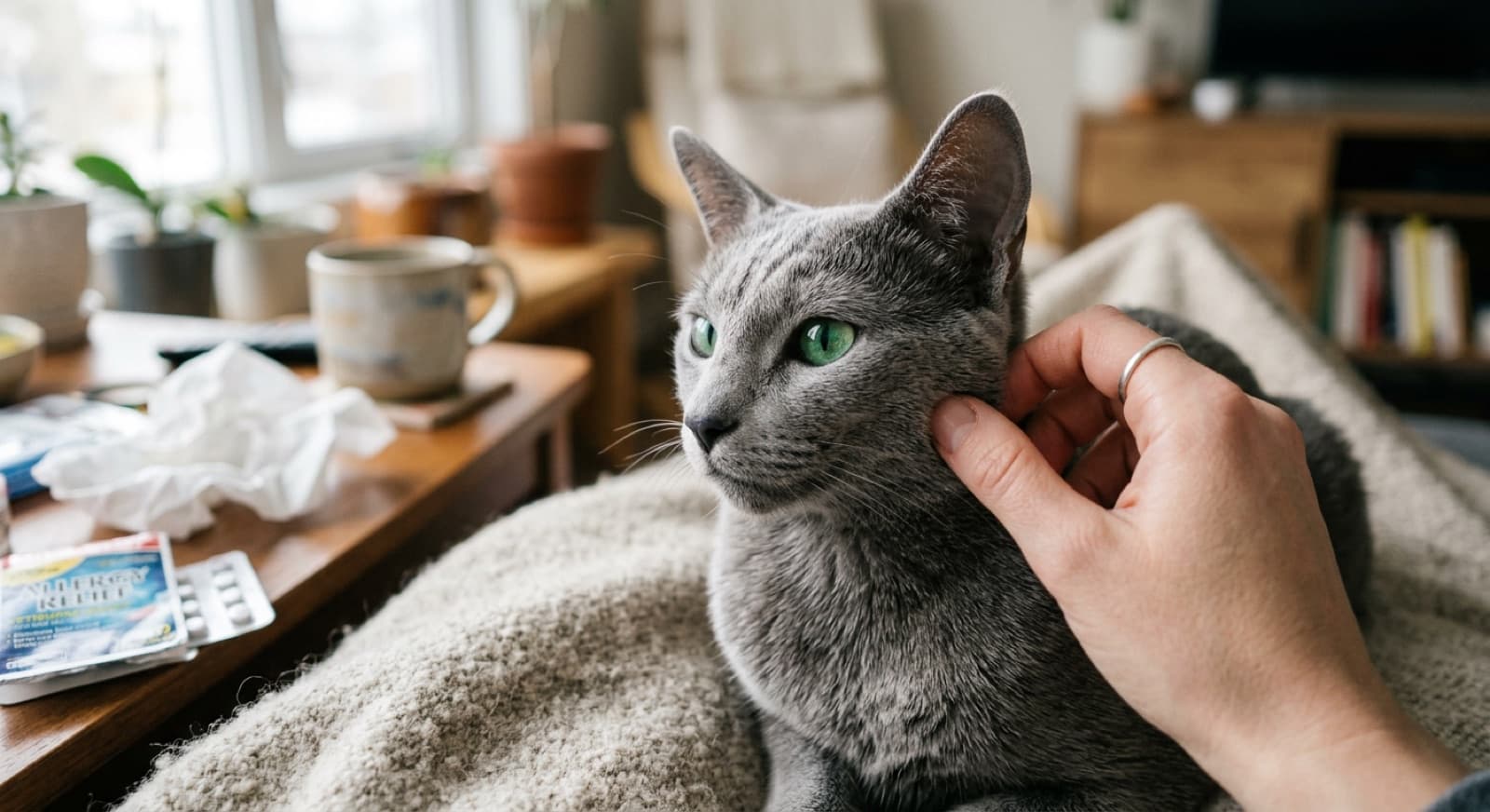
This article is informational only and is not medical or veterinary advice. Always consult your Calgary physician, board-certified allergist, and veterinarian for guidance on your specific case. Allergy diagnosis, medication selection, immunotherapy, and rehoming decisions are medical and veterinary judgements. No medication, dosage, or specific treatment protocol is recommended on this page. Those decisions belong entirely with your medical and veterinary team.
Sources informing this article include the peer-reviewed study indexed on PubMed Central as PMC4072467 (Satorina et al., Clinical and Translational Allergy 2014), the Cornell Feline Health Center for feline allergen reference material, the American Academy of Allergy, Asthma & Immunology (AAAAI) for pet allergy clinical guidance, the American Association of Feline Practitioners (AAFP) for feline care guidance, the Russian Blue Fanciers' Association for the breed organisation's own position on the hypoallergenic claim, the Purina Pro Plan LiveClear research summary (Satyaraj et al.), and the Scientific Reports 2024 CRISPR Fel d 1 paper. Calgary specialty veterinary referrals run through Western Veterinary Specialist & Emergency Centre. Medical decisions still belong with your Calgary physician and allergist.
What “hypoallergenic” actually means (and does not)
The word hypoallergenic literally means “below normal allergenic potential.” In its original medical use it described products less likely to cause an allergic reaction in a sensitised person. It has never meant allergen-free, and there has never been a regulatory definition for the term as applied to cats or dogs.
That last point matters. There is no Health Canada, US FDA, or veterinary regulatory body that has defined what a hypoallergenic cat breed is, what threshold of Fel d 1 production a cat must fall below to qualify, or how a breeder may use the word in marketing. The word is uncontrolled. Anyone can apply it to any breed. The result has been decades of breed-club and breeder marketing built on a foundation of anecdote rather than peer-reviewed evidence.
The breeds most often marketed as hypoallergenic include Russian Blue, Siberian, Balinese, Bengal, Devon Rex, Cornish Rex, Sphynx, Oriental Shorthair, and Javanese. None of these claims is supported by strong, replicable, peer-reviewed evidence at the clinical level. The Cornell Feline Health Center and the AAAAI both maintain public guidance pointing out that no truly hypoallergenic cat breed exists.
Fel d 1: the primary cat allergen
Fel d 1 is the major cat allergen. It accounts for roughly 90 percent of cat-allergic reactions in humans. Every cat produces Fel d 1. No breed has been shown to produce zero Fel d 1. This is the load-bearing scientific fact that the hypoallergenic-cat marketing has been built around for decades.
Fel d 1 is produced primarily in the cat's salivary glands and in the sebaceous (oil) glands of the skin. When a cat grooms itself, saliva containing Fel d 1 spreads onto the fur, and the protein from skin oils transfers through hair follicles to the coat. The protein then sheds with dander, hair, and skin flakes into the surrounding environment.
Fel d 1 is unusually persistent. It is small (about 36 kilodaltons), it binds readily to airborne particles, and it remains active in household dust for months after the cat is no longer present. It transfers easily to clothing, bedding, upholstery, and carpet. It is also detectable in homes that have never had a cat, presumably carried in on visitors' clothing. This is one reason cat-allergic visitors sometimes react in seemingly cat-free environments.
Fel d 4 is a secondary cat allergen, primarily produced in saliva. It accounts for roughly 10 percent of cat allergies and is rarely the dominant trigger. For most cat-allergic adults, controlling Fel d 1 controls most of the clinical problem.
The clinical implication for Calgary allergic adopters: any strategy that meaningfully reduces Fel d 1 exposure will likely reduce symptoms. A strategy that targets only fur or only dander without addressing the saliva-and-skin-oil source upstream will be less effective. This is why frequent vacuuming alone helps less than the marketing suggests, and why approaches that work directly on the source of the allergen, such as Purina Pro Plan LiveClear food, can be more effective at the same level of effort.
What the PMC4072467 study actually found
Satorina et al., published in Clinical and Translational Allergy (PMC4072467), measured Fel d 1 levels on the fur of 6 normal cats and 8 cats from hypoallergenic-marketed breeds. The researchers found that hypoallergenic-marketed cats DID secrete and distribute less Fel d 1 to their fur coats than normal cats, with the reduction most pronounced on chest fur. The sample was small (n=14 total) and the study did not name Russian Blue specifically.
Satorina et al. (Clinical and Translational Allergy 2014, PMC 4072467) measured Fel d 1 levels on the fur of 6 normal cats and 8 cats from hypoallergenic-marketed breeds. The researchers found that hypoallergenic-marketed cats DID secrete and distribute less Fel d 1 to their fur coats than normal cats, with the reduction most pronounced on chest fur. The sample was small (n=14 total), the study did not name Russian Blue specifically, and the paper's focus was demonstrating that hypoallergenic-marketed breeds do show measurable Fel d 1 reductions, not addressing within-breed individual variation.
The broader scientific consensus from this paper plus parallel research and clinical guidance from the AAAAI and Cornell Feline Health Center is what informs the practical takeaway: no breed produces zero Fel d 1, breed-average reductions exist but are modest, and individual cat variation is large enough that the breed label is a weak predictor for any specific allergic pairing. The Satorina finding doesn't refute the hypoallergenic claim outright, it shows a modest, measurable difference at the population level, but it doesn't validate using the breed label as a clinical recommendation for allergic adopters either.
The broader consensus from the feline allergy literature, taken from PMC4072467, parallel research, and clinical guidance from the AAAAI and Cornell Feline Health Center, is:
- Every cat produces Fel d 1. No exceptions documented in any breed studied to date.
- Individual cat variation is large. Two cats of the same breed can differ meaningfully in Fel d 1 production (AAAAI and Cornell clinical guidance).
- The breed-average difference is small relative to individual variation. A breed's average Fel d 1 level tells you very little about how the specific cat in front of you will affect a specific allergic person (broader AAAAI and Cornell consensus, not a Satorina finding).
- Sex and reproductive status matter. Intact males produce meaningfully more Fel d 1 than neutered males or females. Neutering reduces production.
- Age may matter. Some research suggests younger cats produce less than mature cats, but the data is less consistent here.
- No breed should be marketed as a guaranteed solution for cat allergy. Individual cat matching, not breed selection, is the science-backed approach.
The clinical implication for Calgary adopters: the breed label is a weak predictor of how a specific cat will affect a specific allergic person. The strong predictor is testing the specific pairing. Spend 2 to 4 hours with the actual cat, with face-and-hands contact near the end, and wait 30 minutes for delayed symptoms before judging tolerance.
The Russian Blue claim specifically
The Russian Blue is one of the breeds most consistently marketed as hypoallergenic across breeder websites, pet adoption blogs, and general-purpose lifestyle media. The breed's short, dense, blue-grey double coat, gentle quiet temperament, and history as a calm indoor companion have made it an appealing recommendation for the search query “hypoallergenic cat breed.”
The unusual feature of the Russian Blue story is that the breed's own fanciers' organisation has publicly rejected the hypoallergenic claim. The Russian Blue Fanciers' Association has stated publicly that the hypoallergenic idea did not originate with the breed club, and that the club does not endorse the claim. This is meaningful because most breed clubs benefit from any positive claim attached to their breed: a club that actively distances itself from a popular marketing claim is unusual and reflects an underlying commitment to honest representation of the breed.
The most likely origin of the Russian Blue hypoallergenic claim is anecdotal: some allergic individuals have reported better tolerance of specific Russian Blues than of specific cats of other breeds. This is true. It is also true for some allergic individuals adopting specific Domestic Shorthairs, specific Siberians, specific Balinese, and specific cats of every other breed. The pattern reflects individual cat variation within breeds, not a property of the Russian Blue breed itself.
The honest framing for Calgary adopters: the Russian Blue is a wonderful breed for many reasons. Gentle quiet temperament, low-shedding double coat (less hair to vacuum, not less allergen), intelligence, devotion to a small number of people, and tolerance of indoor-only Calgary winter living are all real, well-documented strengths. A guaranteed hypoallergenic experience for an allergic owner is not on that list. If you want a Russian Blue because you love the breed, that is a great reason to adopt one. If you want a Russian Blue because you are allergic to cats and have read that this breed solves the problem, the science does not support that expectation.
The science-backed mitigation toolkit
Several mitigation strategies have actual evidence behind them. None individually eliminates Fel d 1; stacked together they meaningfully reduce exposure for many allergic owners. Discuss specifics with your Calgary physician, allergist, and veterinarian:
| Strategy | What it does | Evidence level |
|---|---|---|
| Purina Pro Plan LiveClear food | Egg-derived antibody (anti-Fel d 1 IgY) binds active Fel d 1 in saliva, reducing the active allergen transferred to fur during grooming. Average reduction roughly 47 percent on hair and dander after about 3 weeks of feeding. | Peer-reviewed (Satyaraj et al.) |
| HEPA air purification | Removes airborne dander particles. Most effective in a sealed bedroom run continuously. Calgary forced-air homes benefit from one HEPA unit per occupied room and frequent HVAC filter changes. | Well-established |
| Bedroom isolation | Keeping the cat out of the bedroom at all times reduces nighttime exposure during the longest single time block in the home each day. Most-impactful single environmental intervention for many allergic owners. | Strongly recommended by AAAAI |
| Hard flooring over carpet | Carpet traps dander; hardwood, vinyl plank, or tile releases it for vacuuming. Calgary owners considering flooring renovations should prioritise hard surfaces in living areas if a cat-allergic family member is present. | Well-established |
| HEPA-filter vacuum, frequent cleaning | Standard vacuums redistribute dander; HEPA-filter vacuums capture it. Twice-weekly minimum for fabric surfaces; weekly washing of cat bedding in hot water. | Well-established |
| Neutering (intact males) | Intact male cats produce meaningfully more Fel d 1; neutering reduces production. All cats adopted from Calgary rescues come spayed or neutered by default. | Peer-reviewed |
| Antihistamines, nasal corticosteroids, immunotherapy | Medical management of allergy symptoms. Immunotherapy (allergy shots) is a longer-term option for severe cases. All require physician or allergist consultation; nothing dosed here. | Standard medical care, allergist-directed |
| Humidity 40 to 50 percent (Calgary winter) | Helps Fel d 1 settle out of air faster. Calgary forced-air homes often run at 20 to 30 percent winter humidity, which keeps allergens airborne longer. A humidifier sized for the home raises humidity to the recommended range. | Indirect support |
| HypoCat vaccine (in development) | Experimental vaccine that immunises the cat against its own Fel d 1. Not commercially available in Canada. Treat as future-state research. | Early-stage research |
| CRISPR Fel d 1 knockout cats | A 2024 Scientific Reports paper describes editing the Fel d 1 gene in cat cells. Research-only, no clinical cats produced, no realistic Calgary timeline. | Research-only |
The pre-adoption test protocol
The single highest-value step for any allergic Calgary adopter considering any cat of any breed: test the specific cat before committing. This is the only science-backed approach. The breed label is a weak predictor; the individual pairing is what matters. Consult your Calgary physician and allergist before relying on this protocol if you have severe allergic history.
Five steps, in order:
- Talk to a Calgary physician or board-certified allergist BEFORE adopting any cat. A baseline allergy panel (skin-prick or specific IgE blood test) takes a single appointment and tells you whether you react to cat allergens at all, and at what severity. If you have a history of asthma, anaphylaxis, severe eczema, hospitalisation for allergic disease, or a strong family history of allergic disease, this step is non-negotiable. If you have mild seasonal allergies and no specific cat-related history, the allergist consultation is still recommended but less urgent.
- Visit the specific cat in person. Spend 2 to 4 hours in a closed room with that specific cat. If the cat is at a Calgary foster home or rescue facility, schedule the visit during a quiet time when the cat will come close and interact. Hold the cat if possible. Let the cat rub against your clothing. Let fur and dander settle on your shirt.
- Face-and-hands contact near the end of the visit. Rub your face and hands gently on the cat near the end of the visit. This is the high-exposure provocation. Then sit quietly for 30 minutes without leaving the room.
- Watch for delayed symptoms over 30 to 60 minutes. Initial sneezing or eye watering during the visit may be misleading (allergens take time to mount a full reaction; symptoms also sometimes appear after the visit ends). Wait at least 30 minutes after face-and-hands contact, and ideally check in with how you feel for the rest of the day.
- If symptoms are absent or mild, ask about a 7-day in-home foster trial. Some Calgary rescues offer trial fostering for adopters who want to confirm tolerance in a real home environment before committing. This is the gold standard test: actual Calgary home, actual ventilation, actual nighttime exposure, actual full day. If the rescue does not offer trial fostering, ask whether they have a return-without-judgement policy for medical incompatibility. Most reputable Calgary rescues do.
What this protocol does NOT do: it does not detect very mild reactions that may amplify over months of ongoing exposure, it does not detect interactions with other household allergens that may emerge only after months at home, and it does not predict whether tolerance will hold up under stress, illness, or seasonal allergy peaks. It is a good first filter, not a guarantee.
Browse adoptable Russian Blue-type cats in Calgary, but test for allergies first
Pre-adoption allergy testing is the only science-backed approach. Spend 2 to 4 hours with the specific cat at the foster home, with face-and-hands contact near the end, and wait 30 minutes for delayed symptoms before committing.
See Available Russian Blue-type Cats →Why Calgary climate amplifies cat allergen exposure
Calgary's climate creates a uniquely challenging environment for cat-allergic owners during the long sealed-home season. Three factors stack:
- Sealed-home season October to April. Calgary homes are tightly sealed for six to seven months of the year. Windows stay closed. Air exchange with outdoor air drops sharply. Indoor allergen concentrations rise correspondingly. A cat-allergic owner who tolerates the cat well in July may struggle by January in the same home.
- Forced-air heating recirculates allergens. Most Calgary homes use forced-air natural-gas heating that runs frequently from October to April. Each cycle pulls air through return vents, past the furnace filter, and back out through supply vents across the house. A standard MERV-8 furnace filter captures very little Fel d 1. The result is whole-home recirculation of cat allergens, including into rooms the cat does not enter.
- Low indoor humidity (20 to 30 percent). Calgary winter outdoor humidity is often very low, and forced-air heating dries indoor air further. Low humidity keeps small particles, including Fel d 1, airborne longer. Higher humidity (40 to 50 percent) helps allergens settle out of air faster.
The Calgary-specific mitigation playbook stacks four interventions: a HEPA air purifier sized for the bedroom running continuously, MERV-13 or higher furnace filters changed every one to two months during sealed-home season, a humidifier targeting 40 to 50 percent indoor humidity, and strict bedroom isolation of the cat. None of these is a hypoallergenic-breed substitute; together they meaningfully reduce exposure for many allergic Calgary owners. Discuss specifics with your Calgary physician, allergist, and HVAC professional.
The takeaway: a Calgary adopter who is mildly allergic and tolerates a cat well in a brief in-person visit during summer may still struggle once the sealed-home season starts. The 7-day in-home foster trial, ideally including at least one night during full forced-air heating season, is the most realistic test of true tolerance in a real Calgary home.
If you are already allergic and have already adopted
Many Calgary owners discover the allergy only after bringing the cat home. The first instinct is often to rehome immediately. The honest advice from Calgary rescues, vets, and allergists is: do not rehome on day one. Most cases are manageable with proper medical and environmental management. Consult your Calgary physician, allergist, and veterinarian before making a rehoming decision.
The realistic order of operations:
- See a Calgary physician or board-certified allergist for proper diagnosis. Symptoms attributed to the cat may actually be partly environmental (dust mites, mould, seasonal pollen carried in on clothing) and may improve with broader allergy management. A proper diagnosis tells you what you are actually reacting to and at what severity. Some allergic owners discover they react less to the specific cat than they assumed, and react more to other household allergens that were easier to address.
- Discuss medical management options with your physician or allergist. Antihistamines, nasal corticosteroids, eye drops, asthma inhalers, and immunotherapy (allergy shots, a multi-year programme but durable in effect) are all standard options. None of these is recommended or dosed on this page; the conversation belongs with your Calgary medical team.
- Implement full environmental mitigation. HEPA air purifier in the bedroom running continuously. Strict bedroom isolation of the cat at all times. MERV-13 or higher furnace filters changed every one to two months. Humidifier to 40 to 50 percent indoor humidity. HEPA-filter vacuum twice weekly. Hard flooring in living areas where budget allows. Wash cat bedding in hot water weekly. Consider Purina Pro Plan LiveClear food (3-week trial, average roughly 47 percent reduction in active Fel d 1 on hair and dander).
- Test the cat at a Calgary vet. Sometimes what is labelled cat allergy is actually environmental, and the cat is the bystander, not the cause. A vet visit confirms the cat is healthy and clean (no skin infection or excessive dandruff making allergen distribution worse) and that there is no medical reason the cat would be unusually high in Fel d 1 production for its breed and sex.
- Reassess after 4 to 8 weeks of full medical and environmental management. If symptoms remain severe despite proper allergist-guided medication and full environmental mitigation, responsible rehoming through MEOW Foundation, Calgary Humane Society, or a breeder return clause is the humane and ethical choice. It is not the failure choice. The cat is better served by a home that does not trigger the new owner's health, and most Calgary rescues will take the cat back without judgement when the rehoming reason is medical incompatibility.
Discuss specifics with your Calgary physician, allergist, and veterinarian throughout.
The honest framing for Calgary adopters
The Calgary adopter who searches “Russian Blue hypoallergenic” usually wants one of two things. Either a) they love the Russian Blue breed for its actual traits (quiet, gentle, intelligent, low-shedding, beautiful blue-grey coat) and are looking for confirmation that the breed is also a good choice for an allergic household. Or b) they are allergic to cats, want a cat anyway, and have read that this breed is a hypoallergenic shortcut.
For the first case: the Russian Blue is a wonderful breed and you should adopt one if you find one that fits your home. Pre-adoption testing of the specific cat for allergic tolerance is still recommended if anyone in the household has any history of cat allergy, but you are not being misled by the breed's real strengths.
For the second case: the science does not support what you have read. The Russian Blue is not a guaranteed hypoallergenic solution. Per AAAAI and Cornell Feline Health Center clinical guidance, individual cat variation makes the breed label a weak predictor for any specific allergic pairing. A specific Domestic Shorthair at MEOW Foundation or Calgary Humane Society may be a better individual match for your specific allergy profile than a specific Russian Blue at a breeder, and the only way to know is to test the specific pairing. Adopting blind on the breed label is the most common path to discovering an allergy after adoption and facing a rehoming decision in month two.
The reframe Calgary search engines should serve, but do not: “low-Fel-d-1 cat” rather than “hypoallergenic cat breed.” The first framing points the allergic adopter at the testable individual property. The second framing points at a marketing label that does not survive peer review.
The honest two-sentence summary: no cat is allergen-free, no breed is reliably hypoallergenic, and the science-backed approach is to test the specific cat for the specific allergic person, support the household with HEPA filtration and bedroom isolation, and consider Purina Pro Plan LiveClear food. The Russian Blue Fanciers' Association has been more honest about this than the broader marketing ecosystem, and Calgary adopters benefit from following the breed club's lead. Consult your Calgary physician, allergist, and veterinarian for individualised guidance.
Frequently Asked Questions
Are Russian Blues really hypoallergenic?
No. No cat breed is truly hypoallergenic. Satorina et al. (PMC4072467, Clinical and Translational Allergy 2014) found a modest, measurable Fel d 1 reduction on the fur of hypoallergenic-marketed cats in a small sample (n=14, no Russian Blue specifically named), but every cat produces Fel d 1, the major cat allergen responsible for roughly 90 percent of cat allergies. Some breeds, including Russian Blue, are anecdotally reported to be better tolerated by some allergic individuals. The broader AAAAI and Cornell Feline Health Center consensus is that individual cat variation is large enough that the breed label is a weak predictor for any specific allergic pairing. The Russian Blue Fanciers' Association itself has publicly stated that the hypoallergenic claim did not originate with them. The science-backed approach for any allergic Calgary adopter is pre-adoption testing of the specific cat, not reliance on the breed label. Consult your Calgary physician or board-certified allergist for medical guidance.
What is Fel d 1?
Fel d 1 is the major cat allergen and is responsible for roughly 90 percent of cat-allergic reactions in humans. It is a small protein produced primarily in the salivary glands and sebaceous (oil) glands of the skin. Cats spread Fel d 1 across their fur and skin through grooming, and the protein then transfers to dander, hair, bedding, and household surfaces. A secondary allergen, Fel d 4, accounts for roughly 10 percent of cat allergies. All cats produce Fel d 1; this is true of every breed examined to date, including Russian Blue, Siberian, Balinese, Bengal, Devon Rex, Cornish Rex, and Sphynx. Consult your Calgary physician for individualised medical advice.
What did the PMC4072467 study find?
The Satorina et al. study (PMC 4072467, Clinical and Translational Allergy 2014) measured Fel d 1 levels on 6 normal cats and 8 hypoallergenic-marketed breed cats. The researchers found that hypoallergenic-marketed cats did distribute somewhat less Fel d 1 to their fur than normal cats, with the reduction most pronounced on chest fur. The sample was small (n=14), the study did not name Russian Blue specifically, and the paper itself focuses on showing a measurable population-level reduction in hypoallergenic-marketed breeds, not on within-breed individual variation. The broader takeaway from PMC4072467 plus AAAAI and Cornell Feline Health Center clinical guidance is that breed-average reductions exist but are modest, no breed produces zero Fel d 1, and the breed label alone is a weak predictor for any specific allergic pairing, which is why pre-adoption time with the specific cat matters more than the breed. Consult your Calgary allergist for individualised medical advice.
Which cat breeds are claimed to be hypoallergenic?
Russian Blue, Siberian, Balinese, Bengal, Devon Rex, Cornish Rex, Sphynx, Oriental Shorthair, and Javanese are all marketed at various points as hypoallergenic. None of these claims is backed by strong peer-reviewed evidence of clinical hypoallergenicity. Each claim originates from anecdote, breeder marketing, or partial measurements that have not held up at the individual-cat level. The honest framing is that any of these breeds may be better tolerated by some allergic individuals because of individual cat variation, not because the breed itself is reliably low-allergen. Consult your Calgary allergist before relying on a breed label.
Does Purina Pro Plan LiveClear really work?
Yes, partially and modestly. Purina Pro Plan LiveClear contains an egg-derived antibody (anti-Fel d 1 IgY) that binds active Fel d 1 in the cat's saliva and reduces the amount of active allergen transferred to fur during grooming. Published research from Satyaraj and colleagues reports an average reduction of about 47 percent in active Fel d 1 on hair and dander after roughly three weeks of feeding. The honest framing: it helps, but it does not eliminate Fel d 1, and the average reduction is the average. Some cats respond more, some less. For mildly allergic Calgary owners it can be a meaningful adjunct alongside HEPA filtration, bedroom isolation, and frequent cleaning. For severely allergic adopters it is not a replacement for medical management. Discuss specifics with your Calgary veterinarian and physician.
Is there a hypoallergenic vaccine for cats?
A candidate vaccine called HypoCat is in development. The concept is to vaccinate the cat against its own Fel d 1, prompting the cat's immune system to produce antibodies that neutralise Fel d 1 inside the cat's body before the protein reaches the fur. Early published work has shown promise but the product is not yet commercially available in Canada and has not been approved for routine veterinary use. Calgary cat owners cannot purchase this today. The realistic time horizon for clinical availability is uncertain. Consult your Calgary veterinarian for guidance on currently approved options.
How do I test if I am allergic to a specific cat?
Five steps. First, talk to a Calgary physician or board-certified allergist before adopting any cat, especially if you have asthma or a strong family history of allergic disease. Get a baseline allergy panel if recommended. Second, visit the specific cat you are considering and spend 2 to 4 hours in a closed room with that cat: hold the cat if possible, let the cat rub against you, and let fur and dander settle on your clothes. Third, rub your face and hands on the cat near the end of the visit and then wait 30 minutes for any delayed symptoms before judging tolerance. Fourth, if no symptoms appear or only mild symptoms appear, ask whether a 7-day in-home foster trial is possible (some Calgary rescues offer trial fostering). Fifth, if your history includes severe asthma, anaphylaxis, or hospitalisation for allergic disease, do not skip step one. Consult your Calgary allergist for individualised medical advice.
What if I am already allergic and have already adopted a cat?
Do not immediately rehome. Many Calgary owners discover the allergy only after bringing the cat home, and most cases are manageable. The honest order of operations is: see your physician or a Calgary allergist for a proper diagnosis and treatment plan, since some symptoms attributed to the cat may actually be environmental and improve with mitigation; implement science-backed Fel d 1 reduction (HEPA air purification, bedroom isolation from the cat, hard-flooring where possible, frequent cleaning of fabric surfaces, Purina Pro Plan LiveClear food trial, frequent HVAC filter changes); and if symptoms remain severe despite full medical management and full environmental mitigation, responsible rehoming through MEOW Foundation, Calgary Humane Society, or a breeder return clause is the humane choice, not the failure choice. Discuss specifics with your Calgary physician and veterinarian.
Does neutering reduce Fel d 1?
Yes, especially for intact males. Multiple studies have shown that intact male cats produce meaningfully more Fel d 1 than neutered males or females, and that neutering reduces Fel d 1 production over the months following surgery. The effect size varies. For Calgary adopters, this means an intact male tomcat is likely to be the worst-case scenario for an allergic household, and a spayed female or neutered male is the better-case scenario at the individual level. All responsibly adopted cats from Calgary rescues come spayed or neutered by default, so this is mostly a relevant consideration for breeder-sourced kittens and for the timing of spay or neuter decisions. Discuss specifics with your Calgary veterinarian.
Should I see a Calgary allergist before adopting a cat?
If you have any history of asthma, hay fever, atopic dermatitis, food allergies, anaphylaxis, or a strong family history of allergic disease, yes. A board-certified Calgary allergist can run a baseline skin-prick or specific IgE blood panel for cat allergens including Fel d 1, identify whether you react and at what severity, and counsel you on whether a household cat is realistic for your specific case. Many Calgary adopters skip this step, adopt, and then discover an allergy the hard way. The fee for an allergist consultation is modest compared with the cost of returning a cat to a rescue weeks later. Most Calgary primary-care physicians can refer; some allergy clinics accept self-referrals. Consult your Calgary physician for guidance.
What is the HypoCat vaccine?
HypoCat is the name given to an investigational vaccine that immunises the CAT (not the human) against its own Fel d 1 allergen. The cat's immune system produces neutralising antibodies that bind Fel d 1 inside the cat's body, lowering the amount of free Fel d 1 that reaches fur and dander. Early published research has shown a reduction in measurable Fel d 1 in vaccinated cats. The product is not yet commercially available in Canada and has not been approved for routine veterinary use. There is no realistic Calgary access point today. The science is promising, the timeline is uncertain. Consult your Calgary veterinarian about currently approved Fel d 1 reduction strategies.
Are CRISPR-edited hypoallergenic cats real?
In research, yes. In a Calgary pet store, no. A 2024 Scientific Reports paper from a US biotech research team described using CRISPR-Cas9 to edit the Fel d 1 gene in cat cells with the goal of producing cats that produce little or no Fel d 1. The work is in early stages, has been demonstrated only in cell culture and limited animal models, and is not commercially available. Even if research progresses to live cats, regulatory pathways, ethical review, and price points are all unresolved. The realistic time horizon to a CRISPR-edited pet cat in a Calgary adopter's home is not soon. Treat this as a future-state research note, not a current option. Consult your Calgary veterinarian about currently available options.
What is the best way to manage cat allergies in a Calgary winter?
Calgary winters concentrate cat allergens because sealed homes (October through April) reduce ventilation, forced-air heating recirculates dander across the house, and indoor humidity often drops to 20 to 30 percent, which keeps Fel d 1 airborne longer. The Calgary-winter-specific playbook is: keep the cat out of the bedroom at all times, run a HEPA air purifier sized for the bedroom continuously, change the forced-air furnace filter every one to two months during sealed-home season (not every six months), add a humidifier targeting 40 to 50 percent indoor humidity (this helps allergens settle out of air and is also kinder to your sinuses), vacuum with a HEPA-filter vacuum at least twice weekly, replace carpet with hard flooring where budget allows, and discuss antihistamine, nasal corticosteroid, or immunotherapy options with your Calgary allergist. None of these steps eliminates Fel d 1, but stacked together they meaningfully reduce exposure. Consult your Calgary allergist and veterinarian.
Why does the Russian Blue Fanciers' Association reject the hypoallergenic claim?
Because the claim is not supported by peer-reviewed evidence and because the Association has watched the hypoallergenic label cause heartbreak for allergic adopters who adopted a Russian Blue expecting an allergen-free experience and then had to return the cat. The Association has publicly said it does not know how the hypoallergenic idea attached itself to the Russian Blue, and that the idea did not come from them. This is unusually direct messaging from a breed organisation: most breed clubs benefit from any positive claim attached to the breed, so a club actively distancing itself from a marketing claim is meaningful. The honest framing for Calgary adopters is that the Russian Blue is a wonderful breed for many reasons (gentle temperament, low-shedding double coat, intelligent and quiet), but a guaranteed solution for cat allergy is not one of them. Consult your Calgary allergist before relying on the breed label.
Russian Blue Cats in Calgary
Browse adoptable Russian Blue and Russian-Blue-look mix listings from Calgary rescues. Real purebreds are rare; blue-grey mixes appear regularly.
Russian Blue Adoption Guide
Rescue versus breeder, real costs, scam patterns, breeder verification, and the buy-vs-adopt math for Calgary.
Russian Blue Health Issues
Breed-specific medical considerations, Calgary specialty vet contacts, anaesthesia profile, and pet insurance ROI.
Russian Blue vs Domestic Shorthair
A practical Calgary comparison: temperament, health, availability, and what blue-grey DSH mixes actually look like.