The short answer
Adopt a Russian Blue-type blue DSH from a Calgary rescue ($300 to $500) or pay $1,500 to $3,000 for a CCA, CFA, or TICA-registered breeder kitten. Real purebreds almost never land at Calgary rescues. Adults settle at 7 to 12 lbs (males larger, females smaller) and reach full size in 18 to 24 months. Lifespan 15 to 20 years, among the longest of any purebred cat. Vivid green eyes are mandatory in purebred Russian Blue per CFA, TICA, and CCA standards; copper or gold eyes are not Russian Blue. The famous hypoallergenic claim is a myth: peer-reviewed science (Satorina et al. 2014, PMC 4072467) and AAAAI clinical guidance both confirm no breed is reliably allergen-free. Anything under $1,000 from a self-described breeder is the scam zone.
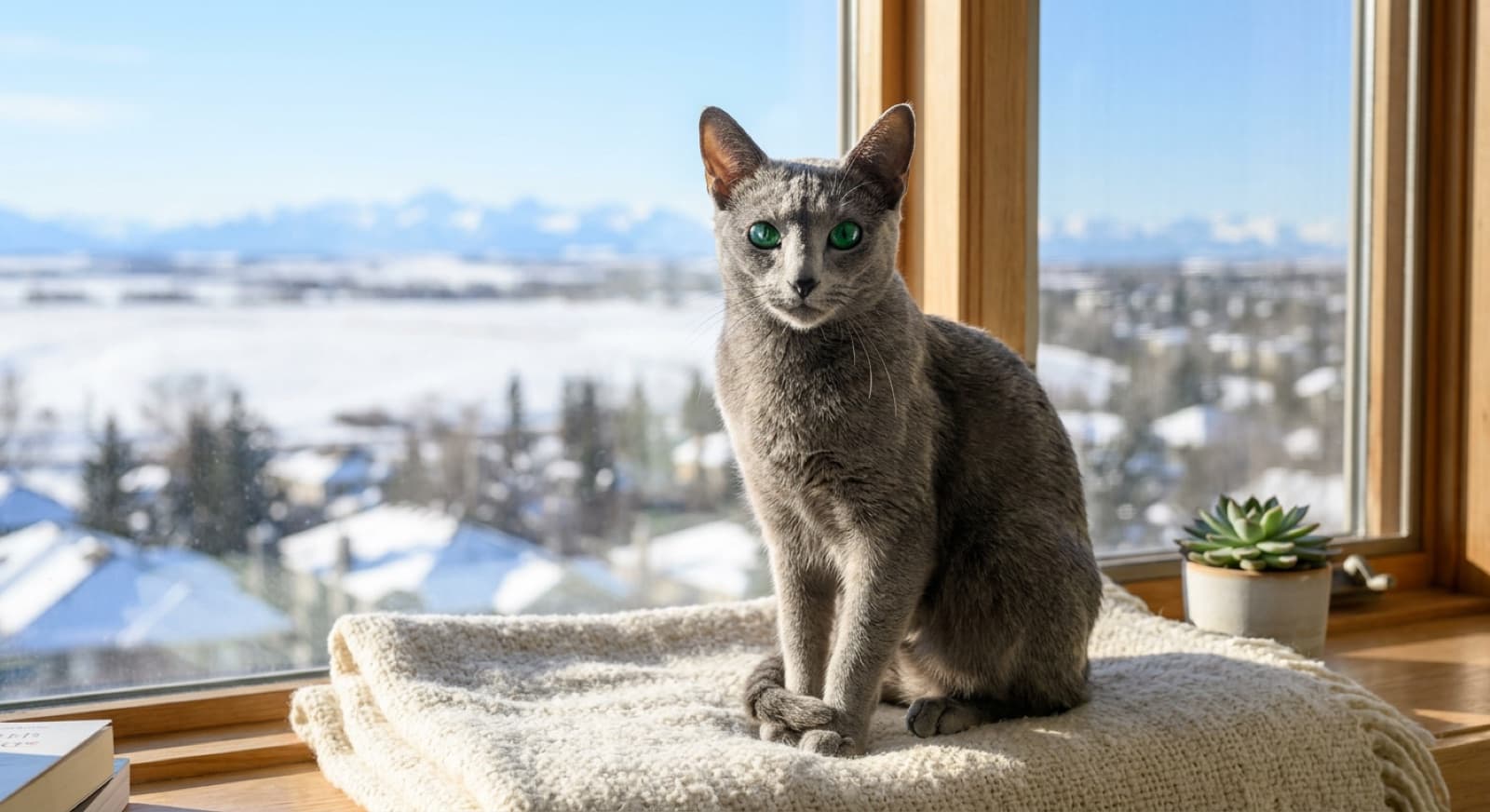
The buy-vs-adopt question for Russian Blue specifically
Most adopters who land on this page have already fallen for the look. The shimmering silver-tipped grey coat, the vivid green eyes, the elegant slim body, the quiet intelligent face. The Pinterest picture is striking. The question they arrive with is the usual one: pay a Canadian CCA, CFA, or TICA breeder $2,000 and wait six months to a year for a kitten with verifiable pedigree, or take a blue Russian Blue-look mix from a Calgary rescue this month for $400. The honest answer depends on what you actually want.
The breeder path gives you predictability. If you specifically want a kitten with both parents CCA, CFA, or TICA registered, the mandatory vivid green eyes guaranteed (a real consideration because eye colour does not stabilise until 4 to 6 months), the silver-tipped double coat with proper shimmer, and the slim wedge-headed conformation that defines the breed, the breeder route is the only reliable way to get all of that. You pay $1,500 to $3,000, plus a deposit, plus a 6 to 12 month wait. Russian Blue are one of the more affordable purebreds at the breeder level because the breed has no documented genetic disorders to test for, which keeps breeder operating costs lower than for British Shorthair or Maine Coon.
The rescue path gives you a real cat now, just not a pedigreed one. Almost no purebred Russian Blue appear in Calgary rescues. The breed is genuinely rare in North America (CFA registered roughly 541 kittens in 2003, the most recent widely-cited public count, and registrations have remained in the same general range for decades), and most stay with their original owners across the long 15 to 20 year lifespan. What does appear regularly are blue or grey domestic shorthairs with some Russian Blue look traits: a plush short coat, sometimes green-toned eyes, sometimes a slim build. Foster teams at MEOW Foundation, Calgary Humane Society, and the other generalist rescues label these honestly: Russian Blue mix, blue DSH, blue DSH with breed look. The cat is wonderful, the look is most of what attracted you to the breed, the temperament is broadly compatible, and the cost is a fraction of the breeder route.
Neither path is wrong. The reframe most Russian Blue adopters miss is that the question is not really “breeder kitten or rescue purebred.” The question is “do I specifically need the verified breed traits, or do I want the cat?” If you need the mandatory green eyes guaranteed, the proper coat with silver tipping, and the registered pedigree, breeder. If you want the cat, a Calgary rescue blue DSH delivers a real companion at 15 to 25 percent of the breeder cost.
Where to find a Russian Blue-type cat in Calgary
There is no Canadian Russian Blue-specific rescue that we can verify, which is genuinely unusual; many pedigreed breeds have one. Adoption flows entirely through the generalist Calgary cat rescues, and the cats are almost always Russian Blue-look mixes rather than verified purebreds. Here is the honest map:
| Rescue | Good to know |
|---|---|
| MEOW Foundation | Cat-only, largest cat intake in Calgary. Pure Russian Blue are extremely rare; blue or grey Russian Blue-look DSH appear regularly. Foster notes are detailed and honest about breed labelling. See meowfoundation.com. |
| Calgary Humane Society | Steady cat intake. Russian Blue-type cats appear occasionally, almost always labelled as DSH or DSH-mix with breed-look notes. Structured written profiles per cat. See calgaryhumane.ca. |
| AARCS | Alberta-wide. Sees Russian Blue-look mixes from rural surrenders and hoarding seizures occasionally. Foster system is strong, so foster notes describe how the cat actually behaves. |
| BARCS, Pawsitive Match, Cochrane Humane, Heaven Can Wait | Generalist Calgary-area rescues. Russian Blue-type intake is uncommon but does happen. Worth alert subscriptions; not worth daily refreshing. |
| Specialty Purebred Cat Rescue (US-based) | A US purebred cat rescue network at purebredcatrescue.org. Occasional Russian Blue placements appear, but cross-border transport to Calgary is rare and requires significant coordination. |
The honest read: there is no breed-specific shortcut for Russian Blue in Canada. LocalPetFinder aggregates live cat listings from Calgary rescues regularly, so an alert keyed to blue or grey cats catches the Russian Blue-look intake without you checking each rescue site by hand. When a Russian Blue-type cat does post, it usually goes within days because so many adopters are watching the breed look.
Foster teams at Calgary rescues are increasingly careful about breed labelling. The pattern most adopters see now is honest: a blue DSH with a plush coat and slim build will be listed as “DSH, Russian Blue-type look” rather than as a Russian Blue outright. This is the right answer ethically (no pedigree, no breed claim) and a useful signal for adopters (the rescue is being transparent about what they know). If a rescue labels a cat as a pure Russian Blue without pedigree paperwork, ask follow-up questions about the source.
The real Calgary cost breakdown
A rescue adoption fee is not the cat's price. It is a partial reimbursement for vetting and foster care the rescue already paid for. That is why a $400 Russian Blue-mix from MEOW Foundation is better value than a “free” Kijiji kitten. And a Russian Blue kitten listed under $1,000 by a self-described breeder is almost always missing the registration, the parent verification, and the contract terms an ethical breeder includes.
2026 Calgary Russian Blue pricing across realistic options:
| Path | Typical price | What is included |
|---|---|---|
| Calgary rescue Russian Blue-mix (blue DSH) | $300 to $500 | Spay or neuter, vaccines, microchip, deworming, vet workup, foster assessment, behaviour notes. Blue or grey DSH with Russian Blue look, not pedigreed. |
| Ethical Canadian CCA, CFA, or TICA breeder (pet quality) | $1,500 to $3,000 | CCA, CFA, or TICA registered, both parents registered with verifiable pedigree, kitten released at 12 to 14 weeks, contract with spay or neuter clause, basic health workup. No breed-specific DNA tests required (the breed is genetically clean). |
| Show or breeding rights kitten | $3,000 plus | Same testing, breeding contract, often co-ownership terms. |
| Under $1,000 unverified seller | Scam zone | Red flag. No paperwork, no parent verification, no registration, often a Kijiji listing with wire-transfer demands or pressure to pay before meeting the kittens. Often a blue DSH being marketed as a Russian Blue. |
The rescue adoption fee covers spay or neuter, core vaccines, a microchip, deworming, parasite treatment, and a vet exam. Replacing all of that on a “free” Kijiji kitten runs $480 to $900, so even the top of the rescue range is cheaper than catching up an unvetted cat. The ethical breeder fee covers all of that plus CCA, CFA, or TICA registration, parent verification, the longer 12 to 14 week rearing window, and the contract terms. Russian Blue breeders run lower-cost operations than most pedigreed-breed catteries because the breed has no documented breed-specific genetic disorders requiring DNA testing, which is why the floor is $1,500 rather than the $2,500 you see in British Shorthair or Maine Coon.
Annual care for a Russian Blue runs in the mid-range for cat breeds:
- Food: $45 to $80 per month. Russian Blue are mid-sized cats (7 to 12 lbs) but free-fed individuals commonly drift to 13 to 15 lbs, which is the breed's main weight-management challenge. Measured meals beat free-feeding for almost every Russian Blue.
- Litter: $25 to $40 per month. Standard covered or open box.
- Annual vet care: $500 to $1,000. Routine wellness, dental monitoring, vaccines, parasite prevention. No annual echocardiogram required because Russian Blue have no elevated HCM risk above general population. This is the line item where Russian Blue cost less than British Shorthair, Maine Coon, or Ragdoll owners face.
- Pet insurance: $35 to $70 per month. Still worth carrying for emergency care and the long 15 to 20 year lifespan. Pre-existing condition clauses matter, so enrol before any diagnosis lands on the record.
- Dental: $1,500 to $3,000 per cleaning under anaesthesia in middle age. Most Russian Blue need one to two of these over their lifespan, at general-population rates rather than breed-elevated.
- Brushing supplies: $20 to $40 per year. Slicker brush and rubber grooming mitt. The plush double coat sheds modestly year-round with seasonal peaks; weekly brushing is enough.
First-year setup costs another $500 to $900 above the adoption fee: litter box, scratching posts, cat tree, water fountain (helps with kidney health across the long lifespan), carrier, food bowls, brushes. Honest first-year total: $1,000 to $1,800 for a rescue Russian Blue-mix, $2,500 to $4,800 for a breeder kitten with full setup. Ongoing years run $1,200 to $2,000, with dental years pushing higher. Our full Calgary cat cost breakdown has the standard-cat line items for comparison.
What sends a Russian Blue-type cat into Calgary rescue?
Russian Blue-type surrenders follow patterns specific to the breed's temperament and the myths that drive adoption decisions:
Allergic-adopter discovery. This is the number one Russian Blue-specific surrender driver because the hypoallergenic claim is so widely marketed. The adopter buys into the “hypoallergenic cat” framing, brings the cat home, and discovers within 2 to 8 weeks that they or a family member still have full allergy symptoms. The cat is then surrendered because the adopter feels misled by the marketing. The honest pre-adoption protocol (sit with the specific cat for 2 to 4 hours, rub your face and hands on the cat, wait 30 minutes for symptoms) prevents almost all of these surrenders. Full depth lives in our Russian Blue hypoallergenic myth guide.
Temperament mismatch in busy households. Russian Blue are shy with strangers, deeply bonded to one or two humans, and routine-sensitive. Adopters who arrive expecting a confident social butterfly (because the Pinterest images suggest one) often find themselves with a cat that hides during the first 4 to 8 weeks and never quite settles in a chaotic household. The owner feels rejected, the bond does not develop the way they imagined, and the cat is surrendered with notes like “the cat just wanted to hide.” The cat was being itself; the household was the wrong fit. We see this pattern at MEOW Foundation and Calgary Humane Society repeatedly.
Routine disruption causing anxiety. Russian Blue are unusually routine-sensitive even by cat standards. Major household changes (new baby, divorce, frequent travel, moving, new pet) can trigger withdrawal, hiding, and sometimes inappropriate litter box use. Owners who interpret these as behavioural problems rather than as the cat asking for stability sometimes surrender rather than waiting for the cat to reset. Foster homes routinely receive Russian Blue-types needing 4 to 8 weeks of quiet, predictable routine before they relax.
Owner relocation or no-pet rental. Calgary is a transient city. Job moves, condo no-pet clauses, downsizing for retirement. The cat is healthy and well-bonded and an excellent adoption candidate for the right quiet household, but the breed's shyness means it will need a careful slow introduction to the new home.
Elderly owner dies or moves to assisted living. A real and common pattern with Russian Blue because the breed is popular with older adopters who want a calm, quiet, undemanding cat. The cat is often 8 to 14 years old at surrender, healthy, and looking for a quiet second home. These cats are genuinely wonderful adoption candidates because the temperament is already settled and the cat is unlikely to bond again as intensely with a primary person but will settle calmly into a steady household. Given the 15 to 20 year lifespan, even a 12 year-old Russian Blue often has 3 to 8 healthy years ahead.
Owner expectation of a cuddly lap cat. Same pattern as British Shorthair: Pinterest images suggest a velcro cat, reality delivers a cat that loves you steadily but on its own terms. Adopters who specifically wanted a cuddler sometimes surrender after 6 to 18 months. The cat does fine in a quieter home that values the gentle bonded-to-one-person temperament rather than performing cuddles on demand.
Adult Russian Blue adoption: the underserved path
The Russian Blue question on most adoption forums is “where can I find a kitten?” The better question for most Calgary households is “why am I not considering an adult?” Adult Russian Blue adoption is genuinely underrated for this breed because the temperament is fully visible in foster notes and the slow-to-bond reality favours adopters who can match the cat's pace.
The advantages of adopting an adult Russian Blue-type cat. The temperament is already known. Foster homes can describe exactly how the cat behaves with strangers, other pets, children, and routine disruption. The size is already there. The cat is housetrained and litter-trained. Most adult Russian Blue-types at Calgary rescues are calm, gentle, and well-socialised to a quiet household. With a shy breed like Russian Blue, adopting an adult removes the temperament gamble entirely. You know what you are getting.
The 15 to 20 year lifespan changes the kitten math. A Russian Blue lives longer than almost any other purebred cat. An 8 year-old adult Russian Blue still has 7 to 12 healthy years ahead. A 12 year-old Russian Blue still has 3 to 8 years ahead. The “older cat” framing many adopters bring to other breeds matters less here because the runway is genuinely long. Adopters who avoid adults because they expect a short window are leaving the best part of the breed on the table.
The adjustment timeline. Four to eight weeks for most adult Russian Blue-types, longer than the British Shorthair or DSH adjustment because the breed is routine-sensitive. The 3-3-3 rule applies but the windows stretch: three days of cautious exploration, three weeks of testing the new space carefully, three months to fully relax. Signs of progress: the cat eats reliably in the open, sleeps in visible locations, accepts gentle attention from the primary household member, begins to follow the household between rooms at its own pace. Patience is the main investment. Our first-week rescue cat guide covers the full transition protocol that applies to Russian Blue-types but with longer windows.
Step back from the kitten-vs-adult debate. A Russian Blue kitten from a Canadian CCA or TICA breeder is a 6 to 12 month waitlist plus a $2,000 kitten plus 18 months of kitten development (including the eye-colour stabilisation window where green eyes finally lock in). A surrendered adult Russian Blue-type from a Calgary rescue is $400, available within weeks, fully grown, with a known temperament, and with 7 to 15 healthy years of bond ahead. For first-time Russian Blue owners and Calgary households that want the breed look and personality without the kitten phase, the adult path is usually the better answer.
The breeder waitlist and verification
Six to twelve months is the honest Canadian Russian Blue breeder waitlist. The waitlist exists because ethical breeders run two or three litters per year and screen homes carefully. If a Canadian breeder offers an immediate kitten with no application, no waitlist, and no parent paperwork, that is a strong red flag worth investigating before any money changes hands.
The deposit conversation is where most Canadian Russian Blue scams start. The reputable pattern is straightforward: you submit an application, get on the waitlist, and pay a deposit only after a specific litter is born and confirmed healthy, usually $300 to $700 toward the final kitten price. A deposit demanded before pregnancy is confirmed, or for a kitten from a litter that does not yet exist, is the textbook signature of a fake breeder. The same is true of wire-transfer-only requirements or pressure to pay before meeting the kittens.
The questions a serious Russian Blue breeder welcomes:
- CCA, CFA, or TICA registration with verifiable cattery number. Verify directly via cca-afc.com, cfa.org, or tica.org. Cattery numbers should appear in the registry breeder directory, not just on the seller's own website.
- Both parents registered, with photos showing vivid green eyes confirmed. Request the actual pedigree paperwork with both parents' registered names. Mandatory vivid green eyes are the single most defining trait of the breed; both parents should clearly show this. A photo of a parent with copper or gold eyes means the cat is not a pure Russian Blue, regardless of paperwork claims.
- Kitten release age. Twelve to 14 weeks minimum. Russian Blue industry standard is 12 weeks, with many ethical breeders holding until 13 or 14 weeks for fuller socialisation. A breeder releasing kittens at 8 to 10 weeks is cutting socialisation short and signals corner-cutting. The eye-colour stabilisation window matters here too: kitten eye colour does not fully stabilise to the adult green until 4 to 6 months, so a 12-week kitten may still have yellow-green transitional eyes that will deepen.
- Contract terms. Spay or neuter agreement (timing varies), return-to-breeder clause if you cannot keep the cat, health guarantee covering early-onset issues diagnosed in the first 1 to 2 years.
- No breed-specific DNA tests required. Russian Blue have no documented breed-specific genetic disorders, so there is no PKD1 test, no Maine Coon HCM test (does not apply), no Ragdoll HCM test (does not apply), no Blood Type B concentration to screen for. If a breeder claims to test for breed-specific diseases that do not exist in Russian Blue, that is either misinformation or a deliberate sales tactic. Wisdom Panel cat DNA testing (wisdompanel.com) can confirm breed-mix ancestry at the buyer's discretion, but it is not a breeder-side ethical requirement.
- Do not accept “hypoallergenic kitten” marketing. Any breeder marketing Russian Blue as hypoallergenic is selling a claim that is not supported by the broader scientific consensus (Satorina et al. 2014, PMC 4072467, plus AAAAI clinical guidance). The Russian Blue Fanciers' Association has publicly stated that the hypoallergenic claim did not originate with them. A breeder still leaning on the hypoallergenic pitch is either uninformed or knowingly using a misleading sales line.
Calgary-area Russian Blue breeders exist; if you go that route, verify CCA, CFA, or TICA registration directly via the registry breeder directories rather than trusting the seller's own claim, and request photos of both parents showing the mandatory vivid green eyes. The most reliable shortcut: if a breeder cannot show you registered pedigree paperwork for both parents and clear photos of their green eyes within 24 hours of asking, walk.
Is that cat actually a Russian Blue?
One of the most common questions we get from new adopters is whether the blue or grey cat they saw on a Calgary rescue listing is actually a Russian Blue. Several traits define the breed under CFA, TICA, and CCA standards:
- Vivid green eyes, mandatory. This is the single most important breed identifier. CFA, TICA, and CCA breed standards all require vivid green eye colour in adult Russian Blue. Copper, gold, yellow, or amber eyes mean the cat is not a Russian Blue, regardless of what the listing says or what the seller claims. Note that kitten eye colour does not stabilise until 4 to 6 months, so very young kittens may still be in the transitional yellow-green stage.
- Wedge-shaped head. The head is medium-sized with a flat top and a straight profile. The face has a wedge shape from above, with prominent whisker pads. This is the structural opposite of British Shorthair's round head and is the second-fastest tell when distinguishing the two breeds.
- Slim, elegant body with long legs. Russian Blue are athletic and graceful, not stocky or chunky. Females settle at 7 to 9 lbs, males at 10 to 12 lbs. A heavy, stocky, broad-chested blue cat is not a Russian Blue.
- Short, plush, even double coat with silver tipping. The coat is short but has a distinctive double-coat structure that stands away from the body and gives a shimmer effect. The silver tipping (paler hair tips against the blue base) creates the metallic sheen the breed is famous for. A flat single coat without shimmer is not a Russian Blue coat.
- Quiet voice but communicative. Russian Blue vocalise gently and use a softer voice than Siamese or Bengal. They do communicate, just at lower volume.
- Reserved temperament with strangers. Russian Blue are shy with visitors and slow to warm up to new people. A confident, social, immediately-approaching blue cat is more likely to be a domestic shorthair or a different breed mix.
The most common confusions at Calgary rescues:
- British Shorthair. The closest visual confusion at first glance. BSH have round heads, stocky bodies, and copper or gold eyes (never green). A green-eyed blue cat is not a BSH.
- Chartreux. French breed with a similar coat colour but copper or orange eyes and a slightly narrower muzzle than BSH. Rare in Canada; almost never seen in Calgary rescue.
- Korat. Thai breed with vivid green eyes and a heart-shaped face. A Korat could be misidentified as a Russian Blue, but the heart-shaped face is distinctive, and Korat have a single coat without the Russian Blue silver tipping. Very rare in Canada.
- Nebelung. The long-haired Russian Blue variant. Same body type, head shape, eye colour, and temperament; coat is long and plush. TICA recognised championship breed (1997); CFA at preliminary level. Genuinely rare; almost never seen at Calgary rescues.
- Blue domestic shorthair (the most common “Russian Blue-look” in rescue). Blue or grey coat, sometimes with one or two breed-look traits (plush coat, slim build, sometimes green-toned eyes). Often labelled “Russian Blue mix” or “blue DSH” in foster notes. Wonderful cats, often very close to the Russian Blue look. Not pedigreed.
Full depth on telling Russian Blue apart from blue domestic shorthair specifically lives in the dedicated Russian Blue vs blue DSH guide linked in the cross-link grid below.
Russian Blue vs Nebelung
The Nebelung is the long-haired variant of the Russian Blue, carrying a recessive long-hair gene. The two breeds share the same body type, head shape, mandatory vivid green eyes, silver-tipped coat structure, and quiet reserved temperament; only coat length differs. The registries vary on recognition:
- TICA recognised Nebelung as a separate championship breed in 1997.
- CFA accepts the breed at preliminary level (not yet championship).
- CCA and FIFe do not yet recognise Nebelung as a separate breed.
- GCCF does not currently recognise Nebelung.
In Calgary rescue, Nebelung listings are essentially non-existent. The breed itself is genuinely rare, with even smaller registered populations than Russian Blue, and almost no Nebelung make it into Canadian rescue networks. Long-haired blue or grey cats that do appear at MEOW Foundation, Calgary Humane Society, or AARCS are almost always domestic longhairs with dilute coat colour, not Nebelung mixes. Adopters specifically seeking a Nebelung should expect a long waitlist with a CCA, CFA, or TICA-registered breeder, often longer than the standard Russian Blue waitlist because the gene pool is smaller.
The hypoallergenic question
Russian Blue is widely marketed as hypoallergenic, and the claim drives a significant share of breed-specific adoption interest. Adopters who have struggled with cat allergies for years search “hypoallergenic cat Calgary” with high intent and find the Russian Blue at the top of breed lists. The marketing pitch is compelling. The science does not back it up.
The peer-reviewed evidence. Satorina et al. (Clinical and Translational Allergy 2014, PMC 4072467) measured Fel d 1 levels on the fur of normal cats and hypoallergenic-marketed breeds and found that hypoallergenic-marketed cats did distribute somewhat less Fel d 1 to their fur coats than normal cats, with the reduction most pronounced on chest fur. The sample was small (n=14 total) and the study did not name Russian Blue specifically. The broader scientific consensus from this paper plus parallel research and clinical guidance from AAAAI and Cornell Feline Health Center is that no breed produces zero Fel d 1, breed-average reductions exist but are modest, and individual cat variation is large enough that the breed label is a weak predictor for any specific allergic pairing.
The breed organisation says the same thing. The Russian Blue Fanciers' Association has publicly stated that the hypoallergenic claim did not originate with them. The myth is older than the internet and has been repeated so many times in popular pet guides that it now feels like an established fact. It is not.
What actually matters for allergic adopters. Individual cat tolerance is the only useful predictor. The honest pre-adoption protocol: sit with the specific cat for 2 to 4 hours in a closed room, rub your face and hands directly on the cat, wait 30 minutes for symptoms. Do this with the actual cat you plan to adopt, not a different cat of the same breed. If you tolerate that specific cat well, the bond is plausibly going to work. If you have symptoms within 30 minutes, no amount of HEPA filtration or Fel d 1 reduction diet will fully resolve the issue.
Why this matters specifically for Russian Blue adoption. The hypoallergenic claim is the number one driver of mid-adoption surrenders for the breed. Adopters trust the marketing, bring the cat home, develop symptoms within 2 to 8 weeks, and surrender because they feel misled. Every Calgary cat rescue sees this pattern. Foster teams now routinely warn adopters: do the in-person allergy test with the specific cat first.
Full depth on the hypoallergenic question, the peer-reviewed science, the practical mitigation steps that actually work (air filtration, Fel d 1 reduction diets, regular brushing, restricted-zone bedrooms), and the Calgary-specific considerations of sealed cold-climate homes lives in our dedicated Russian Blue hypoallergenic myth guide.
Calgary climate considerations
Russian Blue are strictly indoor cats in Calgary, as all cats should be. The dense plush double coat handles Calgary indoor temperatures fine across the full year, so there are no sweater wardrobes, heated-bed requirements, or skincare routines like Sphynx owners face. Most Russian Blue are comfortable at normal household temperatures of 18 to 22C without intervention.
The breed-specific Calgary considerations are short:
Indoor allergen exposure amplified in winter. Calgary winters seal homes for six to seven months a year (October to April), which traps indoor allergens including Fel d 1 with reduced air exchange. For allergic adopters specifically, the Calgary climate makes the hypoallergenic myth more consequential: a borderline-tolerable Russian Blue in a Vancouver bungalow with open windows year-round may become an intolerable Russian Blue in a sealed Calgary home through January. HEPA filtration in the bedroom is the single most useful intervention. Cat-restricted bedroom zones help further.
Seasonal coat shedding. The plush double coat sheds modestly year-round with seasonal peaks during Calgary's spring and fall transitions, when daylight hours change rapidly. Weekly brushing during these periods reduces hairballs and keeps the house manageable. A slicker brush and a rubber grooming mitt cover most of the need. Shedding is less dramatic than British Shorthair seasonal blows.
Indoor exercise in long winters. Russian Blue are moderate-energy cats, less sedentary than British Shorthair but less active than Bengal or Abyssinian. Without active play sessions during Calgary winter (when natural movement opportunities are limited), some Russian Blue gain weight. Wand toys, food puzzles, and structured 10-minute play sessions twice daily keep the cat's weight and joint health better than free-feeding and TV.
Outdoor exposure: never. Standard indoor-only reasoning applies: theft risk for the visible look of a verified Russian Blue, coyotes on the Bow River pathways and Nose Hill, no street smarts. Catio time during summer is fine with shade and supervision; everything else is indoors. Our indoor vs outdoor cats guide covers the full Calgary safety case.
Breed background worth knowing
The Russian Blue traces back to the Archangel Isles in northern Russia, where the breed developed naturally as a working cat in a cold climate. Sailors brought Archangel cats to Britain in the 1860s, and the breed was first shown at the Crystal Palace cat show in London in 1875. Modern Russian Blue were nearly lost during the Second World War, when European cat fancy populations collapsed across the board. The post-war gene pool was rebuilt through deliberate outcrosses to Siamese and British Shorthair, which introduced new genetic material. Subsequent generations of breeders deliberately bred away from those outcross traits to restore the original Russian Blue type, and modern Russian Blue conform closely to the original Archangel cat look.
The breed is registered by the Canadian Cat Association, the Cat Fanciers' Association, TICA, FIFe, and the GCCF. Russian Blue come in a single colour (blue, technically grey, with silver tipping) under all registries, which is unusual because most pedigreed cat breeds have multiple recognised colour variants. The breed standard's strict colour and eye requirements are part of why pure purebred Russian Blue stay relatively consistent in look across breeders and countries.
Three traits surprise most first-time Russian Blue adopters:
The long lifespan. Russian Blue commonly live 15 to 20 years, among the longest of any purebred cat breed. The absence of documented breed-specific genetic disorders is part of why; another part is the moderate body type that avoids both the extreme brachycephalic issues of Persian and the dwarfism issues of Munchkin. Adopters who plan for 12 to 15 years sometimes find themselves caring for a 17 or 18 year-old cat. This is also why annual wellness visits and weight management matter more than usual: small ongoing investments protect a long runway.
The shyness with strangers. Adopters arrive expecting a confident grey cat from Pinterest and bring home a cat that hides for the first week. The Russian Blue temperament is reserved, slow-to-warm, and deeply bonded to one or two specific humans rather than socially open with everyone. With patience and a quiet household, the bond becomes genuinely close. With a chaotic household or impatient expectations, the cat never quite settles. The breed asks for the right home, not just any home.
The quiet voice. Russian Blue vocalise but at much lower volume than Siamese, Bengal, or Burmese. They communicate steadily; they just do so gently. Adopters coming from a more talkative breed sometimes interpret the quiet voice as aloofness. It is not. The cat is talking; you just have to listen more carefully.
Browse adoptable Russian Blue-type cats in Calgary
Calgary rescue blue/grey cats deliver the look at a fraction of breeder cost. Foster notes describe the actual cat in front of you, pattern is just the cover.
See Available Russian Blue-type Cats →Frequently Asked Questions
Where can I adopt a Russian Blue in Calgary?
There is no Canadian Russian Blue-specific rescue, so adoption flows through the generalist Calgary cat rescues: MEOW Foundation, Calgary Humane Society, AARCS, BARCS, Pawsitive Match, Cochrane Humane Society, and Heaven Can Wait. Pure purebred Russian Blue intake at any of these is near-zero, because the breed is genuinely rare in North America (CFA registered roughly 541 Russian Blue kittens in 2003, the most recent year for which a public registration count is widely cited) and most purebreds stay with their original owners across a 15 to 20 year lifespan. What does appear regularly is the blue or grey domestic shorthair with the Russian Blue look: slim build, plush short coat, sometimes green-toned eyes. Foster teams label these honestly as “Russian Blue mix” or “blue DSH.” Set alerts on LocalPetFinder for blue or grey cats and watch listings as they refresh.
How much does a Russian Blue cost in Calgary?
A Russian Blue-type blue DSH from a Calgary rescue runs $300 to $500 fully vetted: spay or neuter, vaccines, microchip, deworming, foster assessment. An ethical Canadian CCA, CFA, or TICA-registered breeder kitten runs $1,500 to $3,000, lower than many pedigreed breeds because Russian Blue have no breed-specific DNA tests to fund. Show or breeding kittens run $3,000 plus. Annual care for a Russian Blue is $1,200 to $2,000, mid-range for cat breeds, with obesity-management feeding driving the food line. Honest first-year total: $1,000 to $1,800 for a rescue mix, $2,500 to $4,800 for a breeder kitten with setup. Anything under $1,000 from a self-described breeder is the scam zone.
Is $1,200 fair for a Russian Blue kitten?
Borderline. Russian Blue is one of the more affordable purebreds because the breed has no documented breed-specific genetic disorders, so there is no PKD1 testing, no breed-specific HCM DNA test, and no recurring screening fees driving breeder costs upward. Ethical Canadian CCA, CFA, or TICA breeders still price pet-quality kittens at $1,500 to $3,000 because registration, contracted spay or neuter, 12 to 14 week rearing, and basic health workups are real costs. A $1,200 kitten could be a smaller-scale breeder cutting margin, but it could also be a self-described breeder with no registration, no parent papers, and a queen labelled as “Russian Blue” without verification. Verify CCA, CFA, or TICA registration directly and ask for the registered names of both parents before any deposit. Anything under $1,000 is firmly the scam zone.
Can I find a purebred Russian Blue at a Calgary shelter?
Realistically, almost never. The Russian Blue gene pool in Canada is small (CFA registered roughly 541 kittens in 2003, the most recent year for which a public registration count is widely cited, and registrations have remained in the same general range for decades), so the breed is rare even before any of those cats reach surrender age. Most purebreds stay with their original owners across a 15 to 20 year lifespan. The cats that appear at MEOW Foundation, Calgary Humane Society, AARCS, or other generalist rescues labelled “Russian Blue” are almost always blue or grey domestic shorthairs with some breed-look traits: slim build, plush coat, sometimes green-toned eyes. Foster teams use the Russian Blue label honestly to flag the look, but they do not have pedigree paperwork. If you specifically need a CCA, CFA, or TICA-registered Russian Blue with verifiable parents, the breeder route is the only reliable path.
Are Russian Blues really hypoallergenic?
No, and this is the single most important myth to clear up before adoption. Russian Blue is widely marketed as hypoallergenic, and the claim drives a lot of search traffic, but it does not hold up to peer-reviewed science. Peer-reviewed research (Satorina et al., Clinical and Translational Allergy 2014, PMC 4072467) found that hypoallergenic-marketed breeds do produce somewhat less Fel d 1 than typical cats, but the reduction is modest and the sample was small. The broader scientific consensus across feline allergy literature, including AAAAI and Cornell Feline Health Center guidance, is that no breed is reliably hypoallergenic and individual cat variation can outweigh breed-level differences. The Russian Blue Fanciers' Association has publicly stated that the hypoallergenic claim did not originate with them. The honest pre-adoption protocol is to sit with the specific cat for 2 to 4 hours in a closed room, rub your face and hands on the cat, and wait 30 minutes for symptoms. Individual cat tolerance is what matters, not the breed label. Full depth lives in our dedicated Russian Blue hypoallergenic myth guide, linked in the cross-link grid below.
Are Russian Blues good for first-time cat owners?
Yes, with the right household. Russian Blue are calm, quiet, low-maintenance, and undemanding, which makes them excellent first cats for introverted adopters, single-person households, work-from-home professionals, and quiet older couples. They are not great first cats for high-traffic homes with young kids, frequent house guests, or adopters who want a social butterfly. The breed is shy with strangers, deeply bonded to one or two humans, and routine-sensitive. The temperament mismatch most adopters miss: people see Pinterest images of a green-eyed elegant grey cat and expect a confident lap companion, then bring home a cat that hides for the first week and bonds slowly. If your household is quiet and you want a steady, gentle companion that follows you between rooms, Russian Blue are excellent. If you want a velcro extrovert, look at Ragdoll or Siamese instead.
Are Russian Blues good with kids and other pets?
Older children yes, toddlers no, calm dogs yes with introductions, other cats usually fine. Russian Blue are reserved with strangers and routine-sensitive, which makes them a poor match for households with toddlers who chase, grab, or shriek. The cat will retreat constantly and never settle. With school-age children who understand “the cat is not a toy,” Russian Blue do well and often bond closely with one specific child. With calm dogs, the breed adapts with proper slow introductions; with high-energy or prey-driven dogs, the constant stress shortens the cat's adjustment and sometimes ends in surrender. With other cats, Russian Blue usually do well after a slow introduction, though the deeply-bonded-to-one-person temperament means they sometimes prefer human company to feline company.
Are Russian Blues cuddly?
On their own terms, yes. Russian Blue are deeply affectionate with their bonded humans, follow you between rooms, sleep beside you, and often greet you at the door. What they typically do not do is sit in a lap for hours on demand, accept being carried, or cuddle with strangers. The bond is steady and quiet rather than performative. The expectation mismatch most adopters bring is the Pinterest image of a green-eyed grey cat draped over a Calgary sofa for an evening; the real Russian Blue will settle in the same room as you and accept short cuddle sessions when they initiate them. Adopters who arrive wanting a velcro lap cat sometimes feel disappointed, and disappointment is the start of the surrender pipeline. If you want quiet steady devotion, Russian Blue are perfect. If you want a cat that demands cuddles, look at Ragdoll or Sphynx.
How long do Russian Blues live?
Fifteen to 20 years, among the longest of any purebred cat. The breed has no documented breed-specific genetic disorders, which is genuinely unusual for a pedigreed cat. There is no PKD1 risk, no breed-specific HCM DNA test required, and no recurring screening expense the way British Shorthair, Maine Coon, or Persian owners face. Standard preventive care covers most of what a Russian Blue needs: annual wellness exams, dental monitoring, weight management, vaccines, parasite prevention. The two variables that affect the upper range are obesity and dental disease. Free-fed Russian Blue commonly hit 13 to 15 lbs (well above the 7 to 12 lb breed range), which strains joints and shortens lifespan. Dental disease is breed-typical, not elevated, but should be monitored. With weight management and routine dental care, a 17 to 20 year lifespan is realistic.
What is the difference between a Russian Blue and a blue domestic shorthair?
Eye colour is the fastest tell. Purebred Russian Blue have mandatory vivid green eyes under CFA, TICA, and CCA breed standards. A blue cat with copper, gold, yellow, or amber eyes is not a Russian Blue, regardless of what the listing says. The next tell is build: Russian Blue have a wedge-shaped head and slim elegant body with long legs, while a blue DSH typically has a rounder face and a stockier build. The third tell is coat texture: Russian Blue have a short, plush, even double coat with silver tipping that creates a distinctive shimmer effect, while a blue DSH has a single coat that lies flat against the body. Most blue cats at Calgary rescues are domestic shorthairs with one or more Russian Blue look traits but not the full breed picture. Full depth on telling them apart lives in our dedicated Russian Blue vs blue DSH guide, linked in the cross-link grid below.
What is a Nebelung?
The Nebelung is the long-haired variant of the Russian Blue, carrying a recessive long-hair gene. The two breeds share the same body type, head shape, vivid green eyes, and quiet reserved temperament; only coat length differs. TICA recognised Nebelung as a separate championship breed in 1997; CFA accepts the breed at preliminary level; CCA and FIFe do not yet recognise it. Nebelung are genuinely rare, more rare than Russian Blue, and almost never appear at Calgary rescues. Long-haired blue or grey cats that do appear at MEOW Foundation, Calgary Humane Society, or AARCS are almost always domestic longhairs with dilute coat, not Nebelung mixes. Adopters specifically seeking a Nebelung should expect a long waitlist with a CCA, CFA, or TICA-registered breeder.
What are the main Russian Blue health concerns?
The shortest health-concerns answer of any pedigreed cat breed. Russian Blue have no documented breed-specific genetic disorders, which is unusual for a purebred. There is no PKD1 risk (the Persian-derived polycystic kidney variant), no elevated HCM prevalence above general population, no Blood Type B concentration like British Shorthair, no Niemann-Pick disease like Siamese. The breed is genetically clean. The two ongoing concerns are obesity and dental disease, both at general-population rates rather than breed-elevated. Annual wellness exams, weight management with measured meals, and routine dental monitoring cover almost everything. Pet insurance is still worth carrying for emergency care and the long 15 to 20 year lifespan, but Russian Blue owners face fewer recurring breed-specific screening costs than almost any other purebred. Our dedicated Russian Blue health guide covers the prevention protocols and Calgary specialty vet contacts, linked in the cross-link grid below.
Russian Blue Cats in Calgary
Browse adoptable Russian Blue and Russian Blue-type cats from Calgary rescues, with foster notes on each cat's actual temperament and care needs.
Russian Blue Health: Bladder, Diabetes
Russian Blue health: 15-20 year lifespan, no breed-specific DNA test, with bladder stones and obesity-driven diabetes the main risks.
The Russian Blue Hypoallergenic Myth
No cat is hypoallergenic. Satorina 2014 PMC 4072467: modest Fel d 1 reduction; AAAAI/Cornell consensus on individual variation. Pre-adoption test.
Russian Blue vs Blue DSH: ID Guide
A real Russian Blue is rare at rescue: vivid green eyes + silver shimmer + wedge head are the tells. Most "mixes" are blue Domestic Shorthairs.
New cat? Start with these care guides
Everything a new adopter needs to set up a safe, happy home.