The short answer
Two body types share the “Siamese” name. Traditional (Applehead) is the original 1800s type: round head, stocky body, mellower temperament. Modern (Wedgehead/Show) is the result of selective show-breeding starting in the 1950s: wedge head, slim long body, large ears, more vocal. CFA registers both as Siamese; TICA, FIFe, and LOOF split Traditional off as a separate breed called Thai. Most Calgary rescue listings labelled “Siamese mix” are actually colourpoint Domestic Shorthairs: colour-point pattern plus blue eyes without documented Siamese ancestry. They are beautiful cats, just not breed-pure. This article teaches you which is which.
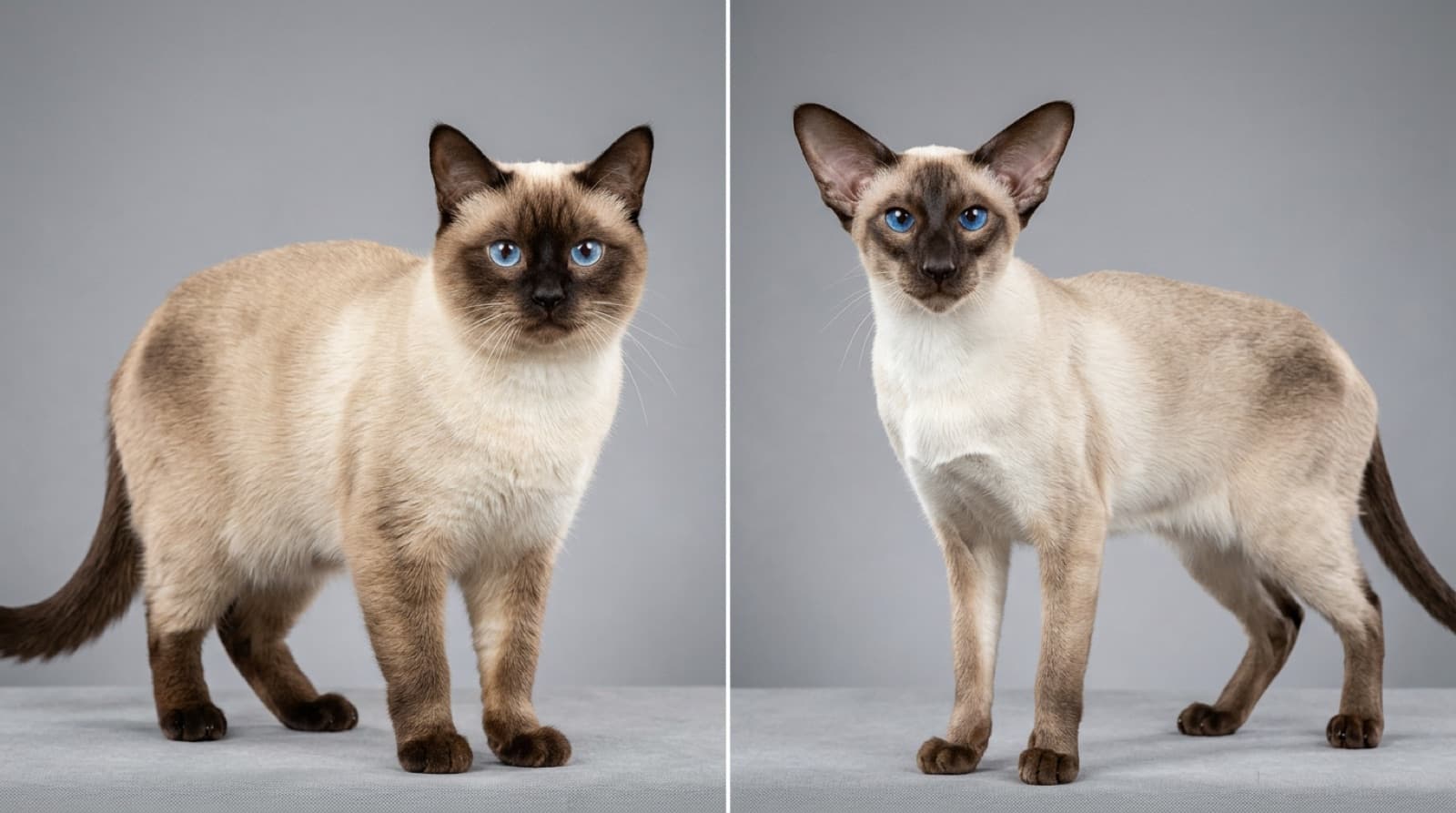
The two body types: Traditional vs Modern
The Siamese breed has split visually into two body types over the last 75 years. Both descend from the same 1800s temple cats imported from Siam (modern Thailand). The split happened because show breeders selectively favoured a more extreme look starting in the 1950s and 1960s. Breeders who kept the original look formed a parallel preservation movement, and by the 2000s the original body type was recognised as a separate breed in several federations.
The two body types are easy to tell apart once you know what to look for. Both share the colour-point pattern (darker face, ears, paws, tail) and the mandatory blue eyes. The differences are in head shape, body proportions, and ear size.
Traditional (Applehead / Thai breed)
- Round “apple” head shape, more rounded skull
- Stocky, heavier-boned body with moderate length
- Slightly rounder eyes (still blue, mandatory)
- Medium-length tail, less whippy
- Medium ears, proportionate to the head
- Mellower personality reputation (still vocal but less extreme)
- Closer to the original 1800s Siamese type before show-breeding diverged the look
- Registered as Siamese in CFA, as Thai in TICA, FIFe, and LOOF
Modern (Wedgehead / Show)
- Wedge-shaped head, long triangular skull from ears to nose tip
- Slender, elongated body with fine bone structure
- Almond-shaped eyes (still blue, mandatory)
- Long thin “whippy” tail
- Large, wide-set ears that continue the wedge line of the head
- More extreme vocalisation, louder and more demanding
- Result of selective show-breeding from the 1950s and 1960s onward
- Registered as Siamese in all major registries (CFA, TICA, FIFe, LOOF)
Both types share the same temperament family: highly social, vocal, dog-like in their attachment to humans, prone to separation anxiety, intelligent, and demanding of attention. The Modern type tends to amplify the volume; the Traditional type is generally more measured. For the full vocalisation breakdown, see our Siamese vocalisation and separation anxiety guide.
The registry split: CFA vs TICA, FIFe, LOOF
The same cat can have different paperwork depending on which registry the breeder uses. This trips up Calgary adopters expecting a “Traditional Siamese” registration certificate.
The Cat Fanciers’ Association (CFA), the dominant North American registry, treats both Traditional and Modern as one breed: Siamese. The CFA show standard favours the Modern type, but a Traditional-bodied cat from registered Siamese parents is still registered as Siamese. The result is that most CFA-registered Siamese cats today are Modern-type, but Traditional-bodied cats exist in CFA pedigrees and are technically the same breed.
The International Cat Association (TICA) took a different path. In 2010, after a multi-year application process that began in 2007, TICA granted the Traditional/Applehead body type Championship recognition as a separate breed called Thai. TICA registers Modern as Siamese and Traditional as Thai. The cats themselves are the same lineage; the names reflect TICA’s decision that the two body types are distinct enough to warrant separate breed status.
Other federations have moved in similar directions on different timelines. WCF (World Cat Federation) recognised Thai as a separate breed back in 1990, predating TICA. Fédération Internationale Féline (FIFe), the major European federation, granted Thai preliminary recognition in 2015. Livre Officiel des Origines Félines (LOOF), the French federation, also lists Thai in its catalog. The exact status varies by federation, but the pattern is consistent: outside CFA, the Applehead body type is increasingly recognised as a distinct breed.
Why this matters for Calgary adopters: paperwork from a TICA-registered Traditional Siamese kitten will read “Thai,” not “Traditional Siamese.” This confuses buyers who expect a Siamese certificate. The cat is the same. The registry just calls it something different. If a Calgary breeder offers a Traditional Siamese kitten with CFA papers, those papers will say Siamese. If the same breeder used TICA, the same kitten would have papers saying Thai. Both are legitimate.
Practical implication for verification: when checking paperwork on a Traditional Siamese kitten, do not be alarmed if the breed reads Thai. Cross-reference the cattery on the registry’s online directory (cfa.org/breeders or tica.org). If the cattery exists and the registration number is valid, the paperwork is real regardless of which name appears on it.
Colour-point genetics: why all Siamese have darker points
The signature Siamese pattern (pale body with darker face mask, ears, paws, and tail) comes from a single gene mutation. The mutation affects tyrosinase, an enzyme that produces dark pigment. The mutated enzyme is temperature-sensitive: it only works at cooler body temperatures. Cooler body parts (the extremities) produce more pigment. The warm torso produces less. The result is the distinctive contrast between pale body and dark points.
The same mutation also affects how the optic nerve crosses at the brain’s optic chiasm, which historically produced the crossed-eye trait and the kinked-tail trait that older Siamese were famous for. Modern show breeders have largely bred those traits out, but the eye-colour side effect remains: all purebred Siamese have blue eyes. Both CFA and TICA breed standards require blue eyes. A colour-point cat with non-blue eyes is not breed-pure.
The four classic recognised point colours are:
- Seal point: dark brown to nearly black points on a fawn/cream body. The original colour and still the most common.
- Blue point: slate grey points on a bluish-white body.
- Chocolate point: warm milk-chocolate brown points on an ivory body. Lighter than seal.
- Lilac point: pale pinkish-grey points on a near-white body. The dilute version of chocolate.
Modern breeders expanded the colour range by outcrossing to other breeds. The newer colours include red/flame point, cream point, lynx (tabby) point, and tortie point. CFA registers these as a separate but related breed called Colorpoint Shorthair, not Siamese (the CFA name is American-spelled by the registry itself). TICA folds them all under Siamese. This is another registry naming difference that confuses buyers: a CFA red point cat is a Colorpoint Shorthair; the same cat in TICA is a Siamese. Same animal, different label.
One more genetic note: kittens are born almost entirely white. The cooler body parts develop pigment as the kitten grows. By 6 to 12 months a Siamese kitten has filled in its adult points. Adult Siamese can darken further with age or in cold environments. A Calgary Siamese living indoors will look slightly different from one fostered in a chilly garage, because the colder environment activates more pigment over time.
What a “Siamese mix” at a Calgary rescue actually is
This is the most adoption-relevant part of the article. Calgary rescue cats labelled “Siamese mix” are almost always colourpoint Domestic Shorthairs without documented Siamese ancestry. They are wonderful cats; they just are not Siamese in the breed-registry sense.
Walk through the MEOW Foundation listings on a Saturday and you will see “Siamese mix” tagged on perhaps every colourpoint cat. The same pattern shows up at the Calgary Humane Society, AARCS, and the smaller cat rescues. The real rate of Siamese breed ancestry is much lower than the label rate suggests. Most of these cats are colourpoint Domestic Shorthairs (DSH).
The colour-point gene escaped into the general feline population centuries ago, probably through cats with partial Siamese ancestry several generations back. It now reappears periodically in mixed-ancestry cats. A colourpoint DSH has the colour-point pattern, often blue eyes, and sometimes a slightly slimmer build than a typical DSH. To a casual observer (including most shelter intake staff), it looks like a Siamese. To a breed-aware adopter, it is a colourpoint DSH with no recent Siamese ancestor.
This is fine. These cats are beautiful, healthy, friendly, and absolutely worth adopting. The point of this section is just to set expectations honestly. Here is the quick guide to reading a “Siamese mix” listing:
- Colour-point pattern + blue eyes + average DSH body type: colourpoint DSH. Probably no recent Siamese ancestor. Most common at Calgary rescues.
- Colour-point pattern + blue eyes + verifiable parent + Modern or Traditional body type: likely real Siamese ancestry. Rare at Calgary rescues but does happen, usually through breeder surrenders or owner crises.
- Colour-point pattern + non-blue eyes: not Siamese genetically. Possibly Tonkinese (aqua eyes), possibly colourpoint DSH with non-matching eye genetics.
- Colour-point pattern + white markings on points (mask, ears, feet, or tail): NOT purebred Siamese. CFA and TICA standards both disqualify white on points. The cat may be a Snowshoe, a Snowshoe mix, or a random-bred colourpoint with white spotting.
The honest framing we tell adopters: a “Siamese mix” label is shelter shorthand for “colourpoint cat that may or may not have breed ancestry.” If you specifically want a Siamese-type cat for the look (colour-point pattern, blue eyes, slender build, vocal personality), the rescue route delivers all of that regardless of breed verification. If you specifically want documented Siamese breed ancestry, you need either parent documentation from a surrender story or DNA confirmation, neither of which most rescue cats have.
How to verify a real Siamese (when paperwork is on offer)
If you are buying a Siamese kitten from a breeder rather than adopting from a rescue, breed verification matters. Here is the step-by-step:
- Ask for CFA or TICA registration paperwork by name. A vague “registered” claim is not enough. The breeder should provide a specific registration number and cattery name. Cross-reference the cattery on the registry’s online directory (cfa.org for CFA, tica.org for TICA). If the cattery does not appear in the directory, the paperwork is fake.
- Confirm both parents are registered. Ethical breeders provide photos and registration numbers for both parents. The pedigree should document at least three generations back.
- Verify eye colour: BLUE only. Any other eye colour disqualifies the kitten from purebred Siamese status regardless of paperwork.
- Verify no white on points. The mask, ears, paws, and tail must be solid point colour. White boots or white face markings indicate Snowshoe ancestry or random-bred colourpoint, not Siamese.
- Ask about health screening. Siamese carry slightly elevated risks for certain conditions including hypertrophic cardiomyopathy (HCM) and progressive retinal atrophy. An annual echocardiogram is the standard screening test. Siamese-specific DNA testing is less established than for Maine Coon or Ragdoll, but breeders should still be running available screens. See our Siamese health issues guide for the full medical picture.
- For Traditional/Applehead kittens: check which registry the breeder uses. TICA registers Traditional as Thai. CFA registers it as Siamese. Both are legitimate. The paperwork will read whichever the breeder’s registry of choice uses.
For adopters who already have a cat without paperwork and want to know what is actually in there, a Wisdom Panel cat DNA test runs around $130 USD (Canadian pricing varies with import and shipping) and reports breed percentages plus health markers. The breed report is informative but not a substitute for a pedigree, since cat breeds are less genetically distinct than dog breeds and most rescue cats come back as “mostly domestic” with low-confidence breed assignments.
Skip the breed-paperwork drama. Browse adoptable Siamese-type cats in Calgary.
Calgary rescue colourpoint cats deliver the Siamese look (blue eyes, point pattern) at a fraction of breeder cost. Most are colourpoint DSH: beautiful cats with the same care needs as breed-pure Siamese.
See Available Siamese →Common breed confusions for Calgary adopters
Several breeds and pattern variations get confused with Siamese in rescue listings and casual conversation. Here are the side-by-side tells.
Siamese vs Balinese
Balinese is essentially a long-haired Siamese. Same colour-point pattern, same mandatory blue eyes, same body type options (Traditional or Modern), same temperament. Coat length is the only meaningful difference. CFA and TICA recognise Balinese as a separate breed. If you want the Siamese personality with a fluffier look, Balinese is the answer. They are rare in Calgary rescues; expect to look harder than for a regular Siamese-type cat.
Siamese vs Tonkinese
Tonkinese is a Siamese-Burmese cross, recognised as a separate breed. Key tells: aqua or gold eyes (not the mandatory blue of a purebred Siamese), a softer point pattern that blends more gradually into the body, and a stockier muscular build. Temperament is generally mellower than a Modern Siamese and the vocalisation is less extreme. A colourpoint cat with green or gold eyes is more likely Tonkinese or Tonk-cross than Siamese.
Siamese vs Birman
Easy to tell apart once you know. Birman is a different breed entirely with long fur, distinctive white “gloves” on the paws, and a softer face. Eye colour is blue (a shared trait that contributes to the confusion). The white gloves are the dead giveaway: Siamese standard prohibits any white on points, so a colourpoint cat with white paws is either a Birman, a Snowshoe, or a colourpoint DSH with white spotting.
Siamese vs Snowshoe
Snowshoe is a Siamese-bicolour cross, recognised as a separate breed. Tells: white “boots” on the paws and an inverted white V on the face. Body type can resemble either Traditional or Modern Siamese. Eye colour is blue. Both registries (CFA, TICA) recognise Snowshoe as distinct. Any colourpoint cat with white boots is a Snowshoe or Snowshoe mix, not a Siamese.
Siamese vs colourpoint DSH (the rescue label)
This is the comparison that matters most in Calgary rescues. A colourpoint Domestic Shorthair has the pattern and often the eye colour of a Siamese but no documented Siamese ancestry. Physical look can be similar. Lifespan and health risks differ slightly: rescue colourpoint DSH cats often have wider genetic diversity (hybrid vigour) than breed-pure Siamese and may carry lower risks for breed-linked conditions. They are not Siamese in the registry sense; they are wonderful cats in every other sense.
Scam patterns specific to Siamese identification
Siamese scams cluster around identification ambiguity. Knowing the breed standard tells you which kittens are mislabelled and which sellers are running fraud. The five most common patterns:
The colourpoint DSH sold as “purebred Siamese”
The dominant Siamese scam in Calgary. Most under-$1,000 “Siamese kittens” on Kijiji or Facebook Marketplace are colourpoint DSH kittens from accidental litters. No paperwork. The kittens are healthy, friendly, and worth a home; the price plus the label together are fraud. Ethical Canadian Siamese breeders charge $1,500 to $3,000 with documented paperwork and health screening. Anyone selling a registered Siamese under $1,000 with no waitlist is misrepresenting. The honest path at the lower budget is rescue, where a Calgary colourpoint cat costs $300 to $500 with full vetting included.
The non-blue-eyes red flag
Any eye colour other than blue disqualifies a cat from purebred Siamese status. CFA and TICA breed standards both require blue eyes. A seller offering a green-eyed or gold-eyed “Siamese” kitten is either misinformed or running a scam. The cat is more likely a Tonkinese, a colourpoint DSH, or another colourpoint mix. Beautiful cat, wrong breed label.
The white-on-points red flag
Any white on the mask, ears, paws, or tail disqualifies a cat from the Siamese breed standard. White boots specifically indicate Snowshoe ancestry. A “purebred Siamese” kitten with white markings is mislabelled, full stop. The cat may be a Snowshoe, a Birman, or a random-bred colourpoint. Worth adopting; not worth $1,500 as a Siamese.
The “Modern is rare” or “Traditional is rare” pricing scam
Sellers exploit buyer ignorance by claiming one body type is rarer and demanding a premium. Both Modern and Traditional are equally available from ethical breeders. Some breeders specialise in Traditional/Applehead preservation lines; some focus on Modern show lines. Neither commands a legitimate “rarity” premium. If a seller is charging $4,000 or $5,000 for a “rare Traditional Applehead”, the rarity claim is marketing, not pedigree fact.
The “F1 Siamese” pseudoscience
F1 and F2 designations apply only to hybrid breeds where a domestic cat is crossed with a wild species: Bengal (Asian Leopard Cat), Savannah (Serval), Chausie (Jungle Cat). Siamese is a fully domestic breed with no wild outcross. Anyone selling “F1 Siamese” kittens is using fake breed terminology to inflate price. Walk away immediately.
The “registered Siamese” claim with no specifics
A vague “registered” claim with no cattery name and no registration number is the most common fraud pattern. Ask for the specific TICA or CFA cattery number. Verify the cattery directly on the registry website. If the cattery does not appear in the directory, the paperwork does not exist. Ethical breeders provide registration details upfront without being asked.
For the broader scam-pattern picture across all Siamese purchases, our Siamese adoption guide covers Kijiji red flags, fake breeder websites, and what real Canadian breeder verification looks like.
The rescue path bypasses all this
Calgary rescue colourpoint cats are wonderful regardless of what genetic percentage of Siamese they actually carry. Adoption fees run $300 to $500 and cover spay or neuter, vaccinations, microchip, deworming, and a vet workup. Zero paperwork verification needed. Zero scam risk. Zero ambiguity about whether the seller is honest.
The rescue path is the clean answer for adopters who want a Siamese-look cat without the breeder vetting process. If colour-point pattern, blue eyes, and a chatty companion are the priorities (rather than the registry paperwork), every Calgary rescue colourpoint cat delivers exactly that. Lifespan is the same (15 to 20 years). Care needs are the same. Temperament is broadly the same: highly social, vocal, dog-like. The only difference is the absence of pedigree confirmation, which only matters if you intend to show the cat or breed from it.
Several Calgary rescues consistently list colorpoint cats. MEOW Foundation is cat-only and the largest dedicated cat rescue in Calgary; their foster homes do detailed temperament assessments. Calgary Humane Society has the highest intake volume in the city. AARCS pulls cats from rural shelters and overflow situations.
Outside Calgary, breed-specific Siamese rescues operate across North America: Rescue Siamese & Stray Cats, Specialty Purebred Cat Rescue, and Pacific Siamese Rescue occasionally facilitate Canadian transfers, though most place locally. Worth checking if you want documented Siamese ancestry without the breeder route.
What real TICA or CFA paperwork looks like
If you are pursuing the breeder route and verifying paperwork, here is what real registration documentation includes:
- Specific cattery name that appears in the registry’s online directory. Cross-reference at cfa.org/breeders or tica.org.
- Cattery registration number that matches the directory entry.
- Pedigree chart documenting at least three generations of registered ancestors, with parents and grandparents named.
- Breed name printed correctly: CFA lists “Siamese” for both body types; TICA lists “Siamese” for Modern and “Thai” for Traditional/Applehead. Either is legitimate depending on the breeder’s registry of choice.
- Official registry seal or watermark on the certificate.
- Microchip number cross-referenced to the registry record (ethical breeders microchip before sale).
Fake or misleading paperwork shows: vague “registered” claims without cattery specifics, missing parent documentation, requests to skip registry verification, breed name written as “Siamese” on documentation from a registry that does not register that body type, or pressure to complete the sale before verification can be done. Walk away from any of these.
Quick history: how the two body types diverged
The Siamese is one of the world’s oldest recognised cat breeds. The cats originated in Siam (modern Thailand), where they were kept as temple and royal companions. The first documented imports to the UK arrived in the 1880s. The first documented Siamese in North America was a diplomatic gift to US President Rutherford B. Hayes in 1878. CFA recognised the breed in 1906.
For the first half of the 20th century, all Siamese had the round-headed Traditional body type. Show breeders started selecting for a more extreme look in the 1950s and 1960s: longer body, wedge-shaped head, larger ears, slimmer build. By the 1980s, the Modern type dominated CFA show rings and the Traditional type had nearly disappeared from registered breeding programs.
Breeders who preserved the original body type formed a parallel preservation movement, kept the Applehead lines alive, and eventually petitioned TICA to recognise it as a separate breed. TICA granted Thai Championship recognition in 2010 after the application process began in 2007. FIFe and LOOF followed similar paths. CFA never split, so Traditional and Modern share the Siamese name in CFA pedigrees to this day.
The practical implication: if you want a Traditional-bodied Siamese in Calgary today, you are looking for a breeder who specialises in preservation lines (Thai breed in TICA terms, Traditional Siamese in CFA terms). They exist but are less common than Modern Siamese breeders. Rescue cats with Traditional body type also exist, usually from owner-surrender situations where the original purchase paperwork is lost or never existed.
Frequently Asked Questions
What’s the difference between Traditional and Modern Siamese?
Body type and head shape. Traditional (Applehead) has a round head, stocky body, slightly rounder eyes, and shorter tail. Modern (Wedgehead) has a wedge-shaped head, slender body, almond eyes, large ears, and a long whippy tail. Both share the colour-point pattern and mandatory blue eyes. Traditional is the original 1800s type. Modern is the result of selective show-breeding starting in the 1950s and 1960s. Modern Siamese are generally louder; Traditional are mellower but still vocal.
Is Traditional Siamese the same as a Thai cat?
Yes, in TICA, FIFe, and LOOF terminology. Those registries classify the Applehead body type as a separate breed called Thai. CFA registers both Traditional and Modern under the single name Siamese. The cat itself is the same physical lineage; the name reflects the registry choice. A TICA Applehead kitten has paperwork reading Thai. A CFA Applehead kitten has paperwork reading Siamese. Both are legitimate.
Why does CFA call them both Siamese but TICA calls Traditional “Thai”?
CFA show breeders selected for the extreme Modern look starting in the 1950s and 1960s, and Traditional cats nearly disappeared from CFA show rings. Breeders who preserved the original body type petitioned TICA to recognise it as a separate breed. TICA granted Thai Championship recognition in 2010 after the application process began in 2007. FIFe and LOOF followed. CFA never split, so both body types still share the Siamese name there. The difference is bureaucratic, not biological.
Are all Siamese supposed to have blue eyes?
Yes, mandatory. The colour-point gene mutation also affects eye pigment, locking purebred Siamese into blue eyes. CFA and TICA standards both require blue eyes. A colourpoint cat with green, gold, or copper eyes is not breed-pure. It may be a Tonkinese, a colourpoint DSH, or another colourpoint mix.
Can a Siamese have green or gold eyes?
No. A purebred Siamese has blue eyes only. If you see a colourpoint cat with green or gold eyes, it is not breed-pure. The most likely identification is a Tonkinese (Siamese-Burmese cross with aqua to gold eye colours), or a colourpoint DSH where the colour-point gene escaped into mixed ancestry without the matching eye-colour genetics.
Why do Siamese kittens look pale and get darker?
The colour-point gene is temperature-sensitive. The mutated tyrosinase enzyme only works at cooler body temperatures, so kittens are born almost entirely white (the uterus is warm) and develop pigment on the cooler body parts (ears, face mask, paws, tail) as they grow. By 6 to 12 months a Siamese kitten has filled in adult points. A Calgary Siamese living indoors will look slightly different from one fostered in a chilly garage.
Is a colourpoint DSH the same as a Siamese?
No. A colourpoint Domestic Shorthair has the colour-point pattern and often blue eyes but no documented Siamese breed ancestry. The colour-point gene escaped into the broader cat population centuries ago and reappears in mixed-ancestry cats. These cats look like Siamese to a casual observer but are not breed-pure. They are wonderful, adoptable cats; just not Siamese in the registry sense. Most Calgary rescue “Siamese mix” listings are colourpoint DSH.
How can I tell if my cat is a real Siamese?
Without registry paperwork from CFA or TICA, you cannot confirm purebred status. The traits to look for: mandatory blue eyes, no white on points (mask, ears, paws, tail), one of the four classic point colours (seal, blue, chocolate, lilac) or a recognised newer colour, and a body type matching either Traditional (round head, stocky body) or Modern (wedge head, slim body). Paperwork from a verifiable CFA or TICA cattery is the only confirmation. A Wisdom Panel DNA test gives breed percentages but is not a substitute for pedigree.
Are Modern Siamese louder than Traditional?
Generally yes, but individual variation is large. Modern Siamese have a reputation for being extremely vocal with a loud, demanding, baby-cry-like vocalisation. Traditional Siamese are still vocal but the volume and intensity tend to be lower. Both will talk to you constantly and have opinions about everything. If quiet matters to you, neither is the right cat.
Is a $500 “purebred Siamese kitten” a scam?
Almost certainly. Ethical Canadian Siamese breeders charge $1,500 to $3,000 for a registered kitten with paperwork, health screening, and verified parents. Anyone advertising purebred Siamese under $1,000 with no waitlist and immediate availability is either running a scam or selling colourpoint DSH kittens as Siamese. The cat may be perfectly nice; the label and the price together are fraud. The honest path at that budget is rescue, where a Calgary colourpoint cat costs $300 to $500 with full vetting included.
What’s the difference between Siamese and Balinese?
Coat length. Balinese is a long-haired Siamese: same colour-point pattern, same mandatory blue eyes, same body type options, same temperament. CFA and TICA recognise Balinese as a separate breed. If you want the Siamese personality with a fluffier look, Balinese is the answer. They are rare in Calgary rescues.
Can a Siamese have white feet?
No. Any white on the mask, ears, paws, or tail disqualifies a cat from the Siamese breed standard in both CFA and TICA. White boots specifically indicate Snowshoe ancestry (Siamese crossed with bicolour, recognised as a separate breed). A colourpoint cat with white feet is either a Snowshoe, a Snowshoe mix, or a colourpoint DSH with random white spotting. It is not a purebred Siamese.
Should I get DNA testing on my “Siamese mix” rescue cat?
For breed curiosity, maybe. For health screening, yes if you can afford it. Wisdom Panel offers a cat test at around $130 USD (Canadian pricing varies with import and shipping) that reports breed percentages and screens for known feline genetic conditions. Cat breeds are less genetically distinct than dog breeds, so the breed report often comes back as “mostly domestic” with low-confidence percentages. The health side is more actionable: Siamese carry slightly elevated risks for certain conditions, and a DNA test that flags markers gives your vet monitoring information.
Is “F1 Siamese” a real thing?
No. F1 and F2 designations apply only to hybrid breeds where a domestic cat is crossed with a wild species: Bengal (Asian Leopard Cat), Savannah (Serval), Chausie (Jungle Cat). Siamese is a fully domestic breed with no wild outcross. Anyone selling “F1 Siamese” kittens is using fake breed terminology to inflate price. Walk away.
Siamese Cats in Calgary
Browse adoptable Siamese and Siamese mixes from Calgary rescues.
Siamese Adoption in Calgary
Rescue sources, real costs, surrender patterns, and how to find a real Siamese or colorpoint mix.
Siamese Health Issues
HCM, progressive retinal atrophy, dental issues, and the Calgary specialty vets who handle Siamese care.
Siamese Vocalisation & Separation Anxiety
Why Siamese are so vocal, how to manage separation anxiety, and what to expect from a chatty breed.