The short answer
Siamese are the most vocal domestic cat breed. The Meezer yowl is hardwired and you cannot train it away. Combined with separation anxiety, working-household reality, and Calgary condo density, this is the number-one reason Siamese end up in rescue. The fix is structural: bonded pair adoption, environmental enrichment, scheduled engagement, and an honest assessment of whether your household can give a vocal needy breed what it actually needs. A single Siamese in a full-time working condo is the surrender pattern. A bonded pair in the same condo is usually fine.
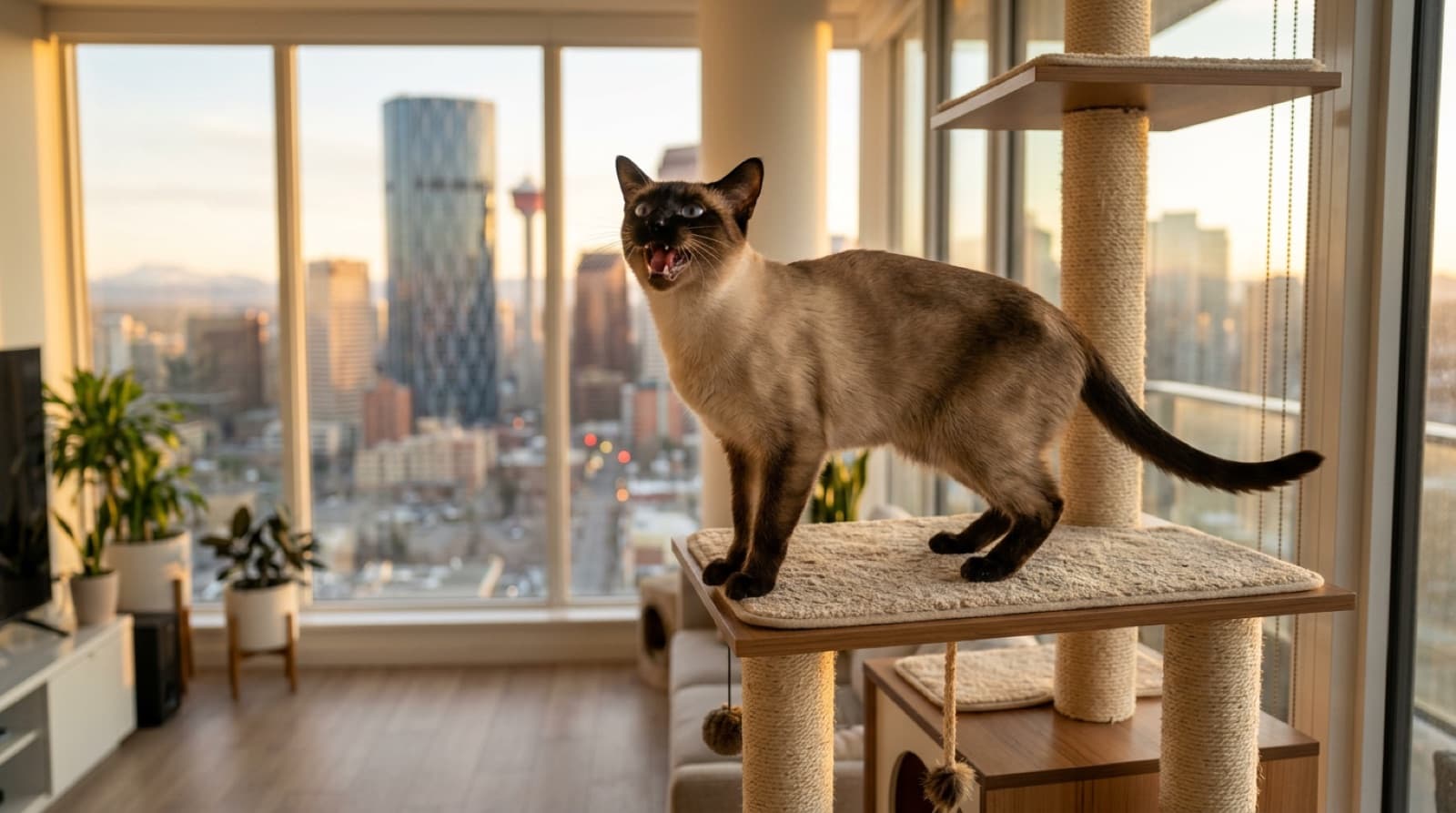
What “Siamese vocal” actually means
Siamese owners describe the sound the same way across every owner forum and rescue intake call: loud, low-pitched, baby-cry-like, persistent. It is not the brief chirp or trill most cats use. It is a sustained vocalisation that carries through walls and demands a response. People who have only owned Domestic Shorthairs sometimes assume the new Siamese is in pain the first time they hear it; the cat is fine, that is the breed character.
The technical name some breeders use is the Meezer yowl, and it has identifiable features. The pitch is lower than a typical cat meow. The duration is longer. The volume is higher. The pattern is conversational, meaning the cat expects a back-and-forth and will continue until it gets one or until the trigger goes away. Many owners describe it as closer to a human infant crying than to a cat meowing, which is part of why it is so hard to ignore and so disruptive in a shared building.
This is not a defect or a behaviour problem. Siamese were royal companion cats in what was then Siam, kept inside palaces and bred for centuries to communicate with humans. The communication trait is the breed. Selecting a quiet Siamese is like selecting a non-shedding Husky: you can find individual outliers, but you cannot get there through training, and the breed average is what it is. The Cornell Feline Health Center notes Siamese among the breeds with elevated rates of bonding-driven behavioural patterns; vocalisation is part of that profile.
The most important reframe for new Siamese owners: the vocalisation is not a problem to solve. It is a feature to manage. The goal is not silence. The goal is reducing trigger-driven yowling (hunger, loneliness, anxiety, reinforcement of demand-yowling) while accepting that conversational chatter is the baseline you signed up for.
Why Siamese end up in rescue
The pattern is depressingly consistent. An adopter sees a Siamese on Instagram or YouTube, falls for the personality, brings home a kitten or young adult, and is overwhelmed within 6 to 12 months. The phrases on surrender forms paraphrase to a small set:
- “Too vocal for our apartment.”
- “Yowls all night.”
- “Neighbours complained about the noise.”
- “Destructive when we leave for work.”
- “Follows me everywhere demanding attention.”
- “We work full time and she is miserable.”
- “Cannot keep up with how needy she is.”
The underlying story is almost always the same. The adopter expected a cat. They got a Siamese. The vocalisation did not decrease with age. The intensity surged in adolescence (often paired with intact-cat reproductive yowling if the cat was not spayed or neutered on time). The working schedule did not flex to meet the breed need. The condo neighbours did not stay quiet. The cat showed visible distress and the household conflict compounded the cat distress.
This is preventable. Not by training the cat to be different, but by setting the household up for what the breed actually is. The rescues that handle Siamese well (Rescue Siamese & Stray Cats in Winnipeg, Pacific Siamese Rescue on the west coast, and Specialty Purebred Cat Rescue) screen adopters specifically for household structure, often require bonded-pair adoption, and turn down single-cat working-household applications that are not set up for the breed. They turn applications down because they have seen the surrender pipeline. The rejection is the breed-protective move.
If you are reading this article before adopting, the goal is to be the adopter the rescue says yes to. If you are reading this after adopting and the cat is struggling, the rest of the article is the structural intervention.
The Calgary apartment and condo reality
The acoustic problem most Calgary first-time Siamese owners do not anticipate.
Calgary’s condo density and apartment-rental concentration in the Beltline, Mission, Bridgeland, Eau Claire, Kensington, and Inglewood means most first-time Siamese owners live in shared-wall housing. The walls in most Calgary condos built after 2000 are drywall over wood or metal stud, with minimal acoustic insulation between units. Voice-frequency sound carries through them.
A yowling Siamese at 3 AM is audible in the adjacent unit. A morning hunger-yowl session starting at 5 AM is audible in the unit above and below. The neighbours rarely complain to your face. They complain to the building manager, the building manager attaches a notice to your door, the second notice mentions the lease pet clause, and the third notice puts you on a 30-day eviction track. Calgary building bylaws do not restrict cats by vocalisation, but practical neighbour-complaint dynamics drive a real surrender pipeline.
The acoustic issue compounds with Calgary’s climate. We are indoors 6 or more months a year because outdoor temperatures hit minus 25 Celsius or colder. Windows stay closed. Walls stay sealed. The cat is inside, the neighbours are inside, and the sound has nowhere to dissipate. Summer is better but only marginally; the building is still enclosed.
The fix is not soundproofing. It is reducing the trigger that produces the worst yowling sessions. Three patterns produce most neighbour-complaint episodes: (1) early-morning hunger-yowling starting 5 to 6 AM, fixed by an auto-feeder that delivers a small meal at the time the cat would otherwise wake you; (2) loneliness yowling during the workday in a single-cat household, fixed by a bonded second cat; (3) intact-cat reproductive yowling, fixed by spay or neuter at 5 to 6 months. A Siamese in a properly-set-up household still vocalises. It does not yowl at 5 AM for 40 minutes straight.
Why a bonded pair fixes most of it
Bonded-pair adoption is the single highest-impact intervention for the Siamese surrender pattern. It works because the loneliness-driven vocalisation that drives most workday yowling is a social problem, and the most direct social fix is another cat.
Siamese form intense bonds with siblings, parents, and long-term cat companions. A pair sleeps together, grooms each other, plays together, eats together, and entertains each other through the workday. Rescue foster homes that observe bonded pairs report markedly less workday vocalisation compared to the same individual cats placed singly. The pattern is consistent enough that Pacific Siamese Rescue, Rescue Siamese & Stray Cats, and most Siamese-specific rescues either require or strongly recommend pair adoption when intake is a bonded pair.
The cost math favours pair adoption more than people expect. Food and litter roughly scale; one cat tree works for two; one set of toys, one auto-feeder, one water fountain. The genuine added cost is vet care, which is per-cat. Two annual exams, two sets of vaccines, two dental cleanings over their lifetime. Calgary rescue adoption fees are typically $250 per cat (some rescues offer a small bonded-pair discount). Lifetime cost of a bonded pair is closer to 1.5x a single cat than 2x.
The pair benefit is not symmetric. A single Siamese in a full-time-out-of-the-home household is the surrender pattern. A bonded pair in the same household is usually fine. The difference between “surrender within a year” and “thrives for 15 years” is often that second cat.
One caveat: the pair has to actually be bonded. Two random Siamese introduced as adults can absolutely conflict. Adopt a documented bonded pair from a rescue, or adopt two kittens together from the same litter, or adopt a single Siamese and then go through a proper 2 to 4 week introduction protocol with a confident second cat. Our cat-to-cat introduction guide covers the scent-swap and gradual-contact process.
The enrichment infrastructure that actually works
These are the environmental interventions Calgary Siamese owners use successfully. None is sufficient alone; combining 5 or 6 of them plus a bonded pair is the realistic setup for a working condo household.
1. A 5 to 6 foot multi-level cat tree
Siamese are smaller climbers than Bengals or Maine Coons, so ceiling-height trees are overkill. A sturdy 5 to 6 foot tree with multiple levels and a built-in scratching post is the sweet spot. Put it in the room you spend most time in (usually the living room), positioned near a window. Cheap pressboard trees wobble and Siamese stop using wobbly furniture; spend the extra $50 on a stable one. Cost: $150 to $250.
2. Two to three window perches
Multiple windows means multiple watching stations. Sun exposure, outdoor visual input, bird and squirrel watching: window time correlates with lower stress behaviour. A $30 bird feeder mounted within sight of a window pays back in cat wellbeing year-round. Calgary backyards attract chickadees, magpies, and house sparrows through the winter.
3. Puzzle feeders rotated daily
Slow feeders and food puzzles convert a 5-minute meal into 20 to 30 minutes of engagement. Mental work tires Siamese as effectively as physical play. Brands worth buying: Trixie, Catit Senses, and Doc & Phoebe’s Indoor Hunting Feeder. Rotate 3 or 4 puzzles so the cat does not solve them on autopilot. Cost: $15 to $40 per puzzle.
4. Wand toys rotated daily, not just laser
Da Bird, Cat Dancer, prey-style wands. Siamese are intense play partners and need the hunt-catch-eat-groom-sleep sequence. Lasers are useful in small doses but frustrating without a capture; the cat never gets the satisfaction of catching anything. Rotate wand toys so they stay novel. 10 to 15 minutes morning and evening is the realistic minimum.
5. A bonded second cat
The single most effective intervention for a working-household Siamese. See the dedicated section above. If you can only do one thing on this list, do this.
6. Auto-feeder for delayed early-morning meals
The 5 AM hunger-yowl pattern is the most common neighbour-complaint trigger. Set an auto-feeder (Petlibro, Petsafe) to deliver a small meal at 5 or 6 AM and a second small meal mid-workday. The cat learns the auto-feeder, not you, controls the meal schedule. Stops waking you at 5 AM; stops waking the neighbours too. Cost: $50 to $100.
7. Background noise during your absence
TV, radio, or a streaming music playlist at low volume while you are out. Siamese tolerate human voices well and the auditory environment reduces silence-driven stress. Cat-specific YouTube content (bird videos, squirrel close-ups) works for some Siamese; experiment with what your cat engages with. Cost: free if you have a tablet or old TV.
8. A catio or enclosed balcony
Calgary catio works most of the year. An enclosed outdoor space (mesh-screened balcony, freestanding patio enclosure, window-mounted catio box) gives Siamese fresh air, real outdoor stimulation, and a break from indoor sameness. Major enrichment win, especially in spring through fall. Condo balconies can be retrofitted with mesh enclosures for $200 to $600.
9. Harness training (start kitten-young)
Siamese are leash-trainable more often than average cats. Not every individual takes to it, so do not force it. Start at 3 to 6 months if possible, use a properly-fitted H-style or vest harness, build up indoors first, and progress to balcony then to outdoor walks. The cats that do enjoy walks get a major enrichment boost from it. Cost: $25 for a quality harness and lead.
10. Predictable daily routine
Same departure, same return, same feeding times, same play times. Siamese are routine-driven and the predictability itself reduces anxiety. Vary the routine and the cat re-evaluates daily whether to be stressed; keep it consistent and the routine becomes its own reassurance. The departure ritual matters most: a brief calm goodbye is better than a long emotional one.
The 24-hour vocalisation scheduling protocol
The schedule below is what works for most Calgary working households. It is not silence enforcement; it is rhythm management.
The fix for trigger-driven yowling is not punishment. It is a 24-hour rhythm that anticipates the predictable trigger points and plugs them before the cat starts yowling.
- 5 to 6 AM: auto-feeder delivers a small meal. This is the slot the cat would otherwise spend yowling at the bedroom door. The auto-feeder removes you from the equation. The cat learns the auto-feeder controls breakfast, not you.
- 6 to 8 AM: your wake-up. Brief 5 to 10 minute wand-play session before you leave the house. Larger breakfast portion now. The play burns adolescent intensity; the meal closes the morning hunger arc.
- 9 AM to 5 PM: bonded pair entertains each other; window perches give visual stimulation; slow feeders extend any midday auto-feeder snack into engagement work; background TV or music covers silence; cat tree provides altitude and watching positions.
- 5 to 7 PM: return ritual. Calm brief greeting (not 15 minutes of high-energy reunion which trains the cat that your return is a major event). 15 to 20 minute wand-play session. Dinner.
- 7 to 9 PM: household time. Siamese gets lap time, attention, and human company. This is the high-engagement slot the cat has been waiting for. Use it.
- 9 to 10 PM: pre-bed wind-down. Final short play session and a small late meal (or schedule the auto-feeder to deliver one). A cat that goes to bed slightly full sleeps better than a hungry cat.
- 10 PM to 5 AM: night rest. If the cat yowls overnight, do not respond. Even negative attention (getting up, telling the cat to be quiet, opening the door to shoo it) reinforces the yowling because it confirms yowling produces human contact. Diagnose the trigger (hunger, environment, boredom, loneliness, illness) and plug it structurally rather than responding interactively.
This schedule does not eliminate Siamese vocalisation. It is not supposed to. It reduces the worst-case yowling sessions (early-morning hunger, workday loneliness, evening attention-seeking) by removing the triggers that drive them. The cat still chats with you. The cat does not yowl at 5 AM for 40 minutes.
Adolescence: the hardest window
The 6 to 18 month window is when most Siamese surrenders happen. Adolescent intensity surges across vocalisation, energy, demand, and (if not spayed or neutered) reproductive yowling. A kitten that was manageable at 4 months becomes a different cat by 10 months. Many adopters interpret the change as a behaviour problem and start looking for a way out.
Intact females cycle through silent heats or loud heats; Siamese tend toward loud. Intact males may spray, roam, and vocalise aggressively for mates. Spay or neuter at 5 to 6 months is the standard intervention and resolves most reproductive-driven vocalisation. Calgary rescues spay and neuter before adoption as a default, so cats adopted from rescue do not present this issue. Cats from breeders or backyard sources sometimes do.
Beyond reproductive vocalisation, adolescent Siamese are testing boundaries. They yowl louder, demand more attention, push limits on what they can knock off counters, and discover that vocalisation tends to produce a response. This is the period when reinforcement habits form. Responding to a yowling adolescent with attention (even “stop yowling” counts) teaches the cat that yowling produces what they want. Ignoring it (while plugging the genuine triggers structurally) teaches the cat that yowling does not. The pattern set in adolescence becomes the adult baseline.
Surviving adolescence is the predictor for the rest of the cat’s life. By 2 to 3 years old the cat has settled into adult vocalisation patterns, which are still chatty but markedly less intense than the 12-month peak. Owners who push through adolescence with the right structure usually keep the cat for the breed’s 15 to 20 year lifespan. Owners who surrender during adolescence often cite reasons that would have resolved by month 24.
Multi-cat household compatibility
Not every cat pairing works with a Siamese. The combinations we see succeeding and failing at Calgary rescues:
- Siamese + bonded Siamese pair: the gold standard for working households. Two Siamese understand each other’s play style, vocalisation, and intensity.
- Siamese + confident Domestic Shorthair or Tonkinese: works well if introduced properly over 2 to 4 weeks. The DSH or Tonkinese provides the social role without competing for vocalisation airtime.
- Siamese + shy senior cat: often fails. Siamese intensity bullies the senior, even unintentionally. The senior retreats, eats less, hides more. Not a kind pairing for the senior.
- Siamese + dog: variable. A calm cat-friendly dog can work as a companion, especially for a single Siamese in a household where adding a second cat is not feasible. A high-energy dog usually does not; the Siamese gets chased or stressed.
- Siamese + small pet (rabbit, bird, hamster, fish): Siamese have strong prey drive and food-thieving intelligence. Do not house in the same room. A separate closed door is the minimum; even then the Siamese will stake out the door and stress the prey animal.
For pair introduction logistics, our cat-to-cat introduction guide covers the protocol. Botched introductions create territorial conflict that is harder to fix than the original anxiety problem; do it properly the first time.
Browse adoptable Siamese-type cats in Calgary
Many Siamese in Calgary rescue are bonded pairs surrendered together because they were intensely bonded. Adopting a pair is often the right answer for working households, and rescue foster notes describe the actual cats in front of you instead of breed-average generalizations.
See Available Siamese →When it crosses into a behavioural problem: the escalation protocol
Normal Siamese vocalisation is not a behaviour problem. It is breed character. The line crosses into behavioural-issue territory when several red flags appear together:
- Sudden vocalisation escalation in an older cat. A 10-year-old Siamese suddenly yowling at night when it did not previously is a medical-workup trigger. Hyperthyroidism, hypertension, dental pain, and cognitive decline all present this way. Vet first.
- Inappropriate elimination outside the litter box with no medical cause. Rule out UTI, urinary crystals, and kidney issues first. If medical is clear and the cat is eliminating near doors or in specific stress patterns, it is behavioural.
- Self-injurious overgrooming or fur loss in stress patterns. Belly, inner thighs, base of tail are typical sites. Symmetrical fur loss with no underlying skin condition is psychogenic alopecia and indicates chronic stress.
- Persistent aggression toward humans or other cats that did not exist before. Hissing, swatting, biting that escalates over weeks. Distinct from breed-typical play intensity.
- Weight loss or refusal to eat unless someone is in the room. The extreme version of social-dependence behaviour. Signals chronic stress.
The Calgary escalation path:
- Primary vet workup first. Bloodwork, urinalysis, and a physical to rule out medical causes. Costs $200 to $400. This step is non-negotiable; medical mimics behavioural for several common feline conditions, and treating the wrong cause wastes 6 months.
- IAABC-certified cat behaviour consultant. Search the IAABC directory for feline-specialty consultants. Calgary-local options are limited; several Canadian consultants offer remote video consults, which expands the field considerably. Initial consult cost: $200 to $400.
- Veterinary behaviourist referral for severe cases. For escalating aggression, chronic elimination unresponsive to environmental work, or cases where the vet thinks anxiolytic medication might be warranted, your primary vet can refer to a veterinary behaviourist. Western Veterinary Specialist & Emergency Centre accepts referrals for behaviour-relevant medical workups and can route to behaviourist consultations.
- Medication only on vet direction. Anxiolytics (fluoxetine, gabapentin) are sometimes appropriate short-term during transitions. Never administer without veterinary direction. Never use medication as a substitute for environmental work; it supplements, it does not replace.
For broader context on feline behavioural conditions, International Cat Care and the American Association of Feline Practitioners publish accessible resources on stress, anxiety, and Fear Free handling principles.
Indoor-only commitment, with a harness exception
Siamese stay indoor-only in Calgary. The breed is too valuable to predators (coyotes are present on the Bow River paths, on Nose Hill, and in most off-leash riverside parks), too valuable to traffic, and too valuable to theft. Outdoor free-roaming is a 6 to 8 year average life expectancy versus the breed’s normal 15 to 20 years indoor.
The exception is a catio or an enclosed balcony, which gives outdoor air and stimulation without the risk. Harness training is the second exception for individual cats that take to it. Start young, use a properly-fitted H-style harness, and build up indoors before going outside. Not every Siamese is a leash cat; do not force it.
Our indoor vs outdoor guide covers the broader case for indoor-only Calgary cats, including the coyote angle.
Working-household decision matrix
The most honest question to ask before adopting a Siamese: does your household structure match what this breed needs? The matrix:
- You work 9 to 5 out of the home, live in a condo, want a single cat: do not adopt a single Siamese. The acoustic, anxiety, and surrender risk profile is the highest we see at Calgary rescues. Options: adopt a bonded Siamese pair, adopt a single Ragdoll (also social but quiet), or adopt a single Domestic Shorthair (more independent baseline).
- You work full-time out of the home but commit to a bonded pair: realistic and often successful. The pair absorbs the social load. Plan budget for two cats and a 2 to 4 week introduction window if not already bonded.
- You work from home or hybrid (3+ home days): a single Siamese can work. The human company covers the social need. A second cat is still a nice-to-have but not a requirement.
- You already have a confident social cat and want to add a Siamese: doable with a proper introduction. The existing cat absorbs some of the Siamese social demand. Watch for the introduction protocol described above.
- You have a partner with opposite work hours so someone is home most days: single Siamese works. The cat gets human company across a broader daily window.
- You have a noise-sensitive household (newborn, shift-work sleeper, sensitive neighbours): Siamese is the wrong breed. The baseline vocalisation is not negotiable and will cause friction.
The honest framing: Siamese are wonderful cats for the right household. The right household is one with the time, structural setup, and acoustic tolerance to meet the breed character. Most adopter regret comes not from the cat being “too much” but from the household setup being mismatched from the start.
Frequently Asked Questions
How vocal are Siamese compared to other cats?
Siamese are the most vocal domestic cat breed by a clear margin. The Meezer yowl is loud, low-pitched, baby-cry-like, and persistent. A typical Domestic Shorthair meows briefly to ask for food or to greet you and then stops. A Siamese will hold a conversation, hold a complaint, and hold a demand for as long as it takes. Many owners describe the sound as closer to a human infant crying than a cat meowing. This is hardwired into the breed, not a behaviour issue you can train away.
Can I train my Siamese to be quieter?
No, not in the sense most people mean. You cannot turn a Siamese into a quiet cat through training. What you can do is reduce the triggers: scheduled feeding, environmental enrichment, a bonded second cat, predictable routines, and avoiding the reinforcement trap where you respond to yowling with attention. Reducing trigger-driven vocalising is realistic. Eliminating breed-baseline conversational vocalising is not. If quiet is a hard requirement for your household, a Siamese is the wrong breed.
Are Siamese okay in apartments?
Yes for the cat, often no for the neighbours. Siamese are happy in apartments physically. The challenge is acoustic. Calgary condos in the Beltline, Bridgeland, Mission, and Eau Claire have thin walls and a yowling Siamese carries through them. Neighbour complaints are a real surrender driver. The fix is a bonded pair (Siamese yowl less when they have a companion), heavy enrichment, and avoiding the 5 AM hunger-yowl with an auto-feeder.
Why does my Siamese vocalise so much?
Because the breed was selected for it. Siamese were royal companion cats and were bred for centuries to communicate with humans. Beyond baseline, common situational triggers include hunger (especially morning hunger), loneliness during the workday, attention-seeking once they learn you respond, anxiety from routine change, and reproductive vocalising if not spayed or neutered. Rule out medical causes (hyperthyroidism, hypertension, dental pain) with a vet workup if the volume suddenly increases in an older cat.
Will my Siamese calm down with age?
Adolescent intensity (6 to 18 months) usually peaks, then settles into adult baseline by age 2 to 3. The adult baseline is still vocal. Senior Siamese sometimes vocalise more, not less, especially if they develop hyperthyroidism or cognitive decline. The worst window is adolescence, the steady state is an adult Siamese is still chatty, and a sudden volume change in a senior cat should trigger a vet visit.
Should I get two Siamese (a bonded pair)?
For working households, yes. A bonded pair is the single most effective fix for lonely-vocalisation patterns. Two Siamese entertain each other and reduce demand on you. Rescues like Pacific Siamese Rescue and Rescue Siamese & Stray Cats frequently intake bonded pairs and require they be adopted together. Cost is roughly 1.5x a single cat. The math heavily favours pair adoption if you work full-time out of the home.
Are Siamese good for working households?
A single Siamese in a full-time-out-of-the-home working household is the highest-risk profile at Calgary rescues. The same household with a bonded pair, structured enrichment, and a predictable routine is usually fine. The breed is not incompatible with working households; it is incompatible with single-cat working households where nobody is home. Work from home or hybrid: a single Siamese can work. Work 8 to 10 hours out: plan for a bonded pair.
Can a Siamese be harness-trained?
Many Siamese are leash-trainable, more so than average cats. Start kitten-young if possible (3 to 6 months), use a properly-fitted H-style or vest harness, and build up indoors first. Not every individual takes to it. Catio access is a more reliable enrichment option for cats that are not into walks. Indoor-only commitment otherwise; Siamese are too valuable to predators, traffic, and coyotes to free-roam in Calgary.
What is the right cat tree for a Siamese?
A 5 to 6 foot multi-level tree is the sweet spot. Siamese are smaller climbers than Bengals or Maine Coons, so you do not need ceiling-height. You do want vertical levels, sturdy construction, and at least one window-adjacent position. Put it in the room you spend most time in (usually the living room). Add 2 to 3 window perches throughout the home and you have covered most of the vertical-stimulation requirement.
Are Siamese destructive when alone?
Sometimes, and the pattern usually correlates with under-enrichment plus loneliness. The destruction is rarely random; it is stress-driven. Knocked-over plants, shredded toilet paper, claw damage on furniture. Cameras have made this visible to many owners who did not realise the cat was tearing apart the apartment within an hour of departure. The fix is the same as for vocalisation: bonded pair, scheduled enrichment, food puzzles, structured engagement.
When should I see a cat behaviourist?
Vet first, behaviourist second. A sudden vocalisation change in an adult or senior cat warrants a vet workup to rule out hyperthyroidism, hypertension, urinary issues, or dental pain. Once medical is clear, escalate to a behaviour consultant if the cat shows chronic stress signs: persistent elimination outside the box, self-injurious overgrooming, weight loss, persistent aggression. Look for IAABC certification with a feline specialty. Calgary referral options are limited; remote video consults expand the field.
Are Siamese good with kids?
Mostly yes, with caveats. Siamese are social, playful, and tolerate handling better than most cats. They do well with calm, respectful older kids. They are less well-suited to households with toddlers or younger children who grab or startle, because Siamese are reactive and will protest loudly or scratch if cornered. The vocalisation can also wake babies. Rescue foster homes can usually tell you whether a specific cat tracks toward kid-friendly or kid-tolerant or neither.
Siamese Cats in Calgary
Browse adoptable Siamese and Siamese-mix cats from Calgary rescues with foster-documented temperament.
Siamese Adoption Guide
Calgary rescue sources, real adoption costs, surrender patterns, and how to find a real Siamese mix.
Siamese Health Issues
Breed-specific medical conditions, anesthesia profile, and Calgary specialty vet contacts.
Traditional vs Modern Siamese
Applehead vs Wedgehead, the body-type split, and what to expect from each in adoption.