The short answer
Alberta has a documented Sphynx scam history. In 2016, Kijiji ads sold regular domestic shorthair (DSH) kittens that had been shaved with razors and chemical depilatories as “Sphynx kittens” for $650 to $800 cash across central Alberta. Coats grew back in two weeks. Some kittens had chemical burns and razor wounds. Alberta SPCA investigated. The pattern still runs today on Kijiji and Facebook Marketplace. If you want a real Sphynx in Calgary, go through Alberta Sphynx Rescue or verify a CFA or TICA registered breeder. Anything below $1,000, paid in cash, with no home visit, is the scam zone.
The 2016 Alberta shaved-kitten case: what actually happened
In 2016, Alberta became the centre of one of the more disturbing pet scams in recent Canadian memory. Kijiji listings advertising “Sphynx kittens for sale” appeared across the province at $650 to $800 cash. Victims came from across central Alberta and the Calgary area. Exchanges happened in gas station parking lots. No paperwork, no home visit, no breeder credentials. The kittens looked hairless. The buyers paid cash and went home.
Within roughly two weeks, the coats grew back.
The kittens were not Sphynx. They were regular domestic shorthair kittens that had been shaved with razors and treated with chemical depilatories to mimic the hairless appearance long enough to complete a cash sale. CBC News reported the case when the first victims came forward. CTV News covered an Alberta victim’s experience (the headline quote from a victim: “they just grew their hair back”). Global News carried the Kijiji-sold-as-hairless story across its national feed.
Veterinary consequences were real. Some kittens needed treatment for razor burn. Others had chemical burns from the depilatory products used to remove fur on parts of the body razors could not reach. One kitten had a tail injury serious enough that veterinarians considered amputation. The Alberta SPCA launched an investigation after the first round of reports.
This was not an isolated viral story. It ran across multiple Canadian outlets. It is part of the public record of pet fraud in Alberta. And in 2026, ten years later, the scam structure that made it work is unchanged.
Why the 2016 pattern keeps working
The 2016 Alberta case worked because of four conditions that all still hold in 2026. Understanding why the pattern persists is how you avoid being the next victim.
The price gap is huge. A pet-quality Sphynx kitten from an ethical CFA or TICA registered breeder runs $1,800 to $3,500 in 2026. A scam Sphynx is offered at $650 to $1,000. To a buyer who has done some reading, a $700 Sphynx feels like a deal worth jumping on. The scammer knows this and prices accordingly. The gap is exactly wide enough to seem like a lucky find and exactly narrow enough not to seem suspicious.
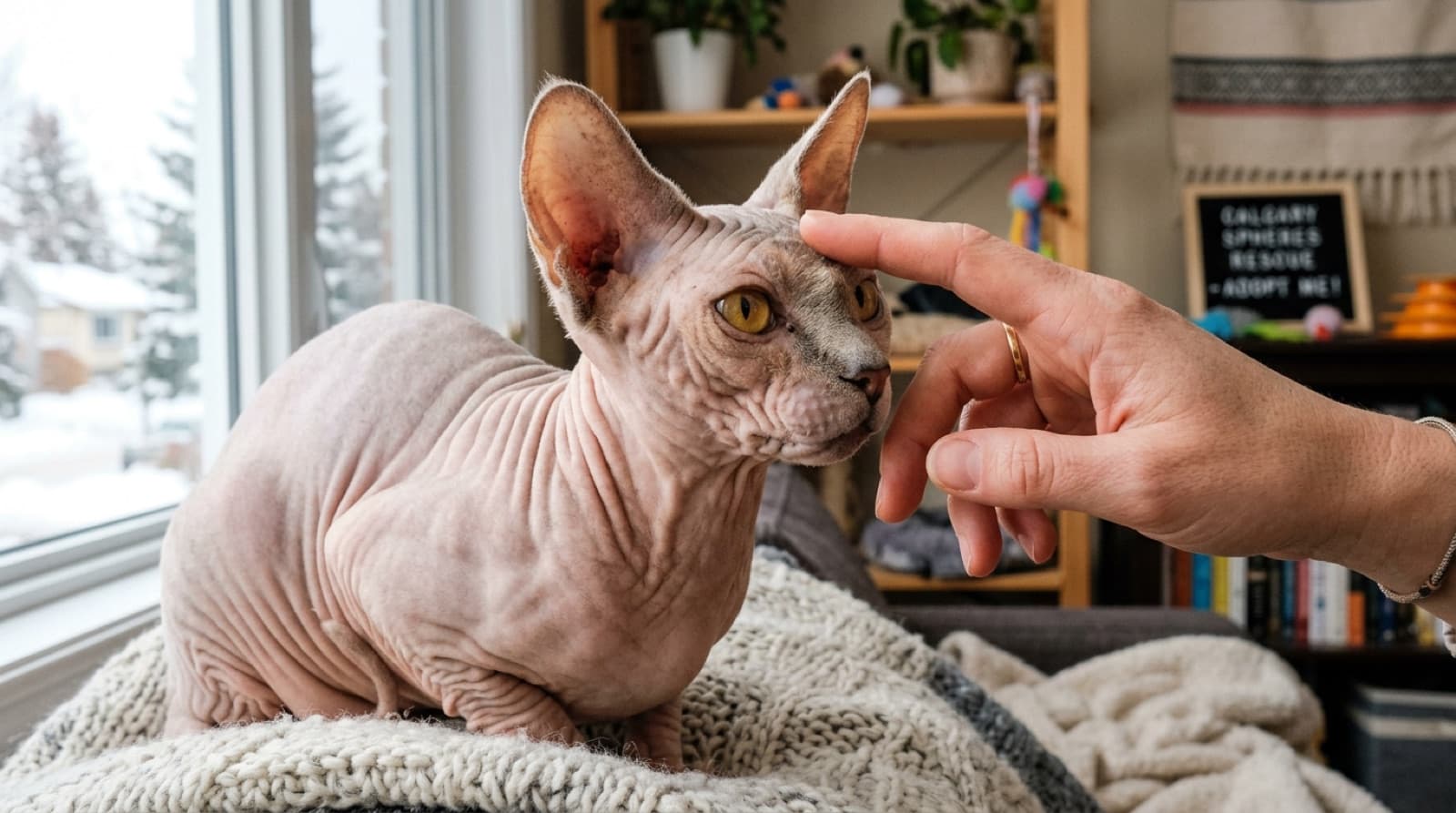
Buyer ignorance about hairless cats is widespread. Most prospective Sphynx buyers have never met one in person. They have seen photos. They have read about the breed online. They know Sphynx are hairless. What they do not know is that a real Sphynx has wrinkled suede-like skin with visible peach-fuzz, a body temperature that feels almost feverish (38 to 40 degrees Celsius), sebaceous oil on the skin, lemon-shaped eyes, bat-wide ears, and a muscular build distinct from a generic DSH body shape. A first-time buyer cannot tell the difference between a real Sphynx and a freshly shaved DSH in the first 24 hours. By the time fur regrows, the cash is gone.
Cash-and-paperwork-free transactions are the classifieds norm. Kijiji and Facebook Marketplace are built for low-friction local exchanges. Cash, no contract, parking-lot meetup. That is the default for buying a used bike or a coffee table. Scammers exploit the fact that buyers do not question that structure when buying a cat the same way.
Verification of breed claims via photos is genuinely difficult. A reverse image search catches stolen photos, but in the 2016 case the photos were of real (shaved) cats the scammer actually had. The photos checked out. The cats were physically there to hand over. The fraud was the species claim, not the photo provenance.
These four conditions are why the same structure keeps producing Alberta victims a decade later. Awareness is the only real defence.
The current scam patterns on Kijiji and Facebook Marketplace
Each of these is the 2016 Alberta playbook in a slightly updated form. One red flag is a yellow caution. Two or more is a scam. Walk away.
1. Cash-only, parking-lot exchanges
The single clearest tell. Legitimate breeders welcome home visits and provide paperwork before money changes hands. Legitimate rescues use official payment portals. A seller who insists on cash in a parking lot is removing every protection you have, which is exactly the point. This was the 2016 Alberta structure. It is still the 2026 structure.
2. No registration paperwork
Legitimate CFA or TICA breeders provide registration numbers, cattery names, and registered parent names freely. Verify directly at cfa.org or tica.org. No paperwork or vague references to “registered with a Canadian registry” without specifics means the cat is not what the seller claims.
3. No CMS DNA test certificate
Congenital myasthenic syndrome (CMS) is a serious inherited neuromuscular disease in Sphynx with a validated DNA test at UC Davis VGL. Every ethical breeder tests breeding parents. Ask for the certificate by the parent’s registered name. No certificate means no genetic screening, which means no ethical breeder behind the listing.
4. No HCM echocardiogram on parents
HCM (Hypertrophic Cardiomyopathy) affects 20 to 40 percent of Sphynx and is the leading inherited killer in the breed. No commercial Sphynx HCM DNA test exists yet. Ethical breeders do annual cardiologist echocardiograms on every breeding parent and share the records. Absence of HCM screening records means the breeder is not screening for the breed’s biggest health risk.
5. Markup claims for “rare colours” without documentation
Pointed, blue, lavender, and mink Sphynx are real but priced honestly by ethical breeders with full pedigree documentation. A scam listing slaps a “rare colour” markup on an unverifiable cat to justify a price closer to legitimate breeder territory while still keeping the transaction cash-only. The markup is the bait, not the value.
6. Refusal of home visits
The 2016 Alberta scammers refused home visits because there was no cattery, only shaved DSH kittens shuttled between parking lots. Ethical breeders welcome and often require an in-person cattery visit so you can meet the parents, see the kittens with their littermates, and inspect the home environment. A refused visit is the moment to walk away. There is no real cattery behind the listing.
7. Urgency pressure (“moving this weekend”)
“We’re moving, must sell by Sunday.” “Family member is sick, need to rehome now.” These are manufactured emotions designed to skip your verification step. Real breeders have waitlists and time. The cat that is right for your home is worth a week of verification. Anyone rushing the timeline is rushing past your due diligence on purpose.
8. Sob stories with cash discounts
“Owner passed away, son just needs the cat in a good home, taking $500 for the lot.” The combination of an emotional story and a heavily discounted cash price is a classic scam template. Real rehomers route through rescues or breed clubs precisely because they care about placement. A cash discount on a hard-luck story should harden your skepticism, not soften it.
9. Stock photos or stolen Instagram photos
Reverse image search every photo. Upload to Google Images or TinEye. If the same photo appears on multiple unrelated listings, breeder websites in other countries, or stock photo libraries, the photos are stolen. The 2016 case used real shaved-cat photos, but most modern scams use lifted photos because it is easier than shaving an actual kitten.
10. Kitten ready at 6 to 8 weeks
Ethical Sphynx breeders do not release kittens before 12 to 16 weeks. Earlier separation damages socialisation and immune development, and on a hairless breed the skincare routine is still being established. Most Canadian jurisdictions also consider releasing kittens under 8 weeks legally improper. A seller offering an “8-week-old ready to go this weekend” is either deeply inexperienced or running a scam.
How to verify a real Sphynx: visual and tactile checks
The single most useful skill for avoiding a shaved-DSH scam is knowing what a real Sphynx feels and looks like. Visual checks first, then the touch test, then a seven-day verification window.
| Check | Real Sphynx | Shaved DSH |
|---|---|---|
| Skin texture | Wrinkled, especially head, shoulders, leg joints. Suede-like. | Smooth, with razor stubble or visible regrowth. |
| Body temperature | 38 to 40 degrees Celsius. Feels almost feverish to the touch. | Normal cat body warmth. Does not feel hot. |
| Peach-fuzz down | Visible “kitten fuzz” on body in good light. | Either fully shaved or with patchy stubble. |
| Sebaceous oil | Skin slightly oily, especially after a week without bathing. | Skin dry or chemically irritated. |
| Ears | Large, wide-set, slightly forward-tilted (bat-ears). | Standard DSH ear shape. |
| Eyes | Lemon-shaped, distinctive almond. | Standard DSH round or oval eye shape. |
| Body build | Solid, dense, athletic, muscular. | Standard DSH frame. |
| Whiskers | Few or none. Most Sphynx are whiskerless. | Standard whiskers, possibly trimmed if seller tried to hide them. |
| Skin trauma | None. Clean wrinkled skin. | Razor burn, chemical irritation, scabs, or healing wounds. |
| Seven-day check | Unchanged appearance. | Visible fur regrowth across the body. |
The seven-day check is the failsafe. Even if every other visual cue could be argued, fur regrowth cannot. Ask the seller for a one-week hold with a small refundable deposit (paid through a method with buyer protection, not cash). A real breeder will accommodate. A scammer will refuse and apply pressure. The refusal itself is the answer.
How to verify a real Sphynx breeder
If you have decided to go the breeder route instead of rescue, here is the verification sequence to run before any money changes hands. Missing any of these is a hard stop.
- Ask for CFA or TICA registration paperwork before discussing payment
- Verify the cattery directly at cfa.org or tica.org breeder directories
- Request both parents’ registration numbers with photos of the parents in the breeder’s home
- Request the CMS DNA test certificate from UC Davis VGL, by the parent’s registered name
- Request HCM echocardiogram records for both parents, dated within the last 12 months
- Visit the cattery in person, not a parking lot. Meet both parents. Inspect the environment.
- Pay via verifiable method: cheque, certified bank draft, or wire transfer to a verified business account. Never cash in a parking lot.
- Read the contract: spay or neuter agreement, return-to-breeder clause, written HCM health guarantee
- Kitten released at 12 to 16 weeks minimum, never earlier
- Vet reference: ask for the breeder’s veterinarian and call to confirm the cats actually exist and see a vet
If a seller cannot or will not produce this within a week, the listing is not a real breeder. The check takes hours of buyer time and prevents thousands of dollars in fraud plus the welfare cost to the cat itself. The 2016 Alberta victims paid $650 to $800 each and ended up with sick, shaved DSH kittens that needed veterinary care. The verification sequence would have stopped every single one of those transactions.
The Alberta Sphynx Rescue path
Alberta Sphynx Rescue (ASR) is the Calgary-based, Alberta-scoped rescue dedicated to Sphynx and related hairless or semi-hairless breeds. Founded by Jennifer in Calgary, with Edmonton volunteer Jaime providing northern coverage. ASR is the canonical Sphynx-focused rescue resource for Alberta and the safest single path to a real Sphynx without scam risk.
Breeds accepted: Sphynx, Devon Rex, Donskoy, Peterbald, Oriental, Cornish Rex, Lykoi, and other hairless or semi-hairless breeds.
Adoption fees: $400 to $700. The fee covers spay or neuter, vaccines, microchip, deworming, a full vet workup, and HCM cardiologist screening for adult cats.
Intake sources: owner surrenders (often for medical, financial, or housing reasons), neglect-case recoveries, retired breeding cats from ethical catteries that have partnered with ASR, occasional cross-border transports from US breed-specific rescue networks.
Foster-based model: cats live in foster homes, which gives adopters direct exposure to the cat’s actual personality, current skincare routine, climate adaptation, and household compatibility before commitment. This is structurally different from a shelter-floor adoption where the cat is stressed and the personality is masked.
Cross-province transport coordination is available for adopters outside Calgary, including Edmonton, Lethbridge, Red Deer, and rural Alberta. Jaime in Edmonton handles northern Alberta coordination.
Why this is the scam-free path: ASR is a real organisation with a public website, a public charitable structure, foster homes adopters can visit, and a verified medical history per cat. There is no parking lot. There is no cash exchange. There is no shaved-kitten risk. Every structural element that made the 2016 Alberta scam work is missing from this path. If you want a real Sphynx in Alberta and you do not want to navigate a $2,000-plus breeder waitlist, ASR is the answer.
Beyond ASR, the broader Calgary rescue network (Calgary Humane Society, MEOW Foundation, AARCS, FRFA, Pawsitive Match) occasionally takes in Sphynx surrenders, though those intakes are rare because most Calgary Sphynx owners route directly to ASR. Across the border, Specialty Purebred Cat Rescue (US-based) occasionally has Sphynx available with cross-border coordination support.
Skip the scam risk. Browse adoptable Sphynx in Calgary.
Alberta Sphynx Rescue is Calgary’s verified Sphynx-focused rescue with foster networks, pre-screening, and full medical history per cat. Zero scam risk.
See Available Sphynx →What to do if you have been scammed
Move fast on the steps where time matters. The 2016 Alberta investigation only happened because victims came forward and filed reports. The same applies now.
- Get the cat to a vet immediately. Chemical burns, razor wounds, and infection are all real risks from shaved-DSH scams. Western Veterinary Specialist and Emergency Centre handles emergency cases in Calgary if visible injuries are present.
- Report to Alberta SPCA. This is the same body that investigated the 2016 case. They take cruelty reports through their public portal. Documented complaints stack, and stacked complaints trigger investigations.
- Report to Calgary Police Service consumer fraud. Cash scams over a few hundred dollars qualify as fraud. Filing a report creates the paper trail that helps catch repeat operators.
- Report the listing on the platform. Kijiji and Facebook Marketplace both have fraud reporting and can ban sellers when complaints stack. Take screenshots of the listing before reporting in case the seller takes it down first.
- Contact Alberta Sphynx Rescue. ASR has rehabilitation experience and can take a surrendered cat into rescue care if the situation has become unsustainable. They also track scam patterns across the province and your report helps the next buyer.
- Document everything. Save the original listing screenshots, the message history with the seller, photos of the cat at time of purchase, all payment records or cash withdrawal records, and your vet’s clinical notes on any injuries. Reports without documentation are difficult to act on. Reports with documentation are how prosecutions happen.
The shame of being scammed is the operator’s strongest tool. The Alberta SPCA, Calgary Police, and ASR all take these reports routinely. Filing is not embarrassing. Not filing is what lets the same operator victimise the next buyer the same way.
Why this scam targets Sphynx specifically
Pet scams concentrate on specific breeds for specific reasons. Sphynx hit every reason for a scammer at once.
Highest-margin domestic cat breed. Ethical Sphynx kittens at $1,800 to $3,500 make even a $700 scam price feel like a generous discount to a buyer who has done some research. The margin is wide enough to bait without being so wide it triggers suspicion.
Visual ambiguity in the first 24 hours. A freshly shaved DSH looks Sphynx-like to an untrained eye. The buyer leaves the parking lot with what they believe is a real Sphynx. By the time fur regrowth begins, the cash is gone and the trail is cold.
Buyer ignorance of breed-specific physical markers. Most prospective Sphynx buyers have not met one in person. They cannot describe what wrinkled suede-like skin feels like, what 38 to 40 degree Celsius body temperature feels like, or what lemon-shaped eyes versus standard DSH eyes look like in real life. The verification skills are not common knowledge.
Cash-friendly buyer demographic. Premium-price buyers tend to be willing to pay cash for what looks like a deal. The same person would refuse a cash-only transaction for a similarly priced couch but will hand over an envelope of bills for a Sphynx because the emotional context is different.
Active Alberta classifieds market. Kijiji and Facebook Marketplace both have strong Alberta user bases. The 2016 case worked because the scammer could list across multiple cities and meet buyers in disposable parking lots without ever returning to the same location. The platform infrastructure has not changed.
These five conditions stack into the same vulnerability pattern that produced the 2016 case. The defence is the verification skills covered earlier in this guide combined with the structural alternative of rescue.
The brand-aligned rescue alternative
LocalPetFinder is a rescue platform. The honest position on Sphynx in Calgary is that the structural risks of breeder-route purchase (scams, paperwork fraud, shaved DSH listings, parking-lot cash exchanges) are absent from the rescue route by design.
The path that minimises scam risk for a Calgary adopter looking for a Sphynx:
- Start at Alberta Sphynx Rescue. Calgary-based, Alberta-scoped, real verified Sphynx with full medical history, foster-based personality assessment, $400 to $700 adoption fee covering everything.
- If a kitten specifically is non-negotiable (ASR mostly places adults and adolescents because that is what gets surrendered), then verify a CFA or TICA registered breeder using the verification sequence in this guide. Expect $1,800 to $3,500, a 6 to 12 month waitlist, and an in-person cattery visit before any deposit.
- Avoid Kijiji and Facebook Marketplace Sphynx listings entirely unless every single verification check (registration, paperwork, CMS DNA, HCM records, in-person home visit, seven-day fur check) clears. Most listings fail this test. The 2016 Alberta case is the warning.
For the full Calgary Sphynx adoption walkthrough including pricing, rescue intake patterns, and what to expect from application to pickup, see our Sphynx adoption guide for Calgary. For the medical context behind why CMS and HCM screening matter so much, see our Sphynx health issues guide. And for the daily skincare routine and Calgary winter adaptation that every Sphynx owner needs to understand before adoption, see our Sphynx skincare and winter guide.
Frequently Asked Questions
Were there really shaved kitten scams in Alberta?
Yes. In 2016, Canadian news outlets including CBC News, CTV News, and Global News documented a scam where regular domestic shorthair kittens were shaved with razors and chemical depilatories, then sold on Kijiji as "Sphynx kittens" for $650 to $800 cash. Victims came from across central Alberta and the Calgary area. Coats grew back within roughly two weeks. Some of the kittens needed veterinary treatment for chemical burns and razor wounds, and one had a tail injury severe enough to nearly require amputation. The Alberta SPCA launched an investigation. This was a real, widely reported Canadian news story.
Is the Alberta Sphynx scam still happening?
The exact 2016 operator was investigated, but the pattern continues. Kijiji and Facebook Marketplace still see "Sphynx kitten" listings in the $600 to $1,000 cash-only range across Alberta most months. Some are shaved DSH kittens. Others are simple deposit scams with stolen photos. The structural conditions that made the 2016 scam work (premium breed prices, cash-friendly classifieds, buyer unfamiliarity with what a real Sphynx looks and feels like) are still in place. The honest expectation: assume any sub-$1,000 cash-only Sphynx listing is the scam zone until proven otherwise.
How can I tell if a "Sphynx" is actually a shaved kitten?
A real Sphynx has wrinkled skin (especially on the head, shoulders, and leg joints), a visible peach-fuzz down sometimes called kitten fuzz, slightly oily skin from sebaceous oil, and a body temperature warm enough that the cat feels almost feverish to the touch (38 to 40 degrees Celsius is normal). A shaved domestic shorthair will have stubble or visible regrowth, lack the body-heat warmth, often show razor burn or chemical irritation, and have a normal cat body shape instead of the Sphynx muscular and dense build. Within days, fur starts visibly regrowing. If you suspect it, ask to come back in seven days. A real Sphynx is unchanged. A shaved kitten is half-furred again.
What is a fair price for a Sphynx kitten in Calgary?
Rescue: $400 to $700 (through Alberta Sphynx Rescue, the Calgary-based Sphynx-focused rescue). Ethical CFA or TICA registered breeder: $1,800 to $3,500 for a pet-quality kitten, sometimes higher for show-quality or rare colours. Anything below $1,000 cash with no paperwork, no parent registration, no CMS DNA test certificate, and no in-person cattery visit is the scam zone. The real cost of breeding a registered Sphynx (HCM echocardiogram screening, CMS DNA testing, queen retirement, skincare, vet care, registration) puts the breakeven price north of $1,800. A "deal" at $700 is the 2016 Alberta scam revisited.
Why are real Sphynx so expensive?
Sphynx are one of the most maintenance-intensive cat breeds to produce ethically. Both breeding parents need annual cardiologist echocardiograms (HCM affects 20 to 40 percent of the breed). The CMS (congenital myasthenic syndrome) DNA test through UC Davis VGL is required to avoid producing affected kittens. Queens retire young because of breed-specific health considerations. Kittens need specialised skincare from birth and stay with the breeder until 12 to 16 weeks. Stud fees from outside catteries are expensive because the verified breeding pool is small. Combined costs per litter run into thousands of dollars before the kitten reaches a buyer. The $1,800 to $3,500 price reflects real costs, not markup.
How do I verify a CFA or TICA Sphynx breeder?
Both registries publish free public breeder directories. Search the cattery name at cfa.org (Cat Fanciers Association) and tica.org (The International Cat Association). A real cattery returns a live entry with current registration and contact details. A fake or unregistered cattery returns nothing. Cross-check the cattery name the breeder gives you against what the directory shows. Real breeders welcome this check and provide their registration number freely. Scammers send screenshots instead of links, claim "registration is in progress," or get evasive when asked. The directory check takes 30 seconds and catches almost every fake breeder website.
What is the CMS DNA test and why does it matter?
CMS stands for congenital myasthenic syndrome, a serious inherited neuromuscular disease in Sphynx that causes progressive muscle weakness. UC Davis Veterinary Genetics Laboratory (vgl.ucdavis.edu) offers the validated DNA test. Ethical breeders test every breeding parent and only pair carriers with non-carriers to avoid producing affected kittens. The certificate names the cat, the date, and the result. Ask for it by the parent's registered name and verify the test was actually run by UC Davis. A breeder who has not done CMS testing is risking the most serious genetic disease in the breed and either does not know the literature or does not care. Either way, walk away.
Can I really find a Sphynx through rescue?
Yes. Alberta Sphynx Rescue (albertasphynxrescue.ca) is the Calgary-based, Alberta-scoped rescue dedicated to Sphynx, Devon Rex, Donskoy, Peterbald, Cornish Rex, Lykoi, and other hairless or semi-hairless breeds. Founded by Jennifer with Edmonton volunteer Jaime. Adoption fees run $400 to $700 and cover spay or neuter, vaccines, microchip, deworming, vet workup, and HCM screening for adult cats. Cats live in foster homes, so adopters meet the cat and learn its actual personality and skincare routine before commitment. Cross-province transport coordination is available. This is the safest Sphynx path in Alberta with zero paperwork-scam or shaved-kitten risk.
What should I do if I think I bought a scammed Sphynx?
Act in this order. Get the cat to a vet immediately. Chemical burns, razor wounds, and infection are real risks from shaved-DSH scams, so emergency care at Western Veterinary Specialist and Emergency Centre (westernvet.ca) is the first stop if signs of injury are present. Report to Alberta SPCA (the same body that investigated the 2016 case) and to Calgary Police Service consumer fraud. Report the listing on the platform (Kijiji or Facebook Marketplace) with screenshots. Contact Alberta Sphynx Rescue (albertasphynxrescue.ca), which has rehabilitation resources and can take a surrendered cat if needed. Document everything: photos, the original listing, message history, payment records. Recovery of money is rare, but each filed report helps authorities track repeat operators.
Are Kijiji Sphynx listings ever legitimate?
Rarely. Occasionally a legitimate rehoming happens (an owner moving overseas, a medical reason), but ethical breeders almost never use Kijiji because the platform attracts cash-and-go buyers and undercuts the screening process that responsible breeders insist on. The 2016 Alberta case used Kijiji because the platform supported anonymous parking-lot exchanges. The pattern still runs there. If you see a Kijiji Sphynx listing, the verification standard is the same: cash-only is a red flag, no paperwork is a red flag, no registered cattery name is a red flag, no in-person home visit is a red flag, and refusal to wait seven days before exchange is a red flag. Most listings will fail this test.
Should I avoid cash payments for cat purchases?
For any transaction over a few hundred dollars, yes. Cash transactions are unreversible and untraceable, which is exactly why scammers prefer them. A legitimate breeder accepts cheque, certified bank draft, or wire transfer to a verified business account. A legitimate rescue takes payment through its official portal or charity processing system. The 2016 Alberta case relied entirely on cash-in-parking-lot exchanges because there was no way for the victims to dispute or trace the payment afterward. The simplest rule: if a seller insists on cash, they are removing every protection you have. Walk away.
What if a breeder will not let me visit the cattery?
That is the end of the conversation. Ethical Sphynx breeders welcome and often require an in-person cattery visit. You meet the queen, see the kittens with their littermates, inspect the home environment, and see the breeder's skincare and feeding routine in practice. A breeder who refuses an in-person visit is either hiding a poor environment or has no kittens at all. The 2016 Alberta scammers refused home visits because there was no cattery, only shaved DSH kittens shuffled between parking lots. The refusal of an in-person visit is one of the strongest single signals of a scam, and it never resolves in the buyer's favour. No visit, no deal.
What is Alberta Sphynx Rescue and how does it work?
Alberta Sphynx Rescue (ASR) is a Calgary-based, Alberta-scoped rescue founded by Jennifer, with Edmonton volunteer Jaime providing northern coverage. ASR is the canonical Sphynx-focused rescue resource for Alberta. They accept Sphynx, Devon Rex, Donskoy, Peterbald, Oriental, Cornish Rex, Lykoi, and similar hairless or semi-hairless breeds. Intake includes owner surrenders, rescues from neglect cases, and retired breeding cats. Adoption fees are $400 to $700 and include spay or neuter, vaccines, microchip, deworming, full vet workup, and HCM screening on adult cats. Cats live in foster homes and adopters meet the cat in person before commitment. Cross-province transport is coordinated for adopters outside Calgary. Visit albertasphynxrescue.ca to apply.
Sphynx Cats in Calgary
Live rescue listings for Sphynx and Sphynx-type hairless cats available in Calgary and across Alberta.
Sphynx Adoption Calgary
The honest Calgary rescue path through Alberta Sphynx Rescue, real fees, and what to expect from intake to pickup.
Sphynx Health Issues
HCM, CMS, skin and dental issues, and the screening protocol every Calgary Sphynx owner should understand.
Sphynx Skincare and Winter Calgary
The daily skincare routine and Calgary winter adaptation every Sphynx owner needs before adoption.