The short answer
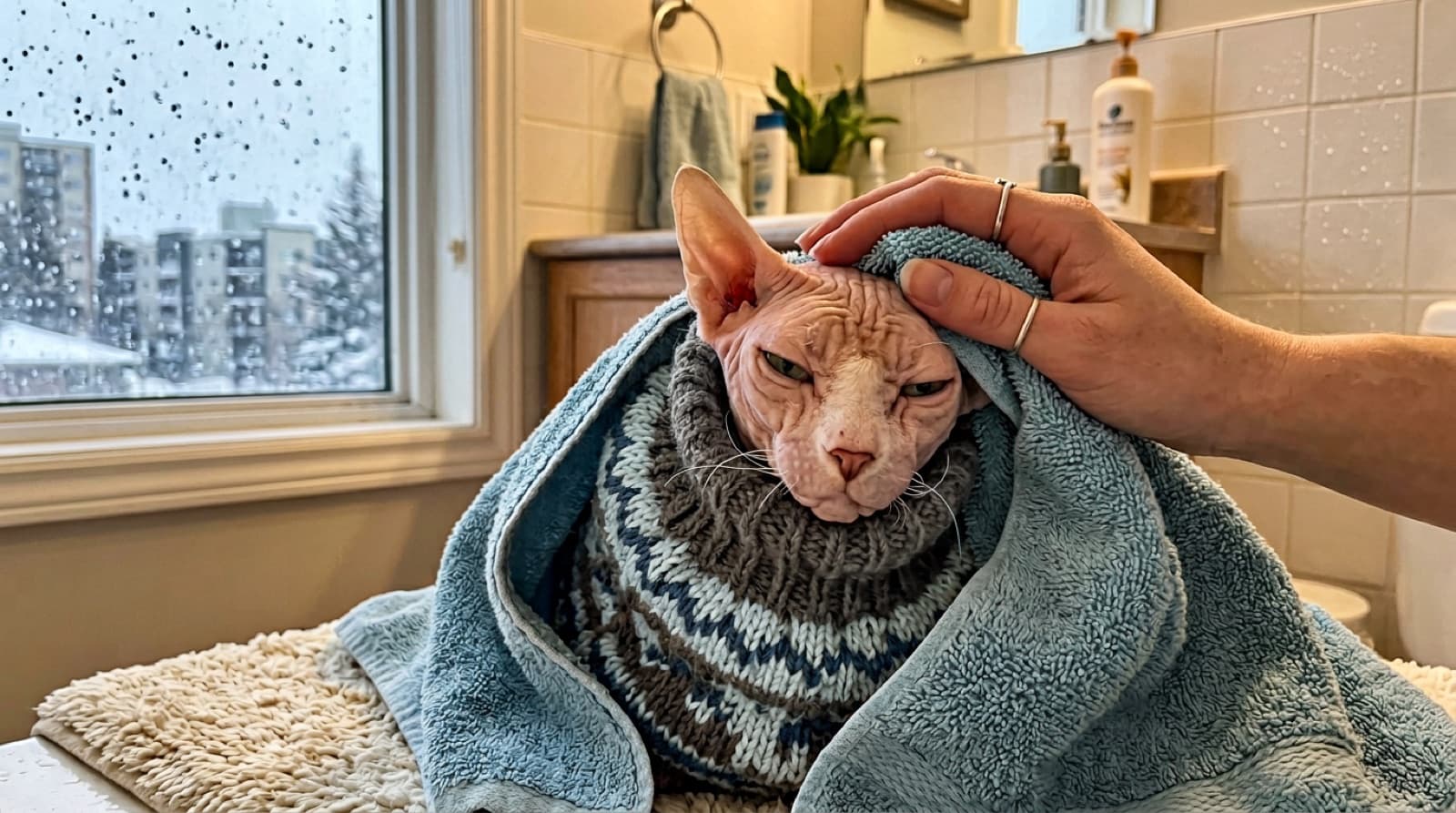
Sphynx need weekly baths, weekly ear cleaning, daily oil blotting, and sweaters whenever the room drops below 22 degrees. Their comfort zone is 20 to 27 degrees. Calgary winters hit -25, summers are brief but UV-intense, and south-facing windows carry a real indoor sunburn risk year-round. Indoor humidity 20 to 30 percent in winter stresses the skin barrier. This is the breed-defining commitment, not optional. Owners who skip the routine end up with skin acne, ear infections, hypothermic shivering, and eventually a surrender call to Alberta Sphynx Rescue.
Why Sphynx skin needs so much management
Sphynx are not actually completely hairless. Most have a thin layer of fine down, almost like peach fuzz, which feels like warm suede. What they lack is a true coat. That single anatomical difference drives every skincare protocol in this guide.
Haired cats distribute sebaceous oil through their fur, where it serves as a waterproof barrier and a self-cleaning mechanism. Sphynx produce the same oil with nowhere for it to go. It sits on the skin instead. Within 4 to 5 days of the last bath it oxidises, and the recurring owner phrase across Sphynxlair threads and Reddit forums is “smells like mushrooms or corn chips.” That is healthy sebaceous oil oxidising. It is normal. The fix is the routine, not a deeper clean or a stronger shampoo.
The friction zones build up oil fastest: skin folds around the neck, armpits, the belly, around the genitals, and the base of the tail (the stud-tail zone). These are also the spots where acne, blackheads, and folliculitis develop first. Daily oil-blotting wipes catch the buildup before it cascades into skin issues.
Ear wax follows the same pattern. Sebaceous glands inside the ear canal produce wax with no fur to absorb it. Black wax accumulation is normal for Sphynx and is sebaceous, not infectious. The protocol is weekly cleaning (sometimes more for heavy producers), not a vet visit. Yellow or green wax is a different story and a same-week vet visit.
The Sphynx skin barrier is also more exposed to UV, temperature, and humidity than any other cat breed. The body temperature runs 38 to 40 degrees, slightly higher than haired cats, which is why Sphynx feel hot to the touch and why owners sometimes mistake them for fever-warm. That elevated metabolic rate is the body compensating for the missing coat, and it explains why the cat is so attracted to warm spots, laps, and heated beds. Once you accept that the breed’s entire physiology runs on heat-seeking, the Calgary winter setup makes more intuitive sense.
The International Cat Care position on hairless breeds is direct: weekly bathing, daily wipes, weekly ear cleaning, and protection from temperature extremes are baseline husbandry, not optional refinements. PetMD reviews of Sphynx care confirm the same protocols.
The weekly bathing routine that actually works
Weekly is the floor. Many Calgary Sphynx owners go to twice-weekly through winter when dry indoor air accelerates oil buildup and skin issues.
Tools first. The kit is short:
- Fragrance-free hypoallergenic cat-safe shampoo. Cat-specific only. Never human shampoo (wrong pH, dries the barrier). Never dog shampoo containing tea tree oil, essential oils, or pyrethrins, all of which can be toxic to cats.
- Large basin or kitchen sink. A non-slip mat at the bottom helps the cat feel secure.
- Soft microfiber towels. Have two ready; one for the initial wrap, one for the second-pass dry.
- Vet-approved ear cleanser for the same-session ear clean.
- Warm pre-heated room. This is the Calgary-specific addition. Pre-warm the bathing room to 24 to 26 degrees before starting.
- Heated cat bed or heated towel ready in a warm dry space for the cat to recover in.
The session itself, in order:
- Pre-bath check (2 minutes). Clip nails if needed (calmer cat, safer for you), gentle ear wax wipe with a cotton pad, brush teeth if that is part of the routine.
- Pre-warm the bathing room to 24 to 26 degrees. Run a space heater for 15 minutes ahead of time, or pick a small bathroom and warm it with a hot shower running on the other side of the room. This single step prevents most of the post-bath hypothermia risk.
- Lukewarm water in the basin. Test on your inner wrist. Cats burn easier than humans because their skin is thinner. Hot is wrong.
- Wet the body from the neck down. Avoid the head completely; head goes last and with a damp cloth, not submersion.
- Apply shampoo and work into the folds. Methodical, by section. Pay extra attention to neck folds, armpits, belly, base of tail. Three to 5 minutes of gentle lathering.
- Rinse THOROUGHLY. Residual shampoo causes skin irritation, which Sphynx are already prone to. Rinse twice if you are unsure.
- Face cleaning with a damp soft cloth. From inner corner of each eye outward, separate side of cloth per eye. Wipe the area around the mouth and chin. Never submerge the head.
- Towel dry immediately and thoroughly. Squeeze water out gently rather than rubbing. Wrap, swap towels, continue.
- Move to the pre-warmed recovery space. Heated bed, heated towel, or the warmest spot in the home. Stay with the cat for at least 30 minutes to make sure they settle and warm up.
- Hold the cat in a warm space for at least 2 hours afterward. No drafts, no cold floors, no outdoor exposure. A damp Sphynx in a normal 21-degree Calgary winter room can become hypothermic fast.
Time of day matters. Morning or afternoon are safest. Never bathe right before bed because the cat needs to be in a warm dry environment for the recovery window, and bedtime cooling of the home reduces that buffer.
The bonding angle is genuine but optional. Many Sphynx tolerate bathing fine after the first few sessions. Others find it stressful. Treat-pair (freeze-dried chicken or salmon works far better than kibble), use a calm voice, move slowly, and accept that the first month may be harder than the rest of the cat’s life. If routine baths cause severe distress, ask Alberta Sphynx Rescue or your vet for a professional cat groomer who handles bare-skin breeds; the right professional often gets through a bath far more calmly than a stressed owner can.
Daily skin oil management
Daily wipes are the second half of Sphynx skincare. The weekly bath resets the skin; daily wipes prevent the 7-day buildup from cascading into acne, blackheads, and folliculitis. The session is short: 5 to 10 minutes.
Tools and method:
- Soft cloth or unscented cat-safe baby wipe. Look for fragrance-free, alcohol-free, and pet-safe labelling. Avoid human baby wipes with added fragrances or essential oils.
- Wipe-down by section. Body, around ears, base of tail, between toes. Folds get an extra pass.
- Light pressure only. You are blotting oil, not scrubbing skin. Aggressive wiping irritates the barrier and makes the next bath harder.
- Skin check during each session. This is when you catch the early skin issues. Small bumps on chin (acne), blackheads on tail base (stud tail), redness behind ears (folliculitis), broken skin or scabs (infection, vet visit).
What you are watching for, in order of concern:
- Chin acne. Small bumps or blackheads on the lower jaw. Common in Sphynx. Daily chin wipes plus replacing plastic food bowls with ceramic or stainless steel usually clears it. Persistent acne is a vet visit.
- Stud tail. Blackheads and oil concentration at the tail base. Daily wipes manage it. Severe cases with redness, swelling, or skin breakdown are a vet visit.
- Folliculitis. Red bumps that look like pimples, often around ears, neck, or armpits. Vet visit; this can need topical or oral antibiotics.
- Yeast or fungal infections. Greasy areas with a yeasty smell, often in skin folds. Vet visit; the right antifungal is prescription.
- Broken skin or non-healing scabs. Same-week vet visit, sometimes a referral to Western Veterinary Specialist & Emergency Centre for dermatology if it persists.
The honest pattern: Sphynx owners who do the daily wipes have almost no skin issues. Sphynx owners who skip them and rely only on weekly baths spend a lot more time at the vet. The 7-minute daily session is the highest-ROI part of the entire routine.
Weekly ear cleaning routine
Weekly minimum. Heavy oil producers need 2 to 3 times per week. The same sebaceous gland output that drives the body skincare routine drives ear wax production too, and Sphynx ears accumulate wax with no fur to absorb it.
Tools and method:
- Vet-approved ear cleanser. Ask your vet for a brand recommendation. Many Calgary vets recommend gentle saline-based cleansers for routine maintenance.
- NEVER hydrogen peroxide. NEVER rubbing alcohol. Both damage the ear canal. Both still appear in some old internet advice.
- Cotton pads or soft cloth. Cotton swabs only for the visible outer ear, never deep in the canal.
- A few drops of cleanser in the ear canal. Gentle massage at the base for 20 to 30 seconds. The squelching sound is normal.
- Allow the cat to shake its head. This brings wax up out of the canal where you can wipe it.
- Wipe the visible wax from the outer ear and the entry to the canal with a cotton pad. Stop where you can no longer see.
Black wax versus infection:
- Black or dark brown wax, no smell, no scratching: normal for Sphynx. This is sebaceous wax, not infection. Weekly cleaning maintains it.
- Yellow or green wax: infection. Vet visit.
- Strong odour from the ear: infection or yeast. Vet visit.
- Head tilt, excessive scratching, or pawing at the ear: infection or mites. Vet visit.
- Crusty skin around the ear opening: can be infection or sunburn (yes, ears burn first on Sphynx). Vet visit.
The American Association of Feline Practitioners (catvets.com) publishes accessible owner-facing resources on cat ear care including the bare-skin breed exception that drives the Sphynx weekly schedule.
The Calgary winter sweater and heating protocol
This is the Calgary-specific moat content. The breed comfort zone is 20 to 27 degrees. Calgary indoor winter homes typically run 19 to 21 overnight. The gap is the entire problem.
The Sphynx comfort zone is 20 to 27 degrees. Anything below 22 and the cat starts seeking heat: curling into the tightest possible position, burrowing under blankets, sleeping on heat vents, and pressing against humans. Below 18 and shivering becomes possible. Shivering is a real intervention signal, not a quirk.
Calgary indoor winter reality. Most homes set the thermostat between 19 and 21 overnight to save on heating costs, occasionally lower. That puts the cat below the comfort zone for the largest portion of every day. Forced-air heating creates additional cold spots near windows, in basements, and along exterior walls. The practical implication: the cat needs help.
Sweater strategy. Multiple weights, rotated by season and indoor temperature:
- Light cotton sweater (spring, fall, summer evenings): for transitional temperatures, 22 to 24 degrees.
- Mid-weight knit or fleece (most of winter): for the standard 19 to 22 degree indoor home.
- Heavy fleece (cold snaps, drafty rooms, near north-facing windows): for -35 nights or any time the cat is visibly seeking heat.
Sweater fit matters. Watch for chafing under armpits, around legs, and at the neck opening. Choose secure-stitched sweaters because Sphynx sometimes chew loose threads and can ingest fibres. Replace sweaters every 6 to 12 months as they stretch out or fray. Most Calgary owners keep 3 to 4 in rotation so a fresh one is always available while others are being washed.
Heated cat beds. Beds with thermostatic control that maintain a low, consistent temperature are the safest option. Hot spots cause thermal burns on bare Sphynx skin; the cat has no fur insulation to slow the heat transfer. Check the warmth weekly by hand for at least 30 seconds. If it feels too warm for your hand, it is too warm for a Sphynx belly. Replace beds every 1 to 2 years; thermostats drift over time.
Self-warming products. Thermal-reflective bed liners and pads reflect the cat’s own body heat back without electricity. These are safer passive alternatives for kennels, carriers, travel, and any place you cannot supervise. Mylar-backed and microfibre options both work.
Draft avoidance. The Sphynx will find the warmest spot in the home automatically. Your job is to make sure none of those spots are accidentally drafty. North-facing windows in winter (cold air pouring off the glass), air conditioning vents in summer, basement doors that crack open, exterior-wall rooms during cold snaps. Block, insulate, or move beds.
Cold snap protocol (-30 to -40 degree nights):
- Extra sweater layer (or upgrade to the heavy fleece if not already wearing it)
- Hold the room temperature at 22 to 24 degrees
- Block any drafts near where the cat sleeps
- Pre-warm the heated bed
- Monitor for shivering, lethargy, or refusal to move from heat sources, all of which are real intervention signals
- If the heat goes out during a cold snap, the cat goes with you to a heated space. This is not optional.
Chinook protocol. Calgary chinooks swing the temperature 30 degrees in hours. A -25 morning becomes a +5 afternoon. The Sphynx skin barrier dehydrates during the cold half and then has to readjust during the warm half. Maintain stable indoor temperature and humidity through chinook events; the cat’s body cannot adapt that fast on its own.
The honest framing: a Sphynx in Calgary is essentially a small mammal that needs household-level climate control to be comfortable. The owners who accept this and build the systems do well. The owners who keep thinking of it as “a cat that occasionally needs a sweater” eventually surrender.
South-facing windows and indoor sunburn risk
The vet-documented issue most Calgary Sphynx owners do not know about. Cats love to sun themselves through windows. For most cats, the worst outcome is a warm nap. For a Sphynx, the worst outcome is solar dermatitis and elevated squamous cell carcinoma risk over time.
The mechanism. Sphynx skin has no UV protection because there is no fur to absorb or scatter solar radiation. Visible light passes through standard residential glass without filtering UV-A meaningfully (and only partially filtering UV-B). The cat lies in the sunny spot, absorbs UV for hours per day, and over months and years the cumulative exposure damages the skin.
The Calgary specifics. The city averages 333 sunny days per year, which is among the highest in Canada. The winter sun angle is low (because of latitude), meaning south-facing and west-facing windows deliver direct sunlight deep into living spaces for several hours during the brightest part of the day, even on cold January afternoons. Year-round risk, not summer-only.
The fix is layered:
- UV-blocking window film on south-facing and west-facing windows. Low cost (about $30 to $80 for film for one or two windows), DIY installation, blocks 95 to 99 percent of UV without significantly reducing visible light. The cat still gets the warmth of the sunny spot, just without the skin damage. This is the single highest-ROI intervention.
- Curtains drawn during peak sun hours. 10am to 4pm year-round. Sheer curtains are not enough; use lined curtains or blinds for actual UV blocking. Pairs with window film as a second layer.
- Cat-safe pet sunscreen for known sunbathers. Some pet-specific sunscreens are safe for cats; cross-reference any product with your vet before applying. NEVER use human sunscreen. Many contain zinc oxide, salicylates, or other compounds toxic to cats if licked. Apply to ears, nose, and any exposed skin areas before the cat moves to the sunny spot.
- Restructure the cat’s favourite spots. If the cat insists on the south-facing window even with film, that is fine. If you have not yet installed film and the cat is currently camping there for hours per day, move the bed to an east-facing window (gentler morning sun, lower UV total) or away from windows entirely.
Squamous cell carcinoma watch. SCC is the cancer most associated with chronic sun exposure in cats. Sphynx are at elevated lifetime risk because of the missing coat. The early signs are easy to miss: a small lump or scab that does not heal, a non-healing wound on the ear tip, eye area, nose, or paw pads. Any of those is a same-week vet visit. Catching SCC early is often the difference between a small surgical excision and a more serious treatment. For depth on Sphynx-specific health, see our Sphynx health issues guide.
The Catster vet-reviewed library and PetMD both publish accessible owner-facing summaries of cat sun-exposure risk including the bare-skin breed considerations that apply here.
Indoor humidity, the Calgary winter problem
Calgary winter indoor humidity typically sits at 20 to 30 percent. Forced-air heating dries the air aggressively, and the colder it gets outside, the drier it gets inside (because the air the furnace is heating starts with very little moisture). Healthy human indoor target is 40 to 50 percent. The Sphynx target is the same.
Symptoms of dry skin in a Sphynx:
- Increased acne and blackheads
- Visible dandruff (yes, hairless cats produce dander; it just lands on the skin instead of being absorbed by fur)
- Increased ear wax production
- Drier skin to the touch
- More frequent scratching, especially after baths
The fix is a cool-mist humidifier in primary cat rooms (the room where the cat sleeps and the room where the cat spends the most active time). Target 40 to 50 percent humidity. Cool-mist humidifiers are safer than warm-mist because there is no scald risk if the cat investigates. Pair with a cheap hygrometer ($15 to $25) so you can see the actual humidity rather than relying on thermostat guesses, which are often wildly off.
Humidifier maintenance matters. Empty and refill daily, deep-clean weekly (mineral buildup and biofilm can become respiratory irritants for both the cat and you). Distilled water reduces white mineral dust on furniture and improves output stability. Place the humidifier somewhere the cat cannot drink from the reservoir; some Sphynx are drawn to standing water and will treat it as a fountain.
Chinook humidity swings stress the skin barrier especially. When indoor humidity drops from 35 to 18 percent over a few hours because the outside temperature jumped 30 degrees, the skin has to readjust. Running the humidifier through chinook transitions softens the swing.
The “owners who burn out” surrender pattern
Most Sphynx surrenders happen at month 4 to 9 of ownership. The reason on the surrender form is some version of “could not keep up with the routine.” The pattern across Alberta Sphynx Rescue intake records, MEOW Foundation intake, and rescue networks across the prairies is consistent.
The trajectory looks like this. Owner falls in love with the look and personality of a Sphynx. Commits to the routine. First month is enthusiastic: weekly baths happen, daily wipes happen, sweater is on. By month 2, the daily wipes are becoming every-other-day. By month 3, weekly baths slip to every 10 to 12 days. By month 4, the cat has chronic chin acne and the ears are starting to smell. Owner pays for the first round of vet treatment ($150 to $400) and is shocked. By month 5 to 6, the cycle repeats and the owner is overwhelmed. By month 7 to 9, the cat is at a rescue or being rehomed informally.
If you are reading this and recognising yourself, the path forward is not shame. It is structural:
- Foster-first if you are still in the considering phase. Alberta Sphynx Rescue places Sphynx in foster homes, sometimes accepting fosters who are evaluating the breed for themselves. You experience the routine for 4 to 8 weeks before committing. If the routine works for your life, you adopt. If it does not, no harm done. This is the single best risk-mitigation step available.
- Sustainable routine design. Pick days. Pick times. Set reminders. The Sunday-morning bath plus daily after-dinner wipes is the most common Calgary pattern that actually sticks. Schedule the bath like any other recurring household task.
- Honest cost budgeting. Annual Sphynx skincare and heating costs run $400 to $800 (shampoo, ear cleaner, wipes, sweater rotation, UV film one-time, humidifier electricity). Plus pet insurance, HCM screening, and dental from the health pillar. Total annual cost of Sphynx ownership in Calgary is high relative to most cats. If the budget cannot absorb it, the breed is the wrong fit and that is a fine conclusion.
- If you are already overwhelmed, contact Alberta Sphynx Rescue BEFORE the situation becomes neglect. They strongly prefer voluntary surrender to neglect cases, and they can often arrange foster placement quickly. The honest framing: surrender before the cat is suffering is responsible; surrender after months of progressive neglect harms the cat. The right time is now, not after another month of trying.
Calgary rescue intake of skincare-neglected Sphynx is more common than most adopters realise. The rescues do not judge surrenderers harshly; they would much rather receive a cat that needs help than discover one that has been suffering for months. There is no shame in admitting the breed is not for you.
Calgary cost reality
Annual skincare plus heating costs for a Calgary Sphynx run $400 to $800. The breakdown:
- Fragrance-free cat-safe shampoo: $20 to $40 per year (one or two larger bottles)
- Ear cleanser: $30 to $60 per year
- Daily oil-blotting wipes: $60 to $120 per year
- Sweater rotation: $80 to $200 per year (3 to 4 sweaters, replaced annually as they stretch and fray)
- UV-blocking window film: $30 to $80 one-time, replace every 5 to 10 years
- Heated cat bed: $40 to $120 one-time, replace every 1 to 2 years
- Self-warming thermal-reflective liners: $20 to $60 one-time
- Humidifier electricity and maintenance: $40 to $100 per year (running through winter)
- Hygrometer: $15 to $25 one-time
- Increased home heating bill in winter: $50 to $150 per year if you previously ran the home cooler (Sphynx push owners toward 22 minimum, which often means an extra degree or two on the thermostat through winter)
This is in addition to the medical and food costs covered in our Sphynx health issues guide (HCM screening, dental, vet insurance, emergency reserve). Total annual cost of Sphynx ownership in Calgary, including the medical pillar, runs significantly higher than for most cat breeds. Budget honestly before adopting.
First-week skincare routine for new Sphynx adopters
If you have just adopted a Sphynx, the first few weeks set the skincare relationship for the rest of the cat’s life. Rush into a full bath on day one and you create lasting resistance. Build up gradually and the cat learns the routine is normal.
The 3-3-3 rule from our first-week rescue cat guide applies to skincare too:
- Day 1 to 3: minimal handling. Let the cat settle into the home. Hands-off skincare. A gentle damp-cloth wipe at the end of the day if the cat is relaxed; skip otherwise.
- Day 4 to 7: introduce daily wipes with treat pairing. Two- to 3-minute sessions only. Show the cloth, treat. Touch the cat with the cloth, treat. One or two gentle wipes, treat. Build positive association before increasing duration. Begin weekly ear cleaning in this window if the cat tolerates handling.
- Week 2: first home bath, if the cat is settled. If the cat arrived from a foster home or breeder, ask for their bath schedule and replicate it for continuity. Pre-warm the room. Keep the session short. Treat-pair every step.
- Week 3 to 4: full routine. Weekly bath, daily wipes, weekly ear cleaning. By this point the cat should accept the routine as normal. Sweater on whenever the room is below 22.
Foster homes typically have an established routine and can hand off the schedule. If your Sphynx came from Alberta Sphynx Rescue, ask for the foster’s bath schedule and the products they used; continuity matters during the transition. If your Sphynx came from a breeder, ask the same questions before the cat ships.
Treat pairing is the consistent ingredient. High-value protein treats (freeze-dried chicken, salmon) work far better than dry kibble. Use them only for skincare sessions so the cat learns the association.
When to escalate to veterinary care
Daily wipes and weekly baths handle most skin maintenance. The signs below are vet territory:
Skin signs that need a vet:
- Red broken skin or scabs that do not heal within a week
- Lumps, bumps, or non-healing wounds on ears, eye region, nose, paws (potential SCC)
- Persistent scratching, especially in one area
- Yeasty or sour smell that persists immediately after a thorough bath
- Visible hot spots or sores
- Hair loss in patches (some Sphynx have light fuzz; sudden loss is unusual)
Ear signs that need a vet:
- Yellow or green discharge
- Strong odour
- Head tilt or balance issues
- Excessive scratching at the ear
- Crusty or peeling skin around the ear opening
Eye signs that need a vet:
- Squinting or holding one eye closed
- Discharge that is yellow, green, or thick rather than clear
- Visible cloudiness
- Swelling around the eye
Temperature-related signs that need intervention:
- Shivering even with a sweater on
- Reluctance to leave a heated space
- Lethargy combined with cool body temperature to the touch (Sphynx run hot; cool is a warning sign)
- Refusing to eat in a previously normal-appetite cat (can be cold-stress, but also points to other issues)
Calgary specialty access. Western Veterinary Specialist & Emergency Centre is the regional referral centre for dermatology, cardiology (relevant because Sphynx are an HCM-elevated-risk breed), and 24-hour emergency care. Most general practice vets in Calgary can refer to Western Vet when needed. Build a relationship with a regular vet who has Sphynx experience early; the first appointment is the time to ask “how many Sphynx do you see in your practice?” rather than during a crisis.
Browse adoptable Sphynx in Calgary
Alberta Sphynx Rescue often places Sphynx with established skincare routines, climate-adapted from at least one Calgary winter. Foster homes describe the actual cat's tolerance, including bathing acceptance and sweater tolerance, which beats breed reputation alone.
See Available Sphynx →Frequently Asked Questions
How often do Sphynx really need baths?
Weekly is the floor. Many Calgary Sphynx owners settle into twice-weekly through winter when dry indoor air (typically 20 to 30 percent humidity with forced-air heat) accelerates skin oil buildup and acne formation. Without bathing, sebaceous oil sits on the skin with nowhere to go, causing odour, acne, blackheads, and folliculitis. Use only fragrance-free hypoallergenic cat-safe shampoo. Pre-warm the bathing room to 24 to 26 degrees, towel-dry thoroughly, and move the cat to a warm dry space for at least 2 hours afterward. Wet Sphynx in a normal-temperature Calgary winter room can become hypothermic fast.
Can Sphynx live in Calgary winters?
Yes, with the right setup. The Sphynx comfort zone is 20 to 27 degrees, and Calgary indoor winter homes (typically heated to 19 to 21 overnight) sit right at the bottom of that range. The required protocols: sweaters whenever the room drops below 22 degrees, multiple weight options, heated cat beds with thermostatic control, draft avoidance near windows, and a humidifier in primary cat rooms targeting 40 to 50 percent humidity. During the deepest cold snaps (-35 nights), hold the room at 22 to 24 degrees and watch for shivering, which is a real intervention signal.
Do Sphynx really need sweaters?
Indoors in a Calgary winter, yes. Sphynx have no fur insulation. Their comfort zone is 20 to 27 degrees and most Calgary homes run the thermostat below that overnight or during the day when no one is home. Without a sweater, the cat seeks heat constantly, curls into the tightest position possible, and may shiver. A light cotton sweater for spring and fall, a mid-weight knit or fleece for indoor winter, and a heavy fleece for cold snaps covers most of the year. Choose secure-stitched sweaters because Sphynx sometimes eat loose threads.
What is the best room temperature for a Sphynx?
22 to 25 degrees is the comfortable indoor range. The breed comfort zone is 20 to 27 degrees, but the practical day-to-day target for an indoor cat (factoring in air movement, cold floors, and proximity to windows) lands at 22 minimum. If you run your thermostat below 22 to save on heating, plan on the cat wearing a sweater 24/7 through winter, using a heated bed, and avoiding floor-level spaces. Sphynx body temperature runs 38 to 40 degrees, slightly higher than haired cats, which is why they feel hot to the touch.
Why do Sphynx smell like mushrooms?
Sebaceous oil. Sphynx produce the same oil as haired cats, but no fur to absorb and distribute it. It sits on the skin instead. Within 4 to 5 days of the last bath the oil oxidises and develops the characteristic mushroom or corn-chip smell. The fix is the routine: weekly bathing as the floor, daily oil blotting with a soft cloth or unscented cat-safe baby wipe, and a closer look at the friction zones where oil pools fastest. If the odour persists immediately after a thorough bath, that points to a skin infection, which is a vet visit.
Can a Sphynx get sunburned through a window?
Yes, and this is the indoor risk most Calgary Sphynx owners do not know about. Sphynx skin has no UV protection. Solar radiation through windows, especially south-facing and west-facing exposures, causes sunburn, solar dermatitis, and elevated squamous cell carcinoma risk over time. Calgary averages 333 sunny days per year, and the low winter sun angle means south-facing windows are a year-round risk. The fix is UV-blocking window film, curtains drawn during peak sun hours, and same-week vet visits for any new lump, scab, or non-healing wound on ears, eye region, nose, or paws.
What shampoo is safe for Sphynx?
Fragrance-free hypoallergenic cat-safe shampoo only. Cat-specific formulations are pH-balanced for feline skin, which is different from human and dog skin. Never use human shampoo. Never use dog shampoo containing tea tree oil, essential oils, or pyrethrins; several are toxic to cats. Avoid medicated or antifungal shampoos unless your vet has prescribed them; they can over-strip the skin. Rinse thoroughly; residual shampoo causes irritation, which Sphynx are prone to anyway.
Are heated cat beds safe for Sphynx?
Yes, with the right product. Beds with thermostatic control that maintain a low consistent temperature are the safest option. Avoid straight heating pads or any pad without temperature regulation; Sphynx have no fur insulation and develop thermal burns on bare skin from prolonged contact with hot spots. Self-warming thermal-reflective bed liners (no electrical component, simply reflect the cat's own body heat back) are a safer passive alternative for kennels, carriers, and travel. Check warmth weekly; if it feels too warm for your hand, it is too warm for a Sphynx belly.
How do I clean Sphynx ears?
Weekly minimum, sometimes 2 to 3 times per week for heavy oil producers. The method: a few drops of vet-approved ear cleanser in the ear canal, gentle massage at the base, allow the cat to shake its head, wipe the accessible wax with a cotton pad. Never push cotton swabs deep into the canal. Never use hydrogen peroxide or rubbing alcohol. Black wax buildup is normal for Sphynx and is sebaceous, not infectious. Yellow or green wax, strong odour, head tilt, or excessive scratching are infection signs and a vet visit.
What is stud tail?
Stud tail is a sebaceous gland concentration at the base of the tail that produces excess oil and blackheads. It occurs in all cats but is far more visible on Sphynx because there is no fur to hide it. Daily wipes during the oil-blotting routine handle most cases. For visible blackheads, gentle weekly cleansing with a cat-safe medicated wipe (vet-recommended) usually clears it. Severe stud tail with redness, swelling, or skin breakdown is a vet visit, because it can progress to folliculitis. Both intact and neutered cats develop stud tail; neutering reduces but does not eliminate it.
Should I use a humidifier for my Sphynx?
In a Calgary winter, yes. Indoor humidity with forced-air heating typically sits at 20 to 30 percent through January and February. Sphynx skin dehydrates fast at that level, producing more acne, more dandruff, and more ear wax. The target is 40 to 50 percent in primary cat rooms. A cool-mist humidifier is safer than warm-mist. Pair it with a cheap hygrometer (about $15 to $25) so you can see actual humidity rather than rely on thermostat guesses. The chinook humidity swings are especially stressful on the skin barrier; a humidifier softens those transitions.
My Sphynx hates baths, what do I do?
Three common patterns. First, no prior bathing socialisation as a kitten: shorten the first sessions to a damp-cloth wipe-down rather than a full bath, treat-pair every step, build up over weeks. Second, traumatic past bath experience (cold water, head submersion, shampoo in eyes): rebuild the association slowly with warm towels, calm voice, very short sessions. Third, underlying skin pain (infection, irritation) making touch unpleasant: vet workup before forcing another bath. If routine baths still cause severe distress, ask Alberta Sphynx Rescue or your vet for a professional cat groomer recommendation.
Sphynx Cats in Calgary
Browse adoptable Sphynx and Sphynx-mix cats from Calgary rescues with foster-documented temperament and skincare routine.
Sphynx Adoption Guide
Calgary rescue sources, real adoption costs vs breeder pricing, surrender patterns, and Alberta Sphynx Rescue overview.
Sphynx Health Issues
HCM screening, dental disease, skin conditions, squamous cell carcinoma risk, and Calgary specialty vet contacts.
Sphynx Scam Avoidance
Red flags in Calgary Sphynx breeder ads, scam patterns, and how to verify a legitimate Alberta source.