The short answer
Adult Sphynx settle at 6 to 12 lbs and reach full size around 12 to 18 months. Two honest lifespan numbers: 6.8 years per the 2024 RVC VetCompass study (shortest of any breed) or 8 to 14 years with proactive HCM screening and dental care. A Calgary rescue Sphynx or Sphynx mix is $400 to $700 fully vetted, typically through Alberta Sphynx Rescue. An ethical Canadian CFA or TICA breeder kitten with CMS DNA-tested parents is $1,800 to $3,500. Anything under $1,000 from a self-described breeder is the scam zone. Calgary winter (-25C) commitment is real: sweaters when room temperature drops below 22C, heated beds, daily skincare, weekly bathing.
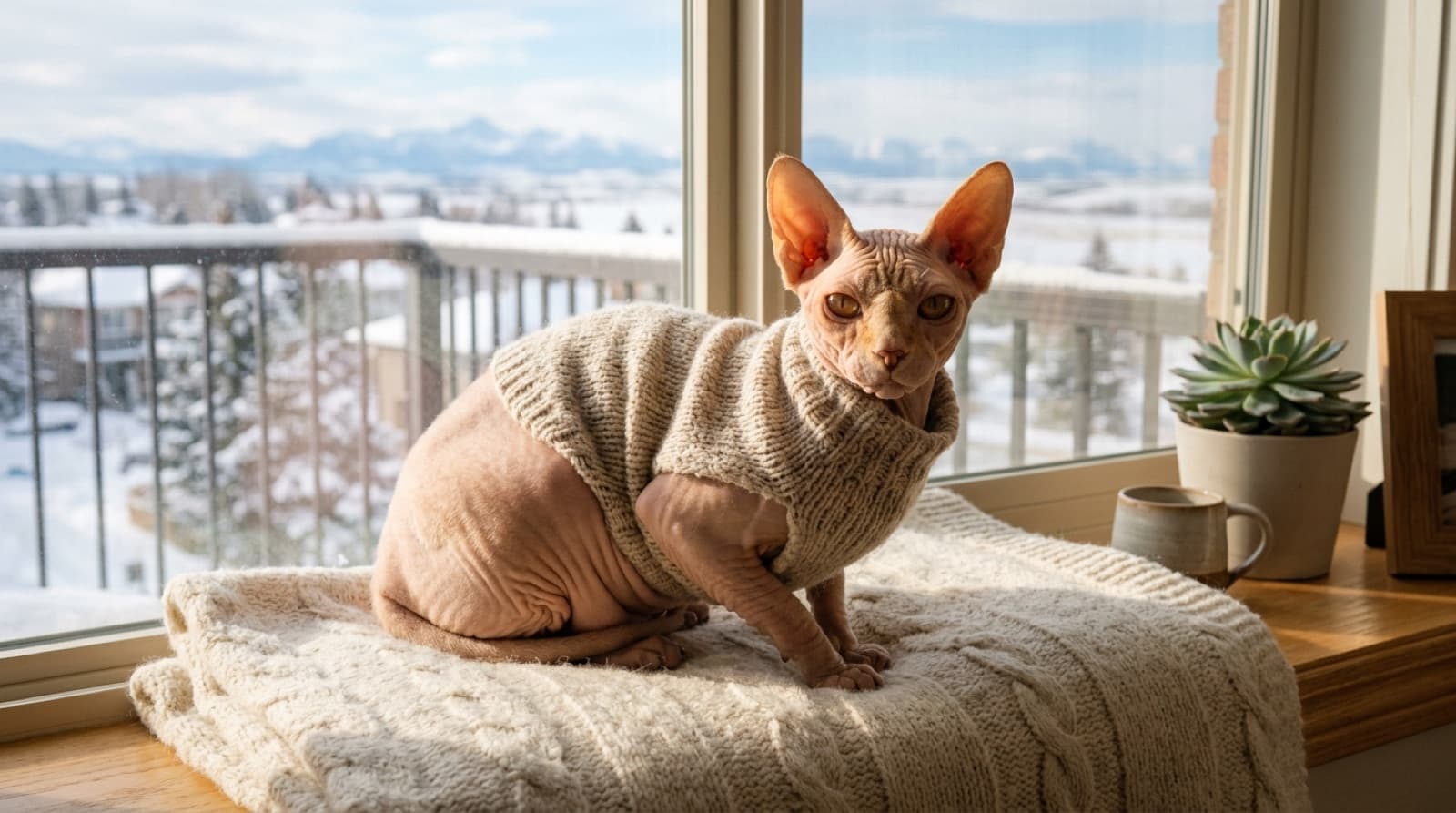
The buy-vs-adopt question for Sphynx specifically
Most people who land on this page already love the look. The wrinkled skin, the bat-ears, the lemon-shaped eyes, the warm-to-the-touch body that feels like holding a small heated water bottle. The question they arrive with is harder than usual for this breed: pay a Canadian CFA or TICA breeder $2,500 and wait six months for a kitten with documented CMS testing, or take a Sphynx from Alberta Sphynx Rescue this month for $500. Both are reasonable. We are a rescue aggregator, so our framing leans toward adoption, but Sphynx come with real commitments that deserve more upfront prep than most cat adoptions.
The breeder path gives you predictability and verified testing. If you specifically want a kitten with documented CMS DNA-clear parents, parent echocardiogram results for HCM screening, and a kitten that arrives at 12 to 16 weeks already accustomed to weekly baths, the breeder route is the only reliable way to get all of that. You pay $1,800 to $3,500 plus deposit, plus a 4 to 9 month wait. For an adopter who specifically wants a Sphynx kitten with the cleanest health-history paperwork, this is the right path.
The rescue path gives you a real cat now, often already winter-adapted. Most Sphynx at Alberta Sphynx Rescue and at the generalist Calgary rescues arrive from one of three patterns: families who underestimated the bathing and skincare commitment, families who got priced out by HCM diagnosis bills, or families whose lives changed (move, new baby, allergies). The cat is already spayed or neutered, vaccinated, microchipped, vet-checked, and the foster home has worked through the bathing and skincare reality with you. The bonus for Calgary adopters: an adult Sphynx in foster care here has typically already lived through a Calgary winter, so they are climate-adapted.
Neither path is wrong. The reframe most Sphynx adopters miss is that the question is not breeder kitten or rescue kitten. It is breeder kitten or rescue adult Sphynx. The latter is usually the better answer for a Calgary household that wants a Sphynx as a pet, not for showing. Adult Sphynx surrenders are almost never about the cat being broken; they are about the bathing schedule the previous family could not maintain or a vet bill that priced them out.
Where to find a Sphynx in Calgary
The reliable path to a Sphynx in Alberta is through one specific rescue. Other rescues see Sphynx mixes occasionally. Here is the honest map:
| Rescue | Good to know |
|---|---|
| Alberta Sphynx Rescue (ASR) | Calgary-based, Alberta-scoped, dedicated to Sphynx and other hairless and semi-hairless breeds (Devon Rex, Donskoy, Peterbald, Oriental, Cornish Rex, Lykoi). The cornerstone rescue for Sphynx in this province. See albertasphynxrescue.ca. Coordinates surrenders, cross-province transports, and skincare-routine handoffs through foster homes. |
| MEOW Foundation | Cat-only, largest cat intake in Calgary. Pure Sphynx are rare; Sphynx mixes and Devon Rex occasionally appear. Worth alert subscriptions. See meowfoundation.com. |
| Calgary Humane Society | Steady cat intake. Sphynx-type cats appear occasionally, often misidentified as Devon Rex. Structured written profiles per cat. See calgaryhumane.ca. |
| AARCS, BARCS, Pawsitive Match, Cochrane Humane, Heaven Can Wait | Generalist Calgary-area rescues. Sphynx intake is uncommon. Worth alert subscriptions but not daily refreshing. |
| Specialty Purebred Cat Rescue (US-based) | A US-based purebred cat rescue network at purebredcatrescue.org. Cross-border placement to Canada is unusual for Sphynx specifically and requires significant transport coordination. |
The honest read on this list: Alberta Sphynx Rescue is the single source that matters for Sphynx in this province. ASR runs surrenders directly and coordinates cross-province transports from other parts of Western Canada, so a Sphynx that lands in Edmonton or Lethbridge may be available to a Calgary home through ASR's foster network. The generalist rescues are worth alert subscriptions because Sphynx mixes do occasionally appear, but if you specifically want a Sphynx, ASR is where you start.
Many Sphynx-type listings at the generalist rescues turn out to be other breeds. The two most common patterns: Devon Rex misidentified as Sphynx (curly fuzz coat regrows over a few weeks in foster care), and Sphynx crosses with domestic shorthairs (partial coat, peach fuzz over much of the body, less wrinkled skin). Both can be wonderful pets, and both still require the same general Sphynx care commitments around bathing, ear cleaning, and warmth. They are not pedigreed Sphynx.
Set up alerts so you do not have to check every site by hand. LocalPetFinder pulls live cat listings from Calgary rescues regularly into one searchable place. A Sphynx-type intake at any rescue moves quickly because so many adopters are watching for the breed, so the day the cat posts is usually the day to apply.
The real Calgary cost breakdown
A rescue adoption fee is not the cat's price. It is a partial reimbursement for vetting and skincare-routine establishment the rescue already paid for. That is why a $500 Sphynx from Alberta Sphynx Rescue is a better deal than a “free” Kijiji kitten. And any Sphynx listed under $1,000 by a self-described breeder is almost always a scam, a backyard breeder, or a domestic shorthair shaved bald and misrepresented (the textbook 2016 Alberta scam pattern).
2026 Calgary Sphynx pricing across the realistic options:
| Path | Typical price | What is included |
|---|---|---|
| Alberta Sphynx Rescue (Sphynx or Sphynx mix) | $400 to $700 | Spay or neuter, vaccines, microchip, deworming, vet workup, foster assessment, skincare routine already established, often pre-screening for CMS and basic cardiac. |
| Generalist Calgary rescue (Sphynx mix) | $400 to $600 | Standard vetting plus foster notes. Skincare may need to be established in your home. |
| Ethical Canadian CFA or TICA breeder (pet quality) | $1,800 to $3,500 | CFA or TICA registered, CMS DNA-tested parents, annual echocardiograms on parents, kitten released at 12 to 16 weeks, contract with spay or neuter clause, established skincare routine. |
| Show or breeding rights kitten | $3,500 plus | Same testing, breeding contract, often co-ownership terms. |
| Under $1,000 unverified seller | Scam zone | Red flag. No paperwork, no DNA testing, often a fake listing, a backyard breeder, or a shaved domestic shorthair sold as a Sphynx. The 2016 Alberta shaved-kitten scam priced at $650 to $800 sits exactly in this band. |
The adoption fee covers spay or neuter, core vaccines, a microchip, deworming, parasite treatment, and a vet exam. Alberta Sphynx Rescue typically also covers initial CMS screening and basic cardiac evaluation, which alone would run $300 to $600 if you paid for them yourself. Paying for that vetting on a free Kijiji kitten runs about $480 to $900 before any breed-specific testing. So even at the top of the rescue range, a $700 ASR Sphynx is cheaper than catching up a free kitten on the same vetting.
Annual care for a Sphynx runs higher than most breeds because of the skincare and winter commitments:
Some product links below are Amazon affiliate links — we may earn a small commission at no extra cost to you. It never changes what we recommend.
- Food: $40 to $70 per month. Sphynx are small to medium and eat more per body weight than haired cats because their higher metabolism is sustaining a warmer body temperature. High-protein wet food plus a quality dry sits in the $55 to $70 range.
- Litter: $25 to $40 per month. Standard large litter box. Sphynx do not drag long fur through litter the way Persians do.
- Bathing and skincare supplies: $400 to $800 per year. The Sphynx-specific line item. Weekly cat-safe shampoo, ear cleaner, skincare oil for daily oil-blotting, microfibre towels, soft cloths for skin folds. Higher end if you use boutique skincare products.
- Annual vet care: $700 to $1,200. Routine wellness plus annual echocardiogram (HCM screening, $300 to $500 each) starting at age 1. This is non-negotiable for the breed and is the single biggest reason ongoing Sphynx vet costs run high.
- Pet insurance: $40 to $80 per month. More valuable for Sphynx than most breeds because of HCM risk and dental disease. Pre-existing condition clauses matter, so enrol before any cardiac or dental diagnosis.
- Sweaters and bedding: $200 to $400 per year ongoing. A wardrobe of sweaters in different weights wears out and needs replacing. Heated cat beds need occasional replacement.
- Heating: $300 to $600 per year additional on your home utility bill. Keeping a Sphynx home reliably above 20 to 22C through Calgary winter costs measurably more than running a haired-cat home cool enough to be comfortable. Not optional.
First-year setup costs another $1,800 to $3,000 above a normal cat: a wardrobe of sweaters in different weights, two or three heated cat beds, UV-blocking window film for south-facing windows (Sphynx are at real risk of solar dermatitis through indoor sun exposure), skincare-routine supplies, large carrier, humidifier for Calgary winter dry air. Honest first-year total: $3,500 to $5,500 for a rescue Sphynx, $5,000 to $8,000 for a breeder kitten. Ongoing years run $1,800 to $3,000, with the HCM diagnosis years pushing higher.
The honest read: Sphynx total cost over the lifespan is higher than DSH despite the shorter lifespan, because the weekly bathing, HCM monitoring, dental work, sweater wardrobe, and winter heating bills all stack. Our full Calgary cat cost breakdown has the standard-cat line items for comparison.
What sends a Sphynx into Calgary rescue?
Sphynx surrenders follow predictable patterns. Almost none of them are about the cat being broken. The dominant reasons:
Underestimated bathing and skincare burden. This is the number one reason Sphynx end up at Alberta Sphynx Rescue and at MEOW Foundation. Adopters underestimate that weekly baths plus weekly ear cleaning plus daily oil-blotting is forever, not a phase. The owner tries to keep up for a few months, the bathing slips, the skin develops yeast or acne, the cat starts smelling, the family stops trying. Foster teams routinely receive Sphynx with skin issues that resolve within 6 to 8 weeks of consistent skincare. The cleanup is straightforward; the prevention is the hard part.
Cold-weather stress in Calgary households without commitment to heating. Adopters who did not budget for the winter heating reality see their cat shivering, develop guilt, and surrender. The cat is otherwise healthy. The fix is sweaters, heated beds, and a thermostat held above 21 to 22C through the winter, which is a real lifestyle and budget commitment.
Velcro-cat attachment incompatible with new work patterns. Sphynx are notoriously demanding companions. They scream when alone, follow owners room to room, and refuse to be ignored. A household that adopted a Sphynx during work-from-home periods and then returned to office full-time sometimes surrenders because the cat is genuinely distressed by solitude. This pattern is breed-specific. Sphynx are not cats for households that are away 10 hours per day.
HCM diagnosis cost shock. The first echocardiogram reveals HCM, and the family is unprepared for ongoing cardiology bills, medication, and follow-up imaging. Cardiology consults in Calgary run $300 to $500 per echo, with medication adding $30 to $80 per month. Rescues often place HCM-positive Sphynx in experienced homes that understand cardiac care.
Dental extraction cost shock. Some Sphynx lines require full mouth extractions by age 3 to 5 due to early-onset feline tooth resorption and gingivostomatitis. The procedure costs $2,500 to $4,500 in Calgary. Families that did not budget for this surrender. Importantly, a Sphynx after full extractions does brilliantly; the procedure resolves chronic pain and most cats eat normally on wet food afterward.
Owner life change. Allergies (still mild but enough to surrender), move to a no-pet rental, financial hardship, divorce, new baby, owner illness. The cat is healthy, bonded, and an excellent adoption candidate for a household that understands the breed.
Adult Sphynx adoption: the underserved path
The Sphynx question on most adoption forums is “where can I find a kitten?” The better question for most Calgary households is “why am I not considering an adult?” Adult Sphynx adoption is genuinely underrated for this breed in particular, because the maintenance commitment is so demanding that an established routine is worth more than a clean slate.
The advantages of adopting an adult Sphynx. The temperament is already known. The bathing tolerance is visible from foster notes. The cat is already housetrained. Most adult Sphynx at Alberta Sphynx Rescue have lived through at least one Calgary winter, so they are climate-adapted. The foster home can tell you exactly how the cat behaves around other cats, dogs, and children. A Sphynx kitten is a temperament and health gamble; an adult is a known quantity, which matters more for a high-maintenance breed than for almost any other.
The skincare-routine advantage. Most adult Sphynx at Alberta Sphynx Rescue arrive with a skincare routine already established in foster care. You inherit a working system: which shampoo the cat tolerates, the ear-cleaning cadence, the bathing day of the week, the skin oil products that work for this specific cat. This is genuinely a feature, not a flaw. Starting a Sphynx kitten on skincare is months of trial and error; inheriting a working system is a head start of immense value for a first-time Sphynx owner.
Retired breeder Sphynx deserve a special note. Ethical CFA or TICA breeders retire breeding females around age 5 to 7 and place them in pet homes. These cats come with documented pedigree, CMS DNA test history, multiple years of echocardiogram records, and were originally selected for temperament. The catch is the adjustment window, because a cat that lived its first 5 to 7 years in a cattery environment needs 6 to 12 weeks to fully relax in a single-family home. Once settled, the bond is deep and persists across the lifespan.
The adjustment timeline. Four to eight weeks for most adult Sphynx, longer for retired breeder cats. The 3-3-3 rule applies but stretches: three days of cautious exploration with frequent retreating, three weeks of testing the new space and identifying their primary person, three months to fully relax. Sphynx signal stress through retreating and through reduced appetite, which can be hard to distinguish from normal cat behaviour at first. Signs of progress: the cat eats reliably in the open, sleeps where you can see them, and begins to follow you between rooms. Eventually the cat seeks physical contact, curls up against you for warmth, and stays.
Step back from the kitten-vs-adult debate. A Sphynx kitten is months on a Canadian CFA or TICA breeder waitlist plus a $2,500 kitten plus a year of kitten chaos plus the bathing-routine learning curve. A surrendered adult Sphynx from Alberta Sphynx Rescue is $500, available within weeks, often climate-adapted, and typically with an established skincare routine you inherit. For first-time Sphynx owners and Calgary households that want the breed without the rookie mistakes, the adult path is usually the better answer.
The breeder waitlist and verification
Six to twelve months is the honest Canadian Sphynx breeder waitlist. The waitlist exists because ethical breeders run two or three litters per year and screen homes carefully. If a Canadian breeder offers an immediate kitten with no application, no waitlist, and no DNA test paperwork, that is a strong red flag worth investigating before any money changes hands.
The deposit conversation is where most Canadian Sphynx scams start. The reputable pattern is straightforward: you submit an application, get on the waitlist, and pay a deposit only after a specific litter is born and confirmed healthy, usually $400 to $700 toward the final kitten price. A deposit demanded before pregnancy is confirmed, or for a kitten from a litter that does not yet exist, is the textbook signature of a fake breeder. The same is true of wire-transfer-only requirements or pressure to pay before meeting the kittens.
The questions a serious Sphynx breeder welcomes:
- CMS DNA test certificate. The single most important breeder question for Sphynx. CMS (Congenital Myasthenic Syndrome, COLQ gene) is autosomal recessive and affects both Sphynx and Devon Rex. Request the actual certificate with the parents' registered names on it, dated and from UC Davis VGL. The test is the Sphynx and Devon Rex CMS test. “They are tested” without paperwork is not enough.
- HCM screening on parents. Annual echocardiogram on breeding cats read by a veterinary cardiologist. Both parents, every year. There is no commercial DNA test for Sphynx HCM that reliably predicts disease (the ALMS1 variant is sometimes mentioned by breeders, but the 2024 NZ study found no association with HCM diagnosis at median age 5.8 years). Phenotypic echocardiogram screening is the standard of care.
- Do not ask for ALMS1 test results. Some breeders advertise ALMS1 testing as HCM prevention. It is not predictive per the 2024 New Zealand research. Variant frequency in the breed is high (around 70 percent) but does not correlate with HCM diagnosis. Annual echocardiograms are the meaningful screening, not ALMS1.
- Kitten release age. Twelve weeks minimum, 14 to 16 weeks is better. A breeder releasing kittens at 8 to 10 weeks is cutting socialisation and skincare-routine handoff short.
- Skincare routine handoff. An ethical breeder sends the kitten with an established skincare protocol: which shampoo, the bathing cadence, the ear-cleaning routine, the products that work. A breeder who hands you a kitten with no skincare routine is signalling that they do not maintain one themselves, which is a real red flag.
- Registration body. CFA registration (under cfa.org) or TICA (tica.org). Verify cattery numbers directly via the registry breeder directory, not just the seller's own claim.
- Contract terms. Spay or neuter agreement, return-to-breeder clause if you cannot keep the cat, HCM health guarantee terms.
Calgary-area Sphynx breeders exist; if you go that route, verify CFA or TICA registration directly via cfa.org or tica.org rather than trusting a seller's own claim, and request the actual CMS DNA test certificate with the parents' registered names. The most reliable shortcut: if a breeder cannot produce a UC Davis VGL CMS certificate within 24 hours of asking, walk. This is the short version of the verification process; the depth lives in the dedicated Sphynx scam avoidance guide in this cluster.
Is that cat actually a Sphynx?
One of the most common questions we get from new adopters is whether the hairless cat they saw on a Calgary rescue listing is actually a Sphynx. Several traits define a purebred Sphynx under the CFA and TICA breed standards:
- Completely hairless or peach-fuzz coat. Sphynx are described as hairless but technically have a fine layer of down, sometimes called “kitten fuzz,” that varies in density. A pronounced curly coat is not a Sphynx; that is a Devon Rex.
- Wrinkled skin, especially on head and shoulders. The defining tactile feature of the breed. Less pronounced wrinkling, especially on the body, suggests a Sphynx cross or a Devon Rex.
- Large bat-ears. Sphynx ears are dramatically large and set wide. Devon Rex ears are also large but slightly less pronounced.
- Lemon-shaped eyes, prominent cheekbones. Distinctive facial structure. Devon Rex have a more elf-like face with a shorter muzzle.
- Long whippy tail, athletic muscular body. Sphynx are lean and muscular with a long tail. Donskoy (Russian hairless) tend to be slightly heavier-bodied.
Common confusions at Calgary rescues:
- Devon Rex. Same KRT71 gene, different allele. The Devon Rex has a soft curly downy coat with curly whiskers. Often misidentified as Sphynx mix during the few weeks before the fuzz becomes obvious in foster care.
- Cornish Rex. Different gene entirely. Wavy “marcel wave” coat. Not hairless. Sometimes misidentified at intake.
- Donskoy (Don Sphynx, Russian Hairless). A Russian breed with a dominant hairlessness gene (Sphynx is recessive). Visually similar but with a slightly heavier build.
- Peterbald. A Donskoy crossed with Siamese or Oriental Shorthair. Long lean body, hairless or peach-fuzz, often confused with Sphynx.
- Lykoi (Werewolf Cat). A roan partial-hairless pattern from a different mutation. Distinctive werewolf appearance with sparse coat on body and face.
- Bambino, Elf, Dwelf. Sphynx outcrosses with Munchkin or American Curl. Recognised by some registries but not CFA. There are real ethical concerns about combining the dwarfism (Munchkin) or ear-cartilage (Curl) traits with Sphynx, and most welfare-focused rescues do not actively promote these outcrosses.
- Sphynx cross with domestic shorthair. The most common “Sphynx mix” you see at Calgary rescues. Partial coat, peach fuzz over body, less wrinkled skin. Still needs much of the same care as a pure Sphynx.
The Calgary climate commitment
Sphynx are strictly indoor cats in Calgary, no exceptions. The case beyond the usual indoor-only reasoning (theft risk, no street smarts, coyotes on Bow River pathways and Nose Hill) is breed-specific. The Sphynx comfort zone is 20 to 27C. Calgary winters routinely hit -25C. This requires real prep:
Sweaters when room temperature drops below 22C. A wardrobe of sweaters in different weights, sized for your specific cat. Many Calgary Sphynx owners keep at least four sweaters in rotation: a light cotton for mild days, a fleece for normal winter days, a knitted wool for cold snaps, and a back-up while one is in the wash. The cat will tell you when it needs the next weight up by shivering, hunching, or refusing to leave a heated spot.
Heated cat beds, but watch for hot spots. Sphynx have no fur to insulate against thermal injury. A heated bed at too high a setting can cause skin burns; the cat will not move away because it loves the warmth. Use low-watt models specifically designed for cats, and check the surface temperature regularly. Multiple heated beds in different rooms let the cat self-thermoregulate.
Avoid drafts. Near windows in winter, near air vents in summer. Sphynx are exquisitely sensitive to airflow because they have no fur to break the wind. A bed near a drafty window in January is not a kindness.
South-facing windows in summer: UV-blocking film. Indoor Sphynx are at real risk of solar dermatitis from sun exposure through south-facing windows, which over years progresses to squamous cell carcinoma on the ears, nose, and back. This is one of the breed-specific risks adopters most often miss. UV-blocking window film is inexpensive and is the standard recommendation. The full skincare and winter routine, including UV-blocking specifics, lives in the dedicated Sphynx skincare and winter guide.
Chinook humidity swings. Calgary's dramatic temperature shifts (-25 to +5 in hours during a chinook) stress the Sphynx skin barrier. Keep the home humidity stable; the cat's skin notices.
Indoor humidity in winter. Calgary winter indoor relative humidity typically falls to 20 to 30 percent. Sphynx skin is happier at 40 to 50 percent. A simple cool-mist humidifier in the main living room makes a measurable difference for the cat's comfort and reduces winter skin issues.
Outdoor exposure: never. Theft is a real concern (Sphynx are visibly valuable and easy to identify), cold exposure for any length of time is dangerous even in mild weather, and Calgary's natural predators (coyotes, raptors) do not differentiate. Indoor-only is non-negotiable. Catio time during the warmest summer weeks is acceptable with shade and supervision; everything else is indoors.
Our indoor vs outdoor cats guide covers the full Calgary safety case.
Breed background worth knowing
The Sphynx originated in Toronto, Canada in 1966, when a domestic shorthair cat named Elizabeth gave birth to a hairless kitten named Prune. The mutation was preserved through careful breeding by Canadian breeders, and Devon Rex outcrosses were used to establish the gene pool. The breed was recognised by TICA in the late 1970s and reached CFA Championship status in 2002. The hairlessness comes from a recessive mutation in the KRT71 keratin gene, which also affects the Devon Rex at a different allele. CFA permits outcrossing to Domestic Shorthair (historical) and Devon Rex.
The breed has been the subject of significant veterinary research because of its early-onset HCM concerns. The 2024 Royal Veterinary College VetCompass UK study (n=7,936 cats from primary-care veterinary records) found Sphynx had the shortest median lifespan of any cat breed studied, at 6.8 years, with cardiac disease as the dominant cause of premature death. Reputable breed-club estimates and longer-term breeder records report 8 to 14 years for cats receiving annual echocardiograms from age 1 and proactive dental care. Both numbers are honest; the difference is preventive medicine. The RVC VetCompass research is publicly accessible.
Three traits surprise most first-time Sphynx adopters:
The warmth. Sphynx body temperature runs slightly higher than haired cats, between 38 and 40C, and without fur insulation the heat is palpable. Holding a Sphynx feels like holding a small heated water bottle. This is the breed's most-loved feature and the reason Sphynx owners describe them as the warmest, most cuddly cats they have ever lived with. The same biology drives the breed's higher caloric needs.
The sebaceous oil reality. Sphynx skin produces oil normally, but with no fur to absorb it, the oil accumulates on the skin surface. Without regular bathing, the cat becomes visibly greasy, leaves oil marks on furniture and bedding, and develops yeast or acne. The breed is not low-maintenance; it is high-maintenance in a different direction than long-coated breeds. Weekly bathing plus daily oil-blotting is the floor, not the ceiling.
The attachment intensity. Sphynx are widely described as Velcro cats. They follow owners between rooms, sit in laps without invitation, sleep under blankets, and scream when alone. The breed bonds with one or two specific people and reacts strongly to separation. This is wonderful for households where someone is home most of the day. It is hard on the cat for households gone 8 to 10 hours daily. A second Sphynx companion helps but does not fully replace the human bond.
Browse adoptable Sphynx-type cats in Calgary
Alberta Sphynx Rescue coordinates most Calgary Sphynx placements. Browse hairless cats currently in Alberta rescue, many of which are climate-adapted adults whose foster families have already established skincare routines you inherit.
See Available Sphynx →Frequently Asked Questions
Where can I adopt a Sphynx in Calgary?
Alberta Sphynx Rescue (albertasphynxrescue.ca) is the Calgary-based, Alberta-scoped rescue dedicated to Sphynx and other hairless breeds, and it is the strongest single placement source for the breed in this province. The generalist Calgary cat rescues, MEOW Foundation, Calgary Humane Society, AARCS, BARCS, Pawsitive Match, Cochrane Humane Society, and Heaven Can Wait, see Sphynx mixes and the occasional Devon Rex misidentified as a Sphynx, but pure Sphynx intake is uncommon at all of them. Watch live listings on LocalPetFinder and set an alert keyed to hairless cats. A Sphynx-type intake at any Calgary rescue moves fast because so many adopters are watching for the look.
How much does a Sphynx cost in Calgary?
A Sphynx or Sphynx mix from Alberta Sphynx Rescue or a generalist Calgary rescue runs about $400 to $700. That fee covers spay or neuter, core vaccines, microchip, deworming, and a vet workup, and the rescue has usually already established the cat's skincare routine in foster care. An ethical Canadian CFA or TICA breeder charges $1,800 to $3,500 for a pet-quality kitten with CMS DNA-tested parents and HCM-echocardiogrammed parents, released at 12 to 16 weeks. Annual care runs $1,800 to $3,000, higher than most breeds because of weekly bathing supplies, ear cleaning, skincare products, sweaters, and the higher winter heating bill.
Is $700 fair for a Sphynx kitten?
Not from a breeder. This was the price point of the 2016 Alberta shaved-kitten scam, when a seller in the province sold domestic shorthair kittens shaved bald as Sphynx at $650 to $800. Buyers found out two weeks later when the fur grew back. The honest Canadian breeder floor for a pet-quality Sphynx kitten with CFA or TICA registration plus CMS DNA-tested parents is about $1,800. A kitten advertised at $700 by a self-described breeder sits in the scam zone. A $700 fee is reasonable for an adult Sphynx or Sphynx mix from Alberta Sphynx Rescue with full vetting and an established skincare routine. Pay $1,800 plus from a verified CFA or TICA breeder, or $400 to $700 from rescue.
Can I find a purebred Sphynx at a Calgary shelter?
Rarely at the generalist shelters. Most Sphynx-type intake at MEOW Foundation, Calgary Humane Society, or AARCS turns out to be a Sphynx cross with a domestic shorthair (partial coat, peach fuzz over most of the body), a Devon Rex misidentified as a Sphynx, or a hairless lookalike like a Donskoy. The reliable path to a verified Sphynx in Alberta is Alberta Sphynx Rescue, which coordinates surrenders and cross-province transports specifically for the breed. Specialty Purebred Cat Rescue in the US (purebredcatrescue.org) occasionally lists Sphynx, but cross-border placement to Canada for Sphynx specifically is unusual and requires significant transport coordination.
Can Sphynx really live in Calgary in winter?
Yes, with real commitment. Sphynx comfort zone is 20 to 27 degrees Celsius. Calgary winters routinely hit -25C, and indoor relative humidity drops to 20 to 30 percent. The breed adapts well to indoor Calgary life with sweaters when room temperature drops below 22C, heated cat beds without hot spots, draft management near windows and vents, and often a humidifier. The catch is the cost: higher heating bills, a wardrobe of sweaters in different weights, and the daily skincare routine. Outdoor exposure is never appropriate, including supervised winter time on a balcony. Most adopted Sphynx in Calgary live full happy lives indoors, but the winter setup is not optional and is a real lifestyle change.
How long do Sphynx actually live?
There are two honest numbers, and reputable sources cite them both. The 2024 Royal Veterinary College VetCompass UK study (n=7,936 cats) found Sphynx had the shortest median lifespan of any breed at 6.8 years, driven heavily by early-onset hypertrophic cardiomyopathy. Breed clubs and longer-term breeder data report 8 to 14 years when cats receive annual echocardiograms from age 1, proactive dental care, and managed skincare. Both numbers are true. The honest read: a Sphynx with conscientious cardiac screening, regular dental work, and a good vet relationship can reach the higher end. A Sphynx without that proactive care is at real risk of the shorter median. Plan for the higher-end cost commitment, and you protect for the longer-end lifespan.
Should I adopt a Sphynx as my first cat?
Temperamentally yes, logistically with serious caveats. Sphynx are exceptionally affectionate, often called Velcro cats because they follow owners room to room and scream when alone. The catch is that they are arguably the most demanding cat breed on the maintenance side: weekly baths, weekly ear cleaning, daily skin oil management, sweaters, heated beds, and a real winter heating commitment in Calgary. A first-time cat owner who underestimates any of this often surrenders within the first year. If you are confident you can commit to the bathing and skincare routine, want a high-attachment cat, and work from home or have a partner home most of the day, a Sphynx is a wonderful first cat. If any of those commitments feel uncertain, start with a haired breed.
How long does an adult Sphynx take to adjust?
Four to eight weeks for most adult Sphynx, longer than the typical DSH adjustment because the breed bonds intensely. Sphynx form deep one-or-two-person attachments and grieve when their environment changes. The 3-3-3 rule applies but stretches: three days of cautious exploration with frequent retreating, three weeks of testing the new space and identifying their primary person, three months to fully settle. Adult Sphynx from Alberta Sphynx Rescue arrive with the foster home's skincare routine already in place, which makes the transition substantially smoother. The bond that develops after the adjustment window is genuinely intense and persists across the lifespan. Signs of progress: the cat seeks physical contact, sleeps in your bed, and follows you around the house.
Are Sphynx good with kids and other pets?
With gentle older kids yes, with toddlers usually no, with other pets often well. Sphynx are warmth seekers and people seekers, which means they often bond closely with calm older children who provide reliable cuddles. Toddlers and high-energy kids tend to overwhelm the breed's preference for steady predictable contact, and Sphynx will hide. With other cats, Sphynx do well with calm companions and often bond strongly because the body warmth-sharing instinct is real for them. With dogs, calm older dogs work; Sphynx will frequently curl up with a friendly dog because the dog is warm. The cat-to-cat and cat-to-dog introduction guides in our resources hub cover the slow-introduction protocol.
Are Sphynx hypoallergenic?
No, but they are often the least bad option for mild cat allergies. Cat allergies are triggered by the Fel d 1 protein in saliva and skin dander, not by coat. Sphynx still produce Fel d 1, but the lack of fur means less allergen is spread through the household via shedding hairs. The weekly bath also removes accumulated saliva and skin oil from the body, reducing the airborne dander load. People with mild cat allergies sometimes tolerate Sphynx well; people with severe cat allergies still react. There is no truly hypoallergenic cat breed. Our hypoallergenic cats guide covers air filtration, frequent bathing, and Fel d 1 reduction diets, all of which matter more than breed selection.
What is the difference between Sphynx and Devon Rex?
They share the same gene (KRT71) but at different alleles, which produces different coats. Sphynx are essentially hairless with at most a peach-fuzz "kitten coat," wrinkled skin especially on the head and shoulders, and large bat-ears. Devon Rex have a soft curly downy coat with curly whiskers, less wrinkling, and slightly less extreme ear size. Both breeds carry the same CMS (Congenital Myasthenic Syndrome) gene mutation and ethical breeders DNA-test parents for it through UC Davis VGL. Many "Sphynx mix" listings at Calgary rescues turn out to be Devon Rex when the coat regrows after the first month of foster care. Both breeds have similar temperaments and care needs, including the bathing requirement, though Devon Rex bathe slightly less frequently.
What are the main Sphynx health concerns?
Three to plan for, and one to anticipate. Hypertrophic cardiomyopathy (HCM) is the dominant concern: prevalence runs 20 to 40 percent depending on population and age cohort, and there is no commercial DNA test that reliably predicts it, so annual echocardiograms starting at age 1 are the standard of care. Congenital Myasthenic Syndrome (CMS, COLQ gene) is autosomal recessive and DOES have a commercial DNA test through UC Davis VGL; ethical breeders test parents and you should request the certificate. Urticaria pigmentosa is a cutaneous mastocytosis the breed is overrepresented for. Dental disease is the fourth, with many Sphynx requiring full mouth extractions by middle age. Calgary specialty cardiac referrals go to Western Veterinary Specialist and Emergency Centre. The dedicated Sphynx health article in this cluster covers full screening details.
Sphynx Cats in Calgary
Browse adoptable Sphynx, Sphynx mixes, Devon Rex, and Donskoy placements from Alberta Sphynx Rescue and Calgary cat rescues.
Sphynx Skincare: Winter, Bath, Sun Guide
Sphynx skincare: weekly bath, daily oil blotting, cold-winter sweater protocols, and UV-blocking window film for indoor sunburn risk.
Sphynx Health: HCM, CMS, Dental Guide
Sphynx health: 20-40% HCM prevalence, CMS DNA testing, juvenile-onset dental, anaesthesia caution, and the honest 6.8-14 year lifespan.
Sphynx Scams: The 2016 Alberta Case Guide
The 2016 Alberta shaved-kitten Sphynx scam (CBC, CTV, Global News). How to verify a real Sphynx, spot the red flags, and use the rescue alternative.
New cat? Start with these care guides
Everything a new adopter needs to set up a safe, happy home.