The short answer
Basset recall failure is genetics, not training failure. When a Basset locks onto a scent, the brain effectively shuts off recall processing. Calgary off-leash parks are dangerous for most Bassets. Nose Hill, Fish Creek, Bowmont, and Weaselhead all have wildlife scent corridors that pull Bassets 3 to 5 km. Use long-line walks (15 to 30 ft biothane, $30 to $80) or Sniffspot rentals ($15 to $30/hour, fenced backyard rentals) instead. Build the best possible recall in low-distraction environments. Expect 60 to 70% reliability max in scent-rich settings. That's the breed, not failure. Yard escape prevention: 4 ft fence minimum (Bassets dig under, don't jump over). Bury chicken wire 6 to 12 inches or install L-footers. Front-clip harness only (collar pressure causes IVDD episodes). Never prong, choke, or e-collar. Back-protection training is non-negotiable from day one (no stairs, no jumping, ramps required). Calgary winter helps training (less wildlife scent). Summer hurts. Force-free trainers we'd recommend include Raising Canine and Pup City Pup Academy. Total investment $500 to $1,500 foundation, $1,500 to $3,000 for behavioural cases.
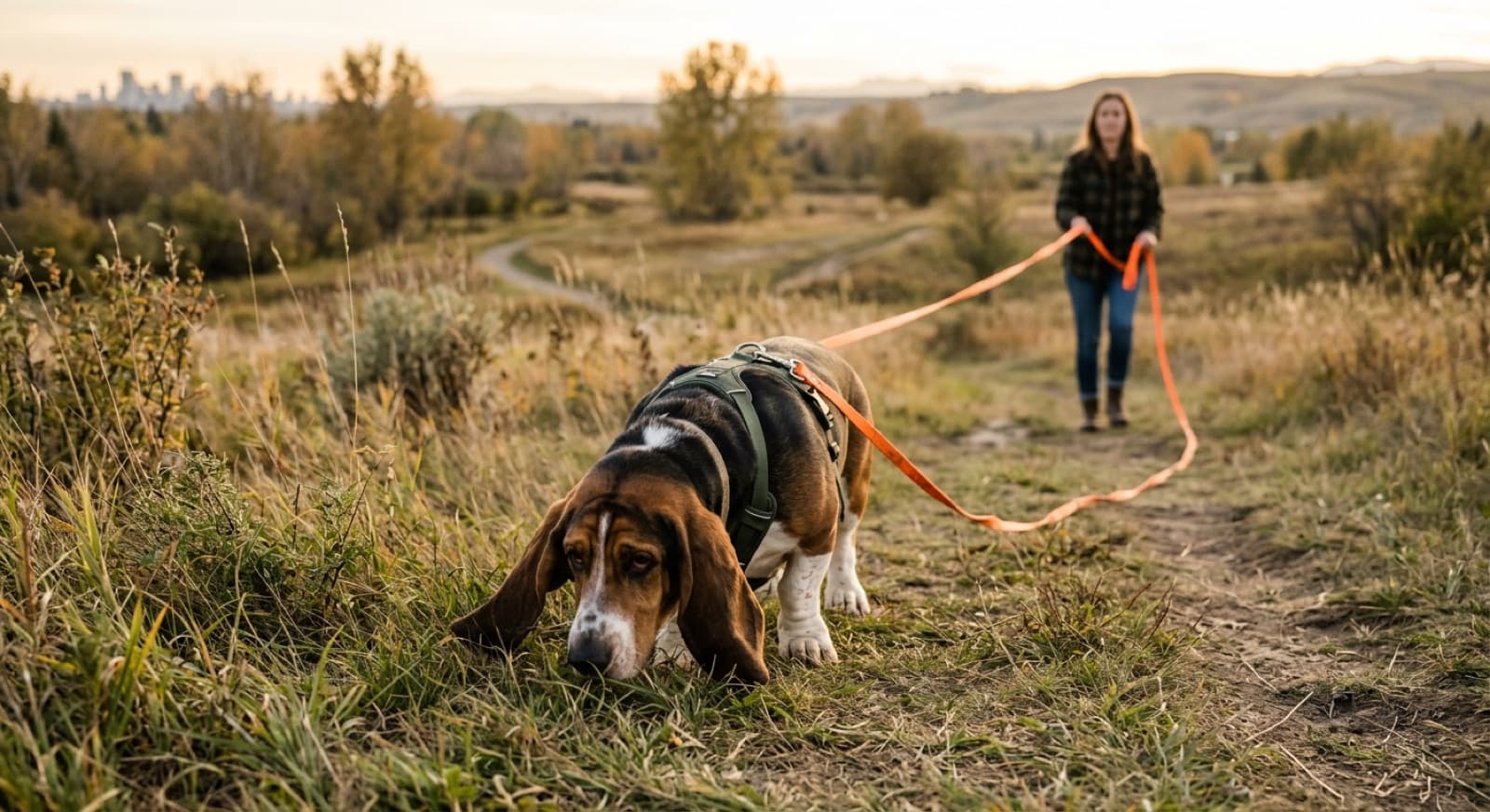
A Basset on a scent trail can travel 3-5 km before stopping
Calgary terrain (open prairie, river valley, wildlife corridors) is the worst possible environment for a scent-driven escape. Owners who lose Bassets off-leash often find them hours later, sometimes injured by wildlife, sometimes hit by cars, occasionally never recovered. Most lifelong Basset owners (including breeders and rescue volunteers) never trust their Bassets off-leash in unfenced public spaces. This is normal and right, not failure. Use long-lines, Sniffspots, and fenced yards.
Why is Basset Hound recall so bad? Is it training failure?
No. Basset recall failure is genetics, not training failure. Bassets were selectively bred over centuries to follow scent trails over distance, ignoring all other stimuli including their handler.
Their nose is second only to the Bloodhound in scent capacity. When a Basset locks onto a scent (rabbit trail, deer path, food trail, garbage scent, another dog's urine), the part of their brain that processes recall cues effectively shuts off. The AKC breed profile describes this scent-driven focus as the defining Basset trait.
This is not stubbornness in the conventional sense. It's neurological. The Basset's scent processing centre literally outcompetes the parts of the brain that hear and respond to verbal commands.
Even Bassets with excellent recall in low-distraction environments fail recall when scent kicks in.
Comparison:
- A Border Collie ignoring recall is choosing to ignore (frustration, herding drive, sport-arousal).
- A Basset on a scent trail is genuinely not processing the recall cue. They have heard it, but their brain has prioritised scent processing.
The implication: training cannot reliably fix Basset recall in scent-rich environments. The right approach is not “try harder with training.” It's “build a lifestyle that doesn't require off-leash trust in scent-rich environments.”
Long-line walks, fenced off-leash areas only, recall built incrementally in low-distraction settings. Many lifelong Basset owners (including breeders and Basset rescue volunteers) never trust their Bassets off-leash in unfenced public spaces. This is normal and right, not failure.
Is it ever safe to take my Basset off-leash in Calgary?
Almost never in unfenced public spaces. The Calgary off-leash culture (150+ off-leash parks) is one of the best in North America for most breeds, and dangerous for Bassets specifically.
| Calgary park | Risk for Bassets | Why |
|---|---|---|
| Nose Hill Park | HIGHEST | Constant wildlife scents (deer, coyotes, rabbits, gophers) in every direction |
| Fish Creek Provincial Park | HIGHEST | Wildlife corridor (bears, deer, coyotes) plus river smells |
| Bowmont Park | HIGHEST | Rabbit/deer corridor with extensive cover for hiding |
| Weaselhead Flats | HIGHEST | Wildlife corridor |
| Sue Higgins (unfenced sections) | MODERATE | Open layout, scent triggers |
| Tom Campbell's Hill | MODERATE | Small + urban, lower scent density |
| Sue Higgins fenced section | SAFE | Fully enclosed |
| Sniffspot rentals ($15–$30/hour) | SAFE | Privately fenced backyards |
Recommended Calgary alternatives:
- Long-line walks (15 to 30 ft biothane, $30 to $80) on trails. Allows sniffing freedom while preventing escape.
- Sniffspot rentals. Privately fenced backyards rented hourly. Safe off-leash exercise. Many Calgary Basset owners use Sniffspots once or twice a week as their off-leash solution.
- Fenced backyard time. Make sure the fence is at least 4 ft tall with anti-dig protection.
- Structured leashed walks. Embrace the “sniffari” approach. Bassets enjoy slow sniff-rich walks more than fast structured ones.
Some of the product links in this section are Amazon affiliate links, we may earn a small commission at no extra cost to you. It never changes which products we recommend.
How do I build the best possible recall in a Basset?
Realistic expectations + structured training. The goal: recall reliable in low-distraction environments. The non-goal: trusting your Basset off-leash at Nose Hill on a Saturday.
Build the recall foundation:
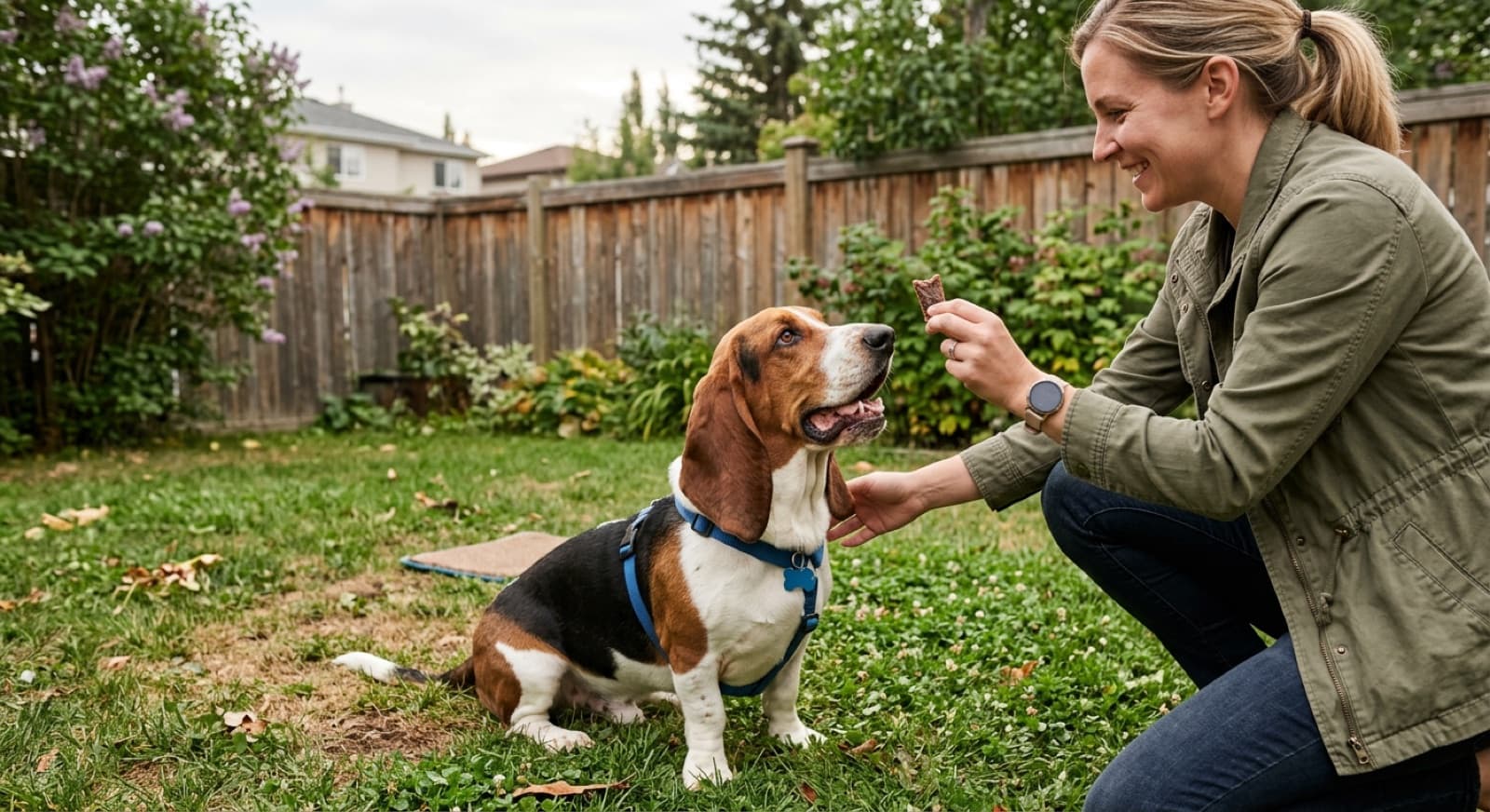
- Start in a zero-distraction environment (your living room). Reward heavily (cooked chicken, freeze-dried liver, not regular kibble). Pair the recall cue 20+ times before expecting any response.
- Move to the backyard. Same protocol. Reward every successful recall, even a partial response.
- Move to long-line walks (15 ft biothane). Practice recall every 20 to 30 paces.
- Add mild distractions (smells, sounds). Continue rewarding.
- NEVER call your Basset for something they don't want (bath, vet, end of fun). Doing this teaches them recall = bad outcome.
- Practice the “emergency recall”: a separate distinct cue (whistle pattern) reserved for emergencies, paired with the highest-value treat (raw beef heart, cheese). Never use casually.
- Acceptance: even with excellent training, your Basset's recall in scent-rich environments will be 60 to 70% reliable at best. That's not failure. That's the breed. Build management around the limit.
Avoid trainers who promise “100% off-leash recall” with Bassets. They're either exaggerating or using aversive methods that damage trust. AVSAB's humane dog training position statement covers why aversive tools should not be used.
How do I escape-proof my yard for a Basset?
Bassets escape via digging, not jumping. Fence-jumping is essentially impossible for Bassets due to short legs and heavy build (this is one breed where Calgary 4-ft fences are tall enough).
Actual Basset escape risks: digging under fences, slipping through gaps, escaping through gates left open, escaping during scent-tracking when distracted.
Fence requirements for Calgary Basset yards:
- Minimum 4 ft tall fence (Bassets won't jump over).
- Bury chicken wire or hardware cloth 6 to 12 inches down at the fence base. Prevents digging under. Calgary cost: $150 to $400. Alternative: install L-footers (chicken wire bent 90 degrees, laid flat extending 18 to 24 inches inward from the fence base).
- Inspect for gaps regularly. Bassets squeeze through 6-inch gaps easily.
- Self-closing gate latches. Gates left ajar by visiting kids or landscapers are a common escape route.
- No “invisible fence” or shock collars for Bassets. Scent drive overrides shock pain when motivated, the tools damage trust, and they don't work for scent hounds.
Calgary Basset escape recovery: if your Basset escapes, immediately:
- Walk in the direction the dog likely went (downwind for scent).
- Call 311 to report (Calgary 311 maintains a dog-found database).
- Post on Calgary lost pet Facebook groups (Calgary Lost & Found Pets, AB Lost Pet Network).
- Check Calgary Animal Services intake daily.
- Put strong-smelling clothing items at your front door (Bassets often return to the smell).
Most lost Bassets are found within 24 to 48 hours if owners take immediate action.
How do I train back-protection?
Back-protection is the single most important Basset training topic. It has to be taught to the dog, not just to the owner.
The behaviours to teach:
- “Wait” before getting off furniture. Train your Basset to pause and wait for permission or help. Use a verbal cue plus a hand signal, lift them down, reward.
- “Ramp.” Teach your Basset to use ramps for car, couch, and bed access. Slow positive introduction with treats over 1 to 2 weeks.
- “Off.” Clear cue to get off furniture (using a ramp or with assistance).
- Stair management. Train “stay” at the top of the stairs while you go down, then carry them down. For multi-level homes, gate stairs.
- Avoid jumping training entirely. Never train your Basset to “up” onto chairs, couches, or beds without ramps.
For adopted adult Bassets: they often haven't been trained back-protection. Implement immediately upon adoption. The “habit” of jumping needs to be unlearned, which takes 6 to 12 months of consistent management.
Common mistake: thinking “my Basset has been jumping fine for years, it's probably ok now.” IVDD episodes can occur at any age and the cumulative spinal damage from years of jumping eventually triggers an episode.
How do I train leash manners for a stubborn scent hound?
Front-clip harness plus patient consistent training. Bassets pull on leash because their nose pulls them. This is genetic-driven, not deliberate disobedience.
Front-clip harness mechanics: the leash attaches to a ring on the chest (not the back). When the Basset pulls forward, the harness gently turns them sideways, redirecting their momentum.
Calgary recommended brands: Ruffwear Front Range, 2 Hounds Design Freedom No-Pull, Blue-9 Balance harness. $40 to $80.
NEVER use prong, choke, or e-collar on a Basset. Neck pressure can cause IVDD episodes (transmits force down the spine), and aversive methods damage the already-difficult trust relationship.
Training protocol:
- Walk slowly. Bassets are scent-and-stop dogs, not heel-and-march dogs. Embrace the pace.
- Reward checking-in. Every time your Basset looks at you during a walk, mark (“yes!”) and treat. Builds engagement.
- Stop when leash tension goes tight. Wait for your Basset to release tension. Resume walking. Repeat.
- Direction changes. When your Basset pulls toward something exciting, calmly turn 180 degrees. They learn pulling = no progress.
- Shorter walks in higher-distraction environments until leash skills are solid.
Realistic expectations: your Basset will probably never heel like a Border Collie. They WILL eventually walk on a loose leash 70 to 80% of the time with some pulling on scent triggers. That's a successful outcome, not a failure.
How do I manage Basset baying and barking?
Baying is genetic communication, not a behavioural problem. But it can be managed. The bay is genuinely loud (90 to 100 dB at close range, similar to a chainsaw).
Why baying happens:
- On scent. Communicates to “the pack” (you).
- Alert. Detects an unusual stimulus (mail carrier, neighbour, squirrel).
- Anxiety or separation. Left alone, may bay for hours.
- Boredom. Under-stimulated.
- Pain. Chronic baying can signal undiagnosed pain (back, ear infection, glaucoma).
Management protocol:
- Address underlying causes first. Vet check to rule out pain. Increase exercise (sniff walks, mental enrichment). Manage separation anxiety. Reduce trigger exposure (close blinds, move the bed away from windows).
- Don't reward attention-seeking baying. Ignore until quiet, then reward calm.
- Train a “quiet” cue. Mark plus treat for spontaneous quiet moments after baying.
- Bay-friendly environments. Single-family detached homes, basement suites with thick walls. Less common in modern condos.
- Calgary apartment strategies: white noise machines mask outdoor triggers, window film prevents visual triggers, daycare during workdays prevents anxiety baying.
Avoid: bark collars (especially shock collars, which damage trust and can cause an IVDD episode in Bassets). Citronella collars rarely work on dedicated bayers. Surgical debarking is unethical and rarely effective.
Discuss with neighbours proactively if you live in attached housing. Bassets WILL bay sometimes despite best management.
How does Calgary winter and summer affect Basset training?
Calgary winter HELPS Basset training; summer HURTS it.
Winter helps because
- Reduced wildlife scent activity.
- Bassets dislike cold, so there's less enthusiasm for scent-tracking.
- Snow muffles outdoor sounds.
- More indoor enrichment time (trick training, scent games).
- Owners more engaged with structured training.
Summer hurts because
- Wildlife scent density peaks May to September.
- Long daylight encourages off-leash adventures.
- Heat reduces training engagement.
- Owners want to use Calgary off-leash culture (where Basset training fails).
Calgary winter Basset training optimisation: indoor trick training daily, scent games (hide treats, command “find it”), mental puzzles (Kong toys, snuffle mats), and short outdoor sessions when temps allow (above -15°C with a sweater for short-coats).
Calgary summer Basset training maintenance: maintain leash skills (don't slip into “off-leash because it's nice out”), use Sniffspots for safe off-leash, time walks for early morning or late evening, and accept that summer walks involve more pulling and less compliance.
What about training Basset puppies from week 8?
Puppy training for Bassets has unique challenges due to immediate back-protection requirements, early scent-drive emergence, and standard puppy mouthing, jumping, and teething.
The 0 to 12 week protocol:
- Back-protection from day one. NO stairs, NO jumping. Carry the puppy. This is non-negotiable. Early back damage compounds for life.
- Crate training. Bassets generally accept crates well. Use a crate sized for an adult Basset with a divider.
- Socialisation window (3 to 16 weeks). Calgary urban environment exposure: surfaces, sounds, people, friendly dogs.
- Recall training from week 8 in zero-distraction environments. By week 16, recall should be solid in a fenced yard.
- Loose leash training from week 12. Front-clip harness from the start.
- Bite inhibition. Standard puppy mouthing protocol. Bassets typically mature out of biting by 5 to 6 months.
Critical no-no's for Basset puppies:
- NO stairs. Period. Until at least 6 months, and ideally never without supervision.
- NO jumping training. Never reward “up” onto furniture.
- NO rough play that involves twisting or pulling on the body.
- NO running on hard surfaces for prolonged periods.
- NO collar leash work. Harness from week 8.
The first 18 months of a Basset puppy are demanding. Adopting an adult Basset (3 to 7 years) skips most of this and is the right choice for most first-time Basset owners.
What Calgary force-free trainers work well with Bassets?
Force-free trainers with hound-specific experience are ideal. Bassets respond poorly to aversive methods due to neck IVDD risk, breed-specific stubbornness, and trust-building requirements.
Calgary force-free trainers we'd recommend for Bassets:
- Raising Canine. Force-free, experienced with scent hounds and working breeds. Strong fit for stubborn or vocal breeds.
- Pup City Pup Academy. Force-free, group classes and private behaviour work, comfortable with hounds.
Both align with IAABC and AVSAB humane training standards.
What to ask when interviewing trainers:
- “Have you trained Bassets or other scent hounds specifically?”
- “What's your approach to recall for scent hounds?” (Should be honest about realistic limits, NOT promise 100% off-leash.)
- “Do you use food rewards? Prong collars? E-collars?” (Force-free means food and verbal rewards only. Avoid prong or e-collar trainers.)
- “How do you handle stubbornness?” (Force-free trainers answer: patience, higher-value rewards, environmental management. Aversive trainers answer: corrections, “showing them who's boss.” Choose force-free.)
Total Calgary Basset training investment: typically $500 to $1,500 over 3 to 6 months for foundation behaviours. Adolescent or behavioural problem training: $1,500 to $3,000+ over 6 to 12 months.
When is behavioural medication appropriate for a Basset?
For most Bassets, never. They're generally not anxiety-prone. But specific circumstances may warrant a behavioural medication consultation with your vet.
Specific circumstances (these are guidance only; always consult your veterinarian or a veterinary behaviourist before starting any medication):
- Severe separation anxiety. Bassets prone to attachment can develop true SA with destructive chewing, prolonged baying, self-injury.
- Severe noise phobia. Especially around Calgary Stampede fireworks (10 nights in July), Canada Day, and NYE.
- Adult-onset reactivity. If training alone isn't resolving in 8 to 12 weeks.
- Senior cognitive dysfunction. Older Bassets (10+) sometimes develop dog dementia. Selegiline and diet supplementation can help.
- Chronic pain-related behavioural changes. Treat pain first. Behavioural meds are a poor substitute for pain management.
Common medication classes discussed with vets (do not self-prescribe; dosing and suitability are case-by-case):
- Fluoxetine (Prozac). Daily SSRI for baseline anxiety, roughly $30 to $60 per month.
- Trazodone. Situational pre-trigger (vet visits, fireworks), roughly $15 to $30 per dose.
- Sileo (dexmedetomidine gel). Storm or firework specific, roughly $50 to $80 per tube.
- Gabapentin. Anxiolytic and analgesic.
Calgary specialty veterinary behaviourist: Western Veterinary Specialist Centre and VCA Canada West (consultation roughly $300 to $500).
Most Bassets don't need behavioural medication. Most behavioural issues respond to environmental management plus training plus addressing underlying medical issues. Medication is appropriate for the small subset of Bassets with genuine behavioural pathology, not as a first-line response to typical Basset stubbornness.
Frequently Asked Questions
Why is Basset recall so bad?
Genetics, not training failure. The scent-processing brain centre outcompetes recall processing. Bassets were bred for centuries to follow scent over distance. Most lifelong Basset owners never trust their dogs off-leash in unfenced spaces. Build management around the limit.
Off-leash safe in Calgary?
Almost never unfenced. AVOID Nose Hill, Fish Creek, Bowmont, and Weaselhead (wildlife scent corridors, 3 to 5 km escape range). Use Sniffspot rentals ($15 to $30/hr fenced) or long-line walks (15 to 30 ft biothane, $30 to $80) instead.
Best possible recall training?
The realistic goal is reliable recall in low-distraction settings. Build the foundation in your living room, then backyard, then long-line. NEVER call for something they don't want. Reserve an emergency recall (whistle pattern, highest-value treat) for true emergencies. 60 to 70% reliability max in scent-rich settings is a successful outcome.
Yard escape-proofing?
Bassets dig under, they don't jump over (4 ft fence enough). Bury chicken wire 6 to 12 inches or install L-footers ($150 to $400). Self-closing gate latches. NEVER use invisible or shock fences (scent drive overrides them, and they damage trust). If a Basset escapes: call 311, post in lost pet groups, check Calgary Animal Services intake daily.
Back-protection training?
Most important Basset training. Teach “wait” before furniture, ramp use, “off” cue, stair management. Never train “up” onto furniture. For adult adoptions, implement immediately. It takes 6 to 12 months to unlearn a jumping habit. IVDD episodes can occur at any age.
Leash manners for stubborn Bassets?
Front-clip harness ($40 to $80) ALWAYS. Never prong, choke, or e-collar (IVDD risk and trust damage). Walk slowly, reward check-ins, stop when leash tightens, use direction changes. A realistic outcome is 70 to 80% loose leash with some scent-trigger pulling.
Baying management?
Baying is genetic communication, not a problem to suppress. It runs 90 to 100 dB at close range. Address underlying causes (pain check, exercise, separation anxiety, trigger reduction). Don't reward attention-seeking baying. Bay-friendly housing matters. AVOID bark or shock collars.
Calgary winter vs summer training?
Winter HELPS (less wildlife scent, snow muffles, more indoor work). Summer HURTS (peak scent density May to September, owner off-leash temptation). In winter: trick training daily and scent games. In summer: maintain leash work, use Sniffspots, walk early or late.
Puppy training week 8?
Back-protection from day one (NO stairs, NO jumping, carry the puppy). Crate, socialisation 3 to 16 weeks, recall in a fenced yard by 16 weeks, loose leash and harness from week 12. NO collar leash work. The first 18 months are demanding. Most adopters are better off with an adult Basset.
Calgary force-free trainers?
Raising Canine and Pup City Pup Academy are the two force-free Calgary trainers we'd recommend for hounds. AVOID prong or e-collar trainers, and anyone promising 100% off-leash recall. Total investment: $500 to $1,500 foundation, $1,500 to $3,000 for behavioural cases.
Behavioural medication?
Most Bassets never need it. Specific cases: severe SA, severe noise phobia (Stampede), adult-onset reactivity, senior cognitive dysfunction, chronic pain. Fluoxetine ($30 to $60/mo), trazodone ($15 to $30/dose), sileo ($50 to $80/tube). Always work with your vet or a veterinary behaviourist (consult roughly $300 to $500).
Stairs and furniture rules, full enumeration?
Puppy (under 12 months): NO stairs unsupervised, NO jumping off any furniture, ramps mandatory for car, couch, and bed. Five-minute-per-month-of-age exercise rule. Adult Basset: limited daily stair count (rough budget 2 to 4 short flights per day max), ramps for couch and bed strongly preferred (especially overnight bed access where dogs jump down without thinking), gates at the top of stairs to prevent unsupervised use. Senior Basset: ramps non-negotiable, single-level home or first-floor bedroom ideal. The biggest cumulative IVDD risk is years of small jumps off the couch, not occasional stair climbing.
Calgary winter paw care?
Bassets have a weather-resistant single coat (cold-tolerant for short periods, intolerant for long). Pawz disposable rubber boots work where rigid boots fail (Basset short-leg anatomy doesn't fit standard boots). Musher's Secret wax for salt protection. Paw-drying after walks (between the toes) for interdigital cyst prevention. Limit outdoor time to 5 to 10 minutes at -25°C and below. See our Basset grooming guide for the full Calgary winter paw care protocol.
Exercise dosing per age?
Puppy (under 12 months): 5-minute-per-month-of-age rule. A 4-month puppy gets 20-minute walks max. NO running, NO long hikes, NO jumping play (developmental joint protection). Adult (1 to 7 years): 30 to 60 minutes per day split into 2 or 3 walks. Sniff-rich slow walks beat fast structured ones. Senior (7+ years): 20 to 45 minutes per day at a very slow pace, watch for stiffness in Calgary cold. Why long weekend hikes are worse than short daily walks: Bassets fatigue easily, and weekend warriors injure backs and joints. Daily moderate consistent beats bursts of intense.
Basset Hound Adoption Calgary
Where to find them, costs, Calgary Basset Rescue Society verification, Bassador mix, adult adoption framing.
Basset Health Issues
IVDD, chronic ear infections, glaucoma, obesity, and bloat. The breed-specific health profile.
Calgary Off-Leash Parks
All Calgary off-leash parks reviewed. Useful context for understanding why Bassets struggle in most of them.
Calgary Lost Dog Action Plan
If your Basset escapes despite escape-proofing, the immediate Calgary recovery protocol.
New dog? Start with these care guides
Everything a new adopter needs to set up a safe, happy home.