Showing 19 cats
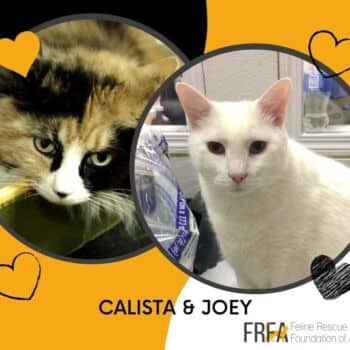
Special needs cats — also searched as “disabled cats” or “handicap cats” — are some of the longest-waiting rescues in Calgary. The category covers FIV+ and FeLV+ cats, blind and deaf cats, three-legged cats (tripods), cats with diabetes or hyperthyroidism, asthmatic cats, cats with cerebellar hypoplasia (“wobbly cats”), cats with chronic kidney disease, and senior cats with managed medical conditions.
Most special needs cats adapt to indoor life beautifully and are no harder to live with than any other cat once you understand the basics. FIV+ cats live full normal lifespans in indoor-only homes. Blind and deaf cats map a familiar home in 1-2 weeks. Tripod cats jump and run like four-legged cats. Asthmatic cats stabilize on inhalers. The biggest barrier is usually the adopter's hesitation, not the cat's condition.
Calgary cat rescues typically reduce adoption fees for special needs cats and many include partial veterinary support, ongoing medication discounts, or a “take it back” commitment if circumstances change. Listings listed here are from 7 Calgary-area cat rescues including MEOW Foundation, AARCS, Calgary Humane Society, Pawsitive Match, Cochrane Humane, Heaven Can Wait, and Feline Rescue Foundation of Alberta. For a full breakdown of what to expect, costs, and how to prepare, read our complete special needs cat adoption guide.
Special Needs Cat Adoption FAQ
How much does a special needs cat cost to care for in Calgary?▼
Depends on the condition. FIV+, FeLV+, blind, deaf, and tripod cats cost the same as any rescue cat (around $800–$1,500/year). Diabetic cats add $80–$150/month for insulin and supplies. Asthmatic cats add $30–$80/month for inhalers. Hyperthyroid cats add $30–$60/month for medication or $1,500–$2,500 one-time for radioactive iodine cure. Most Calgary cat rescues offer reduced adoption fees ($50–$150 vs $150–$300) and many include first-year vet support.
Is FIV contagious to other cats?▼
FIV is only spread cat-to-cat through deep bite wounds, not casual contact, food bowls, or grooming. FIV+ cats can live with FIV-negative cats safely if introductions are managed and the FIV+ cat is non-aggressive. Most FIV+ cats live full normal lifespans (12–15+ years) in indoor-only homes. FIV does NOT pass to humans, dogs, or any other species. See our FIV+ cats guide for full details.
Can blind or deaf cats live indoors alone during the day?▼
Yes, in a familiar home. Blind cats map a home through scent and memory and navigate confidently after 1–2 weeks. Deaf cats sleep through the day like any other cat. The two main precautions: keep furniture in fixed positions (blind cats rely on layout consistency) and approach a deaf cat from the front rather than startling them awake.
What is cerebellar hypoplasia (CH) in cats?▼
Cerebellar hypoplasia is a non-progressive neurological condition where the kitten's cerebellum did not develop fully in utero (typically due to feline panleukopenia exposure during pregnancy). CH cats wobble, have tremors, and may struggle with balance — but they live normal lifespans, are not in pain, and adapt well to indoor homes with low furniture and rugs for traction. Often called “wobbly cats.”
New to special needs cat adoption?
Read our complete guide covering FIV+, FeLV+, blind, deaf, tripod, diabetic, asthmatic, and CH cats — what to expect, real Calgary cost ranges, and how to set up your home.
Read the full special needs cat adoption guide →