The reality every Boxer owner needs to understand
40–60% of Boxers develop cancer in their lifetime. ~20% develop ARVC (Boxer cardiomyopathy). Many face both. This is the breed, acceptance enables preparation. Pet insurance enrolled immediately + annual cardiac screening starting age 3 + annual cancer screening starting age 5 + monthly home body checks + Calgary specialty vet relationship + emergency fund = managing the medical reality with dignity. The shorter Boxer lifespan (10–13 years vs 12–15 for many breeds) makes every healthy year more meaningful.
Why do Boxers get cancer so often?
Boxers have one of the highest cancer rates of any dog breed, 40–60% lifetime depending on study. Multiple genetic factors contribute:
- Genetic predisposition concentrated in modern breeding lines (small founder population in 1900s)
- Mast cell tumor risk specifically tied to KIT gene mutations common in Boxers
- Brain tumor risk (especially gliomas) elevated in brachycephalic breeds
- Hemangiosarcoma risk in spleen + heart
- Osteosarcoma in legs (large breeds generally)
- Lymphoma, most common cancer in Boxers, often presenting as enlarged lymph nodes
The honest reality: even health-tested CKC breeder lines produce cancer-prone dogs because cancer is breed-wide. There is NO DNA test for most cancers. Lineage research (cancer in close relatives elevates risk) helps somewhat but doesn't eliminate concern.
Calgary veterinary oncology referrals: WVSC (Western Veterinary Specialist Centre), VCA Canada West, CARE Centre, all have oncology departments.
The 5 most common Boxer cancers
1. Mast Cell Tumors: most common Boxer cancer. Skin lumps that may grow, change, ulcerate. Some aggressive (high-grade), some indolent. ANY new skin lump warrants vet evaluation + fine-needle aspirate ($150–$400 Calgary). Treatment: surgical removal $1,500–$5,000 depending on grade + location, sometimes chemotherapy or radiation.
2. Lymphoma: second most common. Enlarged lymph nodes (under jaw, in front of shoulders, behind knees) most commonly first sign. Sometimes weight loss, lethargy. CHOP chemotherapy protocol most common treatment, $5,000–$15,000 Calgary, 12-month median survival.
3. Hemangiosarcoma: aggressive cancer of blood vessels, most often spleen, heart, or skin. Splenic hemangiosarcoma often presents as sudden collapse from internal bleeding (medical emergency). Cardiac form sometimes silent until rupture. Splenectomy + chemotherapy $5,000–$10,000, prognosis usually 4–6 months.
4. Osteosarcoma: bone cancer, usually leg. Limping that doesn't resolve, swelling. Amputation + chemotherapy $5,000–$15,000, median survival 12 months with treatment.
5. Brain Tumors: increasingly diagnosed in Boxers. Symptoms: seizures (new-onset adult seizures), behaviour change, circling, head tilt, loss of training, blindness. MRI diagnosis $2,500–$4,000. Treatment limited (radiation, surgery sometimes). Median survival varies.
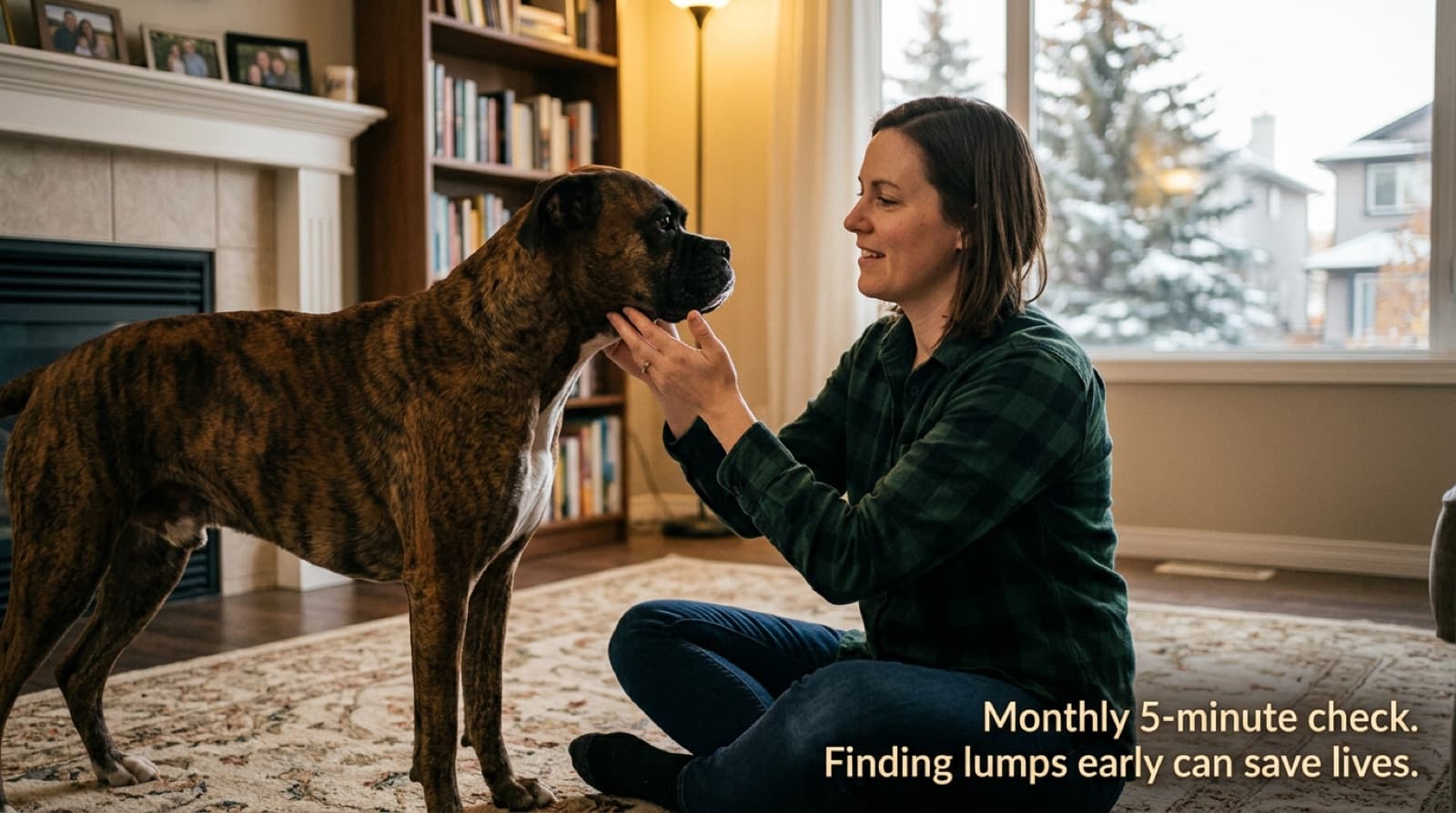
Early detection saves lives + reduces treatment cost. Monthly home body checks (lumps, lymph nodes, mobility) essential.
Boxer cardiomyopathy (ARVC) explained
Arrhythmogenic Right Ventricular Cardiomyopathy (ARVC) is a Boxer-specific heart condition affecting ~20% of the breed. The right ventricle muscle is gradually replaced by fatty/fibrous tissue, causing irregular heart rhythms (arrhythmias) that can lead to fainting (syncope), exercise intolerance, or sudden cardiac death.
ARVC is genetic, caused by a striatin gene mutation, with multiple risk genes still being identified. Inheritance is autosomal dominant with incomplete penetrance, meaning a dog can carry the mutation and never show signs, while another carrier dog develops severe disease.
Symptoms:
- Fainting episodes (especially during/after exercise)
- Exercise intolerance, slowing down, refusing activity
- Weakness, lethargy
- Coughing (rare)
- Sometimes NO symptoms before sudden death
Screening: 24-hour Holter monitor (ambulatory ECG) is the gold standard. Annual screening recommended starting age 3. Reputable Boxer breeders screen all breeding adults.
Diagnosis: Holter shows VPCs (ventricular premature complexes). Frequency + complexity determines severity. >100 VPCs/24hr = consider treatment. >1,000/24hr = significant disease. Echocardiogram complementary (rules out other cardiac disease).
Treatment: anti-arrhythmic medication (sotalol, mexiletine) $100–$400/month. Cannot cure, manages arrhythmias to reduce sudden death risk. Some dogs live near-normal lifespans with treatment; others succumb to sudden cardiac death even on medication.
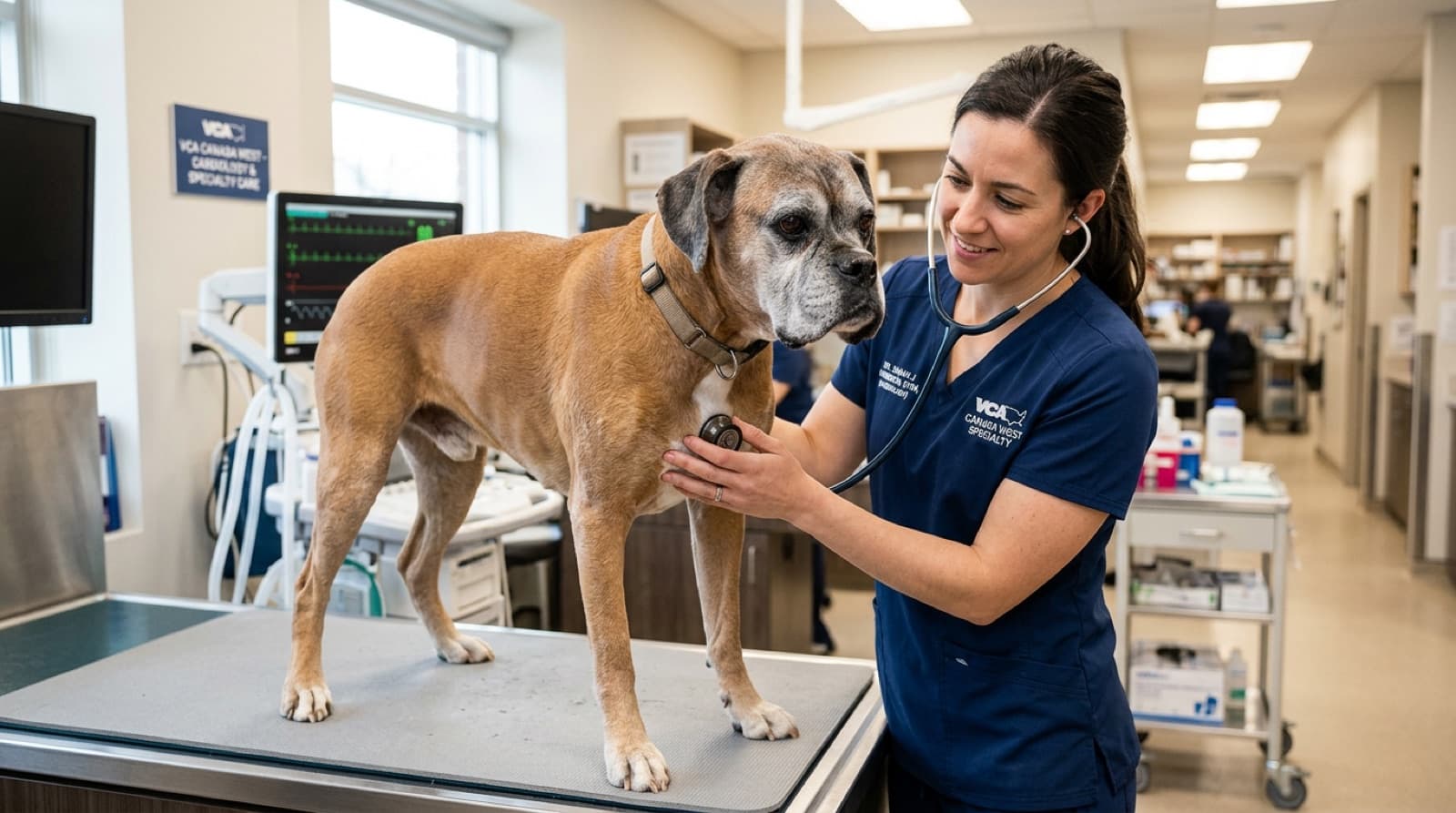
Calgary cardiology: WVSC + VCA Canada West veterinary cardiology can perform Holter monitor placement ($400–$800 per screening).
Calgary specialty vet network
Calgary has strong specialty veterinary services for Boxer health concerns.
Oncology:
- WVSC (Western Veterinary Specialist Centre), board-certified veterinary oncologists, full chemo + radiation programs
- VCA Canada West, oncology department, chemo programs
- CARE Centre Animal Hospital, emergency + specialty referral including oncology
- Sometimes referrals to Saskatoon WCVM (Western College of Veterinary Medicine) for complex cases
Cardiology:
- WVSC, board-certified veterinary cardiologists. Echocardiogram + Holter monitor placement + ECG interpretation
- VCA Canada West, cardiology services
- Some general vets offer Holter monitor placement (sent for cardiologist interpretation)
24-hr emergency: McKnight Veterinary Hospital, critical for cardiac emergencies (collapse, syncope), splenic emergencies (hemangiosarcoma rupture), bloat.
Pricing reality (Calgary, 2026 typical):
- Initial oncology consultation $300–$500
- Diagnostic workup (bloods, imaging, biopsy) $1,500–$3,500
- Mast cell tumor surgery $1,500–$5,000 grade-dependent
- CHOP chemotherapy protocol (lymphoma) $5,000–$15,000
- Radiation course $5,000–$10,000
- Cardiology consultation + echo $400–$800
- Holter monitor placement + interpretation $400–$800
- Ongoing anti-arrhythmic medication $100–$400/month
- Emergency abdominal surgery (splenic hemangio) $5,000–$10,000
Warning signs to watch for
Cancer warning signs:
- New skin lumps: any new lump warrants vet check + fine-needle aspirate. Don't wait
- Enlarged lymph nodes: feel under jaw, in front of shoulders, behind knees. Both sides simultaneously enlarged = lymphoma red flag
- Unexplained weight loss
- Decreased appetite persisting >48 hours
- Lethargy beyond normal
- Limping that doesn't resolve in 24–48 hours (osteosarcoma risk)
- Behaviour change, circling, head tilt, seizures (brain tumor)
- New-onset adult seizures, never normal in mature dogs
- Abdominal distension (splenic mass possible)
- Pale gums (internal bleeding from splenic hemangioma rupture, emergency)
Cardiac warning signs:
- Fainting episodes (syncope): especially during/after exercise. RED FLAG
- Exercise intolerance, refusing usual activity, slowing dramatically
- Weakness, lethargy
- Resting respiratory rate elevated (>30 breaths/min sleeping)
- Coughing
- Abdominal distension (heart failure with fluid)
- Pale or blue-tinged gums
- Sudden collapse: emergency
When to go to 24-hr ER: sudden collapse, difficulty breathing, pale gums + weakness, distended abdomen suddenly, repeated fainting, severe persistent vomiting/diarrhea, bloat-suspect symptoms (unproductive retching, distended abdomen, restlessness, drooling).
Monthly 5-minute home exam: palpate body for new lumps, check lymph nodes (jaw, shoulders, behind knees), look at gums (pink + moist normal), check ears + eyes, watch resting breathing pattern, note limping/stiffness, weigh monthly.
Pet insurance ROI for Boxers
Pet insurance is exceptionally strong ROI for Boxers due to cancer + cardiac risk. Many Calgary owners report insurance as the difference between life-saving treatment + heartbreaking economic euthanasia.
Why insurance matters for Boxers specifically:
- Cancer rate 40–60% lifetime, many owners face $10K–$30K+ treatment cost
- ARVC affects ~20%, annual Holter monitoring + medication $1,500–$5,000/year if diagnosed
- Aortic stenosis sometimes adds cardiac costs
- Bloat (GDV) emergency $5K–$10K Calgary
- Hip dysplasia surgery $5K–$15K
Calgary Boxer insurance premiums: $50–$120/month puppies, $80–$200/month adults. Annual $600–$2,400. Lifetime (10–13 years) $7K–$30K in premiums.
Recommended Calgary insurers:
- Trupanion: 90% coverage, no annual limits, no per-condition caps. Best for cancer + chronic disease. ~$80–$150/month adult Boxer Calgary
- Pets Plus Us, competitive pricing, good cancer coverage
- OVMA Pet Health Insurance, Veterinary Medical Association partnership
- Fetch (formerly PetPlan), competitive options
Enroll early: pre-existing conditions excluded. Enroll puppy IMMEDIATELY. Adopting adult Boxer? Enroll within first 14 days of adoption. Most insurers have 14–30 day waiting period for illness coverage; longer for orthopedic + cancer (3–6 months).
Bottom line: managing the reality
Accept the reality: 40–60% of Boxers face cancer; ~20% face ARVC; many face both. This is the breed. Wishing it away doesn't change the genetics. Acceptance enables preparation.
Successful management if:
- Pet insurance enrolled IMMEDIATELY
- Annual cardiac screening starting age 3 (Holter monitor at WVSC/VCA Canada West)
- Annual cancer screening starting age 5 (senior bloodwork + physical exam + sometimes ultrasound)
- Monthly home body checks (5 min, lump + lymph node + breathing pattern)
- Weight management lifelong (BCS 4–5/9)
- Calgary specialty vet relationship established (WVSC, VCA Canada West, CARE Centre, McKnight 24-hr ER pre-programmed)
- Emergency fund $5K–$15K minimum
- Family conversations + financial planning before crisis
The payoff: Boxers are extraordinary companions. Goofy, loyal, devoted, family-bonded. The medical reality is real but doesn't define the relationship. Many Calgary Boxer owners describe their dogs as their best friends through cancer + cardiac journeys. The shorter lifespan often makes every healthy year more meaningful.
Browse adoptable Boxers in Calgary
Foster-evaluated rescue Boxers from 13+ Calgary rescues, adult adoption preferred + pet insurance enrolled within 14 days = best path for first-time Boxer owners. Updated regularly.
See Available Boxers →Frequently Asked Questions
Why do Boxers get cancer so often?
40–60% lifetime cancer rate. Genetic predisposition concentrated in modern breeding lines. KIT gene mutations elevate mast cell tumor risk. Brain tumors elevated in brachycephalic breeds. No DNA test for most cancers, even health-tested breeder lines produce cancer-prone dogs. Pet insurance + Calgary oncology essential.
What is ARVC (Boxer cardiomyopathy)?
Arrhythmogenic Right Ventricular Cardiomyopathy. ~20% breed prevalence. Right ventricle replaced by fatty/fibrous tissue → arrhythmias → fainting/sudden death. Genetic (striatin gene + others). Annual Holter monitor screening starting age 3. Sotalol/mexiletine treatment $100–$400/month.
Most common Boxer cancers?
Mast cell tumors (#1, skin lumps), lymphoma (#2, enlarged lymph nodes), hemangiosarcoma (spleen/heart, often emergency presentation), osteosarcoma (bone, leg limping), brain tumors (seizures, behaviour change). Monthly home body checks essential for early detection.
Calgary veterinary oncology + cardiology?
Oncology: WVSC, VCA Canada West, CARE Centre. Cardiology: WVSC, VCA Canada West. 24-hr ER: McKnight. Treatment costs: mast cell surgery $1.5K–$5K, CHOP chemo $5K–$15K, Holter $400–$800, splenic emergency surgery $5K–$10K.
Boxer life expectancy?
10–13 years typical. Healthy Boxers reach 12–14 with good care. Cancer/cardiac reduces lifespan significantly. Lean weight (BCS 4–5/9), annual cardiac screening starting age 3, cancer screening starting age 5, dental care, pet insurance = magnificent partnership for the years you have.
Pet insurance ROI for Boxers?
Exceptionally strong. Cancer 40–60% lifetime + cardiac costs make insurance often the difference between treatment + economic euthanasia. Trupanion best (90% coverage, no caps). $50–$120/month puppies, $80–$200 adults. Enroll IMMEDIATELY before pre-existing diagnoses.
Warning signs to watch for?
Cancer: new skin lumps, enlarged lymph nodes (both sides = lymphoma red flag), unexplained weight loss, persistent limping, seizures, pale gums. Cardiac: fainting (syncope), exercise intolerance, elevated resting respiratory rate, sudden collapse. Monthly 5-min home body check essential.
Should I screen rescue Boxer for cancer + cardiac?
YES. Adoption baseline: full physical, blood chem + CBC, urinalysis, heartworm. Annual cardiac (Holter $400–$800) starting age 3. Annual cancer screening (senior bloodwork + physical + sometimes ultrasound) starting age 5. Pet insurance baseline often required.
Bottom line: managing the reality?
Accept the reality (40–60% cancer, 20% ARVC). Pet insurance immediate. Annual Holter starting age 3. Annual cancer screening starting age 5. Monthly home checks. Weight management. Calgary specialty vet relationship. Emergency fund $5K–$15K. Magnificent 10–13 year partnership awaits.
Adoptable Boxers in Calgary
Live listings of Boxers + Boxer mixes from 13+ Calgary rescues.
Boxer Health Issues Overview
Cancer 40–60%, BOAS, ARVC, aortic stenosis, hip dysplasia, lifespan.
Boxer Brachycephalic + Calgary Climate
Heat stroke + cold + BOAS exercise limits + Calgary weather.
Buy or Adopt a Boxer?
Cost + health-testing comparison + when each path makes sense.
New dog? Start with these care guides
Everything a new adopter needs to set up a safe, happy home.