The honest first-timer answer
We tell first-time Calgary adopters this all the time: the Bullmastiff is one of the more honestly first-time-friendly big breeds. Not because it's an easy dog, but because the challenges are predictable. Size, lifespan, drool, medical costs. Boxer and Rottweiler families get blindsided by adolescent behaviour they didn't plan for. Bullmastiff families don't. The breed is calm, low-drive, and doesn't outpace inexperienced handlers the way working breeds do. The catch is that the financial commitment is real and the lifespan grief is real. If you're willing to budget for $80 to $150 a month in pet insurance from day one and you've made peace with an 8 to 10 year dog, this breed is genuinely a good first big-dog choice.
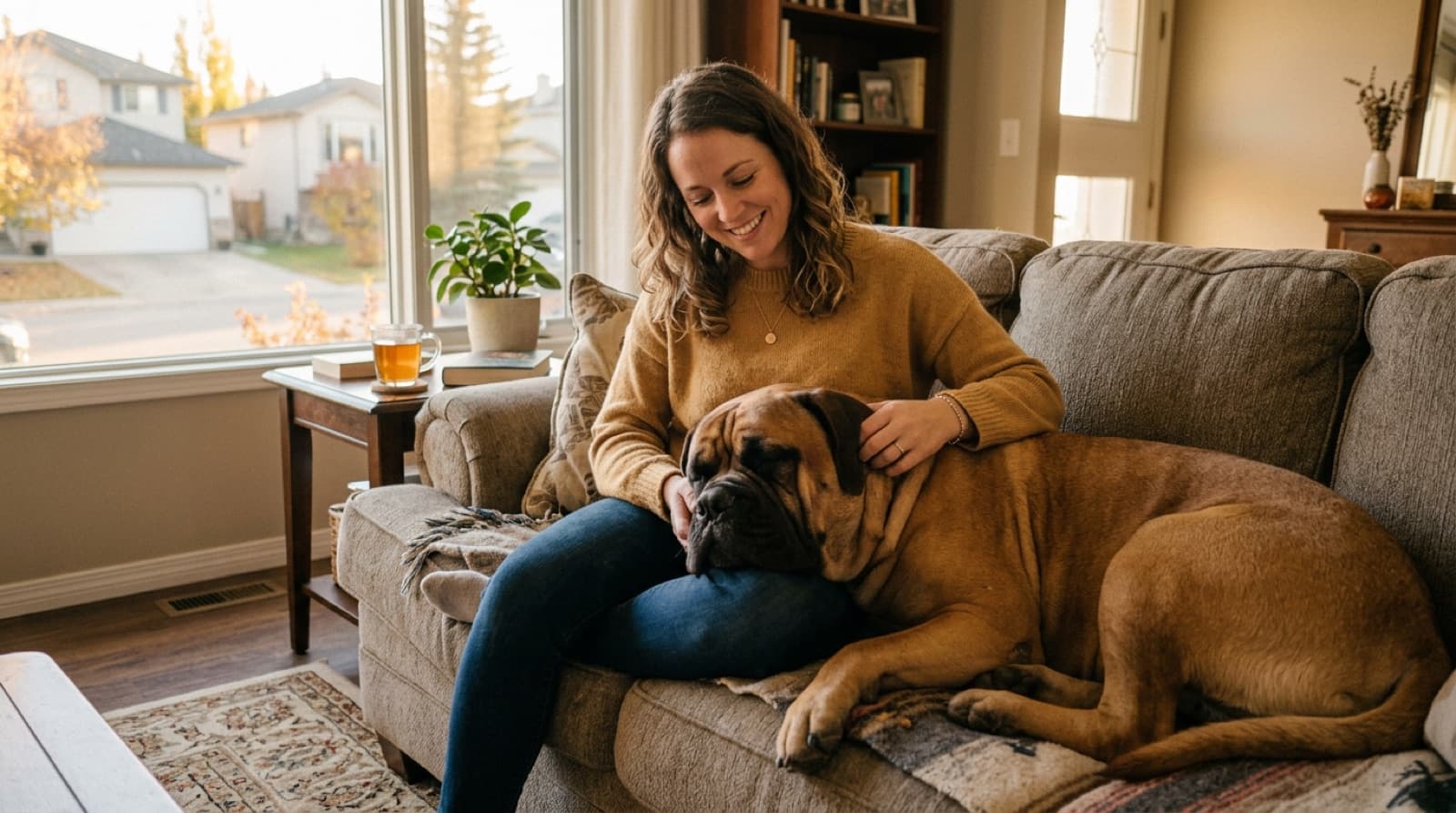
When Bullmastiff as a first dog works
The pattern we see for successful first-time Bullmastiff families in Calgary:
- Months of breed research before adopting (not weeks)
- A Calgary force-free trainer relationship lined up before the dog comes home
- Living situation fixed for the next 8 to 10 years (not moving every two years, no major life transitions on the horizon)
- Honest budget that includes $80 to $150 a month in pet insurance from day 14
- Emotional preparation for the shorter lifespan
- Real consideration of drool as a daily lifestyle factor
- Kids 5+ or capacity for constant supervision around toddlers
- Patience to wait for the right dog instead of taking the first available one
The path that works for first-timers is usually adult adoption (3 to 7 years) through Bullmastiff Rescue Inc. (bullmastiffrescuers.net) or a Calgary foster-based rescue with a detailed temperament report. Foster-to-adopt is the bridge most committed first-time families use. You take the dog home for two to four weeks before the adoption is final. You find out in the first month whether the real temperament fits your real life.
Puppy from a CKC breeder is reasonable too if you specifically want the puppy phase, but it's honestly a harder path for first-timers because you have a year of giant-breed growth-plate management ahead, knockdown risk during the high-energy phase, and a year of figuring out who your dog is going to be. Adult adoption sidesteps all of that.
When Bullmastiff as a first dog doesn't work
The patterns that don't end well:
- Toddler at home AND adopting a new dog at the same time
- Apartment that doesn't allow 130 lb dogs (most Calgary condo boards have weight restrictions, verify in writing first)
- Budget that can't honestly absorb $25,000 to $40,000 in lifetime medical without rationing care
- Not ready emotionally for an 8 to 10 year lifespan
- Drool that's going to genuinely bother you (it's a bigger deal than non-owners think)
- Working full-time without daycare or family support, dog alone 9+ hours a day
- Going through a life transition (move, divorce, baby on the way)
The honest pivot if any of these apply: a Lab or Golden gives you a longer-lived big dog (12 to 13 year lifespan), similar family temperament, lower medical baseline, less drool, and broader Calgary rescue availability. The trade-off is more energy and shedding. For most first-time families weighing Bullmastiff against Lab/Golden, the choice comes down to which set of trade-offs you'd rather live with.
The size and knockdown reality
Bullmastiff knockdown risk is different from Boxer or Rottweiler knockdown risk. Bullmastiffs aren't bouncy. They don't do the full-body butt-wiggle greeting Boxers do, and they don't zoomies through the living room the way an adolescent Rottweiler will. The risk is sheer mass.
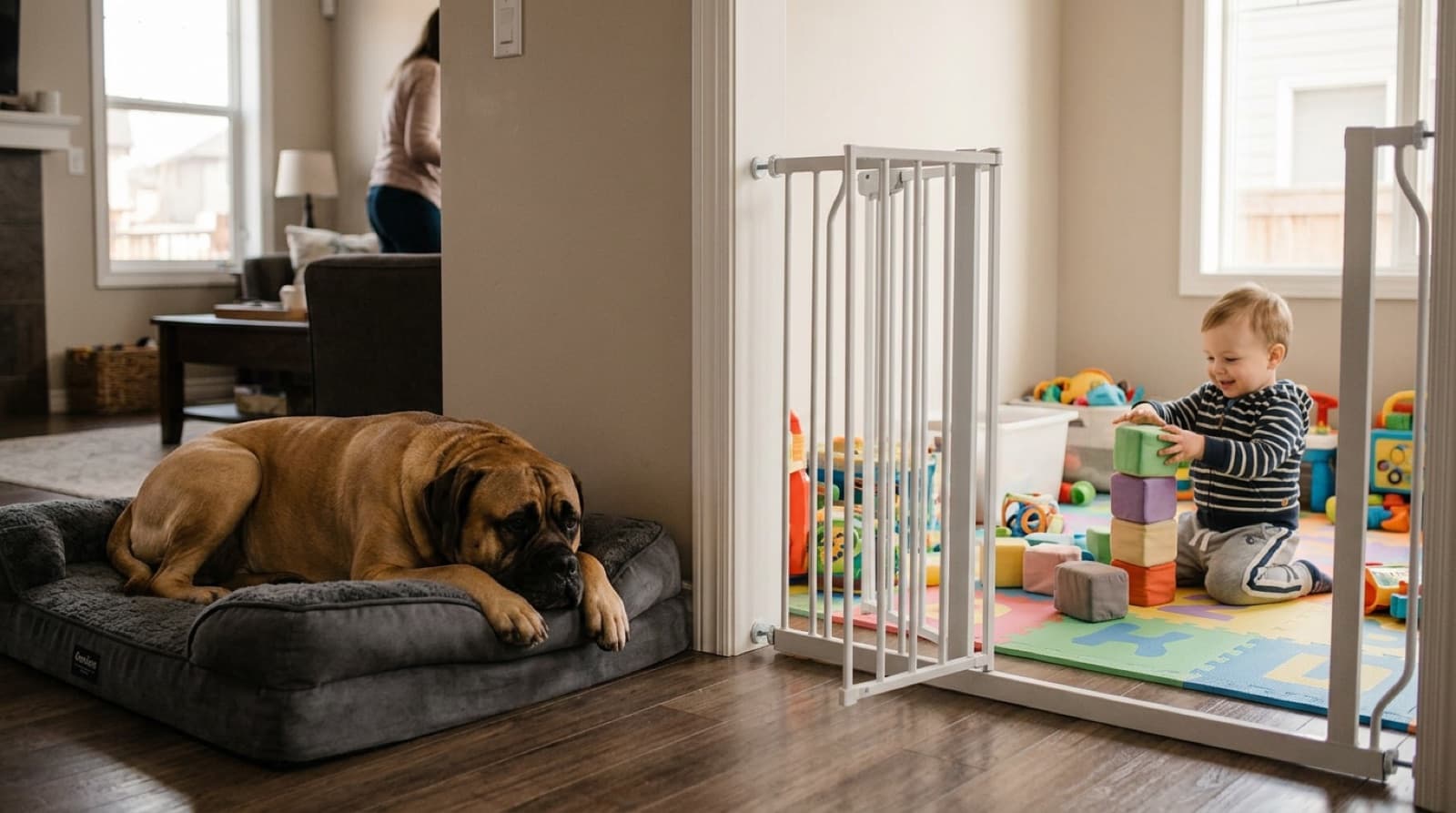
A 130 lb dog leaning against a 30 lb kid is a knockdown without anyone meaning anything by it. A Bullmastiff that decides to sit on your toddler isn't being aggressive, they're being affectionate. The toddler is still getting crushed. We've heard from Calgary families whose Bullmastiff stepped on their kid's foot and broke a toe. Nothing aggressive happened. The dog weighs as much as a small adult.
The management is mostly environmental: house-leash on adolescents, baby gates separating high-traffic kid play areas, “place” command on a designated bed your dog defaults to when the kids are running around, and supervision during meals. Calgary force-free trainers like ImPAWSible Possible build custom plans for families with small kids and big dogs. $80 to $150 per private session is the standard rate.
Knockdown risk drops dramatically once the dog is past the high-energy adolescent phase (usually 18 to 24 months for Bullmastiffs, less brutal than Rottweiler or Boxer adolescence) and the kid is past 5. Most Calgary Bullmastiff and elementary-aged kid pairings are remarkably calm and bonded.
The lifespan grief reality nobody warned you about
Bullmastiff lifespan averages 8 to 10 years. Some larger males reach 11. Few make it to 12. Compared to a Lab (10 to 12) or a Golden (10 to 12) or a Beagle (12 to 15), the Bullmastiff timeline is genuinely shorter.
The owners who do well with this are the ones who go in clear-eyed and decide the bond is worth the shorter timeline. The owners who struggle are the ones who didn't honestly research the lifespan and feel blindsided when their 7-year-old starts slowing down.
If you adopt a 4-year-old rescue, you have 4 to 6 years. If you buy a puppy and the dog has the breed-typical cancer or cardiac event in their late single digits, you might have 6 to 9 years. If you adopt a senior, you're signing up for a deliberately shorter run with the most calm grateful version of the breed.
The financial preparation matters here too. A Calgary owner facing an $8,000 to $15,000 cancer treatment decision under financial pressure makes a different choice than one with pet insurance covering 80% of the bill. We've seen both. Pet insurance enrolled in the first 14 days (Trupanion is the most-recommended for big-breed cancer coverage) is the line between treating disease and economic euthanasia. The Calgary specialty vet relationship matters too: WVSC, VCA Canada West, CARE Centre, McKnight 24-hour ER are where the end-of-life decisions get made, and having a vet you trust before that day is worth a lot.
The drool conversation
Bullmastiffs drool. The heavy jowls and the breed's saliva production combine to produce drool ropes that hang off the face and end up on your floors, your walls, your ceiling (yes, ceiling, when they shake their heads), and your guests. It's a rite-of-passage topic in the breed community for a reason.
The honest version: keep a drool towel in every room. Wipe the jowls after meals and after water. Don't wear black if you're going to be petting your dog before work. The drool peaks during food anticipation and after exercise or warmth.
Some Bullmastiffs drool more than others (genetics matters, jowl conformation matters). If you're looking at a foster-evaluated rescue dog, ask the foster honestly how heavy the drool is. The range is wide.
If you're someone who genuinely can't live with drool on the walls, this isn't your breed. Most Bullmastiff owners adapt within a month and stop noticing. A few never do, and the drool is the surface reason for what was actually a bigger mismatch. Think honestly about it before you adopt.
Apartment Bullmastiff for first-time owners
Possible, but verify the building first. Most Calgary condo boards have weight restrictions (often 25 to 50 lbs) that disqualify Bullmastiffs immediately. A few buildings allow large breeds with board approval. Verify in writing before you adopt, not after. Surprise discovery that your condo doesn't actually allow the dog you just adopted is one of the worst situations Calgary owners get into.
Once you have a building that allows the dog, the apartment fit is actually pretty good. Bullmastiffs are calm in the home. They sleep most of the day. They don't bark much. They're not destructive when alone for reasonable stretches (4 to 6 hours, not 9). The challenge is physical: a 130 lb dog needs floor space, hallway clearance, and bathroom turnaround room.
Stairs are hard on giant-breed joints. If you're looking at a walk-up or a stair-heavy building, factor that in. Elevator buildings are fine.
Calgary apartment-friendly neighbourhoods for big-dog owners include Beltline, Bridgeland, and Sunnyside. Older buildings sometimes have more flexible pet rules. Newer high-end downtown towers usually have stricter weight restrictions.
Twice-daily walks regardless of weather. Calgary winter makes this harder, especially the deep cold weeks in January. Plan accordingly.
The bottom-line first-timer answer
For most first-time Calgary owners willing to do the financial preparation and the breed homework, the Bullmastiff is one of the more honestly first-time-friendly big breeds. The energy and training demands are lower than for Rottweiler, German Shepherd, or working-line breeds. The breed's real challenges (size, lifespan, medical costs, drool) are predictable and budget-able rather than behavioural surprises that ambush you at month nine.
The path most experienced Calgary first-time Bullmastiff families use: adult adoption through Bullmastiff Rescue Inc. or a Calgary foster-based rescue, foster-to-adopt arrangement, pet insurance enrolled in the first 14 days, force-free trainer relationship from week one, honest emotional preparation for the lifespan reality, and a verified pet-friendly home situation that fits a 130 lb dog comfortably.
If you can do those things, this is one of the most rewarding family dogs you can own. If you can't, the honest pivot is a Lab or Golden. Longer-lived, lower-cost baseline, similar family temperament, broader Calgary rescue availability. The trade-off is more energy and shedding. Pick the trade-offs you'd rather live with.
Browse adoptable Bullmastiffs in Calgary
Calgary rescue Bullmastiff intake is genuinely rare. We pull from 13+ Calgary rescues regularly. If nothing's showing today, set a save and check Bullmastiff Rescue Inc. (bullmastiffrescuers.net) for the broader breed-specific network shipping to Alberta.
See Available Bullmastiffs →Frequently Asked Questions
Can a Bullmastiff be a first dog?
Yes, more often than for most big breeds. The Bullmastiff community is unusually permissive about first-timers because the breed is genuinely low-drive and won't outpace an inexperienced handler. The trade-offs are real: 100 to 140 lbs of dog with knockdown risk, an 8 to 10 year lifespan, drool, and $25,000 to $40,000+ in lifetime medical costs.
When does Bullmastiff as a first dog work?
Months of breed research, Calgary force-free trainer lined up before the dog comes home, fixed living situation for 8 to 10 years, $80 to $150 a month pet insurance budget from day 14, emotional preparation for shorter lifespan, drool acceptance, kids 5+ or supervision capacity for toddlers, patience for the right dog. Adult adoption through Bullmastiff Rescue Inc. is the most-used path.
When does it not work?
Toddler at home AND adopting new dog simultaneously. Calgary apartment that doesn't allow 130 lb dogs (verify in writing). Budget that can't absorb $25K to $40K lifetime medical. Not emotionally ready for 8 to 10 year lifespan. Drool that'll bother you. Working full-time with no daycare. Major life transition coming up.
Are Bullmastiffs really low-maintenance compared to other big breeds?
In time per day, yes. 30 to 45 minute walk twice a day plus mental stimulation. Content on the couch the rest of the time. In money over time, no. Cancer rate 30 to 50%, hip and elbow dysplasia, GDV risk, cardiac monitoring, $100 to $150 a month giant-breed nutrition, $80 to $150 a month pet insurance. The breed is low-maintenance daily, high-maintenance financially.
How serious is the knockdown risk?
Real but different from Boxer or Rottweiler version. Not bouncy or zoomies. The risk is sheer mass: 130 lbs leaning on a kid is a knockdown without aggression. Management is environmental: house-leash on adolescents, baby gates, “place” command. Calgary force-free trainers (ImPAWSible Possible) build family-with-big-dog plans.
How do I prepare for the 8 to 10 year lifespan grief?
Honestly, before adopting. Decide the bond is worth the shorter timeline. Pet insurance enrolled at adoption (Trupanion most-recommended for big-breed cancer coverage). Calgary specialty vet relationship before you need it (WVSC, VCA Canada West, CARE Centre, McKnight 24-hour ER). The owners who struggle most are the ones who didn't research lifespan and feel blindsided.
What about the drool?
Bigger lifestyle factor than non-owners think. Drool ropes off the jowls, on floors, walls, ceiling (when they shake their heads). Keep a drool towel in every room. Don't wear black before petting your dog. Some Bullmastiffs drool more than others. If you can't live with drool on the walls, not your breed. Most owners adapt within a month and stop noticing.
Apartment Bullmastiff for first-timers?
Possible but verify the building first. Most Calgary condo boards have weight restrictions (25 to 50 lbs) that disqualify Bullmastiffs. Get written approval before adopting. Once approved, fit is good (calm in home, sleeps most of the day, low bark, OK alone 4 to 6 hours). Avoid stair-heavy buildings (giant-breed joints). Beltline, Bridgeland, Sunnyside have more flexible pet rules.
Bottom line: Bullmastiff for a first-time Calgary owner?
For most first-timers willing to do the financial prep and breed homework, yes. One of the more honestly first-time-friendly big breeds. Adult adoption through Bullmastiff Rescue Inc. or Calgary foster-based rescue, foster-to-adopt, pet insurance day 14, force-free trainer week one, lifespan preparation, verified pet-friendly home. If those don't fit, Lab or Golden is the honest pivot.
Adoptable Bullmastiffs in Calgary
Live listings of Bullmastiffs and Bullmastiff mixes from 13+ Calgary rescues.
Buy or Adopt a Bullmastiff?
Cost comparison plus rescue scarcity reality plus foster-to-adopt path.
Bullmastiff Health Issues
Cancer 30 to 50%, DCM, hip and elbow dysplasia, GDV, lifespan 8 to 10 years.
Bullmastiffs with Kids
Knockdown reality plus drool around baby plus family safety setup.
New dog? Start with these care guides
Everything a new adopter needs to set up a safe, happy home.