Should you buy or adopt a Lab? For ~85% of Calgary households, adopting wins. Adoption fees run $300-$700 from Calgary rescues vs $1,500-$3,500 from a CKC breeder, $3,500-$5,000+ for “silver”, “charcoal”, “champagne”, or English-line Labs. The fee includes $700-$1,200 of medical work. Most rescue Labs are 2-7 year old adults — past adolescence (the hardest 18 months of any Lab's life). Critical reality both paths share: 56-65% of Labs are overweight or obese, the highest rate of any breed, driven by a POMC gene mutation that disrupts the satiety signal in ~25% of Labs. Paying premium prices does NOT buy lower obesity risk — it's genetic. Buying makes sense only for hunting/field, show, breeding, or service-dog candidates.
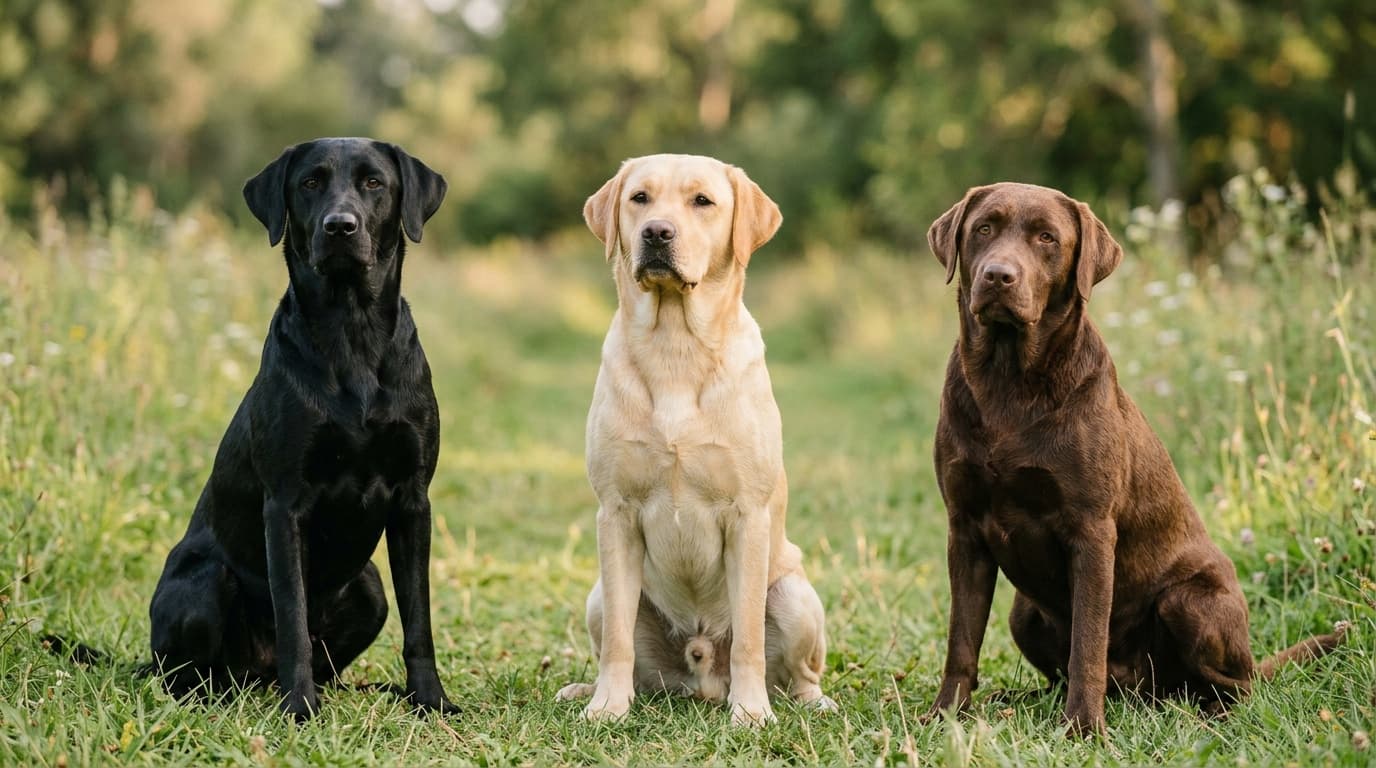
Labradors are Canada's most-popular dog breed and the most-surrendered breed in Calgary rescues. The honest comparison hinges on cost, what each path gives you, and the breed-defining obesity epidemic that every Lab adopter needs to understand — because it affects rescue and breeder dogs equally and changes how you should think about food management, exercise, and lifetime monitoring more than where the dog originally came from.
Labrador Retriever Cost Comparison: Adopt vs Buy in Calgary
| Path | Cost | What's Included |
|---|---|---|
| Calgary rescue (recommended) | $300-$700 | Spay/neuter, vaccinations, microchip, vet workup. Black Lab promotions $150-$400 ($700-$1,200 retail value) |
| Calgary Humane Society | $135-$400 | Same as above; lower fee for seniors and Patient Paws medical-needs Labs |
| Owner rehoming (LocalPetFinder) | $0-$500 | Variable. Budget $700-$1,200 medical catch-up if records incomplete |
| Standard CKC-registered breeder | $1,500-$3,500 | 8-week puppy. Health-tested parents (OFA hips/elbows, eye CERF, EIC DNA, PRA-prcd DNA, CNM DNA). NO spay/neuter or vaccinations — add $700-$1,200 |
| English-line / show-quality CKC breeder | $2,500-$4,500 | Stockier English-line Lab with documented show pedigree. Same health testing as standard |
| Working / field-line CKC breeder | $2,000-$4,000 | Hunting-line pedigree with documented working ability (drive, retrieve, water tolerance) |
| “Silver / charcoal / champagne” Lab | $3,500-$5,000+ | Dilute-coat (d/d) Lab. Controversial within breed community. Outside breed standard. Charged premium for novelty |
| Kijiji “backyard breeder” | $800-$1,500 | No CKC registration, no health testing on parents, often inflated “rare colour” pricing. High health risk |
| “Free Lab” (SCAM) | $0 + scam fees | Avoid. Real owner rehoming meets in person and never asks for upfront shipping/vet fees |
The honest math: a rescue Lab with included vet work runs $300-$700 all-in. A CKC breeder Lab puppy plus first-year vet catch-up runs $2,200-$4,700. The price gap is $1,500-$4,000 in adoption's favour — smaller than other breeds because Labs are accessibly priced from breeders. But Labs are the most-available breed in Calgary rescues, so the speed-to-adoption advantage is huge: rescue Lab in days vs 12-18 month breeder waitlist.
Lifetime Cost Analysis (10-12 Years)
Labs live 10-12 years on average, with lean Labs at body condition score 4-5/9 reaching 13-14+ years. Lifetime cost is dominated by obesity-related health expenses — not breed source. The single biggest financial decision after adoption/purchase is portion control:
Lifetime Labrador Retriever costs (11-year average)
- Initial adoption / purchase$300-$5,000
- Food (large breed, 11 years)$8,000-$13,500
- Routine vet care + vaccinations$5,000-$8,000
- Pet insurance (recommended early)$7,500-$13,500
- Hip/elbow dysplasia management$2,000-$10,000
- Cruciate ligament repair (common in obese Labs)$0-$8,000
- Diabetes / arthritis management$0-$6,000
- Ear infection treatment (drop-eared breed)$1,500-$3,500
- Supplies (beds, leashes, toys, crates)$2,000-$3,500
- Total lifetime cost (lean Lab)$25,000-$35,000
- Total lifetime cost (obese Lab)$40,000-$50,000+
The $1,500-$4,000 saved by adopting matters but the bigger lifetime variable is weight management. A lean Lab costs $25K-$35K lifetime; an obese Lab costs $40K-$50K+ — the obesity premium is 4-5x the entire adoption-vs-breeder cost gap. Lean Labs also live 1-2 years longer.
The 60%+ Obesity Epidemic (Affects Both Paths Equally)
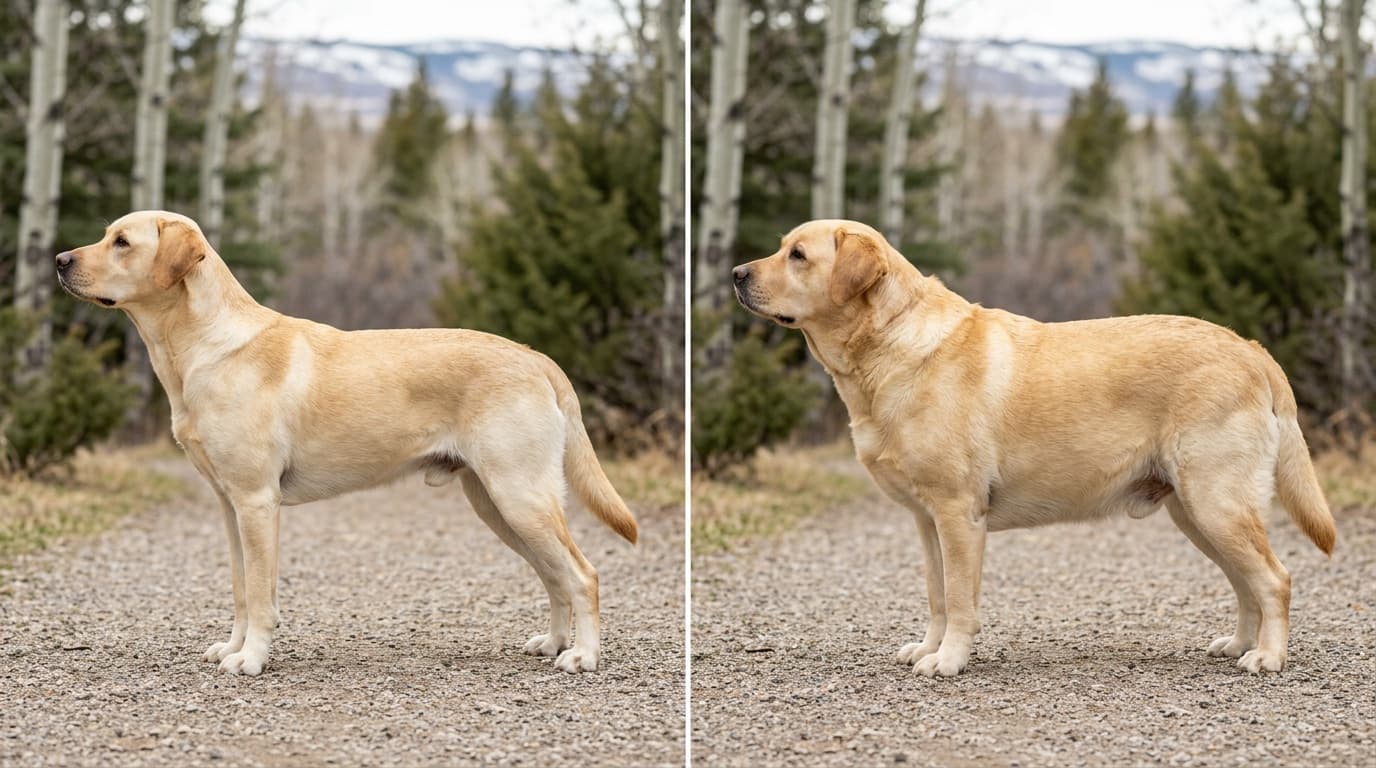
Important: 56-65% of Labrador Retrievers are overweight or obese — the highest rate of any breed.
Multiple studies (AKC Canine Health Foundation, Royal Veterinary College London) confirm the breed-wide obesity epidemic. ~25% of Labs carry a POMC gene mutation that disrupts the satiety signal — meaning they genuinely never feel full. This affects rescue Labs and breeder Labs equally.
The implication for buy-vs-adopt: paying $4,000-$5,000 for a “premium” or “rare colour” Lab does NOT buy lower obesity risk. POMC mutation prevalence is breed-wide, not bloodline-specific. The price premium some breeders charge for silver, charcoal, champagne, or English-line Labs is based on appearance, not metabolic health.
Why obesity is the #1 Lab lifetime cost driver:
- Hip/elbow dysplasia — obese Labs experience joint stress that accelerates dysplasia, leading to $5K-$15K surgical costs
- Cruciate ligament tears — obese Labs are 5x more likely to tear a cruciate, $3K-$8K per repair
- Diabetes — obese Labs develop type 2 diabetes; lifetime management $2K-$5K/year
- Cancer risk — obesity correlates with higher cancer rates across multiple types
- Cardiovascular disease — obese Labs develop heart issues earlier in life
- Shorter lifespan — lean Labs live 1-2 years longer than obese Labs (Royal Veterinary College longitudinal study)
- Reduced quality of life — obese Labs lose mobility, energy, and joy of activity
What actually controls Lab obesity (rescue OR breeder Lab):
- Strict portion control — measure food daily; never free-feed
- No table scraps — Labs will eat anything; train family to never share human food
- Treats < 10% of daily calories — use kibble pieces from daily ration as treats
- Body condition score 4-5/9 — you should feel ribs easily; visible waist when viewed from above
- Regular weigh-ins — monthly until adult weight stable, then quarterly
- Daily exercise — 60-90 minutes of moderate activity (walks, fetch, swimming)
- Slow-feeder bowls — for POMC-affected Labs, slows ingestion and improves satiety
- Pet insurance enrolled early — covers obesity-related conditions if portion control fails
For the full Calgary protocol including portion calculator, BCS guide, and Calgary obesity-vet specialists, see our Labrador weight management Calgary guide.
What Adoption vs Buying Actually Gives You
Adopt a Lab from Calgary rescue
- • Established temperament — most Labs are 2-7 year old adults; you know their actual energy, social style, exercise needs
- • Past adolescence — Lab adolescence (8-30 months) is the hardest 18 months of any Lab's life; rescue adults are typically through it
- • Foster-evaluated — the foster has lived with the dog and can describe kid/cat/dog compatibility, alone-time tolerance
- • Full vet workup included — spay/neuter, vaccinations, microchip ($700-$1,200 retail value)
- • Lifetime return policy at most Calgary rescues
- • Available within days — Labs are the most-available breed in Calgary rescues, no 12-18 month waitlist
- • Black Lab access — deeper pool of well-tempered black Labs available because of Black Lab Syndrome
- • Trade-off: less control over the first 8-week socialization window; some senior Labs come with managed health conditions
Buy a Lab from a CKC breeder
- • 8-week-old puppy — you control all socialization, training, and bonding from the critical window
- • Verified pedigree — CKC papers if you want to show, compete, hunt, or breed
- • Health-tested parents — ethical breeders test OFA hips/elbows, eye CERF, EIC DNA (Exercise-Induced Collapse), PRA-prcd DNA, CNM DNA (Centronuclear Myopathy)
- • Predictable adult size and coat — you know roughly what the dog will look like at maturity
- • Breeder support — ethical breeders provide lifetime advice and a return guarantee
- • Working/show pedigree if needed for hunting, sport, or breeding
- • Trade-off: 12-18 month waitlist with ethical breeders, $1,500-$5,000+ upfront, NO included vet work, 18+ month adolescence training intensity, no lifetime medical history, SAME 60%+ obesity risk as rescue Labs
Silver, Charcoal, Champagne Labs — The Dilute-Gene Controversy
Silver, charcoal, and champagne Labs are among the most-searched Lab queries and the most-controversial within the breed community. Here's the honest breakdown:
What “rare colour” Labs actually are
- • Silver Lab = chocolate Lab + dilute gene (d/d genotype)
- • Charcoal Lab = black Lab + dilute gene
- • Champagne Lab = yellow Lab + dilute gene
- • Genetic research suggests dilute (d) allele entered Lab gene pool from a Weimaraner ancestor decades ago
- • CKC and AKC technically register them under standard colour categories but show judges typically disqualify
- • Labrador Retriever Club of Canada considers them outside breed standard
Health and pricing reality
- • Same obesity risk as standard-colour Labs
- • Colour dilution alopecia — some dilute Labs develop hair loss along pigmented areas (not all)
- • Premium pricing: $3,500-$5,000+ vs $1,500-$3,500 for standard-colour Labs
- • Premium based on novelty, not health or pedigree quality
- • Often sold by backyard breeders without health testing
- • Calgary rescues occasionally see silver/charcoal Labs surrendered (same fees as other Labs)
Bottom line: if you genuinely love the silver/charcoal/champagne coat colour and accept the controversy, it's your call. But paying premium prices for “rare colour” does not mean you're getting a healthier, more pedigreed, or more capable Lab. Verify health testing on both parents regardless of colour.
Black Lab Syndrome — Why Black Labs Sit Longer in Rescues
Black-coated dogs sit in rescues 2-3x longer than yellow or chocolate Labs — despite being equally healthy and well-tempered.
Multiple shelter studies confirm the bias. The pattern: black coats photograph poorly online (faces appear featureless, expressions hard to read), older negative cultural associations, the assumption that “common” black Labs are less interesting than “rare” colours.
The reality for Calgary adopters: black Labs in Calgary rescues are typically the BEST-tempered Labs available. They've been temperament-evaluated longer because they've been waiting longer. Foster families have had more time to assess their kid-compatibility, dog-compatibility, alone-time tolerance, and quirks. They get adopted eventually, but if you're open to a black-coated Lab, you have access to a deeper pool of established adult Labs with detailed temperament documentation.
Calgary rescue strategies that recognize this pattern:
- Calgary Humane Society and AARCS run periodic “Black Lab adoption” promotions with reduced fees ($150-$400)
- Some rescues feature black Labs more prominently in social media to combat the photography bias
- Foster parents often note “great with kids” / “cat-friendly” specifically for black Labs because they've had time to verify
- Black Lab senior promotions (8+ years) at $135-$300 are some of the best Lab adoption values in Calgary
The buy-vs-adopt implication: if you're open to a black Lab, your wait time for a rescue Lab in Calgary drops to days-to-weeks instead of weeks-to-months. The cost gap with breeders ($1,200-$3,000+ savings) is also magnified by the reduced-fee Black Lab promotions.
Why “Free Lab” Searches Find Mostly Scams
“Free Labrador Retriever” or “free Lab puppy” signals scammers.
Real Calgary Labs come from rescue (adoption fee $300-$700), ethical breeders ($1,500-$3,500), or owner rehoming ($0-$500 + medical catch-up). 90%+ of online “free Lab” listings are scams.
Common Lab scam patterns:
- Shipping fee scam. Kijiji or Facebook listing offering a “free Lab puppy”. Beautiful photos (often stolen). Owner is “moving” or “going overseas”. Dog is free but you pay $200-$800 “shipping fees”, “customs fees”, “vet certification fees”. The dog never arrives.
- Bait-and-switch backyard breeder. “Free Lab” reveals $800-$1,500 cost when you message. No health testing.
- Old-Lab dump. Owner trying to dump a Lab with undisclosed health issues (cruciate tear, dysplasia, diabetes). Owner doesn't want to pay treatment cost.
- Stolen Lab resale. Labs are theft targets because of resale value. Some “free” or low-cost listings are stolen.
What real owner rehoming looks like:
- You meet the dog AND current owner at the current home
- Owner provides full vet records, original adoption/breeder paperwork, microchip number
- Owner asks YOU questions about your living situation, exercise commitment, Lab experience
- No upfront payment is requested — any handover fee happens in person
- Owner has verifiable identity, photos with the dog over time, social presence
Closest legitimate “free Lab” option in Calgary: Calgary rescues run periodic “Black Lab” promotions ($150-$400) and “senior Lab” events with reduced fees ($135-$300). Calgary Humane Society's Patient Paws program covers seniors at $135 minimum. AARCS runs occasional senior Lab promotions.
For the full free-and-low-cost adoption playbook, see our free & low-cost adoption Calgary guide.
When Buying a Labrador Genuinely Makes Sense
Four legitimate scenarios where buying a Lab from an ethical CKC-registered breeder is the right call:
- You hunt or compete in field trials. Working/field-line Labs from documented hunting pedigree have verified drive, retrieve instinct, and water tolerance that pet-line Labs may not have. If you genuinely hunt or train for field competition, a working Lab puppy from a verified hunting kennel is the right path.
- You intend to show the dog in CKC conformation events. Show requires a verifiable pedigree. Rescue Labs with unknown or pet-line pedigree cannot compete in conformation, though they can compete in performance events (rally, agility, obedience, dock diving).
- You intend to breed. Ethical breeding requires CKC registration, complete health testing of both parents (OFA hips/elbows, eye CERF, EIC DNA, PRA-prcd DNA, CNM DNA), mentorship from established breeders, and CKC requirements. Don't pursue casually — takes years of investment.
- You want a service-dog candidate. Some service dog organizations (guide dogs, autism, mobility) prefer puppies from health-tested, temperament-tested CKC breeders for the highest training success rate. Labs are the #1 service dog breed globally. That said, many service dog organizations also successfully use rescue Labs — check with the specific program.
For pet-quality companions, family dogs, casual outdoor companions — adopting from a Calgary rescue is dramatically cheaper, equally healthy, faster than the breeder waitlist, and gives you access to adult Labs past the 18-month adolescence.
Calgary-Specific Paths for Adoption and Buying
To adopt a Labrador Retriever in Calgary
- Calgary Humane Society — largest Calgary shelter; Labs are the most-frequent intake breed
- AARCS — foster-based; Labs and Lab mixes appear weekly with detailed temperament info
- BARCS Rescue — foster-based, regular Lab and Lab mix intake
- ARF Alberta — serves Calgary; Labs available regularly
- Pawsitive Match Rescue Foundation — foster-based, occasional Labs
- Cochrane Humane Society — serves Calgary-adjacent area
- Calgary Animal Services — municipal facility, steady Lab intake
- “Black Lab Rescue Alberta” — unverified: no CRA registration, website, social, or adoptable listings behind this name. Use the general Calgary rescues for Labs instead.
Browse all currently available Calgary Labs and Lab mixes (Borador, Labsky, Sheprador, Pitador, Labradoodle) on our Labrador Retriever breed page — updates regularly.
To buy a Labrador from an ethical Calgary breeder
Look for these verification points before committing or sending a deposit:
- CKC registration — verify through the Canadian Kennel Club directly
- Complete health testing on parents — OFA hips/elbows, eye CERF (annual), EIC DNA (Exercise-Induced Collapse), PRA-prcd DNA, CNM DNA (Centronuclear Myopathy), HNPK DNA (Hereditary Nasal Parakeratosis)
- 12-18 month waitlist — ethical Lab breeders are months out; instant availability is a red flag
- Home-raised puppies, not kennel-only
- Lifetime return policy in writing
- Refusal to ship puppies — ethical breeders meet adopters in person
- Detailed contracts with health guarantees and spay/neuter clauses
- No selling through Kijiji or pet stores
- Allows home visits and meeting both parents
- Honest about obesity risk — ethical breeders discuss POMC mutation prevalence and feeding protocols
Starting points: the Labrador Retriever Club of Canada maintains a breeder referral list. Cross-verify any Calgary breeder through Canada Revenue Agency registry, vet references, and recent litter purchasers.
For more on Calgary Lab options, costs, and the rescue landscape, see our Labrador Retriever Adoption Calgary guide, Lab weight management guide, and Lab adolescence survival guide.
Frequently Asked Questions
Should I buy or adopt a Labrador Retriever?
For ~85% of Calgary households, adopting is the better choice. Adoption fees run $300-$700 vs $1,500-$3,500 from a CKC breeder, $3,500-$5,000+ for “silver”, “charcoal”, “champagne”, or English-line Labs. Most rescue Labs are 2-7 year old adults with established personalities and past adolescence (the hardest 18 months). Buying makes sense only for hunting/field, show, breeding, or service-dog candidates.
How much does a Labrador Retriever cost in Calgary?
Adopting from a Calgary rescue: $300-$700. Buying from an ethical CKC breeder: $1,500-$3,500. English-line, show-quality, or working hunting-line Labs: $2,500-$4,500. “Silver/charcoal/champagne rare colour” Labs: $3,500-$5,000+. First-year ownership cost adds $2,000-$3,000. Annual ongoing: $1,800-$3,500. Lifetime cost (10-12 years): $25,000-$50,000 — obesity is the single biggest cost driver, not source.
Is the 60% Lab obesity epidemic real?
Yes — 56-65% of Labs are overweight or obese, the highest rate of any breed. ~25% of Labs carry a POMC gene mutation that disrupts the satiety signal — they genuinely never feel full. This affects rescue Labs and breeder Labs equally. Obesity cascades into hip/elbow dysplasia, cruciate tears, diabetes, shorter lifespan. Paying $4,000+ for a “premium” Lab does NOT buy lower obesity risk. Strict portion control and weight management matter more than source.
Are silver, charcoal, and champagne Labradors a different breed?
No. They are dilute-coat (d/d genotype) Labs — chocolate, black, or yellow Labs carrying the dilute gene. Genetic research suggests the dilute allele entered the Lab gene pool from a Weimaraner ancestor. CKC and AKC technically register them but show judges typically disqualify, and the Labrador Retriever Club of Canada considers them outside the breed standard. Some breeders charge $3,500-$5,000+ premium for novelty. They have the same obesity risk and other Lab health issues as standard-colour Labs.
Why do black Labs sit longer in Calgary rescues?
“Black Lab Syndrome” is well-documented — black-coated dogs sit 2-3x longer than yellow or chocolate Labs. Suspected causes: black coats photograph poorly online, older negative cultural associations, the assumption that “common” black Labs are less interesting. The reality: black Labs in Calgary rescues are typically the best-tempered Labs available because they've been temperament-evaluated longer. Calgary rescues run periodic Black Lab promotions ($150-$400) — among the best Lab adoption values.
When does buying a Labrador Retriever make sense?
Four scenarios: hunting/field competition (requires verified working pedigree), CKC conformation showing (requires verifiable pedigree), intentional ethical breeding (requires CKC requirements + complete health testing), or service-dog candidate (some programs prefer health-tested, temperament-tested CKC puppies). For pet companions, families, casual outdoor companions — adopting is dramatically cheaper, faster, and gives you adult Labs past adolescence.
Browse Adoptable Labrador Retrievers in Calgary
Most-available breed in Calgary rescues. 15+ shelters. $300-$700 adoption fee (Black Lab promotions $150-$400). Most Labs are 2-7 year old adults past the 18-month adolescence. Refreshed regularly.
Browse Calgary Labs →New dog? Start with these care guides
Everything a new adopter needs to set up a safe, happy home.