The honest version
Cavalier King Charles Spaniels are affectionate, quiet, low-key, and built for Calgary apartment life. They are also the breed hit hardest by mitral valve disease: the Universities Federation for Animal Welfare reports it is about twenty times more prevalent in Cavaliers than in other breeds, with about half of Cavaliers carrying a murmur by age 5 and nearly all by age 10. The breed is also commonly identified with Chiari malformation, which can lead to syringomyelia, according to the Cavalier King Charles Spaniel Club of Canada. Lifetime medical cost can run $60,000 or more for an affected dog, and pet insurance is essentially mandatory. The temperament is genuinely lovely. The health and velcro profile is genuinely hard. Most Cavalier regret we hear in the Calgary rescue network is medical-cost surprise or separation anxiety, not personality mismatch. This is the self-assessment that catches both before you bring one home.

10 Honest Truths About Owning a Cavalier King Charles Spaniel
1. Mitral valve disease is not a risk, it is the expectation
About half of Cavaliers have a heart murmur by age 5 and nearly all by age 10, and MVD is the main cause of death in the breed, according to the UFAW summary of published studies. Cavaliers without major progression often live 12 to 14 years. Cavaliers with early-onset MVD typically live 9 to 11. This is genetic and breed-wide, not a bad-luck individual outcome. Plan for it from day one.
2. Syringomyelia is a real second concern
Cavaliers are commonly identified with Chiari malformation, which does not always develop into syringomyelia (SM), according to the Cavalier King Charles Spaniel Club of Canada. Signs are air-scratching at the neck, yelping for no clear reason, sleeping on hard surfaces only, and head sensitivity. Diagnostic MRI in Calgary runs $1,500 to $3,000. Treatment is ongoing pain and inflammation medication. Not every affected Cavalier suffers, but the genetics are widespread in the breed.
3. Pet insurance is essentially mandatory
For most breeds, pet insurance is a sensible option. For a Cavalier it is closer to required. Lifetime cardiac care, possible MRI, and emergency visits can total $30,000 to $50,000. Enrol before any murmur is detected so MVD is never pre-existing. Calgary insurance for a young healthy Cavalier runs $40 to $80 a month. Verify mitral valve disease coverage specifically. Some Canadian insurers exclude or cap MVD claims.
4. They are velcro to a fault
Cavaliers were bred as 17th-century English court lap dogs and never stopped being that. Your dog will follow you from room to room, sit on your lap whenever possible, and want contact most of the day. Working full-time without daycare or walker support is a real separation anxiety risk.
5. Lifetime cost is high even for a healthy dog
A healthy Cavalier in Calgary costs $25,000 to $60,000 over 12 years. A Cavalier with MVD or SM costs $60,000 to $100,000 or more. Annual care for a young healthy Cavalier runs $1,500 to $2,500. Once cardiac meds start (typically by age 6 to 8), annual cost climbs to $3,000 to $6,000. Cardiac echo at a Calgary specialist clinic runs $400 to $700. Budget honestly before you adopt.
6. Adoption fees are reasonable, breeder pricing is not
Adult-dog adoption fees at Calgary's general rescues run about $405 to $650 (Calgary Humane Society $405, AARCS $425, Pawsitive Match $475, BARCS $650, checked October 2026). Canadian Kennel Club (CKC) registered breeders that publish a price ask $3,200 to $4,000 or more for a pet puppy (October 2026, a small sample of four breeders; see our national Cavalier puppy price guide). Cavalier puppies are rare in rescues. Most surrendered Cavaliers are 2 to 8 year old adults with documented health history, which is often more useful than a puppy unknown.
7. They have hunting drive despite the lap-dog reputation
Cavaliers are spaniels. They will chase squirrels, rabbits, and birds, and a Cavalier off-leash near traffic is a real risk. Recall is hard to build in this breed and not fully reliable until around 2.5 years old. Use a 30 foot long-line for off-leash training. Stick to fenced areas like Nose Hill on-leash trails until recall is truly proofed. Many Calgary owners never let their Cavalier off-leash outside a fence.
8. Grooming is moderate but ongoing
The medium-length silky coat needs brushing 3 to 4 times a week to prevent mats behind the ears, on the chest, and on the feathered legs. Professional grooming every 6 to 8 weeks runs $60 to $100 at Calgary salons. Annual grooming budget: $400 to $800. Ear cleaning weekly is non-negotiable. Drop ears with feathering trap moisture and yeast, which is the most common Cavalier vet visit reason after cardiac.
9. Excellent with kids, cats, and other dogs
Cavaliers are among the most family-friendly small breeds. Gentle with kids, rarely reactive with cats, social with other dogs. At 13 to 18 lbs they are sturdier than a Yorkie or Maltese but still fragile around toddlers. Families with kids 5 and older are the best fit. Adult-rescue Cavaliers from Calgary fosters often come with documented kid, cat, and dog history. Read the foster notes before applying.
10. Four standard colours, all the same dog
The CKC recognizes four Cavalier colours. Blenheim (chestnut on white, most common). Tricolor (black, white, and tan). Ruby (solid red). Black and Tan (solid black with tan markings). All four share identical temperament, breed standard, and health profile. Colour is purely aesthetic. Anyone marketing “rare blue” or “merle” Cavaliers at premium pricing is either crossing in non-Cavalier genes or running a scam.
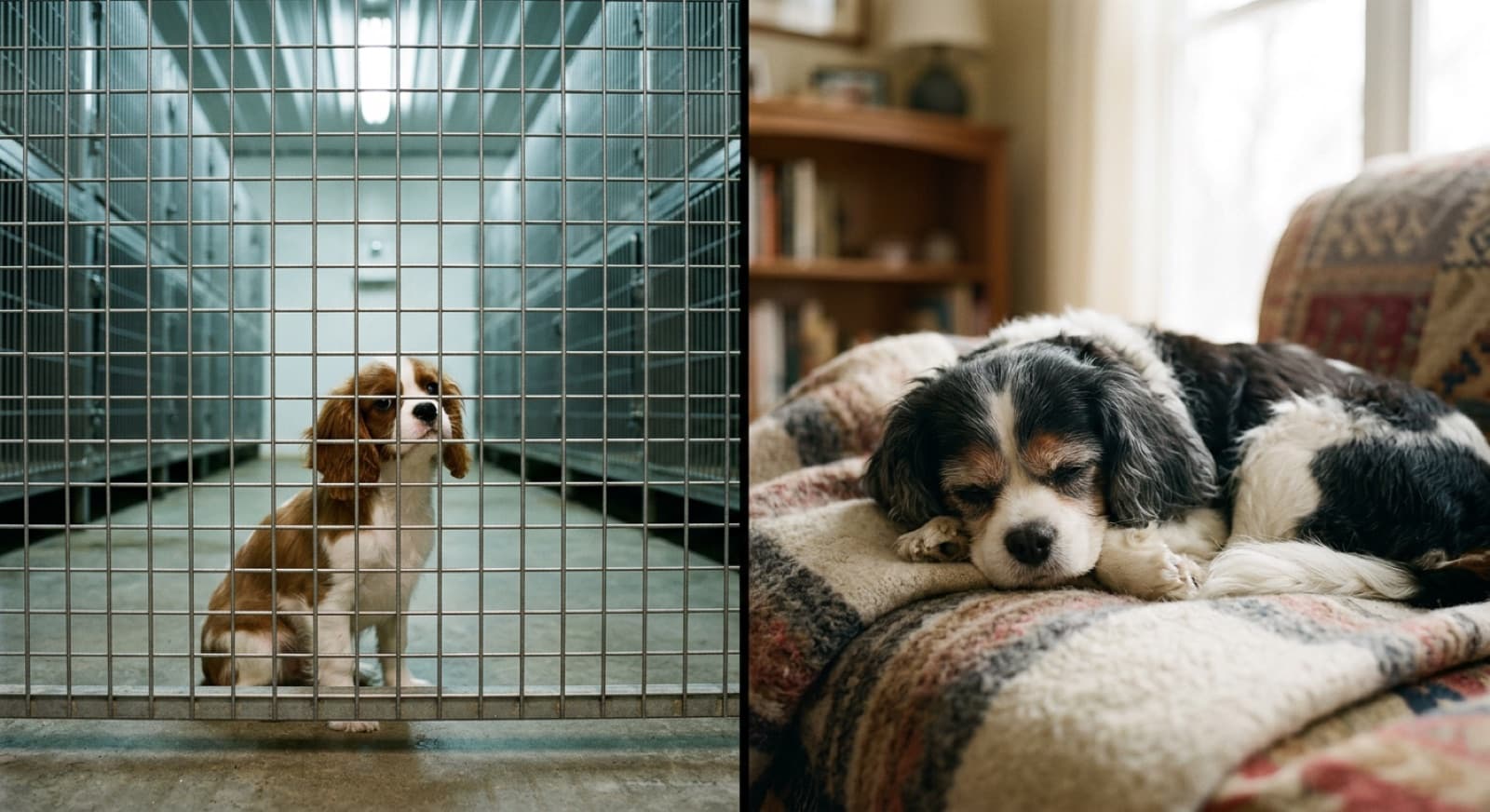
12-Question Self-Assessment
Answer honestly. If you can answer “yes” (or comfortably “mostly”) to at least 9 of 12, a Cavalier is probably a good fit. Below 7, reconsider. The breed needs may not match your lifestyle or budget right now.
1. Can I budget for pet insurance from day one ($40 to $80 a month) and enrol before any heart murmur is detected?
MVD is near-universal in this breed. Insurance enrolled before symptoms is the difference between manageable and crushing.
2. Can my finances absorb $3,000 to $6,000 a year in care once MVD or SM hits?
Both conditions involve lifelong medication, specialist visits, and possible emergency care.
3. Am I emotionally ready for a breed with a 9 to 14 year lifespan and likely cardiac decline at the end?
The end-of-life chapter with a Cavalier can be medically intense. Plan for it.
4. Can I provide daycare, a dog walker, or work-from-home flexibility if I work full-time?
Velcro temperament means real separation anxiety risk without daytime support.
5. Am I patient with a velcro dog that follows me to the bathroom?
Normal Cavalier behaviour, not a problem to fix.
6. Will I commit to force-free training only (no e-collars, leash pops, yelling)?
Cavaliers are soft and shut down with aversive methods. Force-free works.
7. Will I brush 3 to 4 times a week and clean ears weekly?
Drop-eared dogs with feathered coats need consistent maintenance to avoid mats and yeast infections.
8. Can I budget $400 to $800 a year for professional grooming every 6 to 8 weeks?
Calgary salon grooming for a small feathered dog runs $60 to $100 per visit.
9. Do I have a coat and booties for Calgary winters below -10C?
The medium coat insulates the body but not the legs. Sidewalk salt cracks paw pads.
10. Are my kids 5+ years old, or am I willing to supervise toddlers closely?
Cavaliers are gentle but at 13 to 18 lbs they can be hurt by rough toddler handling.
11. Am I willing to keep my Cavalier on-leash or long-line in unfenced areas?
Spaniel hunting drive plus weak recall makes off-leash near traffic a real risk.
12. Am I committed for 9 to 14 years through possible life changes (move, baby, job, health)?
Life-change surrenders are common across all small breeds, and Cavalier medical history makes resurrender harder for rescues.
Score 9+? Browse adoptable Cavaliers in Calgary
Live listings from 15+ Calgary rescues, refreshed regularly. Purebred Cavaliers are uncommon and Cavapoo, Cavachon, and Cava-Tzu mixes show up more often. Foster reports usually include cardiac status, kid history, cat history, and housetraining notes.
See Available Cavaliers →Frequently Asked Questions
Are Cavalier King Charles Spaniels good for first-time dog owners?
Yes for the right first-time owner, no for many others. Cavaliers are gentle, social, quiet, and apartment-friendly, which makes them attractive to new owners. The catch is health. About half of Cavaliers have a mitral valve disease murmur by age 5 and nearly all by age 10, according to the Universities Federation for Animal Welfare (UFAW) summary of published studies, and the breed is commonly identified with Chiari malformation, which can lead to syringomyelia, according to the Cavalier King Charles Spaniel Club of Canada. A first-time owner who can budget for pet insurance from day one and accept the risk of $3,000 to $6,000 a year in care does well. A first-timer expecting a low-maintenance lap dog will be shocked by the cardiac specialist bills.
How long do Cavalier King Charles Spaniels live?
Cavaliers live 9 to 14 years, shorter on average than most small breeds. The variance is almost entirely driven by mitral valve disease. Cavaliers without major MVD progression often reach 12 to 14 years. Cavaliers with early-onset MVD (murmur by age 5) typically live 9 to 11 years. By age 10, nearly all Cavaliers have at least a low-grade heart murmur, according to UFAW. Yorkshire Terriers, Maltese, and Havanese commonly live 14 to 16 years for comparison. The lifespan gap is the single biggest reason vets push pre-adoption pet insurance for this breed.
Can I own a Cavalier if I work full-time?
Conditionally yes. Cavaliers are velcro lap dogs and develop separation anxiety more often than the breed-average dog. The conditions for working full-time are daycare 1 to 3 days a week, a midday walker, gradual alone-time conditioning from day one, and enrichment puzzles during alone time. Without those supports, panting, barking, destruction, and house-soiling are common. Some Calgary rescues ask working-household applicants about daytime support specifically. A Cavalier left alone for 9 hours a day with no plan is the most common Calgary surrender pattern after MVD cost.
How much does a Cavalier cost over its lifetime in Calgary?
A healthy Cavalier costs $25,000 to $60,000 over a 12-year life in Calgary. A Cavalier with MVD or syringomyelia costs $60,000 to $100,000 or more. Annual care for a healthy young Cavalier runs $1,500 to $2,500. Once cardiac medications start (often by age 6 to 8), annual cost climbs to $3,000 to $6,000. A cardiac echo at Western Veterinary Specialist Centre runs $400 to $700. Lifetime cardiac meds, specialist visits, and emergency care can hit $30,000 alone. Pet insurance is essentially mandatory for this breed, ideally enrolled before any murmur is detected so MVD is not pre-existing.
Are Cavaliers really velcro dogs?
Yes, intensely. Cavaliers were bred as English court lap dogs in the 17th century and never stopped being that. Your Cavalier will follow you from room to room, sit on your lap whenever possible, and want physical contact most of the day. The breed is genuinely the velcro standard. That is wonderful for someone who wants a constant companion. It is hard for someone expecting an independent dog content to nap in the next room.
Do Cavaliers handle Calgary winters?
Reasonably well, better than short-coated breeds but not as well as Huskies or Shepherds. The medium-length silky coat insulates the body but not the legs and belly. Below -10C wear a coat. Below -20C use booties because Calgary sidewalk salt and de-icer crack small paw pads, and cap walks at 10 to 15 minutes. Calgary summers in the 22 to 28C range are fine with morning and evening walks. Avoid midday walks in heat above 25C because Cavaliers tire quickly and overheat. The bigger Calgary-winter concern is exercise drop-off, which can worsen weight gain that aggravates an MVD heart.
Are Cavaliers good with kids, cats, and other dogs?
Yes to all three, with normal caveats. Cavaliers are among the most kid-friendly small breeds. Gentle, patient, tolerant of clumsy toddler hands within reason. They are also genuinely good with cats and rarely chase or harass. Most Cavaliers do well at daycare and dog parks with normal socialization. The caveat is fragility. At 13 to 18 lbs they can be hurt by an over-excited toddler or a rough dog. Families with kids under 3 should supervise closely. Adult-rescue Cavaliers from Calgary fosters often come with documented kid, cat, and dog history. Read the foster notes.
Who should NOT get a Cavalier King Charles Spaniel?
Seven honest mismatches. Owners who cannot budget for pet insurance plus $3,000 to $6,000 a year if MVD or syringomyelia hits. Owners gone 9+ hours daily without daycare or walker support. Active hiking or running households, because Cavaliers are companions, not endurance dogs (and a Cavalier heart will not take it long term). Owners who want a dog that handles being alone calmly. Owners unwilling to do weekly ear cleaning and brushing 3 to 4 times a week. Owners committed to harsh or aversive training. Owners not ready for the emotional weight of a breed with a shorter, often medically complicated lifespan.
Are Cavaliers hypoallergenic?
No. Cavaliers shed moderately year-round. The breed is not on any reputable allergy-friendly list. Severe dog allergies or asthma will react to a Cavalier. Mild allergies sometimes tolerate them with frequent vacuuming and brushing outside, but it is a coin flip. If allergies are a real factor, look at Havanese, Bichon, or a Cavapoo (Cavalier crossed with a Poodle) instead. Even then, a 2 to 3 hour in-home visit plus 48-hour wait for delayed response is essential before committing.
More Cavalier guides
Cavalier Adoption Calgary →
Where to find a rescue Cavalier in Calgary, real costs, the one verified Canadian breed rescue, and the four standard colours.
Cavalier King Charles Health Issues: Heart, SM →
Cavalier King Charles Spaniel health issues to plan for: mitral valve heart disease, Chiari-like malformation and syringomyelia, episodic falling, eye disease and teeth.
Cavalier Grooming Calgary →
Brushing schedule, ear cleaning, professional grooming costs, and avoiding mats on the feathered legs.
New dog? Start with these care guides
Everything a new adopter needs to set up a safe, happy home.