The pattern Calgary rescues see every month
Calgary rescue intake spikes for Rottweilers between 12 and 20 months old. The story we hear is almost always the same. The family did everything right with their puppy. The dog was responding beautifully at six months. Then something changed around the first birthday. The recall fell apart. The mouthing came back. The dog started counter-surfing and ignoring cues they used to know cold. By 14 months the family is exhausted and convinced something is wrong with their dog. Nothing is wrong. The dog is in adolescence. Same phase a teenager goes through, but with the body of a 110 pound adult and the impulse control of a six month old. If you can get through the next year with consistency and the right help, the dog you imagined when you adopted shows up on the other side.
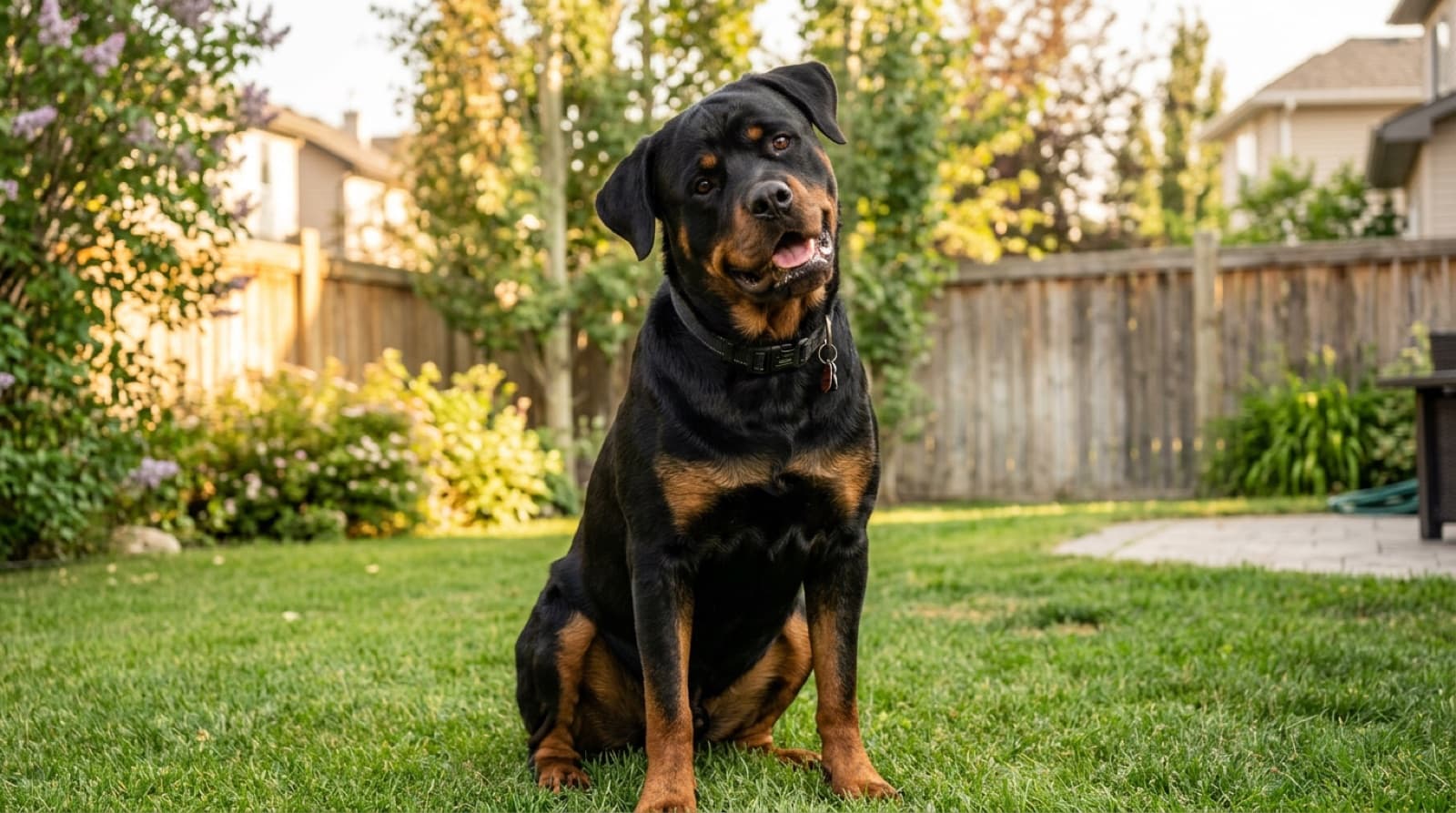
What's actually happening between 8 and 24 months
The first thing to understand is that adolescence is not one phase. It is a series of overlapping changes that play out over more than a year, and Rottweilers go through it longer than most breeds because they take so long to mature.
Around 6 to 9 months, sexual maturity hormones start kicking in and you might notice training getting subtly less reliable. Then somewhere between 10 and 18 months, things often unravel more visibly. Recall fails. Mouthing and lunging come back. Counter surfing starts. The dog seems to test boundaries everywhere. This is the part most owners describe as “our trained dog disappeared.”
Layered on top of that, somewhere around 12 to 14 months, you may also see a second fear period. New fears of things your dog was previously fine with. We'll come back to that in a minute, because it's often misread as aggression and handled badly.
Things usually start settling between 18 and 24 months, and most Rottweilers are mentally mature by 2 to 3 years. Larger males sometimes don't fully settle until 3 or 4. Rottweilers take longer than smaller breeds because giant and large breeds mature slower in general, and the working dog heritage adds independent thinking and boundary testing on top.
The hardest part is the timing mismatch. A Rottweiler hits adult size (80 to 130 lbs) by about 18 months. The brain is still teenage for another year. So you spend that window with a dog who has the body of an NFL linebacker and the impulse control of a 12 year old.
The training regression that blindsides owners
If your previously responsive Rottweiler is now blowing past you on recall, ignoring cues they used to know, and stealing food off the counter, you're seeing classic adolescent regression. The training did not fail. It went underground.
What's changed is mostly invisible. Hormones are shifting (yes, even in spayed and neutered dogs. The developmental window happens regardless of surgery timing). The brain is reorganizing as adolescence progresses. Confidence is exploding. And your dog is figuring out, with a 90 pound body, what they can get away with.
The single most useful thing you can do is keep training, but raise the stakes. The kibble that worked at four months is rarely enough at 14 months. You need real food rewards now. Cooked chicken, hot dogs, cheese, freeze dried liver. Use them generously. Run short sessions, five to fifteen minutes, multiple times a day rather than one long block.
Equally important is environment management. Use a house-leash, baby gates, a long-line in the park, a front-clip harness for walks. None of this is cheating. It's what gets you through the months when your dog can outrun their own training. Manage the environment so your dog can't practise the behaviours you don't want. Every successful counter-surf or lunge is a rep that makes the behaviour stronger.
And expect failure. Adolescent Rottweilers will fail. That's not your fault, and it's not a sign the training was wrong. It's the brain doing what brains do at this age. The trained dog generally returns between 18 and 24 months when families stay consistent through the rough patch (a pattern the AKC Rottweiler breed standard and the American Rottweiler Club both reference when describing this slow-maturing working breed).
The second fear period (and why it gets misread)
Somewhere between 6 and 14 months (for Rottweilers, often around 12 to 14) you may run into a distinct phase called the second fear period. It looks different from general adolescent regression and it needs to be handled differently.
General regression is your dog ignoring cues they know across many situations. A fear period is sudden, specific, and often dramatic. The vacuum your dog ignored last week is now terrifying. The mailman triggers a barking fit. A particular dog at the off-leash park sets them off. The fears are new, not preexisting, and they usually run two to four weeks before resolving.
The body language gives it away even when the dog is lunging forward. Tail tucked, weight shifted backward, ears back. That posture means defensive, not aggressive. Your dog is scared and trying to make the scary thing go away.
The wrong response, and the one a lot of well-meaning owners reach for, is forcing exposure or punishing the growling. Both make things worse. Forcing exposure during a fear period can teach lasting reactivity to whatever the trigger was. Punishing the growl teaches the dog to skip the warning and go straight to a bite. Neither outcome is what you want.
The right response is more boring. Keep distance from the trigger, pair it with high-value food at a distance the dog can handle, and gradually work closer over weeks. If the fear period is dragging past four weeks, generalizing to many triggers, or producing aggressive responses, talk to a force-free trainer. A vet behaviourist consult and short term anti anxiety medication (gabapentin or trazodone) is sometimes the right call.
Calgary triggers worth knowing about: chinook winds and the sudden weather changes they bring, Stampede fireworks, Halloween costumes, Bow River pathway construction noise, and unfamiliar workers showing up in the yard. None of these are unusual for Calgary dogs to encounter. But during a fear period, they can land harder than they would otherwise.
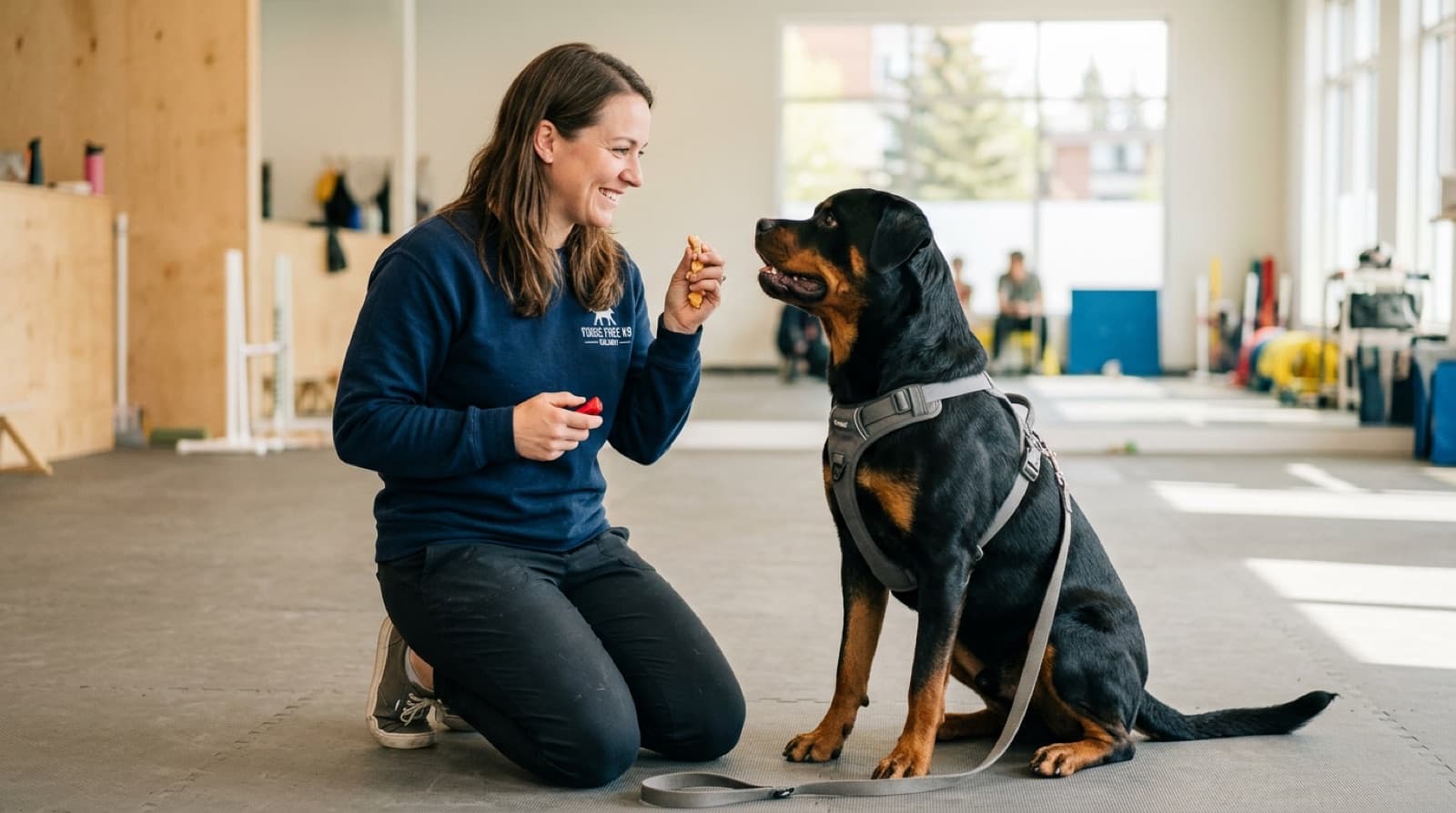
Why prong and e-collars are the wrong tool for this breed?
You'll hear “balanced trainers” in Calgary recommend prong collars, e-collars (shock collars), and choke chains for Rottweilers, often pitched as the only thing that works on a “stubborn” or “dominant” guard breed. Both the research and the experienced force-free trainers in this city say the opposite. Aversive corrections increase aggression and bite risk in guard breeds, and they do it in two specific ways.
The first problem is association. When the leash tightens and the prong digs in while your dog is looking at another dog, your dog associates the pain with the other dog. The other dog becomes a predictor of pain. Reactivity gets worse, not better. Same goes for e-collar corrections used around triggers. The trigger itself becomes more aversive, not less.
The second problem is more subtle and more dangerous. Aversive corrections often suppress growling. From the outside it can look like the dog has been “fixed.” They are no longer growling at the trigger. But growling is the warning system. A Rottweiler who has been corrected out of growling is a Rottweiler who has been taught to skip the warning. The next escalation is a bite without warning. The AVMA and several peer-reviewed studies on guard and herding breeds reach the same conclusion: aversive training increases the risk of serious bite incidents.
The trainers worth working with describe themselves as force-free, positive reinforcement only, or LIMA (Least Intrusive, Minimally Aversive). Look for CCPDT, KPA (Karen Pryor Academy), IAABC, or Fear Free certifications. They'll cost $80 to $150 a session in Calgary, and they don't use prongs, e-collars, or choke chains. Group classes run $200 to $400. None of this is cheap, but it's a fraction of what a single bite incident costs once you factor in vet bills, lost insurance coverage, and potential legal trouble.
Off leash recall and Calgary's off-leash culture
Calgary has a strong off-leash culture, and there's real social pressure to let your dog off-leash early. With an adolescent Rottweiler, resist that pressure. A reliable recall at six months very often falls apart at fourteen, and a 100 pound dog ignoring recall in a crowded park is a problem with much higher stakes than a smaller breed making the same mistake.
The progression most experienced Rottweiler owners follow looks like this. Through the worst of adolescence, keep your dog on a long-line. 15 to 30 feet works for most parks. It gives the dog freedom to move and sniff without giving them the option to ignore you when something interesting happens. Once recall starts rebuilding, usually somewhere between 18 and 24 months, you can start short off-leash sessions in low distraction places and times. Bow River side trails early in the morning are a good starting point.
Some Rottweilers never become reliably off-leash with high-value distractions like other dogs or wildlife. That's not a failure on your part. It's an honest assessment of what your individual dog can handle. A long-line plus structured exercise plus nose work plus daycare can give your dog plenty of physical and mental work without ever needing off-leash freedom.
A few practical Calgary points. Coyotes are a real presence on Nose Hill and along the Bow River corridor. An adolescent Rottweiler chasing one can end with a vet visit at minimum. Calgary's off-leash bylaw (23M2006) requires dogs to be under owner control, and an adolescent Rottweiler ignoring recall in a busy park is a ticket risk on top of everything else. Bowmont, Edworthy, and the quieter sections of Sue Higgins generally have calmer crowds than Nose Hill main trails.
Daycare during adolescence
For most Calgary Rottweiler owners, two or three days a week of daycare during the worst of adolescence is the single biggest quality of life upgrade you can make. A tired dog is a less destructive, less reactive, more responsive dog. Adolescent Rottweilers are also working out social skills, and supervised play with other balanced dogs is part of how they learn.
The trick is finding the right daycare. Look for experienced staff (especially staff who have worked with large guard breeds), smaller play groups (8 to 15 dogs), structured rest breaks, and either no small dogs in the same play group or a clear separation between size groups. Daycares that mix an over-aroused adolescent Rottweiler with a bunch of small dogs can drift into predatory play, which ends badly for everyone involved.
Calgary daycares generally charge $30 to $55 per single visit, with monthly packages for four or five visits a week running $400 to $800. When you tour a facility, ask specifically about staff experience with large guard breeds, group sizes, and the rest schedule.
A few warning signs that the daycare is not the right fit: your dog comes home with puncture wounds or scratches, refuses to walk in, comes home wired instead of pleasantly tired, or seems to lose recall the day after. Communication from the daycare also matters. They should be telling you about behaviour trends, not just collecting payment.
If daycare doesn't suit your dog (some adolescent Rottweilers temporarily flunk daycare assessments and that's okay), alternatives include nose work classes, Sniffspots (private outdoor spaces you can rent for an hour), and structured hikes with a calm adult dog friend.
Counter surfing and destructive chewing
Most adolescent destruction comes from one of three places: not enough exercise, not enough mental work, or stress. The fix is rarely just more training. It's usually more environmental management plus more enrichment.
For chewing, give your dog appropriate things to chew and rotate them so they stay novel. Benebones, beef tendons, and frozen Kongs stuffed with peanut butter (xylitol free) or yogurt are common starting points. Limit access to off limits zones with baby gates or a crate when you can't supervise. Build in 60 to 90 minutes of structured activity daily, plus mental work like food puzzles, snuffle mats, and scent games. A tired Rottweiler chews less. A bored Rottweiler chews everything.
For counter-surfing, the rule that experienced owners repeat is simple: don't let it happen even once. One successful theft creates a habit that takes months to break, because the reward (food) is enormous. Store everything in cabinets or the fridge, dog-proof your garbage (a pull out drawer cabinet or covered bin in a closet works), and add child-locks to your dishwasher if your dog has figured out how to open it. Use a baby gate to block the kitchen during cooking. Train “leave it” and “place” with food on the counter at low height first, then increase the difficulty.
Counter surfing has real medical risk too. Pancreatitis from rich food, GDV (bloat) from eating too fast, and toxic ingestion from things like chocolate, xylitol, grapes, and onions all show up at Calgary 24-hour ERs every holiday and every summer barbecue weekend. The vet bill plus the stress is much more expensive than just blocking access in the first place.
If you adopted an adolescent rescue Rottweiler
Adopting a Rottweiler between 8 and 18 months means you're dealing with two timelines stacking on top of each other. The 3-3-3 adjustment rule (three days to settle, three weeks to learn the routine, three months to feel at home) overlaps with adolescent regression that may run another year. That's a hard combination, and it catches a lot of new adopters off guard.
What helps in the first few weeks is structure. A predictable daily routine, a quiet space the dog can retreat to, baby gates and a leash inside the house to manage interactions, and very low expectations about what your dog “knows.” A rescue Rottweiler who was perfectly trained in a foster home often acts like they've forgotten everything in the new house. They have not. They're overwhelmed. Give them three or four weeks before you draw conclusions about their personality.
Get a vet exam early, mostly to rule out pain or medical causes for behaviour. And reach out to a force-free trainer with rescue experience within the first few weeks rather than waiting for a problem to show up. Most Calgary rescues, including Calgary Humane Society and AARCS, offer ongoing support after adoption. Use it. The foster who knew this dog often knows things about the dog that didn't make it onto the adoption profile.
If, after honest effort over a few months, you find yourself unable to manage the dog safely, it's okay to talk to the rescue about a return. Returning isn't a failure. Forcing a mismatched placement is harder on the dog than an honest second adoption attempt with a family that fits better.
If the dog you brought home is also showing signs of a trauma history (shutdown posture, severe sound sensitivity, panic at handling), the adolescent regression will layer on top of trauma recovery. We cover that overlap in more depth in adopting a rescue Rottweiler with trauma.
Is a Rottweiler a good first dog?
The Rottweiler community is more cautious than the Boxer or Bullmastiff communities about first-time owners. The honest version sounds something like: a poorly trained Rottweiler is a much bigger safety problem than a poorly trained Boxer, so handler experience and confidence matter more here than they do for friendlier breeds. That said, a lot of first-time Rottweiler owners do just fine. The path is usually structured.
What works for first-time Rottweiler owners is a combination of research before adoption (months, not weeks), a force-free trainer relationship lined up before the dog comes home, group obedience classes from puppyhood, adopting an adult or a known companion-line puppy rather than picking the loudest one in a backyard breeder's litter, pet insurance enrolled immediately, and insurance and landlord research done before committing.
One thing that surprises new Calgary owners is how positively the broader Rottweiler community talks about apartment living. Companion line Rottweilers are often genuinely calm dogs in the home. Moderate energy, low maintenance once you're past adolescence, and content with multiple daily walks instead of long runs. Working line Rottweilers are a different story and not a good apartment match. Foster temperament evaluation matters more than the pedigree label when you're trying to figure out which kind of dog you're actually looking at.
If you're weighing whether to buy or adopt, see the deeper comparison in Buy or Adopt a Rottweiler?
The phases owners go through (so you know you're normal)
Almost every Calgary Rottweiler family follows roughly the same emotional arc, and knowing what's coming makes it easier when you hit the rough patch.
The first stage is the puppy honeymoon. The first eight to sixteen weeks after adoption when everything is adorable and manageable. Then comes a settling period from four to eight months when training works, the dog responds to cues, and you feel pretty good about being a Rottweiler owner. This is the version of dog ownership the Instagram photos show.
Then somewhere between eight and fourteen months the wheels come off. Training stops working the way it did. The dog tests boundaries. Recall fails in places where it used to work. Mouthing comes back. The owner's confidence shakes. This is when most Calgary surrenders happen, and it's heartbreaking because most surrendered dogs are six to twelve months from settling into the dog the family wanted in the first place.
If you stay consistent through that phase (force-free training, environmental management, daycare or other outlets, and patience) you start to see slow re-emergence between 14 and 20 months. Things that weren't working start clicking again. New skills land faster than you'd expect. The dog feels like a partner again instead of an opponent.
By 24 months and beyond, most Rottweilers settle into the calm, confident, deeply bonded adults the breed is famous for. The dog you signed up for is the post adolescent version. The teenage version is what you have to live through to get there.
If you're reading this in the middle of the rough phase: it ends. Most owners say the turning point happened somewhere between 14 and 18 months, often without any single dramatic event. Just a gradual realization one month that the dog was easier than they had been six weeks earlier.
Browse adoptable Rottweilers in Calgary
Looking at adopting? Most Calgary rescue Rottweilers are adults past the adolescent phase, with foster temperament evaluations to give you a real sense of who the dog is. That's often the best path for first-time Rottweiler owners. Listings update regularly.
See Available Rottweilers →Frequently Asked Questions
When does Rottweiler adolescence start, and how long does it last?
Most Rottweilers start showing changes around 8 or 9 months. Peak teenage chaos lands between 10 and 18 months. Things start settling by 18 to 24 months. Mental maturity is usually 2 to 3 years, sometimes 3 to 4 for larger males (a pattern the AKC and American Rottweiler Club both flag). The brutal part is the timing mismatch: full adult strength by 18 months, but the brain is still teenage for another year.
Why is my 1 year old Rottweiler ignoring training they knew at 4 months?
The training did not fail. It went underground while the brain reorganizes. Hormones are shifting, confidence is exploding, and your dog is figuring out what they can get away with using a 90 pound body. Keep training but use higher value rewards (chicken, hot dogs, cheese), keep sessions short, and rely on environment management. Most owners see the trained dog return between 18 and 24 months.
What's the second fear period and how is it different?
The second fear period (around 12 to 14 months for Rottweilers) is sudden, specific, and usually lasts 2 to 4 weeks. New fears of things that used to be fine. Tail tucked plus weight back even when lunging means defensive, not aggressive. Don't force exposure, don't punish growling. Pair the trigger with high-value food at a safe distance. Force free trainer if it lasts past 4 weeks.
Will my Rottweiler outgrow lunging, mouthing, and counter-surfing?
Mostly yes, between 18 and 24 months, with consistent management. What does not fade on its own: reactivity, resource guarding, same sex aggression. Those need active force-free training while the dog is still young. A weekly behaviour journal helps. Day to day it feels like nothing is improving, but six weeks of notes usually show real change.
How do I stay consistent with a 100 lb teenager?
Lean on environment management more than you think you should. House-leash, baby gates, front-clip harness, long-line at the park. Tire the dog before training, not after. Real food rewards (chicken, cheese), short sessions, all family members on the same rules. A force-free trainer at $80 to $150 a session is the cheapest insurance you can buy.
Why are prong and e-collars dangerous for adolescent Rottweilers?
Two reasons. First, the dog associates the correction with whatever they were looking at (other dog, stranger), which makes reactivity worse. Second, suppressed growling teaches the dog to skip the warning before a bite. Multiple peer-reviewed studies on guard breeds, in line with AVMA guidance, show aversive corrections increase bite risk. Look for Calgary force-free trainers with CCPDT or IAABC credentials.
Is daycare a good idea during adolescence?
For most Calgary owners, yes. Two or three days a week often makes the rest of the week noticeably easier. Look for experienced staff, smaller groups (8 to 15 dogs), structured rest breaks, and clear separation between size groups. $30 to $55 per visit, $400 to $800 for monthly packages.
When can my Rottweiler be off-leash again?
Later than you think. Use a long-line (15 to 30 ft) through the worst of adolescence, then start short off-leash sessions in low distraction places once recall is rebuilding. Most Rottweilers are reliably off-leash again between 18 and 24 months. Some never are with high-value distractions like other dogs or wildlife. That's normal.
How do I deal with destructive chewing and counter-surfing?
More environmental management plus more enrichment. Rotating chews (Benebones, frozen Kongs), 60 to 90 min daily structured activity, food puzzles and snuffle mats. For counter-surfing: never let it happen once. Store everything, dog-proof the garbage and dishwasher, baby gate the kitchen during cooking.
I just adopted an adolescent rescue Rottweiler. How do I handle the overlap?
You're dealing with two timelines stacking: the 3-3-3 adjustment rule and adolescent regression. Structure helps. Predictable routine, quiet retreat space, baby gates inside, very low expectations about what they “know.” Vet exam early. Force free trainer in the first few weeks. Most Calgary rescues offer ongoing support. Use it.
Rottweiler Adoption in Calgary
Full breed adoption guide. Temperament, exercise needs, fit checklist.
Rottweiler Resource Guarding
Force free protocol for food, toy, owner, and space guarding.
Rottweiler Same Sex Aggression
Why it often emerges in adolescence and what to do about it.
Rottweilers with Kids
What changes when your Rottweiler hits adolescence in a family home.
New dog? Start with these care guides
Everything a new adopter needs to set up a safe, happy home.