The brutal math
A Yorkie weighs 4 to 7 lbs and carries very little body fat. Yorkie hair is a single coat, not the double-layer fur of a Husky or Bernese. The surface-area-to-volume ratio is huge, so heat leaves the body almost as fast as it is made. Calgary winter runs October through April, with deep cold snaps reaching -30°C to -40°C in windchill. At those temperatures, frostbite on ear tips, tail tips, and paw pads can hit a Yorkie in under 10 minutes. The default Calgary Yorkie winter is short outdoor trips with a coat and booties, indoor potty backup, and most walks above -10°C or skipped entirely. Year one gear and setup runs $300 to $700.
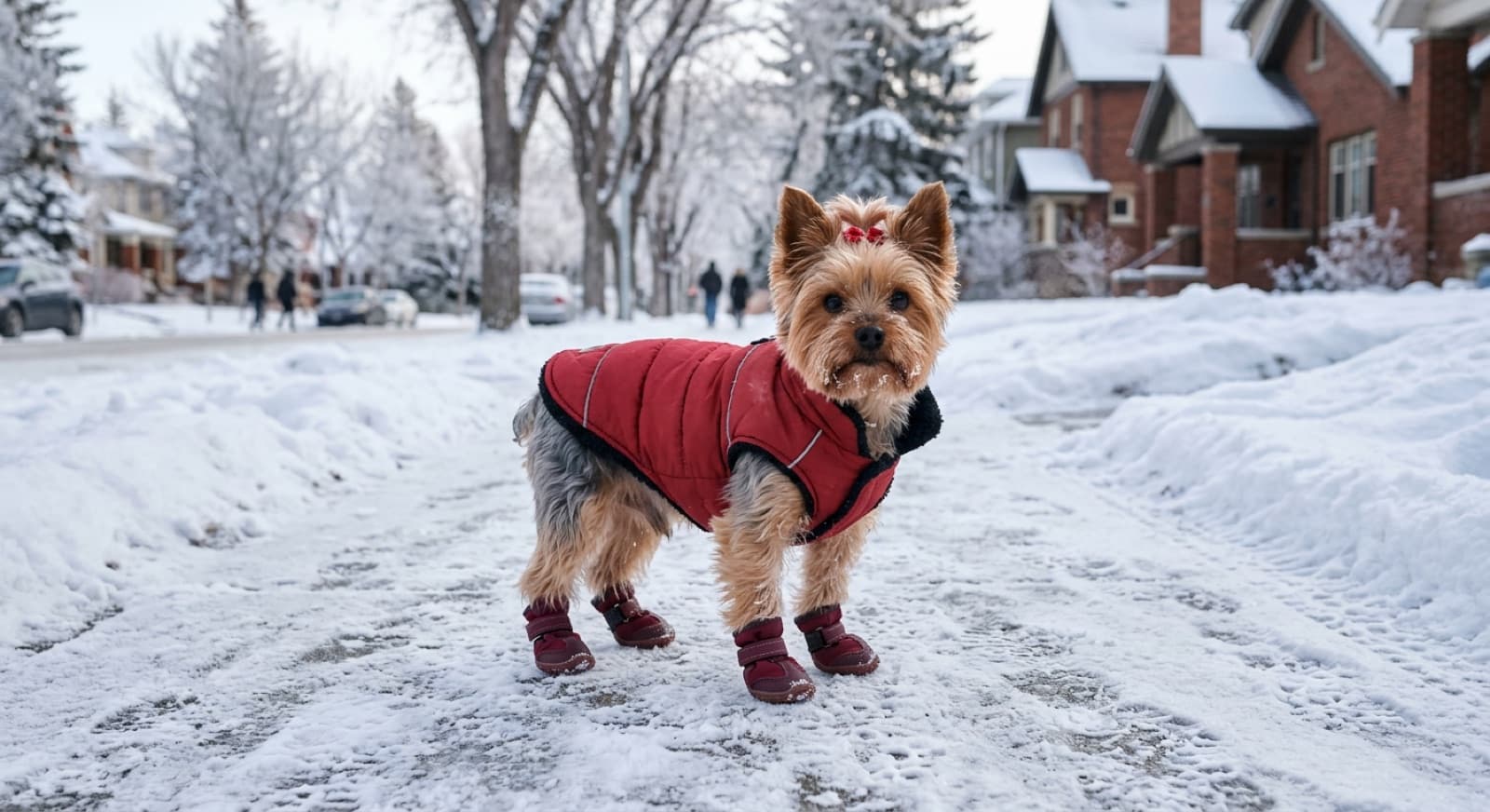
Why Yorkies are uniquely cold-sensitive
Yorkies struggle in Calgary winter for a few reasons that stack on top of each other. Small body mass means tiny heat reserves. Lean breeding means little fat insulation. Single-coat hair holds no warmth the way Husky or Bernese fur does.
- Tiny body mass at 4 to 7 lbs. The surface area to volume ratio drives huge heat loss.
- Low body fat. Yorkies are bred lean and carry almost no insulation under the skin.
- Single coat hair, not a double coat. There is no warm undercoat trapping body heat.
- Thin paws and ears. The peripheral parts freeze first.
- Fast metabolism. Tiny dogs burn calories quickly just to stay warm.
- Small muscle mass. Limited shivering can only raise body temperature so much.
Calgary winter is itself the harder side of the problem. Average winter sits at -10°C to -30°C. Cold snaps drop to -40°C with wind. Chinook winds swing temperatures 30°C in a single afternoon.
The result is a real ownership constraint, not a comfort issue. Most Calgary Yorkie owners run 5 to 6 months of active winter management every year.
Hypothermia: signs and emergency steps
Hypothermia in a 4 to 7 lb dog can move from mild to life-threatening in minutes. Calgary Yorkie owners need to know the signs cold.
Recognition signs (progressive):
- Hard, continuous shivering. This is the first sign.
- Weakness or lethargy as energy diverts to core warming.
- Pale or white gums, meaning circulation is failing.
- Slow heart rate and shallow breathing.
- Stumbling, stiff muscles, dilated pupils.
- Body temperature drop. Normal Yorkie is 38 to 39°C. Mild hypothermia is 36 to 37°C. Moderate is 32 to 35°C. Severe is under 32°C and life-threatening.
Emergency steps:
- Bring the dog inside right away.
- Dry the dog. A wet coat keeps cooling the body.
- Wrap in warm blankets. Microwaved towels work. Not scalding hot.
- Place warm (not hot) water bottles wrapped in towels against the dog.
- Use your own body heat. Tuck the dog under your shirt.
- Offer warm water to drink only if the dog is alert.
- For moderate or severe signs, drive to the ER vet now.
Calgary 24-hour ER vets: CARE Centre, WVSC, VCA Canada West, and McKnight 24 Hour Veterinary Hospital. Pre-program these numbers in your phone today.
Treatment cost estimates: mild $500 to $1,500. Moderate $2,000 to $5,000. Severe $5,000 to $10,000 or more.
One more thing. Hypothermia can hit indoors too. A power outage or broken furnace can drop apartment temps fast, and a Yorkie cools within hours. Keep a backup heating plan.
Calgary winter gear thresholds
Use the temperature, not the calendar. Healthy adult Yorkies sit in the middle. Senior or sick dogs need warmer thresholds. The list below is the working Calgary baseline.
- +10°C and above: short walks fine bare. A light fleece helps older or sick dogs.
- +5 to +10°C: light sweater. Most Yorkies are comfortable in fleece.
- 0 to +5°C: light insulated jacket or thick fleece. Many Yorkies hesitate at the door.
- -10 to 0°C: insulated coat is essential. Standard 15 to 30 min walks need a coat plus boots in many cases.
- -20 to -10°C: heavy insulated parka with belly and chest coverage. Limit walks to 10 to 20 min. Boots strongly recommended.
- -30 to -20°C: full coat, boots, and ear or face cover in wind. Walks 5 to 10 min max. Indoor potty becomes the default.
- Below -30°C: brief potty trips only, 5 minutes maximum. Hypothermia and frostbite are real risks at this range.
Recommended Calgary Yorkie winter kit:
- Insulated coat with belly coverage. Hurtta Extreme Warmer, Voyagers K9 Apparel, Chilly Dogs Great White North, Canada Pooch, Susan Lanci. $80 to $200.
- Boots. Muttluks Winter Fleece-Lined, Pawz disposable rubber, Ultra Paws Durable, Ruffwear Polar Trex (verify XS or small fit). $30 to $80 per set.
- Paw wax for salt and ice. Musher's Secret is the standard. $15 to $25.
- Quick-dry towel for the door. $15 to $30.
- Battery-heated jacket for senior or fragile Yorkies. $100 to $200.
- Pee pads for indoor backup. $20 to $40 per month.
Year one investment: $200 to $500 for a quality starter kit. Subsequent years run $50 to $150 in maintenance.
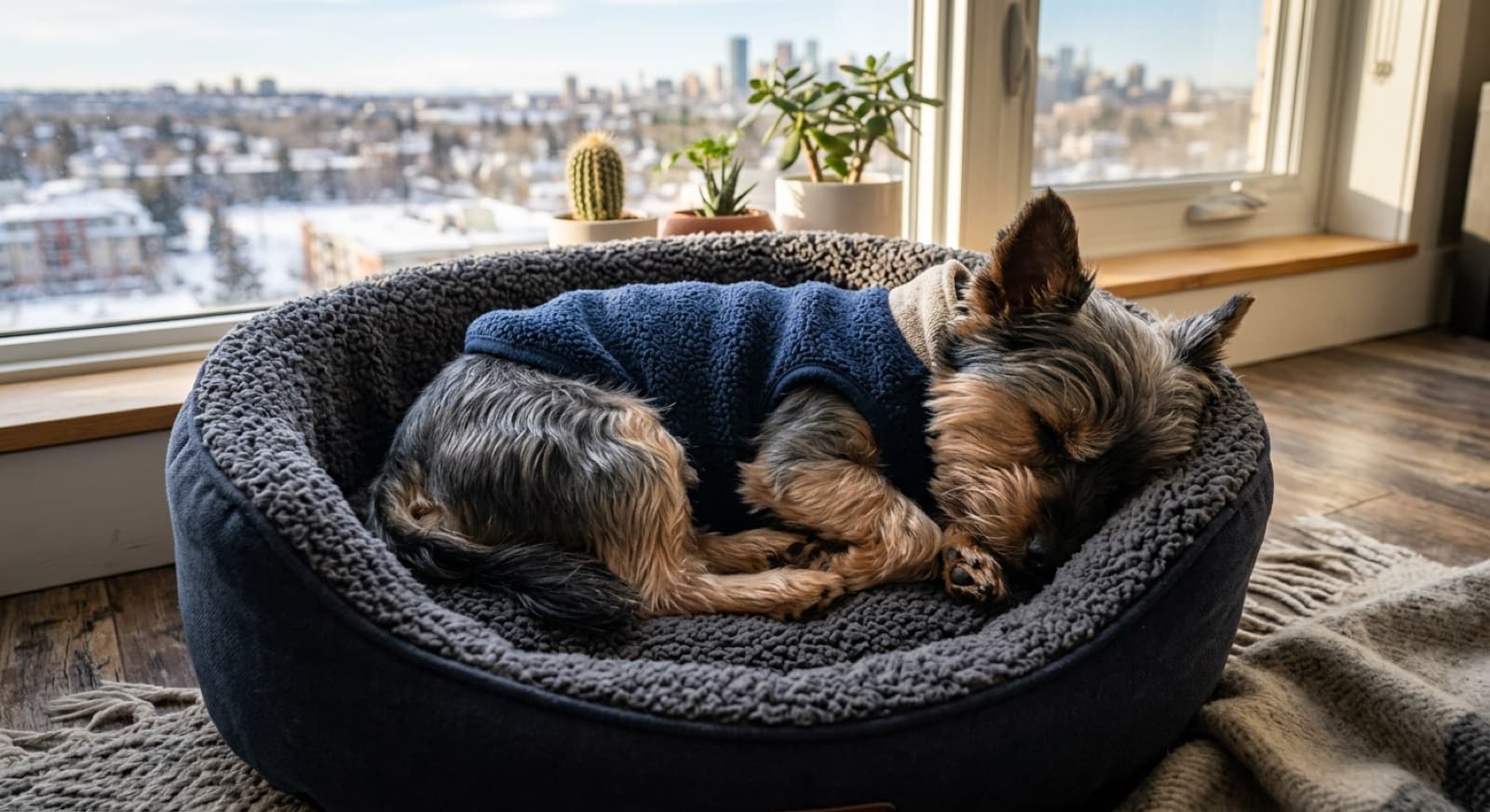
Booties and paw protection
Most Calgary Yorkies need booties or paw wax through the winter. Calgary throws three problems at the paws at once: cold, ice, and chemical salt.
Why Yorkies need paw protection. Paw pads on a 4 to 7 lb dog are thin. Calgary de-icer (calcium chloride and magnesium chloride) burns on contact and is toxic if licked. A small dog ingests a meaningful dose fast. Booties block direct snow contact and slow paw freezing.
Booties that fit a tiny Yorkie:
- Muttluks Winter Fleece-Lined. Popular in Calgary. Fleece inside, flexible outside. $30 to $60. Velcro can pull Yorkie hair.
- Pawz disposable rubber balloons. $15 to $25 for a pack of 12. Easy to put on. Good for short trips or backup.
- Ultra Paws Durable. $30 to $60. Calgary cold-weather brand. Velcro closure.
- Ruffwear Polar Trex. $80 to $120. Premium pick for active outdoor dogs.
Paw wax option. Musher's Secret is the standard ($15 to $25). Apply a thin layer to each pad before walks. It blocks salt and reduces cracking. It is not as good as boots, but it works for dogs who refuse boots.
Train booties indoors first. Most dogs walk strangely the first few times. Put them on inside, feed treats, walk for 5 minutes, then take them off. Repeat over a few days. Build up to short outdoor trips. Most Yorkies adjust within a week.
Post-walk routine. Wipe paws with a warm damp cloth at the door. Check between the toes for ice or salt. Inspect pads for cracks. Apply paw balm if needed.
Indoor potty setup
Indoor potty is the Calgary Yorkie winter default, not a backup. Set it up in October before deep cold so the dog learns it in mild weather.
Many Yorkies refuse to pee in deep snow, and that is a sane response, not a training failure. A 4 lb dog standing on cold ground is in real pain within seconds.
The four main indoor potty options:
- Pee pads. The most common Calgary choice. $20 to $40 per month. Easy to set up. Disposable. Some smell over time.
- Dog litter box. Small breed boxes work well once the dog learns them. $30 to $80 setup. Less waste than pads. Needs training and litter management.
- Indoor turf pad. PetSafe Pet Loo or FreshPatch (real grass delivered weekly in Calgary). $50 to $200 to set up. More natural for the dog. Many Yorkies switch faster than to synthetic pads.
- Balcony potty. A PetSafe Pet Loo or grass square on a covered balcony. Quick relief without elevator trips. Weather still matters, but the trip is seconds, not minutes.
How to train it. Take the dog to the pad after meals, naps, and play. Reward right after they go. Pad-trained puppies pick it back up in a day. Adult rescues take 1 to 2 weeks. Do not punish accidents. Confine to a small area near the pad until the habit sets.
Most Calgary Yorkie owners run a hybrid system. Outdoor when weather allows, indoor in deep cold. That mix works through October to April.
Frostbite on ears, paws, and tail tip
Frostbite hits the peripheral parts first. On a Yorkie that means ear tips, paw pads, tail tip, and sometimes the nose. Male dogs can get exposure-area frostbite from snow contact too.
Signs to watch for:
- Pale, gray-white, or blue-grey skin in the affected area.
- Hard or brittle tissue feel.
- Ice cold to the touch, numb to the dog.
- Blue-red colour as it warms back up.
- Blisters as it thaws.
- Black, dead tissue in severe cases.
- Pain as the area warms.
When it happens. At -15°C and below, 10 to 15 minutes of exposure can be enough for some Yorkies. Wind chill speeds it up. Wet conditions speed it up. Senior dogs are more at risk.
Emergency steps:
- Warm gradually. Do not rub the tissue. Do not use hot water.
- Wrap the dog in a warm blanket and hold against your body.
- For paws, use lukewarm water at 38 to 40°C only.
- Never use direct heat. No heating pad on contact, no hair dryer on hot.
- See a vet right away, even for mild cases.
Calgary 24-hour ER vets: CARE Centre, WVSC, VCA Canada West, and McKnight 24 Hour Veterinary Hospital.
Vet treatment covers pain management, antibiotics, and in severe cases, removal of dead tissue. Amputation of ear or tail tips is rare but possible.
Prevention is much easier than treatment. Proper gear, brief exposure in deep cold, wind-blocked routes, and a watchful eye for shivering will keep most Yorkies frostbite-free their whole lives.
Calgary chinooks and the temperature swing problem
A Calgary chinook is a warm Pacific wind that breaks over the Rockies and dumps a 30°C swing in a few hours. It can be -25°C overnight and +5°C by lunch. Chinooks run from October to April and peak in the deep winter months.
Why chinooks are hard on Yorkies. A tiny body with low fat reserves struggles to keep up with that pace of change. Some dogs (especially seniors or cardiac dogs) react to the pressure shift with breathing changes or odd behaviour. Warm-then-refreeze cycles glaze sidewalks with ice, which is a joint injury risk for a 4 lb dog.
Chinook protocol:
- Watch the forecast during chinook season.
- Walk the yard fence after every chinook. Winds of 80 to 120 km/h damage fences, and a tiny Yorkie escapes through small gaps.
- Adjust gear to the actual temperature, not the forecast.
- Avoid icy driveways and sidewalks. Carry the dog over the worst sections.
- Walk mid-afternoon once temperatures stabilize, not during the rapid swing.
- Offer extra water. Chinook days dehydrate dogs because of low humidity.
- If your Yorkie seems off during a chinook, that is real, not your imagination.
Senior and sick Yorkies need warmer thresholds
Senior Yorkies (10+ years) and dogs with cardiac, thyroid, or arthritis issues feel winter harder than healthy adults. Metabolism slows. Body condition drops. Cold worsens joint pain. Mobility gets harder.
Senior Yorkie winter protocol:
- Lower the thresholds. Coat at +10°C, not +5°C. Indoor potty the default by -10°C, not -25°C.
- Use heavier coat insulation.
- Boots are essential. Paw freezing and arthritis pain stack.
- Walks 3 to 10 minutes only, not 20 to 30.
- Multiple brief trips beat one long one.
- Heated orthopedic dog bed indoors. $80 to $200.
- Monitor cardiac, thyroid, and arthritis with the vet through winter.
- Joint supplements if your vet recommends them.
- Battery-heated jacket for severe cold. $100 to $200.
Yorkies live 13 to 16 years, so a senior adoption is often a meaningful 3 to 6 year partnership. The winter accommodation is the price of that time, and most owners say it is worth it.
Frequently Asked Questions
Why are Yorkies vulnerable to Calgary winter?
A 4 to 7 lb body, low body fat, and single-coat hair (not insulating fur) all stack up. Thin paws and ears freeze first. Calgary winter runs -10°C to -30°C, with -40°C cold snaps. Most Calgary Yorkie owners run 5 to 6 months of active winter management every year.
How do I spot and respond to hypothermia?
Watch for hard shivering, weakness, pale gums, and a body temp under 36°C (normal is 38 to 39°C). Severe is under 32°C. Bring the dog inside, dry off, wrap in warm blankets, use warm (not hot) water bottles, and tuck under your shirt. For moderate or severe cases, drive to the ER vet now. Calgary 24-hour options: CARE Centre, WVSC, VCA Canada West, McKnight. Costs run $500 to $10,000+.
What gear does my Yorkie need at each temperature?
Above +10°C, gear is optional. +5 to +10°C: light sweater. 0 to +5°C: light insulated jacket. -10 to 0°C: insulated coat is essential. -10 to -20°C: heavy parka, walks 10 to 20 min, boots recommended. -20 to -30°C: full gear, walks 5 to 10 min max. Below -30°C: emergency potty only, 5 min max. Quality coats from Hurtta, Voyagers, Chilly Dogs, or Canada Pooch run $80 to $200. Year one gear costs $200 to $500.
Are booties really necessary?
Yes for most Calgary winter conditions. Yorkie paw pads are thin, Calgary de-icer salt burns and is toxic if licked, and ice gets stuck between the toes. Muttluks Winter Fleece-Lined ($30 to $60), Pawz disposable ($15 to $25), Ultra Paws Durable ($30 to $60), and Ruffwear Polar Trex ($80 to $120) all work. Musher's Secret paw wax ($15 to $25) is the alternative if your dog refuses boots. Practice indoors first.
What indoor potty options work in Calgary?
Pee pads ($20 to $40 a month, easy setup), small breed dog litter box ($30 to $80 setup plus litter), indoor turf (PetSafe Pet Loo or FreshPatch real grass delivery, $50 to $200), or a balcony grass square. A hybrid setup (outdoor when weather allows, indoor in deep cold) is the most common pattern. Set it up before winter hits, not during a cold snap.
How do I spot and treat frostbite?
Look for pale or gray-white skin on ear tips, paw pads, tail tip, or nose. Skin feels hard and ice cold. As it warms, it turns blue-red, may blister, and in severe cases turns black. Warm gradually with body heat and a blanket. Use lukewarm water (38 to 40°C) for paws only. Never rub, never use a heating pad, never use a hair dryer on hot. See a vet right away, even for mild cases. Severe frostbite can mean tip amputation.
How do Calgary chinooks affect a Yorkie?
Chinooks bring 30°C swings in hours, hard on a 4 to 7 lb dog. Tiny bodies struggle with that pace of change. Watch the fence (winds of 80 to 120 km/h damage fences and tiny dogs escape). Adjust gear to the actual temperature, not the forecast. Walk mid-afternoon once it stabilizes. Carry the dog over icy patches. Offer extra water.
How is winter different for a senior Yorkie?
Lower the thresholds. Coat at +10°C instead of +5°C. Indoor potty primary by -10°C, not -25°C. Heavier coat. Boots essential. Walks 3 to 10 minutes only. Heated orthopedic bed indoors ($80 to $200). Monitor cardiac, thyroid, and arthritis through winter. Battery-heated jacket for severe cold ($100 to $200). Yorkie lifespan is 13 to 16 years, so senior adoption is often a meaningful 3 to 6 year partnership.
Can a Yorkie live in a Calgary apartment year-round?
Yes, with the right setup. Indoor potty is essential. Raised dog beds keep the dog off cold floors. Manage drafts at doors and windows. Keep a portable heater backup for power outages. Use scheduled outdoor trips in the warmest part of the day. Keep a ready-to-go bag near the door with coat and boots.
What indoor exercise works during deep cold?
Indoor fetch, tug, stair work, food puzzles, snuffle mats, trick training, hide-and-seek with treats, and nose work practice all work. Calgary daycare one or two days a week ($30 to $55 a day) gives a tired Yorkie. Nose work classes run $150 to $300 for eight weeks.
What does the full year-one gear list cost?
Year one runs $300 to $700 all in. Winter gear ($200 to $500) covers coat, boots, paw wax, towel, heated jacket for senior dogs, and indoor potty setup. Summer ($50 to $150) is light jacket and cooling vest if needed. Spring and fall ($50 to $150) is a rain jacket and light fleece. Indoor extras: heated bed ($80 to $200), raised bed ($30 to $80), backup heater ($50 to $100). Year two onward runs $100 to $250 in maintenance.
Bottom line: should I adopt a Yorkie in Calgary?
Yes if you can invest $300 to $700 in year one gear, set up indoor potty before winter hits, keep a warm draft-free home, save Calgary 24-hour ER numbers, and accept that 5 to 6 months of active winter management is the deal. No if your lifestyle expects the dog to be outside all day, your home is drafty and unheated, or you are not ready to invest in winter gear. Most Calgary Yorkie owners say the winter routine becomes second nature by year two, and the 13 to 16 year lifespan makes for a deep partnership.
More Yorkie guides
Adoptable Yorkies in Calgary
Live listings of Yorkshire Terriers and Yorkie mixes from 13+ Calgary rescues.
Yorkie Adoption Calgary
Where to adopt, real costs, teacup scam warnings, common Yorkie mixes, and why Yorkies get surrendered.
Yorkie Health Issues
Liver shunt, tracheal collapse, dental, luxating patella, hypoglycemia, and the 13 to 16 year lifespan.
Yorkie Grooming Calgary
Daily brushing, haircut styles, professional grooming, topknot care, and tear stain tips.
Yorkie Behaviour & Training
Yorkie temperament, barking, small dog syndrome, leash work, and what actually motivates the breed.
Yorkie House Training
Why Yorkies are slow to housetrain, indoor pad transition for winter, and the Calgary specific plan.
Yorkie Feeding & Dental Care
Hypoglycemia prevention, small dog dental disease, food choices, and feeding schedule for tiny breeds.
New dog? Start with these care guides
Everything a new adopter needs to set up a safe, happy home.