The short answer
A microchip is a tiny radio-frequency ID chip, about the size of a grain of rice, placed under your pet's skin. It is not a GPS tracker. It holds a single ID number that links to your contact details in a registry, so a vet or shelter can scan a found pet and reach you. Here is the Edmonton-specific part: your mandatory City pet licence already includes a free microchip, implanted by appointment at the Animal Care & Control Centre. The one rule that matters either way: the chip is useless unless the registration linked to it is kept current.
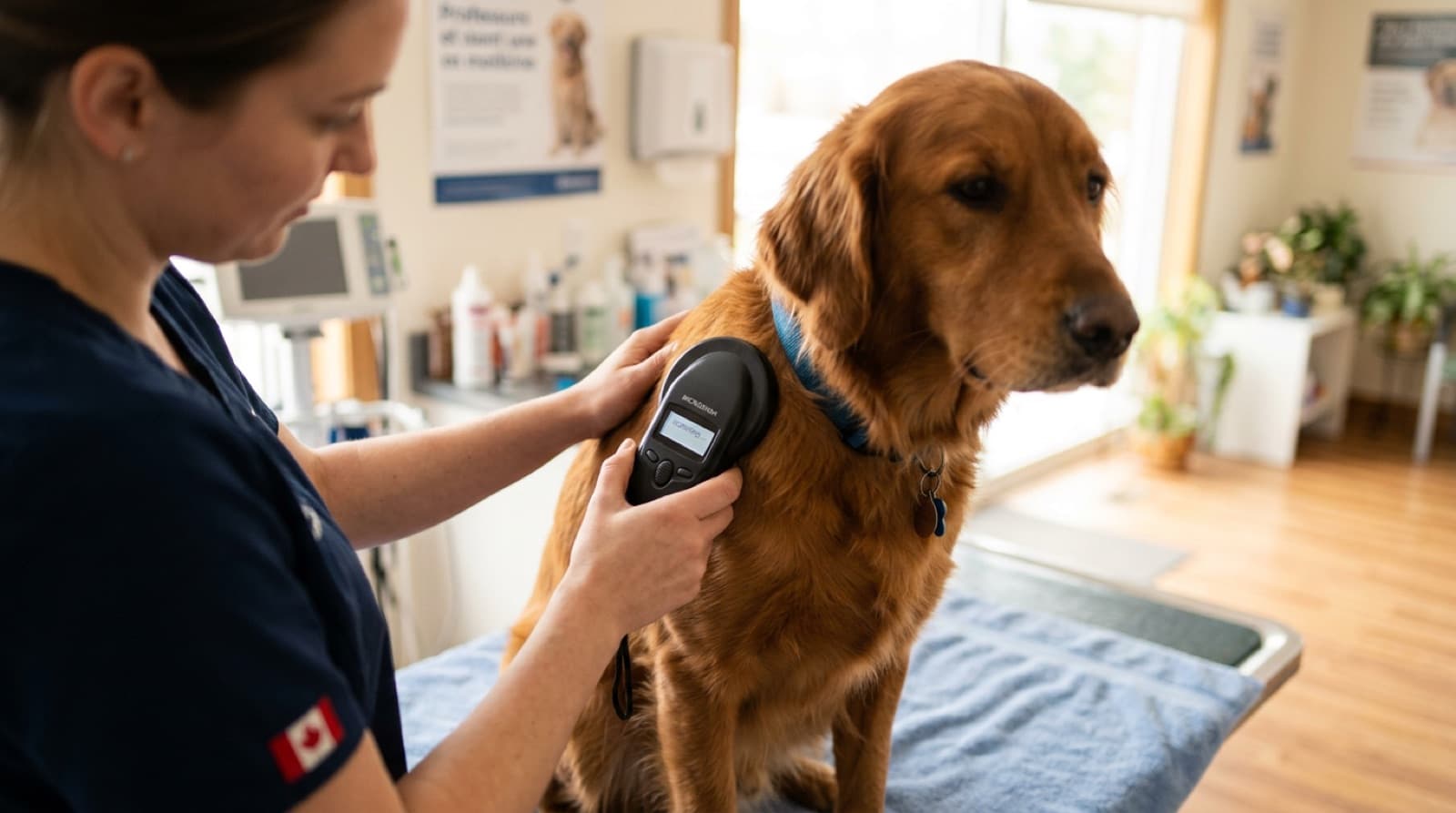
Most Edmonton owners do not realize the licence they are required to buy quietly solved their microchip question for them. The chip comes free with the licence. The part that still trips people up is what a chip actually does, and the one bit of upkeep that decides whether it ever works. Here is the whole picture.
What a Microchip Is (and Isn't)
A microchip is a passive RFID transponder roughly the size of a grain of rice, implanted just under the skin between the shoulder blades. “Passive” is the key word: it has no battery and no power of its own. It sits inert until a scanner's radio waves pass over it, which is what makes it transmit its number. That is the entire job.
It is not a GPS tracker. The American Veterinary Medical Association states plainly that a microchip “cannot track your animal if it gets lost.” It has no location, no signal you can follow, and no app. If you want to see where your dog is in real time, that is a GPS collar tag, a separate device you buy on top of the chip.
The number on the chip is not your information. It is a key. When a clinic scans a found pet, the scanner shows a 15-digit number, and that number is looked up in a registry database that holds your name and contact details. Modern chips follow an international standard (ISO 11784/11785), and the universal scanners every vet and shelter uses can read all the common frequencies, so a chip implanted in Edmonton still reads if your pet turns up in another province.
Implanting it is quick. The AVMA compares it to a routine injection: a hypodermic needle, no surgery, no anesthesia required, usually between the shoulder blades.
Your Edmonton Licence Includes a Free Microchip
This is the Edmonton detail worth knowing before you pay a vet to chip your pet. As the City puts it, “every pet licence includes a microchip,” through its Don't Skip the Chip program, and there is no separate charge for it. The chip is implanted by appointment at the City's Animal Care & Control Centre at 13550 163 Street.
How to get the free chip:
1. Have a valid City of Edmonton pet licence. All cats and dogs over 6 months must be licensed anyway, so most owners already qualify. See our Edmonton licensing guide for fees and how to license.
2. Book a microchip appointment at the Animal Care & Control Centre (online or by calling 311).
3. Bring proof of ownership and your pet, and the chip is implanted at no extra cost.
The licence does not auto-implant a chip the moment you pay; it entitles you to a free implant through the program. Since the licence is mandatory regardless, this is the cheapest microchip route in the city. The only cost is the licence itself: $23 for a fixed cat and $38 for a fixed dog.
What It Costs Outside the Licence
If your pet is already chipped, or you would rather have a vet do it during another visit, that is fine too. As a rough guide, a veterinary clinic typically charges somewhere around $50 to $70 for the chip and implantation (a directional estimate, not an official figure, so confirm with your own clinic). The cheapest add-on is almost always during an appointment your pet is already booked for, such as a spay or neuter.
Bundled at spay or neuter. Edmonton Humane Society includes a microchip when it spays or neuters a pet through its PALS program rather than charging for it separately. Between that, the free City licence chip, and an add-on at your vet, an Edmonton pet rarely needs to pay full price for a standalone microchip.
Keeping It Current (this is the whole point)
Here is the failure point for the majority of microchipped pets that never make it home: the chip works fine, but the contact details attached to its number are out of date. People move, change phone numbers, and adopt pets from previous owners, and the registry does not update itself. A chip number with no current owner record behind it is just a number.
One honest note specific to Edmonton: the City does not publish which registry its licence-chip is linked to or how to update those details online. So if your chip came through the City program, confirm directly with the City how your information is kept current. If your pet was chipped by a vet or a rescue instead, you can enter the chip number into the free AAHA Universal Pet Microchip Lookup Tool, which tells you which registry holds the chip so you know exactly who to contact.
Whichever route chipped your pet, the rule is the same: update the record any time you move, change your phone number, or take on a pet through adoption or rehoming. Five minutes of upkeep is the difference between a found pet and a lost one.
Scanning a Found Pet in Edmonton
A microchip is what turns a found pet into a returned pet. In Edmonton the chain works like this:
Any vet clinic can scan a found animal for a chip, usually at no charge.
The Animal Care & Control Centre scans every animal that enters it, and also offers scanning appointments for residents who find a pet (book online or by calling 311). You can search its found-pet database online to see if an owner has already reported the pet missing.
The hold window rewards ID. Per the City, an impounded animal with no identification is held up to 4 days, while an animal with a tag, tattoo, or microchip is held up to 10 business days, giving staff far more time to reach you. A licensed pet found at large also qualifies for one free ride home each year.
Two layers of ID is the goal: the visible licence tag for a fast neighbourhood return, and the microchip as the permanent backup that travels with your pet no matter how far it goes.
Microchip vs Licence vs Tag
In Edmonton these are bundled in a way that confuses people, so to be clear:
The takeaway: in Edmonton you do not choose between a tag and a chip, because the one mandatory thing, the licence, gives you both. The full breakdown of who needs a licence and what it costs is in our Edmonton pet licensing guide.
Just adopted, or about to?
Browse adoptable rescue dogs and cats across Edmonton, then put the licence and its free microchip on your first-week checklist.
Frequently Asked Questions
Is a pet microchip a GPS tracker?
No, and this is the most common misunderstanding. A microchip is a passive RFID chip with no battery and no location feature. The American Veterinary Medical Association is explicit that a microchip cannot track your animal if it gets lost. It only does one thing: when a scanner passes over it, it transmits an ID number that links to your contact details in a registry. If you want live location tracking, that is a separate GPS collar tag, a different product entirely.
Does my Edmonton pet licence really include a free microchip?
Yes. Every City of Edmonton pet licence includes a microchip at no extra charge, through the City's "Don't Skip the Chip" program. The chip is implanted by appointment at the Animal Care & Control Centre at 13550 163 Street. To get it, you book an appointment, show proof of ownership, and have a valid City licence. There is no separate microchip fee, so the only cost is the licence itself ($23 for a fixed cat, $38 for a fixed dog). For most Edmonton owners, this is the cheapest way to chip a pet, because it is free with the licence you already need.
Is microchipping mandatory in Edmonton?
Not on its own for an ordinary pet, but the licence is. Under the Animal Care and Control Bylaw, all cats and dogs over 6 months old must be licensed, and since the licence now includes a chip, nearly every licensed Edmonton pet ends up microchipped in practice. The one place a microchip is separately required is for restricted or vicious dogs, which the bylaw orders to be microchipped along with other conditions.
How much does it cost to microchip a pet in Edmonton?
The cheapest path is free, through your City of Edmonton licence and the Don't Skip the Chip program. If you want a chip outside the licence, a veterinary clinic typically charges roughly $50 to $70 (this is a directional estimate, not an official figure, so confirm with your vet). Edmonton Humane Society includes a microchip when it spays or neuters a pet through its PALS program rather than selling it as a standalone service.
How do I keep my pet's microchip registration up to date?
A microchip is only useful if the contact information linked to its number is current, which is the step most owners forget. The City of Edmonton has not published which registry its licence-chip is linked to, so confirm with the City how to update your details if your chip came through the licence program. If your pet was chipped by a vet or a rescue, enter the chip number into the free AAHA lookup tool at petmicrochiplookup.org to find which registry holds it, then update your phone, email, and address there. Do this whenever you move or change your number.
I found a pet in Edmonton. How do I get its chip scanned?
Take the animal to any veterinary clinic, which can scan it at no charge, or to the City's Animal Care & Control Centre, which scans every animal that enters and also offers scanning appointments you can book online or by calling 311. The scan reveals an ID number, which is then looked up to find the registry and reach the owner. You can also search the City's found-pet database online to see if the owner has already reported the pet missing.
What is the difference between the microchip and the licence tag?
In Edmonton your pet licence includes both. The tag is the visible ID a neighbour or finder can read right away; the microchip is the permanent backup a vet or shelter scans if the tag is gone. They work together: a licensed, identified pet (with a tag, tattoo, or microchip) is held up to 10 business days at the Animal Care & Control Centre instead of 4, and a licensed pet found at large qualifies for one free ride home each year.