The short answer
Terwillegar Park is Edmonton's largest off-leash area at 169 acres on the North Saskatchewan River, in southwest Edmonton at the south end of Rabbit Hill Road. The whole park is unfenced, which is the most important thing to know before you go. Open daily 5 AM to 11 PM, free gravel parking, no water fountains, no washrooms (portable toilet only). Best for confident adult dogs with reliable recall. New rescues should wait 4-6 weeks before a first off-leash visit. River swimming is gentle most of the year but unsafe during spring runoff.
Quick Facts
| Park | Terwillegar Park (Edmonton river valley) |
| Size | 169 acres (~68 hectares), Edmonton's largest off-leash area |
| Address | 16360 Rabbit Hill Road NW, Edmonton, AB |
| Neighbourhood | Southwest Edmonton (Riverbend area) |
| Fenced area | No, entirely unfenced |
| Hours | 5:00 AM - 11:00 PM daily |
| Parking | Free, gravel lot on Rabbit Hill Road |
| Small dog section | No |
| Water fountains | No (bring your own) |
| Washrooms | Portable toilet only |
| River swimming | Yes, gentle beach entry ~350m from parking |
| Footbridge | 262m to Jan Reimer Park on north side of river |
| Canoe / kayak launch | Yes, hand-launch from parking area |
| Off-leash bylaw fine | $250 if dog off-leash improperly or not under control |
Where Terwillegar Is
Terwillegar Park sits at the southern tip of Rabbit Hill Road NW in southwest Edmonton, on the south bank of the North Saskatchewan River. The cross-streets you'll use are Whitemud Drive (east-west arterial) and Rabbit Hill Road heading south. The official address is 16360 Rabbit Hill Road NW, Edmonton, AB, which is the parking lot itself. The park sits in the Riverbend district, adjacent to the Terwillegar Heights and Magrath communities.
From central Edmonton, plan a 15-20 minute drive south on Calgary Trail to Whitemud Drive, then west on Whitemud and south on Rabbit Hill Road. From south Edmonton communities (Magrath, Terwillegar, Windermere), it's a 5-10 minute drive. There is no LRT or major bus route directly to the park, so you'll need a vehicle for most visits.
Once you're in the lot, the park entrance is at the south end of the gravel parking area. A paved trail leads from the lot down to the main off-leash zone and the river. The 262-metre footbridge to Jan Reimer Park (formerly Oleskiw River Valley Park) is also accessible from this trail, crossing the river to the north bank.
What's Inside the Park
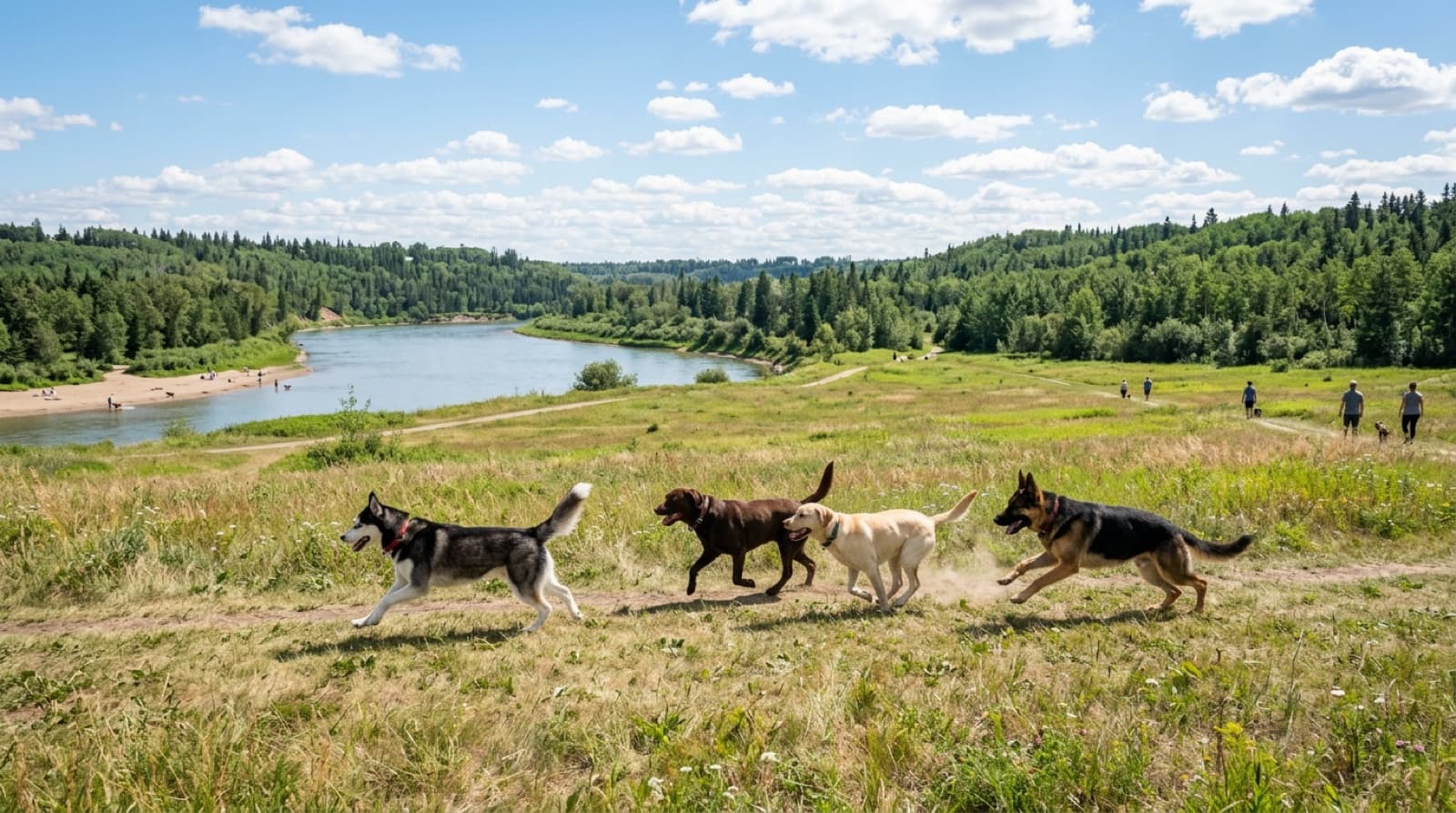
Terwillegar isn't one open field. It's a 169-acre stretch of river valley with several distinct zones, connected by trails. Most regulars use the park as a 60-90 minute loop rather than a 20-minute fenced-park stop.
What you'll find:
- Main off-leash field, just past the access trail from the parking lot. Open grass, popular for fetch and group play
- River beach access roughly 350 metres from the parking lot. Sand and gravel mix, gentle entry, the busiest spot on summer days
- Multi-use trails through the forest cover, ravine slopes, and along the river bank. Mostly dirt and gravel surfaces
- The 262-metre footbridge over the North Saskatchewan to Jan Reimer Park (leashed only on the bridge)
- Forest cover with cottonwoods, balsam poplar, aspen, and willow along the river bank. Useful summer shade, dense enough that an off-leash dog with bad recall can disappear quickly
- Canoe and kayak hand-launch from the parking area, a short portage to the river
- Portable toilet at the parking area, no permanent washroom
What's NOT here:
- No fencing anywhere in the park
- No water fountains for dogs or humans
- No small-dog area or size-segregated zone
- No playground or picnic shelters (this is a natural park, not a community park)
- No paid concessions. Nearest food and water are back along Rabbit Hill Road
Off-Leash Zones Explained
Most of Terwillegar Park is a designated off-leash area, but not every part. The rule pattern is the same as other Edmonton off-leash parks: dogs must be leashed in transition zones (parking lot, access paths, footbridge) and can be off-leash once you're inside the main park area.
Always leashed:
- The parking lot
- The paved access trail between the parking lot and the off-leash zone
- The 262-metre footbridge crossing the river
- Jan Reimer Park on the north side of the bridge (this is a separate park with its own rules, not an off-leash area)
Off-leash permitted:
- The main off-leash field past the access trail
- The river beach access area
- The multi-use trails through the park interior
- The forest cover and ravine slopes inside the park boundary
The most common bylaw violation we hear about is owners letting dogs off-leash in the parking lot or on the access trail. Even though it feels like “basically the park,” bylaw officers can and do ticket. The $250 fine isn't worth it. Keep the leash on until you're past the access trail and inside the open area.
Hours, Parking & Peak Times
Terwillegar is open 5:00 AM to 11:00 PM daily, the standard City of Edmonton park hours per the City of Edmonton Terwillegar Park page. There are no gates, but the bylaw applies regardless of hour. Bylaw officers patrol most often on summer weekends and evenings.
Parking
One gravel lot at 16360 Rabbit Hill Road NW. Free, no permits required. The lot fits roughly 80-100 vehicles. On summer Saturdays and Sundays from late June through early September, the lot can fill by 10:30 AM and stay full until late afternoon. If you arrive to a full lot, your options are: park along Rabbit Hill Road (legal in some sections, check signage), come back at a quieter time, or visit a different Edmonton off-leash area.
Busiest times
- Saturday and Sunday 10 AM-2 PM, June through August. 30-60+ dogs across the field and beach
- Summer weekday evenings 6-8 PM. Heavy after-work rush
- Hot weekends. The river beach acts as a magnet on 25°C+ days
Quietest times
- Weekday mornings before 9 AM. Often only a handful of regulars
- Weekday afternoons 1-3 PM. Most owners are at work
- Winter visits below -15°C. Park is usable but largely empty
- Rainy or muddy days. Most regulars stay home; mud at Terwillegar gets deep fast
Is It Right for Your Dog?
Confident adult dogs with reliable recall
Excellent fit. This is the use case Terwillegar is built for. Open space, river swimming, varied terrain. Most regulars are these dogs and their owners. If your dog comes when called at home, in the backyard, and on quieter Edmonton off-leash trails, Terwillegar is the next step up.
Newly adopted rescue dogs (first 30 days)
Wait. The 3-3-3 decompression principle applies. An unfenced 169-acre park with river access, forest cover, and 50+ unfamiliar dogs is too much for week one or week two. Most rescue dogs from Edmonton Humane Society, SCARS, Zoe's, GEARS, Hope Lives Here, and AHHRB need at least 3-6 weeks of structured decompression before a first Terwillegar off-leash visit makes sense. Start with leashed walks in your neighbourhood, then leashed visits to Terwillegar to acclimate to the smells and sounds, and graduate to off-leash only once recall is solid.
Dogs with unreliable recall
Skip Terwillegar for now. The unfenced layout is the wrong environment for a dog who might bolt. If your dog is still learning recall, work in a smaller fenced park first (Edmonton has a handful, including the fully-fenced O-day'min Dog Park downtown). Use a long-line at Terwillegar instead of fully off-leash. The river, the forest cover, and the slopes are all places where a dog can disappear before you can react.
Reactive dogs (dog-reactive or fearful)
Mixed. The size of Terwillegar means you can usually find space away from other dogs, especially during off-peak windows. But the unfenced layout means you can't control when another off-leash dog will approach. If your dog has a clear bite history or fear-based reactivity, an Edmonton force-free trainer can assess whether Terwillegar is workable at all for your specific dog or whether a fenced option is safer. Avoid summer weekend peak times if you do visit.
Small and toy breeds
Marginal. No size-segregated section means your small dog shares space with 70-lb sporting and working breeds. Confident small dogs (Boston Terriers, French Bulldogs, sturdy Chihuahuas) do fine. Anxious or fragile small dogs (toy Yorkies, senior Pomeranians) usually don't. The river current is also a real hazard for smaller dogs even in mid-summer flow. Most small-dog owners we talk to in Edmonton either visit Terwillegar only on weekday mornings or pick a smaller community off-leash area.
Puppies under 6 months
Not until vaccinations are complete and recall is reliable. Once your vet clears the puppy for unfamiliar-dog contact (usually 2 weeks after the final vaccine round around 16 weeks), Terwillegar works for short, off-peak visits. Don't go off-leash on the first few visits. Use a long-line until you've seen your puppy come back from a distraction. Avoid summer weekends entirely for first visits.
High-energy working and sporting breeds
Outstanding fit. Labs, Goldens, Doodles, Border Collies, working-line Shepherds, Vizslas, hunting breeds. Terwillegar is the kind of park these dogs are built for. Open running, swim access, varied terrain. Pair the visit with structured recall work for the best return.
Senior dogs
Workable at off-peak. The main trails are flat enough, and the river beach is easy on joints. Avoid the ravine slope sections if your senior dog has hip or back issues. Skip summer weekend midday. The energy of 50+ younger dogs running around can be overwhelming for an older dog. Weekday mornings are the right window.
Browse adoptable dogs in Edmonton
Adopting an Edmonton rescue with strong recall who'd love a park like Terwillegar? Browse adoptable dogs from Edmonton Humane Society, SCARS, Zoe's, GEARS, Hope Lives Here, and AHHRB. Many are foster-tested for recall, so the rescue can tell you if the dog is ready for an unfenced park or still needs leash and long-line work.
See Edmonton Adoptable Dogs →Winter at Terwillegar
Edmonton winters are colder and longer than Calgary's, and Terwillegar in January looks very different from Terwillegar in July. The park stays open year-round, but conditions change. Most regulars still visit in winter; some days are better than others.
Trail conditions in winter
The main trails get packed down by foot traffic and become walkable in boots or microspikes. The ravine slope trails can get icy and dangerous, especially after thaw-freeze cycles. The river beach area is usually frozen over from late November through March. The footbridge is generally cleared but stays slippery in deep cold.
Cold-weather thresholds for dogs
Edmonton sees winter lows of -25 to -35°C in January and February. At -15°C, most dogs are still comfortable for 30-45 minutes if they have a winter coat or thick undercoat (Huskies, Malamutes, Bernese, Newfoundlands, Akitas). Short-coated breeds (Greyhounds, Pit Bulls, Boxers, Vizslas) need a coat below -5°C and bootees below -15°C. Below -25°C, limit visits to 10-15 minutes and watch for paw-lifting (the first sign of frostbite risk).
Paw protection
Pack road salt around the parking area is the bigger paw threat than the cold itself. Salt and ice melt cause cracking, bleeding, and chemical burns on paw pads. Use paw wax (Musher's Secret is the most common Edmonton recommendation) before the visit and rinse paws with lukewarm water when you get home. Boots work for dogs that tolerate them.
What to skip in winter
- The frozen river is not safe to walk dogs on. Ice thickness is unpredictable and the current under the ice can be strong
- The ravine slopes after a thaw-freeze cycle are an injury risk for older or arthritic dogs
- Long visits below -25°C with any short-coated breed
River Access & Swimming
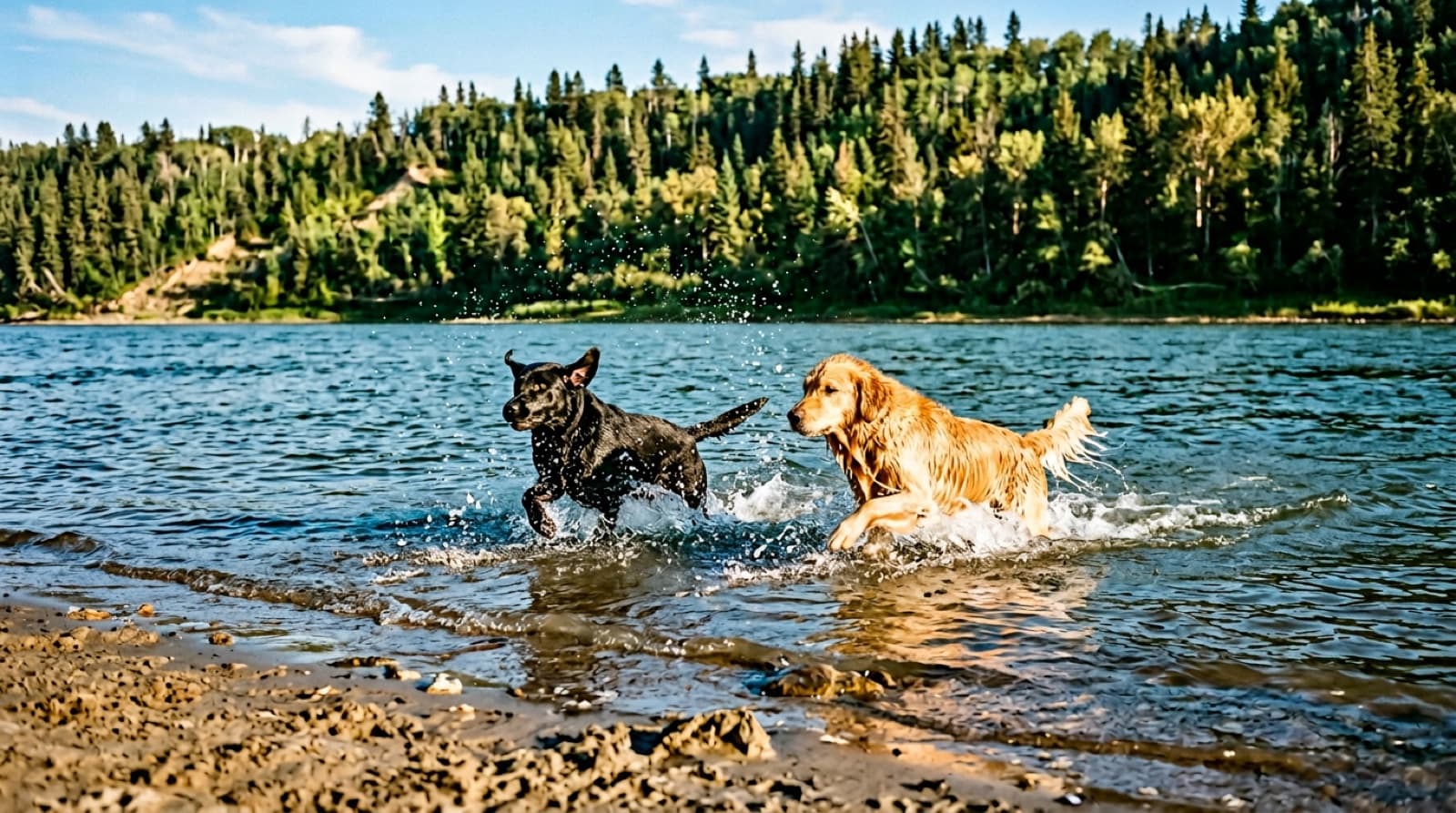
The North Saskatchewan River is the reason most Edmonton dog owners pick Terwillegar over a different park. The beach access is roughly 350 metres from the parking lot, with a gentle entry of sand and gravel. Late summer (August into September), the water level drops and exposes more gravel bar, making for easier wading and shallow swims.
When the river is safe
Mid-summer (late June through early September) is the window when most dogs can swim safely. Flow is calmer, water temperature is bearable, and the river is shallow enough for confident swimmers to touch bottom in the beach area.
When the river is dangerous
Spring runoff (May and early June) carries high flow, debris from upstream, and cold temperatures. The current can carry a dog downstream quickly and into log jams. After heavy summer rain (any time the river looks brown or fast-moving), wait 24-48 hours before letting dogs swim. The river also moves logs and tree branches; visible debris means stay on shore.
Water quality
The North Saskatchewan Riverkeeper samples water quality at Terwillegar weekly from June 15 through August 31. If your dog has a sensitive gut, skin issues, or a compromised immune system, check the Swim Guide before letting them swim. After heavy rain or in early spring, runoff can carry agricultural and urban contaminants downstream from upstream sources.
Swimming protocol
- Stay in the beach area; don't let dogs swim out into the main channel current
- Keep dogs in sight at all times in the water
- Pull dogs out before they tire. Strong dogs underestimate current
- Rinse off after the swim (river silt mats coats and irritates skin if left in)
- Watch for blue-green algae blooms in late summer (rare in flowing water but possible)
- Bring a towel; Edmonton evenings cool off fast even in July
Coyotes & Wildlife
The Edmonton river valley is active coyote habitat, and Terwillegar is no exception. Coyotes use the forest cover and ravine slopes, especially at dawn and dusk. Other wildlife regulars include white-tailed deer, occasional beavers along the river, hawks, and a varied songbird population. Larger wildlife (moose, the rare black bear) is reported less often but isn't unheard of in late summer or fall. The City's broader guidance for the river valley is laid out on the Edmonton off-leash parks guide, including coyote protocol for the other major parks.
Coyote protocol
City of Edmonton policy is clear: if you see a coyote, leash your dog immediately. The vast majority of coyote encounters at Terwillegar are visual only. The coyote sees you, you see it, both parties carry on. Problems happen when an off-leash dog chases a coyote into cover (the coyote may be defending a den or kill) or when a small dog is far from its handler. Coyotes have attacked off-leash dogs in Edmonton river valley parks; small dogs are the highest-risk demographic.
What to do if your dog runs after a coyote
- Don't run after your dog. That's a chase signal that escalates
- Make yourself big and loud: arms up, shout, clap. Coyotes generally retreat from confident humans
- If you have throwable objects (rocks, sticks), use them to intimidate the coyote, not your dog
- Call 311 (Edmonton bylaw) for aggressive wildlife reports
The simplest preventive: keep your dog in sight at all times, recall them at the first sign of any wildlife, and pick smaller parks or fenced options during peak coyote pup season (May through July, when parent coyotes are most territorial).
Edmonton Off-Leash Bylaw Context
Edmonton's new Animal Care and Control Bylaw took effect May 19, 2026. The headline rules that matter at Terwillegar:
- $250 fine for failing to leash or control a dog (off-leash in a non-designated area, or off-leash in a designated area but not under control)
- $1,000 fine for taking a legally restricted vicious dog into an off-leash area. Restricted dogs must always be leashed and muzzled off-property
- Licensing required for dogs over 6 months. License tags should be visible on the collar
- Dogs in heat are not permitted in off-leash areas
- Owners are responsible for behaviour at all times. “Off-leash” never means “out of control”
Practical version: the bylaw applies even when no officer is watching, but enforcement is most common on summer weekends. The most-ticketed Terwillegar offences we hear about are off-leash in the parking lot and unleashed dogs on the access trail. Both feel minor; both carry the $250 fine.
Etiquette regulars expect
- Pick up every time, even in the forested sections where it's tempting not to
- Keep your leash on hand even when your dog is off-leash
- Recall your dog before it greets another dog, not after
- Don't bring high-value toys (chuck-it balls, favourite stuffies) and share them with strangers' dogs. Resource-guarding incidents start there
- Step out of the way of joggers, cyclists, and canoe portagers on the access trail
- If your dog isn't up to date on vaccines or is recovering, keep your distance from other dogs
Practical First-Visit Tips
What to bring
- Water bottle and a portable bowl (no fountains anywhere in the park)
- Extra poop bags (no City bag dispensers at Terwillegar; the few nearby trash bins are at the parking area only)
- Leash on hand even after your dog is off, for the wildlife rule, for the access trail, and for emergency clipping back on
- Treats for recall practice, kept in a sealed pouch
- Towel and mat for the drive home if your dog swims
- In summer: sunscreen for you, a shade plan for the dog (forest cover is patchy)
- In winter: paw wax (Musher's Secret), a winter coat for short-coated breeds, bootees if you have them
What to expect on a busy summer Saturday
- Parking fills by 10:30 AM. Aim for before 10 or after 2
- 30-60 dogs spread across the field and beach. Most are friendly; some are still learning manners
- Beach area is the busiest single spot on hot days
- Canoers and kayakers use the hand-launch from the same parking area; share space
- Bylaw officers do show up, especially in afternoon
First-visit checklist for a new rescue dog
- Wait at least 3 weeks past adoption day (the 3-3-3 decompression principle)
- Visit on-leash first, twice if possible, so the dog learns the smells and sounds before any off-leash attempt
- Test recall in your backyard or a smaller fenced Edmonton park before trying it at Terwillegar
- Use a 10-15 metre long-line for the first off-leash visit; let the dog drag it so you can grab if needed
- Pick a weekday morning before 9 AM for the first off-leash try
- Keep the first visit short (15-20 minutes) and leave on a positive note
- Skip the river beach entirely until your dog is confident with recall in the main field
If you're adopting from an Edmonton rescue and want a structured walkthrough of those first weeks, see our best dog rescues in Edmonton guide. Most Edmonton rescues will tell you honestly whether their foster has tested the dog's recall in unfenced spaces. That information is gold before a first Terwillegar visit. You can also browse current adoptable Edmonton dogs filtered by energy level and good-with-dogs to find a match suited to off-leash life.