The short answer
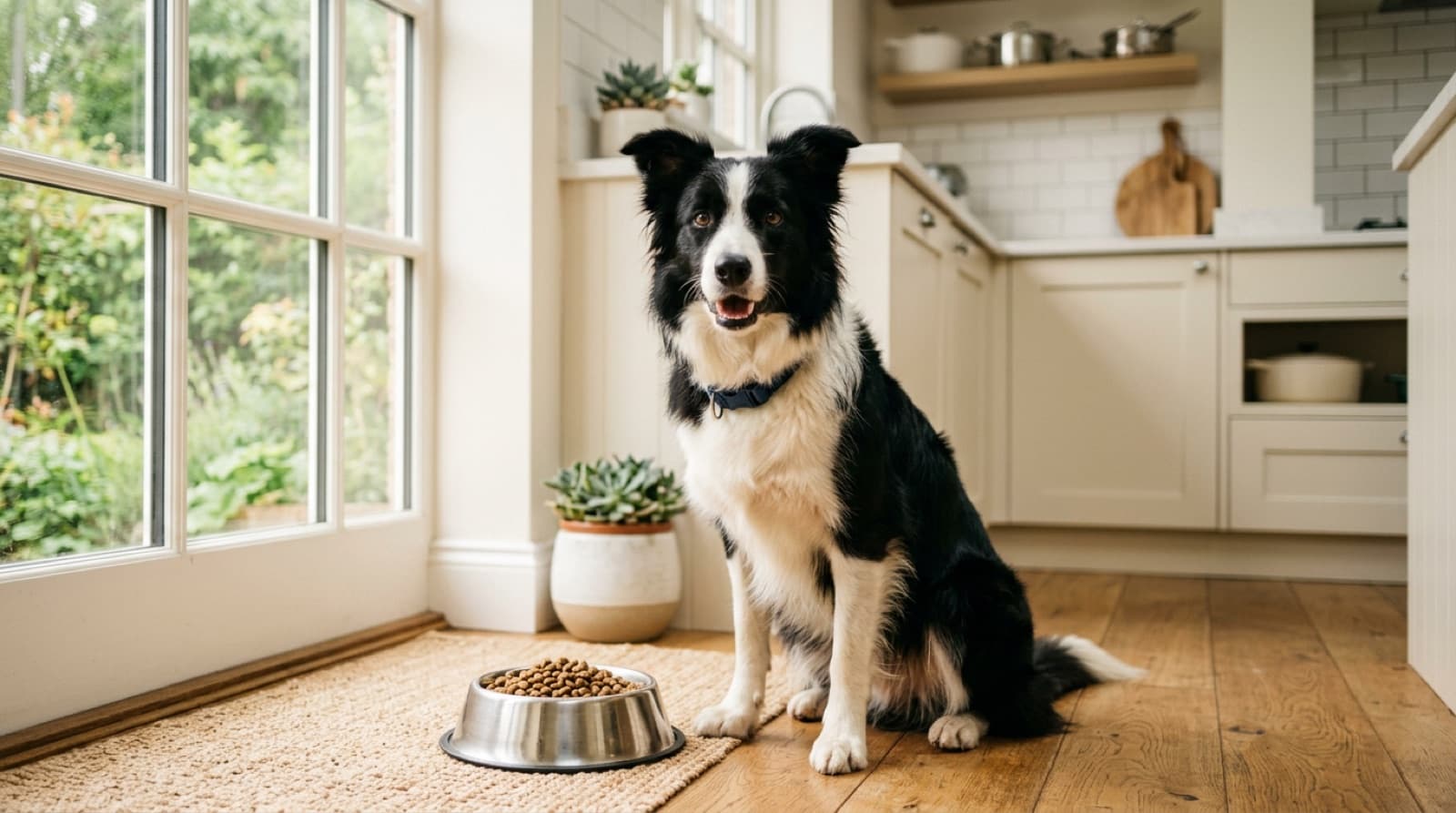
Feed a Border Collie a complete medium-breed food, and match the amount to how hard the dog actually works. This is the one breed where the portion depends on the job: a working or sport Collie burns far more than a pet Collie of the same size. So feed to body condition (lean and athletic is correct), and adjust up for a busy dog or down for a quieter one. A genuinely hard-working dog may do better on a higher-calorie active formula. Two notes that surprise owners: Border Collies are not especially allergy-prone, and the famous MDR1 gene is a medication-safety issue, not a diet one, so there is no special MDR1 food.
How much to feed depends on the job
A Border Collie's calorie needs swing with its activity more than almost any breed. A dog working sheep all day or running agility burns far more than a companion Collie that gets a couple of walks, even at the same weight. There is no single “Border Collie portion.”
A rough starting point for an adult is around 1.5 to 2.5 cups of quality dry food a day, split into two meals, but treat that as a number to calibrate, not a rule. The breed runs about 30 to 55 lb, firmly medium-sized.
Feed to body condition. Use the WSAVA body condition score: aim for a lean, athletic 4 to 5 out of 9, where you feel the ribs easily and see a clear waist. Adjust the portion up for a hard-working dog and down for a quieter one, and check every few weeks. A well-exercised Collie stays lean naturally; an under-exercised one can gain weight, though an under-exercised Border Collie usually has bigger behaviour problems than its waistline.
What is the best food for a Border Collie?
There is no single best bag, but there is a sound way to choose one, from the WSAVA nutrition guidelines.
Choose a medium-breed adult formula with enough calories for an active dog. Skip large-breed foods, which are built for giant-breed growth. Look for a named animal protein, adequate protein and fat for an athlete, omega-3s for the coat, the AAFCO complete-and-balanced statement, and a stated calorie count so you can portion accurately.
Pick a brand that does the science. Ask whether the company employs a board-certified veterinary nutritionist, runs feeding trials, owns its plants, and will share a full nutrient analysis. The big makers that meet this bar are the safe default: Purina Pro Plan (whose Sport line suits hard-working dogs), Royal Canin, Hill's Science Diet, and Eukanuba, with Acana a popular Canadian option. A genuinely hard-working dog often does best on a higher-calorie active or performance formula, so it can eat a sensible volume and still hold weight.
What should I feed a Border Collie puppy?
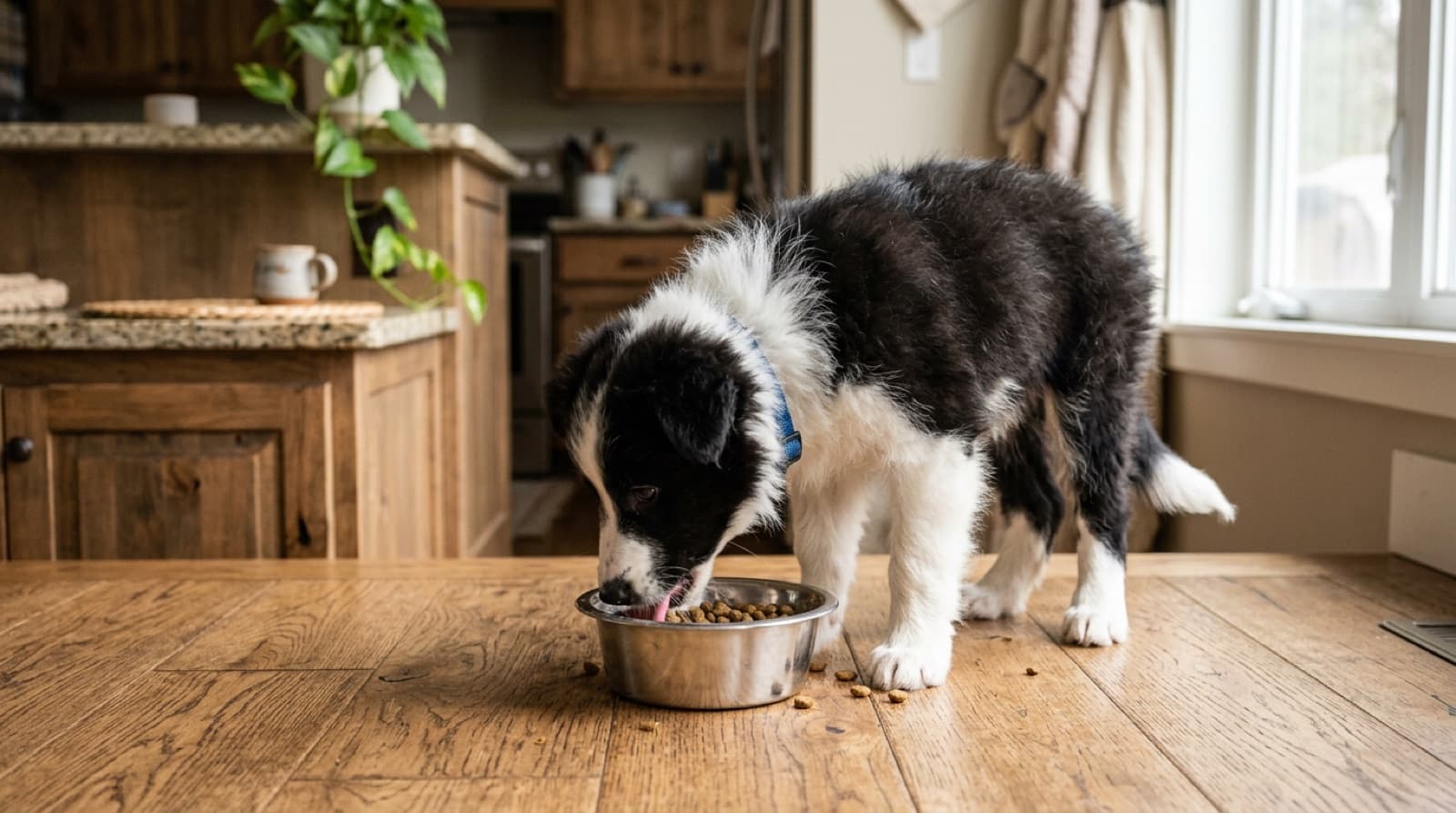
A puppy or all-life-stages formula for small-to-medium breeds, not a large-breed puppy food. Large-breed puppy diets slow giant-breed growth, which a Border Collie does not need.
Follow the standard puppy feeding timeline: about four meals a day from 6 to 12 weeks, three by 3 to 6 months, and two by 6 to 12 months, moving to adult food around 9 to 12 months.
A growing, high-drive puppy needs steady fuel, but keep it lean: a lean body condition protects developing joints and builds good habits. Feed measured meals rather than leaving food down, and put as much energy into the puppy's brain (training, sniffing, problem-solving) as into its body. A tired Border Collie puppy eats and rests well; a bored one finds trouble.
The MDR1 gene: a medication issue, not a food one
If you read about Border Collies, you will hit the MDR1 gene quickly, and it is worth understanding, but it is easy to misplace it as a diet concern. It is not one.
MDR1, the multidrug-resistance mutation, turns up across the herding breeds. It is actually much more common in Rough Collies and Australian Shepherds than in Border Collies, but it can occur in a Border Collie, so it is worth knowing about. It changes how a dog's body handles certain medications, including some anti-parasite drugs at high doses and a few sedatives, which can build up to dangerous levels in a dog with the mutation. It has nothing to do with the food in the bowl, and there is no special “MDR1 diet.”
The practical step is medical, not nutritional: ask your vet about MDR1 testing, available through Washington State University's veterinary lab, so that any medication your dog is given is MDR1-safe. Once your vet knows the dog's status, you feed it exactly like any other healthy Border Collie.
Bloat: not a big Border Collie worry
Bloat (gastric dilatation-volvulus) mainly threatens large, deep-and-narrow-chested breeds like Great Danes and Shepherds. A medium, athletic Border Collie is not in that high-risk group, so this is one worry you can mostly set aside.
The only sensible, non-alarmist habit: if your Collie bolts its food after exercise, a slow-feeder bowl helps it slow down. Otherwise, normal feeding is fine.
Foods to avoid
Keep these toxic foods away from a Border Collie completely: chocolate, grapes and raisins, xylitol (in sugar-free gum, some peanut butters, and baking), onions and garlic, macadamia nuts, alcohol, and cooked bones. Call your vet or a pet poison helpline right away if your dog eats any of them.
One more to weigh: legume-heavy grain-free diets. The FDA has investigated a possible link between them and a heart condition (DCM) but has not proven it. There is no reason to feed grain-free unless your vet diagnoses a grain allergy.
Should I feed my Border Collie a raw diet?
Make it a vet conversation. Raw is popular in working-dog and sport circles, often sold on promises of energy and coat shine, but those benefits are not documented in controlled studies, and the major veterinary bodies are cautious.
The AVMA discourages feeding raw or undercooked animal protein because of the pathogen risk to the dog and the people in the home, and the WSAVA finds no documented benefit over a balanced cooked or commercial diet. A working dog's energy comes from enough calories of a complete diet, not from raw in particular. If you still want to feed raw, use a complete commercial product or a recipe from a board-certified veterinary nutritionist, handle it safely, and check with your vet first.
Looking to adopt a Border Collie?
Sort the food and the puzzle feeder before day one. Browse Border Collies and Collie mixes available right now from the rescues we track.
See Available Border Collies →Where to buy Border Collie food
Every brand worth feeding a Border Collie is easy to find in store and online:
- Pet specialty chains (Pet Planet, Tail Blazers, Tisol, and similar). Carry Pro Plan (including the Sport line), Royal Canin, Acana, and most premium lines.
- Pet Valu and PetSmart. National chains that stock the major adult and active-dog formulas.
- Your vet clinic. The place for any therapeutic or prescription diet.
- Costco. Kirkland Signature is a solid everyday budget option.
Buy a bag size you will finish reasonably fresh and keep it sealed in a storage bin. Online, the same brands ship to your door, and the active-dog formulas are easy to set on a recurring delivery.
Frequently Asked Questions
How much should I feed a Border Collie?
It depends more on the dog’s job than almost any other breed. A working farm or dog-sport Border Collie burns far more than a pet Border Collie of the same weight, so portions vary a lot. A rough starting point for an adult is around 1.5 to 2.5 cups of quality dry food a day split into two meals, but the right amount tracks the food’s calories and your dog’s real activity. Feed to body condition: a fit Border Collie is lean and athletic, with ribs you can feel easily and a clear waist. Adjust the portion up for a hard-working dog and down for a quieter one, and reassess every few weeks.
What is the best food for a Border Collie?
A complete medium-breed adult formula from a company that does real nutrition science, with enough calories for an active dog. A Border Collie is a medium breed, so skip large-breed formulas. Use the WSAVA approach: choose a brand that employs a board-certified veterinary nutritionist, runs feeding trials, and will share a full nutrient analysis, and look for a named protein, the AAFCO complete-and-balanced statement, and omega-3s for the coat. A genuinely hard-working or sport dog may do better on a higher-calorie active or performance formula so it can eat a sensible volume and still hold weight.
What should I feed a Border Collie puppy?
A puppy or all-life-stages formula for small-to-medium breeds, not a large-breed puppy food (those are for slowing giant-breed growth a Border Collie does not have). Feed about four meals a day from 6 to 12 weeks, dropping to three by 3 to 6 months and two by 6 to 12 months. Keep the puppy lean, and feed measured meals rather than free-feeding. A growing, high-energy puppy needs steady fuel, but a lean body condition still protects the joints and sets good habits.
Do Border Collies have sensitive stomachs or food allergies?
No more than dogs in general. Border Collies are not singled out as an especially allergy-prone breed, and true food allergy is uncommon next to flea and environmental allergies. If your dog has chronic loose stool, transition food slowly over 7 to 10 days and rule out the simple causes first. For chronic itching or ongoing GI trouble, see your vet. A real food allergy is diagnosed only by a vet-run elimination diet, never by a blood or saliva test, which research has shown are unreliable.
Does the MDR1 gene change what I feed my Border Collie?
No. MDR1 (the multidrug-resistance gene mutation) turns up across the herding breeds. It is actually less common in Border Collies than in Rough Collies or Australian Shepherds, but it can occur, and it affects how the dog processes certain medications, not its food. There is no special "MDR1 diet." It matters because some drugs, including certain anti-parasite medications at high doses and a few sedatives, can be dangerous for a dog with the mutation, so the practical step is to ask your vet about MDR1 testing (available through Washington State University) and make sure any medication your dog gets is MDR1-safe. It does not change the food in the bowl.
Should I feed my Border Collie a raw diet?
Make it a vet conversation. Raw is popular in working-dog and sport circles, often promoted for energy and coat, but those benefits are not documented in controlled studies, and the major veterinary bodies are cautious. The AVMA discourages raw or undercooked animal protein because of the pathogen risk to pets and people, and the WSAVA finds no documented benefit over a balanced cooked or commercial diet. A working dog’s energy comes from enough calories of a complete diet, not from raw specifically. If you still want raw, use a complete commercial product or a vet-nutritionist recipe, handle it safely, and check with your vet first.
How much does it cost to feed a Border Collie per month?
Roughly $50 to $90 a month for an adult on a quality dry food, with a hard-working dog on a higher-calorie performance diet at the upper end and raw or fresh-cooked diets higher still. Budget kibble runs lower. Treat these as approximate ranges that vary with brand, your dog’s activity level, and where you shop, and price your chosen food by its calories per cup against your dog’s actual daily portion.
Border Collie Exercise & Mental Stimulation
How much a Border Collie really needs, and the brain work that burns more than a walk.
Border Collie Health Issues
Eyes, hips, epilepsy, MDR1, and the conditions worth knowing before you adopt.
Border Collie Adoption
Where to find Border Collies and Collie mixes, real costs, and the energy reality.
Border Collies for Adoption
Live listings of Border Collies and Collie mixes from the rescues we track.