The short answer
Take 4 weeks. Don't skip steps. Week 1: total separation in safe rooms. Week 2: scent swapping. Week 3: visual contact through a barrier. Week 4: supervised face-to-face. Hissing and posturing in the first weeks is normal cat behaviour, not failure. Real failure looks like sustained aggression with no signs of improvement after 4-6 weeks, a pattern the American Veterinary Medical Association notes is a cue to get behavioural help rather than push through.
Before you start: temperament fit
Some pairings are harder than others. Easier matches:
- Two adults of opposite genders (both spayed/neutered)
- Adult resident cat + young new cat (younger usually defers)
- Two cats from the same litter or who already lived together
- Cats described by the rescue as “social” or “loves other cats”
Harder matches:
- Two adult males (territorial)
- A senior resident + an active kitten (the senior gets overwhelmed)
- Resident cat described as “needs to be only cat”: sometimes works, often doesn't
- Resident cat that has lived alone for many years and never met another cat
Calgary rescues including AARCS, Pawsitive Match, MEOW Foundation, and Calgary Humane Society publish “Good with Other Cats” on cat profiles. Use the “Gets Along With → Other Cats” filter on our main listing to find cats specifically flagged as social. The American Association of Feline Practitioners (AAFP) guidelines on multi-cat households recommend taking pairing temperament seriously up front rather than fixing mismatches later.
Week 1: total separation
- New cat lives in a closed safe room (bathroom, spare bedroom). Resident cat has the rest of the house.
- NO visual contact. The new cat needs to decompress from adoption stress; the resident cat needs to get used to the new smell.
- Feed both cats on opposite sides of the closed door. They start associating each other's scent with food (positive).
- Don't let either cat stand at the door hissing or scratching. Redirect with toys or treats.
- End of week 1 sign of progress: both cats eating normally near the door, neither stressed, new cat coming out of hiding when you visit alone.
Week 2: scent swapping
- Rub a soft cloth on the new cat's cheeks (where their scent glands are). Place it where the resident cat sleeps.
- Rub a soft cloth on the resident cat. Place it in the safe room.
- Swap bedding between rooms. Mix scents on furniture by switching covers.
- Mid-week, do a “room swap”: let the new cat explore the rest of the house while the resident cat is closed in the safe room. They get to map each other's neighbouring territory without meeting.
- End of week 2 sign of progress: both cats can investigate the other's scented items without hissing or fleeing.
Week 3: visual contact, no physical contact
- Open the safe-room door 1-2 inches and wedge it. They can see and smell but not reach each other.
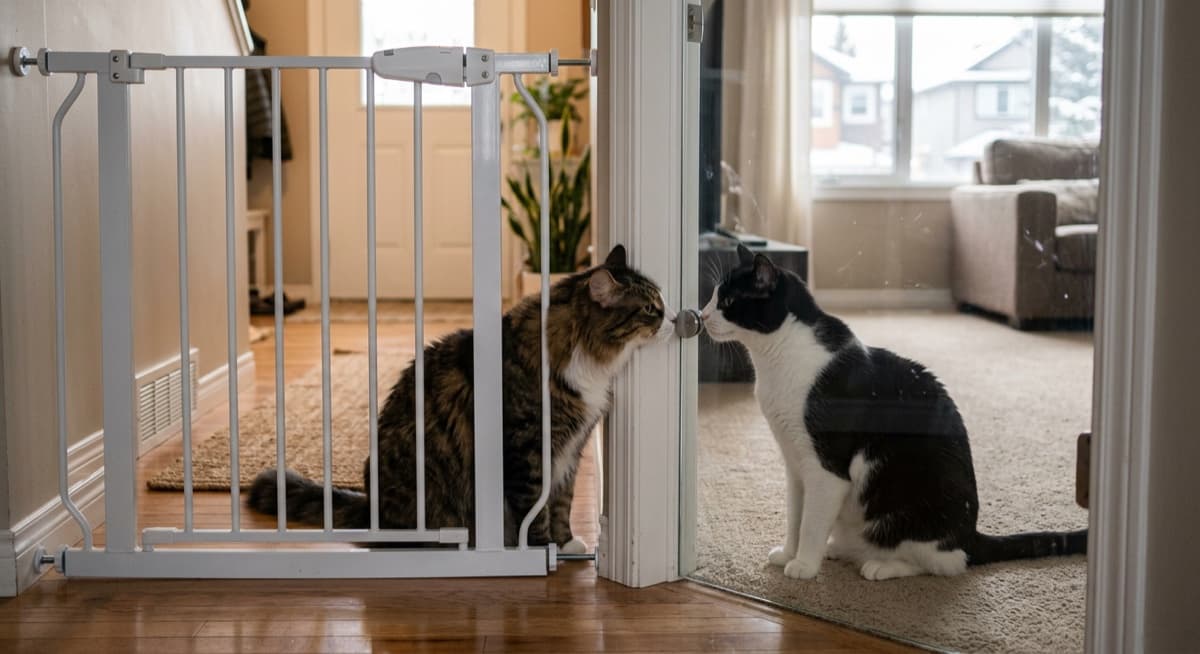
- Or use a baby gate (with a sheet over the top half if either cat is a jumper).
- Or use the carrier method: put new cat in carrier in the main room, let resident cat sniff and investigate.
- Sessions: 5-10 minutes initially. Reward calm behaviour with treats from BOTH sides simultaneously.
- Hissing during these sessions is normal. Lunging at the gate is not: if that happens, go back to scent-swapping for another week. International Cat Care emphasises that pausing and stepping back is the single most under-used tool in cat introductions.
- End of week 3 sign of progress: both cats can be in eyeshot of each other for 10+ minutes without hissing, lunging, or running.
Week 4: supervised face-to-face
- Open the safe-room door fully. Both cats free to explore in the same space, but only when you're actively supervising.
- Have a thick towel or pillow ready to interrupt any altercation. NEVER use your hands: cats redirect aggression onto whatever's closest, a pattern the ASPCA documents in its feline-aggression behaviour notes.
- Sessions 15-30 minutes. Watch for:
- Good signs: sniffing, ignoring, eating in the same room, brief grooming, laying near each other
- Tension: tail flicking, ears pinned back, low growling. Pause but don't panic.
- Bad signs (separate): sustained growling, lunging, swatting that draws blood, blocking food/water
- If a session goes well, gradually increase duration. Never leave them unsupervised in the same space until both are clearly relaxed for several days running.
Long-term coexistence
- Multi-cat resource setup: 1 litter box per cat plus 1 extra (3 cats = 4 boxes). 2-3 feeding stations in different areas. Multiple water bowls.
- Vertical territory. Cat trees, shelves, perches. Cats use vertical space to avoid each other and de-escalate, and horizontal territory alone tends to cause more conflict.
- Hide spots. Boxes, covered beds, spaces under furniture. Each cat needs places they can be alone.
- Feliway Multicat diffuser ($40-60). Specifically formulated for multi-cat tension. Genuinely helps in 50-70% of households.
- Supervised separation when you leave. First 4-8 weeks: separate them when you're out (carrier the new cat back to safe room, or close doors). After that, watch their behaviour to decide if free-roaming together is safe.
Common mistakes
- Skipping straight to face-to-face. The #1 cause of failed cat-cat intros. Take the time.
- Forcing them together. Holding one cat near the other to “help them meet” backfires. Cats associate restraint with the other cat as the cause.
- Punishing hissing or growling. Hissing is communication, not aggression. Yelling or spraying water makes the cat associate punishment with the other cat's presence.
- Insufficient resources. Two cats sharing one litter box and one feeding station is the recipe for permanent tension.
- Giving up at week 2. Most adopters who report “they hate each other” quit before the protocol is complete.
When to abort
Sometimes pairings genuinely don't work. Red flags after 6+ weeks of slow protocol:
- One cat is clearly traumatized (hiding constantly, not eating, urinating outside the box from stress)
- Sustained physical aggression that draws blood
- One cat blocks the other from food, water, or litter
- Vet identifies stress-induced illness in either cat
If any of these persist, contact the rescue for return options. They want to know: the cat may do better as a single cat in a different home, and another cat (more compatible) may suit your existing cat better.
Find a cat-friendly cat
Filter for cats specifically flagged as good with other cats.
Browse Adoptable Cats →