The 3-3-3 rule
3 days to decompress (often hiding) · 3 weeks to learn your routine and feel safe · 3 months to show their real personality. Most rescue cats hit a turning point at 4 to 8 weeks. Calgary adopters often call this the moment their cat “came alive.” The American Association of Feline Practitioners (AAFP) cat behaviour guidelines describe the same decompression curve.
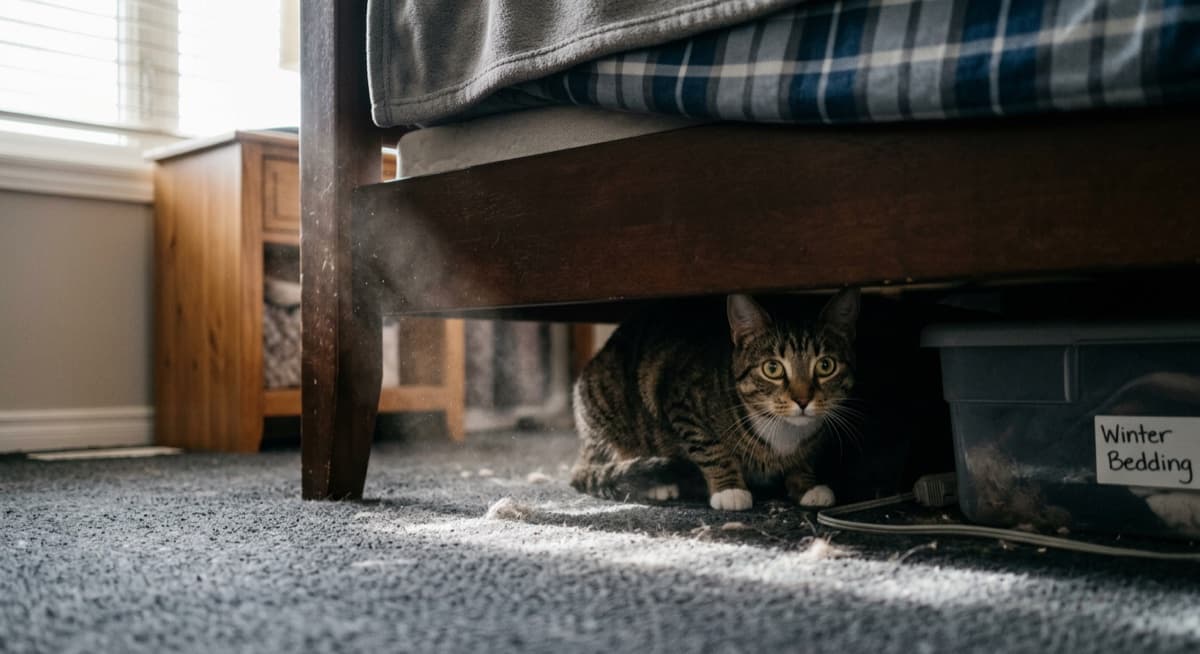
Day 1: arrival
- Bring the cat home in their carrier. Take them straight to the safe room (one bathroom, spare bedroom, or home office).
- Open the carrier door. Don't pull them out. Most cats walk out within 5 to 30 minutes. Some take hours.
- Show them the litter box, food, and water. Then leave the room for an hour or two.
- Visit briefly. Sit on the floor and let them approach. If they hide, that's fine. Talk softly so they learn your voice.
- No other pets allowed in. No visitors. Lower household noise (no vacuuming, loud TV).
- Calgary winter arrivals: keep the safe room warm but not stifling, and skip the bath even if the cat smells like shelter (covered later).
Day 2-3: decompression
- Most cats spend these days hiding under furniture or in a covered bed. Do not pull them out. The ASPCA general cat care guidance lines up: hiding is normal, not a behaviour problem.
- The signs that matter: eating (even at night), drinking, and using the litter box. You may not see any of this happen, but it does.
- If the food bowl is untouched for 48 hours, call the rescue. Try warming a small amount of wet food. Try the exact food brand the rescue used. Hepatic lipidosis can set in fast in cats who stop eating, so the 48-hour mark matters (the Cornell Feline Health Centre covers the mechanism).
- Begin sitting quietly in the safe room, reading or scrolling. Your boring presence is what builds trust.
- If you have other pets, start scent-swapping. Rub a soft cloth on the new cat (gently, when accessible), leave it in the other pet's space, and vice versa. The full step-by-step lives in our cat-to-cat introduction guide and cat-to-dog introduction guide.
Day 4-7: emerging
- By day 4 to 5, most cats start exploring during quiet times. Especially overnight, when you're asleep.
- You may see them eating during the day, briefly. They might let you stroke them while they eat.
- Continue scheduled feeding times. Cats are routine-driven, and predictability builds the bond fastest.
- End of week 1: open the safe room door for short periods so they can explore the rest of the home on their terms. Don't force them out.
- Keep other pets separated still. Visual contact through a baby gate or cracked door comes in week 2.
- If litter box use is the worry rather than eating, our litter box troubleshooting guide is the right next read.
Common worries that turn out fine
- “My cat is hiding under the bed and won't come out.” Normal. They will. Continue offering food, water, and litter access. Sit nearby.
- “My cat hasn't eaten today.” Common in the first 24 to 48 hours. Offer wet food. Call the vet if zero food at the 48-hour mark. The American Veterinary Medical Association (AVMA pet owner resources) treats prolonged anorexia in cats as a vet-visit threshold.
- “My cat hisses at me.” They're scared, not aggressive. Don't reach for them. Sit quietly, ignore the hiss, and let them de-escalate.
- “My cat hasn't purred or shown affection.” Affection takes weeks to months. Don't take it personally.
- “My cat is sleeping in weird spots.” Closets, under furniture, behind sofas. That's safe-feeling territory. Gradually they'll move to more open spots.
What to actually do (your checklist)
- Sit in the safe room 1 to 3 times daily, 15 to 30 minutes, doing something quiet (reading, scrolling).
- Talk softly to the cat by name when you enter and leave the room.
- Feed at the same times each day. Use the food the rescue provided.
- Scoop the litter once a day. Don't change the brand suddenly.
- Move slowly and predictably around the cat. No sudden grabs.
- Reward bravery (when they approach you) with a treat or chin scratch. Not a big reaction.
- Let them come to you. Always.
What NOT to do
- Don't pull them out from under furniture.
- Don't introduce them to other pets in the first 7 days.
- Don't let visitors meet them. The household is enough.
- Don't take them outside, even on a leash, for at least 4 weeks. In Calgary, that goes double during the Chinook freeze-thaw cycle, when coyote sightings along the Bow River and Nose Hill spike.
- Don't change food brands suddenly. Transition over 7 to 10 days if you want to switch.
- Don't bathe them unless absolutely necessary (most cats clean themselves).
If you adopted from a Calgary rescue
Most Calgary cat adopters come through one of a handful of rescues. Each runs a slightly different post-adoption support model. If you have a question that isn't answered here, the rescue is the right first call: MEOW Foundation, Calgary Humane Society, AARCS, Pawsitive Match, and Heaven Can Wait all keep adoption coordinators on email for the first weeks after a placement. For a vet visit during business hours, use the clinic you registered at the adoption. For after-hours emergencies, a Calgary 24-hour vet (directional reference, confirm one near your neighbourhood) is the right call.
If you adopted a kitten under 6 months, the supply list and feeding cadence differ. Read our new kitten checklist (Calgary) alongside this guide. For the broader adoption process, see How to adopt a cat in Calgary.
Frequently asked questions
My rescue cat is hiding and won't come out. Is this normal?
Yes, completely normal. Most rescue cats hide for the first 3-7 days. Some hide for 2 weeks. Don't pull them out. Sit quietly in the room and let them come to you. Eating, drinking, and litter use are the signs that matter.
My new cat isn't eating. Should I be worried?
A rescue cat skipping food for 24 to 48 hours is normal stress response. After 48 hours of zero food, call the rescue or a vet. Use the same food brand the rescue used, leave food in a quiet area, try warm wet food on a saucer, and don't hover while they try to eat.
When can I introduce my new cat to my existing pets?
Start scent-swapping on day 3-7. Visual contact through a baby gate or cracked door at week 2. Supervised face-to-face only after 2-4 weeks. Rushing this step is the #1 cause of failed adoptions.