The short answer
Take 4 weeks. Don't skip steps. Week 1: safe room with no contact. Week 2: scent-swapping. Week 3: gate visits. Week 4: supervised face-to-face on leash. Most failed cat-dog placements are because adopters rushed the meeting. Cats are more sensitive than dogs to high-tension first impressions.
Before you start: is this a viable match?
Not every cat and dog will get along. Look at the cat's rescue profile for clues:
- “Good with dogs” or “Lived with dogs”: high probability of success.
- “Unknown with dogs”: most common. Plan for the full slow intro.
- “Not good with dogs” or “Cat-only home”: don't adopt this cat into a home with dogs.
Look at your dog's history with cats and their general behaviour around small animals:
- Has lived with cats before: usually fine.
- Indifferent to cats outdoors: likely fine.
- Strong prey drive (chases squirrels obsessively in your neighbourhood): proceed cautiously, may not be safe.
- Has chased or harmed cats before: don't risk it. Find a different cat, or stay dog-only.
Calgary rescues that publish detailed compatibility data include AARCS (structured Good-with-Dogs heading) and Pawsitive Match Rescue Foundation. Cats sourced from MEOW Foundation (a cat-only Calgary rescue) often haven't been tested with dogs, so default to the full 4-week plan. The American Association of Feline Practitioners (AAFP) Feline Behavior Guidelines recommend a phased, low-stress introduction for any new cat entering a multi-pet home. The protocol below is built around that principle.
Week 1: total separation (safe room)
- The cat lives in their safe room (bathroom, bedroom, office) with the door closed. No visual contact with the dog at all.
- Feed the dog and cat on opposite sides of the closed door. They begin to associate each other's scent with positive things (food).
- Don't let the dog stand at the door barking or scratching. If they do, redirect with training. If your dog can't calm down at the door, this is a red flag for the eventual intro.
- End of week 1: cat should be eating well, using the litter box, and starting to come out of hiding when you visit alone.
Week 2: scent swapping + brief sight
- Continue safe-room separation but start active scent exchange:
- Rub a soft cloth on the cat (gently). Place it under the dog's food bowl.
- Rub a soft cloth on the dog. Place it in the safe room.
- Switch towels and bedding between rooms.
- Mid-week: brief sight introduction through a baby gate or cracked door. Keep the dog leashed and at a calm sit. Cat decides whether to approach. Most cats hide. That's fine.
- Sessions: 2-5 minutes maximum. Reward the dog for staying calm. End BEFORE either pet stresses.
- Repeat 2-3 times daily. Over the week, the cat starts to relax during these visual sessions.
Week 3: barrier-free room rotation
- While the dog is leashed in another part of the house, let the cat explore the rest of the home freely. They get to map your house at their own pace.
- While the cat is back in the safe room, let the dog visit areas the cat just walked through (more scent absorption).
- Increase gate visit duration to 10-15 minutes. Reward the dog for ignoring the cat.
- If the cat starts approaching the gate confidently and the dog stays calm, you're ready for week 4.
Week 4: supervised face-to-face
- Dog on a leash. Always. For at least 4 weeks of face-to-face contact, even if it's going great.
- First meeting: pick a neutral room. Dog on a sit-stay (or held by a calm adult). Let the cat enter on their own. Don't carry the cat to the dog.
- Watch body language. The ASPCA and International Cat Care both stress that body-language signals are the most reliable indicator of whether to continue or stop a session:
- Cat: tail flicking, pinned ears, hissing = uncomfortable. Stop the session and return the cat to the safe room.
- Dog: stiff body, hard stare, lunging = prey drive activated. End immediately. Work on impulse control before retrying.
- Calm signs (good): sniffing without lunging, looking away, lying down, normal breathing.
- Sessions: 5 to 10 minutes initially, building up. Always end on a positive note.
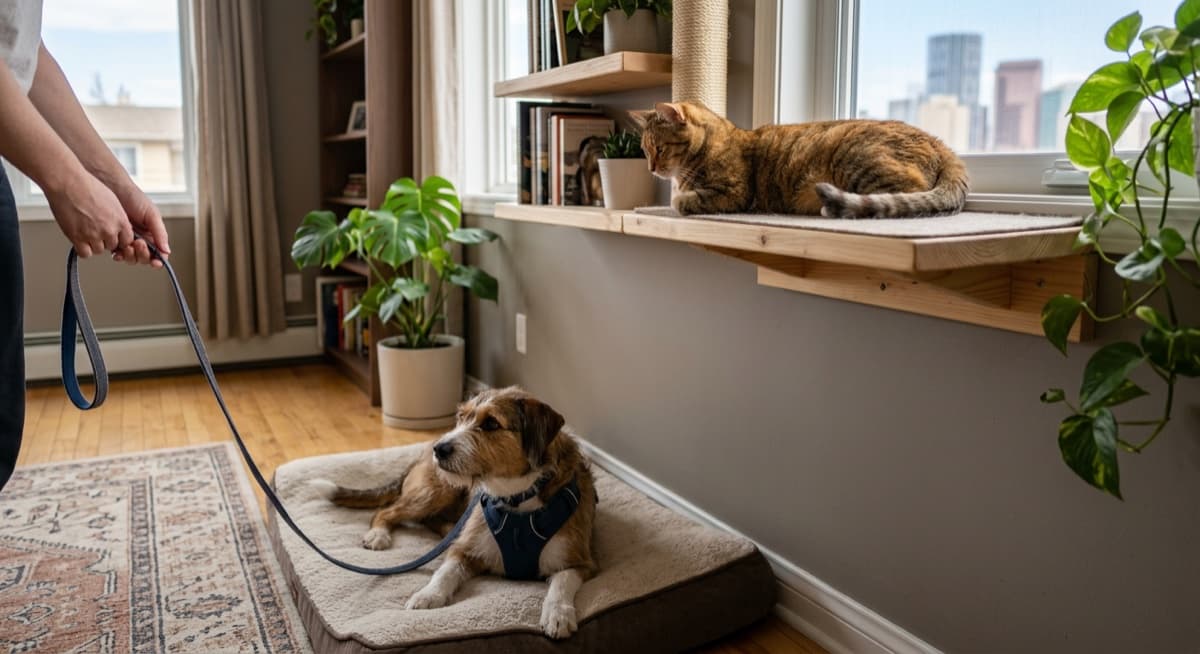
- Always give the cat an escape route. Vertical space they can jump to where the dog can't follow is the safest setup.
Long-term coexistence rules
- Cat keeps a dog-free safe space permanently. A high cat tree, a closet shelf, or a baby-gated room. Cats need to retreat.
- Litter box out of dog's reach. Many dogs eat cat poop. Use a covered box, a baby gate with a small cat-sized opening, or place the box in a room only the cat can access.
- Cat food up high. Dogs will steal cat food (it's richer). Feed the cat on a counter or shelf the dog can't reach.
- Never leave them unsupervised together for the first month. Crate the dog or separate them when you leave the house. The American Veterinary Medical Association (AVMA) notes that unsupervised first-month introductions are the leading cause of injury during multi-pet integration.
Red flags. When it's not working
- Cat hasn't come out of hiding after 2 weeks even with the dog completely separated.
- Dog won't calm down at the gate after a week of training.
- Cat is no longer eating, using the litter, or grooming. These are signs of severe stress.
- Any actual aggression: dog lunges or snaps, cat redirects fear-aggression to humans.
If any of these persist past 2 to 3 weeks of slow intro, contact the rescue. Most will support a return without judgement. That's a better outcome than risking an unsafe situation. Some cats genuinely cannot live with dogs, and that's OK. For a behaviour-led second opinion before giving up, the International Association of Animal Behavior Consultants (IAABC) directory lists certified consultants who handle cat-dog conflict cases remotely.
Cats most likely to do well with dogs
- Confident, mature cats (3+ years old).
- Cats with documented “lived with dogs” or “good with dogs” history (AARCS profiles often state this).
- Younger cats (kittens) paired with a low-prey-drive dog. Kittens are small and fast-moving, so the dog's impulse control matters more than the cat's temperament here.
- Outgoing or social personalities (described as “social” or “dog-like”). These cats tend to be a Calgary adopter's favourite for multi-pet homes.
Filter for these on the main listing using the “Gets Along With → Dogs” option. Each profile that appears has been positively flagged for dog compatibility by the rescue.
Find a dog-friendly cat
Browse Calgary rescue cats specifically flagged as good with dogs.
Browse Adoptable Cats →Related guides
For the first-week decompression plan (3-3-3 rule, safe-room basics) we defer to our first-week rescue-cat guide. For cat-to-cat introductions (different protocol, faster timeline), see our cat-to-cat introduction guide.