The short answer
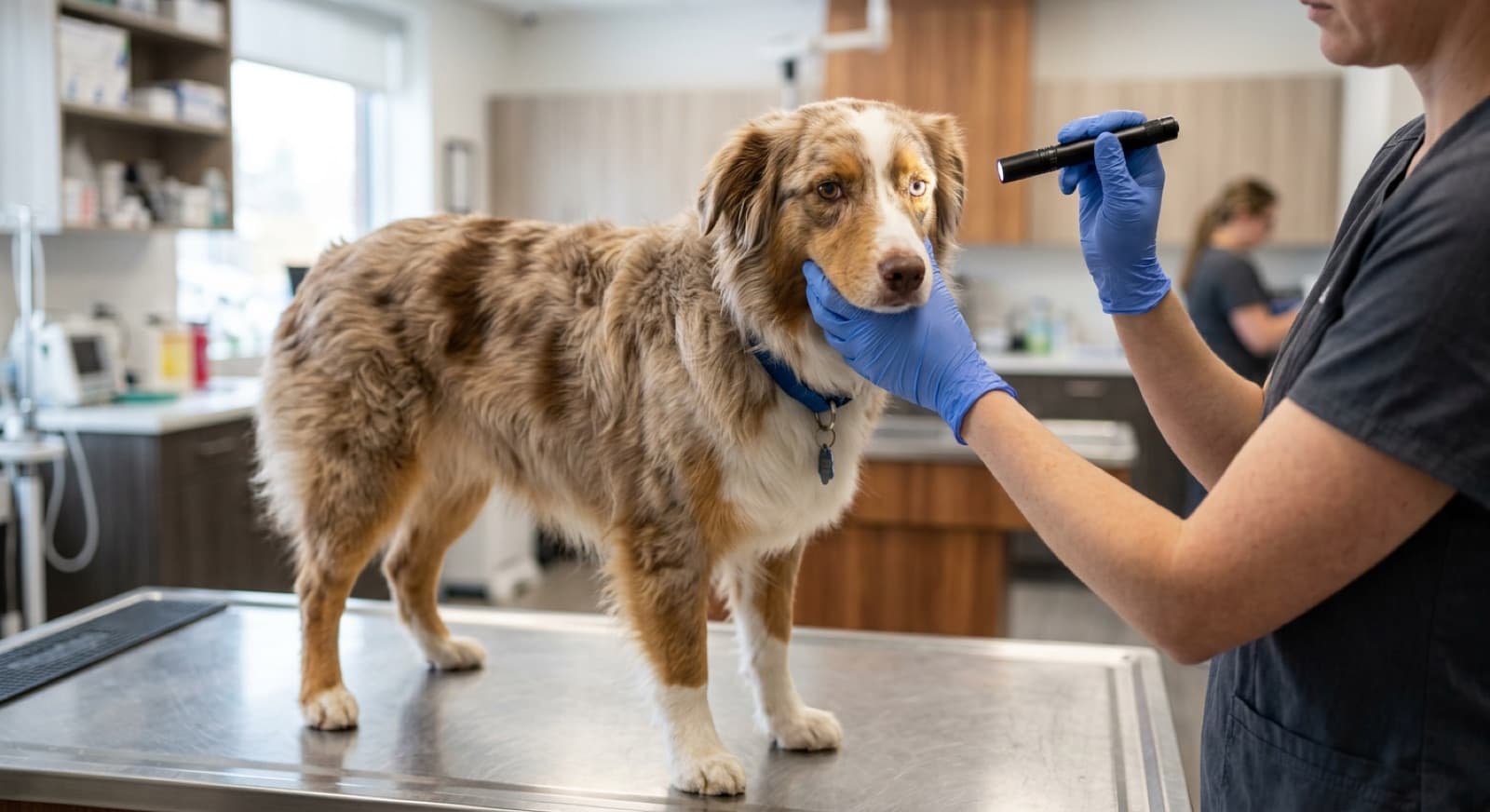
About 50% of Australian Shepherds carry the MDR1 mutation, compared to under 5% in most breeds. Affected dogs cannot tolerate ivermectin (high doses), loperamide (Imodium), several anesthesia drugs, and some chemotherapy. Severe reactions cause seizures, coma, or death. Calgary emergency vet treatment runs $5,000 to $15,000. A single $40 to $80 DNA test prevents this. Every Calgary Aussie owner: test the dog, then inform every veterinarian for life. Other breed-relevant conditions to know: hip and elbow dysplasia (about 13% and 7%), Collie Eye Anomaly, PRA-prcd, HSF4 cataracts, epilepsy (5 to 7%), Malignant Hyperthermia, and the double-merle warning.
Informational only, not medical advice. Consult your veterinarian for any diagnosis, drug, or anesthesia decision. MDR1 status is critical for Australian Shepherds. Discuss with your vet before any medication. Ivermectin (high doses), loperamide (Imodium), several anesthesia drugs, and some chemotherapy agents can be fatal to MDR1-affected dogs. Do not use any drug protocol from this article without veterinary supervision.
The conditions, in order of breed-specificity
- MDR1 drug sensitivity: ~50% of Aussies. The breed-defining health issue.
- Double-merle deafness and blindness: ethical breeding issue (never breed merle x merle).
- Hip and elbow dysplasia: ~13% / ~7% prevalence.
- Eye conditions: CEA, PRA-prcd, HSF4 cataracts (DNA-testable trio).
- Epilepsy: 5 to 7%, treatable with anticonvulsants (mostly MDR1-safe).
- Malignant Hyperthermia (MH): rare anesthesia reaction (Aussies over-represented).
- Hereditary deafness: mostly double-merle origin.
- Hypothyroidism: 5 to 8%, easily treated.
- Autoimmune diseases: somewhat higher rates than average.
- CCL tears, allergies, dental disease: standard medium-dog concerns.
MDR1: the breed-defining drug sensitivity
MDR1 is a genetic mutation that breaks the blood-brain barrier's ability to pump certain drugs out of the brain. Affected dogs accumulate dangerous drug concentrations, which causes severe neurologic toxicity: tremors, seizures, ataxia, coma, death.
Genetic statuses:
- Mutant/Mutant (m/m, AFFECTED): both copies mutant, severe drug sensitivity.
- Mutant/Normal (m/n, CARRIER): one mutant copy, moderate sensitivity, often still reacts to high doses.
- Normal/Normal (n/n, CLEAR): no MDR1 mutation, normal drug metabolism.
Every Calgary Aussie owner should DNA-test their dog. The test costs $40 to $80 from Embark, Wisdom Panel, or the Washington State University Veterinary Clinical Pharmacology Lab, the original MDR1 research lab and authoritative reference for the breed-prevalence and drug-list research.
Inform every veterinarian at every visit. Don't assume past records carry forward. Print the MDR1 status and tape it inside the file.
Severe MDR1 reactions cost $5,000 to $15,000 in Calgary emergency vet care and can be fatal. Prevention (one DNA test) is dramatically cheaper than treatment.
The MDR1 drug danger list
These are the drugs that cause problems in MDR1-affected and MDR1-carrier dogs. Always verify with your Calgary vet. Research evolves, and Washington State University maintains the current authoritative list at vcpl.vetmed.wsu.edu.
HIGH RISK (avoid in MDR1+ dogs):
- Ivermectin at heartworm-treatment doses. Heartgard at preventive doses is generally safe; high-dose ivermectin treatment is dangerous.
- Milbemycin at high doses.
- Moxidectin at high doses.
- LOPERAMIDE (Imodium). This common over-the-counter anti-diarrheal is DANGEROUS for MDR1+ Aussies. NEVER give Imodium to an Aussie without confirmed MDR1-clear status.
- Vincristine and vinblastine: chemotherapy drugs used in lymphoma treatment.
- Doxorubicin: chemotherapy.
- Apomorphine: used to induce vomiting. MDR1+ dogs may have prolonged effects.
- Acepromazine: common sedative. Lower doses required.
- Butorphanol: opioid. Lower doses.
MODERATE RISK (use cautiously, dose-adjust):
- Most narcotics and opioids: morphine, fentanyl, methadone all require dose reduction.
- Some anesthesia induction agents.
- Erythromycin and some other macrolide antibiotics.
- Certain anti-emetics (ondansetron).
Protocol for MDR1+ dogs:
- Always inform the vet so staff can flag the chart.
- Anesthesia: lower doses, slower induction, enhanced monitoring (pulse ox, ECG, blood pressure, capnography, body temperature).
- Substitute drugs where possible. MDR1-safe alternatives exist for most situations.
- Heartworm prevention: Heartgard at preventive doses is generally safe. Verify with your vet.
- Diarrhea: NEVER use Imodium. Use prescription anti-diarrheals or supportive care.
Anesthesia protocol for Australian Shepherds
Aussie anesthesia is more complex than for most breeds. The combination of MDR1 and Malignant Hyperthermia risk drives the difference.
Pre-anesthetic protocol:
- MDR1 DNA testing before any anesthesia. If status is unknown, treat the dog as MDR1-affected for safety.
- Bloodwork ($80 to $150 Calgary). Kidney and liver function affect drug metabolism.
- Cardiac auscultation: routine pre-op.
- Body temperature baseline.
Induction: Veterinary anesthesia literature commonly notes that MDR1-affected dogs may need alternative sedation choices and reduced opioid dosing. Your vet selects the specific induction agents and doses based on your dog's MDR1 status, bloodwork, and the procedure. Do not request specific drugs; ask the vet about their MDR1-aware protocol.
Monitoring (essential for Aussies): pulse oximetry, ECG, blood pressure, capnography, body temperature with an esophageal probe (MH can cause rapid temperature rise).
Recovery: Slower than for other breeds. MDR1+ Aussies metabolize drugs slowly. Watch for delayed reactions 12 to 24 hours after anesthesia.
Calgary anesthesia safety:
- Most Calgary GP vets handle routine spay/neuter, dental cleaning, and simple surgery safely with awareness.
- For complex procedures, emergency surgery, or known MDR1+ dogs, request a board-certified anesthesiologist (DACVAA) at Western Veterinary Specialist Centre.
- Specialty oversight adds $200 to $500. Worth it for high-stakes procedures.
Double-merle warning: ethical breeding
This is a CRITICAL Australian Shepherd breeding ethics issue. Ethical breeders never pair two merles. Backyard breeders sometimes do this for “rare” colouring, producing puppies with severe deafness and blindness.
Merle is a coat colour pattern controlled by the M (merle) gene. Double-merle dogs (MM) come from breeding two merle parents. About 25% of each litter from such a pairing will be double-merle. These dogs typically have:
- Severe deafness (often complete and bilateral).
- Severe vision impairment or blindness (microphthalmia, missing or malformed eyes).
- Excessive white colouring.
- Sometimes other health problems.
Reputable Aussie breeders explicitly disclose breeding pairs. Verify that both parents are NOT merle x merle before buying a puppy.
Adoption reality: Calgary rescues occasionally receive double-merle Aussies surrendered after owners discover the deafness or blindness. These dogs CAN make wonderful pets, but require:
- Sign-language training for deaf dogs.
- Consistent home layout for blind dogs.
- Lifelong commitment to differently-abled dog care.
- Sometimes higher veterinary costs.
See our special needs dog adoption guide. Adoption fees are often reduced ($200 to $500).
Pro tip: when you see “rare white Aussie” or “extreme merle” listings, suspect double-merle origin and ask questions. The visual rarity is genetic dysfunction, not premium breeding.
Hip and elbow dysplasia
The Orthopedic Foundation for Animals (OFA) database reports Aussie hip dysplasia in roughly the 11 to 15% range and elbow dysplasia in the 6 to 9% range. Lower than Goldens or Labs, but still significant for a medium-large breed. Treat numbers as directional, not exact. Figures shift as more dogs are screened.
Calgary-specific factors: cold winters keep dogs sedentary, icy surfaces cause joint impacts, and working or sport Aussies experience more joint stress.
Symptoms: bunny-hopping gait, difficulty rising, stiffness after rest, “puppy sit” (one leg out), thigh muscle atrophy, lameness after exercise.
Treatment by severity:
- Mild: weight management plus joint supplements (glucosamine, chondroitin, omega-3) plus controlled exercise plus PT.
- Moderate: vet-prescribed pain management (commonly NSAID-based, $60 to $120/month, dose chosen by your vet with MDR1 status in mind) plus joint injections in some cases ($800 to $1,500/year range). Discuss options with your vet.
- Severe: surgery.
Calgary surgery costs: FHO $2,500 to $4,500; THR (total hip replacement) $7,500 to $15,000+ per hip at Western Veterinary Specialist Centre or VCA Canada West; elbow surgery $3,500 to $8,000. The anesthesia premium for MDR1+ dogs adds $200 to $500.
Eye conditions: CEA, PRA-prcd, HSF4 cataracts
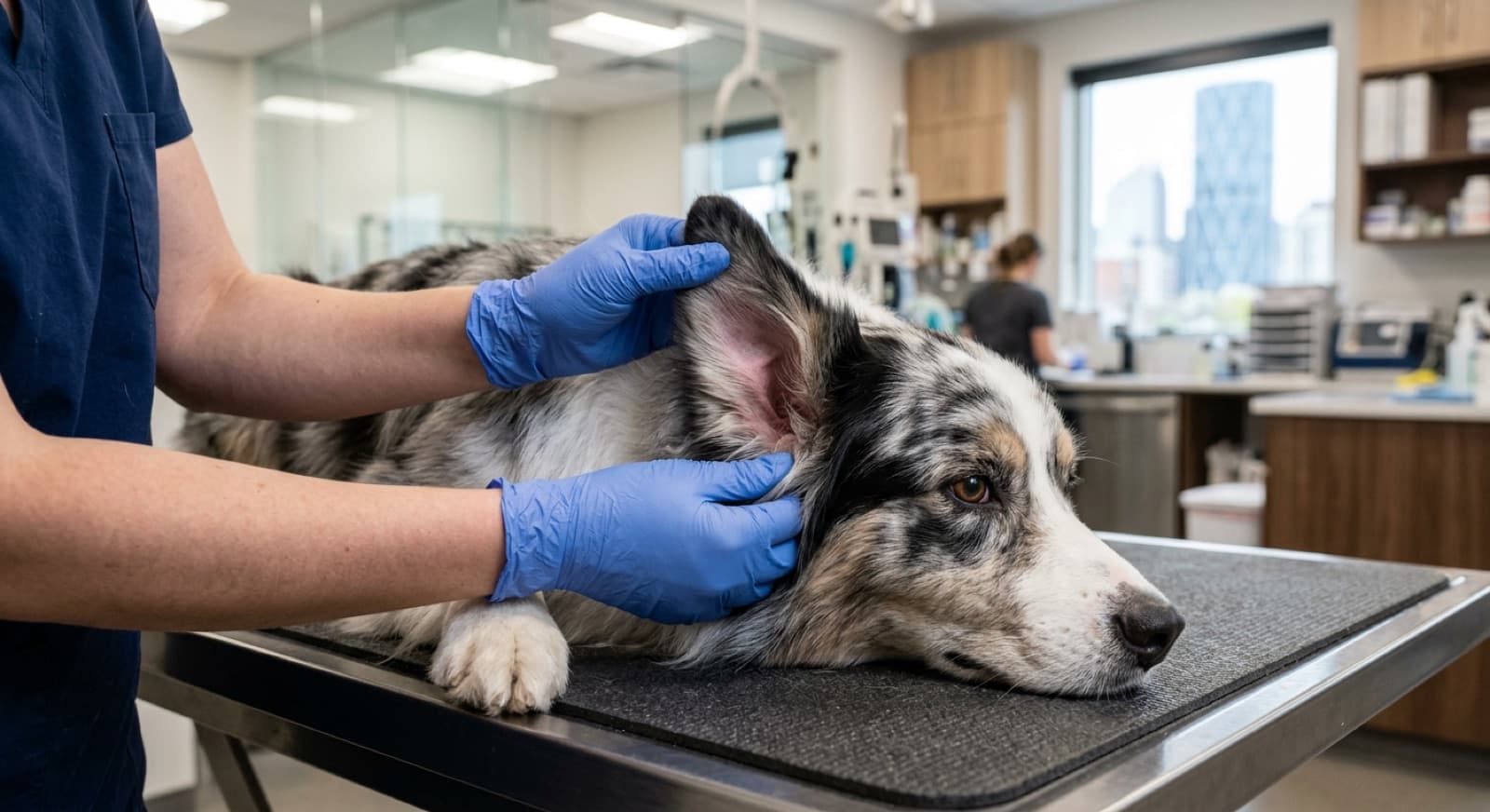
Aussies inherit several breed-specific eye conditions. DNA testing is essential.
- Collie Eye Anomaly (CEA / Choroidal Hypoplasia): autosomal recessive, about 2 to 5% affected and 25 to 30% carriers. DNA testable. Severity varies from asymptomatic to severe.
- PRA-prcd (Progressive Retinal Atrophy): gradual blindness onset at age 4 to 7 (night blindness first). The same condition Goldens have. Not painful. Dogs adapt well.
- HSF4 hereditary cataracts: autosomal dominant. Age-of-onset 6 months to 8 years. Surgical correction costs $3,000 to $5,000 per eye in Calgary.
- Pigmentary uveitis: chronic inflammatory eye condition. Anti-inflammatory eye drops lifelong.
- Double-merle blindness: see double-merle warning above.
Calgary ophthalmology specialists: Western Veterinary Specialist Centre and VCA Canada West both have board-certified ophthalmologists. Dilated eye exam $200 to $400, ERG $300 to $500.
Embark or Wisdom Panel DNA testing covers CEA, PRA-prcd, and HSF4 cataracts in standard panels ($150 to $200). Worth doing at any age for rescue Aussies.
Epilepsy: 5 to 7% Aussie prevalence
Idiopathic epilepsy affects about 5 to 7% of Aussies. That is higher than the general dog population (around 1 to 2%).
Onset: typically 1 to 5 years old.
Symptoms: grand mal seizures (collapse, paddling limbs, jaw clenching, drooling, post-ictal disorientation), focal seizures (one-sided body movement), cluster seizures (multiple within 24 hours: an emergency).
Treatment is veterinarian-directed. Several anticonvulsants are commonly used in canine idiopathic epilepsy (phenobarbital, levetiracetam, zonisamide). Each has a different monitoring profile, cost range ($30 to $200/month is typical), and MDR1 interaction profile. Your vet (or a veterinary neurologist) chooses the medication, starting dose, and titration based on seizure frequency, bloodwork, and MDR1 status. Never start, stop, or change anticonvulsant doses without vet supervision; abrupt changes can trigger cluster seizures.
MDR1 consideration: most commonly used epilepsy medications are considered MDR1-safe in veterinary literature, but your vet verifies for your specific dog.
Prognosis: about 60 to 70% of dogs achieve good seizure control. Quality of life remains high in well-controlled cases.
Calgary neurology specialists: Western Veterinary Specialist Centre and VCA Canada West (DACVIM-Neurology).
Cluster seizures and status epilepticus (continuous seizure over 5 minutes): Calgary 24-hour ER vets handle these (CARE Centre, WVSC, VCA Canada West, McKnight). Emergency.
Malignant Hyperthermia (MH): rare but fatal anesthesia reaction
MH is a genetic mutation in the RYR1 (ryanodine receptor) gene. It causes rapid muscle metabolism in response to certain anesthesia drugs (especially halothane, isoflurane, sevoflurane, succinylcholine).
Symptoms within minutes of anesthesia induction:
- Rapid temperature rise (often over 41°C / 105°F).
- Muscle rigidity.
- Hypercarbia (rising CO2).
- Tachycardia, metabolic acidosis.
Without treatment, MH is rapidly fatal.
Prevalence: low overall, but Aussies are over-represented. DNA test available ($60 to $150).
Treatment: dantrolene (the specific antidote) IV plus rapid cooling and supportive care.
Critical: Most Calgary specialty hospitals stock dantrolene. Many GP practices do NOT. Verify before surgery: “Do you stock dantrolene?” If not, request a specialty referral for the procedure.
Western Veterinary Specialist Centre and VCA Canada West stock dantrolene and have DACVAA anesthesiologists.
Panosteitis: the rescue Aussie “hip dysplasia” misdiagnosis
This is an ASHGI-recognized self-limiting condition that frequently scares rescue Aussie adopters. Owners often mistake it for hip dysplasia.
Panosteitis (“pano” or “growing pains”) is a sudden-onset, self-limiting inflammation of the long bones in young Aussies (5 to 18 months). It is believed to relate to growth-plate development.
Symptoms:
- Shifting-leg lameness. The dog limps on a front leg one week, a back leg the next, a different leg the week after. This is the hallmark distinguishing feature.
- Intermittent pain when handling long bones.
- Reluctance to exercise, lying down often.
- Sometimes mild fever and decreased appetite.
- Self-resolves by 18 to 24 months.
Why rescue adopters panic: a 14-month-old rescue Aussie suddenly limping looks like hip dysplasia. Adopters race to the vet expecting major surgery costs. A Calgary vet exam plus radiograph ($300 to $500) typically rules out dysplasia and diagnoses panosteitis. Pain-relief NSAIDs (MDR1 dose-adjusted), rest, and time do the rest. It self-resolves, is not chronic, and is not life-altering.
Distinguishing from hip dysplasia: dysplasia shows consistent same-leg lameness, worsens with rest, bunny-hopping gait, often bilateral. Panosteitis shows SHIFTING leg lameness, intermittent, ages 5 to 18 months, and resolves with maturity. Radiographs differentiate definitively.
Source: the Australian Shepherd Health and Genetics Institute (ASHGI) maintains breed-specific health information used by reputable Aussie breeders and rescues. ASHGI plus the Australian Shepherd Club of America (ASCA) are the two breed-club references most Calgary Aussie vets and rescues consult.
Shadow and light fixation as Canine Compulsive Disorder (CCD)
Aussies are particularly susceptible to compulsive shadow and light chasing per veterinary behavioural literature. Distinguishing healthy curiosity from clinical CCD matters.
Healthy puppy or young Aussie shadow curiosity: notices shadows, occasionally chases briefly, redirects easily to other activities, doesn't obsess, decreases as the dog matures.
Canine Compulsive Disorder (CCD) shadow and light fixation:
- Persistent, hours-long chasing of shadows or reflected light.
- Cannot be redirected easily. Calling or treats don't break attention.
- Self-injury (running into walls, stumbling, paw injuries from constant pursuit).
- Cannot relax. Shadow vigilance continues even when no shadows are present.
- Eats and sleeps less due to fixation.
- Anxiety and frustration during fixation.
Causes: (1) Insufficient exercise and mental enrichment. Bored Aussies invent compulsive outlets. This often resolves with adequate sport or work outlets. (2) Genuine OCD-like neurological condition. Some Aussies are predisposed. It requires veterinary intervention.
Treatment:
- Increase exercise and mental work to breed-appropriate levels (60 to 90 min daily plus sport).
- Environmental management: reduce exposure to shadow and light triggers (close blinds, redirect from reflective surfaces, dimmable lighting).
- If fixation continues despite adequate exercise: veterinary behaviourist consultation. Calgary virtual DACVB or Edmonton WCVM referral.
- In some clinical CCD cases, a veterinary behaviourist may prescribe a behavioural-medication trial as part of an overall treatment plan. Medication decisions sit with the vet behaviourist, not the owner.
- Force-free behaviour modification protocols plus redirection training.
Prognosis: exercise and enrichment-related fixation typically resolves within 4 to 8 weeks of intervention. True CCD requires lifelong management but usually responds well to medication plus behaviour modification.
If your Calgary Aussie develops persistent shadow or light fixation, treat it as a warning sign that exercise and enrichment are insufficient OR as genuine CCD requiring a vet behaviourist. Don't ignore it.
Pet insurance ROI for Aussies
Moderately cost-effective. Not as universally clear-cut as for Goldens, but recommended for Aussies due to MDR1 reaction risk plus hip dysplasia plus epilepsy.
Predictable lifetime vet costs: $15,000 to $35,000 for a typical Calgary Aussie.
Calgary Aussie insurance premiums: $40 to $70/month for puppies, $70 to $100/month for seniors. Annual $480 to $1,200.
Recommended Calgary insurers:
- Trupanion: Calgary friendly, no payout limits, 90% coverage. Best for breed-specific genetic conditions.
- Pets Plus Us: Calgary widely available.
- OVMA Pet Health Insurance: vet-association partnership.
Key points:
- Enroll BEFORE diagnosis. Genetic conditions are excluded as pre-existing if diagnosed before enrollment.
- Look for UNLIMITED annual payout. Epilepsy treatment can run $200/month plus emergency seizures.
- Bilateral coverage matters. Hip dysplasia often affects both hips.
Verdict: insurance is worthwhile but less critical than for Goldens. For working or sport Aussies (higher injury risk) or rescue Aussies with unknown genetics, pet insurance pays off frequently. For pet Aussies with confirmed-clear DNA testing and a low-injury lifestyle, self-insurance with $10K to $20K in dedicated savings can work.
Frequently Asked Questions
What is MDR1?
A genetic mutation that disrupts the blood-brain barrier drug pump. About 50% of Aussies carry it vs under 5% of other breeds. m/m affected, m/n carrier, n/n clear. DNA test $40 to $80 (Embark, Wisdom Panel, or WSU CTRAW). Severe reactions cost $5K to $15K at Calgary ER. Inform every vet.
MDR1 drug danger list?
HIGH RISK: ivermectin (high dose), loperamide/Imodium, vincristine, doxorubicin, apomorphine, acepromazine, butorphanol. MODERATE: most opioids, erythromycin, ondansetron. NEVER give Imodium without confirmed MDR1-clear status. Check the current WSU list at vcpl.vetmed.wsu.edu.
Anesthesia protocol?
MDR1 DNA test pre-anesthesia (assume affected if unknown). Avoid ace plus opioid combos. Use lower doses. Enhanced monitoring (esophageal temp probe for MH). Slower recovery. GP vet OK for routine procedures; for complex or emergency cases, use a DACVAA at WVSC. Specialty premium $200 to $500.
Hip and elbow dysplasia?
OFA: hips around 13%, elbows around 7%. Calgary winter sedentary patterns plus ice impact plus working stress all play in. Mild cases use weight plus supplements plus PT. Moderate uses NSAIDs (MDR1 dose-adjust) plus Adequan. Severe means surgery: FHO $2.5K to $4.5K, THR $7.5K to $15K/hip, elbow $3.5K to $8K, plus MDR1 anesthesia premium.
CEA, PRA, and HSF4 cataracts?
CEA (Collie Eye Anomaly) is autosomal recessive, with about 2 to 5% affected. PRA-prcd shows progressive blindness onset at age 4 to 7. HSF4 cataracts are autosomal dominant with 6 month to 8 year onset, surgery $3K to $5K/eye. The Embark or Wisdom DNA panel ($150 to $200) covers all three. Annual ophthalmology from age 5+ regardless.
Double-merle warning?
A CRITICAL ethics issue. Merle x merle pairing produces about 25% double-merle puppies with severe deafness, blindness, and microphthalmia. ETHICAL BREEDERS NEVER pair two merles. “Rare white Aussie” and “extreme merle” listings are double-merle red flags. Calgary rescues occasionally have surrendered double-merles with reduced fees. They make wonderful pets with sign-language plus consistent layout commitment.
Aussie epilepsy?
5 to 7% prevalence (vs 1 to 2% general). Onset 1 to 5 years typically. Several anticonvulsants are used in canine idiopathic epilepsy (phenobarbital, levetiracetam, zonisamide); $30 to $200/month range. Drug choice and dosing is veterinarian-directed. About 60 to 70% of well-managed dogs achieve good control. Calgary specialty referral: Western Veterinary Specialist Centre or VCA Canada West DACVIM-Neurology. Cluster seizures are an ER emergency.
Malignant Hyperthermia (MH)?
A rare but fatal anesthesia reaction. RYR1 gene mutation. Symptoms within minutes of induction: rapid temperature rise over 41°C, muscle rigidity, hypercarbia. Antidote is dantrolene IV. Verify your Calgary clinic stocks dantrolene before surgery. Specialty clinics (WVSC, VCA Canada West) routinely stock it; many GPs do not.
Hereditary deafness?
Mostly double-merle origin. BAER test $200 to $400 differentiates full hearing, unilateral, and bilateral deafness. Deaf Aussies make wonderful pets with sign-language plus vibration collars (NEVER shock, vibration cue only) plus visual cues plus long-line outdoor safety. Calgary deaf-dog trainers exist. Reduced adoption fees $200 to $500.
Other Aussie health concerns?
Hypothyroid 5 to 8% (treatable, $20 to $40/mo levothyroxine). Autoimmune conditions (Addison's, AIHA, immune skin) are somewhat over-represented. Allergies (Calgary pollen seasons). CCL tears in active Aussies cost $4K to $7K in Calgary. Cancer rates around 25 to 30% (much lower than Goldens at 60%). Lifespan 12 to 15 years.
Pet insurance ROI?
Moderately cost-effective. Lifetime vet costs $15K to $35K. Calgary premiums $40 to $100/mo. Trupanion (no limits, 90%, best for genetic conditions), Pets Plus Us, OVMA. Enroll PRE-diagnosis. UNLIMITED payout. Working and sport Aussies plus rescue Aussies see insurance pay off frequently. Pet Aussies with confirmed-clear DNA plus low-injury lifestyle can use $10K to $20K self-insurance.
Genetic testing for rescue Aussies?
ESSENTIAL. Test MDR1 (non-negotiable, $40 to $80) plus CEA plus PRA-prcd plus HSF4 plus DM plus MH. Embark $150 to $199 (Canadian, 250+ conditions). Wisdom Panel $100 to $160. WSU CTRAW (vcpl.vetmed.wsu.edu) is the authoritative MDR1 source. Discovery during an emergency can be fatal; pre-emergency testing transforms care. Many Calgary Aussie rescues now do MDR1 pre-adoption. ASK.
Adoptable Aussies in Calgary
Live listings of Aussies and Aussie mixes from 15+ Calgary rescues.
Herding Instinct Mismatch
The differentiator: why bored Aussies destroy houses and chase kids or cars in Calgary suburbia, daily management protocol, herding alternatives.
Aussie Adoption Calgary
Where to find Aussies in Calgary rescues, ARPH clarification, Mini Aussie vs Mini American Shepherd vs Toy Aussie distinction.
Border Collie Health Issues
Companion guide for the sister herding breed. BCs share MDR1, CEA, PRA, and epilepsy concerns. Differences from the Aussie health profile.
New dog? Start with these care guides
Everything a new adopter needs to set up a safe, happy home.