The short answer
Calgary Aussies surrender at 1 to 3 years old, when herding drive fully activates. Bored Aussies chase kids on bikes, cars, skateboards, and joggers. They nip heels. They destroy baseboards, doors, and carpets. They fence-run. They lunge at triggers on leash. The dog is not broken. The dog is doing exactly what it was bred to do, in an environment where the behaviour is dangerous. Responsible Aussie ownership means acknowledging this drive and providing outlets: 60 to 90 minutes of daily exercise, mental work, a sport outlet 2 to 3 times weekly, and family closeness. That is the actual price of admission.
Why Aussies chase kids, cars, bikes, joggers
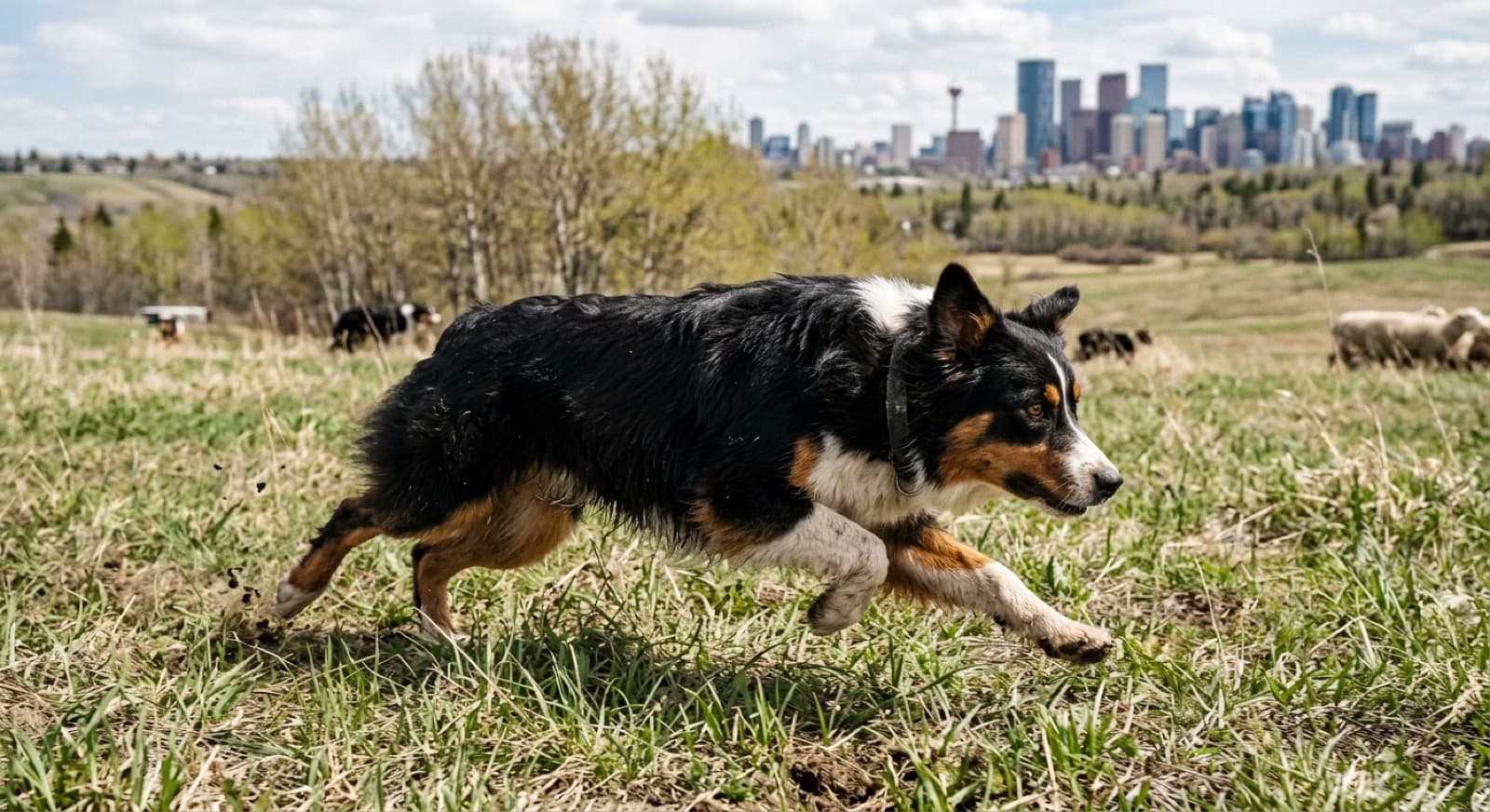
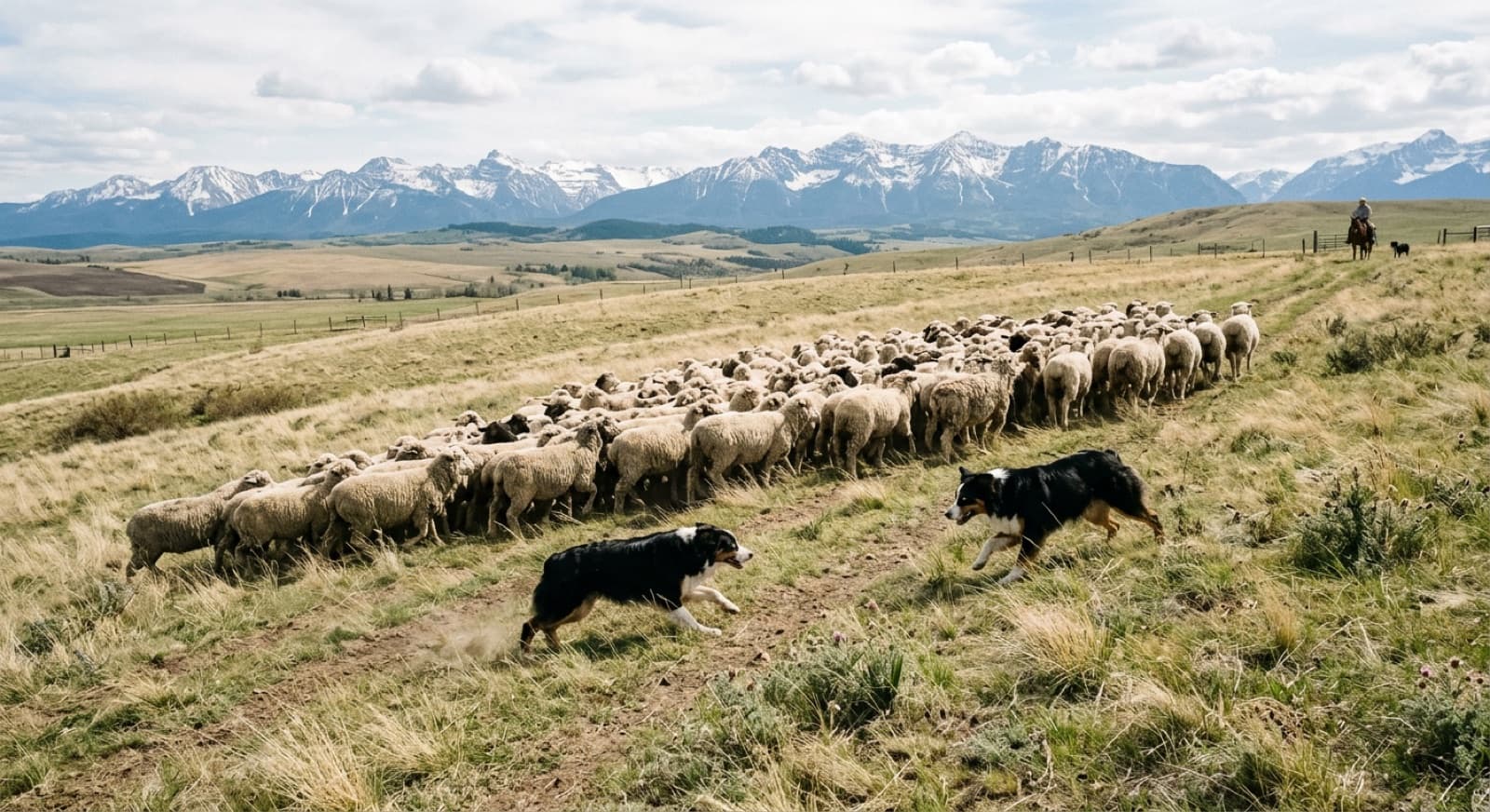
Because they were bred to do exactly this. Australian Shepherds were developed on American ranches in the 1800s and 1900s for cattle herding. The breed was selected over generations for chase instinct, rounding-up behaviour, heel-nipping, an intense stare (called “eye”), and all-day endurance.
These instincts do not turn off in suburban Calgary. A 14-month-old Aussie sees a kid on a bike speeding past and every genetic instinct screams chase, redirect, control.
Critical distinction: this is not aggression. It is misdirected herding drive. But misdirected herding drive can cause real harm:
- Bites to children. A heel-nip becomes a real bite if the child kicks or runs.
- Car accidents. An Aussie chasing a moving car gets hit or causes a crash.
- Bicycle accidents in the same pattern.
- Other dog conflicts. An Aussie tries to herd another dog and the target dog reacts defensively.
- Property destruction. Aussies redirect the drive into fences, doors, and walls when prevented from chasing.
Suburban Calgary is challenging because triggers are constant: kids on bikes and scooters, joggers, cyclists, dog walkers, cars, skateboards, other dogs at off-leash parks. Acreage Calgary (Foothills, Rocky View County, Cochrane area) is much easier because triggers are less frequent.
The 1 to 2 year herding-drive activation wall
The 1 to 2 year mark is when most Calgary Aussies surrender. The timeline is predictable.
- 8 weeks to 6 months: puppy phase. Cute, manageable energy, herding instinct latent. Owners think this isn't bad.
- 6 to 12 months: adolescence starts. Recall fails. Jumping returns. Leash pulling resumes. This is normal adolescent regression for any breed. Owners struggle but persist.
- 12 to 18 months: herding drive fully activates. The defining moment. The dog suddenly fixates on moving stimuli. Begins nipping, chasing, fence-lunging. Many owners bring dogs to the vet thinking something is wrong. The vet says this is breed-typical Aussie behaviour.
- 18 to 24 months: crisis point for unprepared owners. The dog has reinforced chasing and nipping for months. Behaviour issues feel unmanageable. The family questions whether they can keep the dog.
- 18 to 30 months: surrender wave. This is when most Calgary Aussies arrive at rescues. Wonderful dogs whose owners did not expect or prepare for the herding-drive activation.
- Resolved cases: owners who recognized the breed reality, invested in management, added sport outlets, and sometimes worked with a professional trainer succeed. The drive does not go away. It gets channelled.
The critical insight: surrender often happens not because the dog is broken but because the owner was not prepared for what an adult Aussie actually is. Choosing an adult rescue Aussie (3+ years, past the activation wall, with foster temperament evaluation) bypasses this entire phase.
Daily exercise + mental work reality (60 to 90 minutes minimum)
60 to 90 minutes minimum vigorous daily activity, and many Aussies thrive with 2+ hours. This must include both physical exercise and mental work. The most surrendered Calgary Aussies had owners doing physical exercise alone.
Physical exercise minimum:
- 30 to 45 minutes of vigorous off-leash run or play in a fenced area or with rock-solid recall
- 20 to 30 minutes of leashed structured walk
- 5 to 10 minutes of warm-up plus cool-down
Mental work minimum:
- 15 to 20 minutes of structured training daily (nose work, trick training, obedience refinement)
- A food puzzle or snuffle mat for one meal daily
- Decompression walks (sniffari) where the dog leads the pace and sniffs freely
- Variety in training environments
Calgary-optimal routine for an active suburban household:
- 6:30 AM: 45 minutes off-leash at Nose Hill or Sue Higgins
- 12:30 PM: 20-minute food puzzle lunch
- 5:30 PM: 30-minute training class or sport practice (3x per week)
- 8:00 PM: 15 minutes of trick training plus a cuddle wind-down
Calgary off-leash parks ideal for Aussies: Nose Hill Park (large, varied terrain), Sue Higgins (smaller but excellent off-leash work), Bowmont (river access), Fish Creek (long sniffari trails), Weaselhead (river plus forest).
Mental work matters more than physical. A tired Aussie is good. A satisfied Aussie is better. Physical-only exhaustion creates a fitter dog who needs more exercise. Mental satisfaction creates a calmer dog.
Calgary sport outlets: the most effective intervention
Sport outlets are the most effective intervention for herding-drive Aussies. Channelling the drive into appropriate activity prevents it from showing up as inappropriate chasing.
- Herding training: the actual breed-correct outlet. Calgary-area options include Cochrane ranches, Black Diamond, and Foothills County trainers who offer instinct testing plus ongoing herding lessons. ASCA Canada and ASCA-approved Alberta judges run herding trials. $50 to $100 for instinct testing, $80 to $150 for private lessons, $200 to $400 for weekend clinics. Most directly satisfying for working-line Aussies.
- Agility: fast-paced, requires intense handler-dog teamwork. Calgary clubs: Calgary Agility Club, Wagging Tails Dog Sports, Calgary Dog Sports Centre. $150 to $300 for a 6 to 8 week beginner course, $80 to $150 per month ongoing. Many Aussies excel.
- Dock diving: Aussies surprisingly love water work. Calgary: K9 Sports Connection, occasional summer lake clinics.
- Disc dog (Frisbee): high-intensity, accessible, can be done alone. Calgary disc dog meetups exist. Excellent chase-channelling.
- Fly ball: team sport, fast-paced, great for high-drive dogs. Calgary clubs available.
- Nose work / scent detection: mental work that satisfies without overstimulating. Calgary Cypress K9 Detection and various trainers offer scent work classes. Excellent for older or injured Aussies.
- Rally obedience: structured obedience challenges. Less intense than agility, a good entry point.
- Canine freestyle / trick training: creative outlet with excellent mental engagement.
- Treibball: a sport version of herding using inflatable balls instead of livestock. Newer in Calgary but growing.
- Conformation (showing): for show-line Aussies.
Calgary minimum recommendation: 2 or 3 sport sessions per week (one class plus practice). Aussies who get this thrive. Aussies who do not, struggle. The financial commitment ($150 to $400 per month) is significant but dramatically lower than rehoming plus starting over with another dog.
Force-free management protocol for chasing/nipping
(1) Environmental management (essential, does most of the work):
- Long line (15 to 30 ft) instead of full off-leash until rock-solid recall is established
- Fenced yard required if you are not actively supervising
- Avoid predictable trigger situations during the training period. Do not walk past schools at 3 PM kids-on-bikes hour. Do not go to dog parks during peak times.
- Drag line in the house if your dog is chasing children or cats indoors
- Crate or pen during family chaos times until impulse control improves
(2) Impulse control training (the actual fix):
- “Watch me”: the Aussie looks at you instead of the trigger. Build duration.
- “Leave it”: rock-solid.
- Place or mat command: the Aussie goes to a designated mat for 5 to 30 minutes. Reduces chaos at doors, dinner, and visitors.
- Engage-Disengage Game (Leslie McDevitt): the Aussie sees the trigger, looks at the handler, gets rewarded. Builds a neutral response over time.
- BAT 2.0 (Behaviour Adjustment Training) for reactive Aussies.
(3) Professional help if chasing escalates to biting, severe reactivity, or anxiety. Calgary force-free trainers in our editorial rotation include Raising Canine and Pup City Pup Academy. Any CCPDT- or KPA-CTP-credentialled Calgary force-free trainer with working-breed experience will suit.
Leash reactivity and barrier frustration (the “fine off-leash, explodes on-leash” pattern)
Aussies' chase-and-control wiring routes into leash-reactive barking and lunging when restrained. Many Aussies are friendly off-leash but explode at other dogs or triggers when leashed. This is frustration-based reactivity, not fear-aggression. Calgary's high-density pathway system (Bow River, Edworthy, Nose Hill perimeter) makes on-leash dog-dog encounters unavoidable.
Why corrections amplify it: leash tension communicates handler stress. Corrections increase cortisol. The Aussie then associates other dogs with handler tension plus correction, making the next encounter worse. Prong and e-collar corrections are particularly damaging for soft-tempered Aussies.
Force-free protocol: (a) Distance management. Identify the trigger threshold (the distance at which the dog notices but does not react). Work below threshold. (b) LAT (Look At That) plus classical conditioning. Trigger appears, treat. Build a positive trigger association. (c) U-turns. Trigger too close? Calmly turn away, reward the Aussie for following. (d) Long line (15 to 30 ft) instead of a standard 6-ft leash gives more space without full off-leash risk. (e) Avoid trigger-dense areas (off-leash parks during peak hours, narrow Bow River pathways at dog-walking hours) until threshold work is established. (f) Consider Pat Miller's CARE protocol or work with a Calgary force-free trainer experienced in reactivity. Most Calgary leash-reactive Aussies improve significantly within 8 to 16 weeks of consistent threshold work plus force-free distance management.
Avoid: balanced trainers, prong or e-collar trainers, dominance-based methods. Aussies are soft-tempered. Harsh methods create lasting damage and do not resolve the underlying drive. The AVSAB position statement on humane dog training covers the welfare and behavioural-outcome evidence in detail.
What not to do:
- Do not punish chasing. It creates fear-aggression and does not address the underlying drive.
- Do not use shock or prong collars. They damage soft-tempered Aussies.
- Do not expect a 30-minute walk to fix it. Under-exercise is fuel for chasing.
- Do not isolate the dog. Separation anxiety compounds problems.
- Do not rehome at 18 months without trying a management protocol. Most issues resolve within 3 to 6 months of consistent management.
Suburban Calgary vs acreage: can I keep an Aussie in a condo?
| Housing | Difficulty | Best fits |
|---|---|---|
| Condo/apartment | Hardest | WFH plus daycare 2 to 3 days a week plus a committed sport schedule. Aussie mixes preferred. |
| Suburban house with yard | Moderate | Active families, WFH households. Signal Hill / SW Calgary popular. Yard alone is not enough. You still need structured exercise plus mental work. |
| Acreage / rural Calgary | Easiest | Foothills County, Rocky View County, Cochrane area, Bragg Creek, Black Diamond. Traditional Aussie environment. |
Working-line Aussies should be on acreage or in a working-ranch placement. A suburban condo with a working-line Aussie equals guaranteed surrender within 1 to 2 years.
Show-line and mixed Aussies are more adaptable to suburban living with commitment.
Aussie mixes with calmer breeds (Aussiedoodle, Aussie-Lab) often suit condo or suburban life better than purebred Aussies.
Calgary housing reality: many condo boards restrict large breeds. Verify before adopting. Aussies typically run 35 to 65 lbs and may exceed condo size limits.
Why Aussies destroy houses when bored
Boredom destruction in Aussies is herding drive without an outlet: physical and mental energy with no appropriate release.
Common destruction patterns:
- Baseboard chewing. Repair $200 to $500.
- Door frame chewing. Repair $300 to $1,000.
- Carpet digging. Expensive replacement.
- Fence-running or digging under the fence. Lawn damage plus escape risk.
- Furniture destruction. Couches, mattresses, pillows.
- Item chewing. Shoes, remotes, books.
- Obsessive licking or self-chewing. Anxiety and boredom escalation.
- Window barking and lunging. Can damage windows.
- Garden destruction. Landscaping shredded.
Prevention (the only solution):
- Adequate exercise plus mental work before alone time
- Crate training for unsupervised periods (not as punishment, as a safe space)
- Frozen Kongs, lick mats, and snuffle mats during alone time
- Calming music or TV during alone time
- Sport practice 2 to 3 times weekly so satisfaction carries through alone times
- Calgary doggy daycare 2 to 3 days a week
Crate-recovered Aussies: many Calgary Aussie owners who tried “house freedom alone time” experienced major destruction. Switching to crate training resolved 80%+ of destruction issues. The crate is not cruel for working breeds. It is a den.
Frequently Asked Questions
Why do Aussies chase kids, cars, bikes, and joggers?
Because they were bred for it. Ranch herding instinct means chase moving things, redirect them, control them. Triggers in Calgary suburbia are constant: kids on bikes, joggers, cyclists, cars, skateboards. This is not aggression. It is misdirected herding drive. It can still cause bites, accidents, and conflicts. Acreage Calgary is easier because triggers are fewer.
How much exercise really?
60 to 90 minutes daily minimum, often 2+ hours. Physical (off-leash run plus structured walk) plus mental work (training, food puzzles, sniffari, sport practice). Calgary off-leash options: Nose Hill, Sue Higgins, Bowmont, Fish Creek, Weaselhead. Mental work matters more than physical. A tired Aussie is good. A satisfied Aussie is better.
When does the surrender wall hit?
Herding drive activates at 12 to 18 months. The surrender wave hits at 18 to 30 months. Most Calgary Aussies in rescues are 1 to 3 year olds whose owners did not expect activation. An adult rescue (3+) bypasses the entire phase.
Daily management protocol?
Environmental management (long line, fenced yard, avoid trigger times, drag line in the house, crate during chaos) plus impulse control training (watch me, leave it, place, engage-disengage game, BAT 2.0) plus a sport outlet plus a force-free trainer if things escalate. Avoid prong, e-collar, and dominance methods. Aussies are soft-tempered.
Calgary sport outlets?
Herding training (Cochrane, Black Diamond, Foothills ranches, $50 to $150 lessons), agility (Calgary Agility Club, Wagging Tails, $150 to $300 per 8 weeks), dock diving (K9 Sports Connection), disc dog, fly ball, nose work, rally, freestyle, treibball. Calgary minimum is 2 to 3 sessions per week, $150 to $400 per month commitment.
Suburban condo vs acreage?
Condo is hardest. You need WFH plus daycare plus sport commitment. Suburban house is moderate. Signal Hill SW is popular, but the yard alone is not enough. Acreage is easiest: Foothills, Rocky View, Cochrane, Black Diamond. Working-line Aussie in a suburban condo equals surrender within 1 to 2 years. Aussie mixes are more adaptable.
Why do Aussies destroy houses?
Boredom destruction equals herding drive without an outlet. Baseboards, door frames, carpet, fences, furniture, items, self-licking. Prevention: exercise plus mental work before alone time, crate training (not punishment, a den), frozen Kongs, sport satisfaction, Calgary daycare 2 to 3 days a week. The crate resolves 80%+ of destruction issues in Calgary cases.
Calgary force-free trainers and behaviourists?
Force-free Calgary trainers in our editorial rotation include Raising Canine and Pup City Pup Academy. Beyond those, any CCPDT- or KPA-CTP-credentialled Calgary force-free trainer with working-breed experience will suit. Veterinary behaviourists are limited in Calgary. The closest options are a virtual DACVB consult or an Edmonton/USA referral at $300 to $600 initial. Avoid balanced, prong, e-collar, and dominance trainers. They create lasting damage in soft-tempered Aussies.
Working-line vs show-line management?
Working-line: 90 to 120 minutes exercise plus 30+ minutes mental plus sport. Acreage required. Not for suburban or first-time owners. Show-line: 60 to 90 minutes exercise plus 20+ minutes mental plus 2 to 3 times weekly sport. Suburban-OK with an active family. Mixes (Aussiedoodle, Aussie-Lab, Aussie-Golden): 45 to 75 minutes plus 15 to 20 minutes plus occasional sport. The cross-breed parent moderates drive. Trust foster home observation over label.
Will my Aussie ever calm down?
Yes, with adequate exercise, management, and maturity. Adolescence (6 to 24 months) is hardest. Young adult (2 to 3 years) drive remains but impulse control improves. Mature (3 to 7 years) is the typical “calm” phase. Senior (10+) shows dramatic calmness. “Calm” for an Aussie is not Golden-calm. Daily exercise plus mental work still needed. An adult rescue (3+) skips the activation phase. The owner determines outcomes more than the dog.
Rescue Aussie with a problematic past?
Many Calgary rescue Aussies have behaviour histories. Most become wonderful with experienced adopters. Mild reactivity or herding-surrender fits active households. Moderate reactivity fits experienced dog owners. Severe cases require behaviourist support only, no kids, lifelong management commitment. Ask the rescue for full history and foster observations. Calgary Humane, AARCS, BARCS, and Pawsitive Match offer post-adoption behaviour support.
Bottom line: should I adopt an Aussie?
Right if: active outdoor lifestyle, 60 to 90 minute daily commitment, prior dog experience, sport outlet 2 to 3 times a week, suburban plus yard or WFH plus condo or acreage, older kids (8+), willing to MDR1 test. Wrong if: sedentary, condo plus full-time office, first-time owner, want a couch dog, toddlers, financial inflexibility, frequent travel. The best first-Aussie is an adult rescue (3+) past the activation wall, $300 to $700 fee.
Adoptable Aussies in Calgary
Live listings of Aussies and Aussie mixes from 15+ Calgary rescues. Most adult rescue Aussies are past the herding-drive activation wall.
Aussie Adoption Calgary
Where to find Aussies in Calgary rescues, ARPH clarification, Mini Aussie vs Mini American Shepherd vs Toy Aussie, working/show-line distinction.
Aussie Training Calgary
Force-free training playbook for Calgary Aussies. Impulse control, recall, leash reactivity, working with a local trainer.
Aussie Exercise & Apartment Fit
Daily exercise reality, mental work, and whether an Aussie can live in a Calgary condo or apartment.
New dog? Start with these care guides
Everything a new adopter needs to set up a safe, happy home.