The short answer
Bassets are among the hardest dog breeds to housebreak. This is genetics (independent pack-hunting heritage), not training failure. Realistic Calgary timeline: 3 to 6 months minimum, sometimes 9 to 12. Compare to retrievers (6 to 12 weeks). The 3-month clean-streak rule: not fully housebroken until 3 consecutive months without accidents. Use a crate plus umbilical combination. Crate when unsupervised, umbilical (leashed to you) when home. Calgary winter is the hardest housebreaking environment: frozen yards, short daylight, snow obscuring scent markers. A designated shovelled potty area plus a verbal “go potty” cue plus Pawz boots help. Apartment Bassets need daycare or a midday walker ($25 to $55/day) plus pee pad backup. Always rule out medical first for new house soiling: UTI, bladder stones, IVDD pain, cognitive dysfunction in seniors, diabetes. Marking is different from incomplete housebreaking. Small amounts on vertical surfaces, hormonal or territorial trigger, spay/neuter plus belly bands fix it. Adolescent regression (8 to 12 months) is normal. Tighten routine for 4 to 6 weeks and progress returns. Adopted adult Bassets typically need 2 to 4 weeks to re-establish housebreaking in your home. The biggest owner mistake: giving free time too early. Slow, boring, consistent wins.
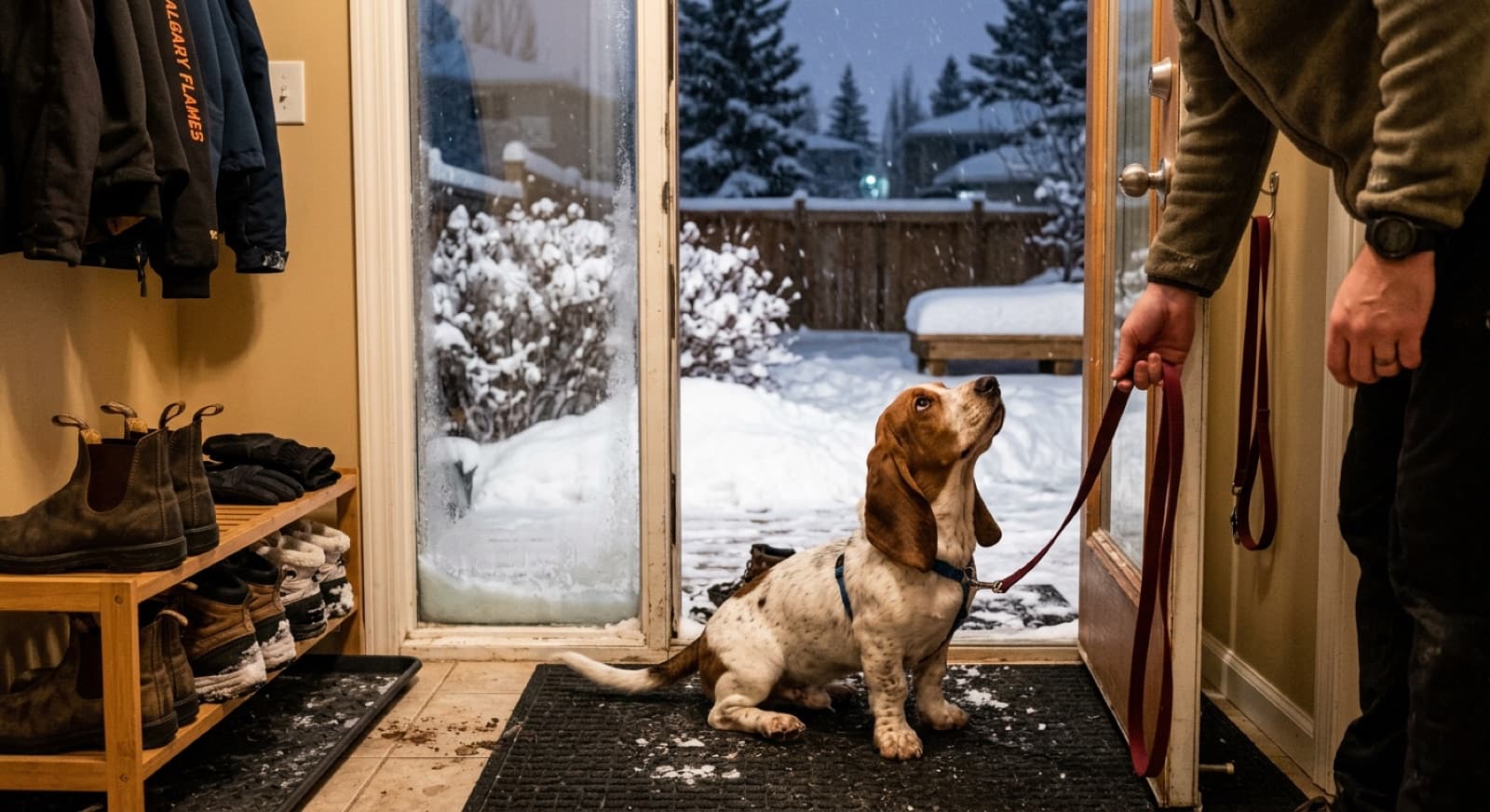
3 to 6 months is normal Basset progress, not failure
Most Calgary Basset surrenders for “not housebroken” happen at month 3 or 4 when frustrated owners expected 6-week housebreaking and quit on a dog who was actually on a normal Basset timeline. Setting realistic expectations from day one is the single most important thing you can do. Read this page, breathe, then commit to the longer timeline.
Why are Basset Hounds so hard to house train?
Genetics, not training failure. Bassets were selectively bred for centuries to work independently in packs, tracking scents over distance with minimal handler input.
The genetic legacy is a brain that prioritises scent processing over handler-pleasing behaviours. Common dog breeds (retrievers, herders) have been selected for thousands of years to constantly check in with humans and modify behaviour based on handler signals. Bassets have not.
The practical implication: Bassets do not housebreak primarily to please you. They housebreak because the routine becomes ingrained and they don't want to use the wrong spot. This takes longer to install than for breeds that learn faster from positive reinforcement alone.
Realistic Calgary Basset house training timeline:
- Most Bassets take 3 to 6 months to be reliably housebroken
- Some take 9 to 12 months
- Compare to retrievers (6 to 12 weeks typical) and small breeds (8 to 16 weeks typical)
The 3-month clean-streak rule: a Basset isn't fully housebroken until they have gone 3 consecutive months without an accident in a fully-supervised normal-routine environment. Until then, treat them as in-training.
Setting realistic expectations from day one is the single most important thing you can do. Frustrated owners who expect 6-week housebreaking quit on Bassets at month 3 or 4 and surrender, when they were actually on a normal Basset timeline.
What's a realistic Basset house training timeline?
| Phase | Period | What to expect |
|---|---|---|
| Establishment | Weeks 1 to 4 | Constant supervision, every 1 to 2 hours outdoor, no unsupervised free time. Expect 3 to 6 accidents/week |
| Pattern building | Weeks 4 to 12 | Outdoor breaks extend to every 2 to 3 hours. Dog starts going to door. Accidents drop to 1 to 3/week |
| Consolidation | Months 3 to 6 | Accidents rare (<1/week). Dog signals reliably. Most Bassets reach this milestone here |
| Final reliability | Months 6 to 12 | Full housebreaking achieved. Some Bassets need this long |
Adolescent regression at 8 to 12 months is common. Hormonal changes, increased independence, sometimes housebreaking regression. This is normal, not failure. Tighten supervision and routine for 4 to 6 weeks and progress usually returns.
Calgary Basset adopters: most adult rescue Bassets (3 to 7 years) come housebroken but may have a 1 to 3 week transition period in your home. Don't panic at first-week accidents in adult adoptions. Establish your new routine and most adult Bassets re-establish reliable housebreaking within 2 to 4 weeks.
Should I use a crate or umbilical method?
Most successful Calgary Basset owners use a combination: crate when unsupervised, umbilical when present.
CRATE METHOD: dog stays in appropriately-sized crate when you cannot directly supervise. Bassets generally do not soil their crates if it's correctly sized (just enough room to stand, turn, lie down; too big and they pee in one corner). Take dog directly outside on leash from crate. Reward heavily for outside potty. Bassets are typically den-friendly due to denning hunting heritage.
UMBILICAL METHOD: dog is leashed to your belt or wrist when you're home. You catch every signal of pre-potty behaviour (sniffing, circling, looking at door) and immediately go outside. Works for Bassets because their pre-potty signals can be subtle. Bassets don't always whine; they sometimes just wander to a corner.
The combination protocol:
- Umbilical when you're home and awake
- Crate when you can't actively supervise (working from another room, on a phone call, taking a shower)
- Crate at night
- Yard time after every meal, after every nap, every 1 to 2 hours during peak training, before bed, first thing in morning
This protocol is intensive but typical for the first 6 to 12 weeks of Basset house training. Expect to commit.
Most Calgary Basset owners who fail at house training fail because they reduce supervision too early. Slow, boring, and consistent wins.
The “I'll just gate them in the kitchen” approach almost always fails. Bassets will pee in the kitchen.
How does Calgary winter complicate Basset house training?
Calgary winter creates the hardest housebreaking environment for Bassets. This is the season Calgary surrender intake spikes.
The compounding factors:
- Frozen yard surface. Bassets dislike standing on cold or icy surfaces. They will refuse to potty outside at -25°C, then come inside and pee on the warm carpet
- Short daylight hours. Calgary December gets 8 hours of daylight. Working owners may not have time for the every-2-hour outdoor schedule
- Snow obscures previous potty spots. Bassets typically use the same area repeatedly (genetic den-keeping behaviour); fresh snow erases scent markers
- Owners reduce yard time during cold snaps. Fewer outdoor opportunities mean more accidents
- Wind chill below -25°C is genuinely uncomfortable for short-coated Bassets, even with a sweater. Most refuse to spend more than 5 to 10 minutes outside in extreme cold
The Calgary winter Basset house training protocol:
- Shovel and salt a designated potty area in your yard regularly. About a 6x6 ft patch. The same spot every time
- Train a “go potty” cue verbally so the dog knows you want them to perform on demand (helps when cold limits outdoor time)
- Boots for paw protection (Pawz disposable rubber boots work for short-leg Bassets; rigid boots don't fit well)
- Coat for prolonged outdoor sessions but most potty breaks are too short to require it
- Carry a treat bag to the door so you can reward instantly outside
- Apartment Calgary owners should add midday dog walker visits during winter ($25 to $40/visit) to prevent accident regression
- Accept that a 1 to 3 week winter regression is normal even for housebroken Bassets. Restart consolidation protocol and progress returns by spring
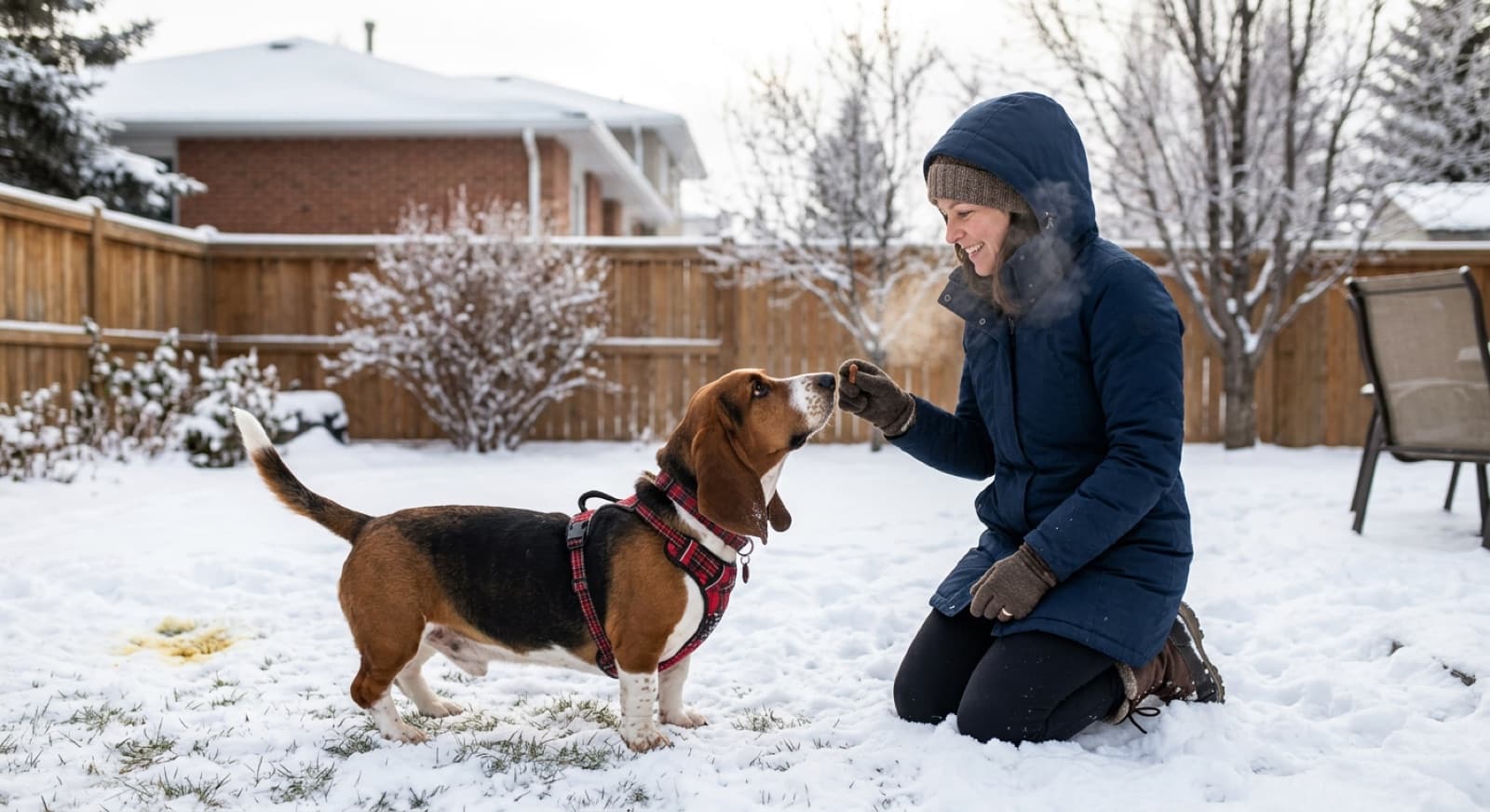
Calgary apartment Basset house training (no yard)
Apartment Basset house training is harder but possible.
Compounding challenges: distance to outside (elevator, lobby, outside), fewer immediate “I gotta go” responses, more accidents during transit, no midday access for working owners.
The apartment Calgary Basset protocol:
- Schedule + frequency: every 1 to 2 hours during waking hours for puppies and new adult adoptions. Most owners cannot maintain this while working. Daycare or midday dog walker is essentially required.
- Quick-access elevator routine: pre-position treats in coat pocket near door. When dog signals, immediately leash + take elevator. Don't stop to grab supplies. Speed matters
- Designated outdoor spot directly outside the building (within 100 feet). Use the same spot. Other building dogs' scents reinforce the location
- Pee pads or puppy pads as backup. Controversial but useful for apartment-only Bassets. Place near door (not in main living area). Some Bassets transition off pads as they mature; others use them long-term
- Doggy daycare 2 to 5 days/week ($35 to $55/day Calgary). Provides midday relief plus socialization. Top Dog Calgary, Calgary Dog Daycare, Doggie Time Calgary all accept Bassets
- Midday dog walker if daycare isn't feasible ($25 to $40/visit). Calgary providers: Rover, Wag, local independent walkers
- Apartment confinement setup: pen or gated area in entryway with pad in one corner, bed in another
Apartment-housebroken Bassets exist and thrive. The protocol requires more deliberate planning than house-with-yard owners need. Consider this before adopting if you live in a high-rise apartment.
Why is my Basset peeing in the house at 6+ months?
Common, frustrating, and usually has identifiable causes.
Diagnostic sequence:
- MEDICAL FIRST. Vet visit to rule out: urinary tract infection (UTI, common in Bassets, especially females), bladder stones (Bassets predisposed), kidney issues, IVDD pain (back pain causing inability to hold), Cushing's disease (older Bassets), diabetes. ANY new house soiling in a previously-trained Basset warrants vet workup BEFORE assuming behavioural. Calgary cost: $200 to $400 for basic urinalysis + bloodwork. The American Veterinary Medical Association notes that sudden changes in elimination habits are a common early sign of medical issues.
- Adolescent regression (8 to 12 months). Hormonal changes cause temporary regression. Tighten supervision and routine for 4 to 6 weeks; usually resolves
- Schedule changes. Owner started new job, dog left longer than tolerable. Bassets typically tolerate 4 to 6 hours alone with full bladder control
- Stress/anxiety. Moved house, new baby, new pet, owner illness
- Insufficient outdoor opportunities. Especially during winter or busy periods
- Marking. Different from incomplete housebreaking (see next section)
- Submissive urination. Appears during greetings/punishment. Address by ignoring greetings until calm and never punishing accidents
- Cognitive dysfunction (senior Bassets 9+). Dog dementia causes progressive housebreaking loss
- Inadequate cleanup. If previous accidents weren't cleaned with enzyme cleaner (NOT bleach or ammonia, which mimic urine), the dog smells the spot and re-uses
The fix sequence: (1) Vet workup first. (2) If medical is ruled out, restart consolidation protocol (return to umbilical + crate, 2-hour outdoor schedule). (3) Calgary force-free trainer if regression persists past 8 to 12 weeks of restart.
Most Basset house training failures resolve with patient restart, not new methods.
How is marking different from incomplete house training?
Critical to distinguish. They have different causes and fixes.
MARKING characteristics
Small amounts of urine (a few squirts), almost always on vertical surfaces (walls, furniture legs, mailboxes, shoes), multiple spots in short period, triggered by other dog scents/hormones/stress, often accompanies leg-lifting (males) or partial lifting (females). Most common in intact males but spayed/neutered Bassets can mark too.
INCOMPLETE HOUSEBREAKING
Full bladder emptying (puddle), usually horizontal surfaces (floor, carpet), single location at a time, triggered by full bladder + inability to access proper spot, random timing related to last potty break.
Marking fixes:
- Spay/neuter if intact (most effective)
- Belly bands for males during training (cloth wrap with absorbent insert; prevents marking, doesn't address cause but prevents household damage)
- Limit access to areas where marking has occurred
- Clean previous marks with enzyme cleaner. Bassets re-mark spots that retain scent
- Address triggers. Limit visiting dogs, supervise during heat cycles in multi-dog households
Incomplete housebreaking fix: standard restart protocol (umbilical, crate, 2-hour outdoor schedule).
Marking is much harder to fully eliminate than incomplete housebreaking. Some Bassets continue mild marking for life despite training. Manage with belly bands and access control.
What about senior Bassets who lose house training?
Common in Bassets aged 9+. Senior house soiling has several possible causes that overlap and require systematic workup.
Causes (in diagnostic order):
- Urinary tract infection. Extremely common in senior Bassets, especially females. Annual urinalysis catches early
- Bladder stones. Bassets predisposed; can cause partial obstruction. Calgary X-ray + ultrasound $300 to $500
- Kidney disease. Increases urine production. Bloodwork screens for early CKD
- Diabetes. Increased thirst + urination
- IVDD pain. Back pain can cause inability to posture for potty or to get to potty location
- Hip/elbow arthritis. Dog cannot get up quickly enough or doesn't want to walk to outdoor spot. Especially in cold weather
- Cognitive dysfunction (canine dementia). Progressive forgetfulness about housebreaking. Selegiline + cognitive diet (Hill's b/d, Purina Bright Mind) can slow progression. The AAHA Senior Care Guidelines recommend twice-yearly exams for dogs aged 7 and older.
- Hearing/vision loss. Dog doesn't notice door cues anymore
- Cushing's disease. Increased thirst + urination
Senior Basset house soiling protocol:
- Vet workup first (urinalysis + bloodwork + physical exam, $300 to $500 Calgary)
- If medical issues identified, treat. House training often returns or improves dramatically
- Senior accommodations: more frequent outdoor breaks (every 2 to 3 hours during day), nighttime potty break (set alarm if needed), pee pads near door as backup, ramps if mobility is part of issue, supervised access only (no more “free run of house” if dementia is part of issue)
- Pain management addresses joint/IVDD-related soiling
- Cognitive support medications if dementia is documented
Many senior Bassets with mild incontinence can be managed comfortably for 1 to 3 more years. Severe incontinence with cognitive decline is one quality-of-life consideration in end-of-life decisions, but house soiling alone is rarely a euthanasia trigger if quality of life otherwise remains good.
Adopted adult Basset re-housetraining
Most adult rescue Bassets come housebroken to their previous home but need a 1 to 3 week adjustment to your home.
The adult adoption Basset protocol:
- Days 1 to 7. Treat as a fresh house training scenario. Crate at night and when unsupervised, take outside every 2 to 3 hours, leash to you when home, immediate reward for outside potty
- Days 7 to 14. Extend intervals between potty breaks based on observed bladder control. Most adult Bassets can hold 4 to 6 hours by week 2
- Weeks 2 to 4. Full normal routine if no accidents are occurring. Continue rewarding for several months
- Watch for stress accidents. Adopted Bassets in their first week often have anxiety-related accidents. Typically resolves with bonding
- Watch for medical. If accidents persist past 2 to 3 weeks, vet workup (UTI common in stressed transition)
- Door signal training. Your dog needs to learn YOUR signals (which door to use, what time you usually go outside)
- Submissive urination is common during early adoption greetings. Don't punish. Ignore enthusiastic greetings until dog calms, then quietly take outside
What the rescue network sees:
- ~70% of adult adopted Bassets re-establish housebreaking within 2 weeks
- ~20% take 4 to 6 weeks
- ~10% have ongoing issues (often medical: UTI, bladder stones, cognitive issues if older) or trauma history (puppy mill background, prior abuse)
Calgary BARCS-style foster-based rescues typically know each dog's housebreaking history. Ask before adopting if this matters.
Why does free time backfire with Basset house training?
The most common Calgary Basset owner mistake. Owners think their Basset has “earned” free time around 4 to 8 weeks of training, give the dog free run of the house, and find accidents within days.
The mistake: Bassets are not generalisers. A dog who reliably uses the kitchen door doesn't automatically understand they should also use it from the bedroom or basement. The neural pathway for “go to door, signal, wait, exit, potty” is location-specific and takes weeks to extend across all rooms.
The right progression:
- Weeks 1 to 12: dog has access to ONE room at a time when supervised, plus crate when not. The kitchen-and-yard combo is most common Calgary setup
- Weeks 12 to 24: gradually add one new room per 2 to 3 weeks AFTER 100% reliability in current rooms. Living room first (closest to door), then bedrooms, then basement last
- Months 6 to 12: full house access only after 3-month clean-streak rule satisfied. Even then, monitor closely after schedule changes
Signs your Basset isn't ready for free time:
- Recent accidents within last 4 weeks
- Adolescent age (8 to 12 months especially)
- Recent schedule disruption
- New environment (just moved)
- New rooms not yet “tested”
- Owner not present consistently to enforce routine
The owners who succeed are patient about expanding access. The owners who fail try to short-circuit the timeline. With Bassets, slow + boring + consistent wins. The 3 to 6 month minimum is real. There are no shortcuts.
Frequently Asked Questions
Why are Bassets so hard to housebreak?
Genetics not failure. Bred for centuries to work independently in packs, minimal handler input. Brain prioritises scent over handler-pleasing. Don't housebreak primarily to please you. Housebreak because routine becomes ingrained. 3 to 6 months minimum, sometimes 9 to 12.
Realistic timeline?
Weeks 1 to 4: establishment, 3 to 6 accidents/week. Weeks 4 to 12: pattern building, 1 to 3/week. Months 3 to 6: consolidation, <1/week. Months 6 to 12: final reliability. 3-month clean-streak rule = not housebroken until 3 consecutive accident-free months.
Crate or umbilical method?
Both. Combination protocol: umbilical when home + awake, crate when unsupervised, crate at night, outdoor every 1 to 2 hours. Bassets are den-friendly (correctly-sized crate). “Just gate them in kitchen” almost always fails.
Calgary winter complications?
Hardest housebreaking environment. Frozen yard, short daylight, snow obscures scent, wind chill below -25°C limits outdoor time to 5 to 10 min. Designated shovelled potty area, “go potty” verbal cue, Pawz boots, treat at door for instant reward, midday walker for apartment owners.
Apartment Basset (no yard)?
Harder but possible. Daycare/midday walker required ($25 to $55/day). Quick-access elevator routine, designated outdoor spot <100ft, pee pads as backup near door. Top Dog/Calgary Dog Daycare/Doggie Time accept Bassets. Consider before adopting if you live in high-rise.
Peeing in house at 6+ months?
VET FIRST. Rule out UTI/bladder stones/IVDD pain/Cushing's/diabetes. $200 to $400 Calgary. Then: adolescent regression (8 to 12mo), schedule changes, stress, marking, submissive urination, cognitive dysfunction (seniors), inadequate enzyme cleanup. Most resolve with patient restart not new methods.
Marking vs incomplete housebreaking?
Marking: small amounts on vertical surfaces, multiple spots, hormonal/territorial. Spay/neuter + belly bands + access control + enzyme cleaner. Incomplete: full bladder on horizontal surfaces, single location, restart standard protocol. Marking harder to fully eliminate.
Senior Basset house soiling?
Common at 9+. Vet workup first ($300 to $500): UTI, bladder stones, kidney, diabetes, IVDD pain, arthritis, cognitive dysfunction, vision/hearing, Cushing's. Senior accommodations: more outdoor breaks, nighttime alarm, pads near door, ramps, supervised access. Selegiline + cognitive diet for dementia.
Adult adoption re-housetraining?
Most come housebroken, need 1 to 3 week transition. Days 1 to 7: fresh training scenario. Weeks 2 to 4: normal routine if no accidents. Watch stress accidents + UTI risk. ~70% re-establish in 2 weeks, ~20% in 4 to 6 weeks, ~10% have ongoing issues (medical or trauma).
Why does free time backfire?
Bassets aren't generalisers. Door-cue is location-specific. Most common owner mistake: giving free run too early at 4 to 8 weeks. Right progression: one room at a time, add new room per 2 to 3 weeks AFTER 100% reliability. Full house access only after 3-month clean-streak. No shortcuts.
Basset Hound Adoption Calgary
Where to find them, costs, why surrendered, adult adoption framing. The cluster overview.
Basset Training + Recall
Scent-hound stubbornness, off-leash recall reality, back-protection training, force-free trainers.
Basset Health Issues
IVDD, ear infections, glaucoma, obesity, bloat. Medical workup matters for sudden house soiling.
Calgary Puppy Crate Training
General crate training principles applicable to Basset puppies.
New dog? Start with these care guides
Everything a new adopter needs to set up a safe, happy home.