The community answer in one paragraph
The Boxer owner community is notably welcoming to first-timers, Boxers are people-pleasing, goofy, family-oriented, and emotionally rewarding. But four breed-defining realities matter: explosive 18–24 month adolescent regression, stubborn streak (friendliness gets mistaken for low-maintenance), 40–60% lifetime cancer + ARVC reality, and severe separation anxiety (velcro breed). Boxer as first dog WORKS with adult adoption + force-free training + pet insurance + active lifestyle + WFH/daycare commitment. It DOESN'T work with sedentary households + apartment + 9-5 + minimal budget. Boxer is a “training-wheels working breed”, easier than working-line GSD or protection-line Rottweiler, harder than Cavalier or Greyhound.
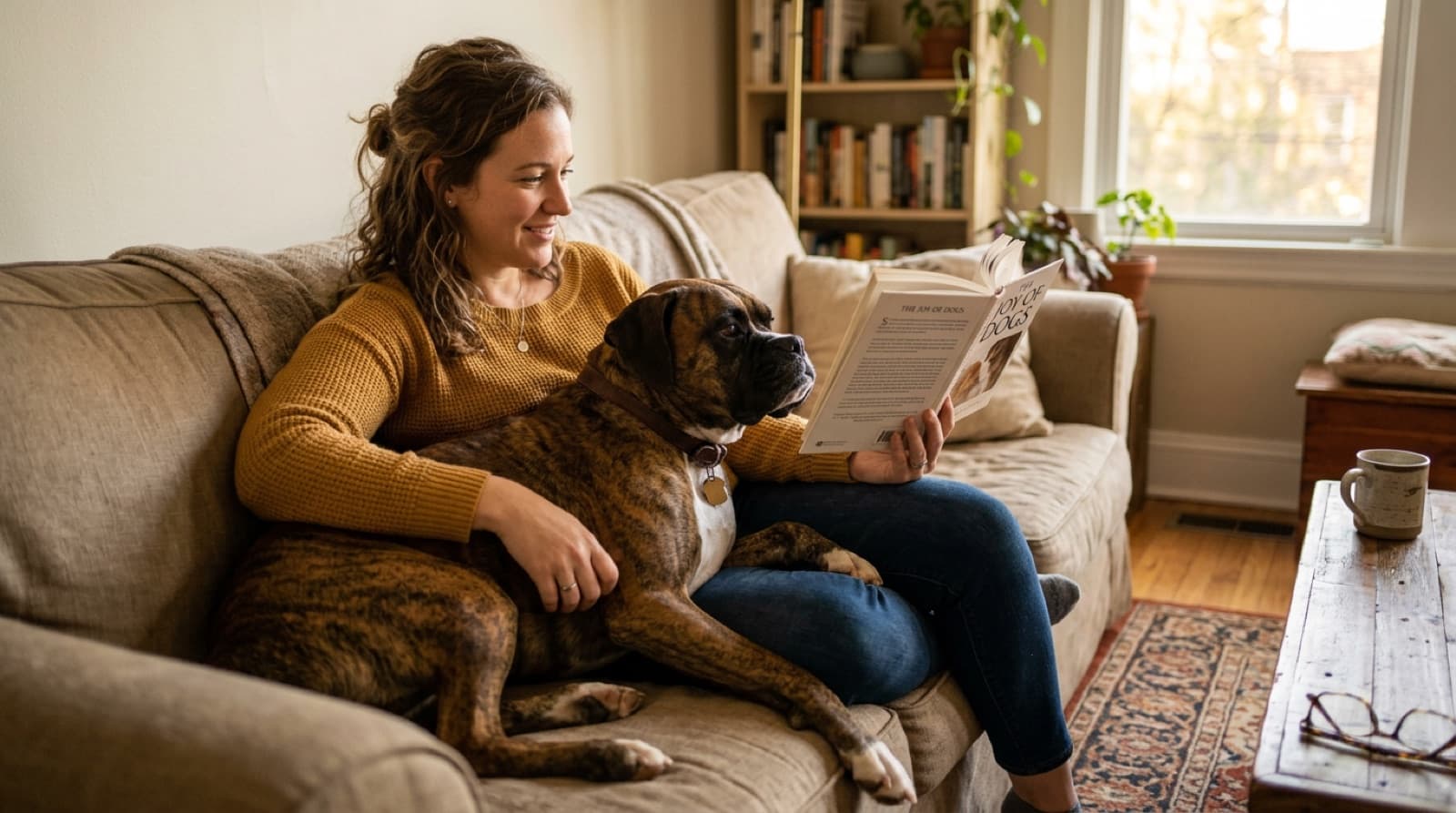
When Boxer as first dog WORKS
- Active outdoorsy lifestyle (60–90+ min daily exercise commitment)
- Suburban house with yard preferred (apartment possible with comprehensive commitment)
- Hybrid/home-based work OR comprehensive daycare commitment ($200–$400/month minimum)
- Force-free training $200–$1,000 first year non-negotiable
- Pet insurance enrollment immediate (Trupanion recommended for cancer coverage)
- Adult adoption (3+ years) preferred over puppy for first-time
- Comfortable with health reality: 40–60% cancer lifetime + ARVC + bloat risk
- Calgary specialty vet relationship (WVSC, VCA Canada West, CARE Centre, McKnight 24-hr ER)
- Family aligned on commitment
- Calgary Boxer community engagement
When Boxer as first dog DOESN'T work
These patterns lead to Boxer surrenders. Honest framework.
- Sedentary lifestyle expecting calm dog
- Apartment + 9-5 + minimal daycare budget (separation anxiety + neighbour complaints)
- Refusing force-free training
- Tight budget for $25K–$50K lifetime medical reality
- Family with toddlers + Boxer puppy + first-time = knockdown + supervision overwhelm
- Allergy-sensitive family + drooling/shedding incompatibility
- Expecting low-maintenance dog (Boxer goofiness gets mistaken for low-effort)
- Cannot tolerate Boxer-specific physical affection (lean, jumping, mouthing during adolescence)
Why Boxers are more first-time-friendly than GSD or Rottweiler
The Boxer owner community is notably welcoming to first-timers, more so than the GSD or Rottweiler communities. Honest framework.
Why Boxers are more forgiving:
- People-pleasing temperament: Boxers are bred for human companionship + entertaining (the breed name comes from boxing-like front-paw play). They WANT to please you
- Goofy + emotionally-obvious: easy to read body language. Less subtle than working breeds. Confusion + uncertainty more visible to handler
- Less protective-reserve: Boxers friendlier to strangers than GSD/Rottweiler. Lower bite-incident concern
- No alpha/dominance folklore baggage: Boxer community has largely accepted force-free training as standard
- Family default: Boxers historically marketed as family dogs. Community supportive of family-pet first-time owners
- Forgiving of mistakes: Boxer goofy temperament often shrugs off training inconsistency that would damage GSD/Rottweiler relationship
Why Boxers are still challenging for first-timers: explosive energy 3–4 years, size + strength (50–80 lbs adult), health reality (cancer + ARVC + insurance complexity), separation anxiety (velcro temperament + WFH dependency), Boxer lean (40–80 lb dog leaning full body weight on you constantly).
Key: Boxer is a “training-wheels working breed”, easier than working line GSD or protection-line Rottweiler, harder than Cavalier King Charles or Greyhound.
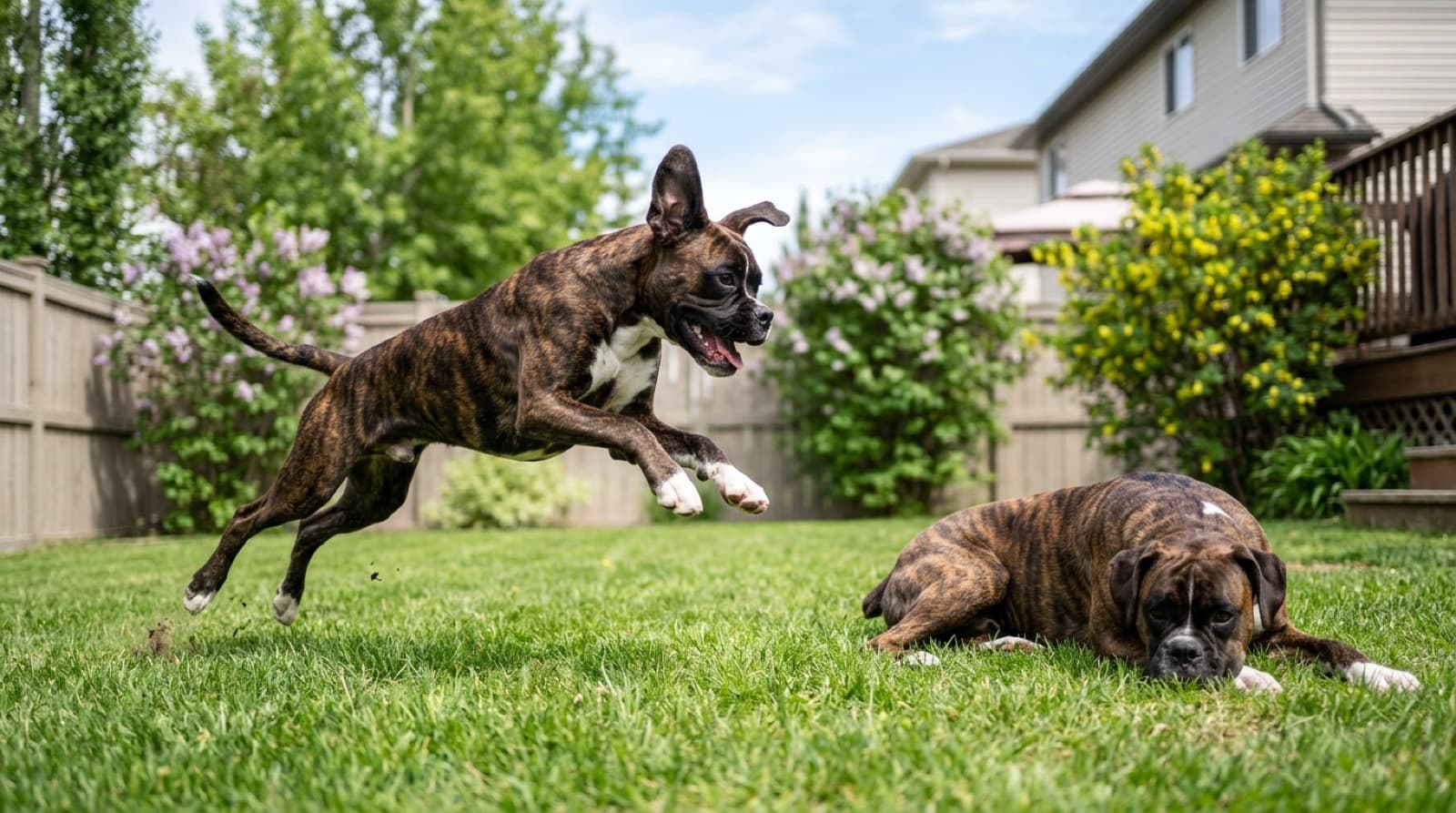
Adult adoption is the first-time path
Why adult Boxer adoption better for first-time owners:
- Past 18–24 month adolescent regression (intense Boxer-specific phase)
- Temperament known via foster evaluation
- Energy level predictable
- Often house-trained
- Health status often known
- Often calmer + more grateful
- Less competitive than puppy applications
- Adoption fee $300–$700 typical
Why Boxer puppy harder for first-timers: Boxer adolescence 8–24 months notorious, mouthing, jumping, counter-surfing, recall failure (see Boxer Adolescence guide). Explosive puppy energy intense. Force-free training required from day 1. Calgary rescue puppy demand high.
Senior Boxer (8+) for first-time owner: often calmest + most predictable. Less competitive applications. Magnificent 3–5 year companionship typical. Health concerns elevated (cancer + cardio). Pet insurance challenging (pre-existing exclusions). Sometimes ideal for retired/senior first-time owners.
The four realities every first-time Boxer owner must understand
1. Energy level (3–4 years explosive): Boxers are explosively energetic for 3–4 years, often described as comically immature. 2+ hours of daily activity is non-negotiable. Apartment Boxers possible only with serious exercise commitment.
2. Stubborn streak (friendliness ≠ low-maintenance): Boxers are people-pleasing AND stubborn. Consistent force-free training essential. People-pleasing temperament responds well to positive reinforcement, but consistency matters.
3. Health reality (40–60% cancer + ~20% ARVC): Pet insurance non-negotiable. $25K–$50K+ lifetime medical reality. Annual cardiac screening starting age 3 (Holter monitor). Annual cancer screening starting age 5. See Boxer Cancer + Cardiomyopathy guide.
4. Separation anxiety (velcro breed): Boxers are velcro dogs. Severe SA common, especially in rescue Boxers. WFH or daycare commitment essential. See Boxer Separation Anxiety guide.
Apartment + first-time + Boxer reality
Possible but challenging. Honest framework.
When apartment + first-time works: adult Boxer (calmer than puppy), verified pet-friendly building + condo approval, daily exercise commitment 60–90+ min outdoor, daycare 1–2x/week financial commitment, Calgary force-free trainer relationship, insurance enrollment immediate, hybrid/home-based work preferred.
Calgary apartment-friendly neighbourhoods: Beltline, Bridgeland, Sunnyside, Inglewood (older buildings sometimes more pet-tolerant).
Apartment Boxer investment: $1,000–$1,500/month sometimes (daycare $200–$400, walker $200–$400, insurance $80–$200, training $50–$200, food $50–$80, pet-friendly premium sometimes $50–$150). Total annual $12K–$18K+ apartment-Boxer ownership.
Red flags: strict noise-restriction building, inflexible 9-5 + minimal daycare budget, allergic family members + drooling/shedding sensitivity, tight budget for daycare + walker + insurance + training, Boxer puppy + apartment + first-time = extreme difficulty.
Working full-time + first-time + Boxer
CHALLENGING due to Boxer separation anxiety reality. The Boxer owner community frequently flags WFH or comprehensive daycare as essentially required.
When it works: adult Boxer (less SA-prone than puppy sometimes), foster-evaluated for alone-tolerance, comprehensive daycare commitment (3–5x/week at $30–$55/visit = $400–$1,000+/month), walker visits midday daily ($400–$800/month), hybrid work or flexible schedule, Calgary force-free trainer for SA prevention from day 1, crate training with positive associations, pet camera for monitoring, pet insurance.
Calgary daycare for Boxers: Doggie District, K9 Sports Connection, Tail Blazers, Bow Wow Calgary, Calgary Pet Crew, Dogtopia, ImPAWSible Possible. Boxer-experienced facilities preferred (high-energy + sometimes rough play styles).
Red flags: tight budget incompatible with daycare + walker + insurance + training, 9-5 inflexible commute + minimal daycare, apartment without daycare commitment (SA + neighbour complaints).
Alternative breeds for first-time owners considering Boxers
Sometimes alternative breeds are the right choice. Honest framework.
Easier first-dog alternatives:
- Cavalier King Charles Spaniel: calm, family-oriented, smaller (15–20 lbs), apartment-friendly
- Greyhound: surprisingly calm + apartment-friendly + lower SA risk than Boxer
- Labrador Retriever: energetic but trainable, family-oriented, healthier than Boxer
- Golden Retriever: family-oriented, easier training, similar size + similar cancer risk
- Bulldog: calmer than Boxer, similar brachycephalic concerns + medical reality, lower exercise needs
- Boston Terrier: Boxer-style temperament in smaller package
- French Bulldog: apartment-friendly + similar people-pleasing temperament
When Boxer still right despite challenges: specifically want Boxer for breed-specific traits (goofy temperament, family devotion, athletic build), comprehensive commitment to research + training + insurance + community, adult adoption + force-free training, active lifestyle + family integration, Calgary specialty vet network access + emergency fund.
Bottom line
Calgary first-time Boxer success recipe:
- Pre-adoption: extensive research + breed knowledge + financial preparation + Calgary community engagement + insurance research
- Adoption: adult Boxer from foster temperament evaluation
- First 333: quiet decompression + routine + initial force-free training + Calgary trainer + veterinary baseline
- First year: force-free training $200–$1,000 + insurance $600–$2,400 + daily exercise 60–90+ min + community building
- Lifetime: continued force-free + Calgary specialty vet access + 10–13 year commitment + cancer/cardiac screening protocol
The payoff: well-managed first-time Boxer = magnificent 10–13 year companion. Goofy, loyal, devoted, family-bonded. Many first-time Boxer owners describe the experience as life-changing. The medical reality is real but doesn't define the relationship, it adds urgency to making every healthy day count.
Key message: Boxer is a “training-wheels working breed”, easier than working line GSD or protection-line Rottweiler, harder than Cavalier King Charles or Greyhound. First-time owners CAN succeed with comprehensive commitment + research + adult adoption + force-free approach + Calgary community.
Browse adoptable Boxers in Calgary
Adult Boxers preferred for first-time owners, temperament known via foster evaluation, past adolescent regression, often grateful + bonded. Foster-evaluated rescue Boxers from 13+ Calgary rescues. Updated regularly.
See Available Boxers →Frequently Asked Questions
Can a Boxer be a first dog?
YES with caveats. More forgiving than GSD/Rottweiler but four breed realities matter: explosive 18–24 month adolescent regression, stubborn streak, 40–60% cancer + ARVC reality, severe SA. Adult adoption + force-free training + insurance + active lifestyle + WFH/daycare = success.
Why are Boxers more first-time friendly than GSD/Rottweiler?
People-pleasing temperament, goofy + emotionally-obvious body language, less protective-reserve, no alpha/dominance training baggage, family default historical marketing, forgiving of training mistakes. Still challenging due to energy + size + health reality + SA + Boxer lean.
Apartment + first-time + Boxer?
Possible with comprehensive commitment. Adult Boxer + verified pet-friendly building + 60–90 min daily exercise + daycare 1–2x/week ($200–$400/month) + force-free trainer + insurance + hybrid work preferred. Investment $1,000–$1,500/month sometimes.
Working full-time + first-time + Boxer?
Challenging due to Boxer SA reality. Daycare 3–5x/week ($400–$1,000+/month) + midday walker ($400–$800/month) + adult dog + force-free SA training + crate + pet camera. Total $1,000–$1,500/month sometimes.
Boxer with toddlers/young kids?
Mixed, knockdown risk (50–80 lb Boxer + young toddler), explosive energy, Boxer lean overwhelming for small kids, mouthing during adolescence. Works: adult Boxer + foster kid-tested + older kids 7+ + active family + force-free training + adult supervision always.
Adult or puppy for first-time?
ADULT typically. Past 18–24 month adolescent regression, temperament known, often calmer + grateful. Puppy = explosive energy + intense training + competitive Calgary applications. Senior (8+) underrated for retired/calm-companion seekers.
Financial preparation for first-time Boxer?
Annual $2,000–$8,000. Lifetime $25K–$50K healthy / $40K–$80K with major medical events. Pet insurance $50–$200/month essential (Trupanion best for cancer). Cardiac screening $400–$800/year starting age 3. Cancer screening $300–$1,000/year starting age 5. Emergency fund $5K–$10K.
What should every first-time Boxer owner know?
Exercise 60–90+ min daily, force-free training essential, cancer 40–60% + ARVC + BOAS + bloat reality, Calgary specialty vets (WVSC/VCA Canada West/CARE/McKnight), pet insurance immediate, brachycephalic heat sensitivity, adolescent regression 8–24 months, SA velcro breed, family alignment essential.
Alternative breeds for first-time owners?
Easier alternatives: Cavalier King Charles, Greyhound, Lab, Golden Retriever, Bulldog, Boston Terrier, French Bulldog. Boxer still right when specifically want breed traits + comprehensive commitment to research + training + insurance + community.
Bottom line: Boxer as first dog?
Successful: research + adult adoption + force-free training + insurance + suburban house + active lifestyle + Calgary community + WFH/daycare. Wrong: sedentary + apartment + 9-5 + minimal budget + toddlers + Boxer puppy. Boxer is “training-wheels working breed”, easier than GSD/Rottweiler, harder than Cavalier/Greyhound.
Adoptable Boxers in Calgary
Live listings of Boxers + Boxer mixes from 13+ Calgary rescues.
Buy or Adopt a Boxer?
Cost + health-testing comparison + when each path makes sense.
Boxer Adolescence (8–24 months)
The teenage phase reality every first-time owner must understand.
Boxer Cancer + Cardiomyopathy
The two breed-defining health realities + Calgary specialists.
New dog? Start with these care guides
Everything a new adopter needs to set up a safe, happy home.