The short answer
Three health conditions define the Cane Corso. Dilated cardiomyopathy (DCM) is the breed-defining concern. Reddit Corso owners consistently report DCM is the #1 fear. Lifetime risk runs about 5 to 10%, typical onset between ages 3 and 7. Surgery for severe cases runs $5K to $15K, and lifelong meds cost $50 to $150/month. Hip dysplasia hits roughly 15% lifetime. Total hip replacement (THR) at Calgary specialists runs $7K to $15K per hip. Bloat (GDV) is the #1 surgical emergency in deep-chested giants. Lifetime risk is 15 to 25%. Preventive gastropexy at $1,200 to $1,800 (often only $400 to $700 added during spay or neuter) is strongly recommended. Other concerns: elbow dysplasia (~10%), demodectic mange in puppies, cherry eye, entropion and ectropion, hypothyroidism in middle age, heat sensitivity (the moderately short face plus heavy body makes Calgary 25°C+ summers a real risk), and chronic ear and skin issues. Pet insurance is essential. Lifetime cost reality: $25K to $45K for a healthy Corso, $50K to $80K+ with a cardiac event. Enrol before the first vet visit to avoid pre-existing condition exclusion.
DCM is the #1 Cane Corso health fear
Reddit Corso owners consistently report dilated cardiomyopathy is the #1 fear, and the data backs it up. About 5 to 10% develop DCM during their lifetime, with typical onset between ages 3 and 7. Annual cardiac screening from age 3 onwards is essential. Calgary specialty cardiology: Western Veterinary Specialist & Emergency Centre or VCA Canada West. $400 to $700 per echocardiogram. Catching preclinical Stage B DCM means starting pimobendan early and adding years to the dog's life. Pet insurance enrolled before the first vet visit is critical. Once a murmur or arrhythmia is documented, cardiac disease becomes pre-existing and is permanently excluded.
What is dilated cardiomyopathy (DCM) in Cane Corsos?
The breed-defining Cane Corso health concern. Reddit Corso owners consistently report DCM is the #1 fear. The heart muscle thins and weakens. The chambers enlarge and pump less effectively. About 5 to 10% of Cane Corsos develop DCM, with typical onset between ages 3 and 7.
Early stages are silent. The dog looks healthy while the heart is already changing. That is exactly why annual cardiac screening from age 3 onwards is essential.
Symptoms when they appear: exercise intolerance, coughing, rapid or labored breathing, fainting or weakness, restlessness at night, distended abdomen in advanced cases, and sudden collapse.
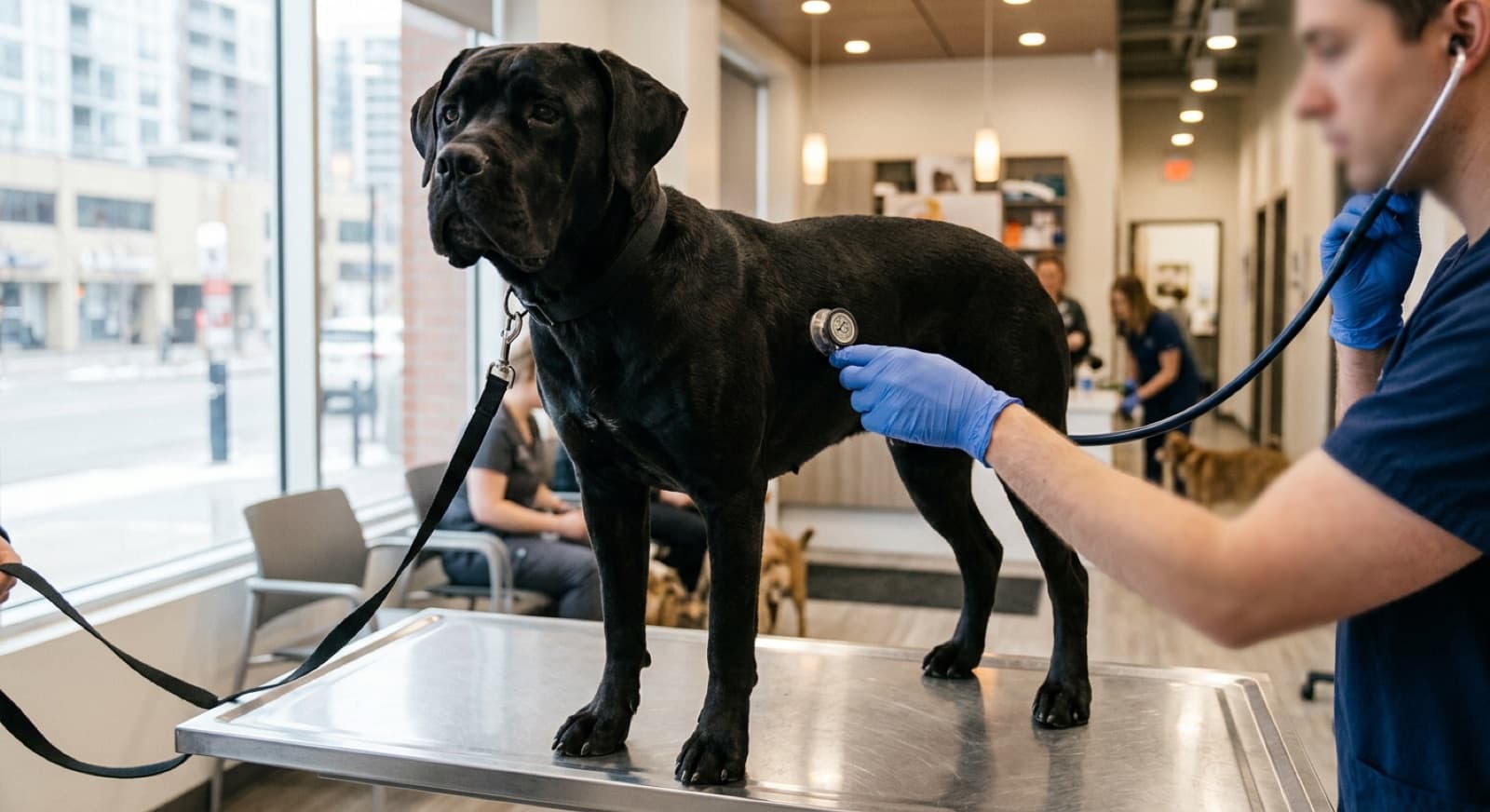
Diagnosis: vet exam (auscultation for murmurs and arrhythmias), chest X-ray, ECG, and echocardiogram. The echo is the gold standard. Calgary specialty cardiology echo: $400 to $700 at Western Veterinary Specialist & Emergency Centre or VCA Canada West.
Treatment by stage:
- Stage A (genetic predisposition, no changes yet). Every Cane Corso sits here at birth. Baseline screening from age 3.
- Stage B (preclinical changes on echo, no symptoms). Start pimobendan (Vetmedin) preventively. This is the high-value catch. Studies show preventive pimobendan adds years.
- Stage C (symptoms present). Pimobendan plus ACE inhibitors plus diuretics. Anti-arrhythmics if needed. Calgary cost: $50 to $150/month in meds.
- Stage D (refractory failure). Intensive management. Surgical interventions for severe cases (pacemaker, valve work) run $5,000 to $15,000+ at specialty referral.
Annual cardiac screening from age 3 is the single highest-value preventive step a Corso owner can take. Catching Stage B before symptoms lets you start pimobendan early.
How common is hip and elbow dysplasia?
Hip dysplasia hits about 15% of Cane Corsos lifetime. Elbow dysplasia hits about 10%. Both are developmental joint conditions where the bones don't fit together properly, leading to laxity, arthritis, and pain. Giant breeds carry elevated risk because of rapid growth and joint loading.
Symptoms: bunny-hopping gait, stiffness after rest, reluctance to climb stairs or jump, loss of muscle in the hindquarters or forelimbs (depending on hip vs elbow), and chronic lameness.
Mild cases manage medically: weight control, joint supplements (glucosamine, chondroitin, fish oil), and NSAIDs (carprofen, meloxicam). Calgary cost runs $100 to $250/month.
Some of the product links in this section are Amazon affiliate links — we may earn a small commission at no extra cost to you. It never changes which products we recommend. Always consult your veterinarian before starting any supplement.
Severe cases need surgery. Total hip replacement (THR) at Calgary specialty orthopedics runs $7,000 to $15,000 per hip. Bilateral THR can run $20,000+. Femoral head ostectomy (FHO) is a cheaper alternative ($3,000 to $5,000 per hip) but works best for smaller dogs. For a Corso, THR is typically the preferred option. Elbow surgery runs similar costs depending on the procedure (fragment removal, arthroscopy, or joint replacement).
Prevention: buy from breeders who do OFA or PennHIP screening on both parents. Adult rescue Corsos can be hip-screened by your own vet ($400 to $600 for hip and elbow X-rays). Keeping the dog lean (BCS 4 to 5 out of 9) and avoiding repetitive high-impact exercise in puppies is the biggest preventable factor. Avoid jumping out of vehicles, long-distance running before age 18 months, and slippery flooring during the growth phase.
Why is bloat the #1 surgical emergency for Cane Corsos?
Cane Corsos are deep-chested giant breeds. They sit squarely in the highest bloat-risk category. Gastric dilatation-volvulus (GDV) happens when the stomach fills with gas and then twists on itself, cutting off blood supply. Without emergency surgery within hours, GDV is fatal. Lifetime risk in Cane Corsos: 15 to 25%.
Symptoms (same-hour ER trip): distended hard abdomen, unproductive retching (tries to vomit, nothing comes up), excessive drooling, restlessness and pacing, rapid breathing, pale gums, and collapse.
Calgary emergency GDV surgery: $5,000 to $12,000. Mortality is significant even with prompt surgery if there is gastric tissue death.
Preventive surgical gastropexy is strongly recommended. The procedure tacks the stomach to the abdominal wall so it cannot twist. Calgary cost: $1,200 to $1,800 as a standalone procedure, or often only $400 to $700 added when combined with spay or neuter. Doing it during spay/neuter is the smart play.
Risk reduction is dramatic. Gastropexy does not eliminate bloat itself but it virtually eliminates the twisting (volvulus) part that turns bloat from urgent into fatal.
Daily management that also reduces risk:
- Feed two or three smaller meals instead of one large meal.
- Avoid exercise for an hour before and after meals.
- Use a slow-feeder bowl if the dog inhales food.
- Avoid raised feeders. Older recommendations have been disproven; raised feeders may actually increase risk.
What is demodectic mange and should I worry?
Common in Cane Corso puppies and young adults. Caused by Demodex mites that live in hair follicles. Every dog has a few. The problem starts when the immune system can't keep them in check. Cane Corsos have a known breed predisposition.
Localized demodex: small isolated patches of hair loss, usually on the face or legs, in puppies under 12 months. Most cases self-resolve as the immune system matures. Monitoring only.
Generalized demodex: widespread hair loss, scaly skin, secondary bacterial infections. Needs medical treatment. Calgary cost: $300 to $800 for diagnosis (skin scrapings, possible biopsy) and treatment ($60 to $200/month for medications like Bravecto, NexGard, or Simparica which also kill the mites). Treatment runs 3 to 6 months until two consecutive negative skin scrapings.
Generalized demodex in a young Corso can flag underlying immune weakness. Worth a conversation about spay/neuter to avoid passing the predisposition.
Adult-onset demodex (over age 4) is rare and usually points to an underlying disease (Cushing's, hypothyroidism, cancer, immunosuppression). Needs a thorough workup, not just mite treatment.
What eye problems do Cane Corsos have?
Several. Common Cane Corso eye conditions:
- Cherry eye. About 5% prevalence. Third-eyelid gland prolapse, usually before age 2. Calgary surgical replacement runs $500 to $1,200 per eye. Replacement is strongly preferred over removal.
- Entropion. Eyelid rolls inward, lashes scratch the cornea. Surgical correction $1,000 to $2,500 per eye. Untreated entropion causes chronic corneal damage and possible vision loss.
- Ectropion. Eyelid sags outward, exposing the inner surface. Common in droopy-faced Corsos. Surgical correction at similar cost to entropion.
- Corneal ulcers from chronic eyelid issues or trauma.
Cherry eye, entropion, and ectropion can all show up in the same dog. Some lines are more affected than others. Verify eye exams in the parents if buying from a breeder. CERF or OFA-Eye certification is the standard. Calgary specialty veterinary ophthalmology: Western Veterinary Specialist & Emergency Centre, VCA Canada West. Daily eye care: wipe corners with a damp cloth or sterile saline pad, watch for redness or discharge, and book annual eye exams.
What about hypothyroidism?
Middle-aged onset, typically between 4 and 7 years. The thyroid gland under-produces thyroid hormone. Symptoms develop slowly and are often misread as the dog “getting older.” Symptoms include weight gain without diet change, lethargy and reduced exercise tolerance, dry brittle coat with hair thinning (especially on the flanks and tail), cold intolerance, recurring skin and ear infections, and slow heart rate. Diagnosis: bloodwork including a full thyroid panel (T4, free T4, TSH). Calgary cost: $200 to $400. Treatment: daily oral levothyroxine for life ($20 to $40/month) plus recheck bloodwork every 6 to 12 months. Treatment is highly effective. Most dogs return to full energy within 4 to 6 weeks of starting therapy. Annual bloodwork starting age 3 catches this early.
When should I spay or neuter my Cane Corso?
Timing matters for giant-breed orthopedic health. Early spay/neuter (before 12 months) in giant breeds is associated with increased rates of hip dysplasia, elbow dysplasia, cranial cruciate ligament rupture, and some cancers. Late spay/neuter (after growth plates close, typically 18 to 24 months for a Cane Corso) gives the joints time to mature properly.
Current consensus for giant breeds:
- Males: consider waiting until 18 to 24 months. Orthopedic benefit is well-documented. Behavioural and prostate considerations matter too. Discuss with your vet.
- Females: the trade-off is more complex. Mammary cancer risk rises sharply after the second heat cycle. Spaying after the first heat (around 12 to 18 months) is often the giant-breed middle ground.
- Combine spay or neuter with preventive gastropexy. $400 to $700 added cost is the best deal in Cane Corso preventive care.
This is a real decision worth a conversation with your vet, not a default age. Rescue and shelter Corsos are often already spayed or neutered before adoption, and that timing is what it is. The behavioural and health outcomes for adult rescue Corsos are still strongly positive.
Are Cane Corsos at risk for heat stroke in Calgary summers?
Yes. Cane Corsos overheat faster than many owners expect. The moderately short face (not as flat as a Bulldog, but flatter than a typical working breed) plus heavy muscle mass plus dark coat all compound. Heat stroke risk rises sharply above 25°C, which Calgary hits regularly from June through August.
Symptoms of overheating: heavy panting that doesn't slow at rest, thick saliva and drooling, bright red gums and tongue, weakness or stumbling, vomiting or diarrhea, rapid heart rate, and collapse in severe cases. Body temperature over 40°C (104°F) is a medical emergency. Brain damage starts at 41°C and death can follow within 30 to 60 minutes.
Calgary heat stroke emergency treatment runs $1,500 to $6,000+ depending on severity and complications.
Prevention:
- Walk early morning (before 8 AM) or late evening (after 8 PM) on hot days.
- Never leave the dog in a parked car. Interior temperatures hit 50°C+ within minutes even with windows cracked.
- Provide constant access to shade and cool water.
- Avoid sustained exercise on pavement above 25°C ambient. Paw burn compounds the heat risk.
- Consider a cooling vest for outdoor activities.
Pay attention if the dog seeks shade, slows down, or pants heavily on what feels like a moderate day. Cane Corsos push through discomfort because they want to keep up with the handler. The handler has to make the safety call.
Why do Cane Corsos get ear infections?
Drop ears trap moisture. Cane Corsos with uncropped ears (which is most Corsos in Calgary, given Alberta's growing pushback against cosmetic cropping) have folded ear flaps that block air circulation and create a warm humid environment. Add typical breed sensitivity to allergies and chronic ear disease becomes common. Symptoms: head shaking, scratching at the ears, redness, dark waxy or pus-like discharge, foul odor. Calgary cost: $200 to $400 per vet visit for diagnosis and medication. Management: weekly ear cleaning at home (Epi-Otic, MalAcetic Otic), monthly checks, and addressing the underlying allergy. Many chronic ear infections are downstream of food or environmental allergies. Apoquel runs $80 to $150/month for a Corso-size dose. Cytopoint injections are an alternative.
Do Cane Corsos have skin allergies?
Yes. Food sensitivities (especially chicken and grains) and environmental allergies are both common. Symptoms: chronic itching, paw licking and chewing, recurring ear infections, hot spots, red inflamed skin (especially belly, groin, and feet), and poor coat quality.
Workup: rule out parasites first, then run a strict elimination diet (single novel protein plus single carb for 8 to 12 weeks). Calgary cost: $500 to $1,500 for a full workup including bloodwork and possibly skin testing, plus a prescription hydrolyzed or limited-ingredient diet ($120 to $180 per bag for a Corso-size dog).
Common Corso-friendly protein swaps: fish, duck, or venison instead of chicken or beef. Grain-free is NOT automatically better and has been associated with secondary DCM in some cases. Always discuss diet changes with your vet, particularly given Corso DCM risk.
Long-term management options: Apoquel, Cytopoint, prescription diet, and in severe cases immunotherapy desensitization (allergy shots).
What is the Cane Corso screening protocol?
Build a year-by-year preventive screening schedule with your vet. This is the single biggest lever Calgary Corso owners have over lifetime health outcomes.
Annual exam baseline (every year, every age):
- Physical exam with cardiac auscultation (listening for murmurs and arrhythmias).
- Hip and elbow palpation.
- Eye exam.
- Weight and body condition score (target BCS 4 to 5 out of 9).
- Dental check.
- Skin and ear exam.
Bloodwork at ages 1, 3, 5, 7, and 9. Full CBC, chemistry panel, thyroid panel. The age 1 panel establishes baseline. Later panels catch early hypothyroidism, kidney changes, and liver changes.
Cardiac screening: annual echocardiogram from age 3 onwards. Calgary specialty cardiology $400 to $700. This catches preclinical DCM before symptoms.
Orthopedic screening: hip and elbow X-rays at age 1 to 2 (OFA or PennHIP). $400 to $600 at most Calgary clinics.
Eye exam: annual at general vet. Specialty CERF or OFA-Eye exam at age 2 to 3 if planning to breed. $200 to $400 specialty.
Dental cleaning: every 18 to 24 months. Calgary cost $500 to $1,500.
Lifetime preventive screening cost: $2,500 to $5,000 over a Corso's 9 to 12 year lifespan. That investment catches conditions early and dramatically reduces emergency surgery and crisis treatment costs.
Calgary specialty referral options: Western Veterinary Specialist & Emergency Centre (cardiology, orthopedics), Mission Veterinary Emergency Hospital, VCA Canada West.
Should I get pet insurance for my Cane Corso?
Yes. The Cane Corso lifetime cost reality is severe enough that pet insurance reliably pays for itself. Plan for $25,000 to $45,000 in lifetime vet care for a healthy Corso. Plan for $50,000 to $80,000+ if a major event like DCM, GDV, or bilateral hip replacement happens.
Calgary insurance for a young healthy Cane Corso: $60 to $120/month with a $300 to $500 deductible, 80% coinsurance, and $15,000+ annual limit.
The single most important rule: enrol BEFORE the first vet visit, or at minimum before any preventive screening detects an issue. Once a heart murmur, hip laxity, or eye condition is documented, that condition becomes pre-existing and is permanently excluded.
Critical caveats specific to Corso insurance:
- Verify the policy covers congenital and hereditary conditions. Some basic plans exclude these, which removes most of the value for a Corso.
- Choose an annual limit of $15,000 or higher. A single GDV plus hip surgery can blow past lower limits.
- Confirm orthopedic surgery is covered. Some policies have separate orthopedic waiting periods.
- Read the fine print on giant-breed-specific exclusions (rare in Canada but worth verifying).
Top providers for Cane Corsos: Trupanion (no per-condition limits, valuable for chronic DCM and orthopedic care), Pets Plus Us, Petsecure. Avoid: any policy with per-condition limits under $5,000 or annual limits under $10,000.
The Corso insurance equation: about $10,000 to $14,000 in premiums over 11 years covers $30,000 to $80,000+ in cardiac, orthopedic, GDV, and eye care.
What is the lifetime cost reality for a Cane Corso?
Healthy Corso: $25,000 to $45,000 over a 9 to 12 year lifespan. With a major cardiac event (DCM): $50,000 to $80,000+.
Annual cost breakdown for a healthy Cane Corso:
- Food (high-quality large-breed diet): $1,200 to $1,800/year
- Routine vet care (annual exam, vaccines, parasite prevention): $600 to $1,000/year
- Annual bloodwork and cardiac echo from age 3: $500 to $900/year
- Pet insurance: $720 to $1,440/year
- Grooming, supplies, training: $400 to $800/year
- Dental cleaning every 18 to 24 months (averaged): $250 to $750/year
One-time and crisis costs to plan for:
- Preventive gastropexy: $1,200 to $1,800 (or $400 to $700 added during spay or neuter)
- Hip X-rays at age 1 to 2: $400 to $600
- Possible cherry eye surgery: $500 to $1,200
- Possible entropion surgery: $1,000 to $2,500 per eye
- Possible THR if hip dysplasia: $7,000 to $15,000 per hip
- Possible DCM medications (lifelong): $50 to $150/month from diagnosis onwards
- Possible emergency GDV surgery if no preventive gastropexy: $5,000 to $12,000
The Cane Corso is not a budget-friendly breed. The lifetime cost reality is genuinely high. Pet insurance changes the math, and so does adopting an adult rescue Corso with known health history rather than buying a puppy with a 15-year unknown ahead.
Frequently Asked Questions
Dilated cardiomyopathy (DCM)?
The breed-defining concern. Reddit Corso owners consistently report DCM is the #1 fear. About 5 to 10% lifetime risk, typical onset ages 3 to 7. Calgary echo $400 to $700. Lifelong meds $50 to $150/month. Severe-case surgery $5K to $15K. Annual cardiac screening from age 3 is essential.
Hip and elbow dysplasia?
Hips ~15% lifetime, elbows ~10%. Calgary THR runs $7K to $15K per hip at specialty orthopedics. Mild cases manage with weight control, supplements, and NSAIDs at $100 to $250/month. Buy from OFA/PennHIP-screened parents and keep the dog lean.
Bloat (GDV) and preventive gastropexy?
Lifetime bloat risk 15 to 25%. Emergency GDV surgery in Calgary runs $5,000 to $12,000. Preventive gastropexy strongly recommended: $1,200 to $1,800 standalone, or $400 to $700 added during spay or neuter. The smart play is to combine with spay/neuter.
Demodectic mange?
Common in puppies and young adults. Localized form usually self-resolves. Generalized form needs treatment $300 to $800 plus monthly medication $60 to $200 over 3 to 6 months. Adult-onset (over age 4) flags possible underlying disease.
Eye problems?
Cherry eye (about 5%), entropion, ectropion. Cherry eye surgery $500 to $1,200 per eye. Entropion or ectropion surgery $1,000 to $2,500 per eye at Calgary specialty veterinary ophthalmology.
Hypothyroidism?
Middle-aged onset, ages 4 to 7. Causes weight gain, lethargy, coat thinning. Diagnosed by full thyroid panel ($200 to $400). Daily oral levothyroxine for life ($20 to $40/month). Highly treatable. Catch it with annual bloodwork.
Spay or neuter timing?
Giant-breed orthopedic health favors waiting. Males: consider 18 to 24 months. Females: typically after first heat (12 to 18 months) as a middle ground. Combine with preventive gastropexy for the best deal in Corso preventive care.
Heat stroke risk in Calgary?
Risk rises sharply above 25°C, which Calgary regularly hits in summer. Moderately short face plus heavy muscle plus dark coat all compound. Walk early or late, never leave in a parked car, and pay attention to slowing and shade-seeking. Emergency treatment runs $1,500 to $6,000+.
Ear infections?
Drop ears trap moisture, especially in uncropped Corsos. Calgary cost $200 to $400 per visit, often 1 to 3 visits per year. Weekly cleaning at home plus addressing underlying allergies. Apoquel $80 to $150/month for a Corso-size dose.
Skin allergies?
Chicken and grain sensitivities are common. Workup runs 8 to 12 weeks on an elimination diet. Calgary cost $500 to $1,500 plus prescription diet $120 to $180 per bag. Grain-free is NOT automatically better and has been linked to secondary DCM in some cases.
Calgary screening protocol?
Annual exam, plus bloodwork at ages 1, 3, 5, 7, 9. Annual cardiac echo from age 3 ($400 to $700). Hip and elbow X-rays at 1 to 2 ($400 to $600). Dental every 18 to 24 months ($500 to $1,500). Lifetime preventive screening $2,500 to $5,000.
Pet insurance for Cane Corsos?
Yes. Lifetime vet costs run $25K to $80K+. Calgary insurance $60 to $120/month. Enrol BEFORE the first vet visit to avoid pre-existing exclusion. Verify congenital and hereditary coverage, $15,000+ annual limit, and orthopedic coverage.
Lifetime cost reality?
Healthy Corso $25K to $45K over 9 to 12 years. With cardiac event $50K to $80K+. The Cane Corso is not a budget-friendly breed. Pet insurance changes the math, and so does adopting an adult rescue Corso with known health history.
Cane Corso Adoption Calgary
Where to find them, ethical sources, what adoption costs really look like.
Is a Cane Corso Right For You?
Honest self-assessment for first-time owners. Time, space, experience, and Calgary lifestyle fit.
Cane Corso Cost of Ownership
First-year and lifetime cost breakdown for Calgary. Food, vet, training, and insurance.
Pet Insurance for Cane Corsos
Provider comparison, what to verify in the fine print, and enrolment timing for Calgary owners.
Cane Corso Diet and Nutrition
Large-breed feeding, bloat-aware meal timing, food allergies, and the grain-free DCM caveat.
Calgary Emergency Vet Guide
24-hour clinics plus Calgary specialty cardiology and orthopedic contacts. Save before you need it.
New dog? Start with these care guides
Everything a new adopter needs to set up a safe, happy home.