The honest version
Cane Corsos in Calgary rescue are uncommon but they do show up, and the pattern is consistent. Most are 1 to 3 year old young adults, surrendered between 12 and 24 months when the breed's guardian instinct kicks in and the original owner realises they bought a working dog and not a couch decoration. Calgary rescues see one to three purebred Corsos a year. Corso mixes (Lab, Mastiff, Pit, Boxer) are more common. Fees run $400 to $800 from rescues against $2,500 to $5,000 from CKC-registered Alberta breeders. There is no Alberta-specific Cane Corso rescue. The path is multi-rescue alerts, fast applications, foster-to-adopt where offered, and a hard pre-adoption check on your condo board and home insurer. This guide covers every part of that decision honestly. No glossing. The breed deserves the truth.
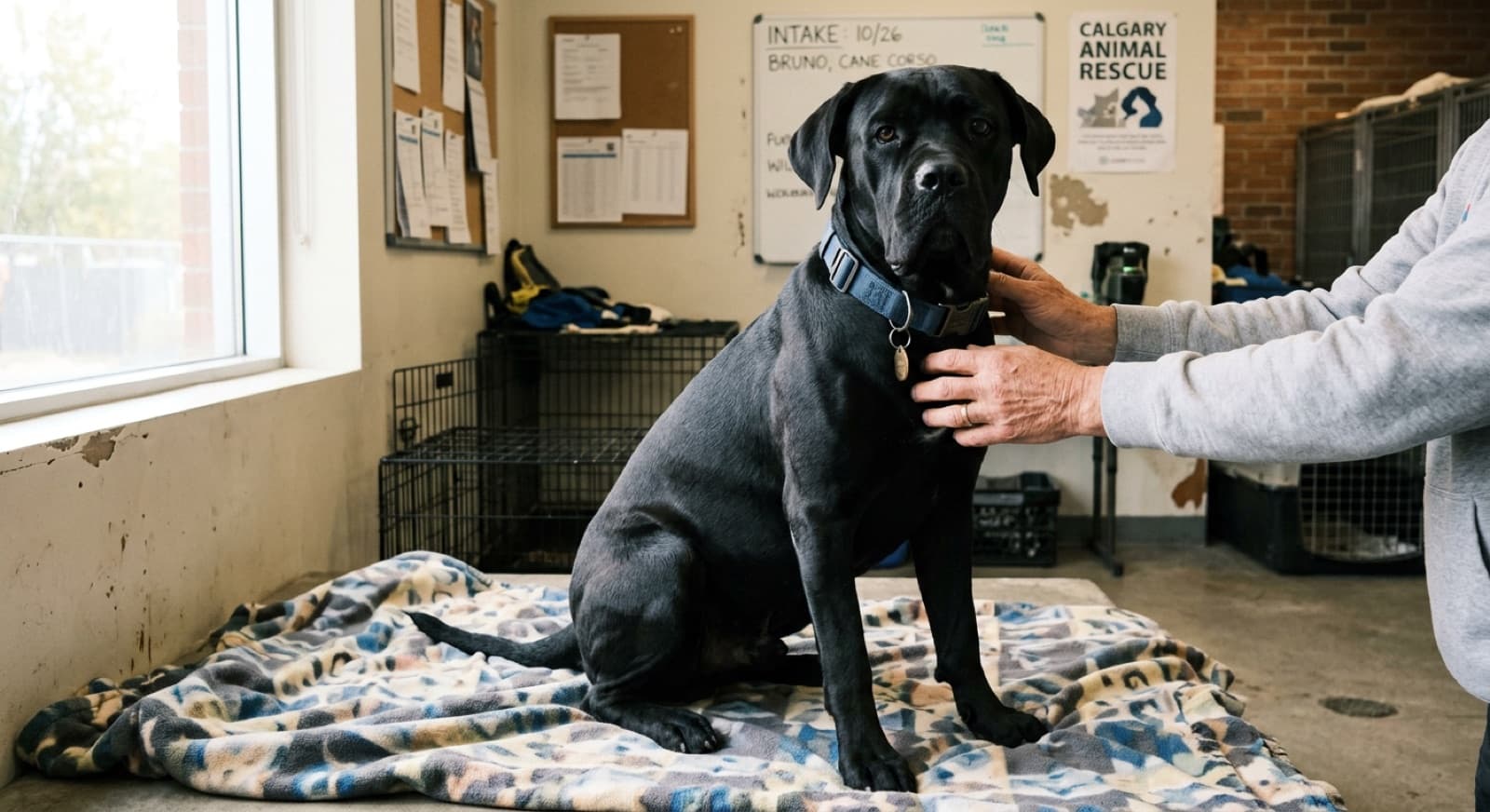
Why Cane Corsos are rare in Calgary rescue, but they do appear
Two truths sit side by side. Calgary rescues do not list Cane Corsos often. And when they do, almost every one fits the same profile: 1 to 3 years old, intact or recently neutered, surrendered by a first-time owner during or right after adolescence.
The reason is the breed itself. Cane Corsos do not become Cane Corsos until they hit puberty. An 8 week old Corso puppy is a lump that sleeps and eats. A 14 month old Corso is a different animal: alert at the door, scanning strangers, barking at the mail carrier, leash-pulling toward unfamiliar dogs. Cane Corso owners on Reddit consistently report that this switch happens between 12 and 24 months, and that's exactly when the surrenders cluster.
If you are willing to accept a young adult with the working-dog edge already showing, you can find a Calgary rescue Corso. If you want a soft, social, easy-to-manage Corso puppy that grows into a couch dog, the breed is wrong for you and no rescue will solve that. This is the honest framing the Reddit Cane Corso community returns to over and over.
The five real surrender reasons
Cane Corso owners on Reddit consistently report the same surrender drivers, and Calgary foster coordinators describe an almost identical pattern. Five reasons dominate.
1. Adolescent guardian-instinct emergence (12 to 24 months)
This is the number one driver. The Corso starts barking at strangers in the home, becomes reactive at the front door, lunges at strange dogs on walks, and shows the working edge the owner thought would never appear. Owners who skipped early socialisation hit a wall here. Owners who did socialise still have to manage the new behaviour. Most surrenders happen in this window.
2. Condo and insurer refusal
Most Calgary condo boards refuse dogs over 50 lbs. Most home insurers in Alberta either refuse Cane Corsos outright or charge a 30 to 50% liability premium. Owners who buy a puppy without checking either constraint surrender at the 6 month mark when the condo board sends a letter or the insurer cancels the policy. Verify both before you apply to adopt.
3. Owner experience mismatch
First-time dog owners buying a Corso on Instagram aesthetic. The breed needs an owner who has worked through adolescence with a 70+ lb dog before. Without that base, the adolescent reactivity feels like the dog “turning on” the owner. It isn't. It is the breed doing exactly what 500 years of Italian guardian selection bred it to do.
4. Size and strength overwhelming the family
A 100 lb Corso that lunges at the leash can pull an adult off their feet. Families with small kids surrender when daily walks become unsafe and visitors stop coming over. This is rarely an aggression problem. It is a strength-management problem with a dog that was never trained to a 7-week loose-leash standard before puberty.
5. Couples splitting or moving
A common late-surrender reason for adult Corsos. The dog stays with the partner who is most attached. That partner moves into a rental that won't allow the breed, and the dog goes to rescue at age 3 to 5. These are often the easiest rescue Corsos to place because they are already past adolescence and the temperament is settled.
Calgary rescues that occasionally see Cane Corsos
No Calgary or Alberta rescue specialises in Cane Corsos. The strategy is to monitor all six rescues that have listed Corsos in the past three years, set Petfinder and rescue-page alerts, and apply fast when one appears. Adult Corsos in Calgary rescue are usually spoken for within a week.
| Rescue | Fee range | Notes |
|---|---|---|
| Calgary Humane Society | $400 to $700 | Open-admission. Most likely Corso source. Behaviour assessments included. Some Corsos held for extended evaluation. |
| AARCS | $500 to $800 | Strongest foster temperament notes in the city. Critical for a guardian breed. Slower placement, deeper screening. |
| BARCS Rescue | $500 to $800 | Volunteer rescue. Occasional Corso and Corso-Mastiff mixes. Active foster network. |
| Pawsitive Match | $500 to $800 | Strong foster-to-adopt program. Best path for testing a Corso fit before committing. |
| ARF Alberta | $500 to $750 | Provincial rescue. Sometimes lists Corsos and Corso mixes pulled from rural Alberta surrenders. |
| Calgary Animal Services | $225 + GST | City stray hold. Rare Corso intake. Includes spay/neuter, microchip, first vaccines, and Calgary dog licence. |
Fees current as of May 2026. Verify on each rescue's website before applying. No dedicated Alberta Cane Corso rescue exists.
Adoption fees vs Calgary breeder pricing
The Cane Corso price gap between rescue and breeder is one of the widest in the working-breed world. Most adopters don't realise how the math actually stacks up.
Calgary rescue: $400 to $800
Fee typically covers spay/neuter, full vaccines, microchip, recent vet exam, and any foster behaviour assessment. Most rescue Corsos are 1 to 3 year old young adults, past the puppy stage and into the temperament-revealing window. A few are 4 to 7 year old adult rehomes with documented history, which can be even better fits for less-experienced adopters.
Kijiji and Facebook backyard breeder: $1,500 to $3,500
Almost never health-tested. Parents rarely screened for DCM (the breed-defining cardiac issue), hip dysplasia, or elbow dysplasia. Many sellers are one-litter accidental breeders or repeat backyard producers using social media as a retail front. Pro: you get a puppy at 8 weeks and shape it from scratch. Con: temperament dice are loaded by genetics you can't verify, and DCM risk is real.
CKC-registered Alberta breeder: $2,500 to $5,000
Genuine show-line or working-line Cane Corso breeders are rare in Alberta. Expect cardiac echo, OFA hips and elbows, eye certifications on parents. CKC papers. Waitlists of 6 to 18 months. These breeders screen buyers as hard as the buyers screen them. They almost never sell to first-time owners without a structured mentor relationship. If a breeder lists puppies available immediately at $3,000+, they are almost certainly not CKC-registered. Verify on the CKC member list before paying a deposit.
For most Calgary adopters, a $500 to $800 rescue young adult with documented foster temperament notes is a better outcome than a $2,000 Kijiji puppy with unknown DCM risk. The shape of the breed's personality is already visible by 18 months, and you adopt a known dog instead of a 50/50 lottery ticket.
Verify before you apply: condo and insurer
No provincial BSL restricts Cane Corsos in Alberta. Calgary regulates by behaviour, not breed. That is the good news. The hard news is two practical restrictions that surrender more Corsos than any city bylaw ever has.
Condo boards: most Calgary condo bylaws cap dogs at 50 lbs or restrict listed “dangerous” breeds in their bylaws (Cane Corso shows up on insurer lists, which condo boards often copy). Get written board approval before you apply to adopt. Verbal “should be fine” from a property manager is not enough.
Home and tenant insurance: many Alberta insurers refuse Cane Corsos outright. Others charge 30 to 50% more on the liability portion. Some require a $1M umbrella policy. Call your insurer with the words “Cane Corso, also known as Italian Mastiff” before you apply. Get the answer in writing or in an email trail. Owners surrender Corsos every year over this exact issue.
Both checks take 30 minutes. Doing them before you apply is the most important thing you can do for the dog.
What to expect from a rescue Cane Corso at home
Most Calgary rescue Corsos are not 8 week old puppies. They are 1 to 3 year old young adults with some history, often surrendered mid-adolescence. That shapes the first weeks at home.
- Young adult body, adolescent brain. Typical age: 14 months to 3 years. Full-size or near it (80 to 110 lbs). Mentally still developing impulse control. Plan training as if for a teenage dog, not a finished adult.
- Likely under-socialised gaps. If the original owner stopped socialising at 6 months (most do), the dog will have a list of triggers: strangers in home, men in hats, kids on bikes, other large dogs. Plan a slow 4 to 8 week decompression. The 3-3-3 rule applies, doubled.
- Door reactivity is common. Plan a leash-on or gate-on entry routine from day one. Practice with friends standing in for unfamiliar visitors. Calgary force-free trainers Dogma, ImPAWSible Possible, and Calgary K-9 all handle Corso door work professionally.
- Leash strength is the daily reality. A 100 lb Corso pulls hard. Front-clip harness, two-point leash, and a known stop cue are basic equipment, not optional. Don't walk a Corso on a flat collar.
- Foster temperament notes are critical. A good rescue will give you written behaviour data: kid history, cat history, dog history, alone-time behaviour, food guarding, door reactivity, recovery time after arousal. If a rescue has no notes, ask why. The data exists or the placement isn't ready.
- DCM cardiac risk. Dilated cardiomyopathy is the breed-defining health issue. Calgary specialty cardiology at Western Veterinary Specialist & Emergency Centre offers cardiac echo screening. Annual screening from age 4 is reasonable. Symptoms (exercise intolerance, fainting) demand immediate cardio referral.
- Health insurance enrolled fast. Cane Corso DCM, hip and elbow issues, and cruciate tears are common. Enrol before any symptom shows. Trupanion, Pets Plus Us, and Sonnet all cover the breed in Alberta but exclusions kick in once issues are documented.
For the full first-month playbook, see our Cane Corso first week at home guide and Cane Corso training guide.
Foster-to-adopt: the most important path for this breed
Foster-to-adopt is more important for Cane Corsos than for any other breed in Calgary rescue. The structure is simple. The rescue places the dog in your home for 2 to 4 weeks, keeps legal ownership, and you adopt only if the fit works. For a guardian breed, this is the single best way to read the dog honestly.
A Corso's real temperament cannot be read in a 20 minute meet-and-greet. The behaviours that drive surrender (door reactivity, stranger response, leash pulling, arousal recovery, kid tolerance under stress) only emerge in a normal home routine. Foster-to-adopt reveals all of it before papers are signed. If the foster doesn't work, you return the dog with no fee and no judgement. The rescue uses your notes to place the dog more accurately next time. Everybody wins.
Pawsitive Match runs the strongest foster-to-adopt program in Calgary. AARCS also offers it. Calgary Humane handles it case-by-case for guardian breeds. Ask every rescue directly when you apply. For Corsos specifically, many rescues will make exceptions to standard adoption processes because they know the mismatch cost.
If a rescue refuses foster-to-adopt for a Cane Corso, that is a signal to ask harder questions about the dog's temperament and history before adopting.
Cane Corso mixes in the Calgary rescue system
Mixed Cane Corsos are more common in Calgary rescue than purebreds. Four mixes appear often. Each blends Corso traits with the other breed's temperament, often making the dog easier to live with than a purebred for an average household.
Corso-Lab (Cane Corso x Labrador)
Most adopter-friendly mix. Lab social drive softens the Corso guardian edge. Often the right first-Corso-mix dog for households without working-breed experience. Energy levels are higher than a purebred Corso, so daily off-leash work is needed.
Corso-Mastiff (Cane Corso x English or Bullmastiff)
Heavier and slower than a purebred Corso. Often less reactive at doors. Shorter lifespan from the Mastiff side (8 to 10 years). Joint issues more common. A good fit for owners who want guardian presence with lower drive.
Corso-Pit (Cane Corso x American Pit Bull or Staffy)
Smaller and more athletic than a purebred. Often higher dog-reactivity from the Pit side, so dog-park work isn't the play. Strong human bond. Calgary Animal Services and BARCS see this mix the most. Verify your insurer accepts both labels.
Corso-Boxer (Cane Corso x Boxer)
More goofy, more energetic, fewer guardian instincts. The most playful of the four mixes. Boxer cardiac risks (aortic stenosis) overlap with Corso DCM, so cardiac screening matters even more.
Mixed Corsos often have better overall health than purebreds (hybrid vigour lowers DCM risk) and are typically $100 to $300 cheaper at the same rescue. Read the foster temperament notes carefully. The non-Corso parent often determines whether the dog fits a normal household or needs a guardian-breed home.
Common Cane Corso health issues to know before adopting
Five health issues come up often enough at Calgary vets that every Corso adopter should plan for them. Pet insurance enrolled before any symptom shows is worth the monthly cost on this breed.
- Dilated cardiomyopathy (DCM). The breed-defining health concern. Heart muscle weakens, often without symptoms until late. Calgary specialty cardiology at Western Veterinary Specialist & Emergency Centre offers cardiac echo screening from age 4. Symptoms: exercise intolerance, fainting, cough. Demand immediate referral if any appear.
- Hip and elbow dysplasia. Standard in giant breeds. Ask the rescue if X-rays were done in foster care. Surgery at Calgary specialty clinics runs $4,000 to $8,000 per hip if needed. Most cases are managed without surgery.
- Cruciate ligament tears. Common in any 80+ lb dog with high arousal. TPLO surgery in Calgary runs $4,500 to $6,500. Pet insurance enrolled early covers it.
- Gastric dilatation-volvulus (bloat). Deep-chested giant breeds are at risk. Feed two smaller meals, not one big one. Rest 30 to 60 minutes after eating. Prophylactic gastropexy at spay/neuter is worth discussing with your vet.
- Cherry eye and ectropion. Loose lower eyelids are breed-typical. Cherry eye (prolapsed third-eyelid gland) needs surgical repair. Both are routine fixes, not deal-breakers.
Full breakdown in our Cane Corso health issues Calgary guide and our Cane Corso pet insurance guide.
Ready to look? See Cane Corsos and Corso mixes in Calgary rescue
Live listings from 15+ Calgary rescues, refreshed regularly. Purebred Corsos are rare; Corso mixes (Lab, Mastiff, Pit, Boxer) appear more often. Foster reports usually include door reactivity, kid history, dog history, and recovery-time data critical for guardian breeds.
See Available Cane Corsos →Frequently Asked Questions
How often do Cane Corsos appear in Calgary rescues?
Rarely, but they do appear. Most Calgary rescues see one to three purebred Corsos per year, plus a steady trickle of Corso mixes. When a Corso does come into rescue it is almost always a 1 to 3 year old young adult surrendered during or right after adolescence. Cane Corso owners on Reddit consistently report that the 12 to 24 month window is when most surrenders happen.
How much does it cost to adopt a Cane Corso in Calgary?
Rescue fees run $400 to $800 depending on the rescue and the dog's age. Calgary Humane Society runs $400 to $700. AARCS, BARCS, Pawsitive Match, and ARF Alberta charge $500 to $800. Calgary Animal Services adoption is $225 plus GST. By comparison, CKC-registered Alberta Cane Corso breeders charge $2,500 to $5,000 with a 6 to 18 month waitlist.
Why do Cane Corsos end up in Calgary rescue?
Four reasons dominate. Adolescent guardian-instinct emergence at 12 to 24 months. Condo and insurer refusal. Owner experience mismatch (first-time owners overwhelmed by a 100 lb teenager). Size and strength overwhelming the family. None of these are dog failures. They are owner-research failures.
Which Calgary rescues are best for Cane Corsos?
Six Calgary rescues see Corsos from time to time: Calgary Humane Society, AARCS, BARCS, Pawsitive Match, ARF Alberta, and Calgary Animal Services. Calgary Humane is the most likely source. AARCS publishes the strongest foster temperament notes. Pawsitive Match runs the best foster-to-adopt program. Apply to all six and set alerts.
Is there a Cane Corso rescue in Alberta?
No. There is no dedicated Alberta-based Cane Corso rescue. The Italian Cane Corso Society and a few US-based breed-club retirement networks occasionally help place Corsos into Canada, but volume is low. Alberta adopters use the multi-rescue path.
What does foster-to-adopt mean for a Cane Corso?
The rescue places the dog in your home for 2 to 4 weeks, keeps legal ownership, and you adopt only if the fit works. For a guardian breed this is the single most important path. Door reactivity, stranger response, kid tolerance, and arousal recovery can only be read in a normal home routine. Pawsitive Match and AARCS run the strongest programs.
Are Cane Corsos restricted in Calgary?
No provincial BSL restricts Cane Corsos in Alberta. Calgary regulates by behaviour, not breed. The hard restrictions are practical: most Calgary condo boards refuse dogs over 50 lbs, and many Alberta home insurers either refuse Cane Corsos or charge a 30 to 50% liability premium. Verify both in writing before applying to adopt.
What Cane Corso mixes show up in Calgary rescues?
Four mixes appear often: Corso-Lab (most social, easiest first-Corso mix), Corso-Mastiff (heavier, slower, less reactive), Corso-Pit (smaller, athletic, higher dog-reactivity), and Corso-Boxer (most playful, fewest guardian instincts). Mixed Corsos often have better health than purebreds and are usually $100 to $300 cheaper.
More Cane Corso guides
Is a Cane Corso Right for You? →
Honest 10-truth breakdown and self-assessment for Calgary households considering a guardian breed.
Cane Corso Training Calgary →
Adolescence work, door reactivity, leash strength, and Calgary force-free trainer recommendations.
Cane Corso Temperament and Aggression →
Guardian instinct, reactivity vs aggression, arousal recovery, and what real Corso behaviour looks like at home.
New dog? Start with these care guides
Everything a new adopter needs to set up a safe, happy home.