The short answer
Great Danes are uncommon but not rare in Calgary rescues; Dane mixes appear more often than purebreds. Plan to apply at Calgary Humane Society, AARCS, Pawsitive Match, ARF Alberta, BARCS Rescue, and Cochrane Humane Society. Adoption fees for an adult dog commonly run $400 to $700; breeder puppies run $1,500 to $3,500. The lifespan reality is 7 to 10 years, and the breed-defining emergency is bloat (GDV): unproductive retching, distended belly, restlessness, drooling. If you see those signs, go straight to a 24-hour emergency vet. Do not wait.
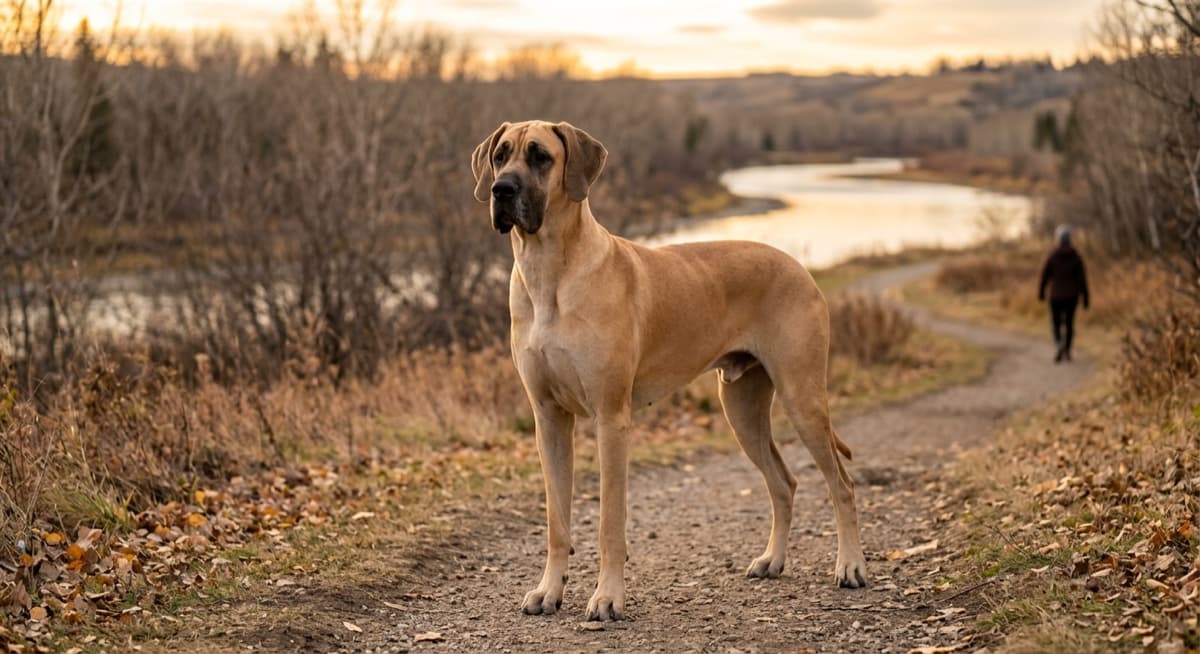
The Great Dane is one of the most recognizable dog breeds in the world. The size carries the breed's reputation: a tall, deep-chested giant that lives up to the “Apollo of dogs” nickname. What the photos do not capture is the temperament, which is usually quiet, gentle, and surprisingly low-energy for the size. This guide covers what Calgary adopters need to know before bringing one home: where Danes actually appear, what they really cost to feed and vet, the short lifespan that comes with the size, and the one emergency every Dane owner has to know how to recognize on sight.
Where to adopt a Great Dane in Calgary
Great Danes pass through Calgary rescues a few times a year, not weekly. Dane mixes (with Mastiff, Lab, or Shepherd lines) appear more often than purebreds. Either way, the realistic path is to apply across several rescues at once and stay ready to move when a giant-breed listing appears.
Rescues to monitor in the Calgary area:
- Calgary Humane Society: Calgary's largest shelter; occasional giant-breed and Dane-mix intakes.
- AARCS: foster-based; structured behaviour evaluations are especially useful for giant breeds.
- Pawsitive Match: Calgary foster-based; periodically takes in giant breeds and Dane mixes.
- ARF Alberta: Calgary foster-based; mid-to-large dogs frequently, with occasional giants.
- BARCS Rescue: Calgary foster-based; transports many medium-to-large dogs.
- Heaven Can Wait: Calgary rescue with broad intake.
- Cochrane Humane Society: Cochrane-based, serves the broader Calgary region.
- Calgary Animal Services: municipal facility; stray giant breeds occasionally pass through.
- A national Great Dane rescue: a national breed-specific rescue that sometimes coordinates Alberta placements when foster homes and transport line up.
Set up notifications on the LocalPetFinder Great Dane breed page. Listings refresh regularly, which matters for giant-breed dogs because adopters often apply within hours of a new posting.
What does a Great Dane cost in Calgary?
The adoption fee is the small number. For a giant breed, ongoing costs are where the budget actually lives.
| Source | Fee range | Typically includes |
|---|---|---|
| Calgary Humane Society | $405 adult (1 to 6 years), $270 senior | Spay or neuter, vaccinations, microchip, vet exam |
| AARCS | $425 adult, $150 senior | Spay or neuter, vaccinations, microchip, foster history |
| BARCS / Pawsitive Match | BARCS $650 / Pawsitive Match $475 (adult) | Spay or neuter, vaccinations, microchip |
| Breed-specific specialty rescue | $400 to $700 | Transport, foster-based behaviour evaluation |
| CKC breeder puppy | $1,500 to $3,500 | Health testing, contract, breeder support |
The ongoing cost shock is what catches most first-time Dane owners off guard. Plan for roughly $200 to $300 a month in food alone, more on premium or fresh diets. Giant-breed vet costs are higher per visit than for medium dogs because anesthesia, medications, and surgical fees scale with body weight. Pet insurance is worth pricing before adoption, since giant breeds often carry higher premiums and several breed health concerns are exclusions on lower-tier plans. For a lifetime cost view, see our Calgary adoption costs guide.
Calgary requires a city dog licence for every dog three months and older under the Responsible Pet Ownership Bylaw (calgary.ca/bylaws-standards). The licence is a small annual fee; the rescue's adoption package usually includes everything you need to apply.
The lifespan reality: a short-lived gentle giant
Great Danes live an average of roughly 7 to 10 years according to the American Kennel Club and the Great Dane Club of America. That is one of the shortest average lifespans of any dog breed. The size that defines the Dane is the same trait that shortens it.
Most Calgary adopters know this number in the abstract and still underestimate what it feels like. A 2-year-old Dane adopted today is realistically a 5 to 8 year companion, not the 12 to 15 you would expect from a Labrador or a Border Collie. Grief tends to arrive earlier with Danes than with most breeds, and the household has to plan for it.
Adopting a Dane responsibly means accepting the timeline going in. Calgary rescues regularly hear from families who took on a Dane expecting a 12-year companion and surrendered when the reality landed. Knowing the math up front is what protects both the dog and the household.
Bloat (GDV): the breed-defining emergency
Bloat, formally called Gastric Dilatation and Volvulus (GDV), is the breed-defining emergency for Great Danes and other deep-chested giant breeds. The stomach fills with gas and can twist on itself, cutting off blood flow to the stomach and spleen. Without surgical treatment within hours, GDV is usually fatal. The American Veterinary Medical Association lists GDV as one of the top medical emergencies in large and giant breeds.
Every Calgary Dane owner needs to recognize the signs on sight. Symptoms typically come on fast:
- Unproductive retching. The dog tries to vomit but nothing comes up. This is the single most specific warning sign.
- Distended abdomen. The belly is visibly swollen, often tight and drum-like to the touch.
- Restlessness or pacing. The dog cannot settle, paces, or repeatedly tries to lie down and stand back up.
- Excessive drooling. Often paired with the retching attempts.
- Signs of pain. Hunched posture, whining, looking back at the abdomen.
- Pale gums, weak pulse, collapse. Late signs that indicate shock.
If you see these signs, go directly to a 24-hour emergency veterinary clinic. Do not wait to see if it passes, do not call the regular clinic in the morning, do not give home remedies. Calgary has several 24-hour emergency veterinary hospitals; know which one is closest to you before you ever need it and program the address into your phone the day you bring the dog home.
Prevention is a conversation to have with your vet, not a checklist on the internet. The research on raised food bowls is mixed and has shifted over time. Weight management, slower feeding, splitting meals across the day, and avoiding heavy exercise immediately after eating are commonly discussed practices. Gastropexy (a preventive surgery that anchors the stomach to the abdominal wall) is a real option for Great Danes and is often done at the same time as spay or neuter. Whether it makes sense for a specific dog depends on age, health, and risk profile: discuss it with a Calgary vet experienced with giant breeds.
This article is the recognition guide. Treatment decisions, dosing, and medication protocols belong to your veterinarian. The contribution this page makes to Dane safety is the warning, the symptoms, and the urgency. The rest is between you and your vet.
Other breed health concerns
Beyond bloat, Great Danes carry several breed health concerns that shape ongoing care. None of these are guarantees, but all are worth understanding before adoption.
- Dilated cardiomyopathy (DCM). A heart condition where the heart muscle weakens and the chambers enlarge. DCM is a leading cause of death in the breed. Annual cardiac screening with a Calgary vet experienced with giant breeds is commonly recommended. Discuss frequency and screening type with your vet.
- Hip dysplasia. A malformation of the hip joint that can cause arthritis and mobility issues. Reputable breeders screen parents through the Orthopedic Foundation for Animals (OFA); rescues do not have that history, so weight and exercise management matter through the dog's whole life.
- Wobbler syndrome. Also called cervical spondylomyelopathy. A neurological condition affecting the neck and spine that causes an unsteady, wobbly gait. Common enough in Great Danes that any change in gait should prompt a vet visit, not a wait-and-see.
- Eye conditions. Various inherited eye conditions appear in the breed. An annual eye exam is good practice for any Dane.
- Skin allergies. Calgary's dry winter air, prairie pollen, and salt on winter sidewalks can flare allergies. A vet-led management plan is more reliable than over-the-counter trial and error.
The recurring pattern across all of these: regular vet care with someone who knows giant breeds matters more for a Dane than for an average dog. Pick a Calgary vet experienced with giant breeds before you adopt, not after a first scare.
Calgary climate for a short-coated giant
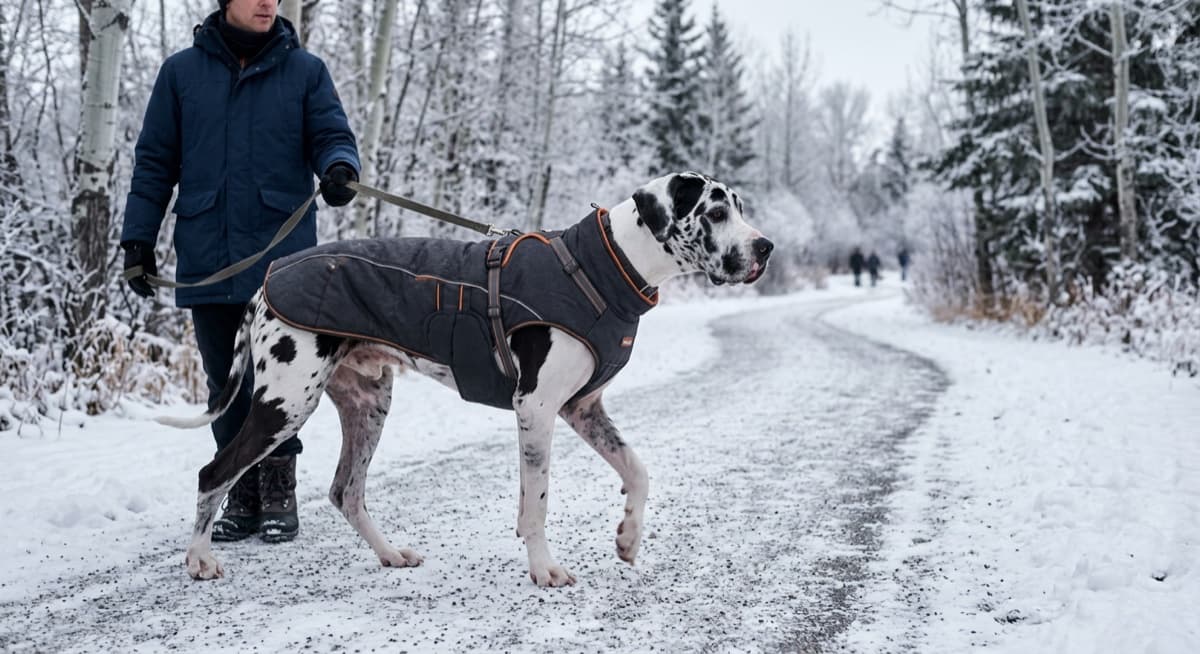
Great Danes have a short, single-layer coat. In Calgary's winter, that is a real consideration. Danes are cold-sensitive in a way that double-coated breeds like Huskies or Bernese Mountain Dogs are not.
- Below -10°C: a fitted dog coat or insulated sweater is reasonable for routine walks. Most Danes are visibly more comfortable with one.
- Below -20°C: short-coat sensitivity becomes a safety question. Limit time outside, watch for shivering and lifted paws, and shorten walks. Frostbite risk on ears and tail tips is real.
- Cold snaps below -30°C: outdoor time stays brief by default. Calgary's deep cold snaps test even cold-hardy breeds; Danes need active management.
- Sidewalk salt: rinse paws after winter walks. Salt and ice melt damage paw pads, and Danes' size means more paw surface area in contact with the ground.
- Boots and balms: paw boots help on salted sidewalks; paw balm helps on dry cold days when pads crack.
Off-leash visits to Nose Hill Park, Bowmont Park, Fish Creek Provincial Park, or Sue Higgins Park work well in fall and summer. Winter walks usually shift to shorter, gear-on outings. Adult Danes are couch-loving enough that this trade-off is less painful than it would be with a high-energy breed.
Why Great Danes end up in Calgary rescues
The surrender pattern for Danes is consistent across rescues, and it differs from most breeds.
- Cost shock. Food, vet bills, and gear cost more for a giant breed than first-time owners expect. Many surrenders happen in the first two years, once monthly cost reality lands.
- Grief after a previous Dane. Owners who loved a Dane through the 7 to 10 year lifespan sometimes adopt again and then surrender mid-life when grief returns. This pattern is common enough that breed-specific rescues screen for it.
- Life changes. Babies, moves, divorces, and new jobs catch every breed, but the practical impact is bigger when the dog is 150 pounds. Rentals that allow medium dogs often refuse giants.
- Knock-over accidents with toddlers. Some families surrender after a Dane accidentally injures a small child through size alone, not aggression. A turning tail and a small face land in the same path, and the result can be serious.
- Health diagnosis. A DCM, bloat, or wobbler diagnosis is sometimes more than a family can take on financially. Pet insurance bought early changes that calculus for some households.
The pattern points the same direction: a successful Dane adoption is a budgeted, planned, eyes-open commitment, not a spontaneous “I saw the listing and fell in love” choice. Use our dog adoption checklist to pressure-test the household before applying.
Family fit: gentle giants, with caveats
Most Great Danes are quiet, gentle, and affectionate. They are not delicate; they are large. That distinction shapes which households work.
- Children five and up: generally fine with adult supervision. Most Danes are patient with school-age kids.
- Toddlers and pre-schoolers: knock-over risk is the main concern, not temperament. A tail or a turning shoulder can flatten a small child by accident. Many rescues prefer to place Danes in homes without toddlers.
- Furniture and space: Danes lean. They lean against legs, walls, and couches. Expect to lose a corner of the couch and to occasionally lose a coffee-table item to a passing tail. The breed is hard on home decor in a way smaller dogs are not.
- Existing pets: most Danes get along well with other dogs and cats, especially when raised with them. Adult introductions need patience because of the size mismatch.
- Exercise commitment: two walks a day, 30 to 45 minutes each, is enough for most adult Danes. They are surprisingly couch-loving for their size. Puppies and adolescents need more, but not endless: over-exercising a young giant breed stresses joints.
Most Calgary Dane adopters describe the breed the same way: enormous, lazy, affectionate, hard on the furniture, gone too soon. If those traits read as features rather than dealbreakers, the breed is a good fit.
Realistic Calgary inventory expectations
Purebred Great Danes appear in Calgary rescues a few times a year, not weekly. Dane mixes (Dane crossed with Mastiff, Lab, or Shepherd lines) appear more often and are sometimes the better fit because the size and energy can be slightly more household-friendly.
When a Dane or Dane mix does appear, read the foster temperament notes carefully. AARCS and Pawsitive Match in particular publish structured behaviour evaluations that flag house manners, dog and cat compatibility, kid suitability, and any medical history. For a giant breed, those notes matter more than they do for a medium dog because the size amplifies any reactive behaviour. A pulling Dane is a different problem from a pulling Beagle.
Browse our Great Dane breed page to see currently available Great Danes and Dane mixes across Calgary rescues, refreshed regularly. If nothing is listed today, set up notifications and apply to several rescues in parallel; giant-breed listings do not stay open long.
Browse Great Danes in Calgary
See current Great Danes and Dane mixes across 15+ Calgary rescues in one place. Listings refresh regularly, and giant-breed openings can clear within a day, so set up notifications and apply quickly when one appears.
See Calgary Great Danes available now →Frequently Asked Questions
Where can I adopt a Great Dane in Calgary?↓
How much does a Great Dane cost to adopt?↓
How long do Great Danes live?↓
What is bloat (GDV) in Great Danes?↓
How much food does a Great Dane eat per month?↓
Are Great Danes good apartment dogs?↓
Are Great Danes good with kids?↓
What health issues should I expect with a Great Dane?↓
Continue reading
Browse Calgary Great Danes
Currently available Great Danes and Dane mixes across 15+ Calgary rescues, refreshed regularly.
Bullmastiff & Mastiff adoption
Calgary Mastiff-type rescues: Bullmastiff, English Mastiff, Cane Corso, and Mastiff mixes that share giant-breed reality.
Dog adoption checklist
Pressure-test your household before applying: budget, space, schedule, family fit, and giant-breed-specific considerations.
Calgary dog bylaws
Calgary's Responsible Pet Ownership Bylaw: licence requirements, leash rules, and what to know before bringing a giant breed home.
New dog? Start with these care guides
Everything a new adopter needs to set up a safe, happy home.